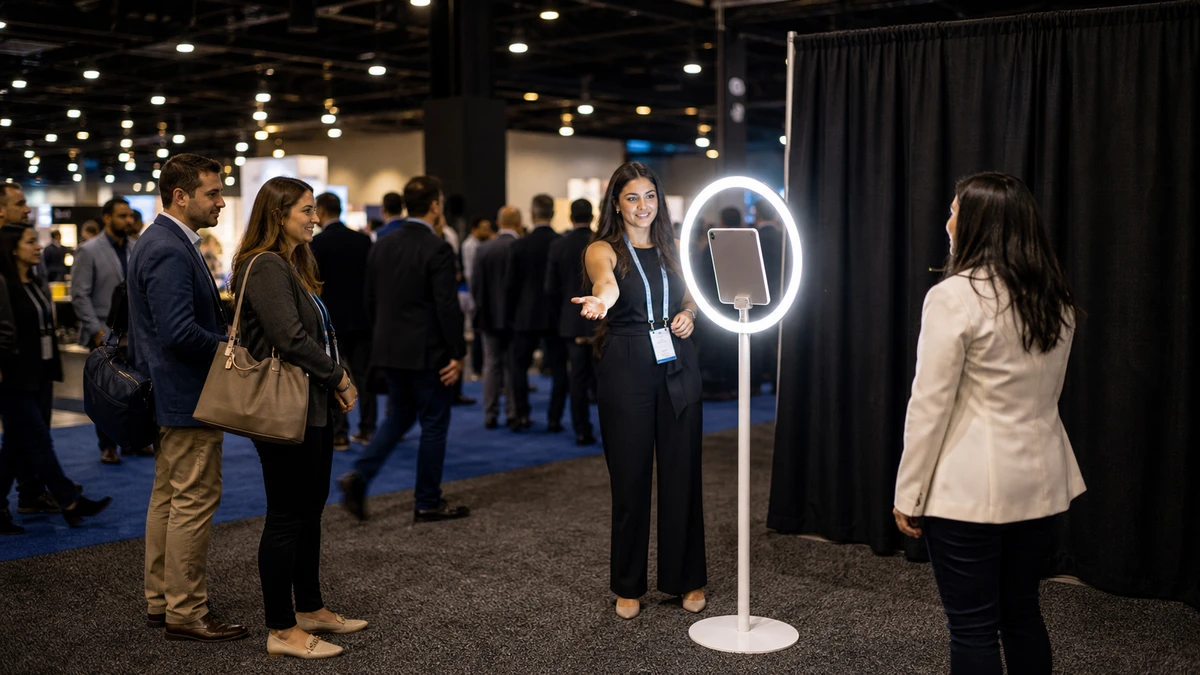
A photo booth pays for itself when three numbers clear its cost: per-event pipeline attribution, rolling email LTV from captured opt-ins, and foot-traffic reconversion at the venue. This page gives you the formula, the realistic ranges, and three worked scenarios a CFO will accept. Skip the “social impressions × $0.10 CPM” math. It almost never survives underwriting, and the reason it fails is worth understanding before you build your own model.
The stakes are real. PQ Media’s Global Experiential Marketing Forecast, covered by Marketing Dive in October 2024, put total experiential spending at $128.35 billion in 2024, with the B2B slice alone at $38.03 billion. Despite that scale, Forrester research reports that only 18% of event technology vendors say their clients can demonstrate measurable returns on event spending, and a joint ANA/Forrester survey found 78% of marketers consider measuring the sales impact of marketing difficult. The gap between spending and defensible ROI is the problem this page is designed to close.
The three-stream ROI formula
The model has one equation and three value streams, expressed as a revenue-to-cost ratio (the convention behind the 3:1 benchmark most finance teams use):
ROI = (Per-Event Pipeline Value + Email LTV Value + Foot-Traffic Reconversion Value) / Total Cost
Each stream answers a different question
Each stream answers a different question. Per-event pipeline value is what a single activation puts into the sales funnel, the same way finance already underwrites a trade show. Email LTV value is the rolling contribution from opt-ins captured continuously at a venue install. Foot-traffic reconversion value is the incremental margin from return visits those emails drive. The streams are kept separate because they have different time horizons (30 days, 12 months, 36 months) and different certainty levels, which means they should be discounted differently when you build the spreadsheet.
What goes in Total Cost: hardware amortization (or rental fee for a one-off event), staffing hours, printing and consumables, the opportunity cost of venue floor space, and any CRM integration work. For a purchased booth, the IRS treats software as 3-year MACRS property and hardware as 5-year MACRS property, per IRS Publication 946. A 36-month schedule works for the iPad and software stack; the physical unit itself amortizes over 60 months. Section 179 lets you expense eligible equipment immediately up to the 2025 cap of $2.5 million, which changes cash flow in year one even if book depreciation is unchanged.
What does not go in the core model: earned media value, calculated as social impressions times some CPM. That number belongs in a separate “brand lift” appendix, and the last section of this article explains why.
Stream 1: Per-event pipeline attribution
This is the trade-show case. A single event, a defined attendee count, a B2B funnel.
Formula: Attendees × Participation Rate × Capture Rate × MQL% × SQL% × Close Rate × ACV
The funnel rates are the part most sources hand-wave. HubSpot’s 2025 CPL and CAC benchmarks, citing First Page Sage data, put events MQL-to-SQL at 24%, compared with 46% for email and 51% for SEO. Events generate higher-intent contacts that convert more slowly and need more nurture. The Calcix 2026 trade-show calculator uses slightly different anchors (30–40% lead-to-MQL, 20% MQL-to-SQL, 10–15% SQL-to-close) and puts a “good” ROI threshold at 3:1, with 5:1 typical for SaaS and 2:1 for hardware manufacturers.
Worked scenario, B2B conference
500 attendees, 40% participation (a conservative midpoint; more on that below), 70% capture rate because email is required to receive the photo, 30% of captures qualify as MQLs, 20% of those become SQLs, 10% close, $75,000 ACV.
500 × 0.40 × 0.70 = 140 emails captured
140 × 0.30 × 0.20 × 0.10 = 0.84 closed deals (expected value)
0.84 × $75,000 = $63,000 in attributed revenue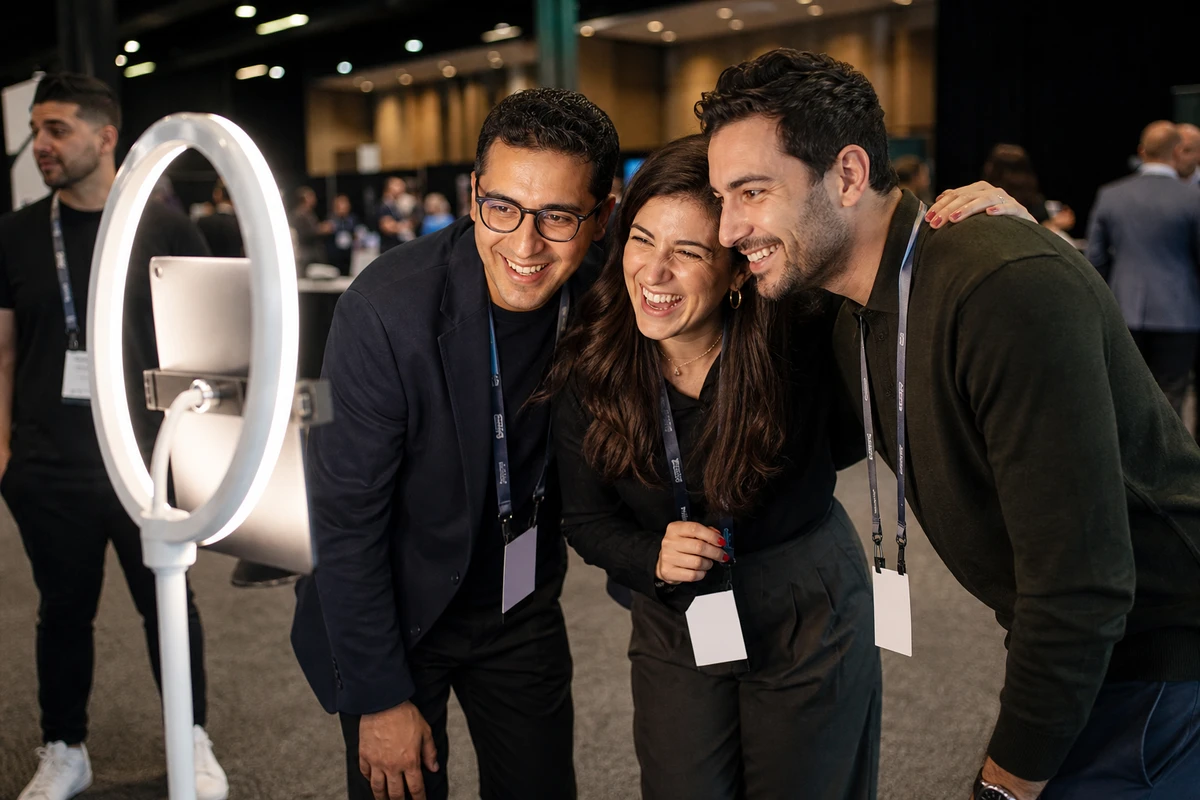
A $20,000 booth activation at this hit rate returns 3.15:1, which clears the CFO-accepted floor by a comfortable margin. Drop the ACV to $25,000 and the same activation returns 1.05:1, which does not. The pipeline stream is almost entirely a function of two numbers you set before the event: who shows up and what a closed account is worth.
A note on participation rate
PONS.ai cites 40% at a 500-person corporate event. Photo Booth Vancity claims 60%+ “at well-placed booths.” Both are vendor-published. No non-vendor primary source was located for experiential-specific participation rates, so a 40% midpoint holds up as a conservative modeling choice. What actually drives participation, rarely discussed in these sources, is booth placement relative to foot-traffic paths, wait time, whether the experience is required or optional, and the perceived quality of the creative output. People share what looks good.
Stream 2: Rolling email LTV (the venue case)
This is the persistent-install case. A booth running continuously at a restaurant, hotel, fitness studio, or retail flagship, capturing emails month after month.
Formula: Visitors/month × Participation Rate × Opt-In Rate × Email Value × Months Active
Opt-in rates are where the buy side wastes the most money on fiction. AnyRoad’s State of Experiential Marketing 2024 reports that leading brands reach 50% data capture and 25% marketing opt-in across its platform, drawing from 73 survey respondents plus platform data covering 3 million+ attendees. That is the most defensible non-photo-booth-vendor benchmark available. Vendor-published numbers run higher (80 opt-ins per hour at MDRN Activations, 30–50% at Photo Booth Vancity) because the booths they sell are designed to require email for photo delivery, which is the real mechanism.
Required-email-for-delivery is the ROI hinge
This single design choice moves the opt-in rate from the 25–30% “they chose to give us their email” range to the 60–80% “they had to give us their email to get the photo” range. It is not about the booth being fun. Fun drives participation. Required delivery drives capture. The two are separate levers, and confusing them is the most common mistake operators make when projecting ROI.
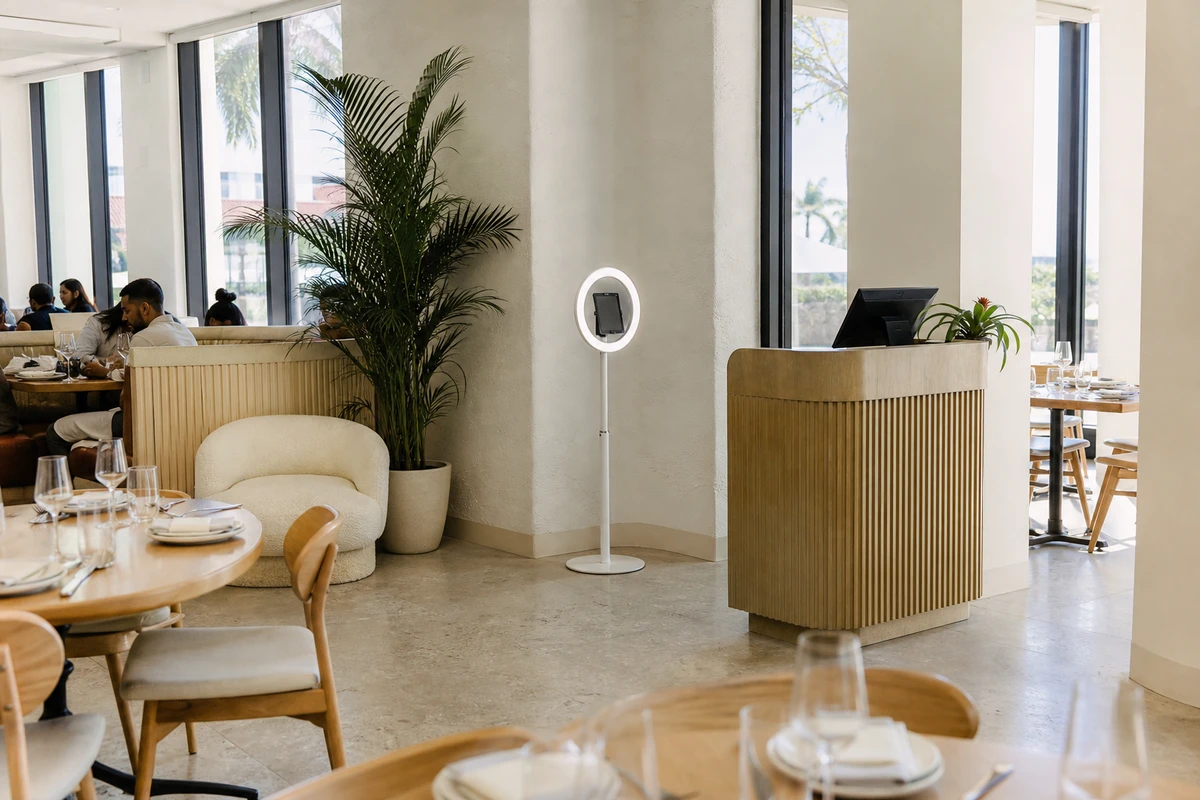
Worked scenario, 120-cover restaurant
600 patrons per month walk past an installed booth during four activation nights, 50% participate, 70% opt in because the photo is delivered by email.
600 × 0.50 × 0.70 = 210 opt-ins/monthWhat is 210 opt-ins worth? Most sources cite a $168 median customer LTV or a $285 vs $125 email-vs-paid-social comparison. Neither figure could be verified in a primary source; they circulate via aggregator posts attributed to Shopify or BDOW without a linkable study. The directional claim (email-acquired customers have higher LTV than paid-social-acquired customers) is well supported qualitatively, but the specific dollar figures should not be loaded into a model a CFO will open.
Build the LTV input from the venue’s own numbers instead. A restaurant with a $45 average check, 3 visits per year per retained guest, and a 35% 12-month retention rate has a gross revenue LTV of $45 × 3 × 0.35 = $47.25 per captured email, compounding across the months the booth is active. Swap in your own AOV, visit frequency, and retention rate. The LTV input in your model should be one the operator can defend, not one borrowed from a screenshot of uncertain provenance.
Stream 3: Foot-traffic reconversion
This is the value stream most ROI posts skip entirely, and it is often the largest one at a venue install.
Formula: Opt-Ins × Return-Visit Rate × Incremental Margin per Return Visit
The common framing calls this “gross margin,” but that is the wrong accounting frame. What matters is the contribution margin on one additional visit, which is revenue minus the variable food cost and the proportional variable labor of serving one more cover. It is not net profit margin, and it is not the 50–60% “gross margin on services” number salon owners sometimes cite.
Per the National Restaurant Association’s Restaurant Operations Data Abstract 2025, labor at full-service restaurants ran at a median of 36.5% of sales in 2024, with profitable operators holding labor to 34.2%. Food COGS typically runs 30–35%. That leaves an operating surplus of roughly 28–36% before rent and overhead, and a net margin of 2–5% on average or 8–12% for well-run operators. For modeling an incremental visit, a contribution margin of 15–25% of check is defensible: the marginal cost of serving one more table is mostly food and a fraction of the labor already staffed.
Return-visit rate
The best public figure comes from Toast POS internal data, which is vendor-published and reflects restaurants using Toast’s own marketing tools between January and July 2024: restaurants that automated email marketing saw 12–20% more repeat guests, and 12% more repeat visits within 90 days of activation. Use the lower bound when underwriting.
Worked scenario, same restaurant
210 opt-ins per month, $45 AOV, 18% contribution margin means $8.10 per incremental visit. Apply a 25% return-in-60-days rate (toward the higher end of Toast’s range because the email is fresh and tied to a recent experience):

210 × 0.25 = 52.5 additional visits/month
52.5 × $8.10 = $425/month
Over twelve months, this stream alone contributes roughly $5,100, on top of Stream 2’s LTV accumulation. That is not trivial for a booth whose annual amortized cost might be $6,000 to $8,000.
A caveat on the half-life
No primary study was found on how long a captured email from an experiential activation remains effective at driving return visits. Toast’s “within 90 days” framing implies the first quarter is the high-conversion window, consistent with email marketing’s broader pattern that the first 30–90 days of a subscriber relationship are the highest-engagement period. Treat any return-rate assumption as decaying across the year and note it explicitly in the model.
How to assemble your own number in 15 minutes
Open a spreadsheet. Seven input cells, three output cells.
Inputs
Inputs:
- Total cost, annualized (amortize hardware over 60 months, software over 36 months per IRS Publication 946, or use the rental fee for a one-event case).
- Attendees or monthly visitors.
- Participation rate (start at 40%).
- Opt-in rate (25% if the photo is free regardless; 70% if email is required for delivery).
- For one-off events: MQL × SQL × close rate × ACV.
- For venue installs: LTV per email, built from AOV × visit frequency × retention, not borrowed.
- Return-visit rate and months of booth activity.
Outputs
Outputs:
- Payback period. Months until cumulative streams clear total cost.
- 12-month ROI ratio. Sum of streams through month 12 divided by total cost.
- 36-month NPV. Streams across three years discounted at the company’s marketing hurdle rate, typically 10–15% for mid-market.
Three archetypes to benchmark against
Three archetypes to benchmark against:
- One-shot B2B trade show. Stream 1 carries the entire ROI. Streams 2 and 3 are near zero because the install is not persistent. Target 3:1 minimum, 5:1 for SaaS, 2:1 for hardware.
- 90-day pop-up activation (retail flagship, seasonal). Stream 2 begins to matter. Stream 3 begins to show if the venue has repeat-customer dynamics.
- Permanent venue install (restaurant, hotel, salon, fitness studio). Streams 2 and 3 dominate. Stream 1 is usually zero because there is no B2B funnel. Target 5:1 or higher once the install is past its payback period.
The number you should not put in the calculator
The single most-shared photo booth ROI metric is “social impressions × $0.10 CPM.” It is the first thing every competing post shows you. It is the wrong number.
Brand24’s 2026 Earned Media Value guide identifies the core problem: “There’s no single EMV formula. You can calculate it using reach (CPM), engagement (CPE), or hybrid models that combine both. EMV has clear limitations, it doesn’t measure revenue and can vary depending on the method or tool used.” The $0.10 figure that circulates across photo booth vendor blogs appears to conflate per-engagement value (CPE, where a like might be priced at $0.10) with per-impression value (CPM, where $0.10 per impression would translate to a $100 CPM, the high end of premium digital display). Treating every follower of a sharer as a guaranteed paid-equivalent impression compounds the error.
Forrester research captures the underwriting reality: 77% of CMOs believe brand marketing drives short-term sales, but only 48% of CFOs agree. That 29-point gap is the gap between an impressions number and a pipeline number. Finance discounts earned-media value sharply, often to near zero, and for defensible reasons: organic impressions are not purchased (no guaranteed delivery, no targeting, no frequency control), a brand logo in a shared photo is not equivalent to a paid ad unit, and “reach” conflates brand recall with purchase intent.
What to put in the deck instead
Segregate a “brand lift” line item, reported separately from ROI, with its own deflated assumption (a $5 CPM, not a $100 CPM, and only for followers of the sharer who are plausibly in-market). Keep the three cash-flow streams on one side of the page and the brand-lift estimate on the other. A CFO will accept one set of numbers and recognize the other as directional color. Mixing them is how the deck fails the first finance review.
What changes the model: vertical and deployment type
The three streams reweight dramatically by deployment type.
| Deployment | Stream 1 weight | Stream 2 weight | Stream 3 weight |
|---|---|---|---|
| One-shot B2B trade show | Dominant | Minimal | Zero |
| Consumer festival activation | Moderate | Moderate | Low |
| 90-day retail pop-up | Low | Moderate | Moderate |
| Permanent restaurant install | Zero | Dominant | High |
| Permanent salon/fitness install | Zero | High | Dominant |
| Multi-location brand rollout | Low | High (compounded) | High (per-location) |
Two patterns matter. First, the B2B trade-show case has fundamentally different unit economics than a venue install. A 500-attendee B2B conference with $75k ACV can support a $20k activation on Stream 1 alone. A 600-visitor-per-month restaurant cannot support the same activation on Stream 1 because there is no B2B funnel; it has to pay for itself on Streams 2 and 3 across months, which means the install has to be permanent or near-permanent.
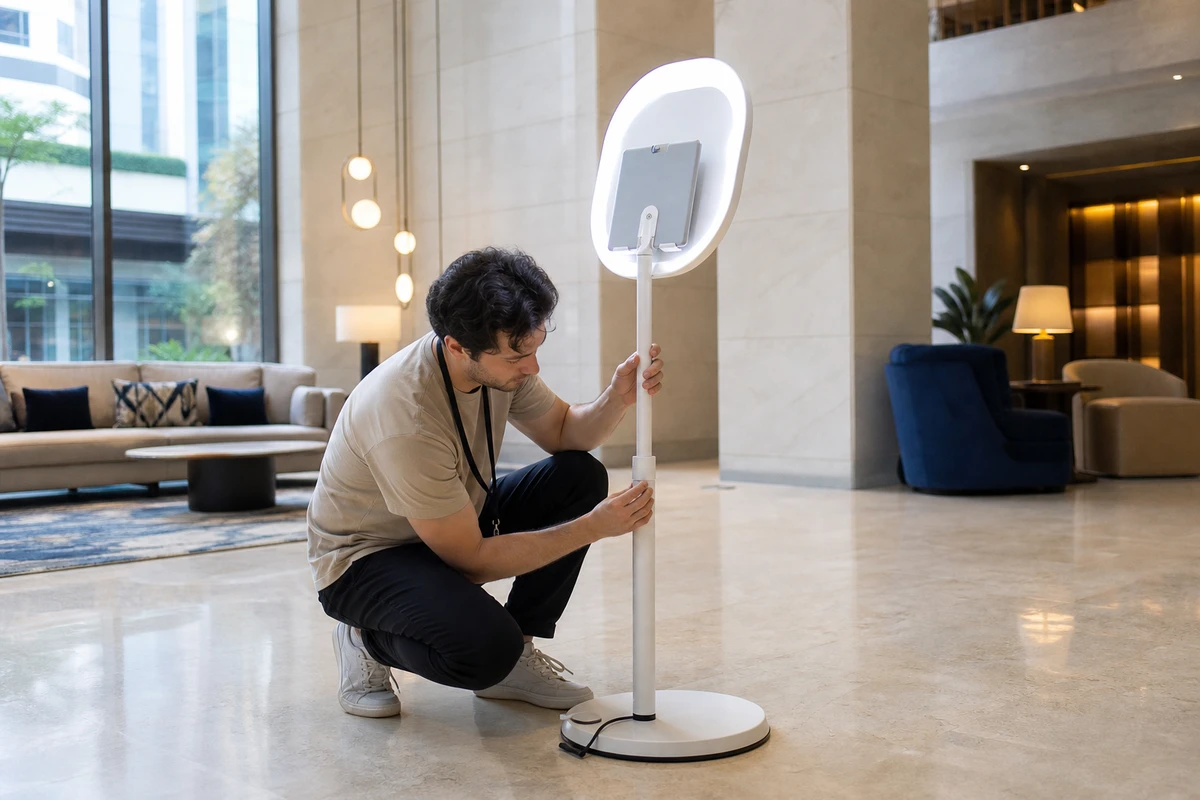
Second, CRM integration is the technology choice that makes Stream 2 even possible. A booth that captures emails into a file you forget about is not a revenue-generating asset. A booth that syncs to the venue’s existing email marketing system and triggers a welcome sequence within 24 hours of capture turns those opt-ins into the LTV your model predicts. Vendor implementations vary: Simple Booth’s HALO kits ship with native MailChimp sync and an open API for custom CRM delivery on the Pro tier and above, which covers most mid-market venue stacks without custom engineering work. Without the integration, Stream 2 collapses to zero, regardless of what the opt-in rate was.
FAQ
What is a realistic ROI target for a B2B photo booth activation?
3:1 is the minimum floor most B2B finance teams accept for event spending, consistent with Calcix’s 2026 benchmark. SaaS activations often target 5:1 because of software’s gross margins; hardware manufacturers often accept 2:1. Venue installs that successfully stack Stream 2 and Stream 3 can exceed 5:1 once past payback.
How long until payback?
For a one-off B2B trade show, payback is typically immediate at mid-market ACVs, because a single closed deal covers the activation cost many times over. For a permanent venue install, a 36-month amortization on a software plus hardware stack combined with continuous email capture typically pays back in 18 to 36 months, depending on participation rate, opt-in rate, and average check.
Does CPM-based earned media value count?
Not in the ROI model. Yes, in a separate brand-lift line item with a heavily deflated assumption. A CFO will not fund a line item based on impressions times a fictitious CPM, and most finance teams already discount earned-media value to near zero in post-event reporting.
How does a permanent venue install change the math versus a one-off event?
The streams flip. Stream 1 goes to zero because there is no event-driven funnel. Streams 2 and 3 become dominant because the install captures emails continuously and drives return visits across months. A venue install underperforms a one-off if you model it as one event; it outperforms a one-off if you model twelve months of rolling capture.
What opt-in rate should I model for my first event?
Use 25% if the photo is free and email is optional, per AnyRoad’s 2024 benchmark for leading brands. Use 65–70% if you are requiring email for photo delivery. Higher figures appear in vendor case studies; do not use them unless you plan to replicate the specific design that produced them.
How does this compare to a trade-show booth with just a badge scanner?
A badge scanner captures contact info from people who chose to engage with a sales rep. A photo booth captures contact info from people who chose to take a photo, many of whom would not have stopped at a traditional booth. The top of the funnel is wider; the intent-per-contact is lower; the net pipeline value depends on how aggressively you filter MQLs in the follow-up nurture. For most B2B expo contexts, a photo booth with required-email capture produces 2–3× the email volume of a badge scanner, which is valuable only if the sales team has the bandwidth to nurture the extra leads.
Sources
- AnyRoad (2024). “The State of Experiential Marketing 2024.” https://www.anyroad.com/2024-report
- Brand24 (2026). “Earned Media Value: Meaning, Calculation & Tools [2026 Guide].” https://brand24.com/blog/earned-media-value/
- Calcix (2026). “B2B Trade Show Booth Lead-to-Close ROI Calculator.” https://calcix.net/calculators/business-startup/b2b-trade-show-booth-lead-to-close-roi
- Event Marketer / Sparks (2025). “Exclusive Research: EventTrack 2026.” https://www.eventmarketer.com/article/exclusive-research-eventtrack-2026/
- Forrester Research (2019). “The Importance of Defining Event ROI In The B2B Marketing Mix.” https://go.forrester.com/blogs/the-importance-of-defining-the-return-on-investment-of-b2b-events/
- Forrester Research (2023). “B2B Marketing Leaders Don’t Trust Their Measurement and What They Measure Isn’t Helping.” https://www.forrester.com/blogs/b2b-marketing-leaders-dont-trust-their-measurement-and-what-they-measure-isnt-helping/
- HubSpot (2025). “2025 CPL and CAC Benchmarks,” citing First Page Sage research. https://blog.hubspot.com/marketing/2022-cpl-and-cac-benchmarks
- Internal Revenue Service (2025). “Publication 946: How to Depreciate Property.” https://www.irs.gov/publications/p946
- Karlovitch, Sara (2024). “Spending on experiential marketing tops pre-pandemic levels.” Marketing Dive, citing PQ Media’s Global B2C & B2B Experiential Marketing Forecast 2024–2028. https://www.marketingdive.com/news/experiential-marketing-spending-surpasses-pre-pandemic-levels-2024/730031/
- MDRN Activations (vendor-published). “How Experiential Marketing Agencies Use Photo Booths to Prove ROI.” https://www.mdrnphotoboothcompany.com/blog/how-experiential-marketing-agencies-use-photo-booths-to-prove-roi
- National Restaurant Association (2025). “Elevated Labor Costs Had a Significant Impact on Restaurant Profitability in 2024.” Restaurant Operations Data Abstract 2025. https://restaurant.org/research-and-media/research/restaurant-economic-insights/analysis-commentary/elevated-labor-costs-had-a-significant-impact-on-restaurant-profitability-in-2024/
- Photo Booth Vancity (vendor-published). “How to Measure Photo Booth ROI: Metrics That Actually Matter.” https://photoboothvancity.ca/how-to-measure-photo-booth-roi-metrics-that-actually-matter/
- PONS.ai (vendor-published). “How to Measure AI Photo Booth ROI: Metrics That Matter.” https://www.pons.ai/post/how-to-measure-ai-photo-booth-roi-metrics-that-matter
- Section179.org (2026). “2026 Section 179 Deduction.” https://www.section179.org/section_179_deduction/
- Toast POS (vendor-published, internal data January–July 2024). Restaurant email marketing and repeat-visit statistics. https://pos.toasttab.com