Trade shows were supposed to be a pandemic casualty. Five years on, U.S. business-to-business exhibitions closed 2024 within 4.4% of their 2019 benchmark on the industry’s own composite index, and exhibitors around the world welcomed 318 million visitors through the door.
The recovery is not uniform. Attendance remains the slowest metric to come back (12.9% below pre-pandemic on CEIR’s Total Index), while revenue and exhibitor counts have essentially closed the gap. Hybrid formats carved out a permanent foothold, but 63% of events in 2026 are once again fully in-person, with just 4% running as true hybrids.
Below, 55+ statistics organized by the numbers that shape an exhibit strategy: industry scale, audience authority, exhibitor return, format share, venue concentration, and the 2026 outlook.
The figures come from UFI, CEIR/IAEE, IBISWorld, Freeman, Event Marketer’s EventTrack, Bizzabo, and the largest U.S. convention authorities.
Top Trade Show Statistics (Editor’s Picks)
- 318 million people attended exhibitions globally in 2024, a full rebound to pre-pandemic scale.
- 82% of trade show attendees have authority to recommend, specify, or approve a purchase.
- $24.2 billion was the U.S. trade show and conference planning industry’s 2025 market size.
- 4.4% was the CEIR Total Index’s Q4 2024 shortfall against the Q4 2019 benchmark, the smallest gap since the pandemic reset.
- 78% of event organizers rank in-person conferences, summits, and conventions as their most impactful marketing channel.
- 1.23 million convention attendees are projected for Las Vegas in 2026, up from 1.06 million in 2025.
- 4% year-over-year growth for CES 2026, the first CES to exceed its pre-pandemic scale.
- 153,000 attendees from 140 countries came to SEMA Show 2025 at the Las Vegas Convention Center.
Industry Scale, Growth, and Post-Pandemic Recovery
The global exhibition industry is larger than most B2B marketers assume. UFI’s 2024 Global Exhibition Industry Statistics, the most comprehensive public dataset on the sector, captured the first full post-pandemic year and found that exhibitions are now a structural component of the global B2B economy, not a niche channel.
Global exhibitions welcomed 318 million visitors in 2024 (UFI)
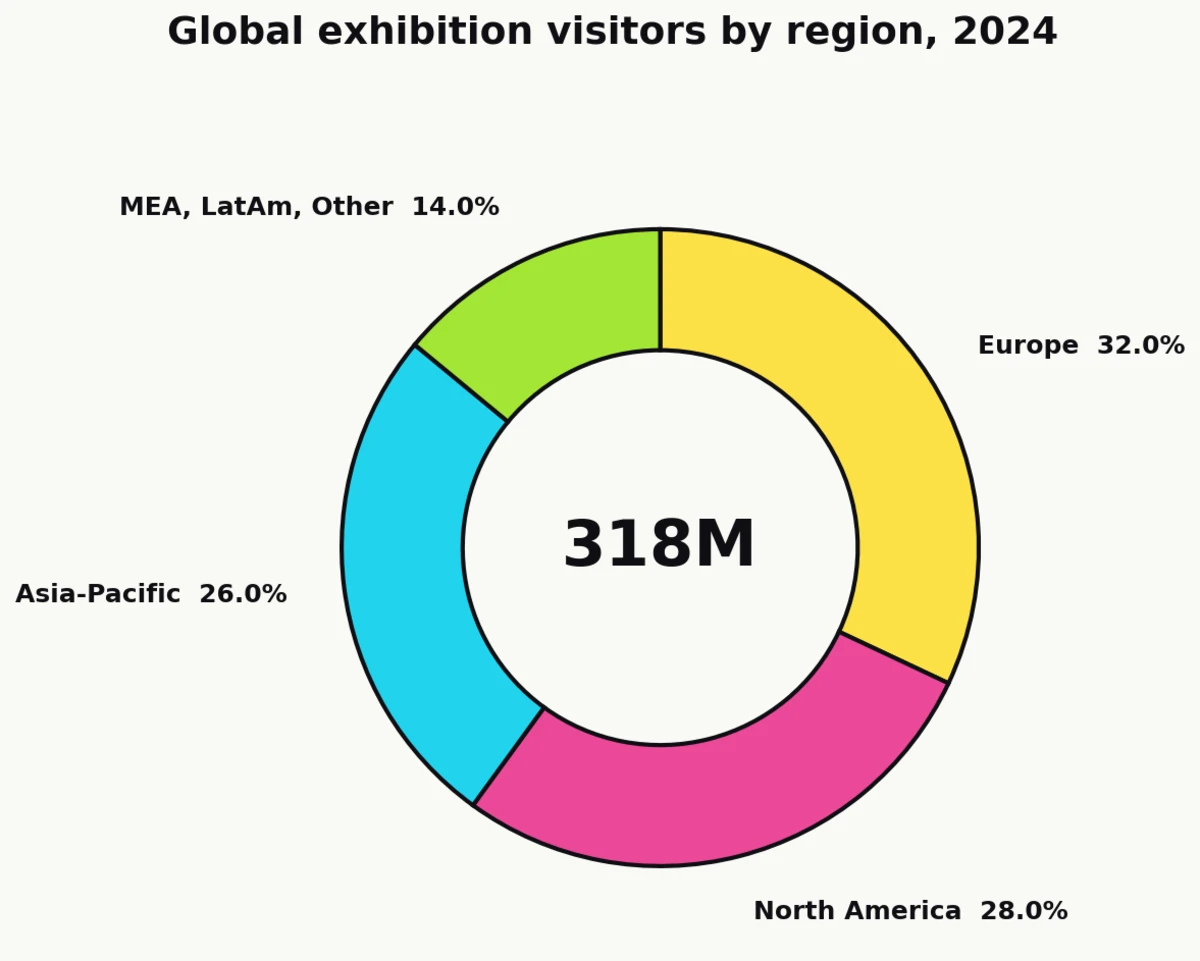
UFI’s 2024 report, compiled with Oxford Economics, found that 4.7 million exhibiting companies welcomed 318 million visitors across the year. Europe led as the largest regional market with 102 million visitors (32% of the global total), followed by North America with 89 million and Asia-Pacific with 84 million.
Roughly 32,000 exhibitions were held worldwide in 2024, a count within a percentage point of the pre-pandemic total. Exhibitors occupied 138 million square meters of space, a 0.8% annual decline against the 143.7 million square meters booked before the pandemic.
Exhibitions generated €368 billion ($398 billion) in global economic impact in 2024 (UFI)
Applying the standard direct, indirect, and induced framework, UFI and Oxford Economics calculated that exhibition activity supported 4.3 million jobs and generated €150 billion ($162 billion) in direct spending worldwide. Per-exhibitor economic impact worked out to €78,800 ($85,200), and each square meter of occupied space produced €8,500 ($9,200) in economic value.
The U.S. trade show and conference planning industry was worth $24.2 billion in 2025 (IBISWorld)
IBISWorld’s industry report for NAICS 561920 (Trade Show & Conference Planning in the US) put the U.S. market at $24.2 billion in 2025, following a 12.7% trailing five-year compound annual growth rate that reflects both the pandemic collapse and the subsequent rebound.
The CEIR Total Index for Q4 2024 closed 4.4% below its Q4 2019 benchmark (CEIR / IAEE)
CEIR’s composite Index (Net Square Feet, Attendees, Exhibitors, and Real Revenues across 14 industry sectors) reached 95.6 in Q4 2024, 6.0% above the previous year and the closest the U.S. B2B exhibition industry has come to pre-pandemic performance. The same quarter in 2022 sat 20.3% below the 2019 benchmark; Q4 2023 was 10.9% below. The 4.4% shortfall in Q4 2024 marks the industry’s shortest gap since the reset.
37% of U.S. B2B events have now surpassed their pre-pandemic performance (CEIR / IAEE)
More than one in three completed U.S. B2B events in 2024 surpassed their pre-pandemic levels on the CEIR Total Index, an 8 percentage point improvement from 2023. The upshot: recovery is not distributed evenly across the industry, but the fastest-moving shows have already re-cleared their 2019 high-water marks.
Attendee counts remain 12.9% below 2019, the slowest-recovering CEIR Total Index component (Exhibit City News)
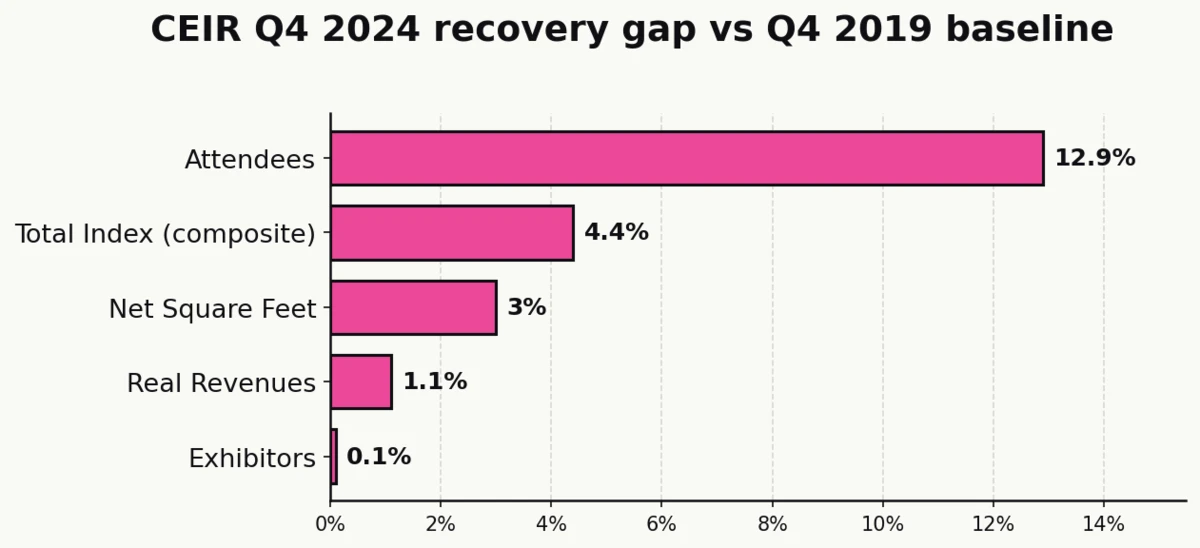
Disaggregating the CEIR Total Index by its four components reveals an uneven recovery. Trade press reporting on the Q4 2024 CEIR Index summary shows Net Square Feet at -3.0%, Exhibitors at -0.1%, and Real Revenues at -1.1% against Q4 2019, while Attendees remain 12.9% below the pre-pandemic benchmark. The takeaway for exhibitors: revenue and exhibitor counts are back, but the audience is still rebuilding.
Only 0.3% of U.S. B2B events were cancelled in Q4 2024, down from 1.4% a year earlier (TSNN)
Cancellation risk, one of the channel’s most-cited volatility arguments, has effectively evaporated. Trade Show News Network’s summary of the CEIR Q4 2024 Index put the cancellation rate at 0.3%, down by more than a full percentage point year-over-year.
Sources: UFI, IBISWorld, CEIR / IAEE, Exhibit City News, TSNN.
The Audience: Authority, Intent, and Preference
The single most persistent strategic argument for the exhibition channel is the density of decision-making power on a show floor. CEIR’s long-running attendee-retention research has also found that roughly two-thirds of attendees at any given exhibitor’s booth are net-new prospects, not existing customers, which makes the in-person moment the exhibitor’s best shot at a first conversation.
82% of trade show attendees hold authority to recommend, specify, or approve a purchase (Exhibit Surveys)
This figure, consistently reported by Exhibit Surveys’ audience research (now hosted by Explori) and echoed by CEIR’s 82% to 84% range across multiple research waves, is the most durable stat in the industry. More than four in five attendees are not information-gatherers on behalf of someone else. They are the person who can sign off.
46% of attendees are in the final stages of a buying decision when they arrive on the show floor (Exhibit Surveys)
Nearly half of B2B trade show attendees are not browsing. They are comparing final options, which makes each booth conversation materially higher-intent than a web-form inquiry and compresses late-stage research into the show days.
80% of respondents identified in-person events as a top source for discovering new products and services (Freeman)
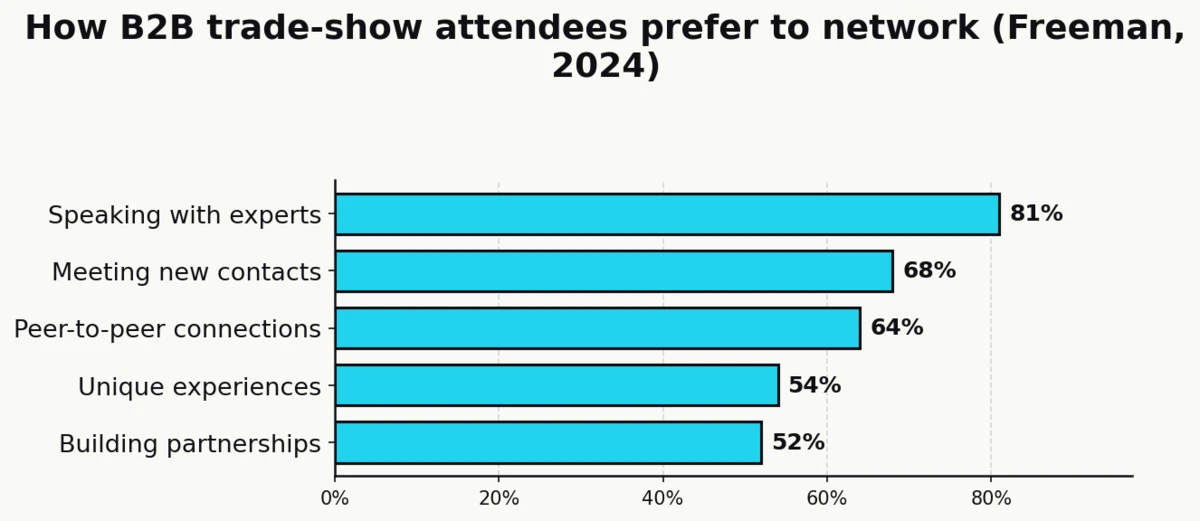
Freeman’s 2024 Trends Report put in-person events ahead of company websites (62%), professional and trade organizations (53%), and trade publications (51%) as attendees’ preferred discovery channel. 82% of the same respondents said they prefer in-person events to online ones, with just 1% preferring virtual as their default format.
Sources: Exhibit Surveys, Freeman.
What Exhibitors Actually Get Back
Exhibitor confidence in the channel runs ahead of general-marketing benchmarks, and the most recent primary data is about to make clear why. The 2024 Freeman Exhibitor Trends Report and Event Marketer’s 2026 EventTrack study converge on the same theme: the value of a trade show is measured in the quality of the audience, not the width of the booth.
93% of exhibitors say the quality of expected attendees is the most impactful outcome of participating (Freeman)
Freeman’s 2024 Exhibitor Trends Report found that 93% of exhibitors rate “quality of expected attendees” as the single most important outcome they look for in an event. The same survey also reported that 61% cite unpredictable costs as a major influence on how they exhibit, and just 49% describe themselves as extremely or very satisfied with the leads they capture. The spread between what exhibitors want (audience quality) and what they are actually getting (lead outcomes) is where most of the channel’s missed ROI sits.
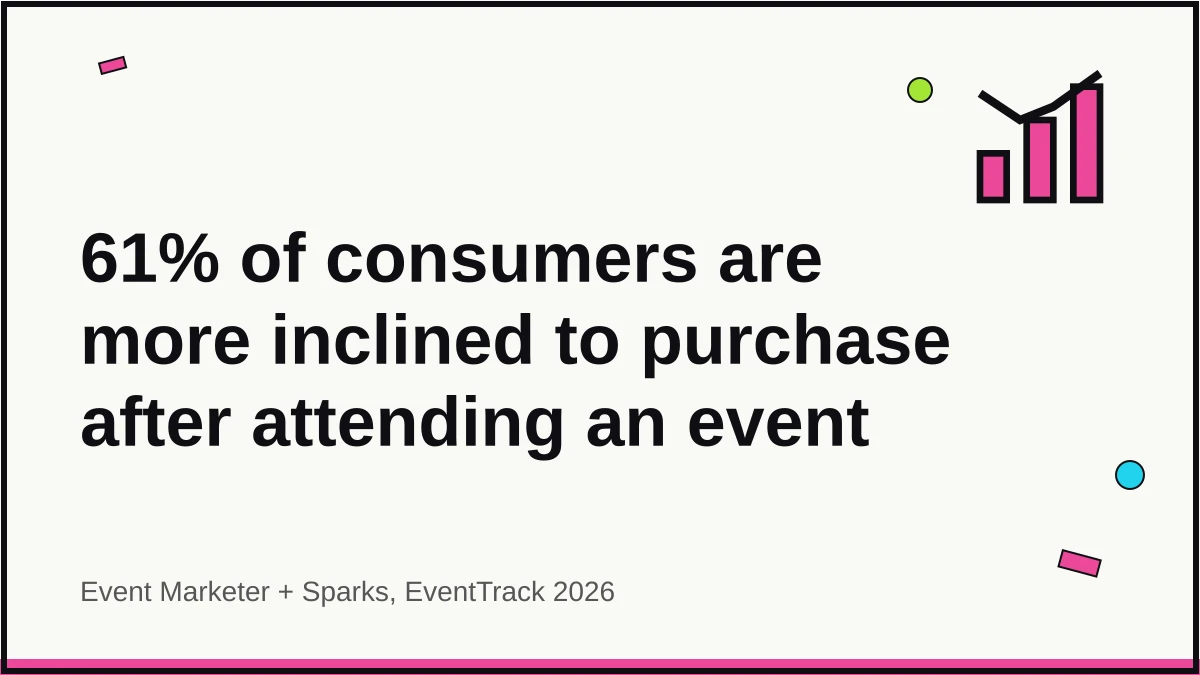
61% of consumers are more inclined to purchase after attending an event (Event Marketer)
The 2026 EventTrack study, produced by Event Marketer in partnership with Sparks, is the most current benchmark on post-event purchase intent. The 85% figure that circulates widely in trade show write-ups is drawn from earlier EventTrack waves; the 2026 data, which reflects current B2B and B2C attendee behavior, puts the “more inclined to purchase” share at 61%.
85% of B2B attendees feel more educated after an event (Event Marketer)
The 85% figure from EventTrack 2026 describes a different outcome from the one often cited: not purchase intent, but post-event knowledge uplift. 57% of the same respondents say they plan to increase their event attendance in 2026, reinforcing the “back to in-person” shift visible in platform data.
Sources: Freeman, Event Marketer.
Format Share: In-Person, Virtual, and Hybrid in 2026
The “everything goes hybrid” peak of 2021 has receded. Hybrid is now a permanent feature of the calendar, but at much smaller share than format vendors predicted. Primary platform data from Bizzabo’s 2026 event operations gives the clearest read on where the format market has settled.
63% of events are in-person, 33% virtual, and 4% hybrid in 2026 (Bizzabo)
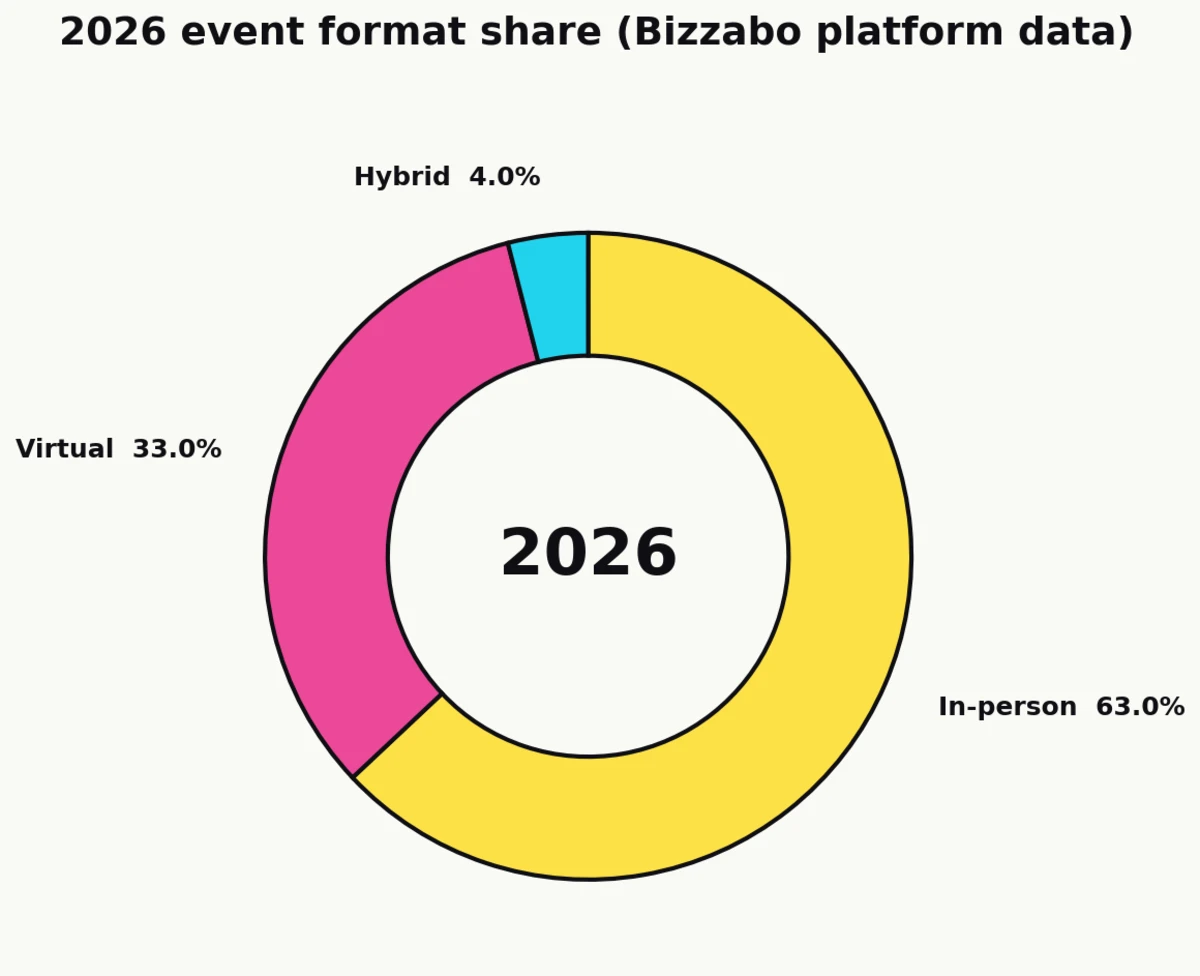
Bizzabo’s 2026 State of Events report, published February 2026, shows the current split across events hosted on its platform. Fully virtual events hold a structural third of the market, but true hybrid collapsed to 4%. The three-year prediction that most large events would become hybrid did not survive contact with attendee preference or production cost.
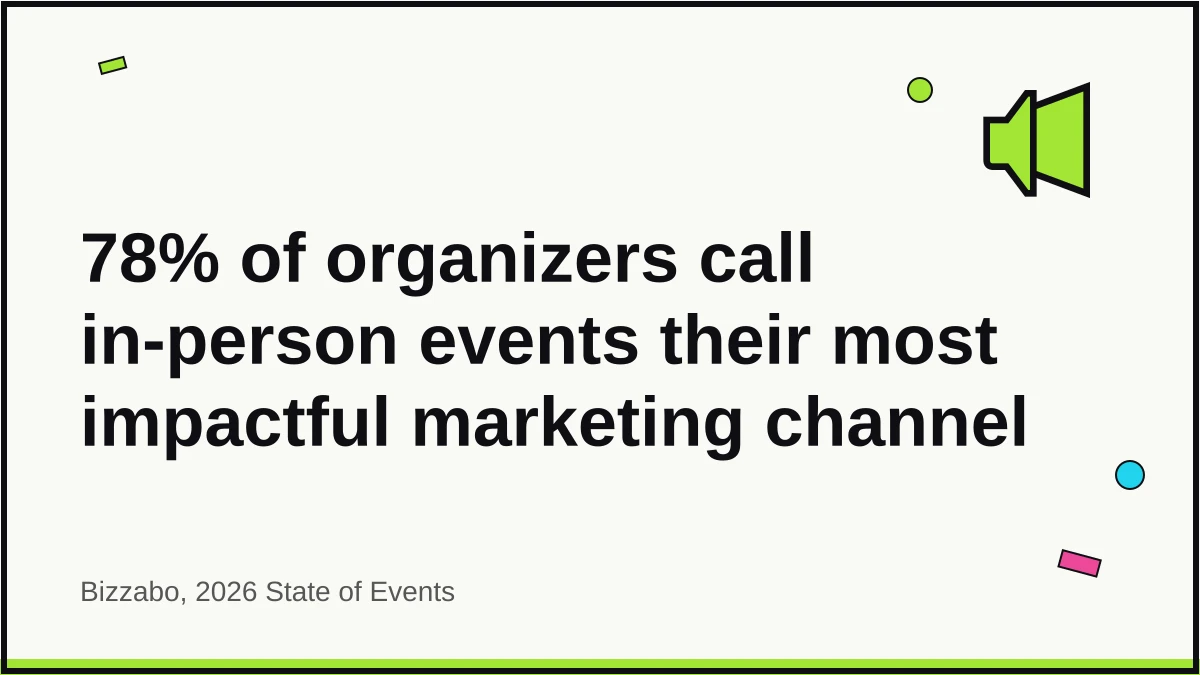
78% of event organizers rank in-person conferences, summits, and conventions as their most impactful marketing channel (Bizzabo)
Bizzabo’s annual organizer survey found that 78% of respondents call in-person conferences and summits their organization’s most impactful marketing channel, ahead of any digital or field alternative. A companion finding: 40% of organizers report difficulty proving event ROI in 2026, a sharp drop from 70% in 2025 as measurement tooling catches up to the channel.
97% of event organizers want to increase the number of valuable B2B relationships built at their events (Markletic)
Markletic’s event-marketer survey put relationship-building at the top of organizers’ improvement list for the next two years. The 97% figure also frames the function a physical show performs that a webinar does not: compressing peer, prospect, and supplier contact into a single three-day block.
Where the Biggest U.S. Shows Happen
Roughly half of the largest U.S. B2B exhibitions are concentrated in Las Vegas, Chicago, and Orlando, and that geographic concentration shapes exhibit-logistics costs, attendance patterns, and the 2026 capacity picture.
Las Vegas is projected to host 1.23 million convention attendees in 2026, up from 1.06 million in 2025 (LVCVA)
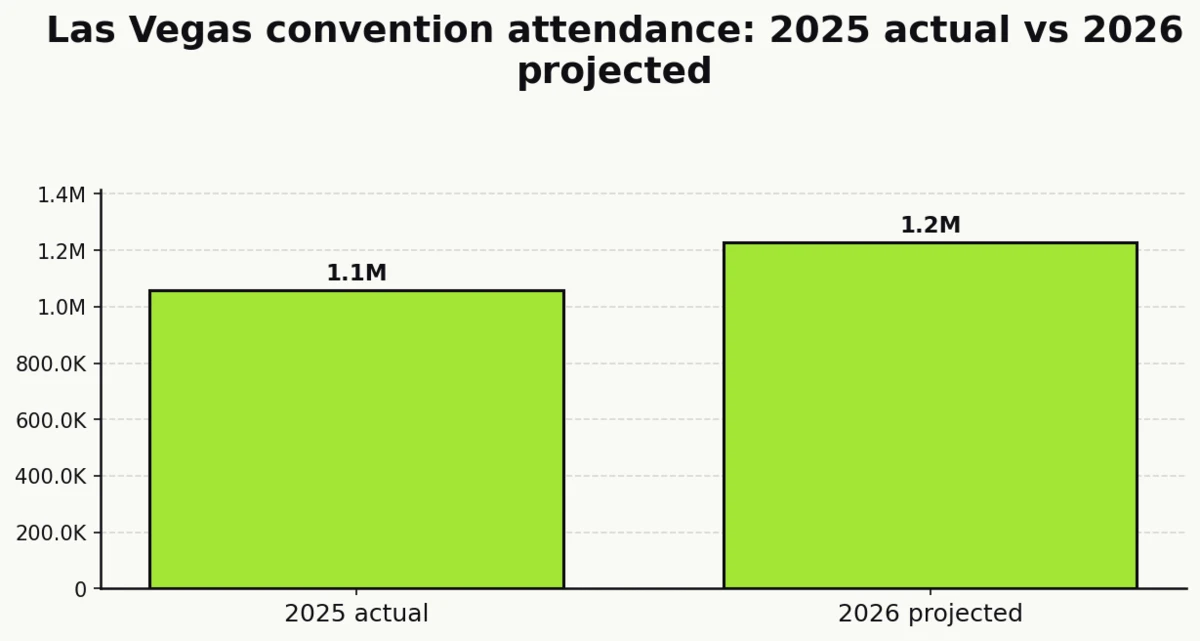
The Las Vegas Convention and Visitors Authority’s 2026 forecast, reported in the Las Vegas Review-Journal, represents the city’s largest projected convention year on record. 48 trade shows are scheduled at the Las Vegas Convention Center, including CES (~140,000), ConExpo-Con/Agg (~139,000), and AAPEX/SEMA (~160,000 combined).
McCormick Place is North America’s largest convention center, with 2.6 million sqft of exhibit space (McCormick Place)
McCormick Place’s December 2025 press release confirmed the venue’s headline capacity: more than 2.6 million square feet of exhibit space across four buildings (North, South, West, and Lakeside Center). Chicago’s anchor venue is the largest by exhibit footprint of any convention center in North America.
CES 2026 grew 4% year-over-year in total participation (CTA)
The Consumer Technology Association’s CES 2026 audit summary reported approximately 4% growth against CES 2025, which itself had audited at 142,000+ participants. CES 2026 was the first edition of the show to exceed its pre-pandemic scale on a full-audit basis.
CES 2026 programmed 400+ conference sessions and 1,300+ speakers (CTA)
Beyond the exhibit floor, CES 2026 ran 400+ conference sessions and featured 1,300+ speakers across nine days of programming. The figures position CES as much as a content-and-thought-leadership venue as a hardware showcase, a shift that drove up the audience of senior-executive attendees.
SEMA Show 2025 drew 153,000 attendees to Las Vegas (SEMA)
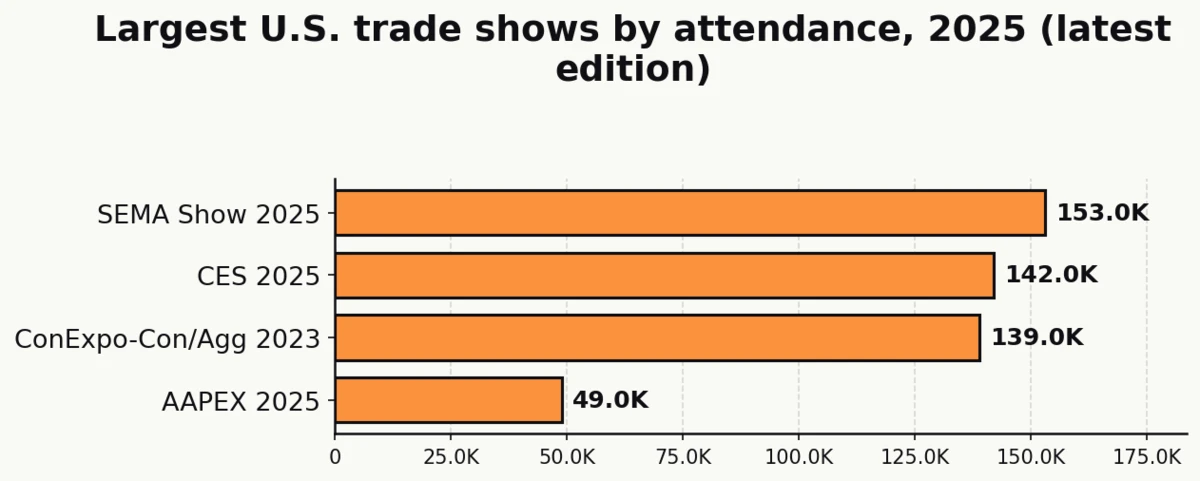
SEMA’s official 2025 show recap put registered attendance at 153,000 across the four-day event at the Las Vegas Convention Center. 2,500+ members of the global media also covered the show, giving exhibitors one of the largest earned-media surfaces of any U.S. B2B trade show.
SEMA Show 2025 gathered 2,300 exhibiting brands from 140 countries, including 500 first-time exhibitors (SEMA)
The exhibitor side of the show reflects the automotive aftermarket’s global concentration. 2,300 brands exhibited, with 500 first-time exhibitors representing roughly one in five booths on the floor, a renewal rate that keeps the show fresh for returning buyers.
Sources: LVCVA via Las Vegas Review-Journal, McCormick Place, Consumer Technology Association, SEMA.
The 2026 Outlook: Growth, Sustainability, and Risk
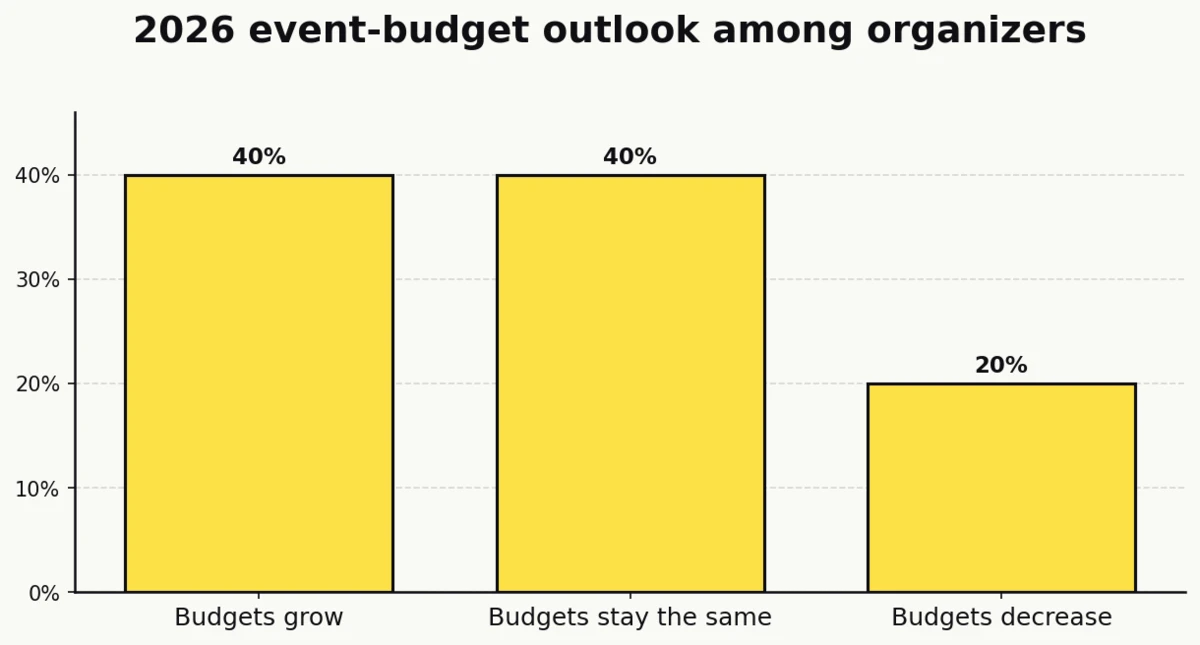
Exhibit marketers are moving capital back into the channel, and a parallel shift in sustainability expectations is reshaping what modern exhibiting looks like. Tourism Economics and IAEE have flagged tariffs and travel-policy uncertainty as the two most credible downside risks to the current forecast.
Las Vegas convention attendance is forecast to grow 16% from 2025 to 2026 (LVCVA)
The move from 1.06 million attendees in 2025 to a projected 1.23 million in 2026 works out to roughly 16% year-over-year growth on the LVCVA’s own tracking. Vegas is accelerating, not moderating, as the industry approaches its structural ceiling.
U.S. trade show and conference planning revenue grew just 1.4% in 2025 after 2.6% in 2024 (IBISWorld)
IBISWorld’s NAICS 561920 industry report reports sector revenue growth of 1.4% in 2025 following a 2.6% expansion in 2024. The deceleration is consistent with the recovery narrative: the market is back to trend but now laps its pre-pandemic peak, so the fast catch-up growth is over.
The exhibition industry’s Net Zero Carbon Events pledge commits signatories to halving emissions by 2030 and reaching net-zero by 2050 (Net Zero Carbon Events / UFI)
The Net Zero Carbon Events initiative, launched at COP26 by UFI and the Joint Meetings Industry Council, binds signatories to a 50% emissions reduction by 2030 and full net-zero operations by 2050. The pledge is the exhibition industry’s single largest coordinated commitment on climate, and it reshapes what RFPs for booth design, freight, and power now ask for.
Sources: LVCVA via Las Vegas Review-Journal, IBISWorld, Net Zero Carbon Events / UFI.
Key Takeaways
The trade show channel is structurally back. By the industry’s own composite index, U.S. B2B exhibitions closed 2024 within 4.4% of their 2019 benchmark, the smallest gap since the pandemic reset. Global exhibitions welcomed 318 million visitors. Outside a handful of lagging segments, the recovery is complete rather than aspirational.
The durable value proposition is the audience, not the floor space. 82% of attendees hold purchase authority, 46% are in the final stages of a buying decision when they arrive, and 93% of exhibitors rank the quality of expected attendees as the most impactful outcome of participating. No other B2B channel delivers that density of decision-makers to the same room on the same day. Attendance is the slowest metric to recover precisely because it has the highest bar: the industry does not count casual browsers.
Return on exhibit spend is an execution question. Only 49% of exhibitors say they are extremely or very satisfied with the leads they capture, and 40% of organizers still report difficulty proving event ROI even as the tooling catches up. The gap between what the channel can deliver and what the average exhibitor takes home sits almost entirely in follow-up discipline, not in booth design.
Format share has stabilized after a volatile half-decade. Fully virtual events hold a structural 33% of activity on a leading event platform. True hybrid is 4%. In-person is 63% and rising. The “everything goes hybrid” prediction of 2021 did not survive attendee preference. The format fight is largely over; exhibitors planning for 2026 can treat the in-person show as the default and add virtual components when the content genuinely warrants it.
Budgets are rising into 2026. 40% of event organizers expect their budgets to grow, and Las Vegas alone expects a 16% bump in convention attendance. The sustainability overlay (a 50%-by-2030 emissions commitment across signatory venues and organizers) is not a distant concern; it is already rewriting RFPs for booth design, freight, and power. The next 18 months will likely widen, not narrow, the gap between exhibitors who treat trade shows as an executional capability and those who treat them as a line-item expense.
Sources
- Bizzabo (2026). “2026 State of Events: The Events Industry’s Top Marketing Statistics, Trends, and Benchmarks for 2026.” https://www.bizzabo.com/blog/event-marketing-statistics
- CEIR / IAEE (2025). “IAEE Releases Comprehensive Update of U.S. B2B Trade Show Industry.” https://www.iaee.com/news/iaee-releases-comprehensive-update-of-u-s-b2b-trade-show-industry/
- Consumer Technology Association (2026). “CES 2026: The Future Is Here.” https://www.ces.tech/press-releases/ces-2026-the-future-is-here
- Event Marketer / Sparks (2025). “Exclusive Research: EventTrack 2026.” https://www.eventmarketer.com/article/exclusive-research-eventtrack-2026/
- Event Marketer (2024). “Five Takeaways from Freeman’s 2024 Exhibitor Trends Report.” https://www.eventmarketer.com/article/five-takeaways-from-freemans-2024-exhibitor-trends-report/
- Exhibit City News (2025). “CEIR Releases Q4 2024 Index Results.” https://exhibitcitynews.com/ceir-releases-q4-2024-index-results/
- Exhibit Surveys (via Explori). “Audience Research.” https://www.explori.com/
- Freeman (2024). “Freeman Trends Report Q1 2024: Attendee Intent and Behavior” (as reported by Trade Show Executive). https://tradeshowexecutive.com/freeman-trends-report-2024/
- IBISWorld (2025). “Trade Show & Conference Planning in the US (NAICS 561920).” https://www.ibisworld.com/united-states/market-size/trade-show-conference-planning/1502/
- Las Vegas Review-Journal / LVCVA (2026). “2026 to Be Record Year for Las Vegas Conventions.” https://www.reviewjournal.com/business/conventions/2026-to-be-record-year-for-las-vegas-conventions-3594021/
- Markletic. “Hybrid Event Statistics.” https://markletic.com/blog/hybrid-event-statistics/
- McCormick Place (2025). “Press Release: December 18, 2025.” https://www.mccormickplace.com/newsroom/press-release-2025-12-18/
- Net Zero Carbon Events / UFI (2021). “Global Events Industry Presented Net Zero Carbon Events Pledge at COP26.” https://www.ufi.org/mediarelease/global-events-industry-presented-net-zero-carbon-events-pledge-at-cop26/
- SEMA (2025). “SEMA Show 2025: Global Stage for Ideas, Products and Passion.” https://www.sema.org/news-media/press-release/sema-show-2025-global-stage-ideas-products-and-passion
- Trade Show News Network (2025). “What’s Trending in U.S. Exhibitions: 5 Takeaways from CEIR’s Q4 2024 Index.” https://www.tsnn.com/trade-shows-conferences/what-s-trending-in-u-s-exhibitions-5-takeaways-from-ceir-s-q4-2024-index
- UFI (2025). “UFI Releases a New Set of Global Exhibition Industry Statistics.” https://www.ufi.org/media-releases/ufi-releases-a-new-set-of-global-exhibition-industry-statistics/