
Commercial venues face four choices on the photo-booth question, not two. You can rent per event, buy outright, finance through a lease, or accept a vendor placement deal. The right answer depends on how many events you host per year, who you want to own the guest data, and whether the booth is a marketing asset or a passive amenity. What follows is the math and the contract language that decide which model fits your venue.
The four-option decision (not two)
Every consumer-facing article on this query treats the choice as rent or buy. For a restaurant, hotel, bar, or retail operator, that framing skips the two options most likely to fit a commercial P&L.
| Model | Upfront cost | Recurring cost | Owns hardware | Owns guest data | Maintenance | Keeps session revenue |
|---|---|---|---|---|---|---|
| Per-event rental | $0 | $300–$2,500 per event | Vendor | Vendor (default) | Vendor | Vendor |
| Outright purchase | $5,000–$15,000 | Software + consumables + insurance | Venue | Venue | Venue | Venue |
| Lease-to-own / financing | $0 down typical | Monthly payment | Venue at term end | Venue | Venue | Venue |
| Vendor placement | $0 | $0 | Vendor | Vendor (negotiable) | Vendor | Mostly vendor; venue gets kickback |
The “free” option carries the highest hidden cost in two columns most operators miss: data ownership and revenue share. We’ll come back to that.
Capex vs. opex: how this hits your P&L
Buy/rent is a capital allocation question dressed in event-planning language. The accounting treatment drives most of the consequences downstream.
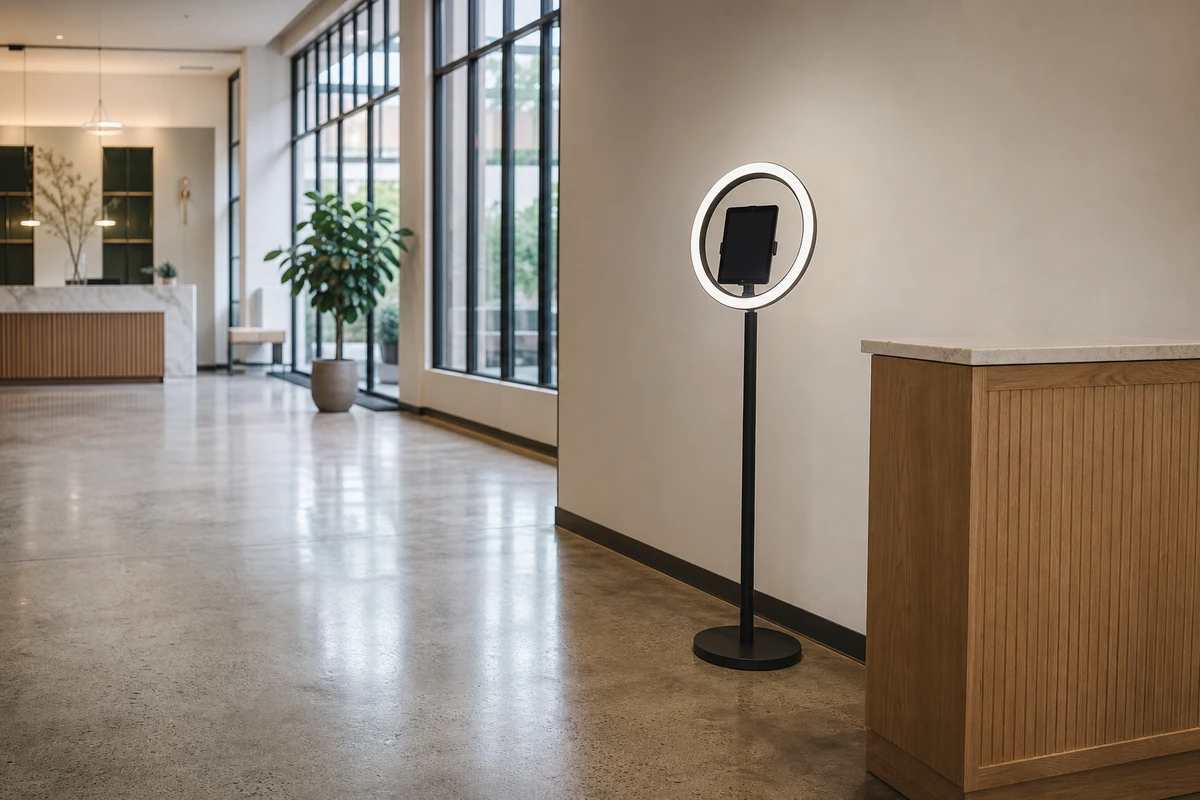
Ownership is capex
A purchased booth lands on the balance sheet as a depreciating asset. Under standard IRS rules, photo booth equipment is classified as 7-year MACRS property, the same bucket that covers most office and small commercial equipment. Revospin, citing IRS Publication 946, publishes a tax breakdown of the year-by-year depreciation schedule: roughly 14.29% deductible in Year 1 and the rest spread across the next six years. For venues with enough taxable income to absorb the deduction, Section 179 changes that math entirely (more on this in a minute).
Rental is opex
Per-event rental flows through the income statement as an event expense. There’s no asset on the books, no depreciation schedule, no residual value to track. Predictable, simple, no CapEx committee review required.
Placement is also opex, but inverse
You’re not paying cash; you’re forgoing revenue and data. The accounting effect is zero on the cost side, but the opportunity cost is real and goes uncounted because nobody books it.
Why this matters: in a venue group with PE ownership or a finance team, capex requests usually trigger an approval cycle that opex doesn’t. A general manager who can sign off on $15,000 of opex over twelve months may not be able to sign off on a single $10,000 capex line. Knowing where the threshold sits in your own org chart changes which model is even available to you, regardless of which is mathematically optimal.
Section 179: the part most buy/rent comparisons skip
For 2026, the Section 179 deduction limit is $2,560,000, with a phase-out beginning at $4,090,000 in property placed in service, and bonus depreciation back to 100%. A photo booth purchase qualifies as tangible personal property used in a trade or business, which means a venue with sufficient taxable income can elect to expense the entire purchase in Year 1 instead of depreciating it over seven years.
Run the arithmetic on a $10,000 commercial-grade booth at a 21% effective tax rate (the US federal corporate rate; pass-through entities should substitute the owner’s marginal rate):
| Standard MACRS | Section 179 election | |
|---|---|---|
| Year 1 deduction | $1,429 (14.29%) | $10,000 (full) |
| Tax savings at 21% | $300 | $2,100 |
| Effective Year 1 net cost | $9,700 | $7,900 |
The Section 179 path cuts your effective first-year cost by about $1,800. That difference rarely shows up in a generic buy-vs-rent comparison, because most are written for consumers or aspiring rental operators, not for a profitable venue with a tax bill. Confirm with a CPA before relying on the election; the deduction caps and bonus-depreciation schedule have moved several times in recent years, and the election requires taxable income to absorb against.
The break-even math your accountant will actually accept
Build the model around four inputs you control: per-event rental cost avoided, events per year, purchase cost, and annual ownership costs.
Annual ownership costs, drawn from verified sources:
- Software subscription: $40–$130/month (Simple Booth’s Core plan, positioned for permanent venue installations, runs $16/week; Kruu cites a typical industry range around $30–$100/month).
- General liability insurance: ~$29/month median for small businesses in this category (Insureon). A business owner’s policy combining liability and property runs about $47/month.
- Inland marine / equipment coverage if the booth travels: ~$43/month median (Insureon).
- Consumables (paper, ink) if you print: $200–$500/year of active use.
- Staff time: 2–4 hours per event at loaded labor cost, for setup, monitoring, and teardown.
That works out to roughly $1,000–$2,500 per year in recurring ownership costs for most commercial setups, before staff hours. A bare-bones configuration (basic software, liability only, no prints) can sit under $1,000; heavy usage with BOP, equipment rider, and active printing pushes higher.
Worked example A: hotel with an in-house events program
- 12 in-house branded events per year, previously paying $1,500 per rental.
- $10,000 commercial booth purchase, $1,000/year ownership costs.
- Net savings per event: $1,500 − ($1,000 / 12) = $1,417.
- Break-even: $10,000 / ($1,417 × 12) = 0.59 years, about seven months.
Worked example B: restaurant with light private-event activity
- 4 private events per year, paying $1,200 per rental.
- Same $10,000 booth, $1,000/year ownership costs.
- Net savings per event: $1,200 − $250 = $950.
- Break-even: $10,000 / ($950 × 4) = 2.6 years.
The threshold
For a venue paying $1,000–$1,500 per rental on a $10,000 booth, ownership beats rental at roughly 8–10 events per year. Below that, rent. Above that, own. (This is different from the 5–10 events per month threshold Clear Choice cites for rental-business operators trying to make a living from the asset; that’s a different P&L.)
The math tilts further toward ownership when the booth earns per-session revenue from guests. At $5 per session and 200 sessions per month (a plausible figure for a busy bar or nightclub), the booth generates $1,000/month of incremental revenue on top of any event savings, compressing payback to a few months even with light internal use. Real session volume varies widely with foot traffic and promotion, so run the numbers against your own venue.
Lease-to-own and financing: the middle path nobody explains
A capital lease or financed purchase preserves working capital while still building ownership. It’s the option that lets a multi-location operator standardize on owned hardware across five sites without writing a $50,000 check.
The two main paths:
Specialty equipment fintechs
Clicklease is the lender most commonly used by photo booth operators. Their pitch: no hard credit pull to apply, instant decision in most cases, ticket size up to $25,000, and an early purchase option at 12 months. Convenience comes at a price; rates are application-dependent and typically higher than bank financing. Useful when speed and credit flexibility matter more than total cost of borrowing.
Traditional equipment lessors
Crest Capital and similar commercial lenders offer three structures worth knowing:
- Operating lease. Monthly payment, return at term end. No ownership, no balance-sheet asset, useful for hardware likely to obsolesce.
- Capital lease ($1 buyout). Treated as a purchase for accounting. Lower monthly than an operating lease, ownership transfers at the end for a token $1, appears on the balance sheet, may qualify for Section 179.
- Lease-to-own with FMV buyout. Hybrid. Higher monthly than a straight loan, ownership option at fair market value at term end.
Terms typically run 24–72 months, with rate factors that include credit quality, term length, and equipment type. Neither Clicklease nor Crest publishes rate tables; both require an application to quote.
Watchouts before signing any lease: total cost of borrowing (compute the all-in cost vs. cash purchase), personal-guarantee requirements (especially for newer entities), and early-termination clauses (rarely written in the lessee’s favor).
The “free placement” trap: what vendor installation programs actually cost you
This is the option most competing articles gloss over. Photomatica’s venue placement page leads with the headline “FREE FOR YOU. PURE REVENUE.” Majestic’s Venue Placement Program installs a custom-built booth at “no cost to you.” Both are legitimate offerings. Both leave out the fine print that decides whether the deal works for your business.
How placement works
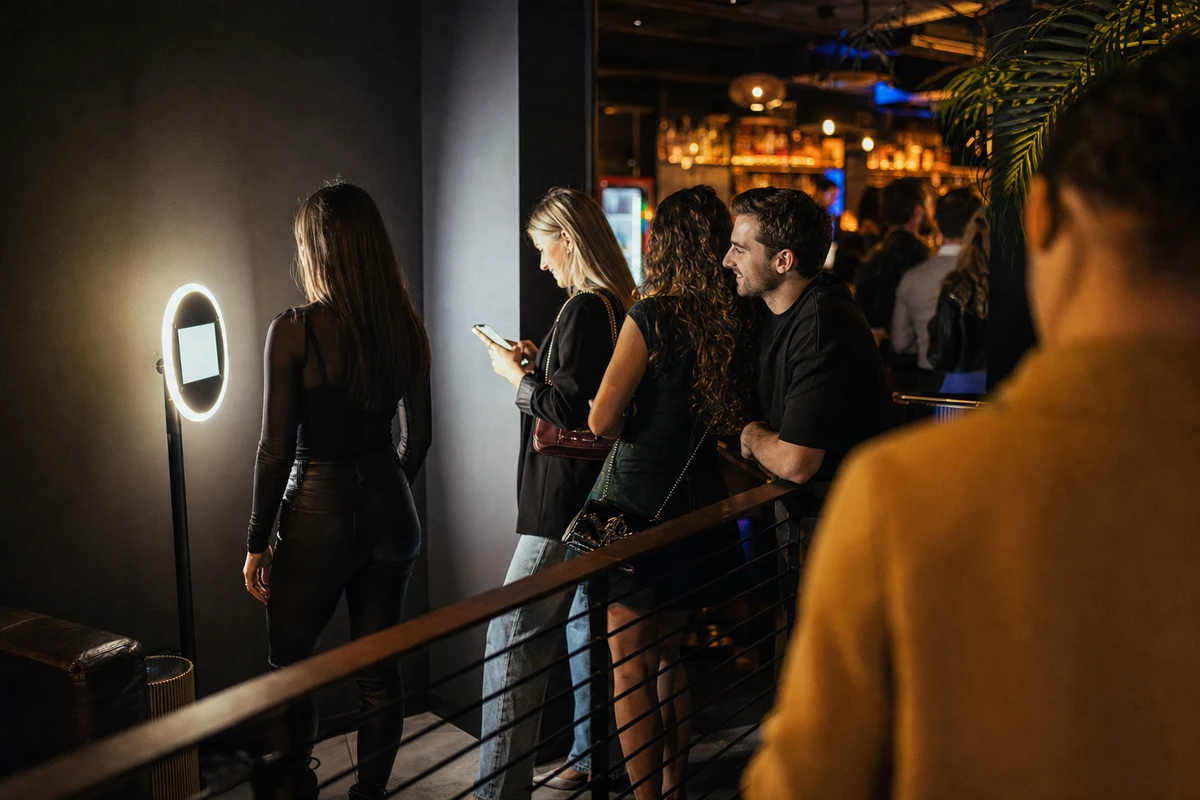
A vendor installs and maintains a permanent booth at your venue. They charge guests per session (commonly around $5). You receive a kickback, structured as a share of session revenue, a flat monthly fee, or a guest-data feed. Majestic uses its TWA Hotel installation as the public benchmark: 8,500 prints per month, 3,500 emails collected per month, with the venue receiving “monthly ready-to-send email lists” (Majestic Photo Booth).
What the venue gives up:
- Vendor owns the booth and sets guest pricing.
- Vendor keeps most session revenue. Specific revenue-share percentages are not publicly disclosed by either Photomatica or Majestic; terms are negotiated per venue.
- Vendor decides branding flexibility. Some programs allow venue logos; some are vendor-branded.
- Vendor typically owns the master guest database. Even when the venue receives an email list, the question is whether the venue gets the master list (portable, exclusive) or a copy (vendor retains primary).
What the venue gains: zero capex, zero maintenance burden, a permanent guest amenity, and a kickback stream of indeterminate size.
Five questions to ask before you sign anything:
- What percentage of session revenue do I receive, and is the calculation gross or net of payment processing?
- Who owns the email list and the photo gallery? Do I get the master record or a sync? Can I export and use it after exit?
- Can I brand the booth with my logo, or is it vendor-branded?
- What’s the exit clause? Notice period, removal cost, what happens to historical guest data?
- Does the vendor have exclusivity on photo-booth installations in my space? For how long?
The honest framing: placement is a revenue-sharing joint venture, not a free service. “Free” refers to hardware and maintenance, not to the economic value of your floor space, your guest data, or your brand association. Placement is right for high-foot-traffic venues that want a guest amenity and have no marketing program built around the booth. It’s wrong for venues building a branded-experience marketing engine.
Why the data ownership question dwarfs everything else
A commercial photo booth is a data-capture device that also produces photos. The photos are the consumer-facing value proposition. The captured email list is the operator’s financial return mechanism.
The consent workflow
When a venue rents a booth for an event, the rental company’s software collects the opt-ins. The guest email enters the rental operator’s CRM, not yours. Unless the contract explicitly transfers data ownership, you walk away with event photos and no list.
When a venue accepts a placement deal, the same default usually applies, with the twist that a placement vendor running guest sessions for years can build a substantially more valuable database than any single event would produce. Whether you receive a useful share of that database depends entirely on what was negotiated.
When a venue owns the booth and the software, the email list, the opt-in record, the photo gallery, and any zero-party survey responses all sit in the venue’s CRM. You can pipe them into Toast POS, Klaviyo, HubSpot, or whichever stack you actually run.

If your answer to “what are we doing with the data the booth captures?” is “nothing,” rent or accept placement. If your answer involves a CRM, an email program, or a loyalty system, you need to own the hardware and the integration.
When each option wins
- Single-location restaurant, fewer than 6 private events per year. Rent. The math doesn’t justify ownership at this volume.
- Single-location restaurant, 6–15 private events per year. Buy outright if cash allows, finance otherwise. You’re past the break-even threshold.
- Multi-location franchise rolling out branded experiences. Buy or finance, and standardize the hardware. Brand consistency and a unified data pipeline are not optional at multi-site scale.
- Bar or nightclub with high walk-up traffic, no marketing program. Placement makes sense if you don’t care about owning the data and your floor space is otherwise unused.
- Hotel with an in-house events team and CRM ambitions. Buy. Own the data pipeline end-to-end. The ROI from a properly integrated email list will dwarf the hardware cost in year one.
- Retail brand activation team running pop-ups. Buy portable units, operate as an internal fleet. Rentals at activation scale add up fast, and you lose data continuity across events.
- Venue with under 4 events per year and no marketing use-case. Rent. Anything else is overinvestment.
Total cost of ownership: the honest line items
If you’re going to own, price it honestly:
- Hardware: $5,000–$15,000 one-time for commercial-grade iPad-based platforms (Clear Choice, Photo Booth International). One specific unit publicly priced: the Selfie Booth S5 at $8,990 (Selfie Booth Co.).
- Software subscription: $40–$130/month for commercial-grade platforms.
- Consumables: $200–$500/year if you print.
- Backdrops, props, branding panels: $500–$2,000 initial, refreshed annually.
- Insurance: ~$29–$47/month depending on coverage type (Insureon).
- Staff time: 2–4 hours per event at your loaded labor rate.
- Storage space: opportunity cost of square footage.
- Replacement cycle: 3–5 years for screens and cameras; longer for chassis.
Five-year all-in TCO for a typical mid-range commercial owner lands near $14,000–$22,000. Heavy usage with the top-tier hardware and full insurance stack can push above $30,000. For comparison, five-year rental cost at 10 events/year × $1,500 = $75,000.
The ownership case holds up cleanly after honest TCO accounting at any realistic event volume above the break-even threshold.
Operational risk: what the rental quote spares you
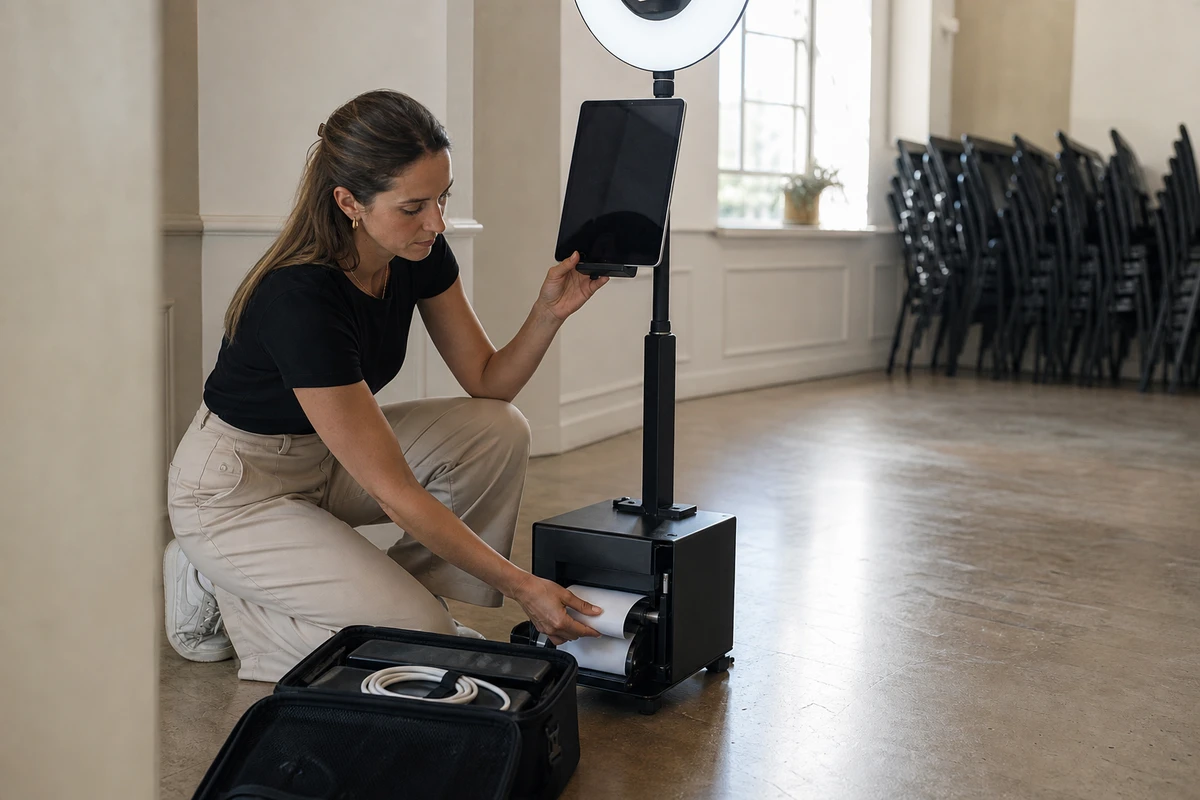
Rental shifts the entire operational burden to the vendor. That’s worth real money on event day. Clear Choice’s blog catalogs the common failure modes: printer jams, software crashes, power issues, tablet crashes, camera connection problems. With a rental, the vendor’s tech fixes it on site. With ownership, your staff fixes it, or your event has a dead attraction in the corner.
Three operational considerations to price into the buy decision:
- Hardware failure. Build a relationship with a local tech who can swap an iPad or printer same-day. Keep one spare of every consumable.
- Theft. iPad-based booths are a target. Mobile Device Management lockdown, physical anchoring, and an inland-marine policy aren’t optional in a public-facing venue.
- Staff training. Owning means one or two trained staff per location. Plan for turnover.
For a venue at 10+ events per year, the operational burden amortizes cleanly. For a venue at 2 events per year, it’s a bad trade.
What most operators get wrong
- “Renting is always cheaper.” False above roughly 8 events per year on standard pricing.
- “Free placement is free.” False. You’re paying in revenue share and data ownership.
- “We can rent now and scale to ownership later.” False for multi-location operators where brand consistency and unified guest data are strategic. The longer you rent, the more guest data sits with vendors.
- “Section 179 is a niche tax trick.” False for any US venue with taxable income. The 2026 deduction limit of $2,560,000 covers any photo booth purchase a single venue is likely to make, and the 100% bonus depreciation extends the benefit further.
- “Any commercial booth will do.” False if you plan to integrate captured emails into a CRM (Salesforce, HubSpot, Klaviyo, Toast POS). Integration support is a real hardware-selection criterion that shows up on no rental quote.
The decision, in one paragraph
Below 8 events per year, rent. Above 8 events per year, buy outright if cash allows or finance through a capital lease if it doesn’t. If you run a high-traffic walk-up venue with no marketing program built around the booth, placement is worth a conversation, but read the data ownership and exit clauses with a lawyer before you sign. If you’re building a branded-experience marketing program, you need to own the hardware and the integration stack. Anything else gives away the asset that justifies the entire spend.
FAQ
How many events per year does buying beat renting?
For a venue paying $1,000–$1,500 per rental on a $10,000 commercial booth, ownership breaks even at roughly 8–10 events per year. Below that, rent. Above that, own. Earning per-session revenue from guests (common at bars and nightclubs) lowers the threshold further.
Does Section 179 apply to photo booth hardware?
Yes, in the US. Photo booth equipment is tangible personal property used in a trade or business, which qualifies for the Section 179 election. For 2026, the deduction limit is $2,560,000 with bonus depreciation at 100%. The election requires taxable income to absorb against; confirm with your CPA before electing.
Who owns the guest email list in a vendor placement program?
By default, the placement vendor. Some programs (Majestic’s, for example) include a “monthly ready-to-send email list” benefit for the venue, but the master database typically remains with the vendor. Always negotiate this in writing before signing, including data portability after contract exit.
Can I finance a photo booth for my venue?
Yes. Clicklease is the most common specialty fintech for photo booth operators, with no hard credit pull, instant decisions, and ticket sizes up to $25,000. Traditional commercial lessors like Crest Capital offer operating leases, $1-buyout capital leases, and FMV-buyout leases on 24–72 month terms.
What’s the typical 5-year total cost of ownership for a commercial photo booth?
Roughly $14,000–$22,000 all-in for a mid-range setup, including a $5,000–$15,000 hardware purchase plus software subscription, consumables, insurance, and staff time. Compare to roughly $75,000 in five-year rental cost at 10 events/year × $1,500.
How much does it cost to rent a photo booth for a commercial event?
Standard open-air rentals run $300–$1,000 per event, mid-range setups $500–$1,500, and luxury or branded installations $1,500–$7,500+ (Kruu, Selfie Booth Co., Majestic). Customization, attendants, and travel charges add to the base quote.
Is a permanent photo booth worth it for a restaurant?
It depends on your event volume and your data strategy. A restaurant hosting 6+ private events per year reaches break-even on a purchase within 2 years. A restaurant with a CRM and email program gets additional value from owning the captured list. A restaurant with neither should rent.
What happens to the booth if my vendor placement deal ends?
The vendor removes the equipment. Whether you keep access to the email list and photo gallery collected during the placement depends entirely on what was negotiated upfront. Default is no continued access. This is the single most important clause to negotiate before signing.
Sources
- Clear Choice Photo Booths (2024). “Buy vs. Rent: Which Makes Sense for Your Photo Booth Business?” https://clearchoicephotobooths.com/photo-booth-articles/buy-vs-rent/
- Clicklease (2026). “Photo Booth Financing.” https://clicklease.com/photo-booth-financing/
- Crest Capital (2026). “Equipment Leasing for Businesses.” https://www.crestcapital.com/equipment_leasing
- Insureon (2026). “Photography Business Insurance.” https://www.insureon.com/photography-business-insurance
- IRS (2025). “Publication 946: How To Depreciate Property.” https://www.irs.gov/publications/p946
- Kruu Photo Booth (2024). “How Much Does It Cost to Rent a Photo Booth?” https://www.kruu.com/en-gb/blog/how-much-does-it-cost-to-rent-a-photo-booth
- Majestic Photo Booth (2026). “Venue Placement Program.” https://www.majesticphotobooth.com/venue-placement-program/
- Photo Booth International (2026). “Photo Booths for Sale.” https://www.photoboothintl.com/photo-booth-for-sale/
- Photomatica (2026). “Venue Placement.” https://photomatica.com/venue-placement/
- Revospin (2026). “Photo Booth Tax Deduction Guide.” https://revospin.us/photo-booth-tax-deduction/
- Section179.org (January 2026). “Section 179 Deduction.” https://www.section179.org/section_179_deduction/
- Selfie Booth Co. (2026). “How Much Does a Photo Booth Cost?” https://selfiebooths.co/blogs/news/how-much-does-a-photo-booth-cost
- Simple Booth (2026). “Plans.” https://simplebooth.com/plans/