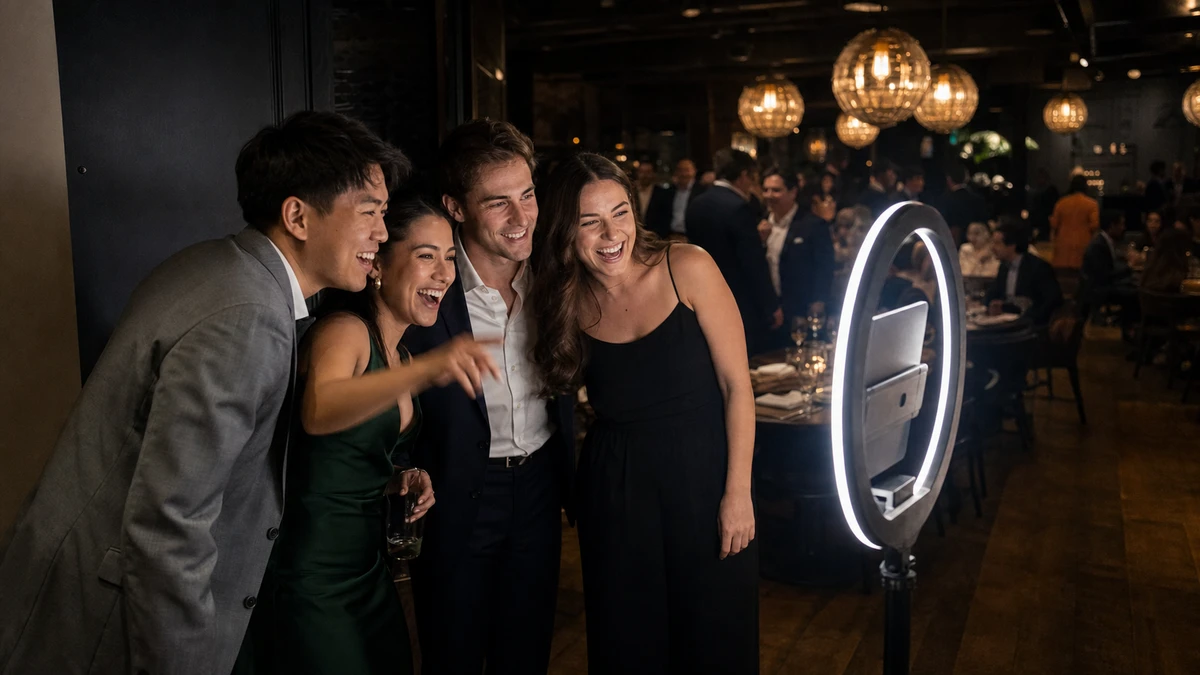
Photo booth image quality is not one decision. It is three variables working together: the sensor that turns light into signal, the lens and aperture that control how much light reaches the sensor and how many guests fit the frame, and the continuous light that gives the sensor something to work with. Commercial operators lose money when any one of the three is mis-specified, because every failed session is a skipped share, a missed email, and a customer who did not become content.
This article walks through the three variables as one exposure equation, then translates each into a business consequence. The aim is not to recommend a specific camera. It is to give operators enough physics to specify the right kit for the venue they are actually deploying in.
Why Commercial Photo Booths Have Harder Camera Problems Than Phones
A guest’s phone takes pictures in daylight, on the subway, in a kitchen with overheads on. A commercial booth takes pictures in rooms designed for ambiance: 10 to 50 lux at most evening receptions, consistent with NOAO’s recommended illuminance range for “public areas with dark surroundings” (Wikipedia, citing NOAO). For comparison, a standard office runs 320 to 500 lux. The booth has to produce a flattering, in-focus, color-accurate group portrait at one-tenth the light level the phone is optimized for, in 30 seconds, on the first try, with no chance to reshoot.
Camera Speed Beats Megapixels
This is also a throughput problem. A booth at a 4-hour event runs 80 to 160 sessions, depending on guest flow. Each failed session, where the camera hunts for focus, blows the exposure, or returns a muddy image the guest will not share, is an irreversible loss. The guest does not come back for a retake. The branded share does not happen. The email is not captured.
The operator’s real KPI is share rate, not pixel count. Flattering light and quick capture beat a technically perfect but dim image every time, because guests share photos they look good in. The rest of this article walks through the technical decisions that make share rate go up.
Mike Bender’s post on Photo Booth Owners describes the universal operator fear precisely: “you arrive and setup your photo booth getting everything setup to perfection and then bam someone kills all the lights in the place leaving you to scramble” (Photo Booth Owners, 2012). Anyone who has run a booth knows the feeling.
Sensor Size: What “More Light Per Pixel” Actually Means
Most photo booth content says “bigger sensor, better in low light” and stops there. The statement is true and attached to no number, which makes it useless for procurement. Here is the number.
A sensor’s light-gathering ability is set by its physical
A sensor’s light-gathering ability is set by its physical area and the size of its individual pixels. Larger sensors with larger pixels collect more photons per pixel, and signal-to-noise ratio scales with the square root of photons collected. The standard sensor formats break down as follows (Wikipedia, Image Sensor Format):
- Full-frame: 36 × 24 mm, area 864 mm². Pixel pitch on a 24 MP body, roughly 5.97 μm.
- APS-C (Canon EF-S / EOS R crop): 22.2 × 14.8 mm, area about 330 mm². Pixel pitch on a 24 MP body, roughly 3.76 μm.
- APS-C (Sony / Nikon / Fujifilm): 23.5 × 15.6 mm, area about 370 mm².
- 1-inch type (premium compact cameras): 116 mm².
- Smartphone main sensor (recent iPhone Pro): 1.22 μm physical pitch on a 48 MP sensor that bins down to 12 MP for stills, giving about 2.44 μm of effective pitch.
Physical area maps to measurable low-light performance. Photons to Photos, an independent sensor benchmark database, publishes a Low Light ISO score in EV stops for each tested camera. The Canon EOS R50 (24 MP APS-C) scores 9.23 EV. The Canon EOS R8 (24 MP full-frame) scores 10.79 EV. The iPhone 14 Pro Max scores 6.74 EV (Photons to Photos). The arithmetic:
- APS-C over smartphone: 9.23 − 6.74 = 2.5 stops.
- Full-frame over APS-C: 10.79 − 9.23 = 1.5 stops.
- Full-frame over smartphone: 4 stops.
Each stop roughly doubles the clean ISO headroom the sensor can use before noise becomes visible. A 2.5-stop advantage means the APS-C body can shoot at about 5× higher ISO than the smartphone with equivalent noise. In a 30-lux dining room, that ISO headroom is what lets the operator keep a fast shutter (around 1/125s) and a working aperture without raising ISO into the noisy range. Without it, the operator’s choices collapse: slower shutter and a guest’s blurred elbow, or wider aperture and a soft back row.
A note on the iPad. Photons to Photos benchmarks discrete cameras, not tablets. The iPhone 14 Pro Max number is the closest available proxy for an Apple-class tablet sensor. iPad rear modules differ in generation and packaging, so treat the smartphone-vs-APS-C gap as directional rather than exact for iPad-based booths.
This is also where the megapixel misconception breaks. Operators specifying gear sometimes lead with the pixel count on the spec sheet, on the assumption that 48 MP beats 24 MP. It does not, in low light, because the 48 MP smartphone sensor has 1.22 μm physical pixels and the 24 MP APS-C has 3.76 μm pixels. Even after the smartphone bins 2×2 (effective pitch 2.44 μm), the APS-C pixel is still about 50% larger by linear dimension. The 24 MP APS-C image will be cleaner, even though the spec sheet shows fewer pixels.
Where sensor size stops mattering is bright venues. At 500 lux on a trade show floor or 1000+ lux in retail, the APS-C and the iPad will produce visually equivalent output. The sensor advantage only cashes out in rooms designed for atmosphere.
Lens Focal Length and How Many Guests Fit the Frame
Focal length is the variable competing pages get wrong by switching between full-frame and crop-sensor numbers without saying which. Here is the correct framing.
A lens’s effective field of view depends on the sensor it is mounted to. A 24 mm lens on an APS-C body with a 1.6× crop factor (Canon EF-S / EOS R crop) gives the same field of view as a 38 mm lens on full-frame. The “group portrait sweet spot” most professional photographers settle on is 35 mm full-frame equivalent. That is wide enough to fit four to six standing adults in a typical booth setup, and tight enough that faces near the frame edge do not stretch from barrel distortion.
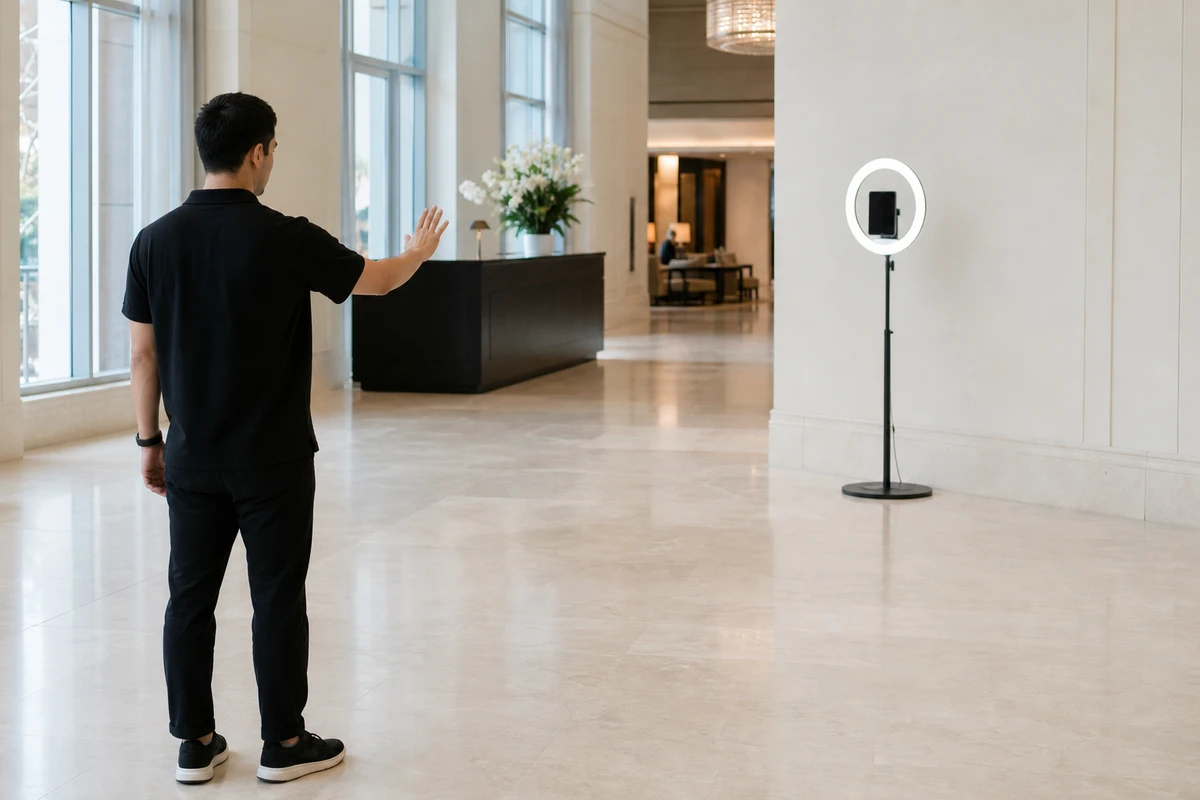
Distance arithmetic, for operators who want to plug their venue into the equation: at 35 mm full-frame focal length, framing a 3-meter-wide group requires the camera to sit roughly 2.9 meters back from the front row. That is a footprint operators need to confirm fits inside the venue’s allocated space before the event, not after the truck is unloaded.
The iPad case is informative
The iPad case is informative. Both the 11-inch iPad Air (M2) and 11-inch iPad Pro (M4) ship with the same rear Wide camera: 12 MP, f/1.8, 26 mm equivalent (Apple iPad Pro specs, Apple iPad Air specs). 26 mm is wider than the 35 mm sweet spot. At close range (under 1.5 meters), faces near the frame edges visibly stretch. The fix is not a different iPad. It is keeping guests at 1.5 to 2 meters minimum distance from the booth. The iPad Pro also includes an ultra-wide at 122° field of view, which is far too wide for portraiture and a configuration trap if the booth software accidentally switches cameras.
The Air and the Pro have identical camera hardware for booth use. Operators paying the Pro premium are buying ProMotion display, LiDAR, and more RAM, not better photos.
Two practical items on lenses for DSLR or mirrorless setups. Avoid zoom lenses that physically extend during autofocus, because the lens barrel can bump the booth shell cutout and damage the focus motor. Prime lenses are mechanically simpler, often optically sharper, and one less moving part to fail mid-event. Zooms give operators flexibility across venue footprints, which is the right trade if the same kit ships to a tight bar one week and an open ballroom the next.
Aperture and Depth of Field: Why f/8 Is the Commercial Default
Most photo booth content tells operators to “open the aperture for low light” without mentioning the depth-of-field cost. That advice works for a wedding photographer shooting one bride against a creamy background. It does not work for a four-deep group portrait where the back row needs to stay sharp.
Aperture is a trade-off
Aperture is a trade-off. Wider apertures (f/2.8, f/1.8) let in more light but narrow the depth of field. At f/2.8 and 2-meter subject distance, only a few inches in front and behind the focus point are sharp. Stage four people in a slightly staggered group and the back row goes soft. At f/8, the depth of field extends across the whole group at typical booth distance, which is why Darkroom Software’s settings guide names f/8 (paired with ISO 100 and 1/125s shutter) as the commercial starting point for booth photography (Darkroom Software, vendor-published).
The cost of f/8 is light
The cost of f/8 is light. f/8 needs about 3 stops more light than f/2.8 to produce the same exposure. That is exactly why integrated continuous lighting matters; without it, f/8 is not an option in a 30-lux room. (See the next section.)
The diffraction ceiling sits around f/16
The diffraction ceiling sits around f/16. Past f/11, the image starts to soften regardless of how good the lens is. The commercially usable range is roughly f/5.6 to f/11, with f/8 as the conservative middle.
The dim-venue compromise plays out in this order: open to f/4 and accept some rear-row softness, then raise ISO, then add more light. The last option is almost always the right one because raising ISO trades cleaner pixels for noisier ones, and opening the aperture trades sharp groups for flattering single subjects. Adding light costs nothing in image quality.
Low-Light Performance: Why Continuous Light Beats Flash for Modern Booths
Sensor, lens, and aperture decisions all collapse if the lighting is wrong.
Flash and continuous light are two different products solving two different problems. A xenon strobe fires once per trigger, recharges over several seconds, and produces a brief, very bright pulse. It is excellent for stills. It is unusable for any session that includes GIF, boomerang, or video output, because those modes capture multiple frames at 24 to 60 frames per second and the strobe cannot fire that often. Any booth offering animated formats is already committed to continuous light, regardless of what camera is bolted in.
Continuous light has a second benefit beyond GIF support. Autofocus needs contrast to lock. In a 10-lux room, the autofocus system hunts because there is not enough light hitting the sensor for the AF algorithm to detect edges. Breeze Systems’ troubleshooting blog documents the failure precisely: “long pause before the camera takes the first photo… The focus motor whirrs and the camera lens moves… ‘Unable to focus!’ error… booth retakes the photo” (Breeze Systems, vendor-published). Continuous lighting at the subject solves this by giving the AF system a well-lit face to work with.
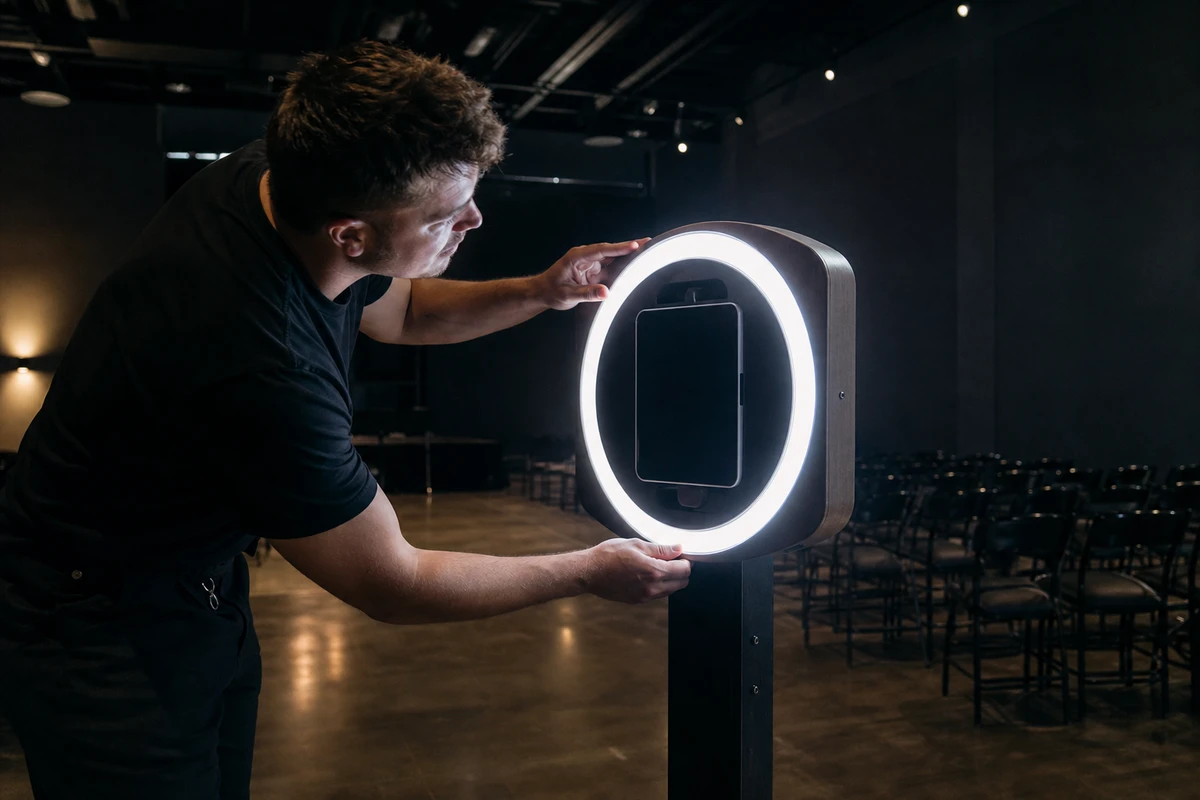
The lighting forms operators choose between are ring lights, softboxes, and LED panels. Ring lights, mounted at or near the camera axis, produce even face illumination with minimal background shadow and a flattering catchlight in the eyes. They are the standard for compact booth form factors because the light source and the camera occupy the same volume. Softboxes spread larger and softer light, useful for larger group framings where a ring cannot cover the full frame evenly. LED panels with adjustable color temperature are the most flexible option for venues with mixed ambient light (warm tungsten overheads against cooler LED accents); they let the operator dial in a color temperature that matches or pleasantly contrasts the room.
Color rendering is its own variable
Color rendering is its own variable. Cheap LEDs with a Color Rendering Index (CRI) below 80 produce sallow, yellow-tinged skin tones regardless of the camera behind them. CRI 90+ is the right floor for any booth that is going to produce shareable images of human faces.
A note on lumen math. Continuous lighting sources are rated in lumens at the source, but what reaches the subject is lux at the subject, which depends on distance and beam shape. A directional LED ring concentrates output forward, so at typical booth distance (1 to 1.5 meters) it delivers enough lux to expose at f/8 and ISO 200 with a 1/125 shutter on most APS-C sensors. The exact lux number depends on the ring’s photometric profile; manufacturer specifications and a light meter on-site beat any back-of-envelope inverse-square calculation. Operators who want a hard number should measure once at their standard distance and write it on the inside of the booth case.
Autofocus Reliability: The Hidden Conversion Killer
Autofocus failure is the most expensive technical problem in commercial booth operation, and the one operators least often quantify.
Autofocus comes in three architectures, in rough order of speed and reliability:
- Contrast-detect AF. The camera moves the lens back and forth, looks for the position where edge contrast peaks, and stops there. It is slow and prone to hunting in low light. Older DSLRs and entry-level cameras like the Canon R100 (143-zone, contrast-detect) use this approach.
- Phase-detect AF. A separate AF sensor (or phase-detect pixels on the main sensor) measures the phase difference between two images and computes the exact direction and distance to move the lens. Faster than contrast-detect.
- Hybrid / dual-pixel AF. Phase-detect points are integrated across the full sensor area, providing fast, accurate focus across the entire frame. The Canon R50 uses 651-zone Dual Pixel CMOS AF; the R8 uses 4779-zone (Simple Booth, vendor-published). This is the current entry-level standard for booth-grade reliability.
The iPad story has moved
The iPad story has moved. Recent iPad Pro and iPad Air models use Apple’s “Focus Pixels,” which is on-sensor phase-detect AF equivalent in function to phase-detect on a mirrorless body. The “iPad AF is too slow for booths” framing is outdated for current-generation hardware. The remaining gap between iPad and APS-C is sensor area and pixel pitch, not AF architecture.
Where this hits the bottom line
Where this hits the bottom line. Each autofocus retake costs 2 to 4 seconds, which is 7 to 13% of a 30-second session window. Beyond a certain failure rate, the booth either runs over time or returns a no-photo result and the guest walks away.
Here is a numeric scenario operators can plug their own numbers into. (Both the failure rate and the per-email value below are illustrative figures, not published benchmarks. Operators should substitute observed data from their own events.)
- Event: 200-guest corporate dinner.
- Sessions during 4 hours: ~120 (typical mid-range throughput).
- Autofocus-related session failure rate: 1 in 20 (illustrative; varies by camera, lighting, and venue).
- Lost sessions: 6.
- Email opt-in rate per successful session: 40% (varies widely by booth UX and incentive).
- Lost email captures: ~2.4.
- Per-email value: $50 (illustrative; actual LTV varies by industry, list quality, and downstream nurture; for context, Litmus reports email marketing produces roughly $36 in revenue per $1 spent across categories, Litmus).
- Lost pipeline per event: ~$120, plus the soft cost of guests who left without a share.
- At 40 events per year: ~$4,800 in lost pipeline from autofocus failures alone.
Plug your own opt-in rate and per-email value. The structure of the math holds regardless. The point is that the upgrade from a contrast-detect entry camera to a hybrid-AF body usually costs less than $500. The return is paid back in a handful of events.
Specifying a Booth by Venue Type
The operator’s actual procurement question is not “which camera is best.” It is “which camera is correct for the venue I am deploying in.” A working decision matrix:
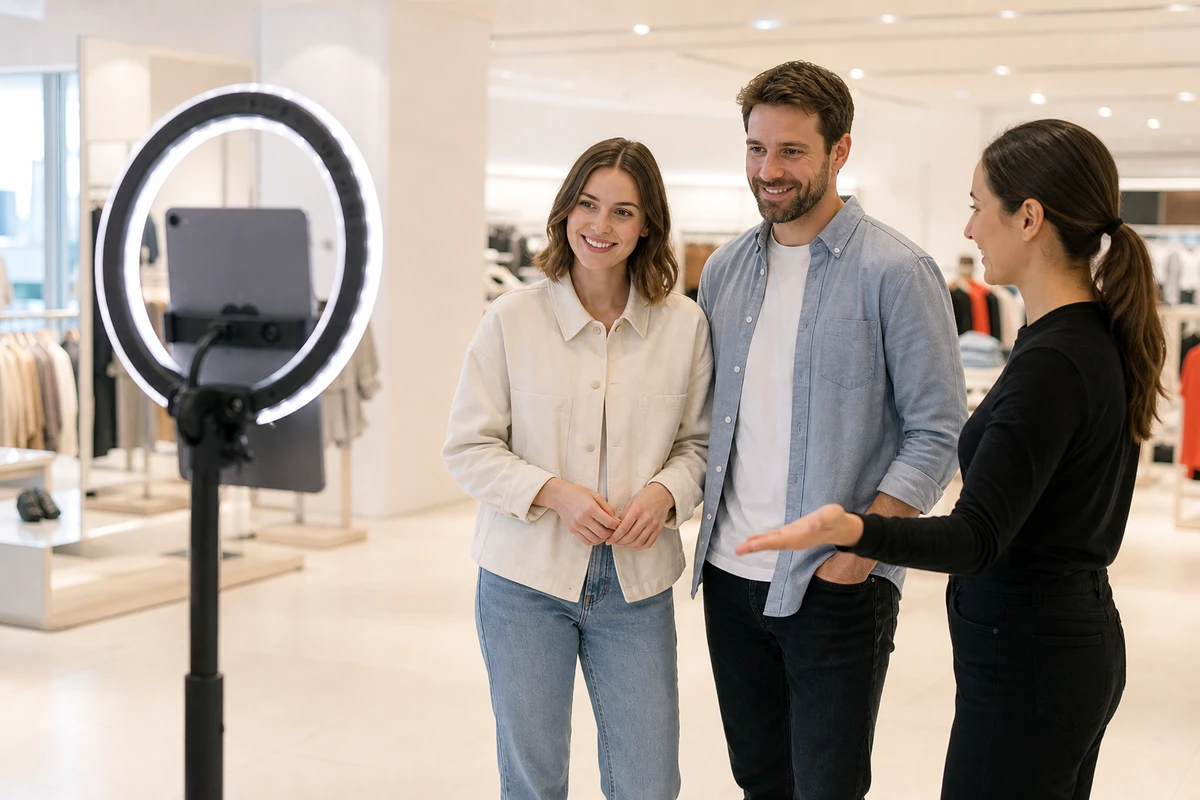
- Bright trade show floor or retail activation (500+ lux). Any tablet-based booth handles this. iPad rear camera at f/1.8 with even ambient lighting produces clean output. Sensor advantage does not cash out at this lighting level.
- Corporate dinner or reception (50 to 200 lux). iPad with a strong continuous LED source (1000+ lumens at the booth, color temperature matched to venue), or APS-C mirrorless with kit lens. Either works. Decision usually comes down to other factors: footprint, GIF support, remote-share UX.
- Dark nightclub, bar activation, or evening gala (under 20 lux). APS-C or full-frame body with f/2.8 lens plus a high-output continuous source. An iPad alone underperforms here even with the best ring light, because at this lighting level the sensor’s native low-light headroom is the binding constraint.
- Outdoor daytime. Almost any camera works. The constraint is harsh shadows from direct sun. Diffusion or a scrim panel solves it. Avoid backlit positioning.
- Multi-venue operators rotating across all of the above. The right kit is the one that holds its lighting envelope constant across venues, so the operator does not re-spec for every new room. Integrated form factors that bundle the camera and the lighting together remove a configuration variable that is usually the cause of bad output.
The pattern is consistent: above 200 lux, the camera matters less than the operator thinks. Below 50 lux, the camera matters more than the operator thinks. The middle range is where the lighting decision dominates.
Share Rate Is the Metric That Matters
Operators who chase spec sheets without auditing share rate end up overpaying for hardware that does not move the number. Share rate is the share of completed sessions where the guest sends, posts, or downloads the image. It is what turns a photo booth from an amenity into a marketing asset, because every share is a branded impression and, in many setups, a captured email.
Start with eligible moments
What correlates with share rate, once you accept that guests share photos they look good in: flattering face light, fast session completion (under 30 seconds, including capture and share UX), easy sharing from the booth (QR, AirDrop, SMS), and consistent output across guests so nobody gets a notably worse photo than the group ahead of them.
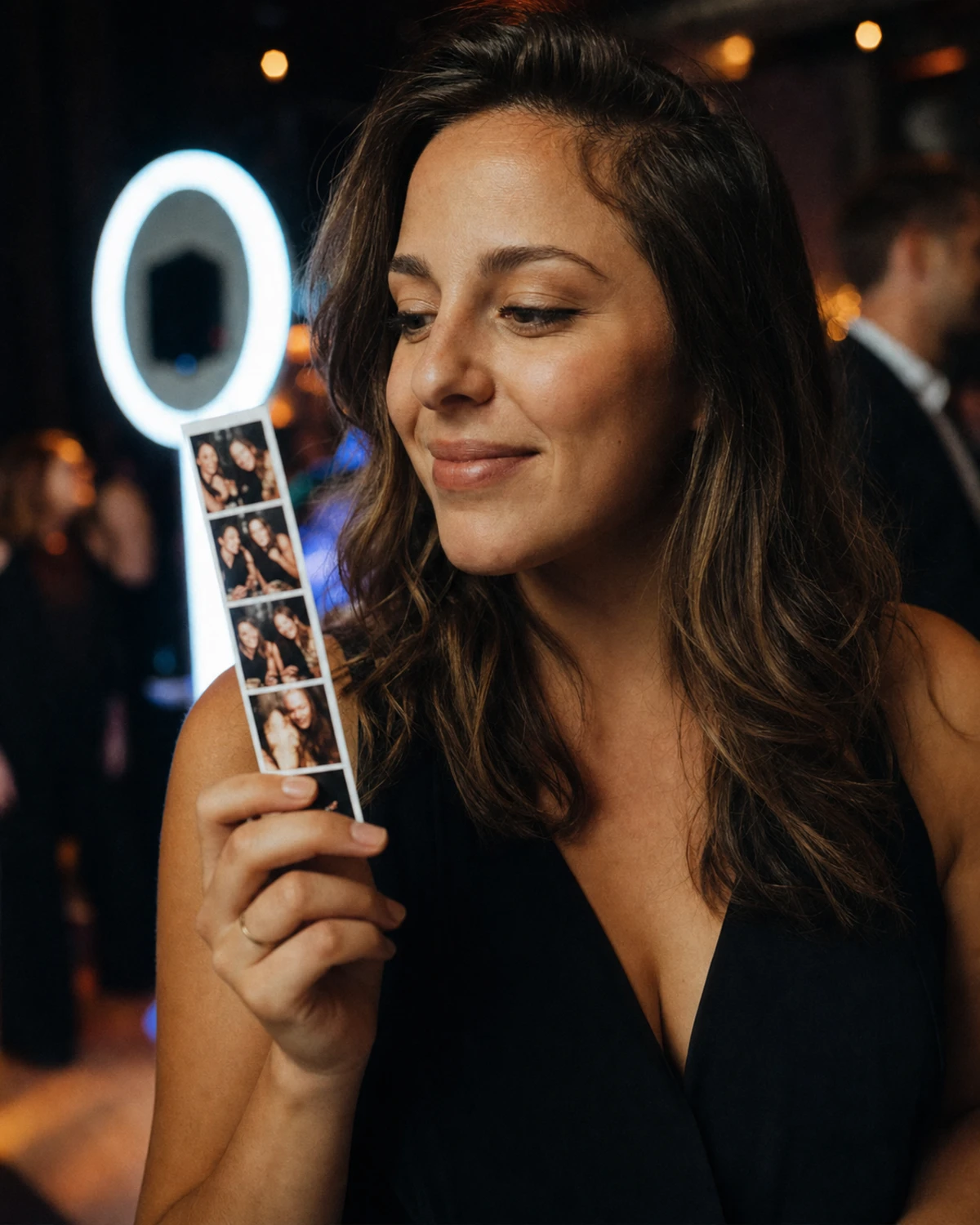
Pixel count and sensor size matter only insofar as they enable those four things. A well-lit iPad photo at f/1.8 in a 200-lux room beats a poorly-lit DSLR photo at f/8 in a 20-lux room, every time, because guests are not pixel-peeping. They are scanning their own face for whether they want to post it.
The practical lens to apply to every camera decision: not “which sensor is bigger” but “which combination of sensor, lens, and lighting produces a face the guest wants to share, in the room I am actually deploying in.” The physics in the rest of this article is the means. The number to track at the end of the event is share rate.
Sources
- Apple. “iPad Air 11-inch (M2) — Technical Specifications.” https://www.apple.com/ipad-air/specs/
- Apple. “iPad Pro 11-inch (M4) — Technical Specifications.” https://www.apple.com/ipad-pro/specs/
- Bender, Mike. “Working in Low Light Situations.” Photo Booth Owners, 2012. https://www.photoboothowners.com/working-in-low-light-situations/
- Breeze Systems. “Auto Focus Blues: How to Cure Them” (vendor-published). https://blog.breezesys.com/auto-focus-blues-how-to-cure-them/
- Darkroom Software. “Camera Settings Every Photo Booth Operator Should Know” (vendor-published). https://darkroomsoftware.com/camera-settings-every-photo-booth-operator-should-know/
- Litmus. “Email Marketing ROI: What’s the Return on Investment?” https://www.litmus.com/blog/email-roi/
- Photons to Photos. “Sensor Analysis” benchmark database. https://www.photonstophotos.net/
- Simple Booth. “Best Camera for Photo Booth” (vendor-published). https://www.simplebooth.com/blog/best-camera-for-photo-booth/
- Wikipedia. “Image sensor format” (citing IEC standards). https://en.wikipedia.org/wiki/Image_sensor_format
- Wikipedia. “Lux” (citing NOAO recommended illuminance levels). https://en.wikipedia.org/wiki/Lux