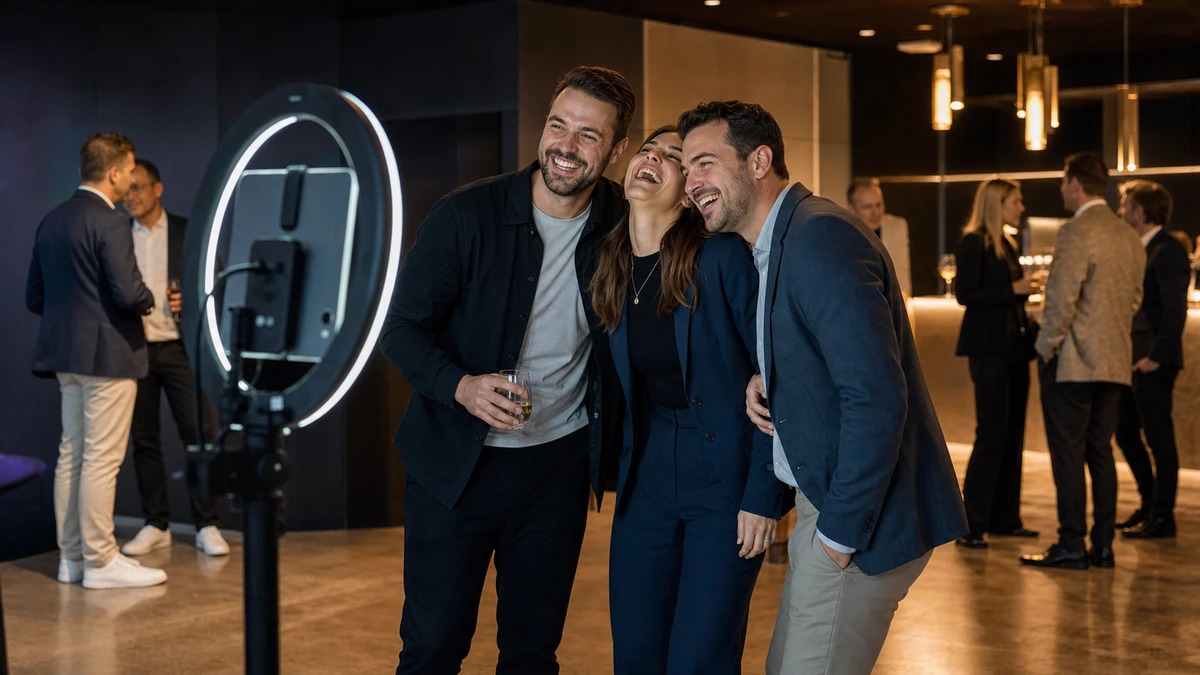
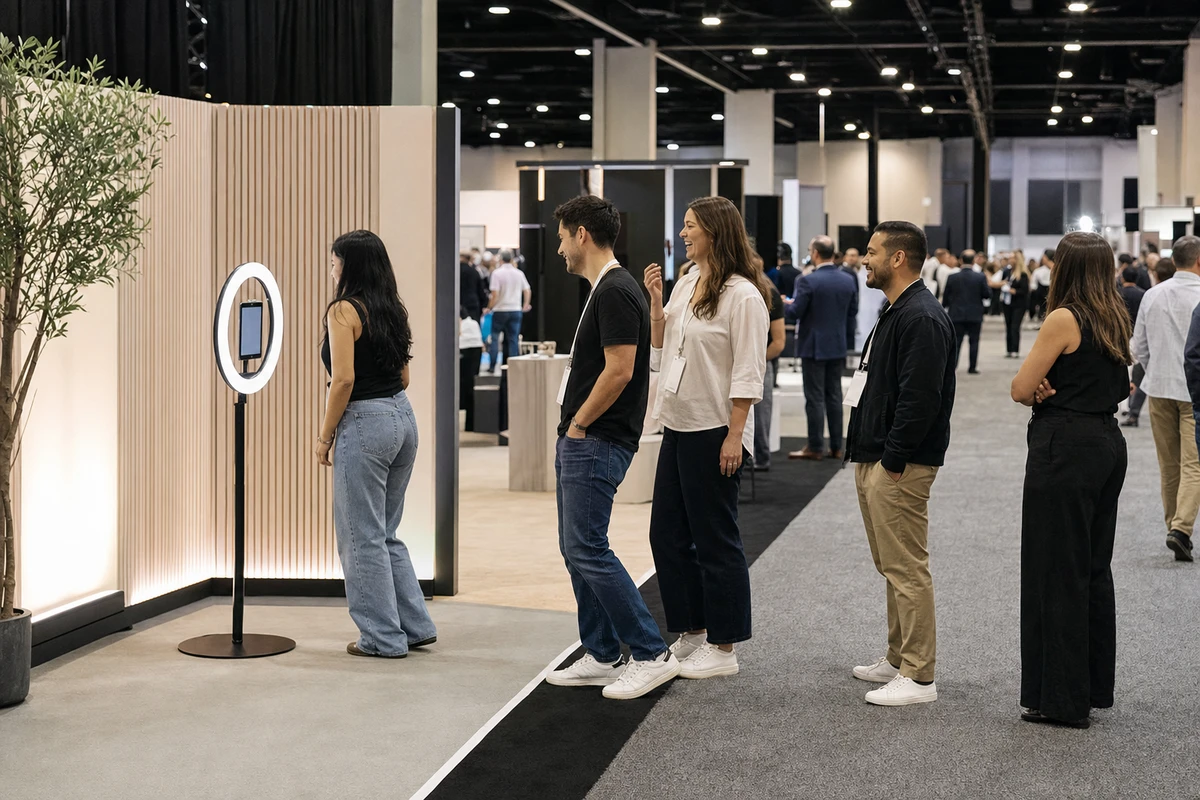
At a trade show, an attendee drifts away from the sessions, spots a sponsor’s photo station, picks a foam crown off the prop table, poses with two colleagues, and has the picture on a phone inside a minute. That evening it lands on a LinkedIn feed where a few hundred connections scroll past it. Whether the sponsor’s logo travels with that photo, or nothing does, was decided weeks earlier by a single setting in the booth software.
That setting is the digital overlay, and most operators frame the decision around it the wrong way. They treat it as digital overlay versus physical props, as if an activation has to pick one. The two are not competing options. They do separate jobs. The overlay controls what brand appears on every photo that leaves the booth. Props control how many people walk up to take one. What follows untangles a confusion that runs through nearly every page on the subject, then gives operators a way to decide how much of each layer a specific corporate activation needs.
What a Digital Overlay Actually Is (and Why It Is Not a Digital Prop)
A marketer briefs a booth vendor and says the activation needs “digital props and a branded overlay,” assuming that describes one feature. It describes two, and a third thing keeps getting folded into both. Search for a digital overlay photo booth setup and the results are almost entirely design tutorials and template shops teaching a designer how to build a transparent PNG. None of them explains what the overlay does for a brand or how it differs from the props on the table. The terms get used as if they were interchangeable. They are not.
What a Digital Overlay Does
A digital overlay is a branded graphic frame that the booth software composites onto every capture. Logo, event hashtag, sponsor lockup, or theme art, usually arranged around the edges so the subject stays clear in the middle. It is applied automatically and identically to 100 percent of output, whether the capture is a still photo, a GIF, a boomerang, or a short video. The guest does nothing to trigger it. In an iPad booth app like Simple Booth’s HALO, the operator uploads one branded graphic before doors open, and every still, GIF, and boomerang the booth captures carries it without anyone touching the iPad again.
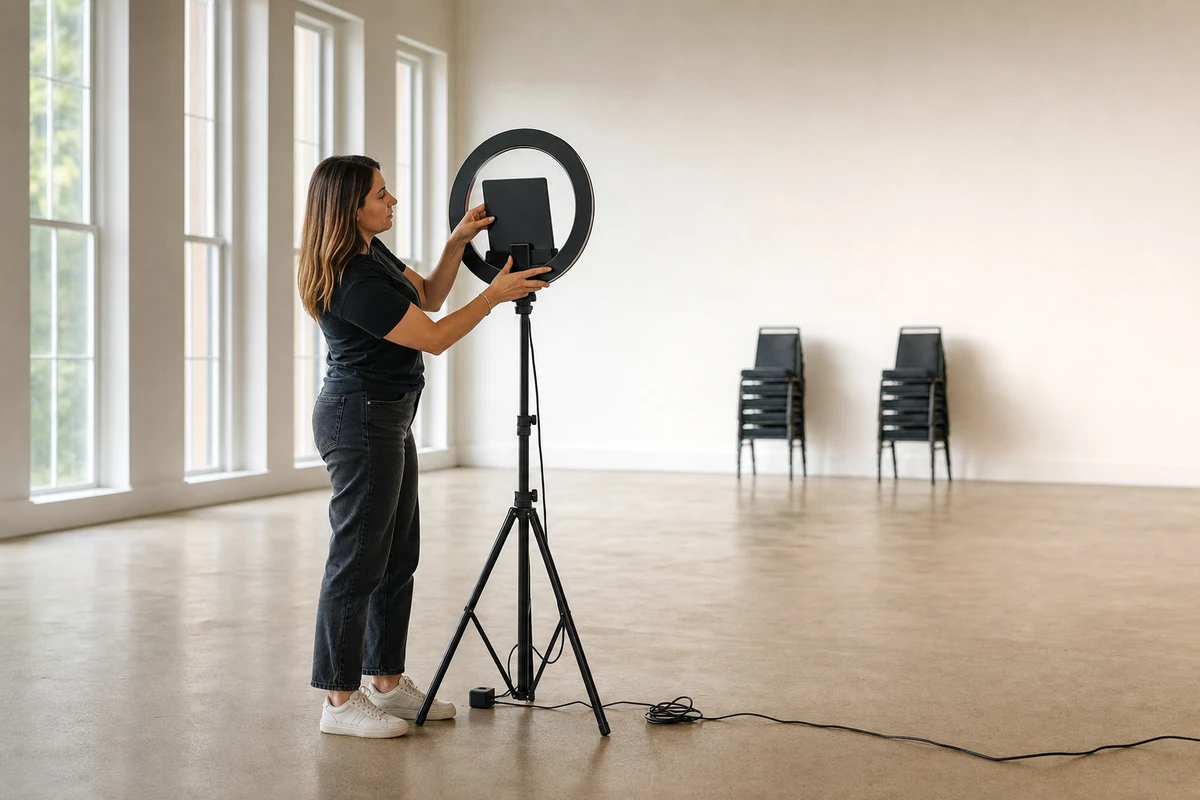
Physical props are the table of hats, oversized glasses, signboards, and held cards that guests pick up before posing. They are optional and guest-selected. They appear in the frame only if a guest chooses to hold one.
Digital props are the third thing, and the one that causes the confusion. They are face-tracked augmented-reality graphics, the on-screen sunglasses, hats, or mustaches that lock onto a guest’s face during the live capture and follow it as the guest moves. An overlay frames the photo. A digital prop sits on the subject inside the frame. Physical props live on a table, digital props live on the screen during capture, and the overlay lives on the finished file. Three layers, three jobs. Every comparison that follows depends on keeping them apart.
Why the Overlay Is the Only Guaranteed Brand Layer
Picture two guests at the same activation. One works the prop table, tries three hats, poses with a sign, and has a great time. The other walks up, takes a quick solo photo, and leaves. The first guest had the richer experience. Both photos head for social feeds. Only one question matters to the brand that funded the booth: is the company’s name on either of them?
Overlays Brand Every File
With an overlay running, the answer is yes for both, automatically. Without one, it is no for both, and the prop table changed nothing about that. This is the mechanism operators miss. The overlay rides every output file regardless of what the guest did, which format the booth captured, or whether the guest touched a prop at all. A guest can skip the prop table entirely and still produce a photo, and with no overlay that photo leaves the activation carrying zero brand presence.
The sharing itself is not in doubt. EventTrack 2025, the annual experiential-marketing benchmark from Event Marketer, found that nearly 72 percent of event attendees actively capture and share content online, with Instagram, YouTube, and Facebook the top three destinations. Attendees will post. The overlay decides whether each post is a branded impression in someone’s feed or just a flattering picture of a colleague.
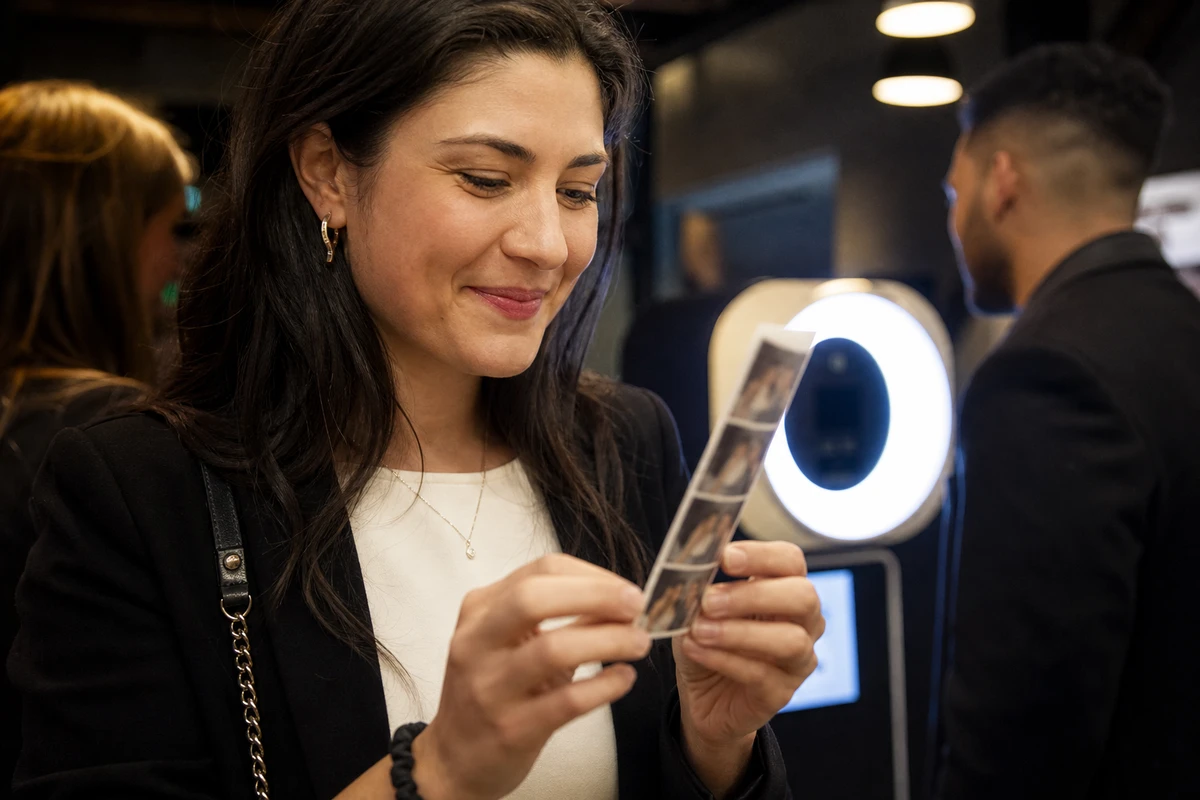
Video Activations, an activation production company, says the request it hears most from corporate planners is a version of “we want a photo booth, but we want it to be more than just a photo booth.” The “more” marketers are reaching for is measurable brand output, and the overlay is the part that delivers it. For any activation whose purpose is brand exposure or post-event reach, and that covers most corporate activations, the overlay is not a finishing touch. It is what turns every share into a branded impression instead of an anonymous photo. An activation that skips it has paid for the experience and discarded the distribution.
What Physical Props Buy, and What They Quietly Cost
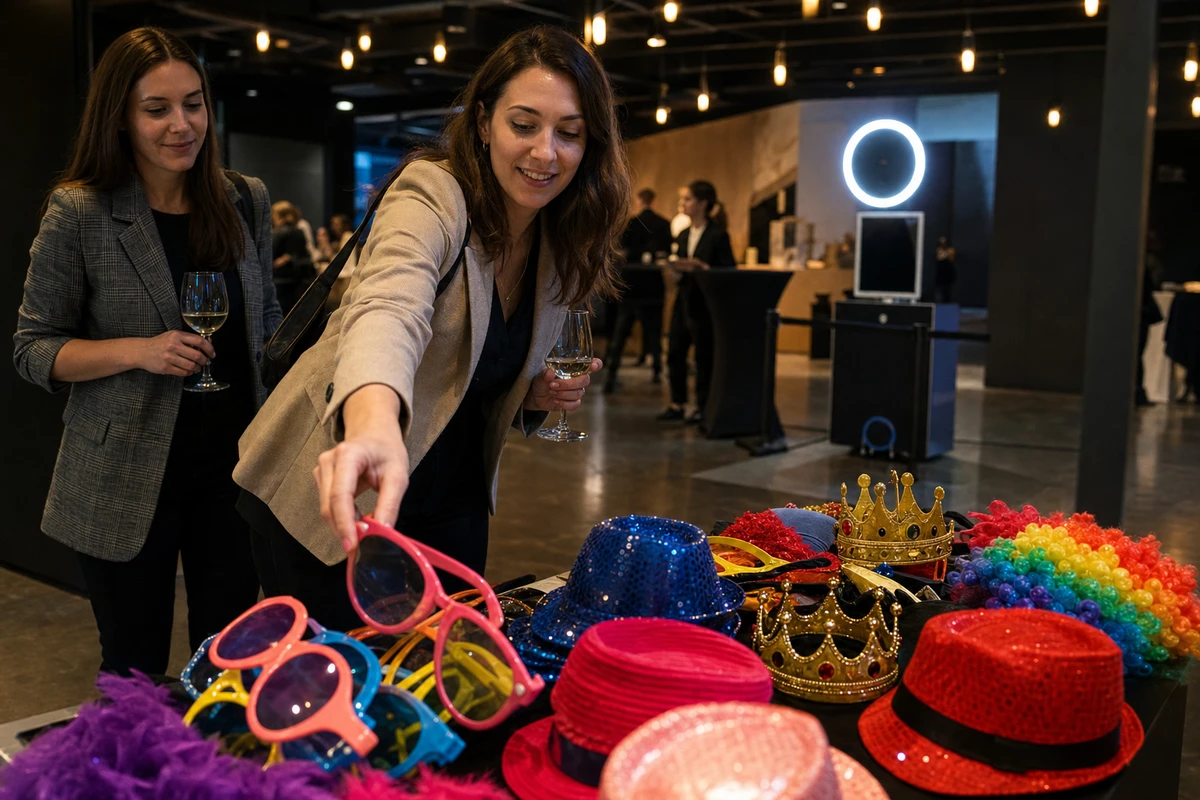
Every activation has the guest who hovers. They stand a few feet from the booth, watch other people pose, and never step up. A prop table is the most reliable tool for moving that person. Picking up an oversized pair of glasses gives a self-conscious attendee something to do with their hands and a little cover, and the social barrier drops. PocketPic, a rental company that has run hundreds of these setups, calls props icebreakers that give camera-shy guests “a sense of comfort.” An overlay cannot do that.
The instinct is well founded
The instinct is well founded. Freeman’s Q1 2024 Trends Report, one of the larger behavioral studies of B2B event attendees, found that 64 percent prefer immersive, hands-on experiences at live events over technological elements like apps and digital displays. A physical object in hand is tactile in a way a screen is not, and props raise both participation rate and dwell time. That lift is real.
The costs are the part operators underweight, because most of them never appear on the rental invoice.
- Logistics. A branded prop kit has to be sourced, transported, set up, stored between events, and replaced as items wear. Rental-industry pricing guides put a custom branded set in the low hundreds of dollars before any of that handling is counted.
- Throughput drag. A busy prop table lengthens the line. PocketPic notes that a popular prop setup “can attract a crowd, which might lead to longer waiting times.” At a high-volume event, every minute a guest spends choosing a hat is a minute the booth does not capture the next session.
- Hygiene. Shared props are a touch surface. Meetings Today documented the industry’s pivot away from shared physical touchpoints in August 2020, and ConnectSpace confirmed in 2024 that regular sanitation of high-contact surfaces had settled in as a permanent event-industry standard.
- Off-brand risk. Props put items in the frame the brand never vetted. PocketPic flags cultural sensitivity directly: a prop that reads as harmless fun to one guest can land as offensive to another, with the company’s logo sitting right next to it.
- Damage and loss. Props break and walk off. Replacement is a standing line item.
Props are a real engagement investment, not a free add-on, and the rental quote understates what they cost.
Digital Props: The Face-Tracked Middle Path
A guest steps up to the booth and a pair of sunglasses appears on the screen, locked onto their face and sliding as they turn their head. There is no table to walk over to, no foam to pick up, nothing to put back. That is a digital prop, and it solves several of the prop table’s costs at once.
Digital props deliver much of what the physical table
Digital props deliver much of what the physical table does, the playful transformation and the reason to step up, without the table itself. For an operator weighing the costs in the previous section, that erases most of them. No sourcing or storage. No shared touch surface. No prop-table crowd slowing the line, because the selection happens on screen inside the session the guest is already in. And because they are software, the brand art-directs them completely and swaps the set per event or per sponsor.
The honest limit is the one Freeman’s data points to. If 64 percent of attendees prefer hands-on experiences, part of what they are responding to is physical touch, and a screen-mediated effect does not fully replace a foam crown in the hand. For the most camera-shy guests, the tactile object is still the stronger nudge. Digital props narrow the gap between fully digital and fully physical. They do not erase it.
One clarification matters here, because it is the same conflation flagged at the start. Digital props are a capability inside the booth software, separate from the overlay. An activation can run an overlay with no digital props, digital props with a weak overlay, or both done well. They are not one feature, and budgeting them as one leads operators to assume that adding “digital props” handles their branding. It does not. The overlay handles branding. Digital props handle engagement.
The Scorecard: Matching the Layer to the Activation
A planner comparing booth quotes sees overlay design, digital effects, and a prop package listed as separate line items, and has to decide which ones the event actually needs. Laid side by side across the dimensions a planner controls, the three layers sort cleanly.
Throughput
| Dimension | Digital overlay | Physical props | Digital (AR) props |
|---|---|---|---|
| Brand on every output | Guaranteed, 100% | None unless a guest picks a branded prop | None on its own (sits on the face, not the frame) |
| Throughput impact | None | Slows the line at the prop table | Minimal (on-screen, no separate station) |
| Hygiene profile | Touchless | Shared-surface concern | Touchless |
| Logistics cost | One-time design | Recurring (source, transport, store, replace) | One-time art direction, swappable |
| Participation lift | None | High (tactile icebreaker) | Moderate (playful, screen-mediated) |
| Art-direction control | Full | Partial (guests choose what enters frame) | Full |
The pattern in the table is the decision rule. The overlay wins or ties every row that touches brand control and cost, and it is the only layer that does the branding job at all. Props win exactly one row, participation lift, and pay for it everywhere else.
So the layer mix follows the event type:
- High-throughput trade show or conference booth, 400-plus attendees with lines forming. The overlay is mandatory. Physical props should be minimal or skipped, because throughput is the binding constraint and the prop table is the bottleneck. Digital props are the better engagement option here, since they cost no line time.
- Intimate VIP night or product launch. The overlay is still mandatory. Here a small, curated, on-brand physical prop set earns its place. Dwell time and room energy matter more than raw session count, and the logistics of a modest kit stay manageable.
- Multi-stop activation tour or roadshow. The overlay is mandatory and should stay visually consistent across every stop. Digital props beat physical ones, because there is no per-city sourcing, shipping, or replacement to manage.
The rule underneath all three: the overlay is never the variable. It is always on. The only real decision is how much of a props budget, physical, digital, or none, a specific event justifies.
Running the Numbers: What Each Layer Returns
Take a 300-person product launch running a four-hour photo activation. At a 60 percent participation rate, that is 180 booth sessions.
Start with the overlay
Start with the overlay. It is composited onto all 180 captures, because that is what an overlay does. If roughly 70 percent of those captures get shared (a working assumption, given EventTrack 2025’s finding that nearly 72 percent of attendees share event content online), that is about 126 shared photos. Each share lands in one person’s network. The average personal Instagram account holds 264 followers, per SQ Magazine’s 2026 follower benchmarks, and attendees at a corporate launch often share to larger professional networks than that. Even at the conservative 264-follower floor, 126 shares put the brand in front of roughly 33,000 potential impressions. The overlay was designed once. Its marginal cost across those 180 sessions, and every future event that reuses it, is effectively zero.
Now add props
Now add props. Say a branded prop set lifts participation from 60 to 75 percent. That is 45 additional sessions, 225 instead of 180. A custom branded prop kit, sourced and handled, runs in the area of $500 for an event of this size. That works out to about $11 per incremental session. Those 45 extra sessions, shared at the same 70 percent rate, produce roughly 32 more shares and about 8,400 more potential branded impressions.
Here is the part the prop-versus-overlay framing hides. Those 45 extra sessions only become 8,400 branded impressions because the overlay is on. Run the same prop spend with no overlay and the $500 bought 45 additional photos that leave the launch with nothing on them: no logo, no hashtag, no campaign. The props did their job, lifting participation, and the activation captured none of it. The overlay is what converts a props budget into measurable reach. Funding props without it is paying for engagement the brand cannot keep.
For a corporate activation, the overlay is mandatory infrastructure. The props budget, physical or digital, is the discretionary line sized to the room. An operator who treats the overlay as optional is buying activations that produce memories instead of measurable brand reach.
Sources
- Event Marketer (2024). “EventTrack 2025: Annual Benchmark Study on Experiential Marketing.” https://www.eventmarketer.com/article/eventtrack25/
- Freeman (2024). “Freeman Trends Report Q1 2024: Attendee Intent and Behavior.” https://www.freeman.com/resources/freeman-trends-report-q1-2024/
- Meetings Today (2020). “A Guide to ‘Touchless’ In-Person Events, Post-Pandemic Shutdown.” https://www.meetingstoday.com/articles/142397/guide-touchless-person-events-post-pandemic-shutdown
- ConnectSpace (2024). “How the Events Industry Has Evolved Since the COVID-19 Pandemic.” https://www.connectspace.com/blog/events-industry-changes-since-pandemic
- SQ Magazine (2026). “Instagram Followers Statistics 2026: 2.7 Billion Users & Engagement Benchmarks.” https://sqmagazine.co.uk/instagram-followers-statistics/
- PocketPic Photo Booth (2023). “The Pros and Cons of Having Props for Your Photo Booth Experience.” https://www.pocketpicbooth.com/blog/the-pros-and-cons-of-having-props-for-your-photo-booth-experience
- Video Activations (2026). “Best Photo Booth for Corporate Events: A Side-by-Side Comparison of Every Format.” https://www.videoactivations.com/blog/best-photo-booth-corporate-events