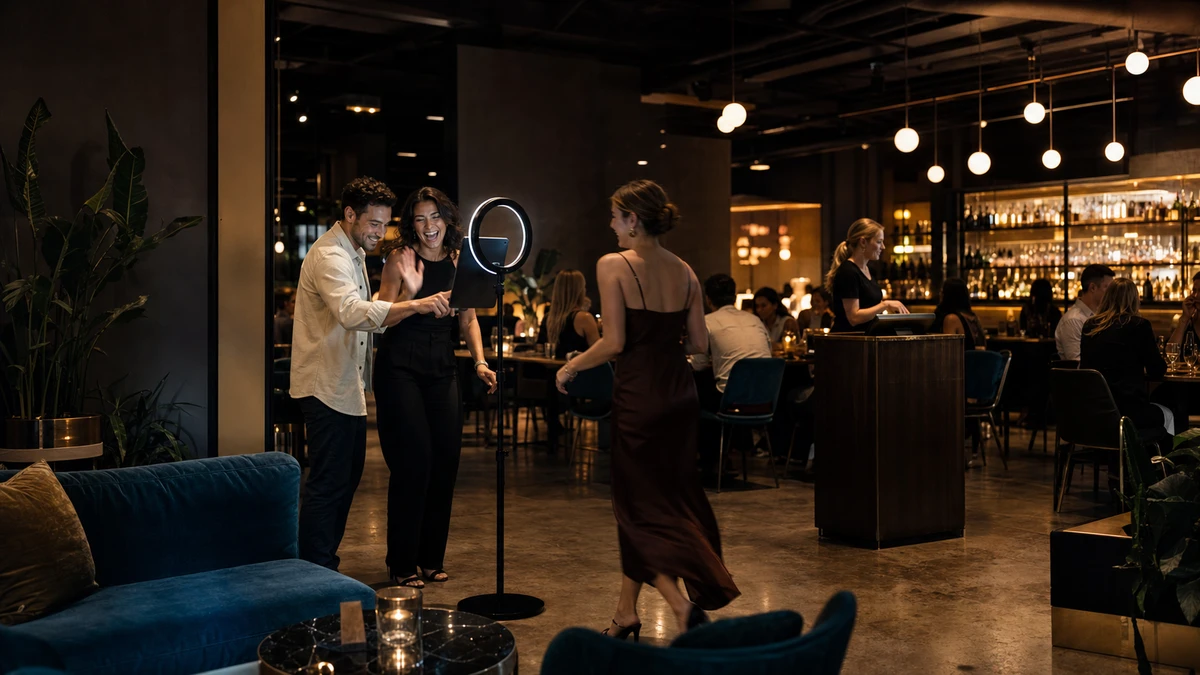
A venue with regular foot traffic can monetize a photo booth five different ways, and the five produce wildly different outcomes even when the headline revenue looks identical. The right choice is rarely the one that sends the largest monthly check. It is the one that leaves you owning the email list, the branded content, and the customer relationship at the end of the year. This guide walks the five models with specific numbers and names the one that fits each operator profile.
Most published guides on this topic write to someone starting a photo-booth rental business, not to a venue deciding whether to install one. That is the gap this piece fills. If someone has walked into your restaurant, bar, hotel, or entertainment venue and offered to place a booth and split revenue, read this before signing.
The five live models, at a glance
The structural differences:
| Model | Hardware owned by | Upfront cost to venue | Revenue taken by | Data and branded content owned by | Operational burden on venue |
|---|---|---|---|---|---|
| 1. Buy and operate in-house | Venue | $3k–$10k+ | Venue (100%) | Venue | Medium |
| 2. Buy and rent out for private events | Venue | $3k–$10k+ | Venue (100%) | Venue | Medium |
| 3. Placement / revenue-share | Outside operator | $0 | Split, operator retains majority | Operator (unless contracted otherwise) | Minimal |
| 4. License a branded operator system | Licensee | $44k–$116k | Licensee minus 15–20% royalty | Licensee | High (it is a business, not a placement) |
| 5. Per-event rental from a third party | Operator | $400–$2,000 per event | Operator (flat fee to venue only if contracted) | Operator or client by contract | None |
Most published guides collapse the first two rows into “buying,” which hides the hybrid play that fits most venues with private-event capacity.
Model 1: buy and operate in-house
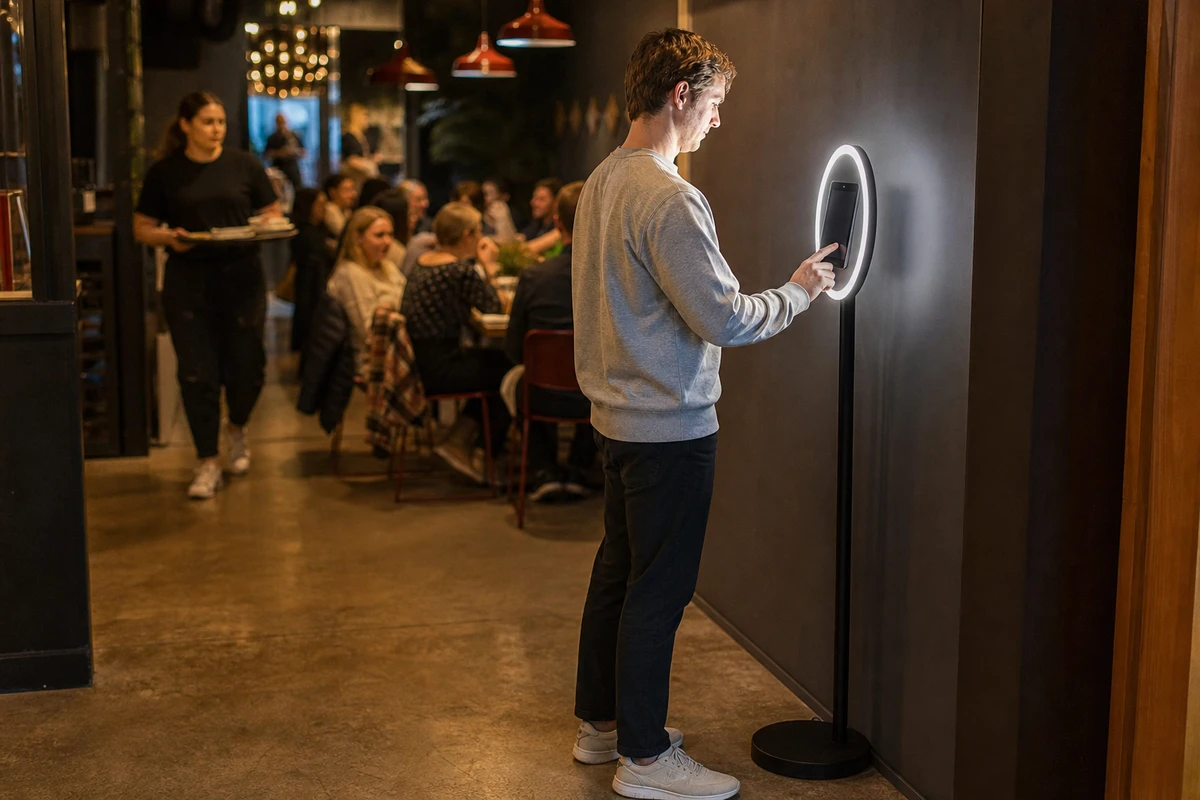
The venue buys the hardware, runs it during normal service, and keeps everything the booth produces. The booth is a marketing asset, not a profit center. Hardware lives in a wide band: Photobooth Supply Co’s iPad-based Salsa 2 lists at $2,999 (pbsco.com, 2025), and enclosed or 360-degree rigs can push past $20,000. The Simple Booth HALO, commonly specified for venue installs, requires a demo inquiry rather than a public price.
Why do this instead of taking a “free” booth from an outside operator? Because the email address and the branded image are the recurring asset. The $3 coin-op session is not. Simple Booth publishes an 87% opt-in rate on first-party data capture at its installed booths (simplebooth.com, 2025). That is a vendor-aggregated, unaudited figure, but even at half the rate a booth with lead capture outperforms a QR code on a receipt by an order of magnitude.
Run the Local Scenario
Plug your own numbers in. A venue capturing 2,000 new email contacts per month (roughly 170 booth users per day at a 40% opt-in rate) applies Mailchimp’s aggregate benchmarks of 35.63% open rate and 2.62% click rate (mailchimp.com, December 2023) to a monthly promotion. That produces about 700 opens and 50 clicks per send. At a 2% conversion of opens to an average restaurant ticket of $40, that is 14 incremental covers per send, and the list compounds every subsequent month.
Pick this if your KPI is foot traffic, repeat visits, or email acquisition. Avoid it if your staff cannot absorb light maintenance (paper reloads, connectivity checks, occasional restarts).
Common misconception to correct: venues assume they need a coin-op session fee to justify a booth. They don’t. A free booth with lead capture outperforms a paid booth on every metric a venue operator cares about, because the friction of payment suppresses participation and therefore suppresses captures. The revenue lives in the list, not in the coin slot.
Model 2: buy and rent out for private events (the hybrid play)
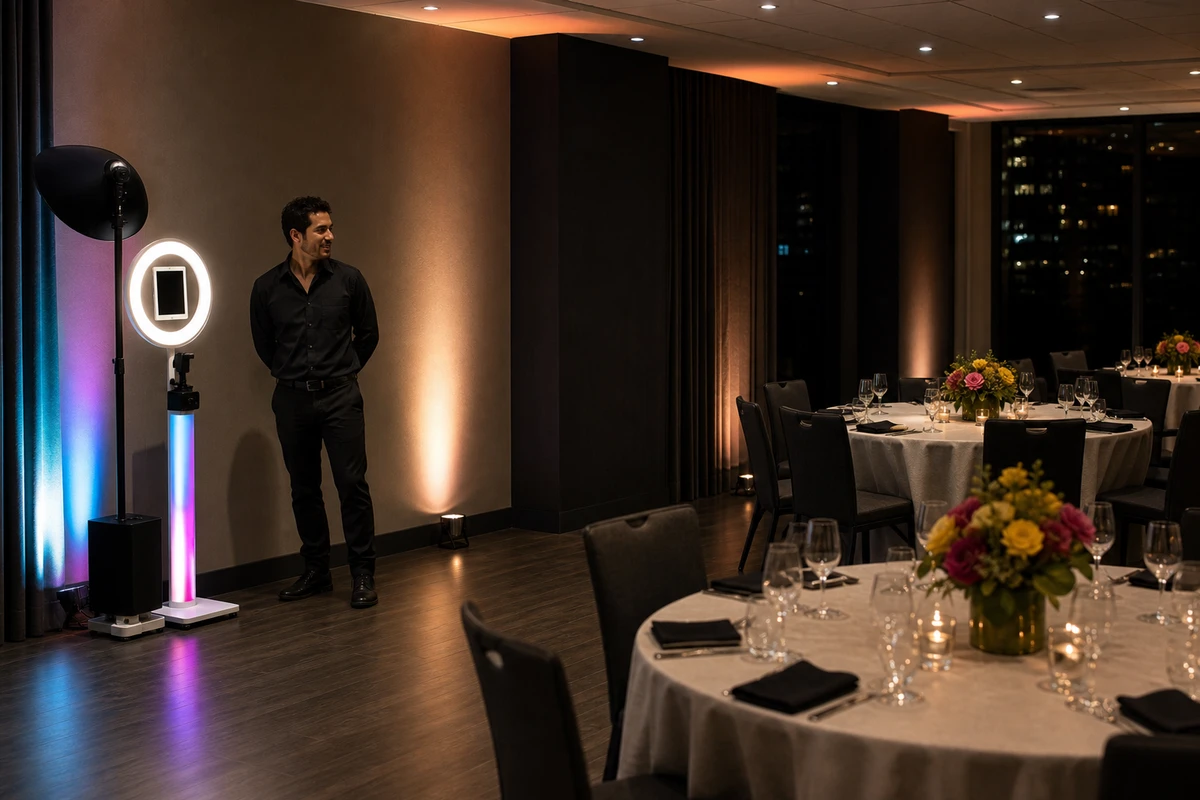
This is the model most undersold in existing coverage. The venue owns the booth, runs it free for walk-ins during normal service, and rents it to private-event clients (corporate holiday parties, birthday blocks, sponsor activations) as a premium line item when the space is booked privately. The same hardware does both jobs.
The arithmetic carries the argument
The arithmetic carries the argument. An $8,000 iPad booth, rented fifteen times in a year at $600 per block as an add-on to a private-event contract, generates $9,000 in gross rental revenue and pays off the hardware inside year one. After that the rental revenue is pure margin, and five weeknights a week the booth is still capturing lead data for the venue’s own marketing. LuxeBooth’s disclosed $1,205 average gross per event (luxebooth.com, 2025) suggests a venue can reasonably price a bundled booth add-on at half that figure, because the venue absorbs no transport, setup risk, or operator labor.
Pick this if you already host private events. It dominates Model 5 (per-event rental) for any venue booking two or more private events a month, because the fixed cost of the booth amortizes quickly and the marginal cost of running it per event is close to zero.
The operational tradeoff is staffing: one trained server can set up, reset paper, and close out a booth. Self-service kits exist for venues that cannot spare the bandwidth. The model fails only if private-event demand is weak. A venue booking two private events a year should not buy the hardware.
Model 3: placement or revenue-share with an outside operator
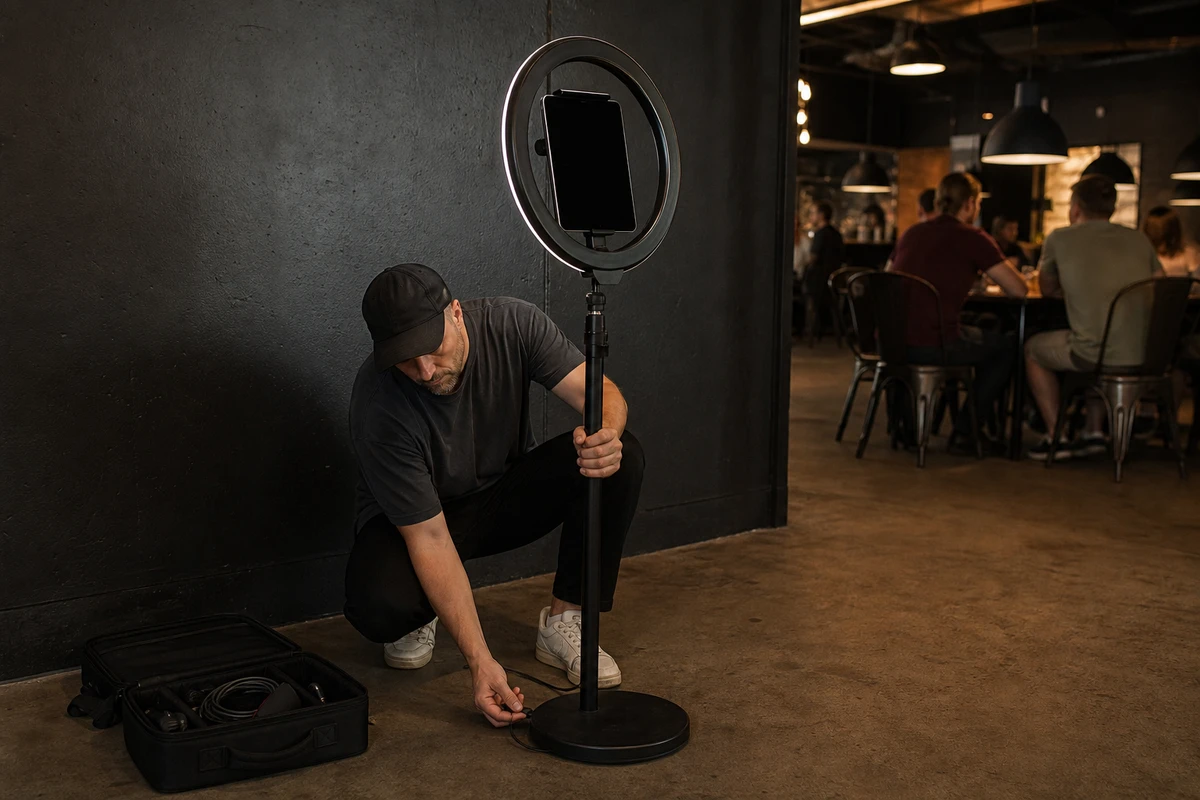
An outside operator (Majestic Photo Booth, HeyOK, PermaBooth, Face Place via Apple Industries, Photomatica, A&A Studios, and others) installs and maintains a booth at zero upfront cost to the venue. Users either pay per session or the booth is free and the operator recovers revenue through sponsorship or a service fee. The venue receives a cut.
What is a fair split
What is a fair split? Public disclosure is effectively nonexistent. None of the operators above publish split terms on their public-facing sites; each routes venue inquiries through a contact form. In an April 2025 r/photobooth thread, an operator entering this model asked the community what rate bars typically expect and received no consensus answer (old.reddit.com/r/photobooth). Assume the operator retains the majority share to cover hardware, maintenance, and insurance. Treat any number quoted in a vendor-friendly article as aspirational unless it is in the contract in front of you.
Revenue is not the central trade in this model. Data is. In most placement programs, the operator owns the captured email list and the rights to the branded content. Guests opt into the operator’s marketing list, not the venue’s. That is the variable to negotiate first. Operator-side exceptions exist: Majestic’s venue-placement program explicitly includes a “monthly ready-to-send email list” deliverable to the venue and publishes a TWA Hotel case study where one placement location produced 8,500 prints and 3,500 emails per month (majesticphotobooth.com, 2025). Those figures come from the operator’s own marketing, and the data-sharing detail should be verified in the contract, not assumed from the sales page.
Use the arithmetic to pressure-test the trade. If a placement deal captures 3,500 emails per month that accrue to the operator instead of the venue, that is 42,000 contacts per year the venue doesn’t own. Once a list of that size is in hand, a monthly promotion against it (Mailchimp’s 35.63% open rate; mailchimp.com, December 2023) produces roughly 15,000 opens. At a 2% conversion on a $40 restaurant ticket and a $15 margin per cover, a full-size list produces about $4,500 per campaign. A venue that signs its data away to an operator gives up that engine to receive a rev-share check that usually lands in the low hundreds.
Pick this if your venue has no staff capacity to manage a booth, runs no email marketing today, and a monthly rev-share is genuinely found money. A concert venue, a non-chain roadside bar, or a late-night club with staff already at capacity can fit this model cleanly. In a January 2025 r/BarOwners thread about an incoming placement pitch, the community’s first questions were about equipment damage risk from intoxicated patrons, contract termination if the bar closed, and whether a $100 monthly cost was worth the floor space. Those are the right due-diligence questions. Do not sign without answers.
Model 4: license a branded operator system
An operator pays an upfront fee to license a branded photo-booth rental system: brand name, lead generation, training, templates, and sometimes hardware. They then pay an ongoing royalty on gross event revenue. LuxeBooth is the clearest public example, with full disclosure on its franchise page (luxebooth.com, 2025):
- Initial franchise fee: $34,995 to $105,995, varying by territory tier
- Equipment package: $9,995
- Ongoing royalty: 15–20% of gross event revenue
- Average gross revenue per event: $1,205
- Average net revenue per event after royalty and materials: $684
Running that math, a licensee hitting six events per month nets roughly $49,000 per year before fixed costs, which lines up with the $50,000-per-booth annual benchmark Simple Booth publishes on its photo-booth-business page (simplebooth.com, 2025). Both figures are vendor-sourced and consistent with each other, which is useful context but not independent verification.
This is not a venue model. It is a model for an entrepreneur who wants to run a photo-booth rental business with a ready-made marketing system and is willing to give up 15–20% of gross plus six figures upfront to skip the cold start. A venue evaluating whether to monetize an existing location should not be looking at Model 4.
License versus franchise is not semantics
The distinction carries legal weight. Under the FTC Franchise Rule (16 CFR Part 436, ecfr.gov), an arrangement is a regulated franchise when three elements are all present: (1) the grantor licenses a trademark, (2) the grantor exercises significant control over or provides significant assistance in the licensee’s method of operation, and (3) the licensee makes a required payment over $500. When all three apply, the grantor must deliver a Franchise Disclosure Document (FDD) to the licensee at least 14 calendar days before any agreement is signed or any payment made. Operators evaluating any branded system, whether the grantor calls it a “license,” a “placement program,” or a “franchise,” should ask whether the three-part test is met and whether an FDD is on the way.
Model 5: per-event rental from a third-party operator
The venue rents a booth from an event-pro operator only for specific occasions (a holiday party, a grand opening, a sponsor activation) and pays a flat fee for three to six hours. Per-event pricing varies widely by market, hardware class, and package. LuxeBooth’s disclosed average gross of $1,205 per event (luxebooth.com, 2025) gives a reasonable midpoint benchmark for mid-market corporate rentals; packages below $500 and above $2,000 both exist.
No hardware commitment, no operational burden, no data asset. The venue pays for a night and walks away with nothing recurring. That is the right answer for a venue running fewer than two activations a year, or one testing whether a permanent booth would pay off before buying.
The mistake is defaulting into this model for any event where a booth shows up. Two or three events per year is already enough volume to justify the Model 2 arithmetic above. Model 5 wins by default because it is the most visible model: operators advertise to event planners, not to venues. Visibility is not optimization.
The decision framework
Three questions resolve the choice for almost every venue operator.
- Does the venue run email or SMS marketing to guests today, or plan to? If yes, only Models 1 and 2 preserve that asset. Models 3 and 4 hand the list to the operator or the licensor.
- How many events per month would use the booth? Under two per month with no daily guest traffic: Model 5. Two or more private events per month on top of regular service: Model 2 dominates. Regular foot traffic with a marketing KPI: Model 1.
- Is the goal to monetize a venue or to run a photo-booth rental business? If the former, never Model 4. If the latter, Model 4 is an entry-cost decision about whether the brand and training are worth 15–20% of forever revenue.
A useful rule of thumb: data follows capital. Whoever pays for the hardware owns the list. When that rule breaks in a contract (Model 3 with a negotiated data-sharing clause, for example), it is because the parties wrote it down.
How the models behave at scale
Multi-location venue operators (hotel chains, restaurant groups, fitness and retail chains) should run Model 1 or Model 2 at every location with central analytics, not Model 3 at each site. Centralizing first-party data across all locations is the entire point of a booth program at multi-unit scale. Every placement deal fragments the data across operator CRMs and removes the executive dashboard a VP of marketing needs to justify the rollout.
Fleet rental operators follow a different scaling curve. At one to five booths, owner-operated is the only economic answer because labor dominates costs. At ten to twenty booths, sub-operators and dispatch software become viable. Beyond that, territory licensing (granting other operators the right to operate under the brand) is how rental businesses grow past the labor ceiling. Margin compresses at every step as fleet-level costs (wear items, logistics, dispatch software, sub-operator pay) eat the per-event margin a single-booth operator enjoys. Independent margin data across this scale curve is not publicly documented; operators building fleet plans should treat single-booth figures as ceilings, not averages.
What your contract actually needs to say
For any placement or licensing deal, the following clauses decide whether the agreement is a good trade or a slow giveaway. Ask to see them written.
- Revenue split named as a percentage, not “market rate.” “Market rate” is a term of art meaning whatever the operator wants to charge today.
- Data-ownership clause. Who owns captured email addresses, phone numbers, and demographic data? Can the venue pull a raw export at any time, or only receive summary reports?
- Branded-content license. Can the venue reuse photos from the booth in its own social and marketing? On what attribution terms?
- Exclusivity scope. Does the operator reserve the right to place booths at competing venues within a defined radius? Does the venue reserve the right to install a second booth?
- Termination and hardware-removal terms. Thirty-day notice, ninety-day, termination-for-cause definitions, who pays for removal, and what happens to in-progress captured data.
- Uptime and service obligations. Downtime is revenue lost for both parties. Specify a response time and a remedy.
- Insurance. Whose policy covers equipment damage, guest injury, and data breach. List each separately.
Camfetti is a B2B publication, not a law firm. Treat these as negotiating checkpoints to raise with counsel, not a substitute for it.
FAQ
Who keeps the email list in a placement deal? Usually the operator, unless the contract specifies otherwise. Majestic’s published placement program is an exception that delivers monthly lists to the venue (majesticphotobooth.com, 2025). Negotiate this clause specifically, or lose the single most valuable asset in the deal.
What is a typical revenue split in a placement deal? No operator publishes specific percentages publicly. A 2025 r/photobooth thread asking this exact question received no consensus answer from the community. Assume the operator retains the majority share, and treat any specific figure as negotiable until it is in the contract.
Is a photo-booth license the same as a franchise? Not automatically. Under the FTC Franchise Rule (16 CFR Part 436), an arrangement becomes a regulated franchise when three elements are all present: trademark license, significant operational control or assistance by the grantor, and a required payment over $500. When all three apply, the grantor must deliver a Franchise Disclosure Document at least 14 calendar days before signing.
Can a venue run a permanent booth as both an in-house and rental asset? Yes. This hybrid (Model 2) typically dominates single-model choices for any venue that hosts private events, because the hardware cost amortizes against private-event rentals while the in-house program captures lead data every other night.
Do I need staff on site when a booth is installed? It depends on the hardware and the model. Modern iPad-based booths are effectively self-service for guests and need only light maintenance from staff. Enclosed coin-op rigs are typically maintained by the operator in a placement deal. Confirm the service terms in writing.
Sources
- eCFR.gov. “16 CFR Part 436 — Disclosure Requirements and Prohibitions Concerning Franchising.” https://www.ecfr.gov/current/title-16/chapter-I/subchapter-D/part-436
- LuxeBooth (2025). “Franchise Opportunity.” https://www.luxebooth.com/franchise
- Mailchimp (December 2023). “Email Marketing Benchmarks and Statistics by Industry.” https://mailchimp.com/resources/email-marketing-benchmarks/
- Majestic Photo Booth (2025). “Venue Placement.” https://majesticphotobooth.com/
- Photobooth Supply Co (2025). “Salsa 2.” https://pbsco.com/products/salsa-2
- Reddit, r/BarOwners (January 2025). “Buzzy Booth experience” thread.
- Reddit, r/photobooth (April 13, 2025). “Photobooth deals with taverns, bars etc.” https://old.reddit.com/r/photobooth/comments/1jy2bq7/photobooth_deals_with_tavernsbarsetc/
- Simple Booth (2025). “Photo Booth for Business.” https://simplebooth.com/photo-booth-business