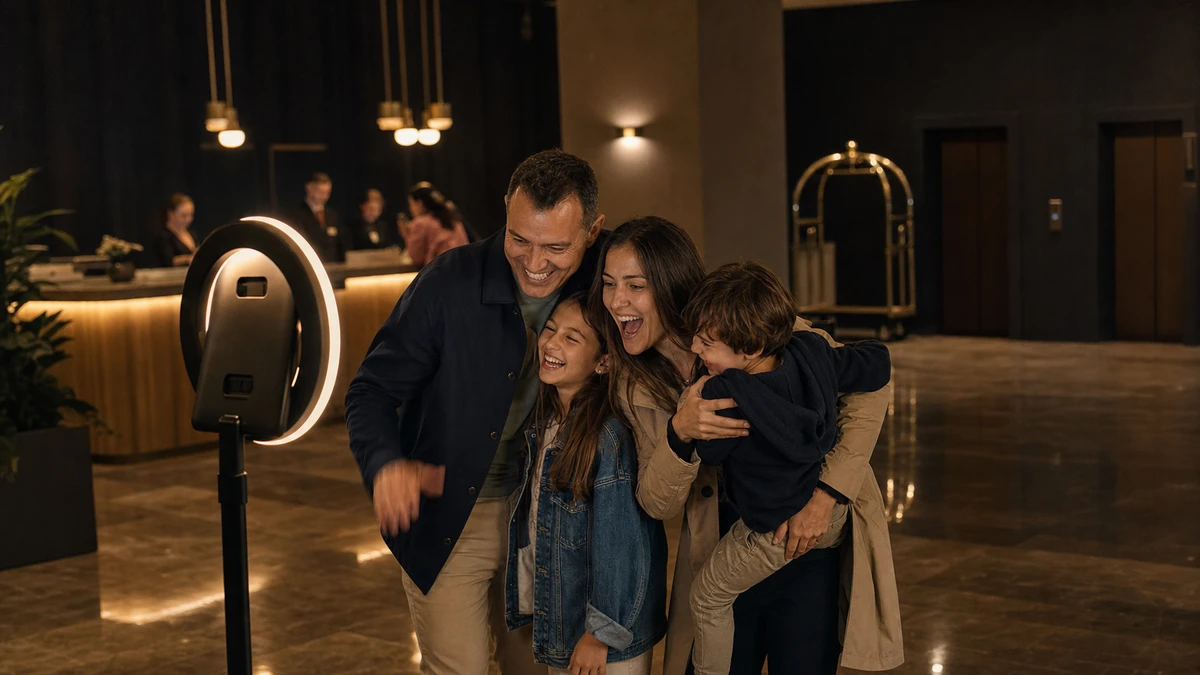
A family wraps up a long weekend at a resort. On the last morning, before the car comes around, the kids want one more picture by the pool. Near the lobby elevators there is a small branded photo station. They stop, the booth shoots a short GIF, and it arrives on a parent’s phone a few seconds later with the resort’s name and social handle printed in the corner. By the time the family reaches the room to grab their bags, the clip is already posted.
That is the moment a hotel photo booth is built around, and it explains why the question of what is the best photo booth for hotels usually gets answered wrong.
The best photo booth for a hotel is not a booth type at all. It is a decision about how the property will use it. Most operators who run that search shop the way an event planner shops, comparing booth styles, hourly rates, and prop kits. A property that wants a booth living in its lobby every day needs almost none of that. The two are opposite purchases, and choosing the wrong frame is how hotels end up with equipment that does not fit.
Two Different Buyers Are Hiding Behind One Search
A hotel sales manager booking a booth for next Saturday’s gala and a marketing director planning a permanent lobby amenity will type the same words into a search bar. They are not shopping for the same thing, and almost no page that ranks for this keyword tells them so.
When renting makes sense
The first operator runs a property that books functions. It has ballrooms, a conference calendar, and a sales team that assembles event packages. When this operator needs a photo booth, the need is specific and temporary: a booth for a Saturday gala, a three-day conference, a partner reception. The booth arrives, runs for four hours, and leaves with the vendor. Call this Buyer A, the hotel as event venue.
When owning makes sense
The second operator is a general manager, a marketing director, or a director of guest experience who wants a booth living on the property as a standing amenity. It is there every day, in the lobby or by the pool, used by transient and leisure guests who never booked an event. It carries the property’s brand, captures guest contacts, and feeds the hotel’s marketing all year. Call this Buyer B, the hotel as property.
Nearly every page that ranks for this keyword answers Buyer A. The generic event-rental guides frame a hotel as a place that rents equipment for a booked function, priced by the hour. That logic, booth style and hourly rate and prop selection, is the wrong tool for an amenity decision, where what matters is durability, unattended operation, branding control, and data capture measured over months rather than over one evening.
Two questions settle which buyer applies
Two questions settle which buyer applies. Is the booth for booked functions, or for everyday guests? And is it leaving with a vendor after four hours, or staying on the floor? An operator who answers “everyday guests” and “staying” is Buyer B, and the rest of this guide is built for that operator. A property with real event volume can be both, which changes the acquisition decision later.
What a Photo Booth Actually Does for a Hotel
A general manager who reads a lobby photo booth as “entertainment” will treat it like a nice-to-have and cut it in a tight budget year. Read correctly, it is three working assets at once, and the buying decision should be made against those, not against novelty.
Guest Photo Engine
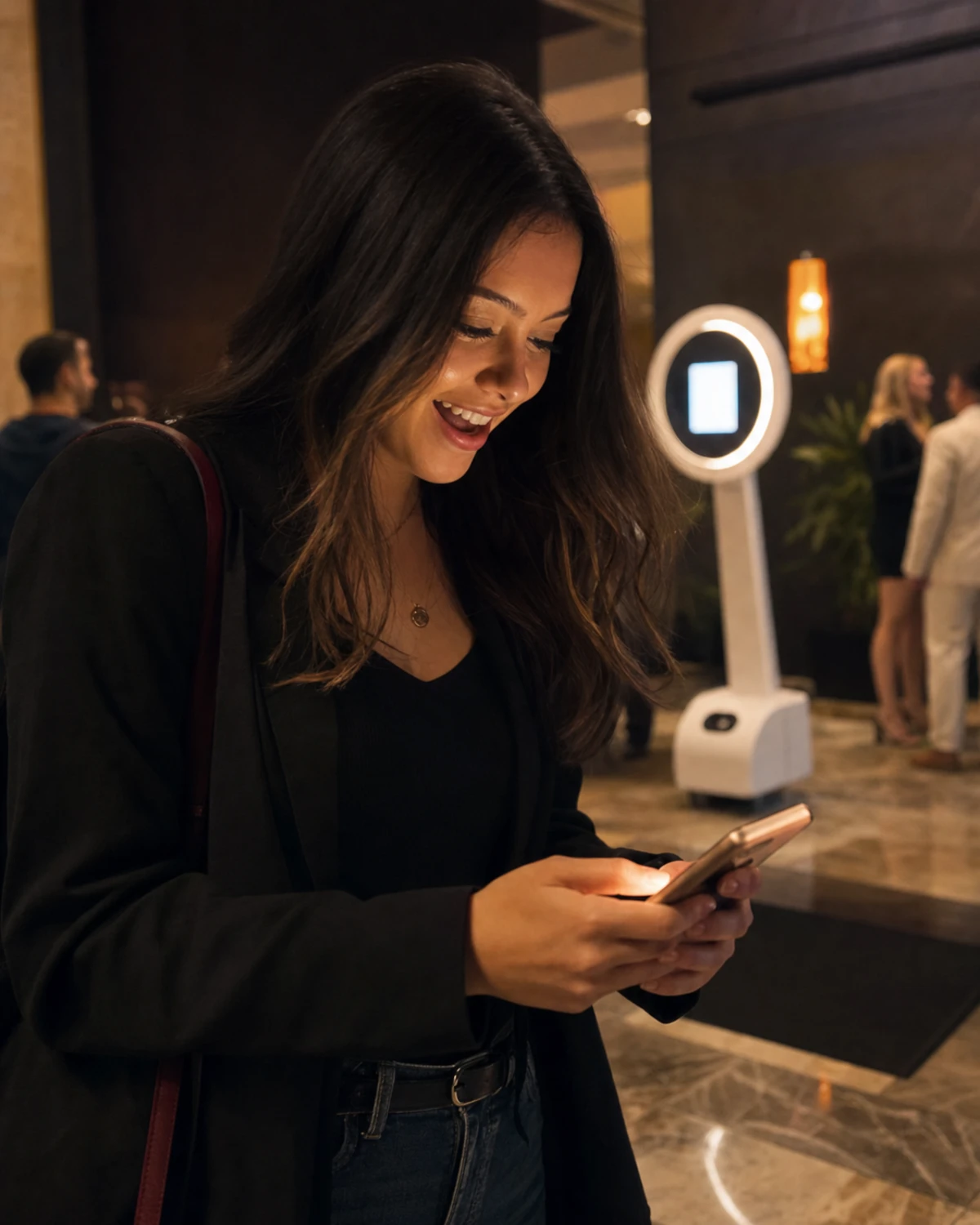
The first is an engine for guest photos, the candid images and clips a hotel never has to produce itself, what marketers call user-generated content. The mechanism is simple. A guest takes a photo or a short GIF. A branded overlay puts the property’s name and social handle on the image. The guest sends it to their own phone and shares it to their feed, where friends and family, who often share their travel taste and budget, see the property in a candid and trusted context.
That is reach the hotel did not buy, and it lands with people already inclined to trust a friend’s recommendation. Skift reported in 2025 that social media has become travelers’ single most influential source of trip inspiration, ahead of official travel sites, review platforms, and traditional media. A guest’s photo lands inside that channel, and it carries more weight than the hotel’s own marketing images because it comes from a peer rather than an advertiser.
A contact-capture point
The second is a contact-capture point. To send a guest the photo, the booth asks for an email address or a phone number, and it asks at the one moment a guest is most willing to give it, right after something that delighted them. A guest who books through an online travel agency often reaches the property as someone else’s contact, with the email address and the ongoing relationship sitting on the agency’s side. The booth captures a contact the hotel owns outright, one it can use to market a return stay directly.
A satisfaction and review trigger
The third is a satisfaction and review trigger. A small, well-made moment late in a stay can lift how a guest remembers the property. A 2025 J.D. Power guest satisfaction study, reported by Hotel Dive, found that hotel investment in amenities and in-room technology produced measurable gains in guest satisfaction even as room rates hit record highs. That study scores satisfaction across categories a photo booth plausibly touches, including facilities, connectivity, and a sense of distinctive value. Higher satisfaction also feeds stronger value perception, and value perception is what drives the recommendations and repeat stays a property depends on.
All three feed the one number a hotel actively defends, direct bookings against dependency on online travel agencies (OTAs). Skift Research’s 2024 Hotel Distribution Outlook projected direct digital bookings to overtake OTAs as the largest hotel distribution channel by 2030, and found that hoteliers themselves want only about a third of their business arriving through indirect channels. Every booking a hotel sources itself avoids an OTA commission, and social reach plus an owned guest list are precisely the channels that produce direct bookings.
Booth Types, Honestly Assessed for Hotel Use
Walk a hotel lobby on a slow afternoon and the photo booth either looks like it belongs there or looks like rented event gear nobody collected. The event-rental market sells roughly five booth formats. Judged for a four-hour reception they rank one way; judged as a fixture that has to survive months in a public space they rank in a different order. The honest test for a property is footprint, whether the format needs a staff member, how well it carries the hotel’s brand, what it produces, and whether it holds up unattended.
Open-air iPad booths have a small footprint, often a single stand with a compact backdrop. The software is highly brandable, the output is digital and shares instantly, and the better models run unattended. For most properties this is the default. Simple Booth’s HALO kit is one iPad booth built for this standing-amenity use rather than the four-hour rental: at the W Hotel Austin, a single ongoing HALO install has logged 12,765 photos and 31,730 participants.
Mirror booths are a full-length reflective panel that doubles as a styled lobby centerpiece. They are visually striking, but they carry a larger footprint and a higher price, and they read more as a design object than an everyday-use station.
360 booths put a guest on a platform while a camera arm orbits to shoot video. They are strong for resorts, pool decks, and event-heavy properties, but they need clear space and usually an attendant, and the output skews high-energy rather than quick and easy.
Vintage and enclosed analog booths make a design statement for boutique and lifestyle properties, and they are often tied to a revenue-share placement, covered below. They look the part, but they are generally weaker on branded digital output and on data capture.
Unattended self-service kiosks are built specifically to live in a public space with no staff posted to them, with automated sharing and remote management. When the goal is an always-on amenity, this is the format the others are being measured against.
No single format wins
No single format wins. An airport business hotel that wants an always-on lobby fixture and a boutique hotel that wants a décor-grade centerpiece are different problems with different answers. The format follows the property and the placement.
The Three Ways to Get a Booth: Rent, Buy, or Revenue-Share
Once a property knows it wants a booth, it still has to decide how to acquire one, and vendors rarely lay the choices side by side. There are three, and the right one depends less on the booth than on how the property plans to use it.
Rent per event
The hotel pays a vendor for a specific function and the booth leaves afterward. Foto ATM’s 2025 rental guide lists market rates for four-hour events: roughly $400 to $1,000 for an open-air booth, $800 to $1,200 for a mirror booth, and $1,000 to $2,500 for a 360 booth, with extra hours billed at $100 to $200 each. No capital, no maintenance, no permanence. This is the right model for a hotel whose need is genuinely Buyer A, occasional booked functions. It is the wrong model for an everyday amenity, because renting a booth a few hundred days a year costs far more than owning one.
Buy and own
The hotel purchases the hardware outright. Quality booths built for permanent installation generally run $5,000 to $15,000 depending on format, and the software that runs them is a separate subscription, commonly $29 to $199 a month. A realistic first-year cost, covering hardware, software, and setup, lands somewhere around $6,000 to $17,000. In exchange the property controls everything that matters for Buyer B: the branding on every photo, the guest data, the placement, and the uptime. At amenity-level usage the cost per session falls quickly, and the booth becomes a property asset rather than a recurring invoice.
Revenue-share or free placement
A vendor installs and maintains a booth at no cost to the hotel, and the two split per-session revenue, or the vendor keeps the session fees outright and the hotel simply hosts the equipment. Photomatica, for instance, builds vintage-inspired booths and places them in approved venues for free, billing the arrangement as “free for you.” Snappic runs a pay-per-session model where the guest pays for each session. Zero capital and zero operational burden are real advantages. The trade is also real: the hotel gives up brand control, since the booth typically promotes the vendor’s experience rather than the property, gives up ownership of the guest data the booth collects, and gives up the upside on its own guest traffic. Neither vendor publishes its split terms, which are negotiated privately and vary by property.
The decision rule is short. Choose on three things: how often the booth will be used, how much the property values controlling its brand and owning its guest data, and whether it prefers a capital purchase or a hands-off arrangement. A hotel with rare event needs rents. A hotel that wants a daily amenity and intends to keep the reach and the data buys. A hotel that wants income from a booth with no involvement, and does not mind another brand on its floor, takes the concession. The deeper buy-versus-rent economics, including depreciation and tax treatment, deserve their own analysis, but the model choice above is the one that has to be made first.
Where to Put It: Placement Strategy by Property Type
A booth pushed into a back hallway because that is where the spare outlet was will sit unused. The same booth ten feet from check-in becomes part of the property. Placement is a buying decision, not an afterthought, because footprint, power, and connectivity needs all follow from where the booth goes.
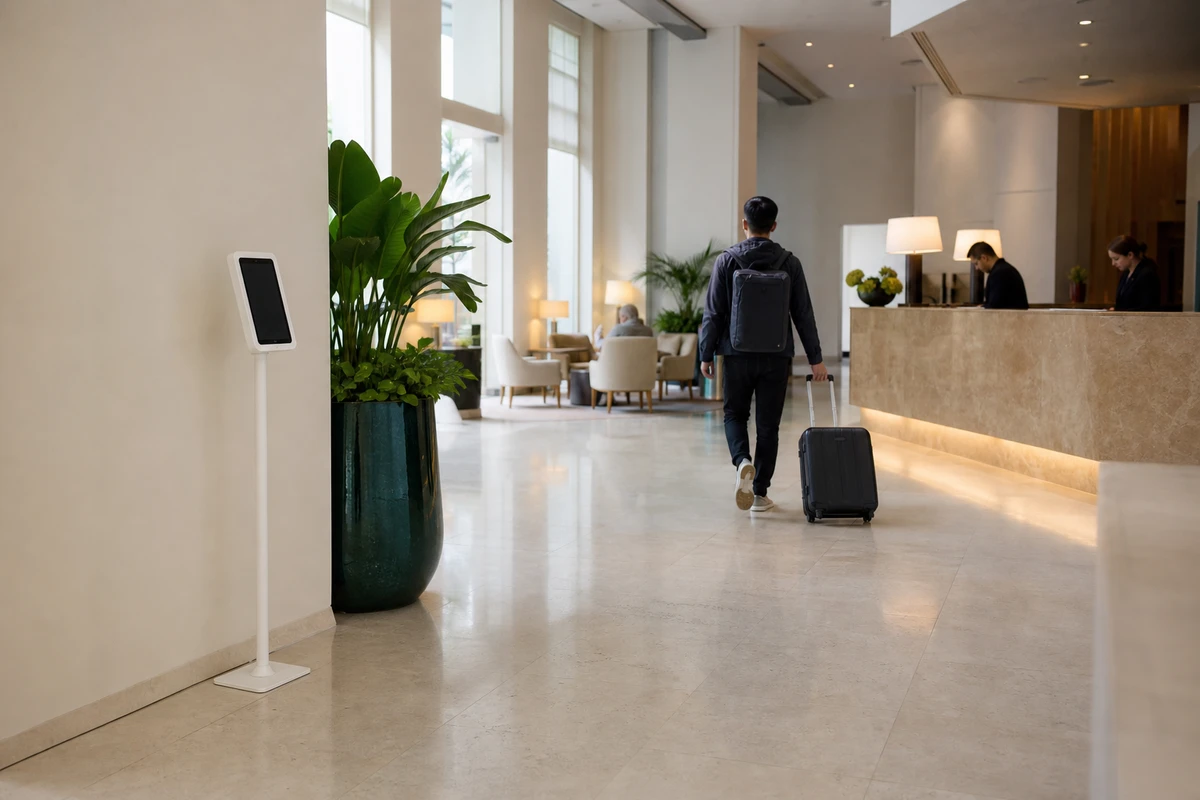
The lobby, near check-in or the elevators, sees every guest who walks the property. It is the strongest spot for an always-on amenity and for the satisfaction and review lift, because the booth becomes part of the arrival and departure ritual.
A rooftop, pool deck, or terrace gives the best backdrop for shareable content, which makes it powerful for a resort, but it is seasonal and weather-dependent and usually needs a plan for off-season storage.
Pre-function and ballroom space serves Buyer A’s booked events, and it lets the sales team fold the booth into event packages as an upsell.
A spot inside the bar or restaurant ties the booth to a revenue outlet and to the evening hours when guests are most social.
Property type then sharpens the choice
Property type then sharpens the choice. A boutique or lifestyle hotel should treat the booth as a design element, which argues for a centerpiece format in a visible lobby or bar. A full-service resort has the space and the backdrops for a pool-deck placement and the event volume to justify a second use. A business or airport hotel serves guests who are time-poor and often traveling alone, so a fast, unattended lobby kiosk fits where a 360 platform would sit idle. A conference hotel leans toward pre-function space. An extended-stay property, where guests settle in for weeks, gets the most from a lobby booth that grows familiar over a long stay. The booth, the placement, and the property type are one decision, not three.
Running the Numbers: A Booking-Attribution Model for Hotels
Every page that ranks for this keyword gestures at return on investment, and none does the arithmetic. Here it is, built conservatively.
Take a 200-room hotel running 65% occupancy. That is 130 occupied rooms a night, or about 3,900 occupied room-nights in a 30-day month. At an average stay of two nights, that is roughly 1,950 separate guest stays a month.
A lobby booth will not be used by everyone. Assume a conservative 10% of guest parties stop and use it: about 195 booth sessions a month.
Two things happen from those sessions, and they are worth modeling separately, because one is far easier to attribute than the other.
The social path
The first is the social path. Say 40% of sessions get shared publicly, about 78 shares a month, and each share reaches a modest 250 people. That is roughly 19,500 branded impressions a month, close to 234,000 a year, placed in social feeds at no media cost. This reach is real, but it is hard to tie to a specific booking, so the honest move is to treat it as earned top-of-funnel exposure and not pin a revenue number on it.
The owned-list path, and this one is defensible
The second is the owned-list path, and this one is defensible. To deliver a photo, the booth captures an email address or a phone number. Assume 60% of sessions yield a usable contact: about 117 a month, roughly 1,400 in a year. Market a return stay to that list, and assume a conservative 2% of those contacts book a direct stay within the year: 28 direct bookings. At an average booking value of $400, a two-night stay at a $200 nightly rate, that is $11,200 in direct revenue.
Now compare that against the OTA channel. NPR’s Marketplace reported in 2025, citing hospitality faculty at the University of South Florida, that OTA commissions typically run 15% to 25% of the booking. Had those 28 bookings come through an OTA at 20%, the hotel would have paid $80 each in commission, $2,240 across the year. Some of those guests might have rebooked anyway through an OTA, so part of the booth’s value is not net-new demand but commission avoided, moving a known guest onto the direct channel.

Set that against cost
Set that against cost. A first-year, all-in spend of around $8,000 for an owned self-service booth sits below the $11,200 the owned list is modeled to produce, before any social reach, satisfaction lift, or event-rental use is counted. Not every dollar of that $11,200 is found money, because some of those guests would have booked anyway. But the share that is genuinely new demand, plus the commission moved off the OTA channel, clears an $8,000 booth inside its first year. Every figure here is an assumption a specific property can replace with its own occupancy, nightly rate, capture rate, and list-conversion rate. The arithmetic is deliberately conservative. The point is the structure: a chain that runs from booth session to guest contact to direct booking to commission avoided.
The Features That Matter for a Hotel (and the Ones That Don’t)
A vendor quote for a hotel photo booth often arrives with a feature list built for one-night event rentals. Half of it is priced for a four-hour reception and irrelevant to a fixture in a lobby. A property can score any quote against a short checklist instead.
What matters:
- Custom branded overlays and templates, so the property name and social handle sit on every image that leaves the booth. Without this, the booth generates content for nobody.
- Email and SMS delivery, because that is the data-capture mechanism. A booth that only prints, or only sends by AirDrop, captures no contact.
- A branded online gallery where guests revisit their photos and the hotel pulls content for its own channels.
- An analytics dashboard, so the booth reports sessions, shares, and opt-ins instead of being a black box.
- Durability and reliable unattended operation, since the booth has to survive months in a public space.
- Guest-data ownership and privacy compliance, which matters more for hotels than for event rentals because hotels serve international guests, and a property in or serving the EU carries GDPR obligations on every email address and phone number it collects.
- A simple guest interface usable by a child or an older traveler without instruction.
What matters less, or can be skipped: elaborate physical prop kits, which serve a four-hour reception rather than an everyday fixture; instant-print hardware for an amenity use case, where digital sharing carries the marketing value and print only adds cost and refills; and gimmick effects that do not produce branded, shareable output. Reading a vendor quote against this list shows quickly how much of the price is event-rental equipment a property will never use.
Operational Reality: Staffing, Maintenance, and Uptime
The questions that decide whether a booth keeps running or gets quietly unplugged behind the bell desk are the ones vendor pages skip. They are worth answering before signing.
Staffing
The honest answer is that “unattended” is mostly true and not entirely. A well-chosen self-service kiosk runs without an attendant, and remote-management tools have made this real rather than marketing copy: Snappic, for example, lets an operator log into the booth software from anywhere to check the queue, monitor storage, and troubleshoot. What a hotel still needs is a short orientation for front-desk or food-and-beverage staff, so someone on each shift can clear a jam or answer a guest question. That is familiarity, not a posted job.
Security
An iPad or camera sitting in an open lobby is a theft target. The booth needs secure mounting or an enclosure, and the hardware belongs on the property’s insured-equipment list.
Connectivity
Sharing and data capture both depend on reliable internet. A booth on weak guest WiFi will fail at the exact moment a guest is waiting for a photo. Plan the bandwidth, and consider putting the booth on a dedicated connection rather than the open guest network.
Maintenance and uptime
For an owned booth, this means a defined support relationship with the vendor for software updates and hardware issues. For a revenue-share booth, it means reading the vendor’s service commitment before signing, because uptime is then someone else’s responsibility and the hotel’s amenity.
Power, space, and access
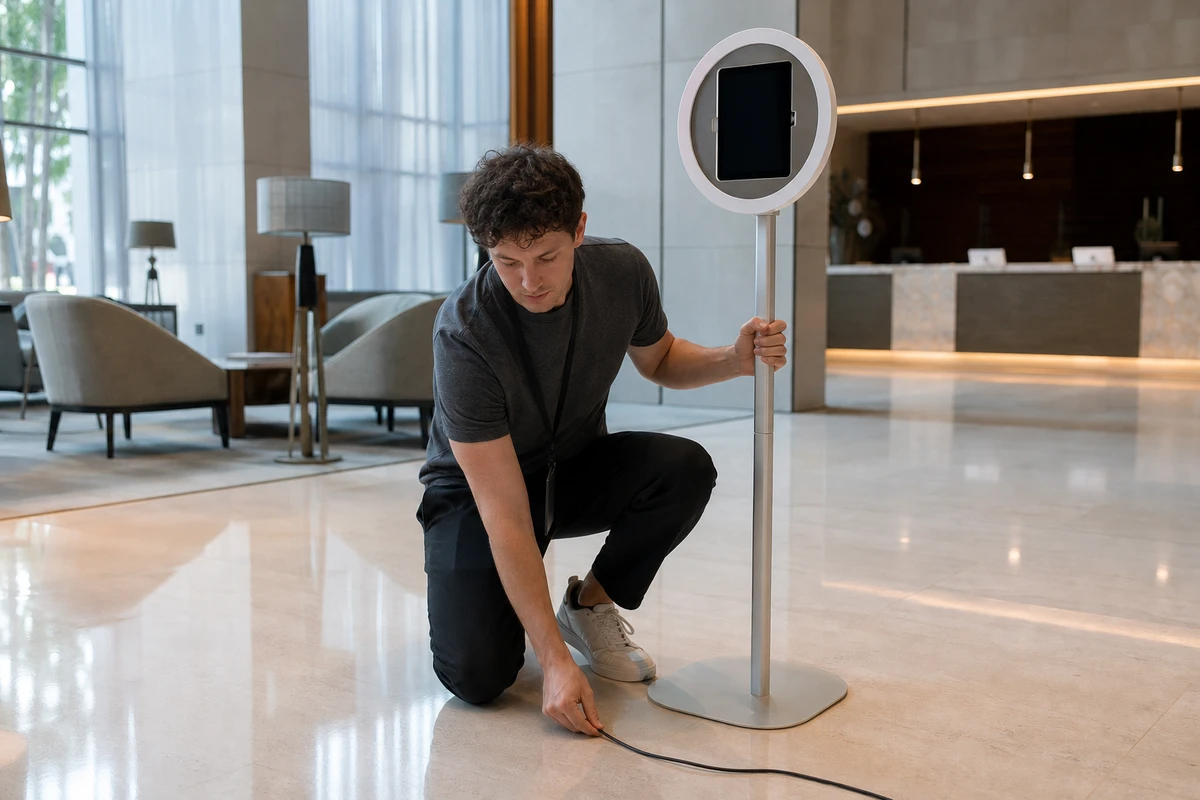
Foto ATM’s guide specifies a dedicated 110V, 10-amp circuit so the booth does not trip a shared breaker, and notes that a full multi-element setup wants roughly a 6-by-9-foot floor area, though a self-service kiosk with no props table needs considerably less. Routes to the booth should be wheelchair accessible and the interface reachable from a seated height. Any seasonal outdoor placement needs an off-season storage plan.
How to Choose in One Afternoon: A Buyer’s Shortlist
The decision comes together in five steps a single afternoon covers.
Diagnose the buyer type
First, diagnose the buyer type. Booked functions point to event-rental thinking; everyday guests point to an amenity. Most operators reading this far are the second.
Pick the acquisition model from the rule above
Second, pick the acquisition model from the rule above: rent for rare events, buy to own the brand and the data, take a concession for hands-off income with another brand on the floor.
Match Format to Property Type
Third, match the booth format to the property type and the placement. An open-air or kiosk format suits an always-on lobby fixture; a centerpiece format suits a design-led boutique; a 360 platform earns its space only where there is room and event energy to use it.
Score Vendor Quotes
Fourth, score every vendor quote against the feature checklist and the operational questions, and treat each event-rental feature in the price as a line to challenge.
Run the property’s own numbers through the booking-attribution chain
Fifth, run the property’s own numbers through the booking-attribution chain before signing, so the spend is validated against modeled direct revenue rather than a vendor’s ROI promise.
The through-line under all five steps: the best photo booth for a hotel is not the most advanced model or the one with the longest feature list. It is the one whose acquisition model, placement, and feature set match how that specific property will actually use it.
Frequently Asked Questions
How much does a photo booth cost for a hotel?
There are two prices, for two different uses. Renting a booth for a single event runs roughly $400 to $2,500 for four hours depending on the format, per Foto ATM’s 2025 rental rates. Buying a quality booth for permanent installation generally costs $5,000 to $15,000 for the hardware, plus a software subscription of about $29 to $199 a month. A realistic first-year ownership cost lands near $6,000 to $17,000.
Should a hotel buy a photo booth or rent one?
Rent if the need is occasional booked functions and the booth leaves with the vendor afterward. Buy if the goal is a permanent amenity used by everyday guests. Renting a booth a few hundred days a year costs far more than owning one, and ownership keeps the branding and the guest data with the property rather than the vendor.
Do hotel guests actually use a photo booth?
Usage depends heavily on placement. A booth tucked in a back hallway sits idle; one in the lobby near check-in or by the pool becomes part of the arrival and departure routine. Even a conservative estimate, around one in ten guest parties, produces a steady stream of sessions at a mid-size property. The booth has to be visible and effortless to use.
What is a hotel photo booth revenue-share program, and is it worth it?
A vendor installs and maintains a booth at no cost, and the two parties split per-session revenue, or the vendor keeps the session fees and the hotel simply hosts the equipment. It removes the capital cost and the operational work. The trade is brand control and guest-data ownership, since the booth usually promotes the vendor’s experience rather than the property. It suits hotels that want hands-off income more than a marketing asset.
Where is the best place to put a photo booth in a hotel?
For an everyday amenity, the lobby near check-in or the elevators, where every guest passes it. Resorts get strong shareable content from a pool deck or terrace, though that placement is seasonal. Conference hotels benefit from pre-function space. The rule is high foot traffic plus a good backdrop, somewhere the booth becomes part of a natural moment rather than a detour.
Does a hotel photo booth need a staff member to run it?
Not a dedicated one. A self-service kiosk built for permanent installation runs unattended, and remote-management software lets a vendor or operator monitor and troubleshoot it from off-site. What you do need is a brief orientation for front-desk or food-and-beverage staff, so someone on each shift can clear a jam or help a confused guest.
How does a hotel measure the return on a photo booth?
Trace a chain rather than a vanity metric. Count booth sessions, the share of sessions shared publicly, and the share that produce an email address or phone number. The captured contacts feed direct marketing for return stays; model a conservative booking conversion on that list, and value each direct booking against the 15% to 25% OTA commission it avoids.
Sources
- NPR Marketplace (2025). “How do online travel agents like Expedia and Booking.com work?” https://www.marketplace.org/story/2025/05/26/how-do-online-travel-agents-like-expedia-and-bookingcom-work
- Hotel Dive (2025). “Hotel room amenities, tech boost guest satisfaction: J.D. Power.” https://www.hoteldive.com/news/hotel-amenities-technology-boost-guest-satisfaction/753036/
- Skift (2024). “The Ideal Mix For Hotel Distribution: Direct Bookings to Lead by 2030.” https://skift.com/2024/11/11/the-ideal-mix-for-hotel-distribution-direct-bookings-to-lead-by-2030/
- Skift (2025). “How Social Media Is Shaping Travel Planning and Booking.” https://skift.com/2025/03/03/how-social-media-is-shaping-travel-planning-and-booking/
- Foto ATM (2025). “How to Choose the Right Photo Booth for Your Venue.” https://fotoatm.com/how-to-choose-the-right-photo-booth-for-your-venue/
- Photomatica (2025). “Permanent Photo Booth Installations.” https://www.photomatica.com/permanent-photo-booth
- Snappic (2025). “Permanent Photo Booth Installs for Passive Income.” https://www.snappic.com/use-cases/permanent-installs