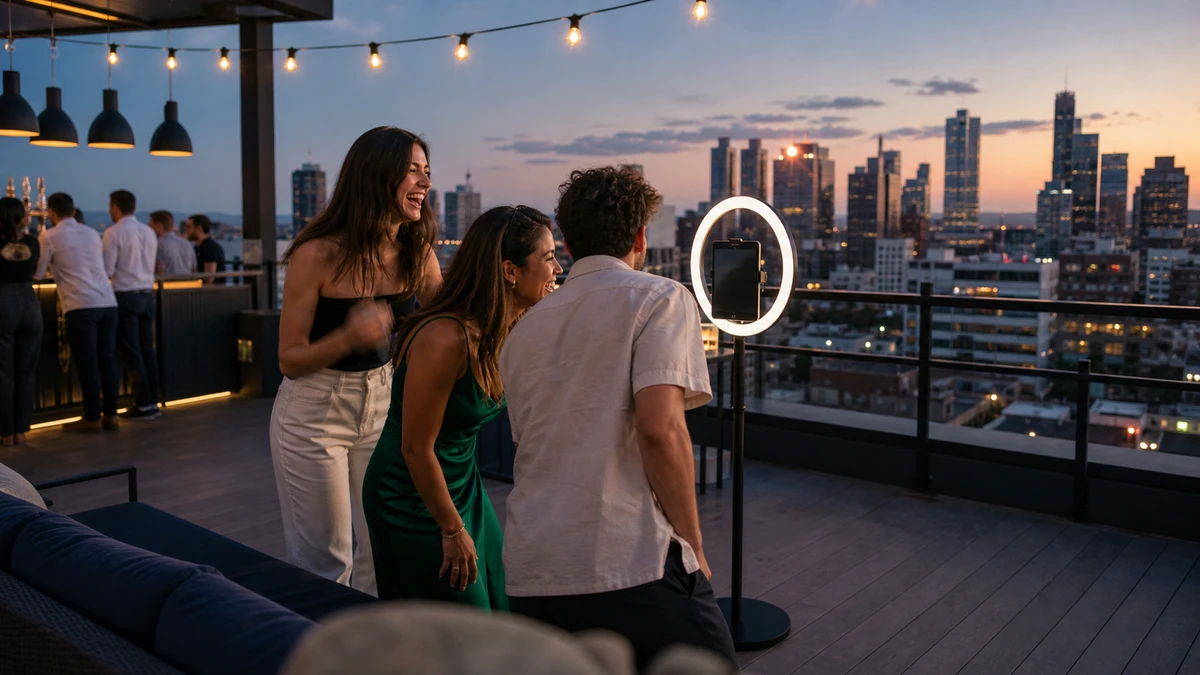
On a hotel’s rooftop bar at sunset, three or four guests have their phones up. One is filming the skyline, one is photographing a cocktail, one is in a group shot with the city behind them. By the next morning, the hotel’s marketing team has no idea whether any of that footage exists, where it went, or whether a single frame named the property. The branded hashtag printed on the bar menu sat unused.
That gap is the real state of most hotel guest UGC programs. The property has a hashtag, a photo contest it runs once or twice a year, and a line of signage in the lobby. It produces a trickle of tagged posts and almost no measurable organic reach. The problem is not effort or creativity. It is volume. Organic reach is decided by how many distinct guests post, not by how clever the hashtag is. A hashtag is a bucket that labels content; it does not generate it. What follows is the math behind organic reach, and how to engineer guest posts at volume while turning each one into a guest the property can contact again.
Why a Hashtag Is Not a Hotel Guest UGC Strategy
The hashtag is a label, not a faucet
Most hotel UGC advice describes the same playbook: choose a branded hashtag, run a contest, print it on signage and room keys, then repost whatever shows up. Look closely and the playbook is a collection mechanism. It assumes the posts already exist somewhere in guests’ camera rolls and the hashtag’s only job is to label them so staff can find them.
Large brands get away with this because their scale does the generating for them. Ritz-Carlton’s #RCmemories has gathered more than a million reels on Instagram, and Hyatt’s #InAHyattWorld has passed 100,000 posts (a figure cited by the marketing agency Hummingbird). A single independent property with no comparable pull collects a thin stream of posts, then wonders why the identical tactic produced almost nothing.
The friction stack a guest post has to clear
Before a single guest post happens, the guest has to clear a stack of small frictions, and each step sheds participants. Take a photo good enough to share, then decide it really is good enough. Remember the hotel’s handle and the branded hashtag. Write a caption. And, in that moment, actually want to attach a personal feed to a hotel’s brand.
Treat each step as a filter that keeps, say, two-thirds of the guests who reach it, and five filters in a row leave roughly one in eight. Real funnels are messier than that, but the shape holds: a multi-step ask converts in the low single digits because every step multiplies the loss. That is why only a small share of guests ever post, and the ones who do post content the property cannot predict, time, or count on.
Guests are not unwilling. In a 2019 Nosto/Stackla survey (vendor-commissioned, from a UGC platform), 89% of consumers said they would post about a travel destination after a great experience, the highest of any category measured. Willingness is not the bottleneck. Friction is. That is the distinction the standard advice skips: “we have a hashtag” and “we have a hotel guest UGC strategy” are not the same sentence. A strategy answers how many posts per month, from how many distinct guests. A hashtag answers neither.
Organic Reach Is a Volume Game
Why a guest post reaches people the hotel cannot
The hotel’s own Instagram account mostly reaches people who already follow it, an audience that already knows the property and may have already stayed. Engagement is thin even there: Instagram’s average engagement rate across all account types was 0.48% in Socialinsider’s 2026 benchmark (drawn from 70 million posts), and Facebook’s was 0.15%. A branded post talks to a small, already-converted audience, and most of it scrolls past.
A post shared from a guest’s personal account does something the hotel’s account structurally cannot: it reaches that guest’s friends and family, people who have never heard of the property. That is borrowed reach, and it is the entire reason guest content matters for distribution. Most advice gestures at this (“every share increases reach”) without explaining why. Guest content reaches new audiences because it travels through networks the hotel does not own and cannot buy into directly.
Reach scales with the count of posters
Borrowed reach only compounds at volume. One reshared guest post a week is statistically invisible. The lever is the number of distinct guests posting multiplied by their average network size. Reach scales with the count of posters, not the brilliance of any single post.
This is where the trust data earns its place rather than decorating the page. Nielsen’s 2015 Global Trust in Advertising study found 83% of consumers trust recommendations from friends and family above any advertising format, and 66% trust opinions posted online. Travelers do not just hold that preference, they act on it before booking: a TrustYou study with NYU’s Tisch Center found 95% of leisure travelers read online reviews before reserving a room, working through six or seven of them and spending around half an hour doing it.

That habit now extends from review sites to social feeds. Phocuswright’s 2024 research found 62% of travelers who use social media for trip planning said social content led them to a specific travel decision, and Skift Research reported in 2025 that social media is the single most influential source for travel inspiration. Each guest post is a distribution node aimed squarely at the audience that books on peer proof. A property with few nodes has no reach engine, no matter how trusted guest content is in principle.
The Numbers: What Guest Content Is Actually Worth
The reach layer
Take a 120-room property that builds one designed on-property share moment, a fixed point where guests make and send a good branded photo in seconds, and 300 guests use it in a typical month. Suppose 35% share the result to their own feed, roughly 105 guests. The average personal social account is small: industry estimates put a typical non-influencer account in the range of 150 to 300 followers, a directional figure rather than a precise one. At a midpoint of 200 followers, 105 shares put the property in front of about 21,000 accounts a month that do not follow the hotel, with no paid media. Over a year that is more than 250,000 borrowed impressions.
Set that against the same property’s owned Instagram account. With a few thousand followers and three posts a week at industry-average engagement, the hotel reaches a few hundred mostly-existing followers per post. The owned account talks to people who already know the property. The guest shares talk to people who do not.
The contact layer
Now the layer most write-ups skip. The same 300 guests want their photo, so the share moment sends it by email or text and records the opt-in as it does. If 60% provide a valid address, that is about 180 new contacts a month, roughly 2,160 a year. That list is an asset the hotel owns outright.
Its value shows up against OTA economics. Online travel agency commissions run 10% to 30% of room revenue (a 2024 Preno guide, vendor-published, puts Booking.com and Expedia near 15% and Agoda as high as 25%). A guest re-booked from the property’s own list pays none of that. If the hotel’s email program converts even 2% of 2,160 contacts into a direct stay, that is about 43 stays; at a $400 two-night booking, more than $17,000 in direct revenue that owed no commission to a third party.
For scale on the email side, a Litmus survey found 35% of companies see between $10 and $36 back for every dollar spent on email, a cross-industry figure that hospitality will not match exactly. The chain above is illustrative, not a forecast. The structure is the point: one designed moment produces two returns, the visible reach and the contactable list the hotel actually owns.
Engineer One Moment Instead of Hoping for Many
Stop spreading the ask across the whole stay
Most properties scatter a vague “please post” request across the entire stay: a line at check-in, a placard in the elevator, a tent card in the room, a sentence in the post-stay email. Each placement competes with everything else a guest is processing, and converts almost no one. The fix is not more placements. It is concentration: one designed moment where making and sharing branded content is the easiest thing in front of the guest.
Design each choice to remove a friction
Map the moment back to the friction stack. Each design decision should kill one step:
- Place it at a natural peak or pause (the rooftop at golden hour, the pool deck, a lobby feature, the lull during check-in) so it catches guests when they are receptive, not tired or rushing.
- Make the output pre-branded, so the property name and location travel with the content automatically. This removes the “guest forgot the handle and hashtag” failure outright.
- Make sharing one tap, not a multi-step upload with a caption to write.
- Make the content genuinely good, so the guest is proud to post it. That removes the “is this good enough” hesitation that kills most posts.
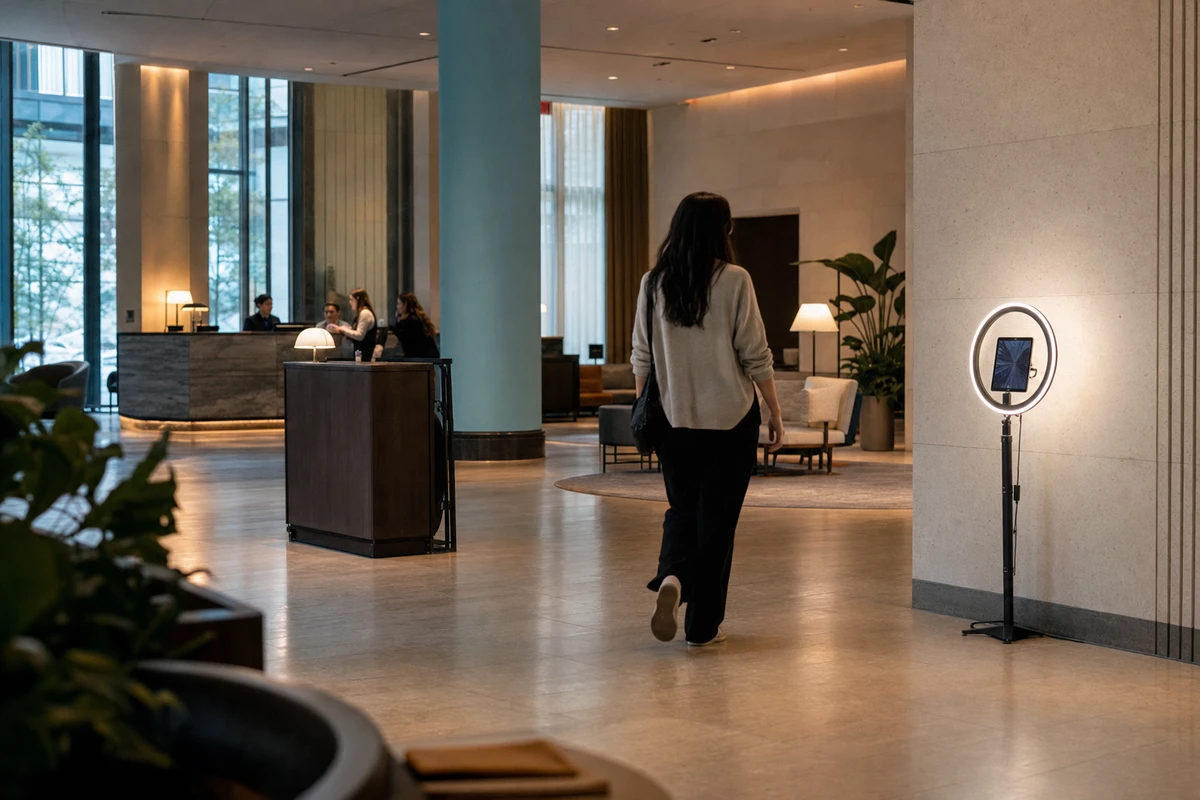
This is where a dedicated on-property capture station fits the model: a fixed, designed point where good branded content gets made and sent in seconds. Simple Booth’s HALO kit is one concrete version of that fixed point: an iPad station with a built-in ring light that a venue sets up once and leaves running, so guests make and send a branded photo themselves. At W Hotel Austin, a single ongoing HALO install logged 12,765 photos and 31,730 participants, the kind of volume a twice-a-year contest never reaches. The principle holds whatever the specific tool. Predictable volume comes from one engineered moment, not from hope sprinkled across the property.

Make Every Share Capture a Guest the Hotel Can Reach Again
The exchange that captures a contact
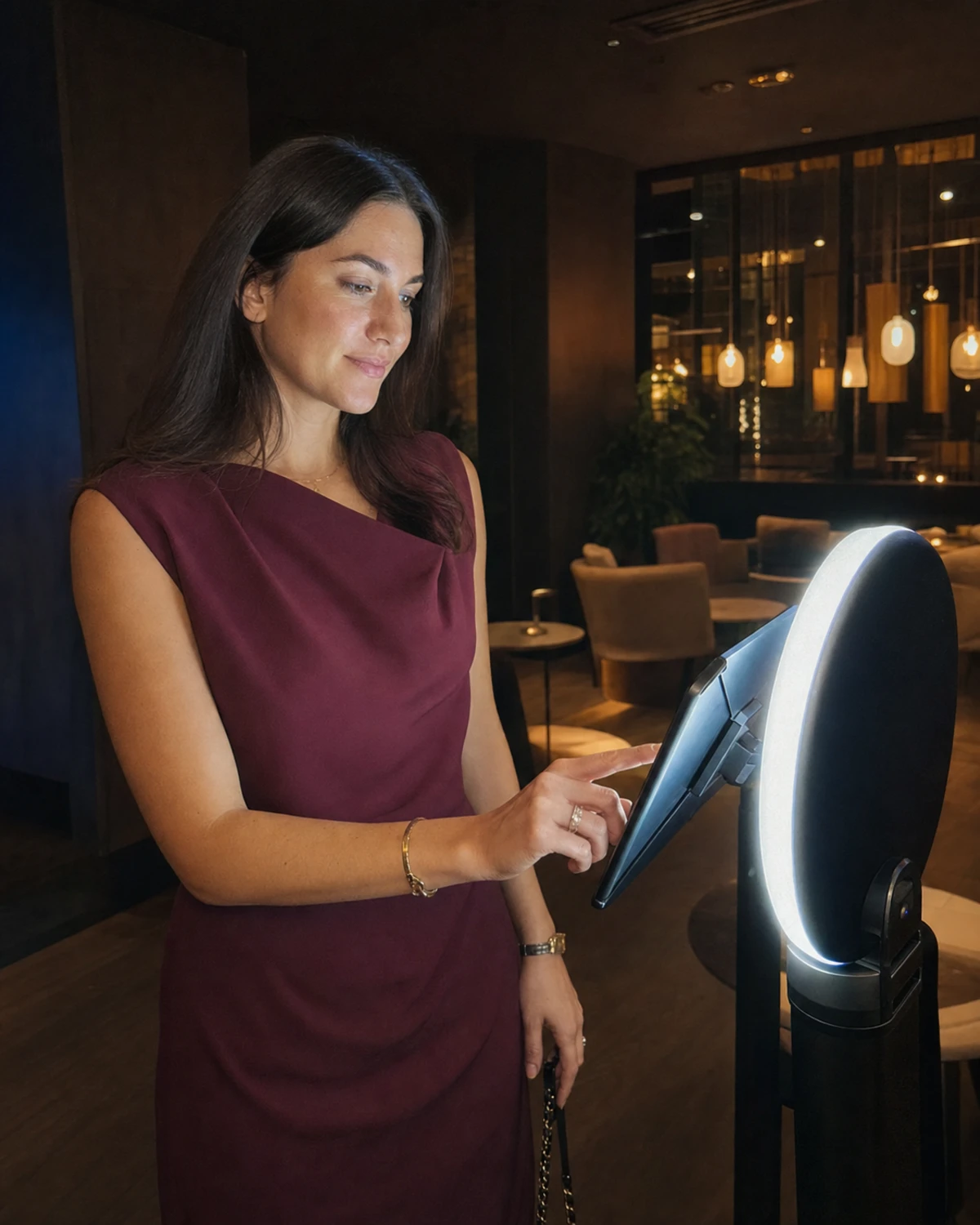
A share moment built to collect an email or SMS opt-in turns a one-time public impression into a guest the property can reach directly, on its own terms. The mechanism is a fair exchange, not a bolt-on form. The guest wants the photo, so the moment sends it by email or text. The hotel records a consented contact in return. Nothing extra is asked of the guest, and both sides come away with something.
Why this matters more in hospitality than anywhere else
A guest booked through an online travel agency is, in marketing terms, the agency’s contact, not the hotel’s. The property paid a commission for that stay and still has no easy way to reach the guest again without paying to find them a second time. A guest who opted in at the share moment belongs to the property: re-bookable through post-stay nurture, seasonal offers, and direct campaigns that owe no commission to anyone. Reaching that guest by email costs effectively nothing. Reacquiring the same guest through an OTA costs the commission all over again.
There is a data-durability point too. Because the contact was volunteered and consented (zero-party data, in marketing terms), it holds up as third-party cookies and tracking-based audiences degrade. Most advice treats guest content as social proof for the booking page and stops there. Capturing the guest is the missed half of the opportunity, and it is the half the hotel fully controls.
Run It Like a System: Rights, Reuse, and What to Measure
Secure rights at the point of capture

The brand-control worry is real. Properties fear resharing a photo they have no license to use, or amplifying an off-brand image. The standard advice raises this concern and then mishandles it, telling operators to chase permission through direct messages after a manager spots something useful. At any real volume, that does not scale. The fix is to secure usage rights at the point of capture, with a clear opt-in checkbox at the share moment itself. A useful checkbox is specific about scope: that the hotel may reshare the photo on its own channels, use it in paid promotion, and feature it on the booking site. Vague consent invites a dispute later; specific consent collected once, at the source, covers every later use.
Reuse one moment across the whole funnel
Guest content volume is an input to far more than an Instagram feed. The same library of approved photos feeds the booking page, OTA listing galleries, paid social creative, and post-stay email. Not every photo fits every channel: a polished rooftop shot at golden hour belongs on the booking page, a candid group laughing by the pool works harder as paid social creative, and a guest’s specific caption about the staff pairs with a written testimonial. A property generating content at volume can be selective about which image goes where, instead of stretching two usable photos across every surface. One designed moment supplies the whole funnel, which is what makes it worth engineering rather than treating it as a feed gimmick.
Measure it like a channel
Replace “we have a hashtag” with a scoreboard. The metrics that predict whether the program works:
- distinct guest posts per month (the volume metric that actually moves reach)
- organic impressions attributable to guest content
- email and SMS opt-ins captured, and cost per captured contact
- share rate at the moment (how many guests post the result they made)
- direct bookings and repeat stays attributed to the captured list
The hotels winning organic reach are not the ones with the cleverest hashtag. They are the ones that stopped treating guest content as a happy accident and built one reliable moment that produces it at volume, and that hands them a guest list on the way out.
Sources
- Nielsen (2015). “Global Trust in Advertising.” https://www.nielsen.com/insights/2015/global-trust-in-advertising-2015/
- Hotel News Resource (2015). “TrustYou / NYU School of Professional Studies Study on Traveler Review-Reading Behavior.” https://www.hotelnewsresource.com/article82018.html
- Nosto / Stackla (2019). “Bridging the Gap: Consumer and Marketer Perspectives on Content in the Digital Age.” https://www.nosto.com/blog/stackla-survey-reveals-disconnect-between-the-content-consumers-want-what-marketers-deliver/
- Socialinsider (2026). “Instagram Benchmark Report.” https://www.socialinsider.io/blog/instagram-benchmark-report/
- Phocuswright (2024). “Scroll, Heart, Fly.” https://www.phocuswire.com/
- Skift Research (2025). “How Social Media Is Shaping Travel Planning and Booking.” https://skift.com/2025/03/03/how-social-media-is-shaping-travel-planning-and-booking/
- Litmus. “Email Marketing ROI.” https://www.litmus.com/blog/email-marketing-roi
- Preno (2024). “Understanding OTA Commission Rates: A Guide for Hotel Managers.” https://prenohq.com/blog/understanding-ota-commission-rates-a-guide-for-hotel-managers/
- Hummingbird Agency. “User-Generated Content in Hotel Marketing.” https://www.hummingbird.agency/user-generated-content-hotel-marketing/
- Instagram. “#RCmemories Tag Page.” https://www.instagram.com/explore/tags/rcmemories/