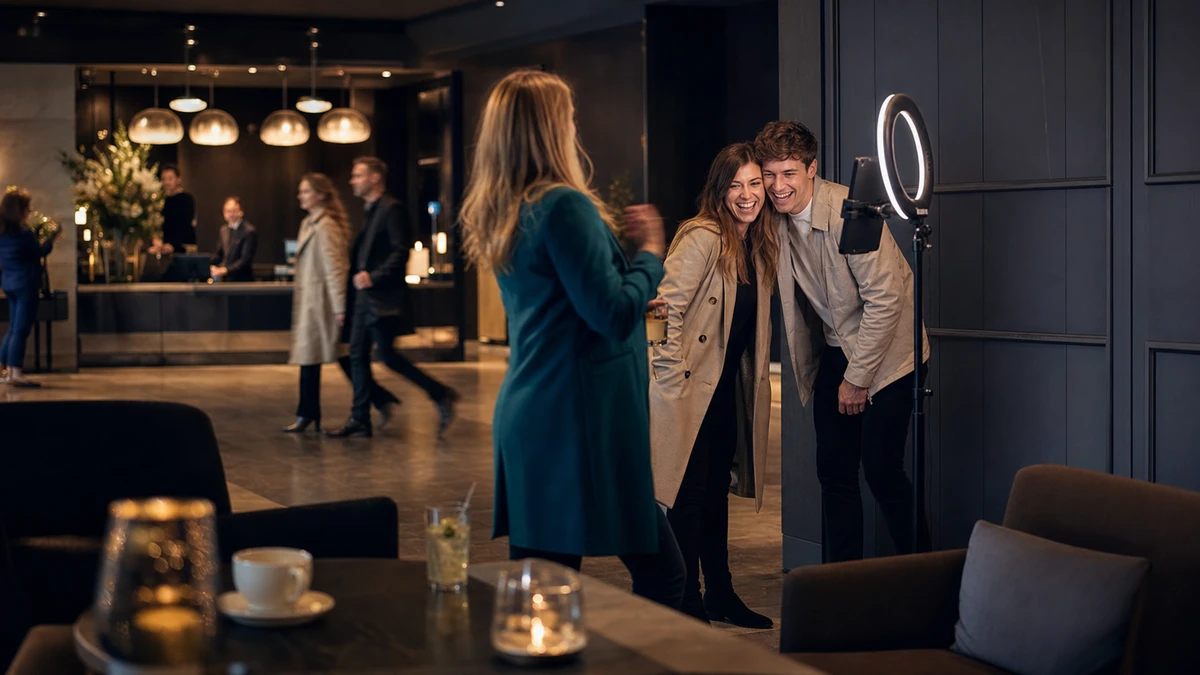
At two in the afternoon on a Tuesday, most hotel lobbies are nearly empty. The morning checkouts have left, the evening arrivals are hours away, and the room sits full of expensive furniture with almost nobody in it. A hotel lobby activation is the fix for that idle stretch: any programmed, time-bound use of the lobby that gives guests and locals a reason to stop, stay, and do something. A good one does a measurable job, not just a decorative one.
Most advice filed under hotel lobby ideas is renovation advice in disguise. It covers lighting temperature, statement furniture, biophilic accents, and gallery walls. That work matters, but it is slow, capital-heavy, and hard to undo. Activation is the lower-cost, faster lever, and it works with the room a property already has. What follows is a way to choose an activation by the outcome it produces, a model for estimating what one is worth, and a rule for not running too many.
What a Lobby Activation Actually Is (and Why It Isn’t a Renovation)
A renovation changes the fixed lobby: the lighting, the finishes, the furniture layout, the front desk millwork. An activation changes what happens inside that room on a schedule. The first is a one-time bet that takes months, a budget committee, and a contractor. The second can run next weekend and be reviewed by Monday. Activations are repeatable, time-bound, low-to-mid cost, and reversible, which means an operator can test one, drop what fails, and keep what works without rebuilding anything.
The distinction matters because the lobby is usually the highest-traffic, lowest-utilization square footage in the building. Menno Hilberts, citizenM’s managing director of development, put the stakes plainly, in remarks reported by Hotel Management Network: “Gone are the times when you could afford to have a dead hotel lobby that’s empty for the rest of the day; it needs to be vibrant all the time.” An idle lobby is not neutral space. It is paid-for square footage producing nothing for most of the day.
It is also not as private as the floor plan suggests. Travelers, remote workers, and people meeting friends already treat hotel lobbies as semi-public ground, walking in to sit, charge a phone, or wait without ever booking a room. Operators can ignore that foot traffic or program for it. Naming the difference between renovation and activation is the easy part. The harder skill, and the rest of this article, is choosing which activation to run.
Start With the Outcome, Not the Idea: The Four Jobs a Lobby Activation Can Do
Picture a general manager asking, three weeks after a lobby event, whether it was worth repeating. If the activation was chosen because it “looked nice,” there is no answer. Nobody set a number to beat, so nobody can say it cleared one. An activation picked for its appearance cannot be measured, cannot be defended to ownership, and cannot be repeated with any confidence.
The most useful way to sort hotel lobby activation ideas is not by how they look but by the job they do. There are four:
- Dwell-time revenue. Keep guests in the lobby longer so food, beverage, and ancillary spend rises.
- Local foot traffic. Give non-guests a reason to walk in, building vibrancy and reaching a new audience.
- Shareable content. Create a moment guests photograph and post, turning the lobby into organic reach.
- First-party guest data. Convert a lobby moment into an email or SMS opt-in, building a marketing channel the hotel owns outright.
Most activations do one of these jobs well and one or two others as a side effect. A lobby happy hour mainly drives dwell-time revenue, but it also produces content if the space photographs well. A local-maker market mainly drives foot traffic, but it can capture opt-ins at the entry table. The point is to name the primary job before spending a dollar, because the primary job is also the thing to measure. The next four sections take one job each; the last covers cadence and measurement.
Activations That Turn Dwell Time Into F&B and Ancillary Revenue
A guest who lingers in the lobby spends money there. A guest who crosses it in a straight line to the elevator does not. That is the entire mechanism behind dwell-time activations, and for lobby-forward properties the stakes are real. Marcos Eleftheriou, a VP at the lifestyle hotel group Ennismore, told HotelsMag that food and beverage drives 50% of revenue across the group’s properties. That is one company’s figure, not an industry average, but it explains why operators of lifestyle and independent hotels treat the lobby’s commercial pull as survival rather than decoration.
The activations that extend dwell time are specific and mostly low-cost: live music scheduled into the lobby’s lowest-energy hours, a signature happy hour built around one drink the property becomes known for, a seasonal food-and-beverage pop-up tied to the locale. As of late 2022, the Grand Geneva Resort in Wisconsin ran winter igloos with fire pits and s’mores boards served with homemade hot chocolate, alongside a grab-and-go counter selling 72-hour croissants; its director of food and beverage told HotelsMag the lobby “is just as important as any restaurant on our property.” QT Sydney ran QTea, a weekend high tea with three sittings and a house DJ in the lobby itself. Both are point-in-time examples, useful as illustration of format rather than as menus to copy.
Copying another property’s activation is, in fact, where most of these fail. Charlie North, an interior design VP at Ennismore, describes redesigning a Rome espresso bar around how Italians actually drink coffee: they removed the bar stools because locals stand at the bar and leave within minutes. An activation has to fit the customer’s real day in that location. North adds a detail most lobby advice skips: “The reception should be secondary to the lobby spaces … so it doesn’t immediately feel like a hotel when you walk in.” A lobby that announces “hotel” first invites guests to check in and leave the room. One that reads as a place to sit and order keeps them in it.
Activations That Bring the Neighborhood Through the Door
A local walks into the lobby, orders a coffee, and settles in for an hour without booking a room. It is tempting to file that person under freeloader, someone using the furniture for free. They are worth more than that. A local who comes in for coffee is a repeat food-and-beverage customer, a word-of-mouth source, and the person most likely to book a room for visiting family.
The cleanest test for whether a lobby activation will
The cleanest test for whether a lobby activation will pull locals in comes from Alex Ghalleb, an F&B operations VP at Ennismore, quoted in HotelsMag: “If it feels like a hotel geared to tourists, it won’t appeal to locals. If it appeals to the locals, it will appeal to travelers. That builds a vibrancy.” Build for locals and travelers follow; build only for travelers and neither shows up.
The open-lobby model has a clear origin point. Ace Hotel New York opened in 2009 with communal tables, plentiful power outlets, and Stumptown Coffee. Hotel Management Network credits it with popularizing the idea that hotel common areas can pull in locals as readily as guests. Zoku Amsterdam later built an entire property around the same logic, with communal dinners and shared spaces designed to mix international travelers with local professionals.
The activations that bring the neighborhood in run in the dead daytime hours when the lobby would otherwise be empty: a rotating local-maker market or pop-up retail, a standing partnership with a neighborhood roaster or bakery, classes and tasting workshops, a showcase that rotates work from local artists, RSVP community events. The shift these represent is structural. Hotels moved from guarding the Wi-Fi password and the lobby furniture from outsiders to actively inviting the outside world in, because a room full of locals is the lowest-cost vibrancy a hotel can buy. One caution applies to all of it, and the final section returns to it: a lobby that serves locals well still has to protect the arrival experience for the guest who paid for a room.
Activations That Turn Guests Into a Content Channel
Guests are already filming the lobby. The vendor Prostay noted in late 2025 that “lobby vibe” increasingly appears in Booking.com and Google reviews, and that travelers sift through short-form video of hotel lobbies before they book. The operator’s only real choice is whether to shape what gets captured or leave it to chance.
The mechanism is straightforward
The mechanism is straightforward. A guest holding a phone, standing in a moment that was deliberately designed to be photographed, is unpaid distribution. A single strong shareable moment can spread well beyond the property at close to no media cost, and it carries a credibility a paid ad never has, because it travels through the guest’s own network.
There is a trap, though, and it is the most common mistake in this category. A generic selfie wall produces generic photos and no brand recall. The viewer cannot tell which hotel it was. The activations that work are unmistakably tied to the property. BizBash documented a useful example: an agency built 25 separate activations for 25 Marriott brands, and every one was anchored to a specific brand’s identity rather than a neutral backdrop. Le Meridien’s “Swings of Glamour” was a travel-themed swing set that recalled the brand’s Air France heritage, while Aloft’s “Listen Up” let guests put their heads inside directional speaker cubes to hear artists from the brand’s concert series. Each produced a photo that could only have come from that brand.
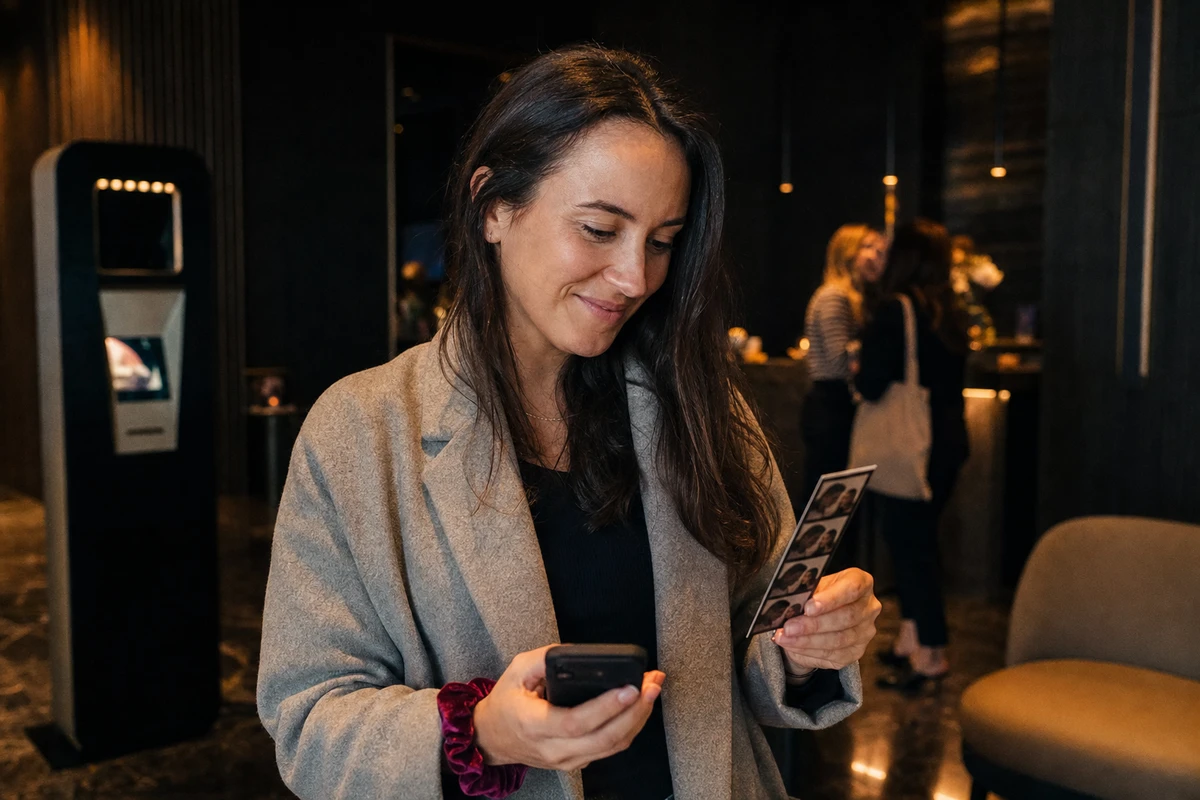
The practical activations follow the same rule: a signature on-brand backdrop or installation that reads as “this hotel” in a single frame, a rotating seasonal photo moment, an interactive or kinetic art piece, a designated photo station for guests and lobby events, a digital display that pulls guest-posted content back into the room. The format matters less than the test. If the resulting image could have been taken in any hotel, the activation produced reach for hotels in general and brand recall for none.
Activations That Build a First-Party Guest List
A guest checks in, drops a bag, and has twenty minutes to spare before the room is ready. They are relaxed, holding a phone, and in a good mood about the trip ahead. It is the easiest moment in the whole stay to ask for an email address, and most hotels let it pass without asking for anything. Almost no lobby-ideas content connects the lobby to marketing. It should.
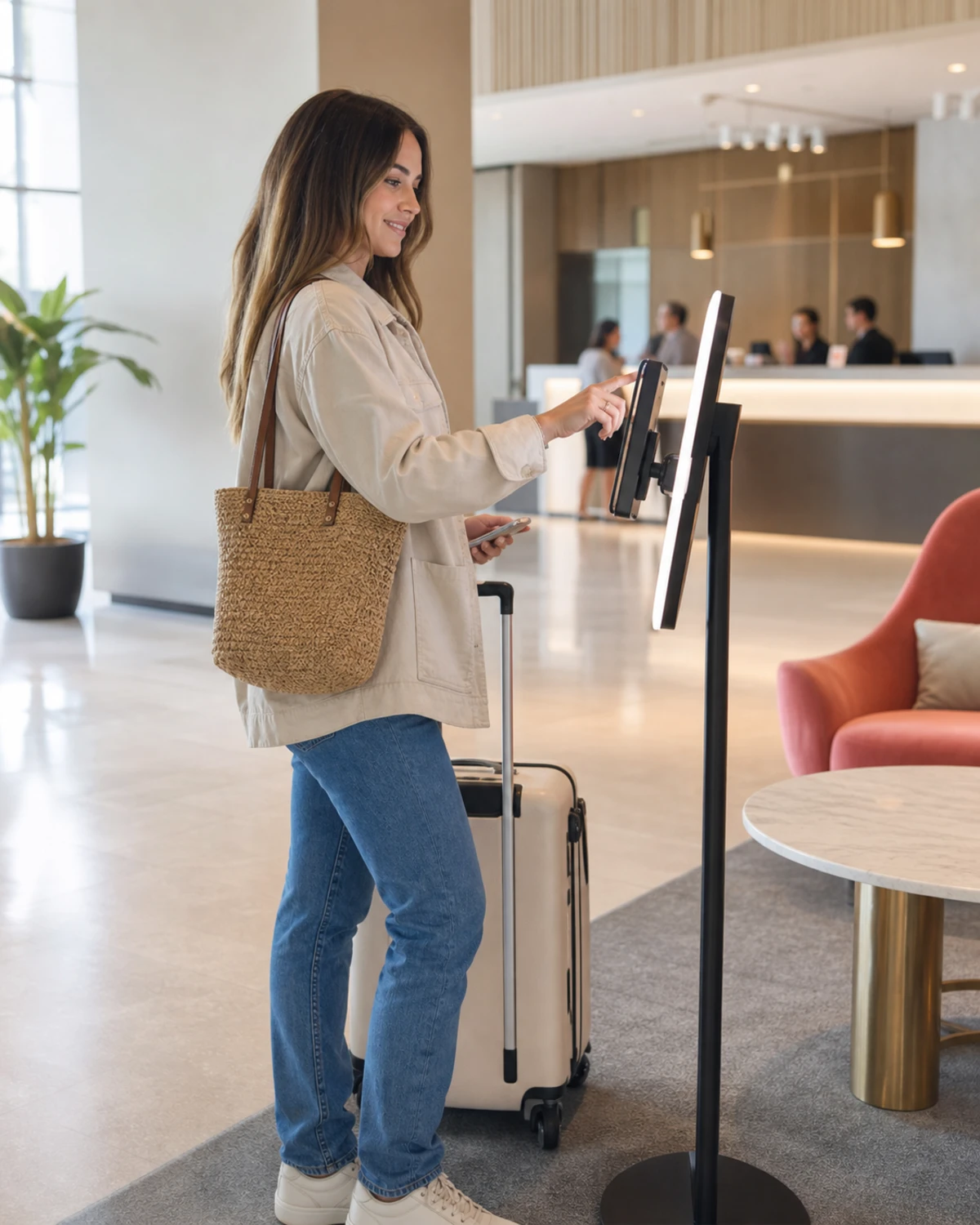
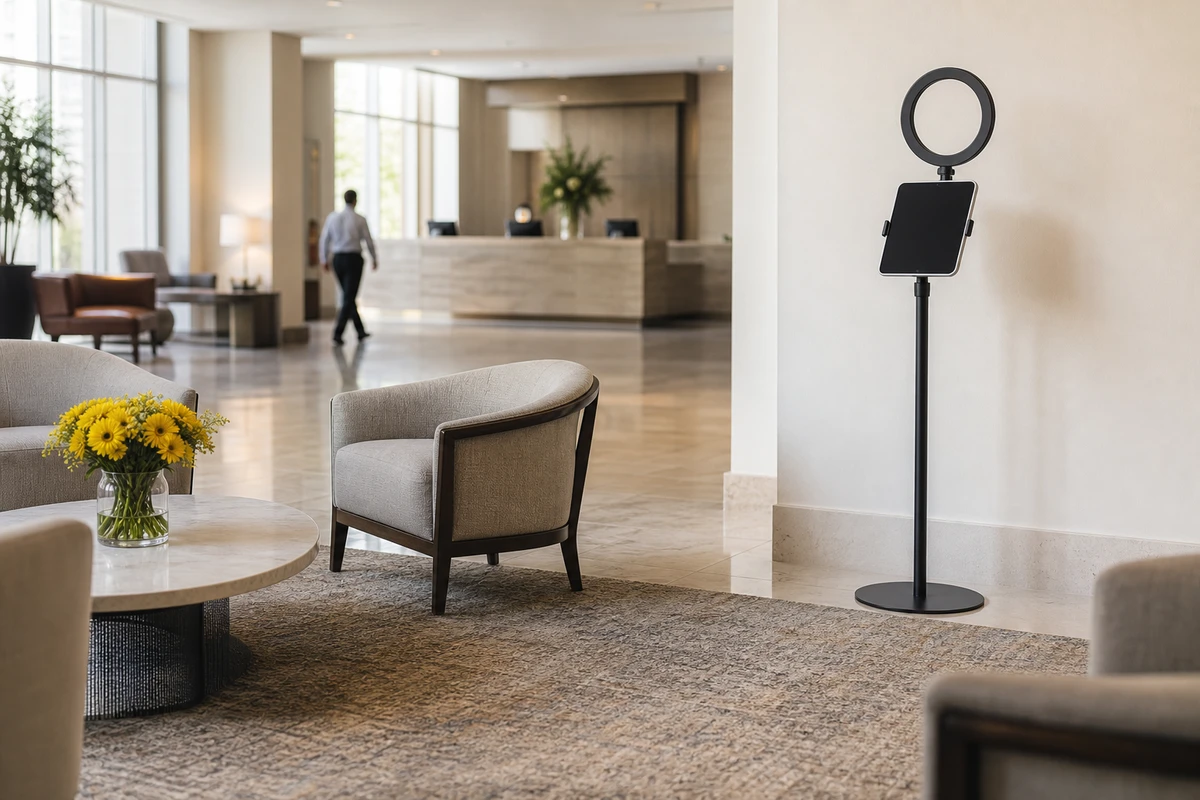
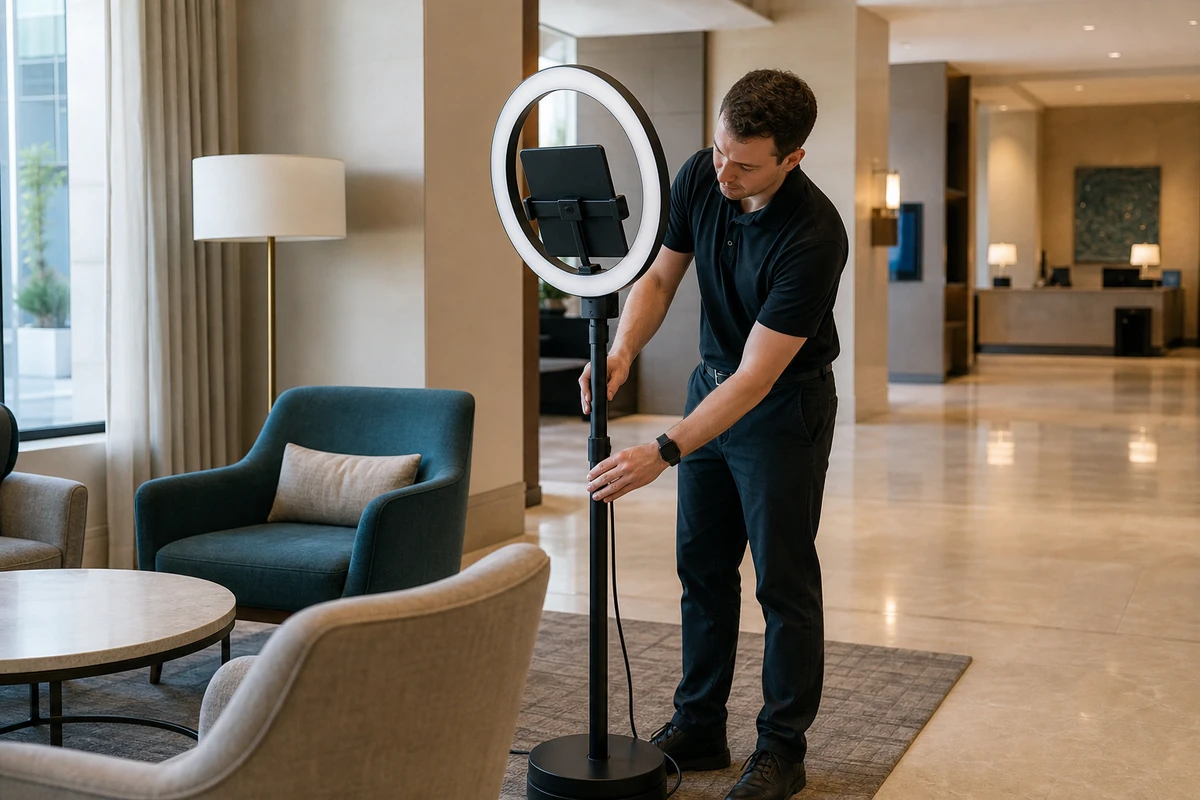
An activation that ends in an opt-in converts a one-time physical visit into a contactable relationship. When a guest gives an email address or a mobile number to receive a photo, enter a giveaway, RSVP to an event, or join a local-perks list, the hotel gains first-party data: contact information given willingly and owned outright, not rented from an online travel agency. Every activation in the earlier sections can carry an opt-in. A photo activation can deliver the image by email or text. A contest takes entry by sign-up. A workshop runs on an RSVP list. Simple Booth’s HALO kit is one version of the photo route built for a permanent lobby install: a guest taps an email address or phone number into the iPad station to receive their picture, and that contact detail is the opt-in. The W Hotel Austin runs an ongoing HALO deployment that has logged 31,730 participants to date.
The arithmetic is worth running
The arithmetic is worth running. Take a mid-size hotel that sees a few hundred people through its lobby on a busy day, and a recurring weekend activation built around an opt-in. Suppose 250 lobby visitors engage with it over a weekend and 35% leave a contact detail. That is roughly 88 new contacts. (The 35% rate here is an illustrative figure, not a measured hospitality benchmark; a property’s real rate depends on the activation and the size of the ask.) Run that activation on monthly weekends and the list grows by about 1,000 contacts a year, at close to zero media cost.
The value shows up on the back end. Online travel agencies typically take 15% to 25% of a booking’s value in commission, as the vendor Little Hotelier documents, so a guest who books again through the hotel’s own email list instead of an agency keeps that money in the building. That commission math is much of why email stays a high-return channel for hotels; Revinate, which sells hotel email software, puts the return from its platform data at $38 for every $1 spent, a vendor figure that nonetheless points the right direction.
Suppose 3% of that 1,000-contact list books a direct repeat stay. If each direct booking keeps roughly $180 in commission on a multi-night stay that an agency would otherwise have taken, the activation recovers about $5,400 a year, through a channel the hotel owns rather than one it rents. An operator whose lobby runs heavier traffic, or whose room margins sit higher, will land on a larger figure; the structure holds whatever the inputs.
Program With Restraint, and Measure What You Run
More programming is not better. An Independent Lodging Congress panel, reported by CoStar, made the point that programming and activation are “the answer” for lobbies, but that “too much programming can have the opposite effect, offsetting or displacing guests.” Every listicle adds ideas. Few admit that a lobby crowded with events stops working for the guest who simply wants to check in, sit down, and decompress after a flight.
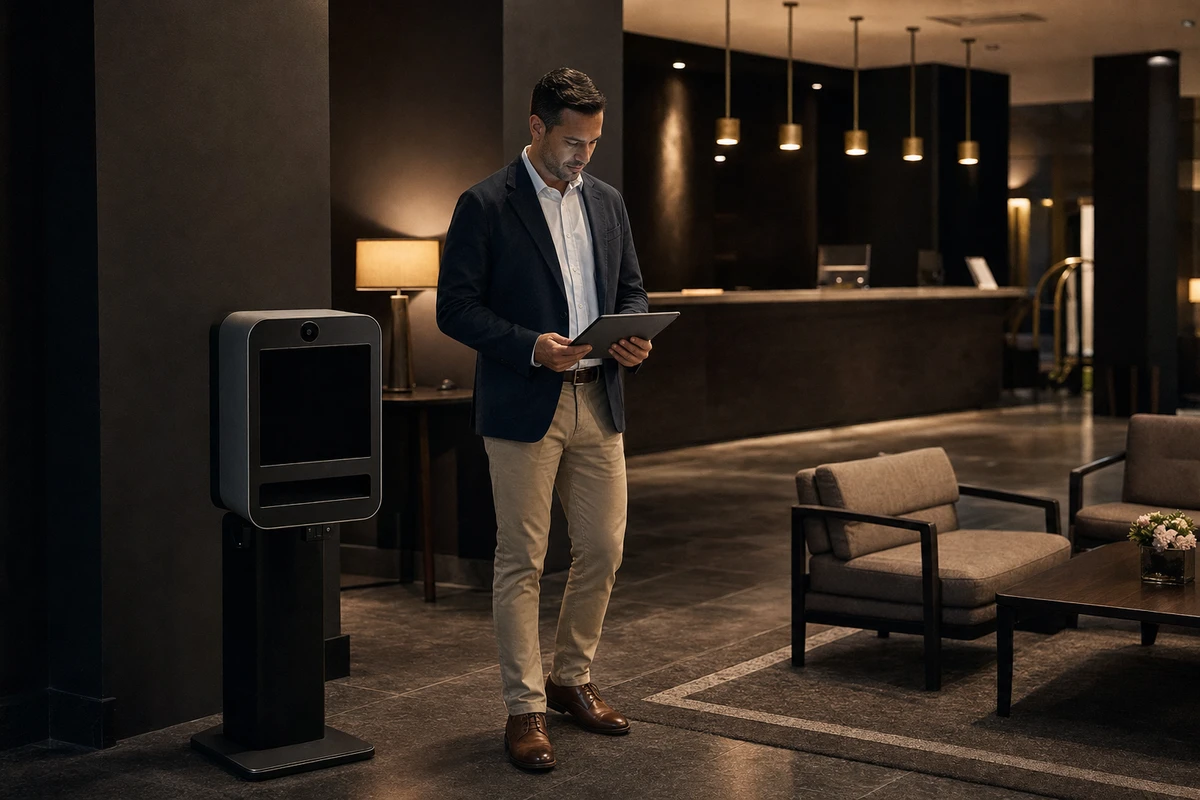
A few guardrails keep activation from tipping into clutter. Zone the lobby so an activation never blocks check-in sightlines or the main circulation path. Schedule activations into genuine dead hours, the empty Tuesday afternoon rather than the peak evening arrival window. Match the energy to the time of day, calm in the morning, social in the evening. Keep any single activation time-bound so the space resets to a quiet default between runs. And apply one decision rule before anything goes on the calendar: if an operator cannot name the activation’s primary job from the four, the activation should not run.
Naming the job also fixes measurement, because each job carries an obvious metric:
- Dwell-time revenue: food and beverage covers and average spend during activation windows, compared against a normal baseline.
- Local foot traffic: door counts or non-guest covers, and how many local faces return.
- Shareable content: tagged posts, location check-ins, volume of guest photos, and review mentions of the lobby.
- First-party guest data: opt-ins captured per activation, and per hour of staff time spent running it.
None of these requires new software
None of these requires new software. They require deciding what the activation was for before it runs, then checking the number after. The hotel lobby is not décor waiting to be admired between check-ins. It is a recurring, measurable surface, and the operators who get the most from it are the ones who program it on purpose and keep score. Sources
- HotelsMag (2022). “Activating the Lobby.” https://hotelsmag.com/news/activating-the-lobby/
- Hotel Management Network (2020). “Rubbing Shoulders: The Hotel as Social Hub.” https://www.hotelmanagement-network.com/features/hotel-social-spaces/
- BizBash (2018). “Experiential Activations: Hotel Brand.” https://www.bizbash.com/experiential-marketing/experiential-activations-hotel-brand
- Prostay (2025). “25 Hotel Lobby Ideas for a Memorable Arrival Area.” https://www.prostay.com/blog/hotel-lobby-ideas/
- Revinate (2025). “Hotel Email Marketing.” https://www.revinate.com/channels/hotel-email-marketing/
- Little Hotelier (2024). “The Complete Guide to OTA Commission Rates and Fees.” https://www.littlehotelier.com/blog/get-more-bookings/make-ota-commissions-less-painful-small-hotel/
- CoStar. “How Hoteliers Make Lobbies Somewhere People Want to Be.” Subscription required; quote attributed via CoStar reporting of an Independent Lodging Congress panel.