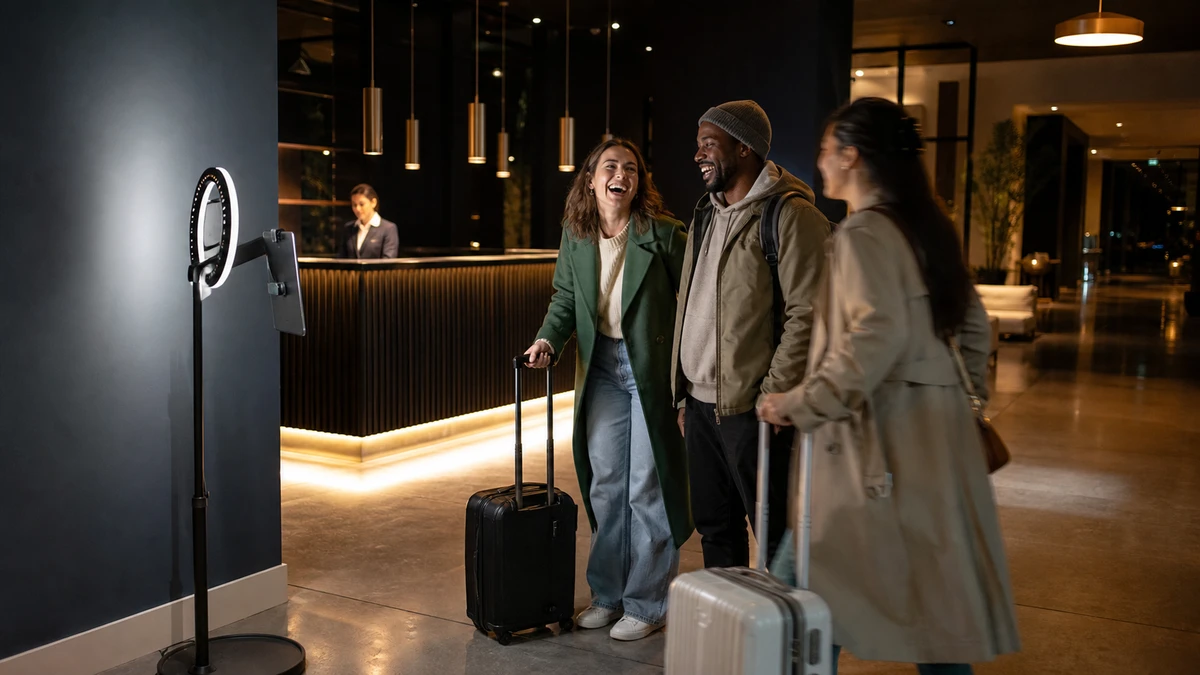
A guest lands after a long flight, drops their bags upstairs, and drifts back through the lobby. A few steps from the front desk sits a small branded photo station. They step in, the screen counts down, and once the picture is taken it asks one question: where should we send this? They tap in a phone number. The photo arrives by text before the elevator doors open.
That final step is the whole point. A hotel guest photo activation is a branded, on-property photo experience built to capture a guest’s contact details at the moment it hands them their photo. Its value is not the picture itself, and it is not the social tag. The value is the working phone number or email address the delivery step produces, along with the consent attached to it. That contact belongs to the hotel outright, with no platform in the middle.
An online travel agency booking gives a property far less. The OTA keeps the guest profile, the booking history, and the stated preferences. The hotel receives a name and an arrival date. A photo activation is built to close that gap.
What a Guest Photo Activation Actually Is
Plenty of hotels have installed a striking mural near the elevators or a neon sign in a stairwell. Guests photograph it for years. The hotel never learns a single thing about any of them. The wall produces photographs and captures nothing, because there is no step where the guest and the property exchange anything.
A guest photo activation is built around that missing step. It is a system with three parts, not a decorative amenity. The first is a capture device, a camera and a screen, either fixed in place or portable. The second is a delivery layer, the text message or email link the guest receives to retrieve their photo. The third, and the one hotels most often forget, is a destination: the list, CRM, or marketing platform the captured contact actually flows into.
The activation is easy to confuse with three things it is not. The mural from the opening produces photos and captures no contact. A branded-hashtag campaign drives posts and reach on a platform the hotel does not control. The old fishbowl business-card draw at the front desk does capture contacts, but with poor data quality and no real engagement, since guests drop a card for a prize and half the cards are illegible or invented. The activation is the only one of the four that both creates a moment a guest actually wants and ends with an addressable contact the hotel keeps. That combination is the whole design.
Owned vs Rented: Why the Instagram Tag Is the Wrong Scorecard
Most advice aimed at hoteliers tells them to chase shares. Lodging Magazine, the trade publication of the American Hotel & Lodging Association, urges operators not to underestimate the “free marketing” that social media can bring to a property. TravelBoom, a hotel marketing agency, lists the photo booth among experiential installations whose purpose is to generate shareable content. Both treat a guest photo as a social asset. That framing is the misconception worth correcting.
An Instagram tag is a rented outcome. The platform decides who sees it. The follower it produces is not addressable on the hotel’s schedule, so reaching that person again means buying an ad or hoping an algorithm cooperates. Reach can be cut, accounts change hands, and the hotel has no contract and no recourse. Guest content does move bookings (a TripAdvisor survey found 93 percent of travelers said online reviews influenced their booking decisions, reported by Revinate, though that figure dates to 2012). But influence that lives inside someone else’s platform is influence the hotel rents by the month.
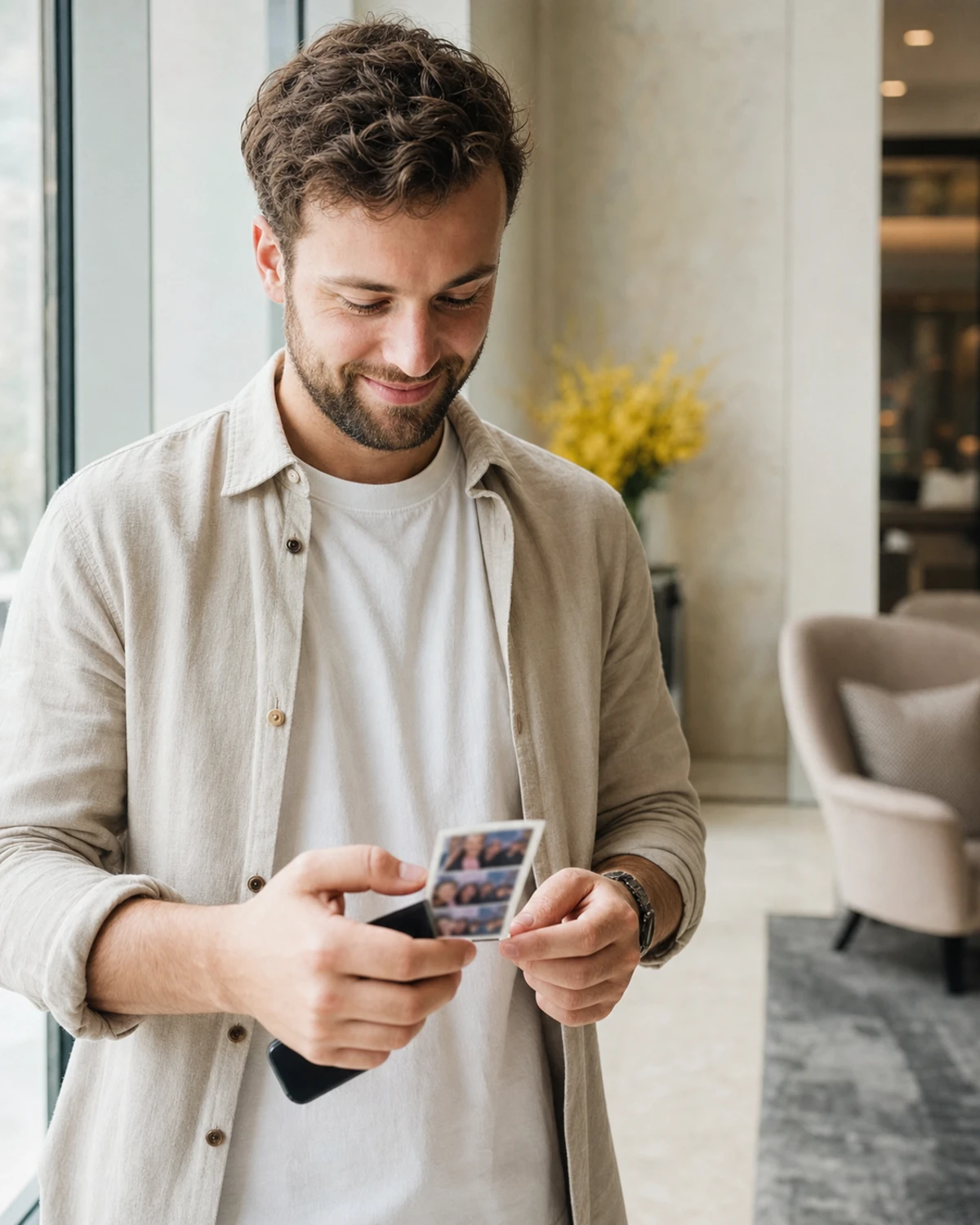
An OTA-originated guest is rented in exactly the same way. When a traveler books through an online travel agency, the agency owns the profile, the history, and the preferences, and the property is left with a name and an arrival date. The hotel paid a commission to host a guest it cannot contact directly.
Owned means something specific
Owned means something specific. It means a contact the hotel can reach on its own schedule, at no incremental cost, with no intermediary deciding whether the message arrives. A photo activation exists to move a guest from the first category to the second: from a face in a feed to a consenting email address or phone number in the hotel’s own list. An untagged photo sitting on a guest’s camera roll is worth almost nothing to the property. The activation’s job is to make sure the hotel is a party to the moment, not a bystander to it.
The Mechanism: Why Photo Delivery Is the Highest-Yield Opt-In on the Property
Watch a front desk ask arriving guests to join the newsletter. Guests who do not want email say no. A few who do not want to seem rude write down a real-looking address they will never open. The card asks for something and offers nothing back in the same breath, so the contacts it collects are thin and the data is unreliable.
Consent
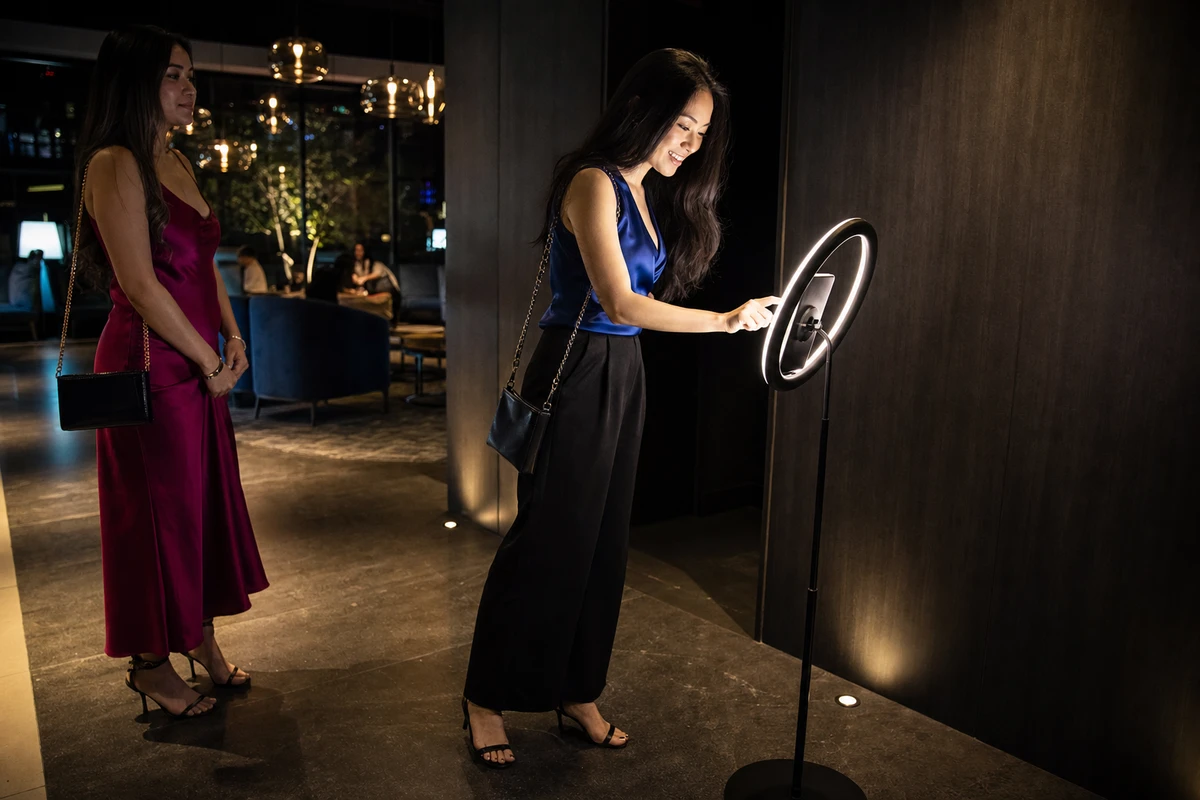
A photo activation inverts that exchange. The guest genuinely wants the photo. To receive it, they have to enter a real, deliverable phone number or email, because a fake one means the photo never arrives. The incentive and the capture are the same action. The guest is not doing the hotel a favor; the hotel is doing the guest one, and the contact details are simply how the favor gets delivered. Consent is native to the moment instead of bolted onto it.
That is why both the yield and the data quality beat the alternatives a hotel already runs. The newsletter card offers no reciprocal value. A QR code pointing to a signup form adds friction between the scan and the submit, and people drop off in that gap. The photo-delivery screen asks for a contact at the one second the guest most wants the hotel to have it.
The contacts it captures also stay reachable. SimpleTexting’s 2025 survey of US consumers and businesses found that 82 percent of people check a text within five minutes of receiving it, and that 69 percent of hospitality businesses report SMS conversion rates above 20 percent. A phone number a guest actively wanted a photo sent to is a phone number that works. The principle underneath all of it is plain: people hand over a working contact when, and only when, they need a business to send them something they want. The photo is that something.
The Stack: Turning a Photo Into a CRM Record
The most common way a photo activation fails is not on the floor. It is in the back office. A hotel runs the experience for a year, collects thousands of phone numbers, and never moves them anywhere a marketer can use them. The activation produces smiles and a folder of data nobody touches. Walking the pipeline from camera to usable record shows where the contact gets lost.
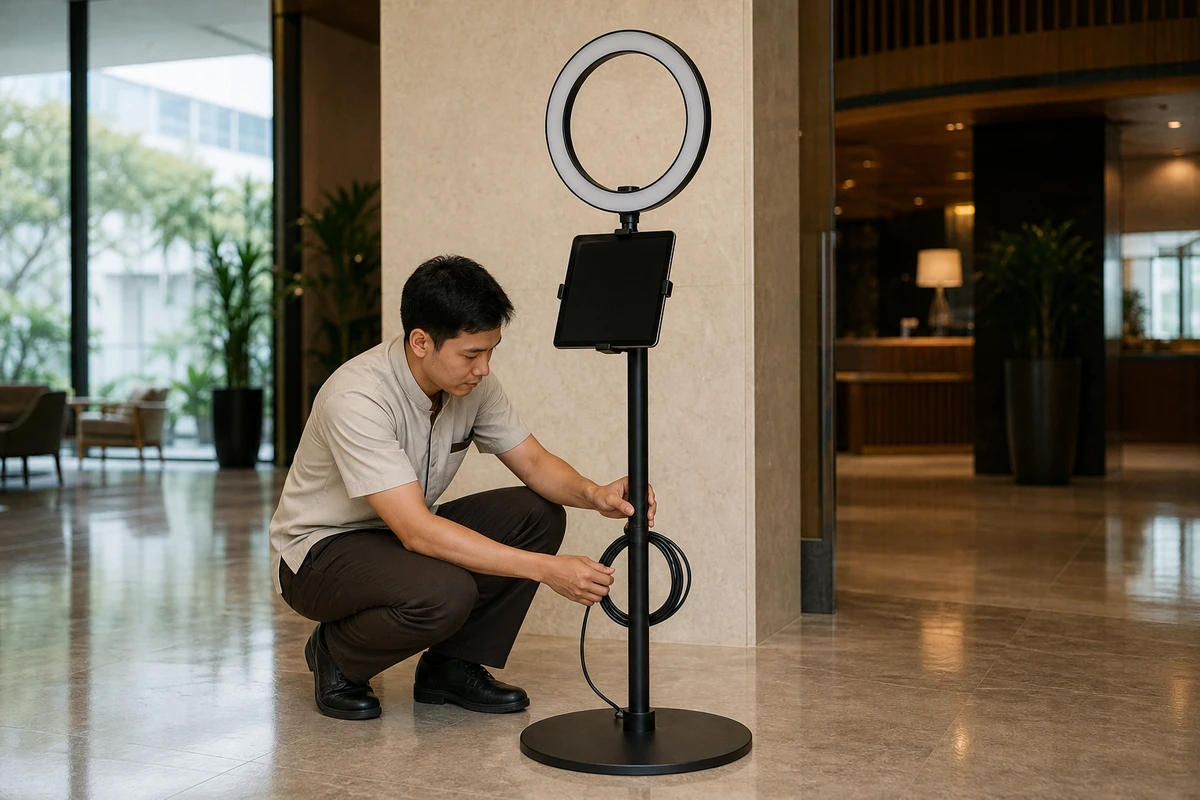
Capture device and form factor come first. A semi-permanent fixture suits a single high-traffic spot the hotel can count on, like a lobby everyone crosses. A movable kit suits a property whose best photo moments shift around the calendar, redeployed from the pool deck in summer to the ballroom in winter.
The delivery layer is the next choice: send the photo by SMS or by email. The two differ in opt-in rate and deliverability, and the trade-off deserves its own analysis, but the short version is that text tends to win on speed and open behavior while email captures a richer record.
Consent is the step a hotel cannot skip. The cleanest place to capture marketing consent is an opt-in checkbox on the delivery screen, asking permission to send future messages, because the guest is already there and already entering a contact. That checkbox satisfies the core requirement for marketing-consent capture under GDPR and equivalent privacy frameworks, though a full compliance walkthrough sits outside this article.
The last step is the handoff
The last step is the handoff. The captured contact has to route into the hotel’s email platform, CRM, or property management system. A contact that never leaves the photo-booth software is data the hotel holds but cannot market to. One practical wrinkle sits underneath all of this: guest Wi-Fi in lobbies and pool decks is often unreliable, so a system that can capture offline and sync when the connection returns is worth checking before signing anything. Simple Booth’s HALO kit, for one, runs an offline upload queue: photo sessions captured while the connection is down stay on the device and upload once it returns, so a contact a guest enters on a dead lobby network still produces a delivered photo.
Where on the Property the Activation Earns Its Contacts
The instinct is to place the photo station wherever the design team built the prettiest corner. The more useful question is where guests already want a photo without being prompted, because that is where the honest exchange from the previous section happens on its own.
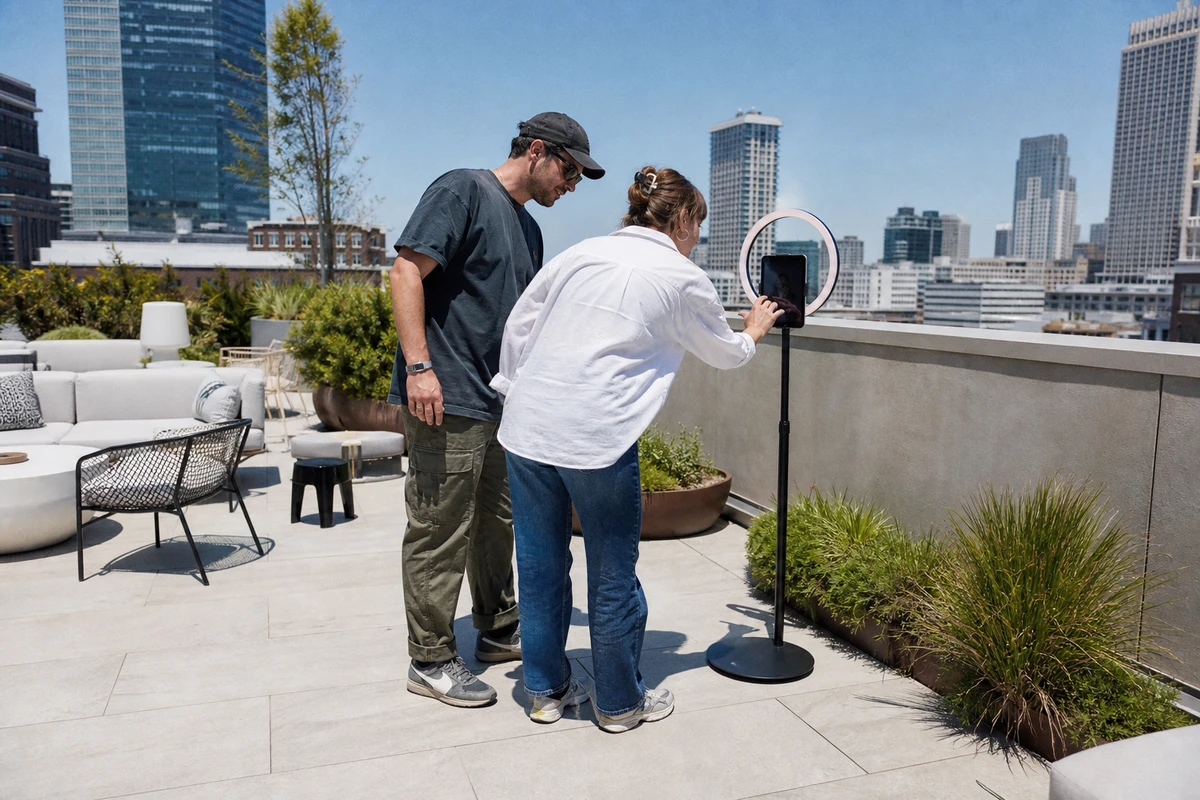
Four zones cover most properties, and each trades volume against intent. The lobby sees every guest who stays, which makes it high-volume, but photo intent there is only moderate, since many guests are tired or in a hurry. The pool deck or rooftop sees fewer people, but photo intent runs high and the backdrop does the selling. Event and conference spaces deliver concentrated bursts of sessions from a captive audience already in a photo-taking mood. The bar or restaurant offers something the others do not: repeated, social exposure across a multi-night stay, so a guest who skipped the activation on the first night may use it on the third.
The funnel logic holds in every zone. The best spot is wherever guests already want a picture, because that is where they will most willingly hand over a working contact to receive it.
What an Owned Contact Is Actually Worth
A general manager weighing the activation against next year’s budget wants a number, not a feeling. The arithmetic below runs on labeled assumptions a property can swap for its own.
Start with a 200-room hotel running at 63 percent occupancy, roughly the 2025 US average reported by SiteMinder, citing STR data. That works out to about 3,780 occupied room-nights a month. At an average two-night stay, the property hosts close to 1,900 separate guest stays, which is 1,900 chances for the activation to do its work.
Suppose 20 percent of those guests engage with it. No public benchmark for photo-experience engagement exists, so that figure is one to test, not a promise. Twenty percent is about 380 sessions a month. Suppose 65 percent of those sessions end with a delivered, opted-in contact, again a labeled assumption. The hotel adds roughly 250 owned contacts a month, about 3,000 in the first year.
Now the value of one contact
Now the value of one contact. An OTA booking at a $160 average daily rate (a labeled US-average estimate, also derived from SiteMinder’s figures) carries a commission typically cited in the 15 to 30 percent range by hotel marketing analysts. At 20 percent, the agency keeps $32 of every $160 night, and it keeps that $32 again on the guest’s next stay, because the relationship sits on the OTA’s side of the transaction.
A contact on the hotel’s own list behaves differently. The same hotel marketing analysis puts the cost of acquiring an email or SMS subscriber through ordinary channels at $20 to $50 each. A photo activation acquires that same contact for close to nothing, because the photo, not a discount or a paid ad, is the incentive. The 3,000-contact list that would cost $60,000 to $150,000 to build through paid acquisition instead costs the hardware and the staff minutes to keep it running.
From there the math compounds
From there the math compounds. At a modest 3 percent annual rebooking rate, a list of 3,000 contacts produces about 90 direct bookings a year. If each is a two-night stay at $160, that is $28,800 in revenue the hotel routes directly. Booked through an OTA at 20 percent, those same stays would have cost about $5,760 in commission. The hotel keeps close to that figure every year, against the cents it costs to send the messages, and the saving grows in step with the list as the activation keeps running. Direct bookings carry a second, quieter advantage: hotel marketing practitioners note that OTA reservations cancel at roughly double the rate of direct ones, so an owned-list booking is also a more dependable one.
Measuring Whether the Activation Is Working
A manager walks past the activation at 6 p.m., sees a group laughing inside it, and concludes the thing works. Smiling guests are not a metric. An activation earns its place on three numbers, and they belong in a specific order.
Engagement rate
The first is engagement rate: photo sessions divided by the guests who passed the activation. The second is opt-in rate: delivered, consented contacts divided by photo sessions. Those two measure whether the activation is healthy, whether guests use it and whether using it produces a contact.
Owned-List Growth
The third number is the one that justifies the spend: owned-list growth, and the direct bookings or rebookings the hotel can attribute to that list. A property tracking only the first two metrics is flattering itself, because a busy activation that never produces a booking is an expense, not an asset. Revinate’s 2026 hospitality messaging benchmark offers a reference point for what a captured contact does next: hotels on its platform see a 19.5 percent messaging engagement rate against a 3 percent annual opt-out rate, which means a contact captured well tends to stay reachable for a long time.
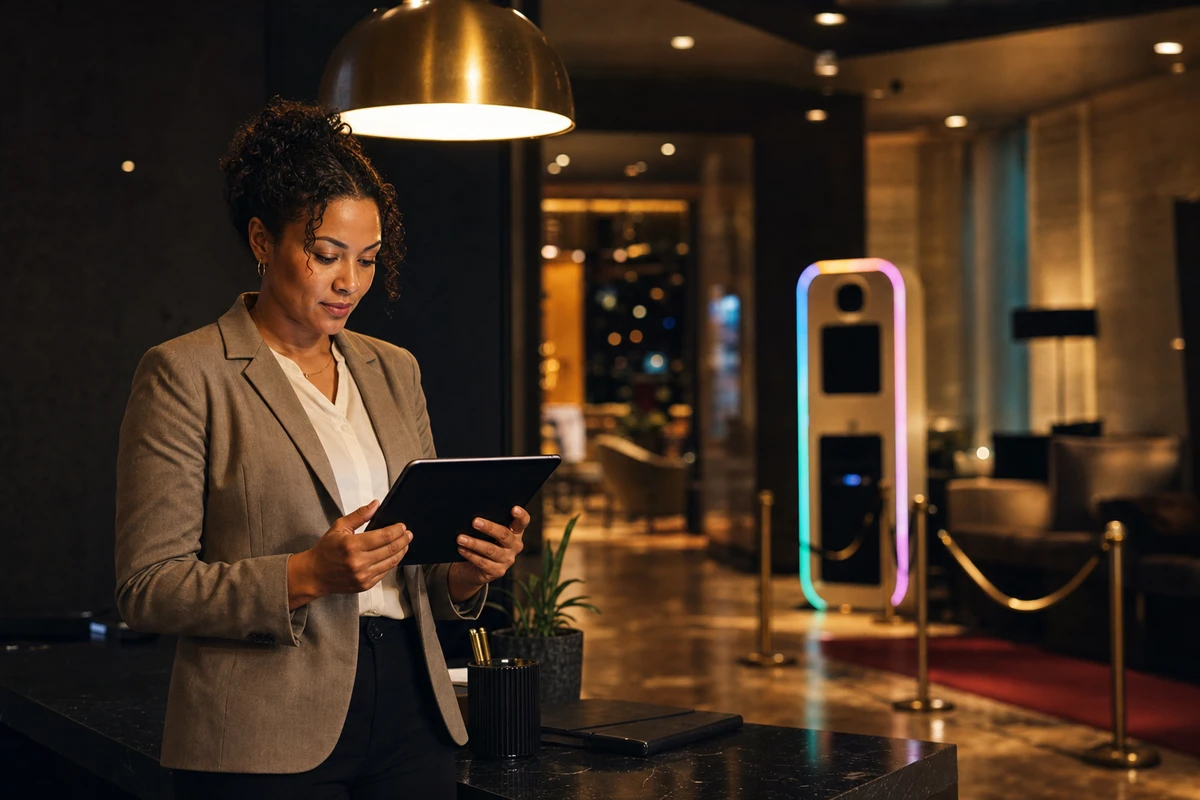
The reframe to keep is simple
The reframe to keep is simple. The photo is the bait. The contact is the catch. A hotel that wants to know whether the activation is working should count the catch.
Sources
- Americas Great Resorts. “How Luxury Resorts Reduce OTA Dependence With Email Marketing: The Real ROI of Direct Booking Strategy.” https://www.americasgreatresorts.net/how-luxury-resorts-reduce-ota-dependence-with-email-marketing-the-real-roi-of-direct-booking-strategy/
- Revinate (2014, citing a TripAdvisor 2012 survey). “User-Generated Content in Hospitality.” https://www.revinate.com/blog/user-generated-content-hospitality/
- Revinate (2026). “Messaging Channel Benchmark Report, North America.” https://www.revinate.com/hospitality-report/messaging-channel-north-america/
- Lodging Magazine, American Hotel & Lodging Association. “Five Ways to Inspire Instagrammable Moments in Hotels.” https://www.lodgingmagazine.com/five-ways-to-inspire-instagrammable-moments-in-hotels/
- TravelBoom Marketing. “Experiential Marketing for Hotels.” https://www.travelboommarketing.com/blog/experiential-marketing-for-hotels/
- SiteMinder (2025, citing STR/CoStar data). “Hotel Industry Statistics.” https://www.siteminder.com/r/hotel-industry-statistics/
- SimpleTexting (2025). “Texting and SMS Marketing Statistics.” https://simpletexting.com/blog/2025-texting-and-sms-marketing-statistics/