
Most photo booth analytics articles are glossaries of the same ten metrics. They are also addressed to the wrong reader. A commercial photo booth operator and the operator’s client need different dashboards, and real-time telemetry is a third category again. Confuse the three and you will either run your business on event-planner metrics (and lose money) or hand a client a post-event report that their own social team can debunk in an afternoon. This article separates the layers, walks through each KPI with honest benchmarks, and flags the two mistakes (inflated impressions and real-time addiction) that cost operators accounts they thought were safe.
The analytics stack has three layers, not one
The metrics an operator uses to run the business are not the metrics a client uses to judge one event, and neither of them are the numbers that flash on the booth’s admin screen mid-event. Treat them as one dashboard and each layer gets worse.
- Operator KPIs are cumulative and internal. Booth-month utilization, revenue per booth-day, gross margin per event, repeat-client rate. The operator reviews these monthly or quarterly, and nobody outside the company ever sees them.
- Per-event KPIs are external and land in the client’s inbox within 48 hours. Participation rate, delivery completion, opt-in rate, share rate, assets delivered. These are the numbers a CMO or event sponsor defends in their own debrief.
- Real-time telemetry is operational. Queue length, battery, connectivity, email delivery queue. It exists so the attendant can fix problems in minutes, not so the client can “watch the activation work” on a second screen.
A fourth layer sits on top of these: cohort analysis across events, clients, and venues. Almost no one in the category does this well, which is the opportunity the second half of this article is about.
The distinction is not academic. A vendor real-time dashboard that tries to serve all three audiences produces a fleet view too coarse to price capex against, a client deliverable too vague to defend, and a staff screen cluttered with numbers the attendant cannot act on. Stitch the layers together in a spreadsheet and each layer becomes clear. No booth-app vendor in 2026 produces all three in one system, regardless of what the product page says.
What real-time dashboards are good for, and what they are not
Real-time analytics is operational telemetry. The window the operator is looking at is the next fifteen minutes. Useful questions it answers: is the queue getting long enough that time-constrained guests are bailing, is the booth still reaching the email provider, is the printer ink running low, is one attendant handling a surge that needs two.
It is not campaign measurement. A two-hour window inside a four-hour event has no statistical power to tell a client whether the activation worked. And staffing decisions were made before the truck left the warehouse, not at minute 47.
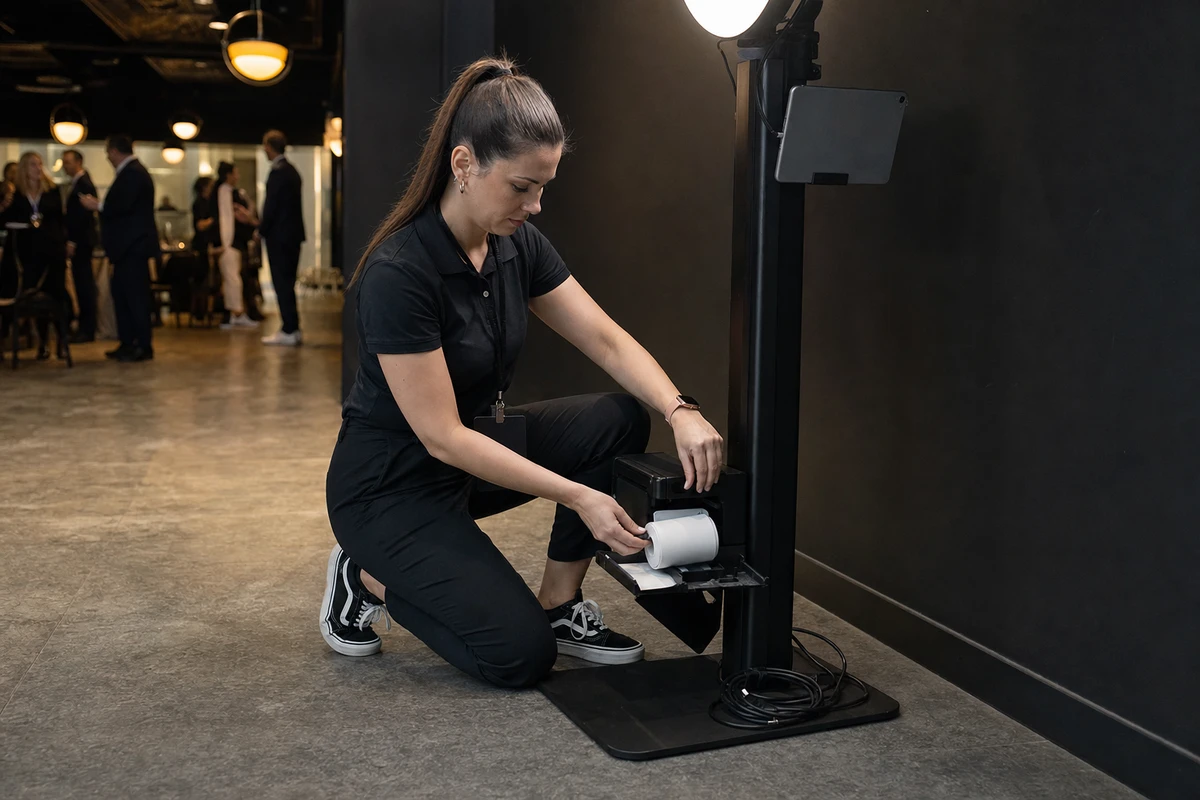
The pattern that trips operators up is the “live analytics screen” they put in front of the client during the event. It either becomes a content wall (a perfectly fine guest engagement tool, but label it as that, not as analytics) or it becomes a vanity screen that pulls the attendant’s attention away from the actual operational problem on the other side of the room. If a client asks for one, be clear about what it is and what it is not. The useful conversation with that client happens 48 hours later, with a report.
Operator KPIs: the business-health dashboard
These are the metrics that tell the operator whether the business is healthy. They never appear in a client deliverable.
Booth utilization rate
Booked event-days divided by bookable event-days per month or quarter. Operator community references cite roughly 25 events per booth per year as a typical operator number, consistent across Photobooth Supply Co. and Kande Photo Booths’ 2026 compilation. Weekend-slot utilization is usually the number that matters, because spring-summer weekends concentrate most of the annual calendar.
Revenue per booth-day
Gross revenue divided by active days. This catches the idle-inventory problem that utilization alone can mask. A booth that ran five high-ticket events beat a booth that ran ten low-ticket ones, even though the second booth looks busier on the calendar.
Gross margin per event
Revenue minus attendant labor, travel, consumables, platform fees, equipment depreciation. Operator blogs sometimes quote headline numbers in the 200–400% range over direct event cost, but no publicly available survey documents the methodology for that figure and several of its common citations quietly leave out depreciation, insurance, storage, and marketing overhead. Build the number from your own P&L rather than repeating the category number.
Repeat-client rate and client LTV
The percentage of quarterly revenue from clients booked in the prior year. One-shot clients barely cover acquisition cost in most markets. Multi-event clients are where the margin lives.
Inquiry-to-booking conversion
Leads in divided by contracts out. A low conversion rate with plenty of inquiries means the pricing page, the sales call, or the proposal is the drop-off point. This is the KPI that decides whether the next investment is marketing spend or sales process.
Cancellation and no-show rate
A useful signal on pricing model health. Deposits too low invite late cancellations, deposits too high suppress booking volume in a way that does not show up until the fourth quarter.
A worked example to make the numbers concrete: one booth, 25 events a year at a $600 average (within the $400–$1,000 range reported across Kande and Photobooth Supply Co.), produces $15,000 of gross annual revenue per unit before costs. Three booths rarely produce three times that figure at realistic weekend-season utilization, because the third booth cannibalizes weekend slots you would have otherwise sold on the first two. The question “should I buy a fourth booth” is answered by weekend utilization on booths one to three, not by last year’s revenue line.
Per-event KPIs: the client-facing report
These are the numbers the operator puts in the 48-hour post-event deliverable. Each one has to be comparable to the client’s other activations, which means using definitions the client’s marketing team will accept.
Participation rate
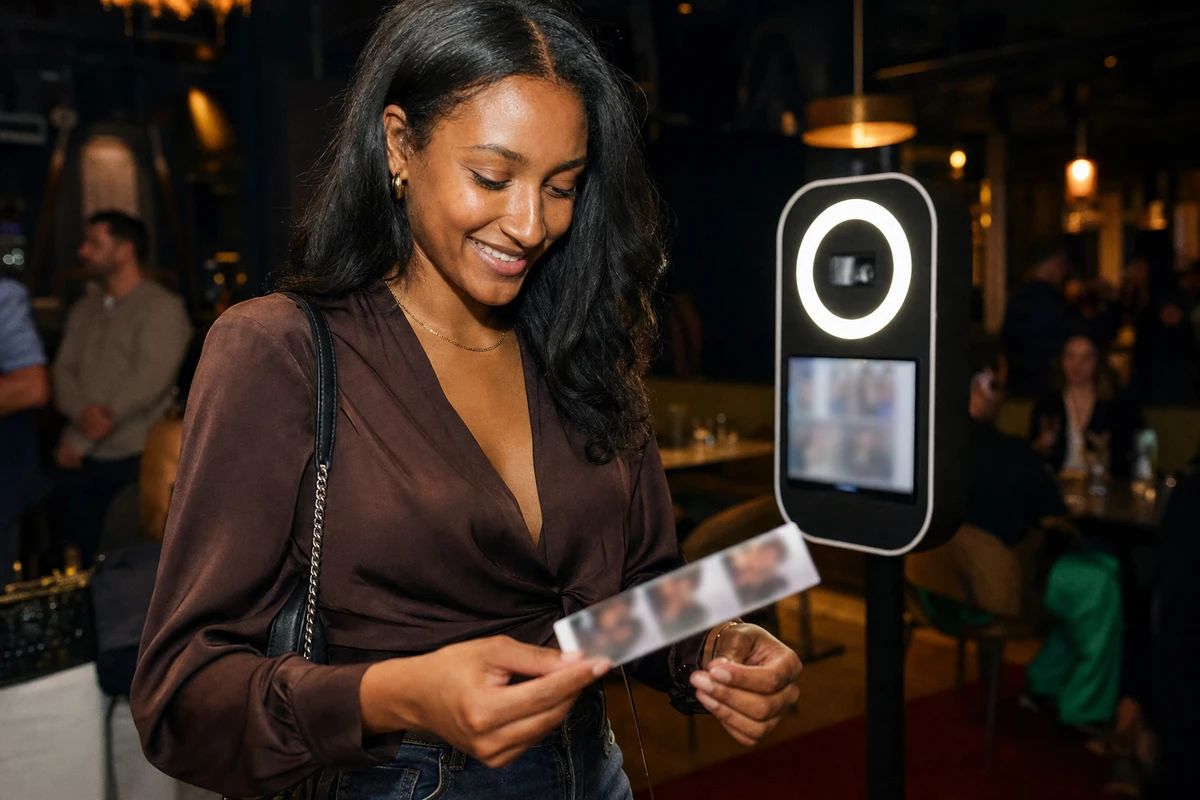
Sessions divided by estimated attendees. Operator blogs consistently cite 60–80% at corporate events and 40–60% at larger public events as “well-placed booth” benchmarks (Feature Booth, Vancity Photo Booth). These are operator community numbers, not independently audited research, and they require an honest attendee count to mean anything. Corporate events with a registration list make this easy; public festivals where the venue guesses at attendance make the rate directional at best.
Delivery completion rate
Sessions that resulted in at least one delivered photo to the guest. This is the single most predictive operational metric and it is missing from almost every competing vendor article. It catches guests who abandon at the email-entry step, broken SMS links, delivery queues that backed up after the event, and DNS or provider issues nobody would otherwise know about. A 90% completion rate and a 60% completion rate in the same session count are two different events.
Capture (opt-in) rate
Contacts collected with marketing-consent opt-in, divided by sessions. The 30–50% range is the most-cited operator benchmark and it is directionally consistent with activation-agency experience. MDRN Activations, a Canadian experiential agency that publishes its own performance numbers, reports 80 opt-in emails per hour as its internal average and 320+ contacts from a four-hour event, per their ROI benchmarks post. Attribute those numbers to MDRN specifically; a mid-market operator at a 200-person regional conference will not reliably reproduce them.
Share rate
Percentage of delivered photos that the guest shared externally. Prefer platform-attributed shares over “guest said they would share.” MDRN’s sample post-event report shows 412 content shares on 623 captured contacts, or about a 66% share rate for a well-run corporate activation. That is a more honest reference than the oft-repeated “70%+ of photo booth guests share” claim, which propagates across vendor blogs without a disclosed methodology.
Assets generated
The count of usable branded creative outputs the client can reuse. Break this out by format (still, GIF, boomerang, short video) because the downstream paid-media team treats them differently. If the booth produced 847 interactions but only 212 brand-safe stills, report both numbers.
Average session duration
Report it, do not optimize it in isolation. A 90-second session at a brand launch is good; a 90-second session at a trade show with a 15-minute exhibitor window is a queue disaster. Context changes the interpretation.
The impressions inflation trap
The single biggest credibility problem in photo booth reporting is the “impressions” number. The standard formula used across vendor ROI articles is shares × average follower count. Applied without discount, it overstates actual reach by a wide margin on Instagram and TikTok, which means the client’s own social team can debunk it the first time they run an audit.
Two independent 2026 sources make the correction non-optional
Two independent 2026 sources make the correction non-optional.
Emplifi’s 2026 Social Media Benchmark Report, drawn from tens of thousands of global brands tracked on its platform, found that Instagram organic reach fell 30–40% across every post format, including Reels, in 2025. Median Instagram engagement fell from 16.9% in Q1 2024 to 9.7% in Q4 2025. Organic distribution has moved toward interest-based signals and away from follower graph by design.
Hootsuite’s 2026 Social Media Trends report is blunter: follower count has “essentially become a vanity metric.” Distribution is algorithm-led, using micro-behaviors like hover time, rewatches, and pauses to decide who sees what. The same report notes that Adam Mosseri, head of Instagram, has publicly said the metric brands should watch is reach, not followers.
Practical implication: a post shared by a guest with 2,400 followers does not deliver 2,400 impressions. It delivers whatever the algorithm decides, which is usually a minority of the follower base plus a tail of interest-matched non-followers. Two responsible approaches work better than the inflated multiplier:
- Pull actual impressions from native platform analytics when the guest posts from an account the client controls, or from a social listening tool (Brandwatch, Sprout Social, Emplifi) when the shares are user-generated and discoverable by the event hashtag.
- Apply a conservative multiplier (a fraction of follower count, not the full number) and disclose the assumption in a methodology footnote. Anchor the fraction to 2026 reach benchmarks rather than guess; the Emplifi reach decline is the reference point the client’s social team will accept.
The reputational cost of the inflated version is asymmetric. A conservative, footnoted impressions estimate keeps the account. An inflated one survives exactly as long as it takes a client-side analyst to run a hashtag audit.
Utilization KPIs: the metric that decides whether to buy another booth
Fleet-level metrics exist to answer one question: is capacity the constraint, or is demand the constraint. Three cuts matter.
Weekend-slot utilization is usually the binding one, because roughly 40% of annual bookings fall in the spring and summer peak across operator community data. A booth at 80% weekend utilization in the April-to-September window has a stronger case for capacity expansion than a booth at 50% weekend utilization and 90% weekday utilization of corporate bookings.
Booth-hour yield
Revenue divided by active booth-hours (not calendar hours). A single premium-priced booth routinely out-earns two mid-priced booths by this measure, and the calculation tells the operator which direction to scale, up-market or up-volume.
Deadhead ratio
Travel hours as a percentage of active hours. A high ratio signals either that pricing is not recovering travel cost or that the operator is chasing events outside a profitable radius. Either way, the fix is in the pricing page, not in adding more booths.
Break-even events per unit
Capex divided by average margin per event. A $7,000 iPad-based kit at $400 gross margin per event breaks even at 18 bookings, which is roughly one peak season for a well-utilized booth. The operator who knows this number stops cutting the day rate to fill the new booth, because they can see how many additional events at the lower rate it takes to pay for the purchase, and usually that calculation kills the discount.
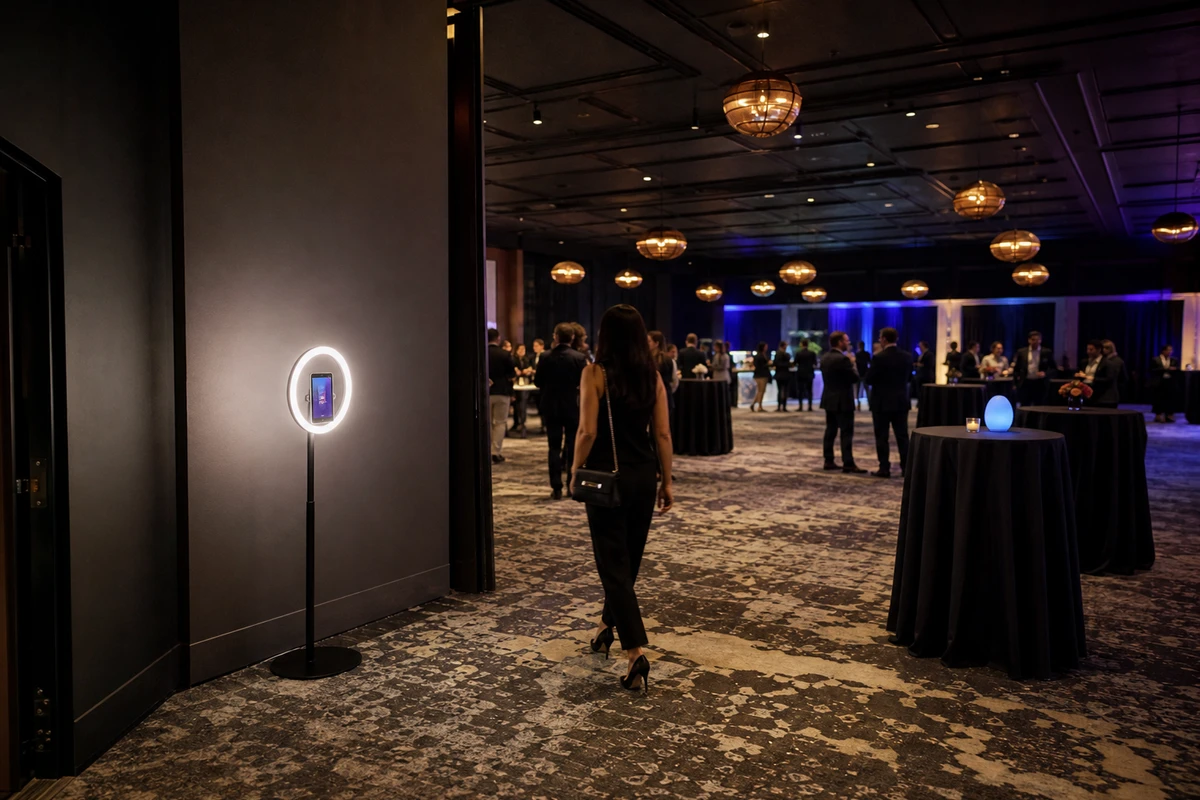
The trap to avoid: adding a booth without tracking these numbers creates a capex hole. One unit at 80% weekend utilization beats three units at 35%, and a fleet that is growing in revenue can be shrinking in margin.
Per-event reporting: the deliverable structure that drives repeat bookings
The 48-hour post-event PDF is a sales document, not an archive. The structure that works follows the same discipline as any good marketing report: headline numbers first, narrative second, assets third, recommendation fourth.

- Page one, headline numbers. Participation rate, captures, assets delivered, estimated reach with methodology stated in the same breath. One glance, no fog.
- Page two, engagement story. Share rate, top-shared images, platform split. This is what the CMO actually wants to see.
- Page three, asset library. Links and preview tiles of usable creative by format. If the client’s paid team cannot find the files within 30 seconds, they will not use them.
- Page four, recommendations. Placement tweaks, prop changes, incentive timing, based on whatever the data said about drop-off. This is the page that gets the next booking.
The timing matters more than the formatting. The client’s internal debrief happens in week one. A report that lands after that meeting has missed the conversation about next year’s budget line. MDRN’s published template delivers within 24 hours. A 48-hour turnaround is a credible commitment and a competitive advantage over operators who take two weeks.
One editorial caveat worth stating in the report itself: the impressions number has a methodology line beside it. A client who sees “54,000 estimated organic reach (methodology: shares × discounted follower multiplier of X%, based on 2026 Emplifi and Hootsuite reach data)” trusts the whole report more than one who sees “54,000 estimated organic reach” alone.
Cohort analysis: what separates a vendor from a partner
Cohort analysis is the layer almost no competing article addresses and no booth-app vendor produces natively. Mature operators run three cohort cuts, usually in a spreadsheet that pulls from both the booth app and the booking CRM.
Same client across multiple events
Q1 participation at Conference A was 68%. Q3 participation at Conference A fell to 52%. What changed? Booth placement moved from near registration to near the lunch buffet. Attendance shifted to a more B2C audience. A prop set that delighted engineering in Q1 fell flat with marketing in Q3. The cohort cut isolates the cause and turns the conversation with the client into “here is the $1,200 line item that recovers the delta,” which is a much easier approval than “please pay us again.”
Same venue across clients
Which placements at which venues produce which participation rates, regardless of which client is running the activation. This is the operator’s proprietary IP after a few years in business and it prices repeat-venue events more intelligently than any general benchmark.
Same configuration across time
A prop library or overlay template that performed in January may degrade by July because it feels stale to a returning corporate audience. This is why experienced operators rotate content sets on a schedule, rather than treating the best-performing template as permanent.
A concrete numeric example to make the value visible: a client runs an identical conference booth in Q1 and Q3 with the same spend. Q1 delivers 544 sessions at 68% participation. Q3 delivers 416 sessions at 52%. Cost per session has risen 31%. Without cohort analysis, the operator says “the second event underperformed” and hopes for a renewal. With cohort analysis, the operator says “placement changed, here is the fix, the add-on is $1,200,” and the client buys the fix because the delta is measurable.
The limitation is real. No vendor app produces this view. Cohort analysis requires exporting from the booth app and the booking CRM into a spreadsheet or a light BI tool (Looker Studio, Metabase, or plain Google Sheets). The operators who do it are the ones who graduate from vendor to partner in their clients’ eyes.
The tools that produce each layer
A practical mapping of layer to tool. Not a product review, a responsibility matrix for the operator building the stack.
- Real-time operator telemetry. The booth app’s admin panel. Simple Booth, Snappic, dslrBooth and comparable iPad and DSLR apps all handle this layer.
- Real-time client-facing display. Live-feed mosaics and content walls. Guest engagement, not decision-grade data. Label them accordingly.
- Per-event client report. Booth-app export for session-level data plus a social listening source for impression ground-truth. Brandwatch, Sprout Social, Emplifi, or the account owner’s native platform analytics.
- Operator fleet KPIs. Booking and CRM tools. BoothBook and Check Cherry are the two most-cited in operator communities and both handle bookings, unit availability, staff assignments, invoicing, and revenue reporting. Neither produces booth-level activation metrics (session counts, opt-in rate, share rate), and that is the intended design. Do not try to reconstruct fleet utilization from booth-app data or the other way around.
- Cohort analysis. Spreadsheet or BI tool. Exports from the above two stitched together on a shared client ID.
The correction to internalize: “one dashboard for everything” is marketing copy. In 2026, every serious operator runs two to three tools and a spreadsheet. That is not a failure of the market, it is the shape of a problem that actually has multiple readers.
Misconceptions that cost operators real money
Five recurring errors worth naming plainly.
Vanity metric trap
Total photos taken and total seconds of engagement are the two numbers that look best on a slide and predict the least about repeat bookings. Capture rate and delivery completion rate predict repeat bookings.
Impressions inflation
Shares times average follower count with no discount factor. The client runs a social audit after the third quarterly report and the account goes cold. Cover the methodology in every report.
Real-time addiction
Watching a live dashboard during an event does not improve outcomes. Staffing, placement, and prop decisions were made pre-event. The real-time view exists for operational fire-fighting, nothing else.
Missing the operator layer
Event-planner clients never ask about booth utilization. Operators who never track it tend to decline over a few years, usually while adding capacity they cannot fill.
Demographic machine learning presented as data
Age and gender estimation from face photos has documented error rates that vary by race, age, and sex. The US National Institute of Standards and Technology’s Face Recognition Vendor Test Part 3 report (NISTIR 8280, 2019) tested roughly 200 algorithms from 100 developers across more than 18 million images and documented materially higher error rates for non-white faces, women, and children in most tested systems. Use those outputs as directional atmosphere in the booth’s own settings (crowd skew toward younger or older, for instance) and never as a reported figure in a client deliverable. Reporting a demographic breakdown as fact is a compliance problem waiting to happen.
What to track next week, if nothing else
If you do nothing else with this article, track three numbers.
- Participation rate per event. The single number clients argue about. Define attendees honestly.
- Weekend-slot utilization per booth. The single number that decides whether to add capacity.
- Repeat-client rate per quarter. The single number that predicts whether the business is compounding.
Three metrics tracked weekly beat thirty metrics nobody reviews. Add delivery completion rate when the first three are running cleanly. Add cohort analysis the quarter after that. Everything else is either a derivative of these or a distraction from them.
Sources
- Emplifi (2026). “Median Brand Follower Counts on TikTok Increased 200% YoY, While Instagram Organic Reach Declined” (2026 Social Media Benchmark Report press release). https://emplifi.io/press/median-brand-follower-counts-on-tiktok-increased-200/
- Newberry, C. / Hootsuite (2026). “The 18 Social Media Trends to Shape Your 2026 Strategy.” https://blog.hootsuite.com/social-media-trends/
- National Institute of Standards and Technology (2019). Grother, P., Ngan, M., Hanaoka, K. Face Recognition Vendor Test (FRVT) Part 3: Demographic Effects, NISTIR 8280. https://www.nist.gov/programs-projects/face-recognition-vendor-test-frvt
- Photobooth Supply Co. (2025). “21 Surprising Photo Booth Industry Stats.” https://blog.photoboothsupplyco.com/photo-booth-industry-21-surprising-statistics
- Kande Photo Booths (2026). “Photo Booth Industry Statistics 2026.” https://www.kandephotobooths.com/blog/photo-booth-industry-statistics/
- MDRN Activations (2025). “How Experiential Marketing Agencies Use Photo Booths to Prove ROI.” https://www.mdrnphotoboothcompany.com/blog/how-experiential-marketing-agencies-use-photo-booths-to-prove-roi
- Feature Booth (2025). “Event Photo Booth 2025: Maximize Engagement & ROI Guide.” https://www.featurebooth.com/post/event-photo-booth-2025-maximize-engagement-roi
- Vancity Photo Booth (2026). “How to Measure Photo Booth ROI: Metrics That Actually Matter.” https://photoboothvancity.ca/how-to-measure-photo-booth-roi-metrics-that-actually-matter/
- BoothBook (2026). “Browse Our Features.” https://boothbook.com/browse-our-features
- Check Cherry (2026). “Photo Booth CRM and Booking Software.” https://www.checkcherry.com/photo-booth-crm