
Whether you need an attendant depends less on the event than on the deployment mode. For a one-off four-hour rental, a $130 to $190 fully-loaded attendant shift can either protect a $1,000 booking or claim more than a third of its gross margin. For a permanent venue install capturing photos every day of the week, staffing is almost never viable. The real question becomes what software and remote monitoring make unattended operation reliable enough to replace a human entirely.
The two deployment modes nobody separates
Consumer-facing search results treat every booth as a night-of-event rental. In practice, commercial photo-booth labor economics split cleanly into two scenarios with very different math:
- Mobile event rental. Four to eight hours, one location, a rental operator delivers, a human may or may not stay on site.
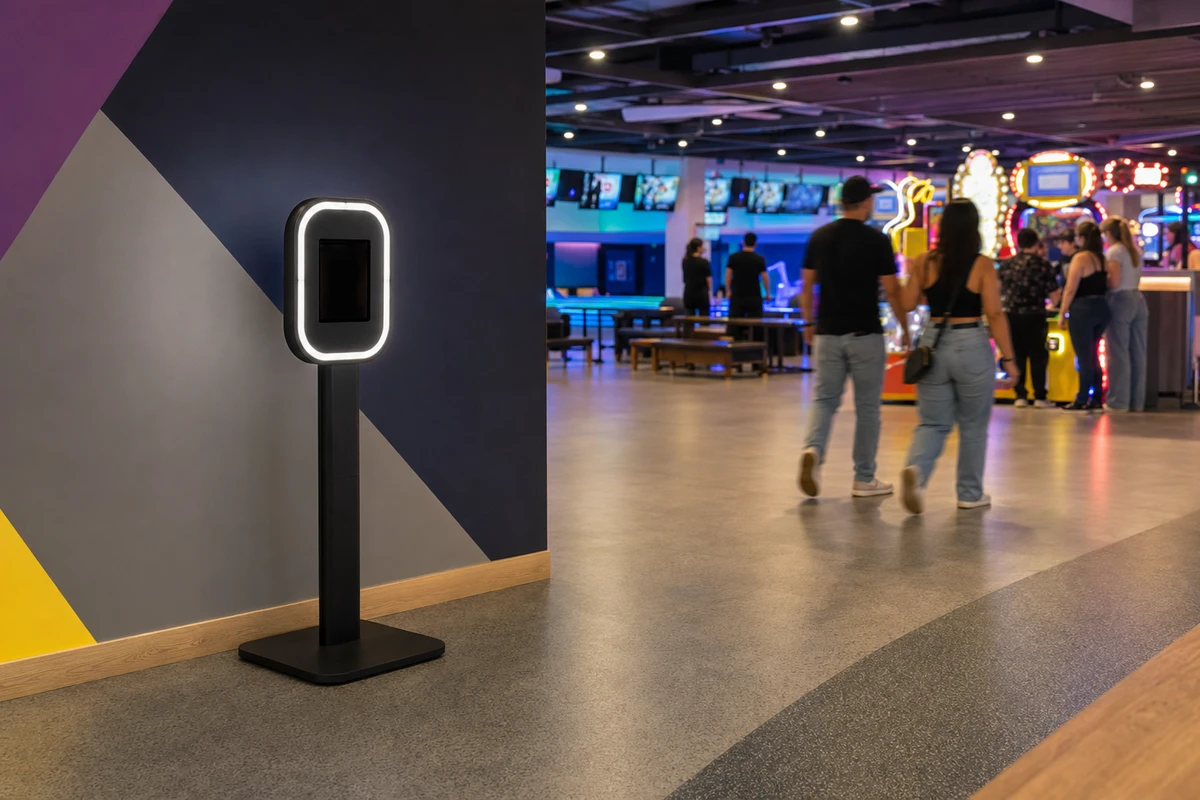
- Permanent venue install. A booth mounted in a restaurant, bar, retail store, entertainment venue, brand experience center, or coworking space. Runs 30 to 60 hours a week, every week, unattended by definition.
Every number after this point is scoped to one of those two modes. If the consumer-facing SERP is unanimous that attended wins, it’s because every competing article assumes mode one.
The real cost of an attendant (not the hourly wage)
Before any breakeven math, the per-hour number has to be right. The sticker wage is not the cost.
Published wage data from Indeed’s photo-booth attendant salary page, updated April 2026 from 878 data points, shows an annualized national average of $42,713, with live job postings clustering at $15 to $30 per hour. Secondary markets pay $15 to $20 (Complete Weddings + Events in South Saint Paul, Fox and Raven Mead in Carrollton). Specialty 360-booth postings in Silver Spring MD and Fort Lauderdale FL push $20 to $30.
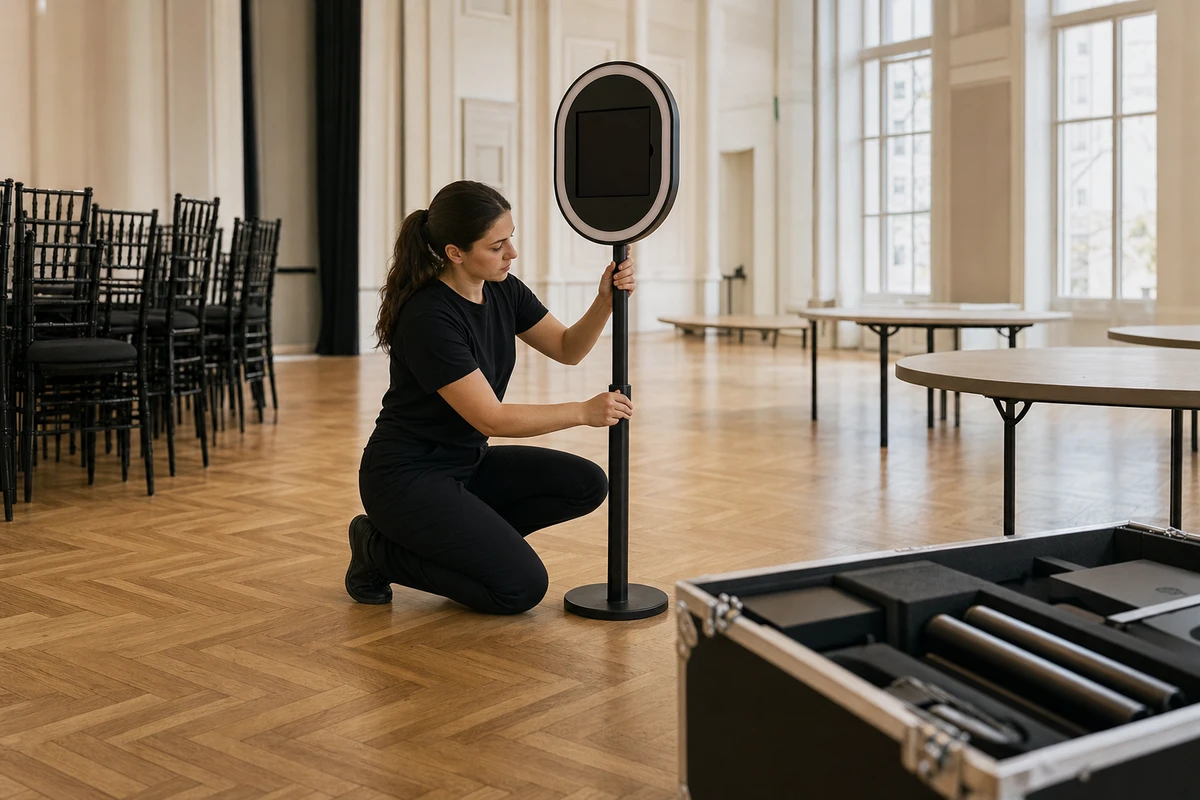
The sticker wage isn’t what the operator pays. Every W-2 attendant carries a labor burden on top:
- FICA, 7.65%
- FUTA, 0.6%
- SUTA, 2% to 6% depending on state and filing history
- Workers’ compensation, rated by state and NAICS class (entertainment and event-services classes typically sit between 3% and 15% of payroll)
- Benefits, variable (most small operators skip health coverage; anyone offering it adds another 10% to 20%)
The U.S. Bureau of Labor Statistics Employer Costs for Employee Compensation release for December 2024 puts the leisure and hospitality sector’s benefit burden at 18.3% of total compensation, lower than the 29.5% private-industry average. Add employer payroll taxes (roughly 10 to 14% combined on top) and a small event-services operator without health benefits lands at about 25% to 32% burden. Larger operators with benefits and higher workers’ comp classes can reach 40% to 50%, which is where the worked example in Aroundwire’s labor cost calculator ends up when it walks a $20 base wage to $30.03 fully loaded.
Worked example, small operator
$20 per hour direct, 25% burden, $25 per hour fully loaded. A typical four-hour event with 1.5 hours of setup and one hour of teardown is 6.5 paid hours: $162.50 per event in fully-loaded labor before any no-show or overtime variance. Use $130 to $190 as the anchor for every calculation that follows. Wages outside that range (metro premium, higher-burden state) scale the math proportionally.
That’s still before travel time, pre-event training, equipment handoff, scheduling admin, and the cost of backfilling a no-show. A realistic per-event figure adds another 10 to 15% on top. Most operators don’t track these overheads separately, which is why attended packages stay chronically underpriced.
The labor math for a mobile event rental
Work the P&L line by line, not the brochure.
Labor Cost Baseline
Revenue per event runs $500 to $1,500 for typical private bookings and $1,500 to $3,000 for corporate activations, per Photo Booth International’s operator margin analysis (Pather, 2026, vendor-published). Fully-loaded labor sits at $130 to $190 from the section above. Two concrete breakevens:
- A $1,000 mid-size booking. A $160 attendant cost is 16% of gross revenue. At a 50% gross margin ($500 gross profit), the attendant takes about 32% of gross profit. Defensible if guest comfort, prop management, and overlay delivery are explicit parts of the package and the client expects a human on site.
- A $500 casual booking. The same $160 attendant cost is 32% of revenue and about 64% of a $250 gross. Running unattended is the only way this booking clears minimum margin. This is the small-event lane the consumer SERP keeps mentioning but never quantifies.
Offering attended delivery at the same price as unattended burns $130 to $190 of gross margin per event. At 40 events a year that’s $5,200 to $7,600 in forfeited profit, the equivalent of running seven to ten bookings entirely for free.
The market does price the attendant premium, just not always consistently. Puddles Photo Booth’s 89-company pricing study (Eggerman, 2025) found the average three-hour booking ranges from $556 for an unattended selfie station to $870 for an attended open-air setup, a $314 gap. Treat that $314 as a cross-operator market signal, not a same-operator upsell elasticity; the gap blends different companies, formats, and markets. Even so, against a $130 to $190 true cost, the market shows real headroom for operators who price their attended packages correctly. Feature Booth’s 2025 pricing guide describes the same spread as a tier jump from a $400 to $800 “budget, minimal staff support” bracket to a $1,200 to $2,000-plus “professional equipment, experienced staff” bracket. Whichever tier you sell into, the question isn’t whether attendants cost money. It’s whether the upcharge sticks or prices you out of the booking.
The labor math for a permanent venue install
This is where the SERP consensus silently collapses. None of the top-ranked consumer articles price a permanently installed booth, because consumer buyers don’t have one.
Do the arithmetic
Do the arithmetic. A permanently mounted iPad booth in a brewery, entertainment venue, or retail store covers 30 to 60 hours a week of customer-facing activity. At 40 hours a week and $20 per hour fully loaded (a conservative floor; the event-rental anchor of $25 takes this to $52,000), a single staffed shift runs $41,600 per year per location, before overtime, benefits, or backfilling a no-show. Hardware for the same booth is a one-time $3,500 to $5,000 for a professional iPad kit, per Photo Booth International’s cost breakdown. A single month of labor roughly equals the entire upfront hardware budget.
The named case studies in this segment are unattended by necessity. Treetop Golf’s five-location UK rollout (Simple Booth, April 2024, vendor-published) captured 300,000-plus photos, GIFs, and video clips and built a 150,000-address email list, with 90% of the newsletter list coming from the photo booth. Staffing those five booths at 40 hours a week each would cost $208,000 a year in theoretical labor, all avoided. “Very hands-off. It sells itself,” says Brent Ledet, Director of Marketing at Creole Cuisine Restaurant Concepts (Simple Booth, June 2024, vendor-published), where 35 New Orleans locations capture thousands of uploads every weekend against a running total of 200,000-plus photos. Staffing 35 locations to cover peak evening and weekend traffic would run roughly $2 million a year. No restaurant operator has done that math and concluded the staffed version is viable.
Revenue-share permanent-install models (where the operator and venue split per-session revenue) are unattended by design. At realistic per-session rates and peak-night volume, a single dedicated attendant shift erases the entire operator share, no matter how the contract is structured.
For brick-and-mortar operators evaluating a booth, the labor question isn’t “will we staff it.” It’s “what onboarding, signage, and software choices eliminate the need to.”
When an attendant earns their cost
For rental operators still running a staffed model, here is a framework for picking which events get an attendant and which get delivered unattended.
The marginal-hour test
At $25 per hour fully loaded and 50% gross margin on add-ons, each attendant hour has to drive about $50 in incremental sales (prop rentals, extended-hours upsell, template customization, branded-overlay upsell) just to break even. Most attendant hours don’t.
High ROI, the attendant pays for themselves:
- Corporate brand activations where a booth hiccup becomes a brand-risk event the client will blame the operator for. The Event Marketer and EDPA Fortune 1000 exhibit budget survey (January 2024) found 66% of corporate exhibitors expect rising costs (with “surging labor pay and revised partner rate cards” named as the primary driver) to reshape which activations they fund. Corporate buyers are simultaneously the most price-sensitive and the most reputation-exposed segment.
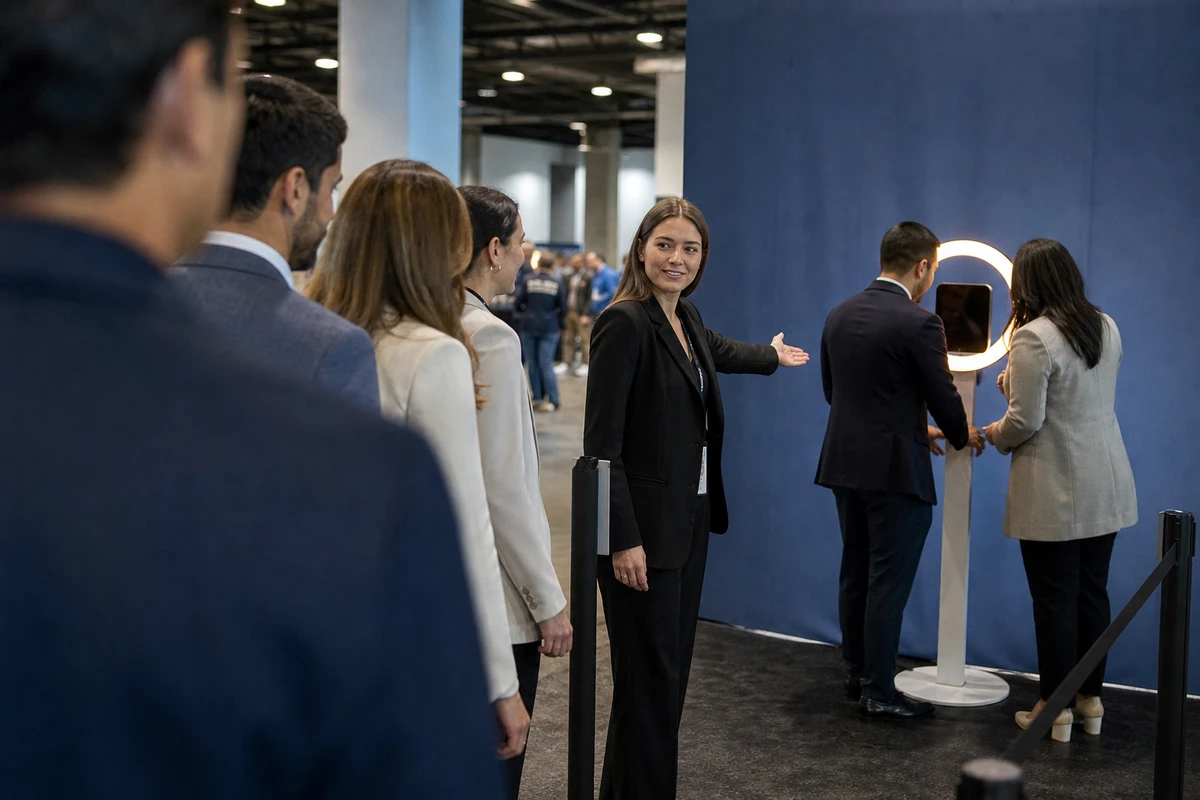
- Events with 150-plus guest throughput in a short window, where queue management frees the operator to book a second event the same day.
- Mixed-age or tech-reluctant demographics where self-serve visibly underperforms.
Break-even at best: mid-sized corporate holiday parties, milestone-birthday bookings, smaller private events in tech-comfortable demographics. Staffing is defensible; not staffing is also defensible.
Negative ROI: short-window bookings under 75 guests, second-day corporate roadshows (onboarding already done from day one), kiosk-style activations where the booth is one attraction among many.
The hybrid model the SERP never mentions
Schedule the attendant only through delivery, setup, and the first hour of guest use, then leave. Paid hours drop from 6.5 to roughly 2.5, cutting labor by about 60% while still catching the highest-risk window of the event: the moment technology and guests first meet.
The uptime myth, examined honestly
Every top-ranked consumer article on this query asserts that attendants reduce downtime. The claim is asserted, not measured. Pull it apart.
What an attendant actually fixes: paper jams, software freezes, stuck sessions, guest confusion. Real work, real value, hard to replace in a chaotic high-volume event.
What an attendant doesn’t fix: failures that happen while they’re on break, helping a guest across the venue, or repacking props between sessions. At high-traffic events, attendant attention is the scarce resource, not reboot capability.
Attendant-side failure modes the consumer SERP doesn’t mention: no-shows, early exits, phone-scrolling disengagement, undertrained operators, equipment missing from the prior booking. Operators report these frequently enough to factor into scheduling, though no primary survey publishes a measured rate.
What modern self-service platforms have changed
Foto ATM’s platform-capability overview (August 2025, vendor-published) reviews four major industry platforms (Foto ATM, Social Booth, dslrBooth, FavBooth) and finds cloud dashboards, real-time status monitoring, software watchdogs, remote restart, and emergency alerts are standard, not premium. “Use our mobile app to control and keep tabs on your photo booth from anywhere,” reads the dslrBooth tagline quoted in the piece. Sync queues keep capturing photos through network drops. iPad hardware has far fewer moving parts than a DSLR-plus-laptop-plus-printer stack.
The permanent-install design pattern that replaces the attendant
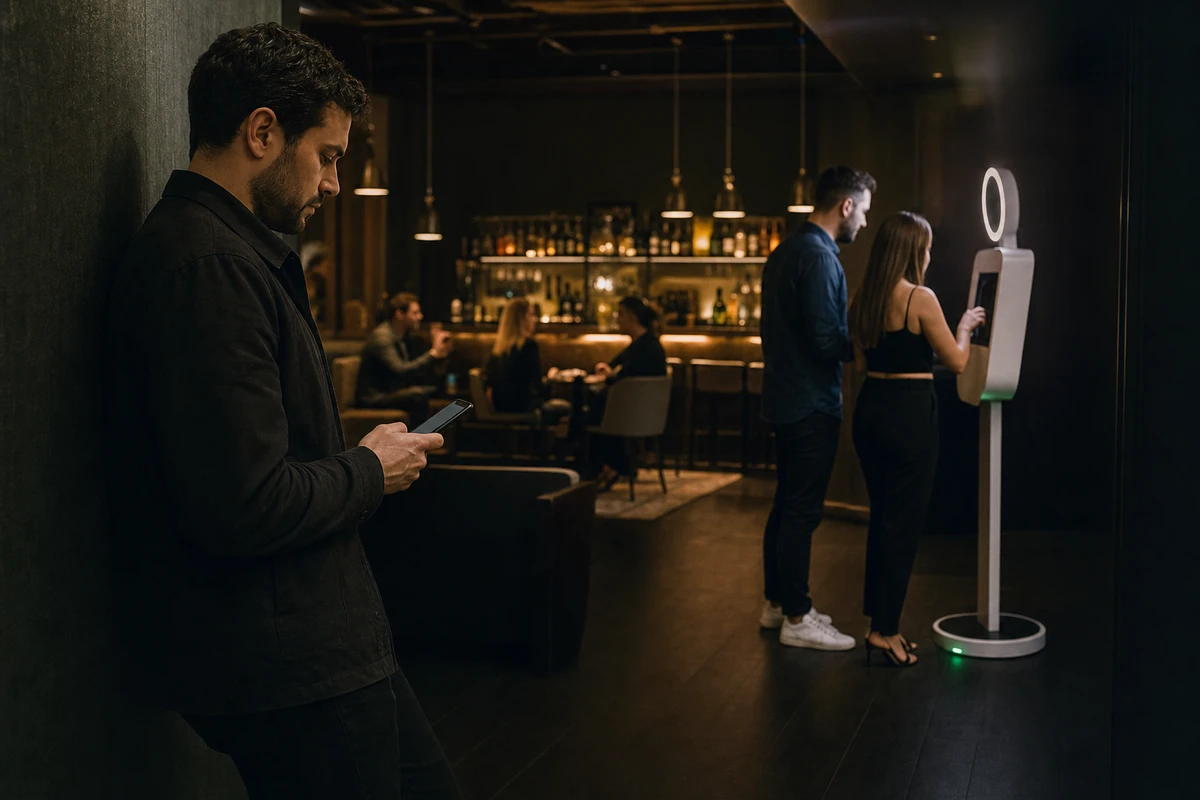
Laminated restart instructions visible at the booth, 15 minutes of training for two venue staff on the top three failure modes, remote monitoring that alerts the operator when the booth is offline for more than N minutes, and a visible status light. Venue staff become the cheapest reliability backstop available. They’re already on site.
Honest conclusion: a trained attendant still delivers higher uptime in chaotic high-volume mobile events. For calm retail environments and permanent installs with good signage, an iPad-based UI, and remote monitoring, unattended uptime matches or beats a distracted human. The answer isn’t “attended always wins.” It’s mode-specific and software-dependent.
Hybrid models: three schedules that beat both extremes
For operators who want uptime insurance without the full margin hit, three hybrid patterns repeat across operator commentary:
| Model | Typical cost | What it covers | Best fit |
|---|---|---|---|
| Setup-and-leave | ~2.5 paid hours (~$65) | Delivery, setup, first-hour ramp | Four-hour private events in tech-comfortable demos |
| On-call tech | $0 base plus dispatch fee | Remote monitoring triggers a drive within 15 minutes | Multi-event nights, metro rental fleets |
| Venue-staff training | 30 minutes at setup (~$15) | Two venue staff trained on common failure modes | Multi-day activations, permanent installs |
Setup-and-leave cuts labor from about $160 to about $65 on a typical booking (a 60% reduction) while still catching the two highest-risk hours of the event. On-call tech is the pattern most compatible with modern remote-monitoring platforms: the operator pays only when the booth alerts. Venue-staff training is underused for one-off events and the default answer for permanent installs.
A worked scenario you can plug your own numbers into
Regional rental operator, 40 events a year, $950 average gross booking. Full-attendant delivery costs $160 per event fully loaded. Attendant is deployed on every job.
Move Low-Margin Events to Unattended
Switch the bottom 15 events (the $500 to $700 jobs where the labor line swallows 25%-plus of revenue) to unattended delivery:
- 15 events × $160 = $2,400 per year in recovered labor cost
- Net annual margin uplift of $2,400 with minimal customer churn risk, because the $500 price-sensitive bookings and the $1,500 full-service bookings sit in different client segments
Run the same exercise for a brick-and-mortar venue considering staffing a permanent booth:
- Single part-time shift, 20 hours a week × $20 fully loaded = $20,800 per year
- Hardware cost, $3,500 to $5,000 one-time
- Staffing runs roughly five times the hardware cost annually, for a benefit customers rarely notice, let alone pay for
Plug your own wage, burden rate, event count, and average booking size in. The structure of the answer doesn’t change. At low booking values, unattended is the only path to acceptable margin. At any permanent install, staffing is arithmetically indefensible.
What actually matters when you’re choosing
Four questions in order. Each one eliminates a large part of the problem.
- Is this one event or an always-on install? Picks the mode. For a permanent install, the conversation is over: the answer is unattended, and the next decision is software and onboarding, not scheduling.
- What’s the event revenue, and what’s the fully-loaded attendant cost? Gives the breakeven. If attendant cost is over 25% of projected gross, you’re subsidizing the client.
- Does the software stack include remote monitoring, watchdog auto-restart, and sync queues? Decides how recoverable unattended failure is. An iPad-based platform with alerts is a different risk profile from a DSLR stack with a paper-roll printer.
- Who’s the guest demographic, and is there a venue staff person who can become an emergency backstop? Mixed-age or kid-heavy events push toward an attendant; tech-comfortable adult crowds push away. Trained venue staff is almost always the cheapest reliability insurance.
“Attended or unattended?” isn’t one question. It’s two, with two different answers. Anyone giving you a single answer hasn’t separated them.
Frequently asked questions
Is unattended cheaper for the client or just for the operator? Both, but unevenly. The operator saves $130 to $190 in fully-loaded labor per event. On the client side, the Puddles pricing study shows unattended selfie stations averaging $314 below attended open-air packages across 89 companies. That gap blends format and operator differences, not a clean same-operator upcharge, but it confirms real client-side price movement exists on the attendant line.
Do guests actually use unattended booths correctly? Modern iPad-based booths are designed for self-serve from the ground up, and most guests complete a session on the first try. The 2015-era “nobody figures it out” concern is largely obsolete.
Can I offer both as packages? Yes. Price the attended upcharge at least 1.5x your fully-loaded labor cost, to cover scheduling overhead, occasional no-shows, and the opportunity cost of committing the staff-hours.
What about insurance and liability? Attended and unattended bookings carry similar general-liability profiles. Unattended booths with on-screen payment may require added PCI-related coverage; permanent installs carry venue-placement insurance obligations that a mobile booking doesn’t.
Sources
- U.S. Bureau of Labor Statistics (2025). “Employer Costs for Employee Compensation, December 2024.” https://primarynewssource.org/sourcedocument/employer-costs-for-employee-compensation-december-2024/
- Indeed Career Explorer (2026). “Photo Booth Attendant Salary in United States.” https://www.indeed.com/career/photo-booth-attendant/salaries
- Event Marketer and EDPA (2024). “Survey: Fortune 1000 Exhibit Budgets are Up, But so are Costs.” https://www.eventmarketer.com/article/survey-fortune-1000-exhibit-budgets-are-up-but-so-are-costs/
- Eggerman, Connor. Puddles Photo Booth (2025). “Photo Booth Rental Cost Guide 2025: How Much Does It Cost to Rent a Photo Booth?” https://www.puddlesphotobooth.com/2025-photo-booth-rental-costs
- Aroundwire (2025). “Free Photo Booth Rentals Labor Cost Calculator.” https://aroundwire.com/articles/free-photo-booth-rentals-labor-cost-calculator
- Pather, Josh. Photo Booth International (2026). “Is a Photo Booth Business Profitable? Real Numbers.” https://photoboothint.com/photo-booth-business-profitable-real-numbers
- Simple Booth (2024). “At Treetop Golf, Everyone Knows the Power of the Photo Booth.” https://www.simplebooth.com/blog/treetop-golf-photo-booth-case-study
- Foto ATM (2025). “Real-Time Analytics for Photo Booths: Key Features.” https://fotoatm.com/real-time-analytics-for-photo-booths-key-features
- Feature Booth (2025). “Photo Booth Rental Pricing 2025: Complete Guide.” https://www.featurebooth.com/post/photo-booth-rental-pricing-guide-2025-costs-packages