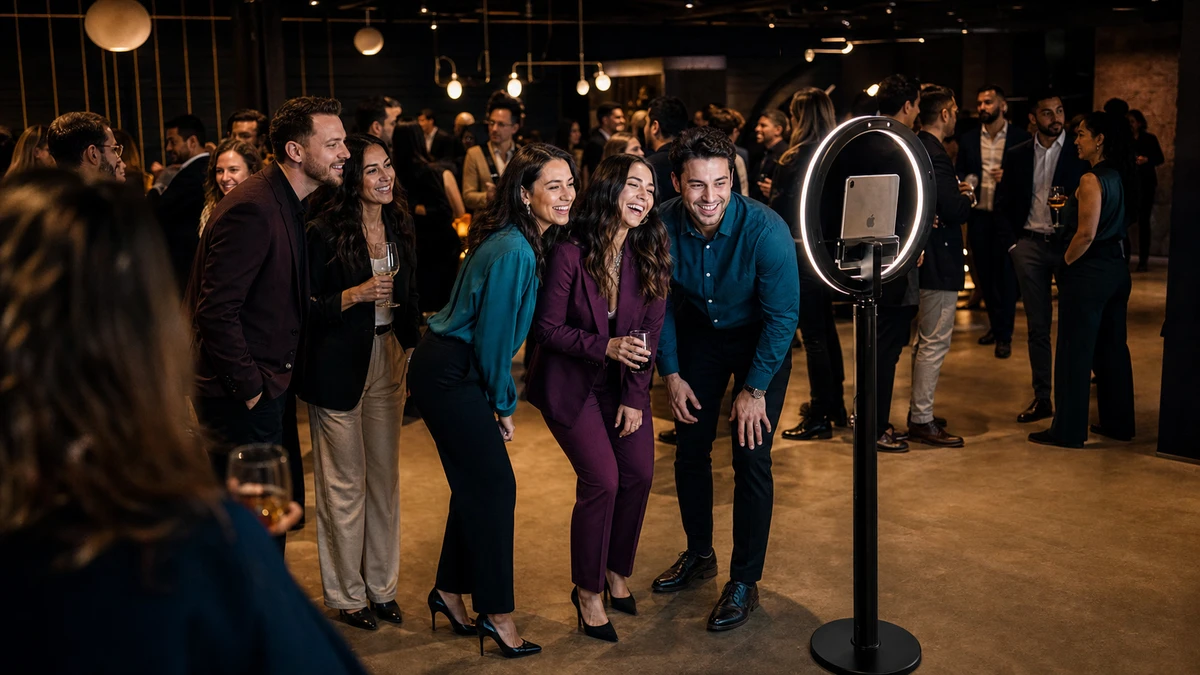
A photo booth runs at a company’s anniversary event. Three hundred guests cycle through it across four hours. Each one steps in, sees a branded screen, poses, and gets the photo sent to their phone before stepping out. At midnight the operator packs the gear, paid a flat rental fee for the night.
That operator just delivered 300 branded images into 300 phones and watched a healthy share of them get posted and re-shared to people who never attended. They sold an hourly rental. They could have sold a sponsorship.
A photo booth becomes a sponsorship asset the moment the operator stops selling booth-hours and printed strips and starts selling the booth’s digital output as measurable media: every shared photo carrying a branded overlay, every visit to a branded gallery, every opt-in contact collected at delivery. Priced to what a sponsor’s brand gains rather than to what the booth cost to run, one sponsor can become a recurring revenue line worth more than the booking. That gap, between a rental fee and the media value the booth actually produces, is where photo booth sponsorship monetization lives.
What a Digital Photo Booth Sponsorship Actually Sells
Ask most operators what a sponsor gets, and the answer is a logo on the printed photo strip. A local insurance agency’s name sits under the picture, the guest takes the strip home, and it ends up on a fridge. That is a real impression. It is also, in most published advice, the entire product.
The print is the smallest and least measurable piece
The print is the smallest and least measurable piece. A digital photo booth sponsorship sells a bundle of brand assets the operator controls and the sponsor cannot get any other way:
- A branded overlay applied to every photo, GIF, and video the booth produces.
- A branded delivery screen, the text-or-email handoff the guest sees while waiting to receive the image.
- A branded online gallery or microsite where guests retrieve and re-share their photos.
- A QR code routing to the sponsor’s offer or landing page.
- The opt-in contact data collected when the guest asks for their photo.
Captured Celebrations, a photo booth company, lists a near-identical set of deliverables in its sponsor materials (vendor-published). The list is not the hard part. The hard part is understanding why the digital version is worth more than the print, and that comes down to one mechanism.

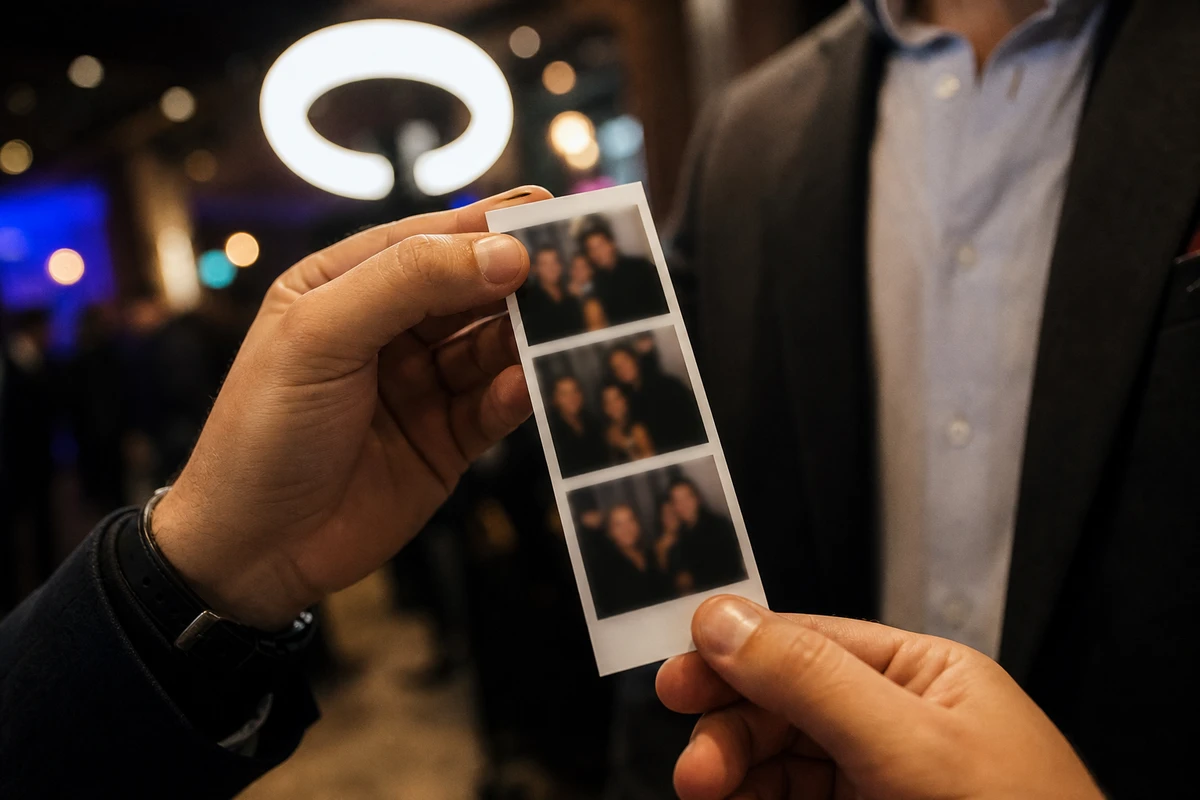
A print is one impression. It costs paper and ink, it is capped by how many strips the booth prints, and it stays in the room. A branded digital image has no such ceiling. The thousandth copy costs effectively nothing, the image leaves the venue inside the guest’s phone, and when the guest posts it, the same overlay reaches their whole network at no additional cost to anyone. Most of that resharing lands on Instagram, where the US audience skews affluent: Sprout Social reports that 60% of US Instagram users live in households earning over $100,000, which makes each share a higher-quality impression than a paper strip in a kitchen drawer. The sponsorship is monetizable because the operator is selling distribution and data, not cardstock. Print exposure ends when the event ends. Digital exposure compounds for as long as the images circulate.
Why “Double Your Rental Cost” Is the Wrong Way to Price It
An operator who decides to sell a sponsorship quickly finds the same answer everywhere: price it off what the booth costs to run. Elevated Entertainment, an Alabama photo booth and DJ company, describes the standard arrangement plainly (vendor-published): a host secures a local business to cover the cost of the booth, and the business “just has to send over their logo.” Operators who want a margin on top land on the familiar rule of thumb, charge the sponsor about double the rental.
Cost-Recovery Pricing
That rule is not wrong because the math is hard. It is wrong because it anchors the price to the wrong number. Cost-recovery pricing comes from charity fundraising, where a non-profit rents a booth, finds a sponsor to cover the rental, and keeps a small margin. The goal there is cost recovery, and the sponsor is treated as a patron.
A commercial sponsor is not a patron. A sponsor’s marketing team evaluates the spend the way it evaluates every other line on the plan: impressions delivered, contacts captured, cost per impression against the competing channels. The operator’s rental cost is a number that team never sees and has no reason to care about. Pricing to it fails in two directions. For a busy, high-sharing event, cost-doubling can sit far below what the booth’s output is demonstrably worth, and the operator leaves money unsold. For a small, low-energy event, cost-doubling can overprice a booth that will not produce much, and the deal dies quietly in the sponsor’s spreadsheet.
The correct anchor is the value the sponsor receives. Once that value is on paper, the operator can set a fee, defend every line of it to a marketing director, and raise it the following year. The next section builds that number.
How to Price a Sponsorship to Its Earned-Media Value
Operators say pricing is the part that keeps them up at night. One second-season operator on the r/photobooth forum put it plainly: “I am super lost with prices … trying to figure out exactly what to price.” For a sponsorship specifically, a defensible number can be built in about five minutes, before any pitch.
Marketing teams estimate the worth of brand exposure they
Marketing teams estimate the worth of brand exposure they did not pay for with a metric called earned media value. The common method: take the number of impressions, divide by 1,000, and multiply by the CPM (cost per thousand) the brand would pay to reach the same audience through ads. Earned media value is a working convention rather than a regulated standard, and marketers openly note there is no single agreed formula for it, but the comparison to paid CPM is the most intuitive and widely used version.
The impression count is built from the event itself:
Branded Sessions
- Branded sessions: the number of guests who use the booth.
- Social shares: branded sessions multiplied by a share rate.
- Secondary impressions: social shares multiplied by the average reach of one guest’s post.
- Earned media value: total impressions divided by 1,000, multiplied by the CPM.
Now a worked example, with every input set deliberately low so the result survives a skeptical marketing director. Take a 300-guest activation. That is 300 branded sessions. Vendor blogs claim photo booth share rates as high as 89%, with no disclosed method behind the figure; independent research from Event Marketer’s EventTrack 2025 study found 72% of event attendees capture and share content online across all event types. Use 50%, comfortably below both. That gives 150 shares. A personal social account reaches a few hundred people, so use 200 as a conservative reach per share. That is 30,000 secondary impressions. For the CPM, Affect Group’s 2026 analysis of US Meta advertising put reach-and-impressions campaigns at $9 to $14 per thousand. Use $8, just below that range. Earned media value: 30 multiplied by $8, about $240.
That number is small on purpose, and it carries the article’s most useful correction. The example produced 30,000 impressions. Even tripled to the 90,000-impression headline that vendor pitches like to lead with, at a real CPM that is worth roughly $700. An operator who sells a sponsorship on impression counts alone is selling the cheap half of the product.
The valuable half is the opt-in contacts. A digital booth delivers the photo by email or text, so nearly every guest who uses it hands over a contact. The narrower number is how many also agree to hear from the sponsor. Assume 220 of 300, and treat that opt-in rate as the one input to pull from a past event rather than guess. What is one contact worth? WordStream’s 2025 Facebook advertising benchmarks show advertisers paying about $1.72 per click at a 9.21% conversion rate, which works out to roughly $19 to turn one click into a converted action.
HubSpot’s 2025 benchmarks put the average B2B cost per lead across digital channels at $84. A booth contact is warmer than a cold form-fill in one way (the person physically attended and engaged) and cooler in another (the opt-in was for a photo, not the sponsor’s offer), so $18 a contact is a fair, conservative figure. At $18, 220 contacts are worth about $3,960.
Total demonstrable value: roughly $240 in earned media plus $3,960 in contact value, about $4,200, before counting the live brand interaction in the room that the formula never prices. The pricing rule follows from there. Set a fee that hands the sponsor about two dollars of measured value for every dollar spent. At $2,000, the sponsor receives roughly $4,200 in measurable value, and an operator whose booth rents for $900 has just defended a number above the $1,800 that “double your cost” would have produced. The difference is not only the figure. It is that this operator can walk a marketing director through every line of it, and a higher-engagement event pushes the same calculation well past it.
Build a Tiered Sponsorship Package
An operator who offers “a sponsorship” as one flat product hands the sponsor a single decision: yes or no. A structured set of tiers hands the sponsor a choice of how far in to go, and a choice almost always pulls more spend than a flat offer. Three tiers work well.
Tier one is visibility
Tier one is visibility. The sponsor’s branded overlay appears on every photo, GIF, and video, and the branded online gallery carries the logo. This is the entry product, pure exposure, the earned-media half of the value.
Tier two adds data
Tier two adds data. The branded delivery screen, the QR code routing to the sponsor’s offer, and the opt-in contact handoff turn the booth into a lead channel as well as a billboard. This is where operator margin lives, because the cost of capturing one more contact is close to zero while its value to the sponsor is the $18-and-up figure from the pricing formula.
Tier three is the presented-by experience
Tier three is the presented-by experience. It adds naming rights (“The [Brand] Photo Lounge”), a custom microsite, a short survey question inside the sharing flow, and a post-event analytics report. The survey is the quiet upgrade. MDRN Photo Booth, a vendor serving brand activations, reports in-flow survey completion around 85% (vendor-published), against the single-digit response rates typical of post-event email surveys. The mechanism is sound: the guest answers one question while waiting for the photo they already want, so the survey reads as part of the delivery rather than an interruption. A sponsor who wants audience research, not just a contact list, will pay for that.
Tiers also do quiet pricing work
Tiers also do quiet pricing work. A high tier makes the middle tier look reasonable, which steers most sponsors toward the data tiers where the operator earns the most.
One caution belongs here
One caution belongs here. Tiers two and three hand guest contact data to a third party. The opt-in has to be explicit at the moment of capture, and the guest has to know the sponsor receives it. That is both a legal line and a trust line, and the final section returns to it.
Single-Event Fees vs. Recurring Venue Sponsorships
Everything so far assumes one event, one sponsor, one fee. The larger opportunity is a booth that does not leave.
A booth installed in a standing venue (a restaurant, a gym, a hotel lobby, a retail floor) is not an event rental. It is a standing media channel, and a standing channel can be sold the way media is sold:
- A rotating monthly sponsor: a different local brand each month, each buying 30 days of branded output.
- A season-long title sponsor: one brand for a quarter or a year, at a premium.
- A co-op arrangement: several complementary local businesses sharing one booth’s branding rotation.
The arithmetic changes the business
The arithmetic changes the business. A single event sponsorship at $2,000 is $2,000. A venue booth that sells a $1,500 monthly sponsorship books $18,000 a year from the same hardware, a recurring line that can outrun what the booth cost to buy.
A standing booth is also easier to sell than an event booth, for a concrete reason. An event is a one-time audience the sponsor has to take on the operator’s word. A venue has a footfall pattern the operator can measure month over month and put in a media kit: this many guests, this much sharing, this many contacts, every month, predictably. Those contact numbers compound in a permanent install. Running Simple Booth’s HALO kit across its locations, the entertainment venue chain Treetop Golf collected 150,000 unique email addresses from guests opting in for their photos, the kind of standing audience a venue can sell access to month after month. A sponsor evaluating a venue booth is reading something close to a rate card, not a pitch. A predictable audience is what turns a single tactic into a revenue line, and that is the difference between monetizing a photo booth once and running it as a business.
Finding and Pitching the Right Sponsor
The right sponsor is the one whose ideal customer looks like the booth’s typical guest. A booth at a downtown food festival is a strong fit for a regional beverage brand and a poor fit for an industrial-equipment supplier. Audience overlap is the whole test. In practice that points to a few archetypes: local brands that want a physical presence, B2B vendors exhibiting at trade shows, businesses near a venue that want its foot traffic, and regional arms of national brands with local marketing budgets.
The pitch is where most operators lose the deal, and the reason is specific. One operator on r/photobooth described pitching corporate clients “without a visual to show them what a branded photo booth would look like at their event,” and built a mockup tool to fix exactly that. A verbal description of a sponsorship reads as a favor request. A one-page sheet reads as a media buy.
That sheet has two halves. One is a branded mockup: the booth carrying the prospect’s actual logo, so the marketing team sees the product instead of imagining it. The other is the projected numbers from the earned-media formula: projected impressions, projected contacts, and projected cost per impression set against what the sponsor already pays for the same reach elsewhere. Sponsor budgets for this are real and growing. Global experiential marketing spend passed $128 billion in 2024, according to Marketing Charts, and Freeman’s 2024 research found 80% of consumers consider in-person events the most trusted way to discover a product. The operator is not asking a brand to fund a fun thing. The operator is selling a measurable channel inside a category the brand is already increasing its budget for.
Timing follows the type
Timing follows the type. Pitch event sponsors six to ten weeks out, while the marketing calendar still has room. Pitch venue sponsors whenever the media kit is ready, because the venue’s audience is there every month regardless.
Prove It, Then Renew It: The Post-Event Report
A sponsor decides whether to renew in the days after the event, while the invoice is still fresh. An operator who reports back with “it went great” is asking for that decision on faith. An operator who sends a one-page report is making the decision easy.
The Renewal Report
The report is short and specific: total booth sessions, photos and videos created, share rate, estimated social impressions, QR scans and landing-page visits, and opt-in contacts collected. For a venue deal the same report goes out monthly. The numbers do the selling. A sponsor looking at 30,000 impressions and 220 contacts, with a cost per impression below their paid-social rate, does not need to be persuaded to renew. The report has already made the case, and it usually makes the case for a higher tier, because the sponsor can now see which part of the package performed.
This is the mechanism that makes the revenue recurring. A cold annual sell becomes a warm upsell. The first sponsorship is the hard one. Every renewal after it is a conversation about a number both sides already trust.
The report only works if the data behind it is clean, which brings back the consent question. The operator has to capture explicit opt-in at the point of delivery, tell the guest plainly that the sponsor receives the contact, and hand over only what the guest agreed to. This is not fine print to handle later. It is the thing that keeps the lead-capture tiers sellable. A sponsor will not stay attached to contacts gathered in a way that generates complaints, and a venue will not keep a booth that makes its guests feel sold. Clean consent is what lets the operator keep charging for data year after year.
Sources
- Event Marketer (2024). “EXCLUSIVE RESEARCH: EventTrack 2025.” https://www.eventmarketer.com/article/eventtrack25/
- Freeman (2024). “Freeman Trends Report Q1 2024: The Latest Insights for Event Attendee Intent and Behavior.” https://www.freeman.com/resources/freeman-trends-report-q1-2024/
- HubSpot (2026). “2025 CPL and CAC Benchmarks [HubSpot Research].” https://blog.hubspot.com/marketing/2022-cpl-and-cac-benchmarks
- WordStream (2025). “Facebook Ad Benchmarks for Your Industry [Data].” https://www.wordstream.com/blog/ws/2017/02/28/facebook-advertising-benchmarks
- Affect Group (2026). “Meta Ads CPM in the United States: Benchmarks for Facebook and Instagram.” https://affectgroup.com/blog/meta-ads-cpm-in-the-united-states-benchmarks-for-facebook-and-instagram/
- Sprout Social (2026). “38 Instagram Statistics You Need to Know for 2026.” https://sproutsocial.com/insights/instagram-stats/
- Marketing Charts (2024). “Marketing Budgets.” https://www.marketingcharts.com/business-of-marketing/marketing-budgets-234383
- Reddit, r/photobooth (2025). “Pricing.” https://www.reddit.com/r/photobooth/comments/1jygmvs/
- Captured Celebrations (2025). “Top 5 Ways Branded Photo Booths Deliver Value for Sponsors.” Vendor-published. https://www.capturedcelebrations.com/post/branded-photo-booths-value-sponsors
- MDRN Photo Booth (2024). “How Experiential Marketing Agencies Use Photo Booths to Prove ROI.” Vendor-published. https://www.mdrnphotoboothcompany.com/blog/how-experiential-marketing-agencies-use-photo-booths-to-prove-roi
- Elevated Entertainment (n.d.). “Sponsored Photobooths: How to Get a Business to Sponsor Your Photobooth for Events.” Vendor-published. https://www.elevatedbham.com/sponsored-photobooths