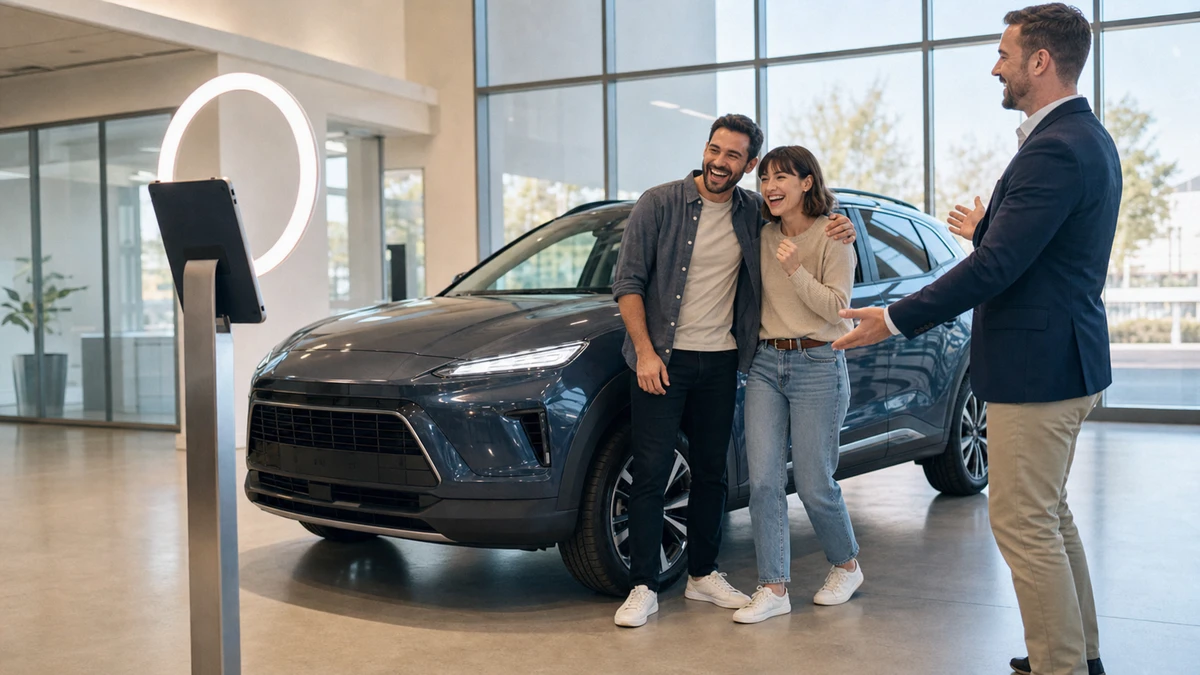
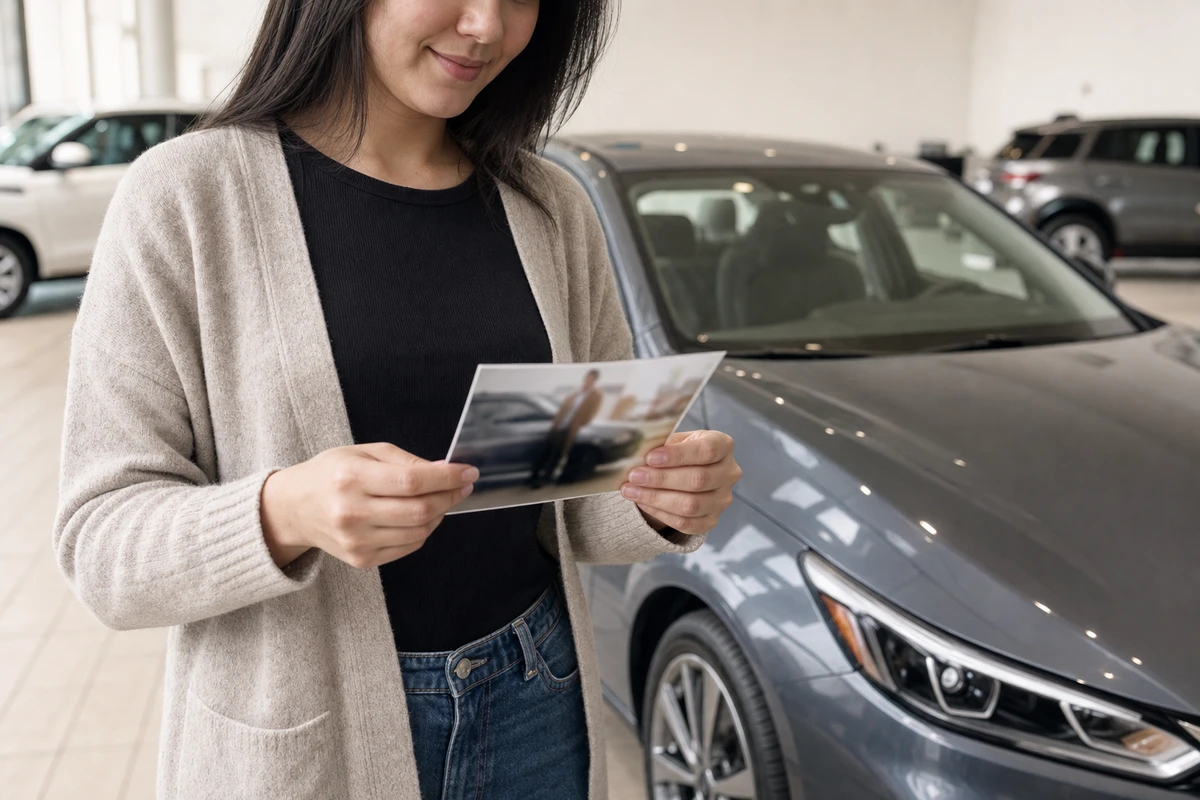
A customer signs the last form, the salesperson walks them out to the lot, and there it is: the car, detailed, full tank, a bow on the hood if the dealership bothered. The customer pulls out a phone. Someone takes a crooked photo against a row of trade-ins. Everyone smiles, the customer drives off, and the dealership keeps nothing.
Search “best photo booth for car dealerships” and Google will not help with that moment. The first page of results is dominated by one category of tool: systems that photograph the car for online listings. Those tools are real and useful, but they solve a merchandising problem, not a marketing one. There is a second product almost no buyer’s guide mentions, the guest photo booth, the kind a customer steps up to, and it does a different job. It turns the people moving through the showroom into branded photos, a verified list of recent buyers, and leads from every sales event. This guide covers how the two differ, where the guest booth pays off, what it is worth to a dealership, and how to choose one.
Inventory booth vs. guest photo booth: the two products behind one search term
A dealership’s inventory manager and its marketing manager can type the exact same phrase into Google and walk away needing two completely different machines. Right now the search results only know how to help one of them.
Throughput
The product the results do return is the inventory booth, sometimes called a 360 booth. 360Booth builds a physical turntable studio: the car drives onto a rotating platform, the rig turns around it, and a camera array captures 360-degree imagery for vehicle detail pages. The company’s own marketing cites a throughput of more than 40 vehicles a day. MotorStreet360 manufactures custom steel-built turntable studios for the same purpose at a larger scale. Spyne AI and DealerVision skip the hardware entirely: their software photographs a car in place and uses AI to replace the background with a clean, consistent one. DealerVision’s product is even called a “virtual photo booth” despite having no physical booth at all. DealerMade sells automated photo studio systems and, confusingly, publishes content about “interactive photo booths” that is entirely about photographing cars. Every one of these tools photographs the vehicle, for the online listing, and is bought by the inventory or merchandising team. The job is to sell cars faster online and replace a roaming photographer.
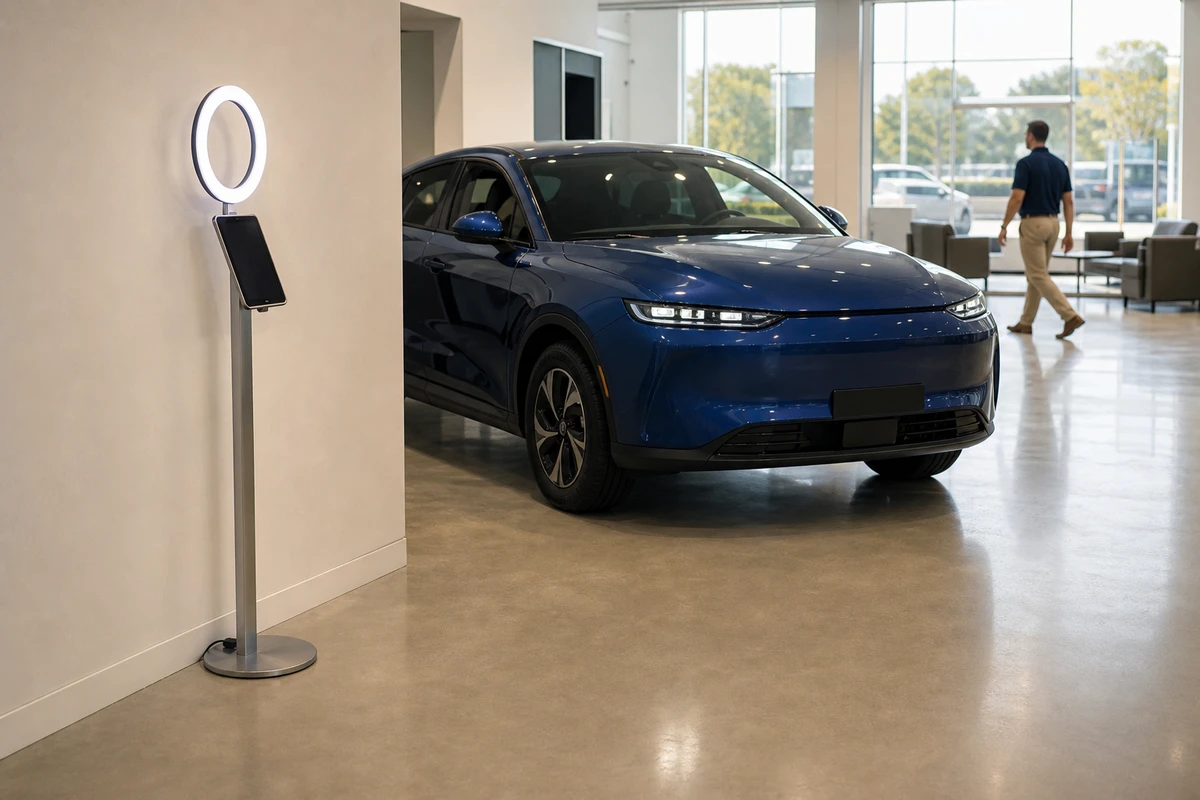
The product this guide is about is the guest photo booth. It photographs the customer, not the car. It is usually an open-air setup, an iPad running an app on a stand, and it lives on the showroom floor, in the service lounge, or under a tent at an event. It is bought by marketing, and its job is branded customer photos, contact data, social proof, and leads from sales events.
| Inventory / 360 booth | Guest photo booth | |
|---|---|---|
| Photographs | The vehicle | The customer |
| Run by | Inventory / merchandising team | Marketing / showroom staff |
| Lives | A dedicated bay or the software stack | The showroom, the service lounge, an event tent |
| Produces | Listing images and 360 spins | Branded customer photos, contact data, social posts, event leads |
| “Good” looks like | More cars shot per day, cleaner detail pages | Higher opt-in, more shares, reviews timed to delivery |
The honest position is that a dealership can reasonably want both. They are not competitors. They are two different line items solving two different problems, and a dealer who understands the split can budget for each on its own merits. The rest of this guide is about the second one, because it is the one buyer’s guides routinely skip.
What a guest photo booth actually does for a dealership
On most lots, the delivery photo is whatever one salesperson happens to capture: phone out, a quick frame against a row of trade-ins, sometimes texted to the customer, often not, and almost never saved anywhere the dealership can find it again. A guest photo booth turns that from an afterthought into a system, and it does three specific jobs.
That it makes the delivery moment repeatable
The first is that it makes the delivery moment repeatable. Instead of depending on which salesperson remembers, has a charged phone, and frames the shot straight, the booth makes the photo a fixed step with consistent branding and lighting on every car, every day. That consistency is what lets a dealership treat delivery photos as a content stream rather than a pile of mismatched snapshots.
Contact capture
The second job is capturing data the customer hands over willingly. To get the photo by text or email, the customer types in a contact detail, and optionally something about the vehicle they bought. They do it because they want the photo, not because a form was pushed at them. This is what Forrester Research named zero-party data in 2019: information a customer intentionally and proactively shares with a business, as distinct from first-party data, which is behavior the business observes quietly in the background. A clipboard, a “follow us” QR sign, or a fishbowl of business cards offers the customer nothing in exchange, which is why those methods capture so little. The booth offers a photo the customer actually wants, so the exchange has almost no friction. And the record it produces, a verified recent buyer with a known vehicle and purchase date, is among the most valuable a dealership can hold.
The third job is producing social proof
The third job is producing social proof. A named, real customer posting a branded photo of their new car reads as exactly what it is: a real person trusting the dealership with a major purchase. A dealership ad cannot claim that, however well it is shot or written. The difference is specificity. An ad is a general promise, while a delivery photo is a particular person, a particular car, and a visible moment of satisfaction. It also travels through that customer’s own network of friends, family, and coworkers, an audience a dealership cannot buy its way into. Whether or not any single photo reaches a wide audience, it carries the weight of a completed transaction, and that is the one thing paid creative can never manufacture.
There is a documented reason this particular minute is worth building a fixed step around. People do not remember an experience by averaging every moment of it. They remember the emotional high point and the ending, a pattern the behavioral economist Daniel Kahneman and colleagues established in 1993 and which is now called the peak-end rule. The key handoff is both the peak, the moment the customer takes possession of a significant purchase, and the end, the last step before driving off the lot.
It is the minute that will dominate how the customer later tells the story of buying the car. Cox Automotive’s 2023 Car Buyer Journey Study found that 82 percent of new-vehicle buyers were satisfied with the vehicle pickup and delivery process, among the highest-rated stages of the entire experience. The booth turns the minute customers already rate among the best of the buying experience into a permanent, branded, shareable photo.
Where the booth earns its keep: four deployment moments
The fastest way to underuse a guest photo booth is to think of it as event equipment, booked for the summer tent sale, switched on four times a year, and stored the rest of the time. The booth has at least four distinct jobs at a dealership, and the one most buyers overlook is also the one that runs every business day.
Every delivery, every day
This is the standing key handoff, not an event. Every car sold is a delivery, so this is the highest-volume use by a wide margin, and it is the case the inventory-booth search results do not address. A booth positioned in the delivery area turns each handoff into a consistent, branded photo and a captured contact. Because it runs daily, it is also the strongest argument for owning a booth rather than renting one. It needs no dedicated operator; a salesperson triggers it in the few seconds they already spend on the handoff.
Showroom sales events and manufacturer launches
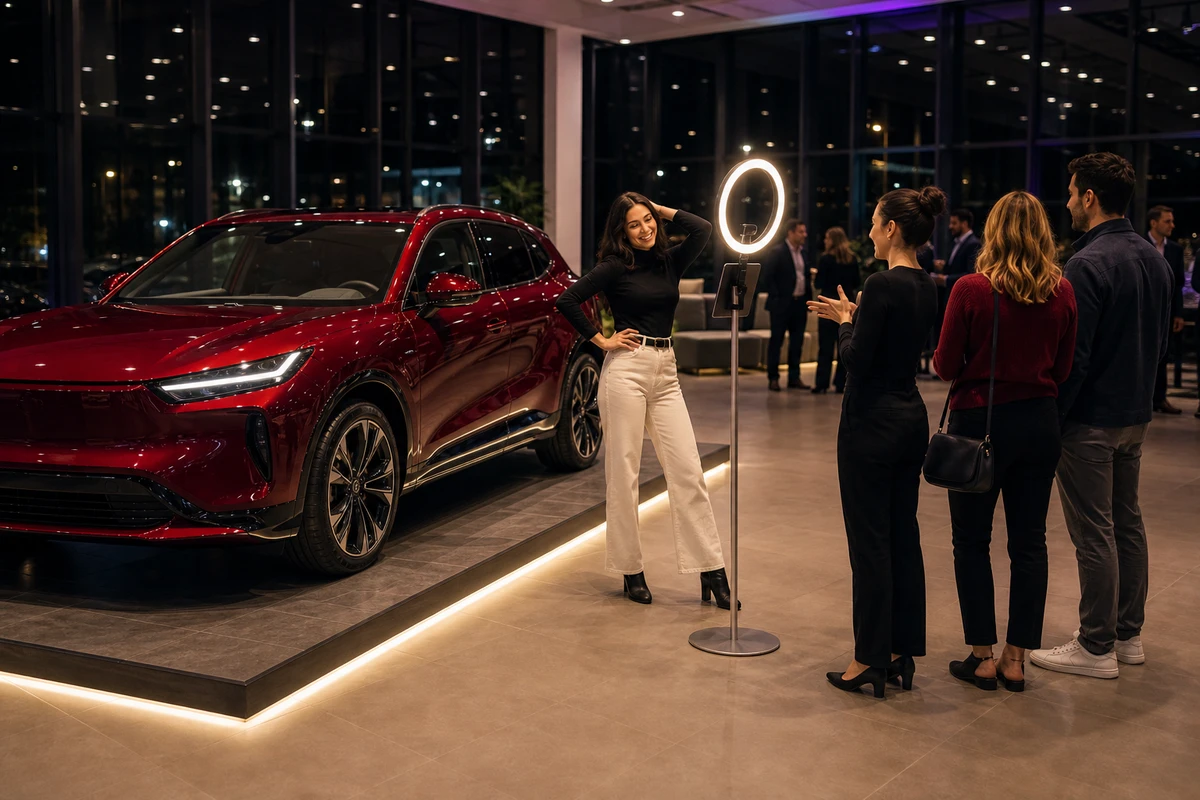
Model launches, weekend sales events, and new-showroom openings draw foot traffic that has no particular reason to leave a contact detail behind. A booth placed next to the featured vehicle gives a visitor a campaign-quality photo beside the car and a reason to share it. Brand events measurably move buyers: Event Marketer’s EventTrack 2026 study found that 61 percent of consumers are more inclined to make a purchase after attending a brand event or experience. These activations also pair naturally with manufacturer co-op creative, since OEM branding can sit in the photo overlay.
Customer appreciation and the service drive
Anniversary nights and VIP appreciation events are obvious fits. The service lane is the overlooked one. Service is where dealership retention is actually won, and a customer waiting on an oil change is a customer the dealership rarely treats as a marketing audience. A booth in the service lounge reframes a routine visit as a brand touchpoint and reaches people who are not buying a car today but will.
Off-site activations
Charity car shows, local sponsorships, and regional auto shows put the dealership in front of buyers away from the lot. A branded booth gives passers-by a reason to stop, and it captures leads in a setting where a clipboard would be ignored. Off-site use raises practical questions about power supply, screen glare, and weather that an indoor showroom does not, which is worth checking before committing a booth to an outdoor date.
Across all four, the staffing rule is simple: the daily delivery use should run unattended, triggered by whoever is handing over the keys, while large events justify a staffed setup. Each moment is also worth measuring on its own terms, by sessions started, opt-in rate, and shares, so the booth is judged as a marketing line item and not as showroom furniture.
What a guest photo booth is worth to a dealership: running the numbers
Take a single-rooftop dealership that delivers 80 new vehicles in a typical month. That number is not a guess. NADA’s 2024 data records 16.2 million new vehicles sold across 16,990 franchised dealerships, which works out to roughly 954 new vehicles a year, or about 80 a month, for the average store. Used-car deliveries push the real total higher, but new vehicles alone are enough to show the mechanism.
Contact capture
Put a booth in the delivery path and assume 60 percent of buyers type in an email or phone number to receive their photo. Photo booth operators report opt-in rates between 30 and 50 percent at public events, though those figures come from vendor case studies and have not been independently benchmarked. A delivery is a warmer setting than a public event: the buyer has just signed for the car, is standing beside it, and wants the photo. That figure reflects the warmth rather than wishful math. Sixty percent of 80 deliveries is 48 contacts a month, and 576 over a year.
Each of those 576 records is a verified recent buyer: a real name, a working contact detail, a known vehicle, and a documented purchase date. Compare that to what a dealership pays for an anonymous prospect. Automotive search advertising runs about $38.86 per lead, according to WordStream’s 2025 benchmarks, and once display, video, and third-party listings are blended in, the cost per lead for a new-car dealership lands between $250 and $283, per Promodo’s 2026 automotive benchmarks. Those leads are people who clicked an ad or filled out a form. They have not bought anything. The 576 booth contacts cost nothing to acquire, because the customer was already on the lot, and every one of them has already bought a car.
The value shows up in three places a dealership already measures. The first is service retention. Fixed operations, the parts and service side of the business, generates close to half of a franchised dealership’s total gross profit, according to NADA’s data. A captured, contactable buyer is a service-retention target, not just a sales lead, and the booth contact arrives with the exact purchase date that tells the service department when to reach out. The second is referrals. A recent, satisfied buyer is one of the best referral sources a dealership has.
If only one in fifty of those 576 contacts produces a referred sale over the year, that is roughly a dozen additional cars, and the front-end gross on a dozen sales is multiples of what any guest booth costs. The third is reviews. Each opt-in is a well-timed prompt to ask for a review while the customer is at their happiest. That matters, because 97 percent of consumers rely on reviews when making a purchase decision, per BrightLocal’s 2024 consumer review survey, and review volume and rating are among the few dealership signals a car shopper sees before ever picking up the phone.
None of this requires the booth to perform miracles. It requires a fixed step, a real opt-in, and someone who owns the follow-up. A dealership with different volume or a different opt-in rate reaches a different total, but the structure holds: a recurring stream of verified-buyer contacts, acquired at zero marginal cost, feeding the three areas where a dealership protects and grows revenue.
How to choose: a dealership photo booth buyer’s checklist
Two open-air booths can look identical on a showroom floor and behave nothing alike once a customer steps up to one. The differences that matter are not in the housing; they are in what the booth collects, how it brands the photo, and how it hands the data off. Eight decisions separate a booth that earns the numbers above from a booth that becomes an expensive prop.
Form factor
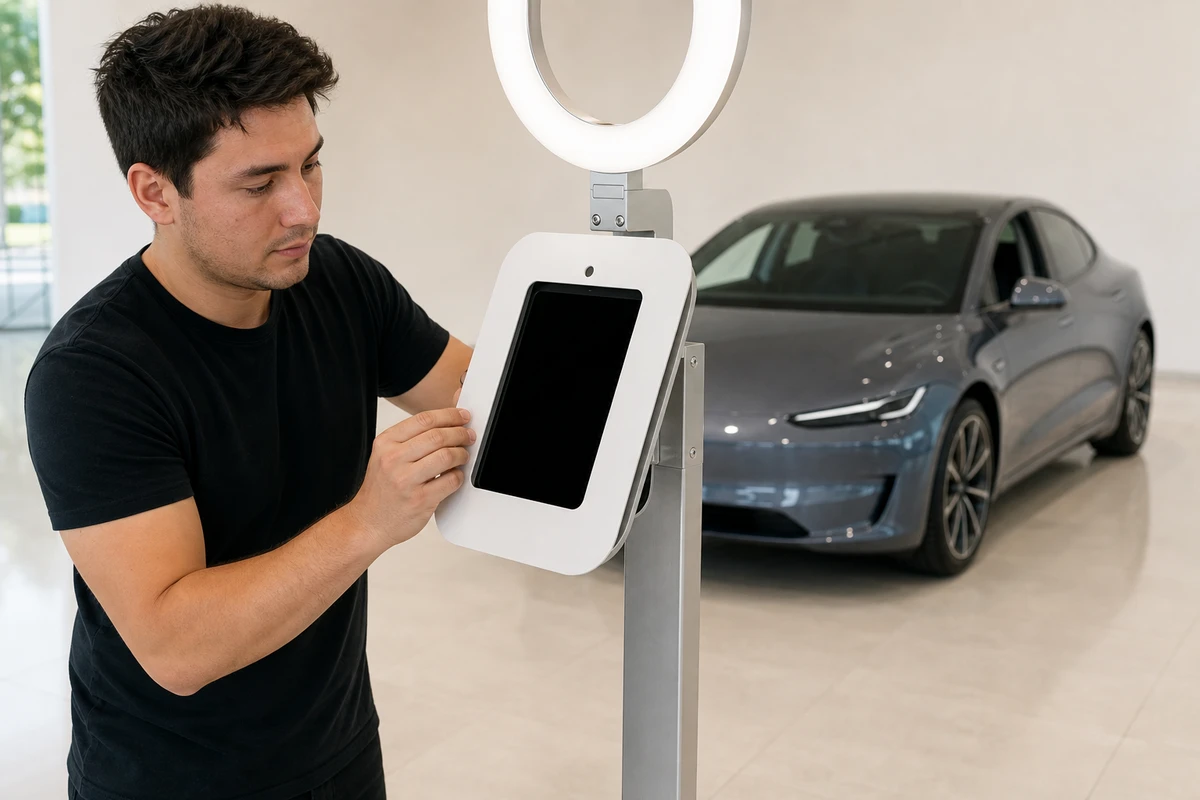
The common showroom choice is an open-air booth: an iPad and an app on a stand, compact enough for a corner and simple enough to run unattended. Simple Booth’s HALO kit is one open-air version of this form factor, an iPad-based booth with a tool-less faceplate that sets up in under a minute, which is what makes it practical for a salesperson to trigger at the handoff without a dedicated operator. Enclosed booths take more room and more setup. A guest 360-video spinner, a platform a person stands on while a camera arm rotates around them, is a different machine from the inventory turntable in the first section of this guide, despite sharing the “360” label. One spins a person for a video clip; the other spins a camera around a parked car. For everyday delivery use, the open-air booth is almost always the right call.
Branding and customization
A photo with no dealership branding spreads with no attribution back to the dealership. The booth should place the dealership logo, any OEM co-branding, and per-event overlays on every image, and ideally deliver the photos through a branded landing page rather than a generic one.
Data capture and CRM handoff
A booth that takes a photo but collects no contact detail captures none of the value in the previous section. It should gather email or SMS and, optionally, vehicle interest, and it should make that data available as a clean export the dealership’s CRM or marketing platform can ingest. Treat this as a data-handoff question, not a promise of one specific native integration.
Sharing speed
The customer should receive the photo by text, email, or QR code within seconds. Speed is the point: a customer is most likely to post the photo while still standing next to the car and still excited about it.
Attended versus unattended
Daily showroom and delivery use needs a booth a salesperson can trigger in seconds without a dedicated operator. Large events warrant a staffed setup. A dealership should buy for the everyday case, since that is where the volume is.
Durability and environment
The booth has to survive showroom-floor traffic, and if it will travel to the lot or an auto show, it has to handle heat, direct sun, glare on the screen, and variable power.
Analytics
Sessions, opt-in rate, and shares should be visible without manual counting. Without them, the booth cannot prove the model in the section above, and an expense no one can measure is the first one cut at budget time.
Software and support
App stability, a sensible update cadence, ready-made content templates, and responsive support all matter, because a booth frozen mid-event at a launch is a wasted spend on the one day it was supposed to earn the most.
Buy vs. rent for a dealership
Renting a booth for a single weekend launch is sensible. Renting one for every car delivered is not, and the arithmetic makes the line obvious.
Event rentals for a branded guest photo booth run roughly $1,400 to $1,800 per three-hour activation, based on the published automotive pricing of one Southern California rental operator (rates vary by market and configuration). For a one-off, that is reasonable. A dealership that runs four to six events a year spends $5,600 to $10,800 on rentals and never has to store, maintain, or update hardware.
Now apply rental pricing to the daily delivery moment. A dealership doing 80 deliveries a month, spread across about 22 business days, would need the booth on the floor every working day. At even $1,400 a day, that is $30,800 a month. No dealership would rent under those terms, which is exactly the point. The everyday delivery use only works economically if the dealership owns the booth, and ownership is where the captured-contact model compounds, because the booth runs every day at zero marginal cost per session.
The rule of thumb is straightforward
The rule of thumb is straightforward. If the booth would sit idle most weeks, rent it for the events that need it. If it would run every business day, which it will at any dealership that takes the delivery moment seriously, owning it is the only sensible option. The full financial comparison, including depreciation, useful life, and tax treatment, is its own exercise, but the directional answer rarely changes: occasional use rents, daily use buys.
Common mistakes dealerships make with a photo booth
The most common photo-booth mistake at a dealership is visible from the showroom door: a booth switched on, looking sharp, and collecting nothing. A few failure modes account for most of the wasted spend.
Treating it as decoration
A booth with no opt-in step takes photos and captures no data. It then has no measurable return, and it is fair to call it an expensive prop.
Skipping the branding
Unbranded photos circulate on social feeds with no attribution back to the dealership. The reach happens; the credit does not.
Events-only thinking
A booth used four times a year and kept in storage otherwise forfeits the daily delivery volume, which is most of the value.
No process
If the photo step is not written into the delivery checklist, salespeople skip it under time pressure. It has to be a trained, fixed part of the handoff, not a nice-to-have someone remembers on a slow afternoon.
Mishandling permission
Posting customer photos without a clear consent step is both a trust problem and a compliance risk. The booth’s opt-in flow solves it, but only if the consent language is explicit about what the customer is agreeing to.
Ignoring the data after capture
Contacts that never reach the CRM, and never enter a service or follow-up sequence, are contacts wasted. Someone has to own the data once the booth collects it.
Buying the wrong category
A dealership that buys an inventory turntable expecting customer engagement, or a guest booth expecting faster listing photos, has bought a working machine that does the wrong job. The two products share a search term and almost nothing else, and the time to catch the mismatch is before the purchase order, not after the booth arrives on a pallet.
Frequently asked questions
Is a dealership photo booth the same as a 360 inventory booth? No. They are separate products doing separate jobs. A 360 inventory booth photographs cars on a turntable for online listings, and it is run by the merchandising team. A guest photo booth photographs customers, and it is run by marketing to generate branded content, contact data, and event leads. A dealership can use both, but buying one when you needed the other is the most expensive mistake in this category.
How much does a photo booth for a car dealership cost? It depends on whether you rent or buy. Event rentals for a branded guest booth run roughly $1,400 to $1,800 per three-hour activation in one Southern California market, with rates varying elsewhere. Owning a guest booth is a one-time hardware cost plus any software subscription. The rule: rent for occasional events, buy if the booth will run every business day at the delivery moment.
Do we need staff to run it? Not for everyday use. A modern open-air booth runs unattended, and a salesperson triggers it in the few seconds they already spend handing over the keys. Large events, such as a model launch or an auto show, are worth staffing so someone can guide guests and keep the line moving.
Can it work outdoors on the lot or at an auto show? Yes, with planning. Outdoor use raises questions an indoor showroom does not: a reliable power source, protection from direct sun and screen glare, and cover from the weather. Confirm the specific booth is rated for the conditions before committing it to an outdoor date.
How does it capture leads, and is collecting contacts at an event legal? The customer enters an email or phone number to receive their photo, and the booth records that contact along with any optional details, such as vehicle interest. Collecting the contact is fine. Sending marketing texts afterward is regulated: under the federal Telephone Consumer Protection Act, marketing texts to a mobile number require prior express written consent, and that consent has to be explicit. A number entered only to receive a photo does not by itself authorize future marketing messages unless the opt-in language says so clearly and the consent is documented. This is general information, not legal advice, so confirm your approach with counsel.
Will customers actually use it, or is it a gimmick? The delivery moment is already among the highest-rated parts of the buying experience, so the booth is not manufacturing enthusiasm; it is capturing enthusiasm that already exists. Cox Automotive found 82 percent of new-vehicle buyers were satisfied with vehicle pickup and delivery. A booth turns that feeling into a branded, shareable photo instead of letting it drive off the lot uncaptured. Sources
- NADA (2024). “NADA Data 2024: Annual Economic Impact of America’s New-Car and Truck Dealers.” https://www.nada.org/nada/research-data/nada-data
- Cox Automotive (2023). “2023 Car Buyer Journey Study.” https://www.coxautoinc.com/market-insights/2023-car-buyer-journey-study/
- Kahneman, D., Fredrickson, B. L., Schreiber, C. A., & Redelmeier, D. A. (1993). “When More Pain Is Preferred to Less: Adding a Better End.” Psychological Science, 4(6), 401–405. https://doi.org/10.1111/j.1467-9280.1993.tb00589.x
- Forrester Research (2019). Concept of “zero-party data” introduced and defined by principal analyst Fatemeh Khatibloo.
- Event Marketer (2026). “EventTrack 2026: The Power of In-Person Experiences.” https://www.eventmarketer.com/article/eventtrack-2026-the-power-of-in-person-experiences/
- BrightLocal (2024). “Local Consumer Review Survey 2024.” https://www.brightlocal.com/research/local-consumer-review-survey/
- WordStream / LocaliQ (2025). “2025 Google Ads Benchmarks.” https://www.wordstream.com/blog/2025-google-ads-benchmarks
- Promodo (2026). “Digital Marketing Benchmarks of the Automotive Industry.” https://www.promodo.com/blog/digital-marketing-benchmarks-of-automotive-industry
- Federal Communications Commission. “Stop Unwanted Robocalls and Texts.” https://www.fcc.gov/consumers/guides/stop-unwanted-robocalls-and-texts
- Captured Celebrations. “Photo Booth for Automotive Events & Vehicle Launches.” Vendor-published rental pricing reference.