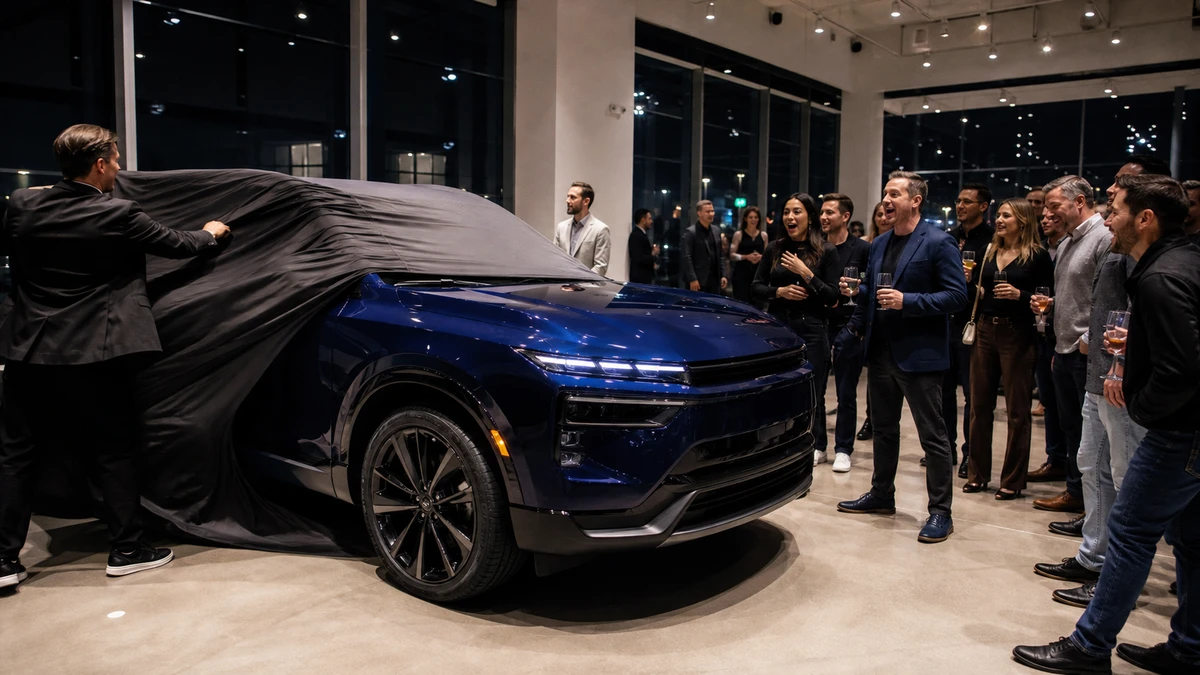
On a Friday evening, the new model sits under a fitted cover at the center of the showroom floor. The catering trays are out, the service bays are dark, and three dozen guests work the lot with drinks in hand while salespeople hover nearby. By closing time the sales board shows two delivered units, and the general manager quietly files the night under break-even.
That scoreboard is the mistake. A car dealership launch party is one of the highest-leverage events on the calendar, but only when it runs as a lead-capture and content engine rather than a one-night sale. The model being launched will not sell out that evening, and it is not supposed to. The night’s real payoff is a room of identified, interest-tagged prospects who buy over the following quarter, plus a stock of guest-made photos that keeps promoting the model for weeks. What follows is the set of party formats that fit a dealership lot, then the capture, follow-up, and measurement mechanics that decide whether the spend was worth it.
Why Most Launch Parties Get Measured Wrong
Most dealerships book the catering, draw a crowd, and grade the night by units delivered before the doors close. For a clearance event or a weekend sales blitz that scoreboard is fair, because those events exist to harvest buyers already at the edge of a decision. A new-model launch is a different animal, and using the same scoreboard quietly buries good events.
A newly launched model attracts shoppers who are early in a research cycle. The trigger that actually moves someone to buy (a lease ending, a vehicle that failed, a growing family, a new commute) arrives on its own schedule, and for most launch-night guests it is months out. The party does not create those triggers. It puts the dealership and the model in the shopper’s mind before the trigger lands, which is precisely when most competitors are invisible.
The in-person visit still carries real weight. Cox Automotive’s 2025 Car Buyer Journey Study, which surveyed 2,300 recent buyers and was released in January 2026, found that 53% of buyers completed every required purchase step in person at the dealership while only 7% bought fully online, with new-vehicle satisfaction at a record 76%. Kelley Blue Book’s read of the same research noted that 63% of shoppers describe their ideal experience as a blend of online research and in-person steps. A launch night is the in-person step a shopper attaches to the model long before signing anything, which means success has two parts and both pay out later: a captured, segmented prospect list, and a stock of guest-made content. The rest of this article is the system that produces them.
Eight Launch Party Formats for a Dealership Lot
The new vehicle is the most interesting object on the lot, and that draws a particular guest: curious enough to give up a Friday evening, rarely ready to sign that night. Those guests also arrive under real financial pressure. Experian put the average new-vehicle monthly payment at $767 in the fourth quarter of 2025, up from $746 a year earlier, on an average loan of $43,582. The strongest formats let a guest do something practical (get a real trade-in number, compare two trims, sit with a finance manager) rather than just handing them a drink. Eight work well for a franchise rooftop, as distinct from the broadcast-scale reveals an automaker stages for a brand.
Formats that reward existing customers
- VIP first-look preview night. Invite sold-order holders, repeat buyers, and service regulars to see the model before the public does. Built for loyalty and word of mouth; suits any store with a healthy owner base.
- New-owners delivery celebration. Stage the first deliveries of the launched model as a group event, so early buyers take their keys in front of the crowd. Turns routine deliveries into live social proof.
Formats built around the reveal and the test drive
- Public reveal with a cover-drop. Stage a real unveiling moment, a cover pull and a lighting cue, so the night has a clear photo-and-video peak. Good for high-interest mainstream launches.
- Ride-and-drive day. Park the new model beside the outgoing generation and a key rival for back-to-back drives. Suits a launch where the gain is something a shopper has to feel, not read.
- Trade-in appraisal pairing. Run on-the-spot appraisals so an interested guest sees a concrete path into the new model that night. Best for stores that can make competitive used-car numbers.
Formats that widen reach beyond in-market shoppers
- Community block party or family day. Food trucks, kids’ activities, and local partners pull a wider crowd and soften the sales-push perception. Fits family models like SUVs and minivans.
- Co-marketing partner night. Pair with a complementary local brand (a coffee roaster, an outdoor outfitter, an EV-charging installer) to borrow their audience. Useful for a store with a thin owner list.
- After-hours enthusiast meet. For a performance or heritage model, host an evening meet that draws the local owner and enthusiast community.
Match the staging to the vehicle
The build should echo the product. An EV launch suits a clean, quiet tech-lounge setup with live charging demos and a payment-and-incentive table, because the questions an EV draws are practical ones. A truck or off-road SUV suits an outdoor, terrain-styled space that lets guests climb in and picture the use. A performance car suits a darker room and a dramatic reveal under tight lighting. The format and the staging are not decoration; they decide who walks in and what they do once they arrive.
Promotion: A Four-Week Runway to Fill the Room
The operator’s real nightmare is a catered lot with eight guests on it. Most ranking pages answer the turnout fear with “promote it on social,” which is not a plan. A four-week runway is.
Build the four-week cadence
Four weeks out, publish a teaser and a save-the-date, and point both at an RSVP landing page. Three weeks out, send the formal invitation to the existing customer and service database. Two weeks out, run paid social against in-market and lookalike audiences, naming the date and the model. The final week is a reminder sequence and a day-of countdown. The RSVP landing page does quiet double duty here: it captures intent before the event, so a soft RSVP count two weeks out is an early warning a dealership can still act on, by widening the invite list or adding an incentive, rather than a surprise on the night.
The cheapest reach is the list the dealership already owns
Most promotion budgets get spent buying strangers. The highest-yield invite list is already in the building: the service drive and the existing customer database. Those people have a relationship with the store, they respond at far higher rates than cold audiences, and reaching them by email or text costs effectively nothing. Second, OEM co-op funds often cover launch-event promotion and routinely go unclaimed because nobody filed for them. Before a dealership spends its own money on launch advertising, the marketing manager should confirm what the manufacturer will reimburse.
Engineer the Night So Guests Make Your Content
On most evenings, a shopper will not photograph themselves next to a car on a dealership lot. On launch night they will, because the new model is genuinely interesting and the event gives the photo a reason to exist. That window is short and worth designing for.
Guest-made content is social proof a dealership cannot buy. A photo a guest posts of themselves with the new model reaches that guest’s friends with a credibility a dealer ad never has, because it reads as a real person’s choice rather than a placement. It also keeps working after the lot is swept, surfacing in feeds and searches for weeks.
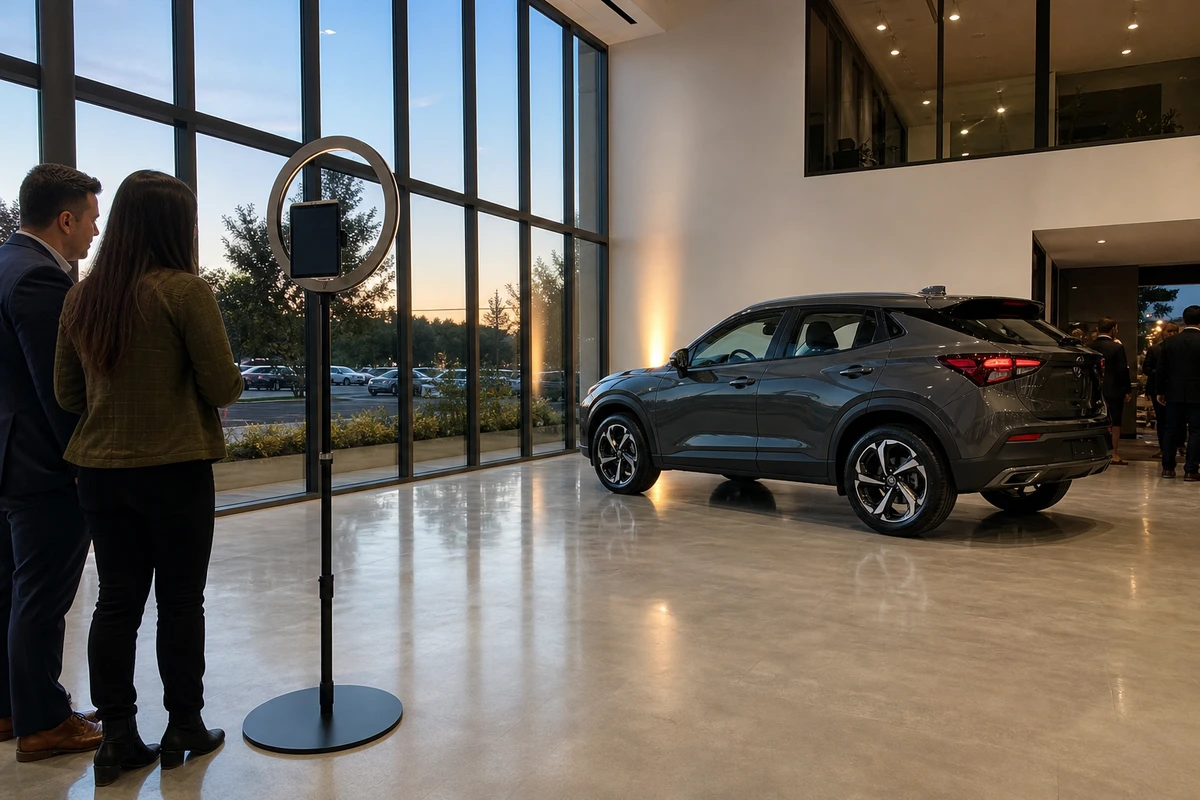
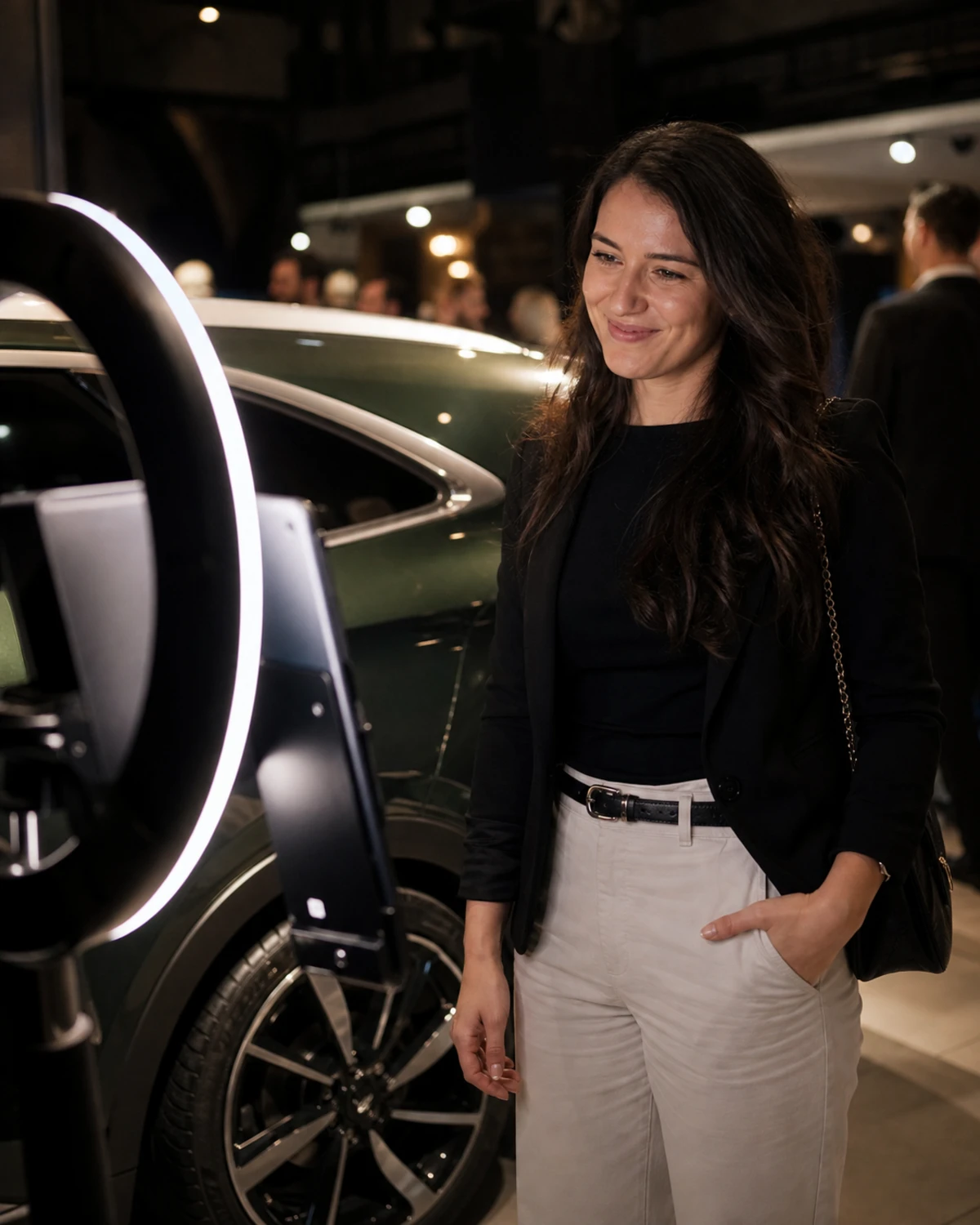
Designing for it is straightforward. Create one or two deliberate photo moments: the cover-drop, a styled backdrop with the model under good light, the first set of keys handed over. Give the event a short, dealership-owned hashtag and put it on physical signage where guests are already standing. Make sharing effortless rather than hoping it happens, including a staffed photo station beside the vehicle that sends each guest their picture on the spot. A photo station built for this job, such as Simple Booth’s HALO kit, is an iPad with a 2,100-lumen ring light that delivers each guest’s photo by QR code, email, or text before they leave the vehicle. That delivery step doubles as a capture step, because a guest hands over an email or phone number to receive the shot. And have someone capture the dealership’s own footage of the reveal and the first reactions, because that reel becomes the opening asset of the follow-up sequence.
Capture Every Guest, Not Just the Buyers
Here is where most launch parties leak their value: a room full of warm, in-market prospects walks back to their cars unidentified. An anonymous attendee is worth almost nothing 30 days later, because there is no name to call and no interest to act on.
A capture stack guests will actually use
Driftrock, a lead-capture vendor, has described a BYD France activation in a shopping center that switched to a short mobile sign-in form and collected more than 400 leads in a few days. Treat the number as vendor-published rather than a benchmark, but the principle transfers cleanly: capture friction is what leaks an in-person automotive event. The fix is a stack. An RSVP landing page captures the keenest guests before the night. On site, a low-friction sign-in (a few fields, mobile-first, never a clipboard on a podium) captures the rest. And every guest needs a reason to opt in: a test-drive registration, a prize-draw entry, or simply their own event photos sent to them afterward.
Collect the timing, not just the contact
A name and an email are the floor, not the goal. The detail that makes follow-up land is zero-party data, the information a guest knowingly volunteers about themselves: which model and trim pulled them in, what they drive now, and when their lease ends or their current vehicle is due for replacement. A guest whose lease expires in three months is a different follow-up task from one who is two years out, and only the captured timing tells staff which is which. Connect the sign-in to the dealership CRM so the list is segmented on the night itself, not retyped from cards the following week. Dealertrack, a Cox Automotive brand, makes the same operational point: launch energy is wasted if it lands in a pile of handwritten notes instead of a clean workflow.
The 60-to-90-Day Follow-Up Where the ROI Lands
The launched model will not sell out on launch night. That makes the follow-up the return on the event, not an afterthought to it.

Build the sequence around the captured data
Within 48 hours, send each guest a thank-you that delivers their event photos and the reveal reel, the warmest possible reason to reopen contact. Over the first four weeks, run a model-specific nurture (specs, availability, finance and lease offers) segmented by the trim interest each guest registered, so a truck shopper never gets sedan emails. Over the longer tail, retarget attendees with ads and time direct outreach to each prospect’s lease-end or replacement window as it arrives.
Speed matters most at the front of that sequence. Harvard Business Review’s 2011 analysis of 1.25 million sales leads found that firms contacting a lead within an hour were far more likely to qualify it than firms that waited. The study is old and its channel was web forms, but the operational lesson holds: a hand raised at the party cools fast, so same-day tagging and next-day contact beat a tidy spreadsheet worked the following week.
Why the follow-up beats the blitz
A launch party compresses a quarter of cold prospecting into one identified, interest-tagged list in a single evening. Disciplined follow-up is what converts that list into delivered units. This is the line that separates a launch party from the staffed sales blitz: the blitz works every buyer in the tent hard, then abandons every non-buyer the moment the tent comes down. A launch party treats the non-buyers as the actual inventory of the night.
Run the Numbers Before You Book Anything
Before signing the quote for catering, entertainment, a photo setup, promotion, and staff overtime, a general manager should run the launch through a formula. It takes five minutes and it changes decisions.
The formula, and a worked example
Pipeline value = guests attending × opt-in rate × 90-day close rate × average gross per unit. Set that against total event cost to find the break-even.
Take a single-rooftop store planning a launch night for roughly 150 guests. If 60% sign in and opt into follow-up, that is 90 identified prospects. Apply a deliberately conservative 90-day close rate of 5%, a figure to test against the store’s own CRM history rather than accept as a benchmark, and the night yields four to five sold units. If that store books around $3,000 of average front-end gross on a new unit, the resulting 90-day pipeline is roughly $13,000 to $14,000, set against an event cost in the low five figures. On units alone, that is close to break-even, and a store that lifts opt-in or sharpens its follow-up moves the same night into clear profit.
What the formula does not price
The formula deliberately undercounts. It ignores the earned reach of guest-made content, the loyalty value of existing customers who attend, and the service relationship behind every sold unit. NADA’s 2025 full-year data put franchised-dealer service and parts sales above $164 billion across more than 276 million repair orders, a reminder that a new-vehicle sale opens years of service revenue the launch-night formula never sees.
The decision rule is the useful part. If the modeled 90-day pipeline does not clear event cost on conservative inputs, the format or the guest list is wrong, and that is worth fixing before any money is spent, not after the lot is catered.
Sources
- Cox Automotive (2026). “Cox Automotive Car Buyer Journey Study Finds Efficiency, Digital Tools and AI Drive Record Satisfaction.” https://www.coxautoinc.com/insights-hub/cox-automotive-car-buyer-journey-study-finds-efficiency-digital-tools-and-ai-drive-record-satisfaction/
- Kelley Blue Book (2026). “Study: Car Shopping Is Getting More Pleasant.” https://www.kbb.com/car-news/study-car-shopping-is-getting-more-pleasant/
- Experian (2026). “State of the Automotive Finance Market: Q4 2025.” https://www.experian.com/blogs/insights/tag/auto-finance/
- National Automobile Dealers Association (2026). “NADA Data: 2025 Full-Year Report.” https://www.nada.org/nada/nada-data
- Harvard Business Review (2011). “The Short Life of Online Sales Leads.” https://hbr.org/2011/03/the-short-life-of-online-sales-leads
- Dealertrack (2026). “Car Buyer Journey Insights: Build Trust and Speed.” https://us.dealertrack.com/resources/car-buyer-journey-insights-trust-speed/
- Driftrock (n.d.). “BYD France shopping-center lead-capture activation.” https://www.driftrock.com/