At a regional college fair, an admissions counselor stands behind a folding table with a banner, a bowl of pens, and a stack of inquiry cards. A high-school junior leans in, asks two questions about the nursing program, and writes down an email address that may or may not be legible. Forty feet away, a counselor from another school scans the barcode on the same student’s pre-printed badge in under a second. Both just did campus event lead capture: collecting attendee contact details and engagement signals at an in-person campus event, then routing them into the system that will act on them.
The phrase hides two different jobs. An admissions open house and an alumni homecoming are both campus events, but the data each one produces, the system that data belongs in, and the rules that govern it have almost nothing in common. A capture method tuned for one will quietly degrade the other.
Campus event lead capture is two jobs, not one
Walk a campus events calendar across a year and the same data team keeps showing up at different tables. In October it is a college fair: high-school juniors, parents, a stack of inquiry cards. In April it is an admitted-student day. In the fall there is also a homecoming tailgate, where the people at the table are graduates the institution has known for decades. Vendor pages flatten all of this. A typical higher-education event-tech page lists donor tailgates, recruitment open houses, job fairs, orientation, and alumni receptions in a single undifferentiated grid, as if one capture workflow served them all. It does not.

Recruitment and Advancement Events
Campus events fall into three groups, and two of them carry the weight. Recruitment and admissions events are college fairs, on-campus open houses, admitted-student days, and high-school visits. The audience is prospective students and their parents, and many of the students are under 18. The output the office wants is an inquiry: a new, contactable record an admissions counselor will nurture toward an application.
Advancement and alumni events are homecoming, reunions, tailgates, regional receptions, and donor galas. The audience is the opposite kind of person, a known constituent already in the institution’s database. The output is rarely a new lead at all. It is a re-engagement touch and a chance to fix a record that has gone stale: a changed email, a new employer, a job title that hints at giving capacity.
Operational events, the third group, are orientation, guest lectures, research symposia, and career fairs. Capture there serves logistics, feedback surveys, and continuing-education credit rather than pipeline.
Naming the groups makes the real consequence visible. A good lead means opposite things for the first two jobs. For admissions, a good lead is a complete record that did not exist before. For advancement, a good lead is a match to a constituent who already exists, plus one fresh data point. A capture tool that creates a brand-new record for every scan is doing the right thing at the open house and the wrong thing at the tailgate, where every duplicate it spawns becomes a mailing sent twice and a giving history split across two profiles.
Design capture backward from the system of record
Picture the Monday after a fair. A coordinator has a spreadsheet of 200 contacts exported from a capture app and a Slate instance to load them into. Thirty of those 200 are already in Slate as prior-year inquiries. The bulk import now faces a choice no one made in advance: create thirty duplicates, overwrite thirty existing records, or fail silently on the rows where the email does not match cleanly. None of those is good, and the coordinator is making the call alone, days late.
The mistake happened before the event
The mistake happened before the event. The capture method was chosen for its booth-side convenience, not for the system the data had to land in. Designing it the other way around, backward from the record system, removes the Monday problem.
Admissions data flows into a small set of platforms: Slate from Technolutions, Element451, or Salesforce Education Cloud. Advancement data flows into Blackbaud Raiser’s Edge NXT or Slate’s advancement module. Slate now spans both functions, and Technolutions reports it is used by more than 1,700 institutions, which is why one capture decision can affect two departments at once. These names are infrastructure context, not endorsements. What matters is that each platform has a schema, a set of fields it expects, and a rule for what counts as a unique person.
The question every captured record has to answer is whether it is a new record or a match to an existing one. For recruitment, the answer is almost always new. For advancement, it is almost always existing, which makes deduplication and identity matching the real work, not an afterthought at import time.
Three decisions belong before the event, not after it. First, capture the fields the destination actually requires; a system that keys on email needs a verified email address, not a guess written on a card. Second, decide the deduplication rule in advance, so a match against an existing constituent updates that record instead of cloning it. Third, agree who owns the import and by what deadline. A generic tool that advertises exporting to any CRM produces a flat list someone re-keys later, and that flat list is how duplicate constituents and orphaned inquiries get made. A method that writes in the destination’s schema avoids the problem at the source.
Five capture methods, and where each one breaks
Stand at a campus capture point and the method in use is usually visible at a glance: a bowl of pens and a card stack, a tablet on a stand, a counselor thumbing a phone scanner, a kiosk by the door. Five methods are in common use, and the useful way to judge them is not by feature list but by the situation that breaks each one.
Paper inquiry cards are the baseline everyone is trying
Paper inquiry cards are the baseline everyone is trying to escape. They work until a counselor reads them back: handwriting that cannot be parsed, half-filled fields, and a re-keying lag of several days while a stack of cards waits to be typed. A reasonable working estimate, though results vary by institution, is that something like a quarter of a paper stack arrives unusable. Paper also records nothing about the conversation, only the contact.
Event-specific landing pages and QR forms are the digital baseline: one branded form with its own URL per event, open on a booth tablet or reached by a QR code on a sign. They break on two things. The first is venue wifi, which on a fair day is often closer to no connection at all. The second is the attendee, who has to be willing to type their own details on their own phone in a crowd, and a meaningful share will abandon the form half-finished.
Badge and barcode scanning is the standard at organized college fairs. Students register ahead of time, receive a barcode or QR code, and counselors scan it. NACAC runs an official In-Person Lead Retrieval system at its National College Fairs, which confirms that scanning, not card collection, is the architectural standard at formally organized fairs. Vendors such as GoToCollegeFairs describe the mechanics plainly: a scan pulls the full registered profile, a counselor can attach an interest rank and notes on the spot, and the app drops into offline mode when venue internet fails, then syncs later. GoToCollegeFairs lists pricing at 25 dollars per user per day or 199 dollars per user per year. The method breaks where there is no code to scan, which is most self-hosted events: an open house, a guest lecture, a tailgate. Scanning solves the fair and nothing else.
Self-serve kiosks and check-in stations suit high-volume moments, admitted-student days and large operational events, where a queue needs to move. They break on depth. A kiosk records that a person was present and little else, with no conversation and no interest signal attached.
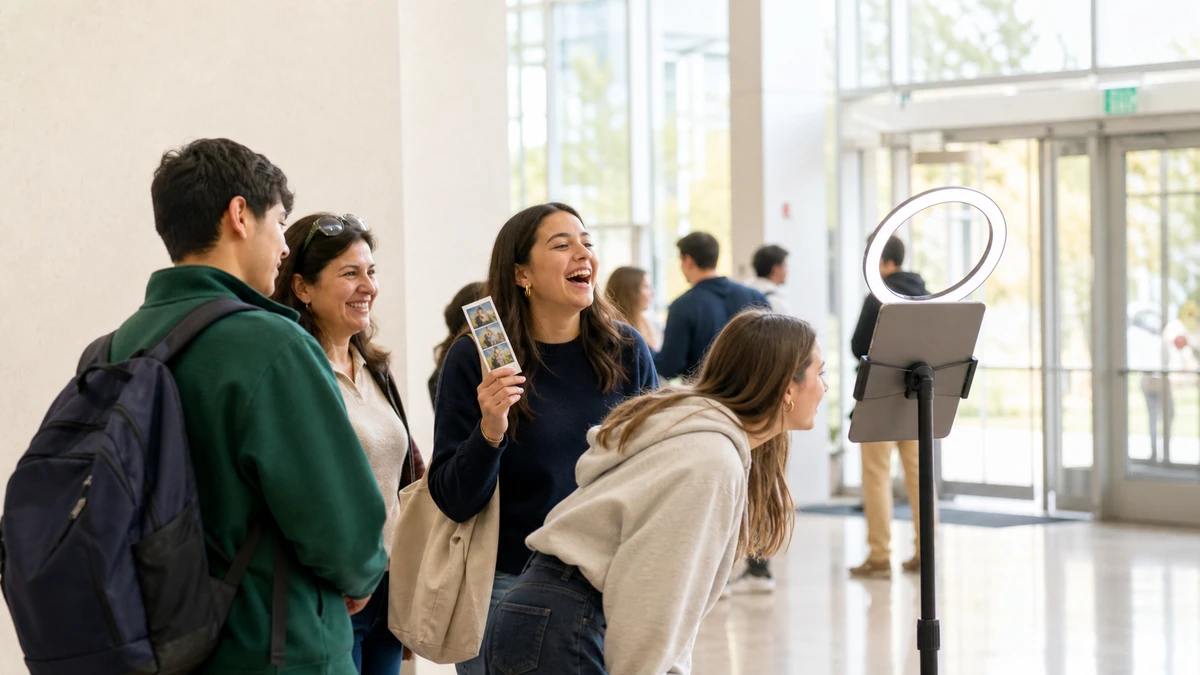
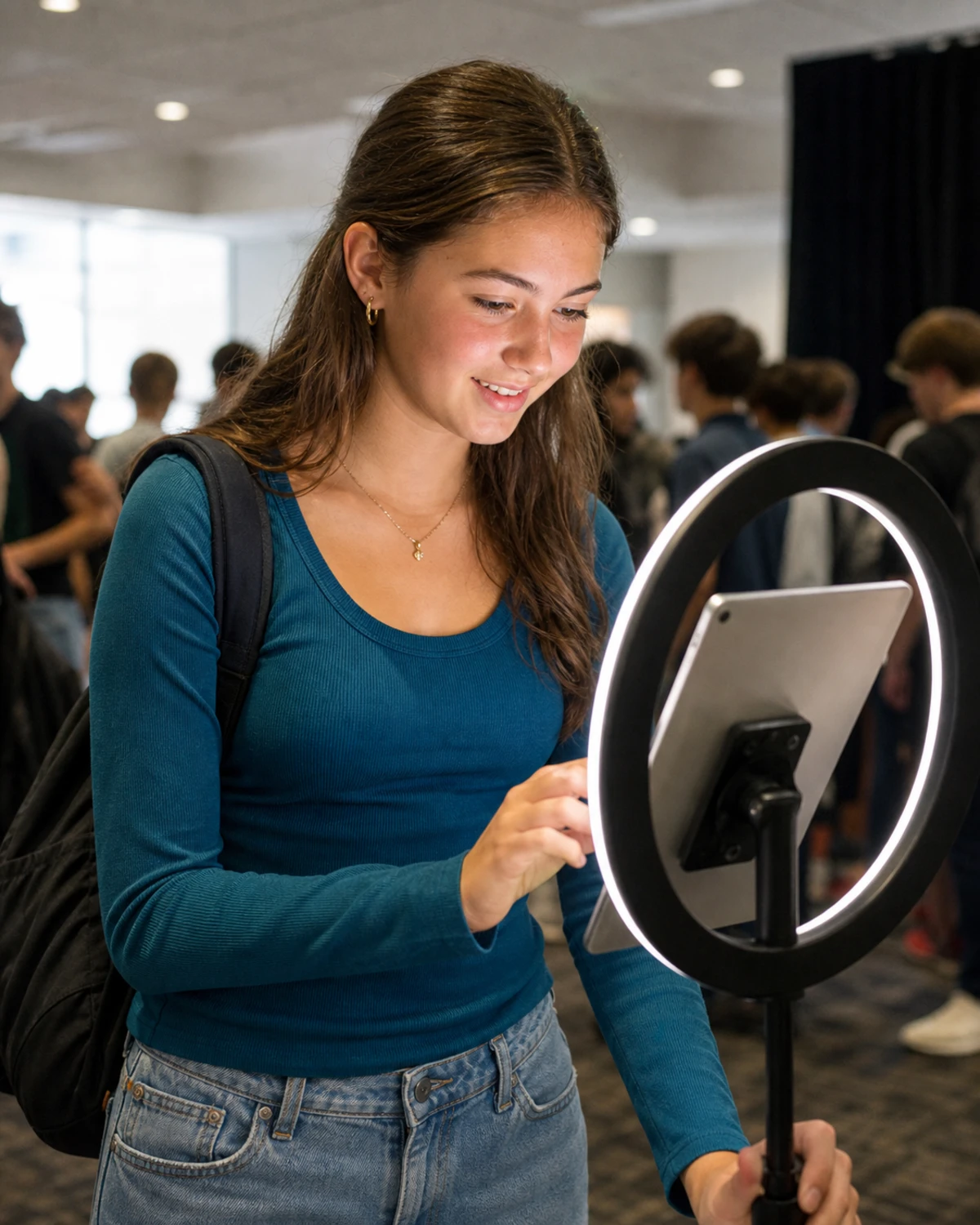
Branded experiential capture is a photo or short-video activation where the step that delivers a guest their photo, by text or email, is also the moment the institution records an opt-in and produces a piece of branded content it can reuse. It captures contact data well and fits advancement and engagement-heavy events. Simple Booth’s HALO kit is one concrete version: an iPad photo station where the guest, to receive their photo, enters an email address or phone number the institution can actually reach, and the nonprofit Arizona Opera used that kind of station to add roughly 1,000 email addresses across a handful of events. It breaks on interest depth: without a question or a staff note attached, it tells the institution who attended and how they felt, but not which program a prospective student wants.
The pattern across all five is the same. The best method is not the one with the longest feature list. Judge a method on three things: whether its output matches the destination schema described in the previous section, how complete each record is, and how fast it lands. Raw volume, the sheer count of names, is none of the three. It is the easiest to chase and the least worth having.
The consent problem: recruitment events capture minors
A counselor collects a 17-year-old’s mobile number at a fair on Saturday. The following week, the admissions office sends an automated text reminder about an application deadline. That single text, sent without a documented opt-in, is the live legal risk in campus event capture, and no vendor product page mentions it.
The consent workflow
A name on a card is not permission to market to the person who wrote it. Many operators assume FERPA covers this. It does not. FERPA, the Family Educational Rights and Privacy Act, governs the education records of students already enrolled at an institution. The U.S. Department of Education’s Student Privacy Policy Office is clear that FERPA is not implicated before a student enrolls. Recruitment-event data about prospective students sits outside FERPA entirely.
What governs that data instead is marketing-consent law. Email is covered by CAN-SPAM. Automated text messages and calls are covered by the Telephone Consumer Protection Act (TCPA), which, as the law firm Bryan Cave Leighton Paisner explains, requires prior express written consent before a marketing text is sent using automated technology. An FCC rule that took effect on April 11, 2025 also lets a recipient revoke that consent at any time by any reasonable means. The harder issue is age. Whether a minor can give legally valid TCPA consent is unsettled: the National Law Review has reported a class action arguing that a 13-year-old cannot. No court has settled the question, but the exposure is real, and a large share of college-fair attendees are under 18.
The practical response is to make consent part of capture rather than an assumption layered on afterward. Record an explicit opt-in at the moment of collection. Store the consent basis as its own field on the record. Segment minor records so they can be handled under stricter rules. And offer a real channel choice instead of defaulting every attendee into SMS. The advancement side carries less minor-related risk, since alumni are adults, but it carries its own duty: an honest opt-in for solicitation, and respect for any opt-out a constituent already registered. That last point is one more reason matching to the existing record matters.
An event captures a signal, not a contact
Two admissions tables at the same fair: one collected 180 names, the other 90. The first feels like the winner. That instinct is the most expensive mistake in campus event capture, and the data does not support it.
Per admissions practitioners Robert Kadar and Steve Roth, writing
Per admissions practitioners Robert Kadar and Steve Roth, writing in Inside Higher Ed and reporting on data from multiple institutions, 85 to 90 percent of enrolled students never filled out a lead form at all. Students research a college over several months across many touchpoints and apply when they are ready. Raw lead volume, the count of names a table collected, is a weak predictor of who eventually enrolls.
What an event actually captures is not a contact. It is a demonstrated-interest signal: evidence that a specific person spent part of a Saturday in the institution’s presence. For admissions, that signal has direct value, because showing interest is itself an admission input. NACAC’s Factors in the Admission Decision data for the Fall 2023 cycle, drawn from 185 four-year institutions, shows 15.7 percent of colleges rate a student’s interest in attending as of considerable importance and another 27.6 percent as of moderate importance, so roughly 43 percent weigh it at least moderately. A capture record that logs only an email throws that signal away. One that also logs attendance, an interest rank, the program discussed, and a counselor’s note preserves it.
For advancement, the signal feeds engagement scoring, the behavioral measure that tracks with future giving. Analysis by Marts & Lundy of CASE’s 2023 alumni-engagement survey found that in the United States, 33.2 percent of alumni with experiential engagement, such as attending events, also give philanthropically, against 20.9 percent of those engaged only through communications. The ViTreo Group’s 2024 white paper on alumni philanthropy points the same direction: alumni who attend events sponsored by their institution have a greater tendency to give. The timing detail matters for capture. Event attendance peaks among very recent graduates, who are also the least likely group to be donors yet. Capturing and tagging them now is how the future giving pipeline gets built.

This resolves a real contradiction: vendor pages sell more leads, while practitioners call lead volume a dead end. Both can be right. An institution can capture diligently and still reject name count as its scoreboard. The numbers that belong on the scoreboard are record completeness, speed to first contact, and downstream influence: applications started and gifts made by people who attended. Names collected is an activity number, not a result.
The handoff: the 72 hours that decide whether the event paid off
The box of inquiry cards on a desk on Monday morning is where most of an event’s value is lost. Capture quality means nothing if the data sits. Routing, deduplication on import, and a first contact should happen within days, ideally the same week.
The work has a fixed shape
The work has a fixed shape. Deduplicate against the system of record before importing, so advancement matches update constituents instead of cloning them. Route each record to the person who can act on it: an admissions counselor by territory or program, a gift officer by portfolio. Trigger a first touch that is automated in its timing but personal in its content. And log the event itself as a field on the record, so a counselor reviewing that prospect in March can see the student stood at the table in October.
Speed matters because contact decays
Speed matters because contact decays. The clearest evidence comes from outside higher education: a Harvard Business Review study by Oldroyd, McElheran, and Elkington of 2,241 companies handling web leads found that responding within five minutes made a firm 100 times more likely to connect with a prospect than waiting 30 minutes, and responding within an hour made it seven times more likely to qualify a lead than waiting a full day. That is B2B sales data from 2011, and a teenager choosing a college is not a buyer choosing software, so the transfer is directional, not exact. The mechanism, though, holds: the longer a captured record waits, the colder it gets.
The arithmetic makes the stakes concrete
The arithmetic makes the stakes concrete. Picture an admissions open house that draws 220 prospective students. Captured on paper, with an illustrative 25 percent loss to illegible or incomplete cards, the office keeps about 165 usable records. A same-day digital capture keeps roughly 210. Applying an illustrative 12 percent inquiry-to-application rate, the gap between 165 and 210 is about five extra applications from a single afternoon, before counting the cost of slow follow-up on the records that did survive. (Both rates here are illustrative; real loss and conversion figures vary by institution and should be measured locally.) The advancement parallel runs the same way: a homecoming tailgate of 400 alumni, with a capture point used by 35 percent of attendees, yields about 140 refreshed constituent records, each tagged as an engagement touch that will sit in the giving pipeline for years.
The method matters only because the handoff matters. Capture is the first ten minutes of a 72-hour process. The institution that runs it that way is the one whose events actually pay off.
Sources
- National Association for College Admission Counseling (2023). “Factors in the Admission Decision.” https://www.nacacnet.org/factors-in-the-admission-decision/
- National Association for College Admission Counseling (2025). “In-Person Lead Retrieval.” https://www.nacacnet.org/get-involved/exhibit-at-a-nacac-college-fair/in-person-lead-retrieval/
- Inside Higher Ed (2022). Kadar, Robert and Roth, Steve. “Lead Generation Has Distorted Admissions Advertising.” https://www.insidehighered.com/admissions/views/2022/08/15/lead-generation-has-distorted-admissions-advertising-opinion
- Marts & Lundy (2024). Clough, Sarah. “Engaging Alumni: Key Findings from the 2023 CASE Insights on Alumni Engagement Survey.” https://martsandlundy.com/what-we-think/engaging-alumni-key-findings-from-the-2023-case-insights-on-alumni-engagement-survey/
- ViTreo Group (2024). “Alumni Engagement and Philanthropy at Colleges and Polytechnics.” https://www.vitreogroup.ca/vitreo-research/2024/2/20/alumni-engagement-and-philanthropy-at-colleges-and-polytechnics
- Harvard Business Review (2011). Oldroyd, James B., McElheran, Kristina, and Elkington, David. “The Short Life of Online Sales Leads.” https://hbr.org/2011/03/the-short-life-of-online-sales-leads
- U.S. Department of Education, Student Privacy Policy Office. “What Is FERPA?” https://studentprivacy.ed.gov/ferpa
- Bryan Cave Leighton Paisner (2025). “The TCPA’s New Opt-Out Rules Take Effect on April 11, 2025: What Does This Mean for Businesses?” https://www.bclplaw.com/en-US/events-insights-news/the-tcpas-new-opt-out-rules-take-effect-on-april-11-2025-what-does-this-mean-for-businesses.html
- National Law Review (2024). “New Class Action Alleges Minors Can’t Give Legal TCPA Consent to Be Called or Texted.” https://natlawreview.com/article/new-class-action-alleges-minors-can-t-give-legal-tcpa-consent-to-be-called-their
- GoToCollegeFairs (2022). “College Fair Scanning App.” (Vendor-published; cited for capture mechanics and pricing only.) https://gotocollegefairs.com/products/scanning-app/
- Technolutions (2025). “Alumni & Advancement.” (Vendor-published; cited for infrastructure context only.) https://technolutions.com/advancement