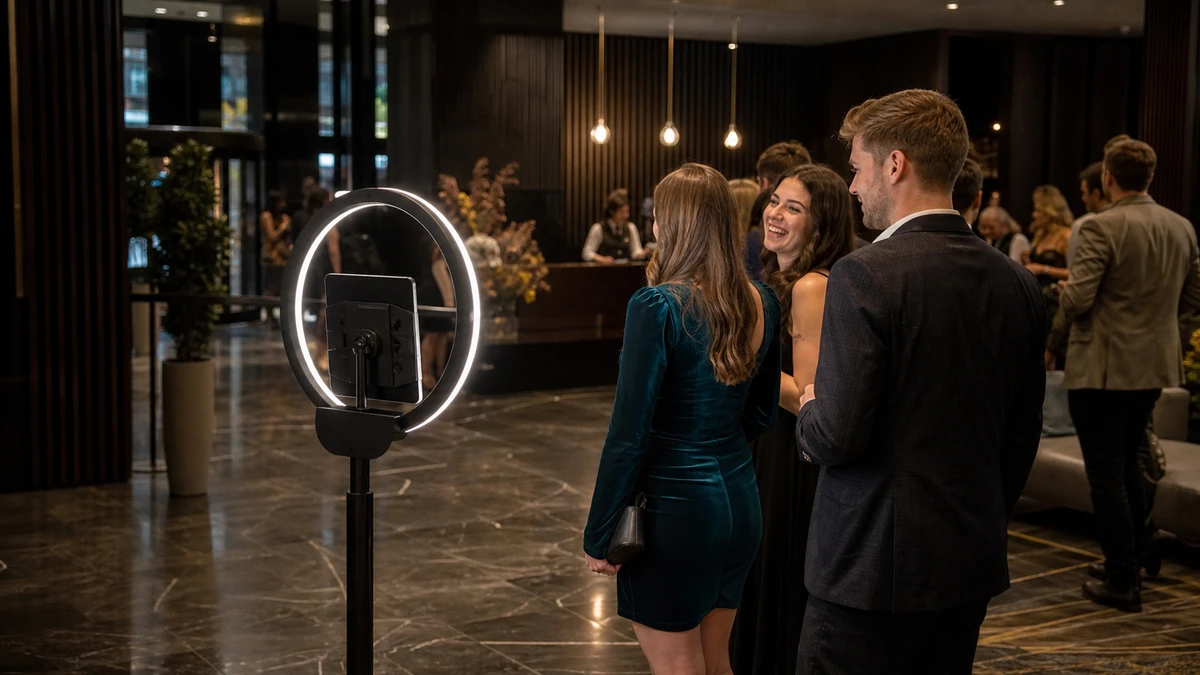
A commercial photo booth at your venue is a high-throughput data collection device. Every guest who taps through it generates an image, often an email address, sometimes a phone number, and, if AI transformations or face filters are involved, a biometric identifier. GDPR, CCPA/CPRA, and a tightening patchwork of US state laws all apply, and the venue is usually on the hook whether it runs the booth itself or hires a vendor.
This guide walks the actual data flow at a venue activation, names where each regulator bites, and gives procurement an 11-question audit to use before signing a vendor contract. Skim-readers can jump to the audit and the breach math. Operators who want to understand why those questions exist should read the legal classifications first.
What actually gets collected at your booth (and why each piece is regulated differently)
A typical commercial booth captures six distinct data categories in a single guest session. The legal posture changes for each one.
- Raw facial images. Personal data under GDPR Article 4. Personal information under CCPA/CPRA. By itself, a photograph is not “biometric data” under EU law. Recital 51 of the GDPR is explicit: photographs are biometric data only “when processed through a specific technical means allowing the unique identification or authentication of a natural person.” Just storing JPEGs does not flip the switch.
- Images run through face filters or AI transformations. Potentially special-category biometric data under GDPR Article 9, but only if the processing extracts a biometric template for the purpose of uniquely identifying the person. A style filter that warps pixels does not qualify. A face-detection or face-matching pipeline does.
- Email address or phone number for delivery. Personal data. Triggers the marketing consent question downstream.
- Custom-field lead data (company, job title, dietary flags). Personal data. Some fields, especially health-adjacent ones, can be sensitive.
- Engagement metrics (session counts, dwell time, filter popularity). Personal data only when tied to an identifier. Properly anonymized aggregates fall outside GDPR scope per Recital 26.
- Wi-Fi and device telemetry. Personal data if IP or device ID is stored.
The classification matters because it dictates the consent requirement. Capturing an email for photo delivery and running an AI face-swap on the same shot are two different processing operations under GDPR Article 4, with two different lawful-basis questions, and they need two different opt-ins.
The four-step data flow and where each step is regulated
Treat one guest session as a four-stage state machine. Each stage is its own processing operation.
- Capture. The camera fires, the image lands on the booth’s storage. Lawful basis question: is signage and a notice screen sufficient, or do you need affirmative consent? For a print-and-walk-away interaction with no downstream storage, a clear notice usually suffices. The moment the image leaves the local device for any other purpose, you need a documented basis.
- Delivery. The guest enters an email or phone number to receive the image. This is genuine “performance of a contract” territory under Article 6(1)(b): the guest has asked for delivery, and you need the address to deliver. Don’t dress this up as marketing consent.
- Storage and gallery display. The image lives on the vendor’s cloud, sometimes accessible by URL, sometimes embedded in a public gallery. Article 5(1)(e) storage limitation applies. So does Article 32’s security-of-processing standard, which is what failed at the Vibecast incident below.
- Downstream use. Email goes into a CRM. The image gets used in a brand recap reel. The vendor reuses photos for case studies. Each downstream use needs its own basis. Marketing requires its own affirmative, unbundled opt-in. Vendor reuse for case studies needs explicit consent and disclosure of the vendor as a controller for that purpose.
The most common venue mistake is treating these four stages as one consent event. Most “I agree” checkboxes on booth screens cover stage 2 well and the rest poorly. The UK Information Commissioner’s Office is direct on this: consent must be granular, with separate opt-ins for separate purposes.
Consent-first UX: what the screens should actually look like
A consent flow that survives a regulator walkthrough has three screens, in this order.
Screen 1, before capture
Plain-language notice. What’s being collected, who controls it, what happens to it next. A link to the full privacy notice. No checkboxes yet, but a visible “back out” path. This is your Article 13 information notice obligation discharged in interface form.
Screen 2, before delivery
Email or phone entry. Below it, a single, unticked checkbox for marketing follow-up, with copy that names the brand or venue that will email them and what kind of message they’ll receive. The marketing opt-in is separated from the delivery field. The guest can submit the delivery field with the marketing box left blank and still receive their photo. This is the “freely given” criterion in operating form. The ICO is explicit that pre-ticked boxes, silence, and inactivity do not constitute consent (Recital 32).
Screen 3, after delivery
Confirmation of what was sent, what was stored, the retention period in plain English, and a one-tap link or QR to request deletion. This screen is also where you discharge the “as easy to withdraw as to give” requirement the ICO calls out.
A Simple Booth HALO deployment should be reviewed against the same three-screen flow: photo delivery, optional marketing, and any venue or brand reuse need to stay separated so consent remains granular.

Anti-patterns that draw enforcement attention: pre-ticked checkboxes, bundled “I agree to terms and to marketing” copy, consent buried in a Terms of Service scroll, and any flow that withholds the photo until the marketing box is checked. The last one fails the “freely given” test by definition, because the consent is the price of the service.
A useful framework here comes from Forrester’s Julian Archer in 2018, who segmented event data into four categories: consent gained, consent agreed, interest shown, and no contact. Only the first category, where the attendee has given specific, opt-in permission for a defined use, can be marketed to under GDPR. “Interest shown” (the guest walked up to the booth, posed, and walked off without completing the opt-in) was treated as implicit consent before 2018. It is not anymore.
When a photo crosses into “special category” biometric data
This is the threshold most generalist GDPR coverage gets wrong. The line is sharper than “faces are personal data.”
Under Article 4(14), biometric data means personal data resulting from “specific technical processing relating to the physical, physiological or behavioural characteristics of a natural person, which allow or confirm the unique identification of that natural person.” The operative phrase is allow or confirm the unique identification. A photograph alone does not satisfy that test. A photograph processed through software that extracts a face geometry template for matching does.
Article 9(1) then prohibits processing biometric data for the purpose of uniquely identifying a person unless one of the Article 9(2) exceptions applies. For a commercial venue, the relevant exception is 9(2)(a): explicit, separately documented consent for the biometric processing specifically. A general photo consent does not cover it.
Three practical implications for booth operators
Three practical implications for booth operators:
- A booth that captures and prints a photo with no further processing is generally outside Article 9.
- A booth with face filters that warp or restyle pixels (no template extraction, no matching) is generally outside Article 9, though still subject to Article 6.
- A booth with face-swap, “guess my age,” return-customer recognition, or any other feature that extracts a facial template for identification crosses into Article 9 and needs explicit biometric consent, plus a Data Protection Impact Assessment, plus an evaluation against the EU AI Act.
GDPR Local cites the facial recognition research literature for a useful technical floor: roughly 40 pixels between the eyes is the threshold below which reliable identification breaks down. Almost every commercial booth produces output well above that resolution, so the question is never about resolution. It is always about whether downstream software does template extraction.
Retention: a concrete schedule that actually minimizes risk
“Define a retention period” is the universal advice and the universal cop-out. Here is a defensible schedule, with the basis for each interval.
| Data type | Retention | Basis |
|---|---|---|
| Source images, no marketing consent | 24–48 hours after the activation ends | Storage limitation (Article 5(1)(e)); aligns with the post-incident Vibecast standard |
| Delivered gallery (link guests received) | 30 days, then hard delete from primary and backups | Storage limitation; reasonable delivery and re-share window |
| Marketing-consented contact list | Per consent, with a re-consent or preference check at 24 months | Article 5(1)(e) and Article 7(3) right to withdraw |
| Engagement analytics tied to an identifier | 30 days, then strip the identifier and retain only anonymized aggregates | Recital 26 (anonymized data is out of scope) |
| Biometric output (templates from Article 9 processing) | Same-day deletion unless explicit, separate Article 9 consent for extended retention | Article 9 + Article 5(1)(e) |
Two operational notes that matter more than the numbers themselves.
The deletion has to be automated
The deletion has to be automated. A scheduled job that removes objects from the primary store, the CDN, and the backup snapshots. Manual deletion is not compliance, because Data Subject Access Requests under Article 12(3) carry a one-month response clock and Article 17 erasure requests carry the same. Any process that depends on a person remembering to clean up after each event will miss that window.
The retention period must cover backups
The retention period must cover backups. A photo deleted from the production database but still sitting in last week’s snapshot is not deleted. Vendor due diligence has to include backup rotation and the actual time-to-zero for an erasure request.
Controller vs processor: who is actually liable at your activation
This is the question the rest of the SERP avoids. At a venue activation, there are usually three parties, and the controller assignment determines who the regulator names in the enforcement notice.
The three parties
The three parties:
- The venue (a hotel, a retail store, a family-entertainment center) hosting the activation
- The activating brand (a sponsor running a pop-up at the venue)
- The booth vendor (hardware, software, cloud platform)
The common allocations under GDPR Article 4(7), which defines the controller as whoever determines “the purposes and means” of processing:
- Venue-run booth, no external sponsor. The venue is the controller. The booth vendor is the processor. The venue must have a written Data Processing Agreement with the vendor under Article 28.
- Brand-sponsored activation at a third-party venue. The brand is usually the controller (it sets the marketing purpose). The venue and the vendor are processors. Both Article 28 agreements are required, and the consent screens must name the brand as the controller.
- Vendor uses guest data for its own purposes (model training, cross-client analytics, case studies). The vendor becomes a joint controller (Article 26) or an independent controller for that downstream purpose. The consent screen has to disclose this and name the vendor.
The consequence is concrete
The consequence is concrete. If a vendor leaks a gallery, the regulator names the controller in the enforcement notice. The Article 28 Data Processing Agreement does not shift that liability; it gives the controller a contractual claim back against the vendor for indemnification and the cleanup costs. Without one, the controller absorbs the fine and the remediation with no recourse.
The Vibecast/Hama Film breach in December 2025 is the cleanest recent illustration. A security researcher, Zeacer, found that the platform’s photo URLs were sequential and guessable, with no authentication and no rate limiting. More than 1,000 event photos were retrievable to anyone who incremented a number in a URL. TechCrunch reported the disclosure on December 12, 2025. Vibecast cut its retention from two-to-three weeks down to 24 hours after the incident. Malwarebytes’ follow-up coverage framed the venue-side takeaway directly: venues that hire a booth service should ask the operator how photos are stored and for how long. That is a controller obligation. It belongs in procurement, not in the post-incident postmortem.
Vendor audit: 11 questions to ask before you sign
Take this list to the procurement meeting. Each question maps to a specific failure mode that has cost operators money in the last 24 months.
- Where are source images stored, and are gallery URLs guessable or authenticated? (Vibecast failed this.)
- What is the written retention schedule for each data type, and how is automated deletion verified?
- What encryption is in use in transit (TLS 1.3 or higher) and at rest (AES-256 or equivalent)?
- Are gallery download endpoints rate-limited? (Vibecast also failed this.)
- Is there a written Data Processing Agreement under GDPR Article 28, and does it include Standard Contractual Clauses for any non-EU/UK data transfer?
- Has the vendor completed SOC 2 Type II or ISO/IEC 27001 in the last 24 months?
- What is the breach notification SLA from vendor to controller? Article 33 gives the controller 72 hours to notify the supervisory authority, and the processor’s clock has to fit inside that.
- Is any guest data ever used to train AI models, and if so, under what consent? (The default answer should be no.)
- How are erasure requests under Article 17 processed, what is the SLA, and does the deletion cover backups?
- Does the consent screen support granular, unbundled opt-ins with the controller’s name and the specific purpose for each opt-in?
- Is the age gate configurable, and where is data routed for under-13 guests (or under-16 in jurisdictions that adopt the higher threshold)?
If a vendor cannot answer questions 1, 5, 7, and 9 in writing, walk away. Those are the four that show up first in DPA enforcement decisions.
CCPA parallels and the US state patchwork
The US picture is easier to summarize than most operator coverage suggests, once you separate it into two layers: state consumer-privacy laws and state biometric-specific laws.
Consumer-privacy layer
California’s CCPA and CPRA carry $2,500 per violation (unintentional) and $7,500 per violation (intentional) under Cal. Civ. Code §1798.155, enforced by the California Privacy Protection Agency. There is also a private right of action for breaches under §1798.150 at $100 to $750 per consumer per incident. Per the California AG’s CCPA page, the core obligations are notice, opt-out of sale, and access/deletion rights. The threshold for CCPA coverage matters for venue operators: a single restaurant rarely meets the $25M revenue, 100,000-consumer, or 50%-of-revenue-from-data tests. Their photo booth platform almost always does. The platform is the regulated entity for most independent venues.
The IAPP state-privacy tracker counts 19 states with comprehensive consumer-privacy laws enacted as of mid-2025, with more added since. Most follow the CCPA/CPRA template with variations on opt-out scope and rights.
Biometric layer
This is the more dangerous one for venues that use AI booth features. Two statutes lead.
Illinois BIPA (740 ILCS 14) requires written consent before any biometric identifier is collected. The statute defines “biometric identifier” to include “scan of hand or face geometry” and explicitly excludes “photographs.” So a booth that captures a JPEG and prints it is outside BIPA. A booth that runs face-geometry detection on the same image (for filters, smile detection, or return-visit recognition) is inside it. Penalties are $1,000 per negligent violation and $5,000 per intentional or reckless violation, with a private right of action and a five-year statute of limitations. The class-action math is what makes BIPA dangerous: Meta settled an Illinois face-tagging class action for $650 million, Google settled a Google Photos case for $100 million.
Texas CUBI (Bus. & Com. Code §503.001) covers the same biometric-identifier categories with the same photograph carve-out. Penalty is up to $25,000 per violation, but enforcement is limited to the Texas Attorney General. There is no private right of action, so class-action exposure is much lower than Illinois. Don’t conflate the two: the operational risk profile is different.
The simplification operators can use in practice: build the consent UX to GDPR standard (explicit, granular, written, with biometric consent separated where applicable), and you meet or exceed every comprehensive US state law currently in force, including the BIPA-style biometric statutes. The US map then becomes a deployment decision (where do I run the activation?) rather than a compliance decision (do I need to redesign the screens?).
Breach math: what a leak actually costs a venue
Plug-in-your-numbers scenario for a venue running four activations a year.
- 4 activations × 800 guests = 3,200 guests per year
- 40% completing the email opt-in = 1,280 marketing-consented contacts per year
- Assuming one image per guest on average, roughly 3,200 stored images per year
- A breach exposing the gallery (the Vibecast pattern) triggers Article 33 notification within 72 hours, and Article 34 notification to data subjects if the risk to rights and freedoms is high
The exposure is in three layers.
Regulator fines
GDPR maximum is €20 million or 4% of worldwide turnover, whichever is higher (Article 83(5)). For Article 32 security-of-processing failures specifically, the cap is €10 million or 2% (Article 83(4)). Most venue-scale enforcement lands well below the cap. Reputational damage from being named in a DPA decision tends to cost more than the fine itself.
Private actions
In Illinois, if the booth runs face-geometry extraction (a BIPA-covered processing, not the photographs themselves), a class action covering all 3,200 guests at $1,000 to $5,000 per class member sits between $3.2M and $16M before fees. Even a discounted settlement is six to seven figures. In California, the §1798.150 private breach action at $100 to $750 per consumer puts a 1,280-record breach at $128K to $960K.
Operational cost
If the breach generates 100 manual erasure requests at 30 minutes each, that is 50 engineer-hours just to honor the requests, plus the risk of missing the one-month Article 12(3) reply window for any of them. Each missed reply is its own enforcement risk.
Set against those numbers, automated deletion, authenticated gallery URLs, rate-limited endpoints, and a vendor audit done before procurement signs the contract are the cheapest line items in the budget.
The 2026 reality check: EU AI Act plus state laws
Two near-term changes matter for anyone designing a booth program now.
EU AI Act, Regulation (EU) 2024/1689. The Article 5 prohibitions took effect on February 2, 2025. The transparency obligations and high-risk system rules apply from August 2, 2026, with full high-risk obligations applicable from August 2, 2027. Penalties go up to €35 million or 7% of worldwide turnover for prohibited practices.
What the Act does and does not cover for a commercial booth:
- The February 2025 prohibitions ban real-time remote biometric identification in publicly accessible spaces by law enforcement, plus building facial-recognition databases by scraping the internet or CCTV. A consent-gated booth that does not build a cross-session facial database is not in scope of the prohibitions.
- The August 2026 transparency rules require AI systems interacting with people to disclose that they are AI. Emotion-recognition and biometric-categorisation systems carry additional restrictions, with some uses prohibited outright (notably emotion recognition in workplace and education contexts) and others classified as high-risk. A booth feature that infers guest mood, age, or other characteristics from facial images may land in the high-risk category, which triggers conformity assessment, registration, and ongoing monitoring obligations.
State biometric laws expanding
The 19 comprehensive state laws on the IAPP tracker keep growing, and biometric-specific provisions (in the BIPA mold or weaker variants) keep appearing in new state bills. The trajectory is more state laws, not fewer, and the patchwork rewards consent designs built to the strictest jurisdiction rather than the average.
The safe commercial-booth design for 2026 and beyond: AI used only for artistic transformation, no biometric template extraction, an explicit AI-disclosure line in the consent screen, and regional data residency options for any cross-border deployment. That posture clears every regulator currently writing rules.
What to take away
Three things, in priority order:
- Treat the booth as a biometric data collection device, not a camera. The consent UX has to assume that some downstream feature, today or in the next contract renewal, will extract a template.
- Make sure the consent screen is granular, unbundled, and identifies the actual controller. A single “I agree” checkbox covering delivery and marketing fails on its face.
- Vet the vendor against the 11-question audit before procurement signs. The four non-negotiable answers are gallery authentication, the Article 28 Data Processing Agreement, the breach notification SLA, and the erasure-request workflow including backups.
The compliance work doesn’t make the booth a worse activation. A guest who sees a clear notice, a single unbundled marketing checkbox, and a confirmation screen with a one-tap deletion link gets a better experience than the guest who tapped “I agree” on a wall of legalese. The two are aligned.
Sources
- TechCrunch (2025). “Flaw in photo booth app Vibecast exposed more than 1,000 photos from events, security researcher finds.” https://techcrunch.com/2025/12/12/photo-booth-app-vibecast-exposed-more-than-1000-photos-from-events-security-researcher-finds/
- Malwarebytes Labs (2025). “Photo booth app exposes more than 1,000 photos from events.” https://www.malwarebytes.com/blog/news/2025/12/photo-booth-app-exposes-more-than-1000-photos-from-events
- Forrester / Julian Archer (2018). “GDPR: What marketers need to do differently at events.” https://www.forrester.com/blogs/gdpr-what-marketers-need-to-do-differently-at-events/
- Regulation (EU) 2016/679 (GDPR), Article 4 (definitions, including biometric data). https://gdpr-info.eu/art-4-gdpr/
- Regulation (EU) 2016/679 (GDPR), Article 9 (special categories of personal data). https://gdpr-info.eu/art-9-gdpr/
- GDPR Local (2025). “When does a photo become biometric data under GDPR?” https://gdprlocal.com/when-does-a-photo-become-biometric-data-gdpr/
- Information Commissioner’s Office (UK). “Lawful basis for processing.” https://ico.org.uk/for-organisations/uk-gdpr-guidance-and-resources/lawful-basis/
- Information Commissioner’s Office (UK). “Consent.” https://ico.org.uk/for-organisations/uk-gdpr-guidance-and-resources/lawful-basis/consent/
- California Office of the Attorney General. “California Consumer Privacy Act (CCPA).” https://oag.ca.gov/privacy/ccpa
- California Civil Code §1798.155. https://leginfo.legislature.ca.gov/faces/codes_displaySection.xhtml?lawCode=CIV§ionNum=1798.155
- Illinois General Assembly. Biometric Information Privacy Act, 740 ILCS 14. https://www.ilga.gov/legislation/ilcs/ilcs3.asp?ActID=3004&ChapterID=57
- Texas Legislature. Business & Commerce Code §503.001 (Capture or Use of Biometric Identifier). https://statutes.capitol.texas.gov/Docs/BC/htm/BC.503.htm
- IAPP. “US State Privacy Legislation Tracker.” https://iapp.org/resources/article/us-state-privacy-legislation-tracker/
- European Commission. “Regulatory framework on AI” (Regulation (EU) 2024/1689). https://digital-strategy.ec.europa.eu/en/policies/regulatory-framework-ai