The reason most in-store email programs underperform is not the technology. It is the moment. A customer who just walked in or just paid does not need a definition of zero-party data; they need a five-second reason to share. This playbook ranks the mechanisms an operator can deploy, attaches realistic opt-in rates, walks the math from capture rate to projected pipeline, and exposes the failure modes that turn a list into landfill.
What zero-party data actually means for a physical business
Forrester’s Fatemeh Khatibloo coined the term “zero-party data” in 2020 and defined it as “data that a customer intentionally and proactively shares with a brand, which can include preference center data, purchase intentions, personal context, and how the individual wants the brand to recognize her.” That is the definition every marketer should memorize, and the one most in-store programs misapply.
In a physical venue, the data being collected is not click trails or device IDs. It is what a person volunteered after standing six feet from a member of staff. That changes both the value-exchange dynamics and the failure modes. The customer can read the room, watch the cashier, and gauge whether the ask is a chore or a courtesy. None of that is true online.
First-party data is everything the venue can already observe (visit count via POS, dwell time via WiFi, basket composition). Zero-party data is what the customer chose to declare (email, birthday, taste preferences, dietary flags, sizing). The two compound rather than compete. A loyalty enrollment that captures both an email and a stated style preference is more valuable than either alone, because the second piece tells the operator how to use the first.
Why the “ask at the register” playbook quietly fails
In June 2018, The Philadelphia Inquirer reported that Five Below cashiers were told to capture emails from 20–25% of customers they rang up. Workers who fell short had hours cut. Tiffany Rogers, a former Columbus Boulevard employee, told the paper her hours dropped from 20 a week to as low as 4 when her capture rate slipped. A Glassdoor reviewer in Columbus, Ohio described the same regime: “You have to get at least 20 percent in e-mails every week … Sometimes one of our shifts would get taken if we didn’t hit 20 percent.” A former manager in Hopkinsville, Kentucky said leadership “hound[ed] you to the point of quitting.”
The same reporting documents the predictable response. Cashiers, “out of desperation,” fabricated email addresses to satisfy bosses. That is the silent failure mode operators never see in their dashboard. A 5% fake-address rate on a 50,000-name list is 2,500 invalid addresses generating hard bounces and spam complaints. A complaint rate above 0.3% is enough for Gmail and Microsoft to start suppressing legitimate sends. The cascade from cashier pressure to junk list to degraded deliverability is invisible at the checkout where it begins.
Rogers also identified the root cause
Rogers also identified the root cause. When customers asked her, “What do you need my email for?” she had no answer. The register is a low-attention, high-pressure moment for both sides. The customer wants to leave. The cashier is being measured on a metric that punishes the asking, not the answering. Jill Dvorak of the National Retail Federation, quoted in the same Inquirer piece, framed the discipline correctly: email collection is “about quality over quantity,” and the staff training has to be on when and how to ask, not on hitting a volume number.
The reframing operators should adopt is straightforward: the register is a delivery point for a digital receipt, not a primary capture surface. Stack the loyalty enrollment, the tasting card, or the photo activation upstream of checkout. Use the register to confirm the address the customer already provided.
The value-exchange equation: what makes someone trade an email
A customer trades an email when the perceived value of the offer exceeds the perceived cost (inbox clutter, privacy concern, social friction of refusing). The variables an operator controls are the clarity of the offer, the time to redeem, the exclusivity, and whether the ask falls inside or outside a moment of attention.
McKinsey’s Next in Personalization 2021 report puts the demand side in numbers. 71% of consumers expect personalized interactions, 76% get frustrated when personalization fails, and companies that excel at it generate 40% more revenue from those activities than average players. The customer is already expecting the brand to know something useful about them. The question is whether the operator earns the data or extracts it.
Three offer types worth distinguishing
Three offer types worth distinguishing:
- A 10%-off coupon. Baseline. A first-touch coupon converts because it is concrete, but as Dave Kersey of GSD&M warned in Marketing Brew, “people will sign up just for the immediate discount, but it doesn’t really connect them to the brand long term.” The customer signs up for the coupon, redeems, and unsubscribes.
- Early access to a drop, release, or table. Exclusivity carries the same psychological weight as savings, with the added benefit of self-selecting for higher-LTV customers who are likelier to return.
- A personalized artifact the customer takes home or shares. A branded photo, a tasting flight card, a customized sample. This is where the in-store mechanism breaks the digital benchmark, because the email is functionally required to deliver the artifact, not extracted as a price of admission.
For comparison, the digital ceiling: Claspo’s 2026 benchmark study, drawing on more than 100 million widget views across 51,000 websites, finds the standard ecommerce popup converts 4–5% of visitors, top performers with personalization and timing reach roughly 20%, and gamified flows can reach 50% in well-executed campaigns. (The Polish fashion brand WHOSE went from 3–5% to 50% with a spin-to-win for Black Friday 2024.) Those are the digital ceilings. A well-designed in-store activation routinely starts above the digital ceiling because the value exchange is visible in the room.
The seven in-store capture mechanisms, ranked
Pick the mechanism that fits the moment a venue actually creates. Each row below describes one capture surface, the realistic opt-in range when it is well-executed, and the failure mode that separates a good deployment from a wasted one.
1. Branded photo or video activation
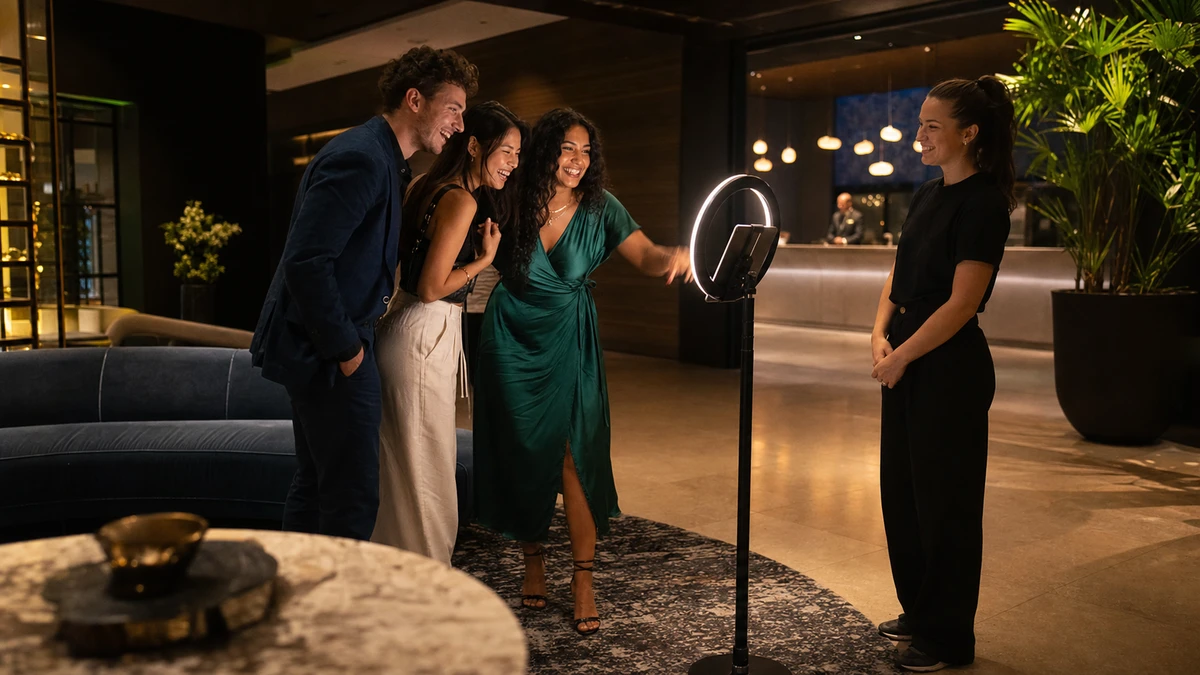
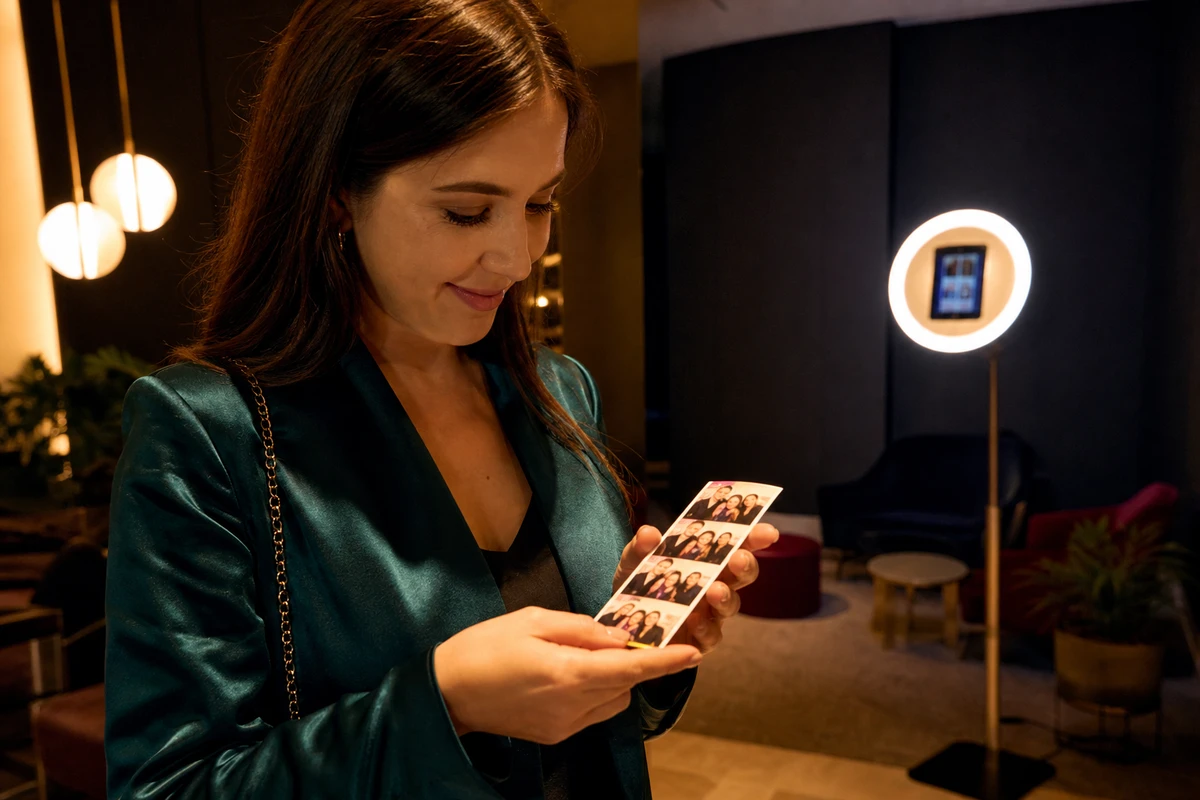
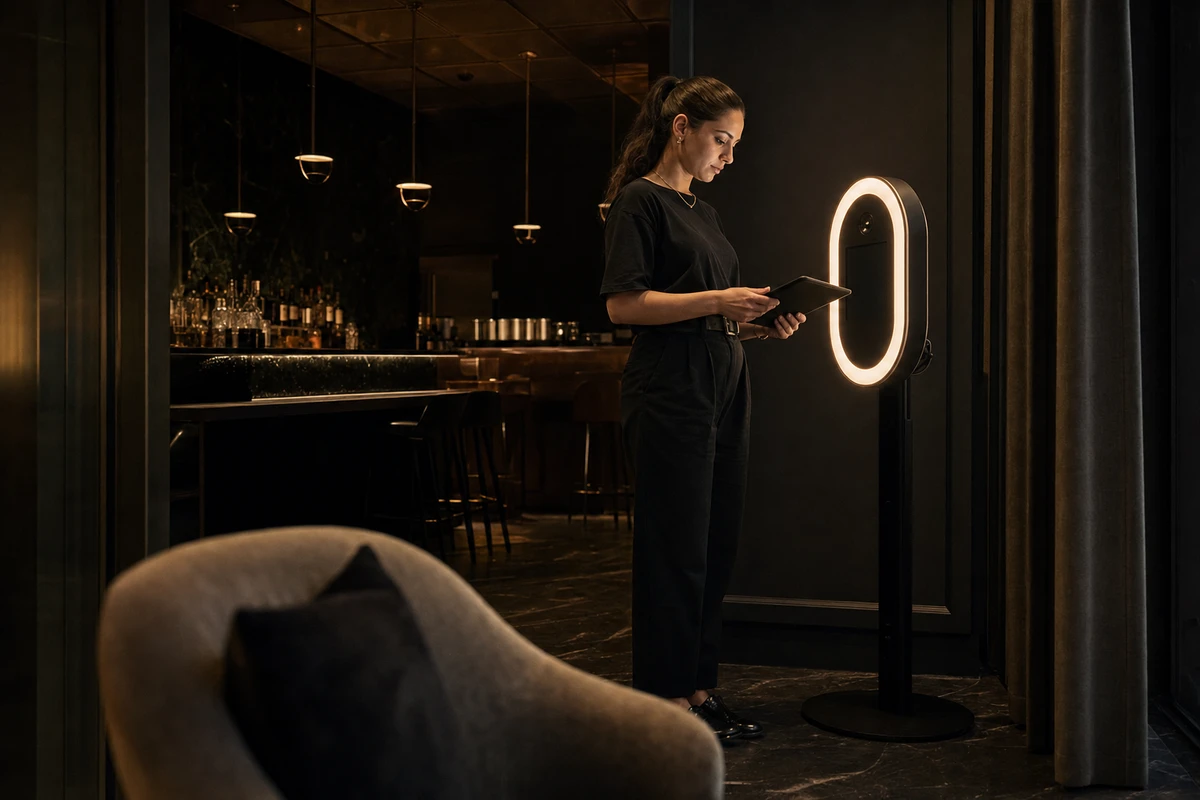
A photo capture station, green-screen kiosk, or AR mirror that delivers an image or clip by email. Adam Salacuse of experiential agency Alt Terrain told Marketing Brew that a photo booth is the canonical physical-activation capture method because “people enter their email address to receive the photos. From there, the brand can follow up to see if the customer would like to continue the relationship.” Salacuse adds the operative point: “People are more apt to give their information out when they’re in a good mood, when they’re having fun, when they’re emotionally engaged.” Opt-in rates are high relative to every other mechanism because the email is the delivery channel for a thing the customer wants.
As a concrete benchmark, entertainment-venue chain Treetop Golf built more than 150,000 unique email addresses across its locations using Simple Booth’s HALO kit, an iPad photo booth with built-in lead capture and delivery. Best fit: venues with dwell time and a moment of genuine attention (events, pop-ups, hospitality, retail flagships, lobbies). Failure mode: collapsing the photo-delivery consent and the marketing consent into one checkbox. The flow has to ask both, distinctly.
2. Branded WiFi gate
A login wall in exchange for free WiFi access. Volume is high in venues with dwell time (cafes, hotels, gyms, transit, healthcare). Vendor data from Social WiFi reports global opt-in rates of 40–60% across thousands of venues, although the figure is platform-aggregate rather than third-party validated. Data quality is medium because users frequently enter throwaway addresses. Best fit: a venue where the customer needs the network, can authenticate to it once, and is then remembered.
3. Loyalty or rewards enrollment at POS
The Sephora and Reformation pattern. Strong long-term value because a loyalty-enrolled customer is opted into a multi-year relationship. Capture rate depends entirely on perceived program value. Shopify’s case study on jewelry retailer Little Words Project (a vendor-published source, treated as such) reports a more than 20% average lift in in-store email capture across 14 locations after switching to a Shop Pay match flow at the register, and up to 95% lift at top stores. Best fit: any venue with repeat-visit economics. Failure mode: a loyalty program with no perceived benefit; the ask collapses to a coupon and the program collapses with it.
4. POS digital-receipt prompt
Square, Toast, and Shopify POS all surface a one-tap email-or-text receipt option. Friction is near zero. Shopify reports that retailers using its POS email capture see a 9% lift in POS orders with email attached and an 11% lift when the customer also opts into marketing. The marketing opt-in rate inside the receipt flow is lower than a loyalty enrollment because the customer is consenting to a receipt, not a newsletter. Best fit: every venue with a modern POS, but only as a layered capture, never as the primary one. Pair with a loyalty enrollment ask for compounding rates.
5. Sampling or tasting station with intake card
Wineries, breweries, food retail, beauty, and any venue that pauses the customer for an experience. The intake card with a “send me my tasting notes” tickbox piggybacks on attention the customer is already giving. Best fit: experience-led retail. Failure mode: paper cards that never get digitized, or a 14-day lag between the visit and the first email.
6. QR-to-SMS or QR-to-microsite
Table tents, signage, receipts, and trade-show booth surfaces. Conversion is low (typical 1–3%) but the surface area is large and the cost of placement is near zero. Best fit: distributed physical surfaces where the operator does not control attention but does control real estate.
7. Fishbowl raffle or business card drop
Included so the reader can rule it out. Data quality is poor (illegible handwriting, no consent record, frequently expired addresses), the privacy posture is hostile to GDPR and CCPA (no record of affirmative consent), and the redemption ceremony is too distant from the ask to motivate good data. The fishbowl persists because deploying one costs nothing. The list it produces is worth less still.
A coffee shop with a 90-second average dwell time should not deploy a tasting-flight intake card. Match the surface to the moment, or save the budget.
The math: turn capture rate into projected pipeline
A worked scenario clarifies what the ranking is worth in dollars. Take a venue with 8,000 monthly customer interactions, a 30% opt-in rate at the chosen mechanism, a $50 customer LTV, and a 12% activation rate from email. The arithmetic: 8,000 × 0.30 × $50 × 0.12 = $14,400 in attributable monthly pipeline from the program. Annualized, that is $172,800 from a single capture surface.
Now turn three sensitivity dials.
- Mechanism upgrade (opt-in 30% → 50%). Replacing a register-side coupon ask with a photo activation or loyalty enrollment lifts opt-in to 50%. The new monthly figure is 8,000 × 0.50 × $50 × 0.12 = $24,000. The mechanism change alone adds $115,200 a year without changing visit volume or LTV.
- Post-capture nurture (LTV $50 → $80). A welcome sequence that confirms the value-exchange and a value email that reinforces the moment of capture lifts LTV from $50 to $80. At the original 30% opt-in rate: 8,000 × 0.30 × $80 × 0.12 = $23,040 a month, roughly $276,480 a year.
- Segmentation (activation 12% → 18%). Mailchimp’s analysis of its own platform finds segmented campaigns achieve 14.31% higher open rates than non-segmented sends, and 70% of top-performing campaigns are sent to segmented lists. Klaviyo’s ecommerce benchmark adds that stores with more than $10M in revenue average 133.97 segments versus 13.36 for sub-$100K stores; the advisory line is direct: “‘batch and blast’ is not your best bet.” Lifting activation from 12% to 18% pushes the original example to 8,000 × 0.30 × $50 × 0.18 = $21,600 a month, $259,200 annualized.
The compounding case (50% opt-in, $80 LTV, 18% activation) yields 8,000 × 0.50 × $80 × 0.18 = $57,600 a month, or $691,200 a year. The point of the math is not to forecast every operator’s actual revenue. It is to make visible that the gap between a fishbowl program and a designed program is not 10% or 20%. It is several multiples.
What must happen before the first email goes out
Three guardrails, all non-negotiable.
Consent records and double opt-in for marketing
Receipt opt-in is not marketing opt-in. Under the UK ICO’s PECR guidance, an operator must not send marketing emails or texts without “specific consent” signified by a clear affirmative action; pre-ticked boxes do not give valid consent. Canada’s CASL requires express consent (verbal or written) before sending commercial electronic messages, with the burden of proof on the sender. In the United States, the Telephone Consumer Protection Act, codified at 47 U.S.C. § 227, sets statutory damages for SMS marketing violations at $500 per violation, raised to up to $1,500 per violation if the court finds the conduct willful or knowing. Text messages are treated as “calls” under the statute. A multi-location operator running an SMS list without written express consent is one class action away from a material liability.
Suppression-list hygiene across locations
Operators with multiple venues need a single suppression list shared across all of them. A customer who unsubscribes at the Chicago location must not get re-prompted in Austin. Under CASL, failing to honor an unsubscribe within 10 business days is a regulatory violation. Most operators learn this only after a complaint.
Receipt versus marketing wording at the POS
The opt-in checkbox at the register has to distinguish “send me my receipt” from “send me promotions.” Combining them is a regulatory tripwire under PECR and an unsubscribe accelerant in any jurisdiction. The customer who thought they signed up only for a receipt will mark the first promotion as spam.
What to do with the data once it lands
A capture surface without a post-capture program is a list that decays. Three tactical touches turn an opt-in into a returning visit.
Day-0 welcome, day-3 value, day-14 promotion
The welcome confirms the value-exchange (the photo, the tasting notes, the points balance). The value email three days later reinforces the moment of capture with something useful and asks for nothing. The first promotional ask waits until day 14, after the relationship has earned the right to it. Omnisend’s 2025 statistics report finds that automated emails (the structure that powers this kind of sequence) generate $2.87 per email versus $0.18 for broadcast campaigns, a 16x revenue-per-send difference.
Segmentation by capture surface
A loyalty enrollee behaves differently from a WiFi-gate signup. Tag every opt-in with the source mechanism and the location. A photo-activation guest at a flagship store is a different audience from a QR-to-SMS opt-in at a satellite booth. Tag them differently and write to them differently.
Attribution back to the venue and to the staff
The operator should know which location, which day-part, and which mechanism produced each opt-in, and which of those opt-ins eventually transacted again. Without that loop, the operator cannot tell whether the program is paying for itself, and cannot reward the staff or the location that produced the highest-quality signal.
Stop asking for emails. Start designing moments that make a customer want to share one.
Sources
- Forrester (2020). “Collecting Zero-Party Data From Customers.” https://go.forrester.com/blogs/straight-from-the-source-collecting-zero-party-data-from-customers/
- McKinsey & Company (2021). “The value of getting personalization right, or wrong, is multiplying.” https://www.mckinsey.com/capabilities/growth-marketing-and-sales/our-insights/the-value-of-getting-personalization-right-or-wrong-is-multiplying
- The Philadelphia Inquirer (2018). Juliana Feliciano Reyes, “Retail workers say they’re under pressure to get your emails.” https://www.inquirer.com/philly/news/retail-workers-say-theyre-under-pressure-to-get-your-emails-20180621.html
- Marketing Brew (2023). Katie Hicks, “Tips to incorporate first-party data collection into experiential marketing.” https://www.marketingbrew.com/stories/2023/02/24/incorporating-first-party-data-collection-into-experiential-marketing
- Claspo (2026). Taras Talimonchuk, “Our 2026 Benchmark Study: 9 Focus Areas Behind 10-30% Opt-In Growth.” https://claspo.io/blog/ecommerce-email-opt-in-benchmarks/
- Shopify (2025). “What is Shopify Email Capture? How it Works & Examples.” https://www.shopify.com/retail/email-capture-at-pos-checkout
- Social WiFi (2025). “WiFi Marketing Opt-In Rates: How They Beat Website, E-Commerce, and SMS Channels in 2025.” https://socialwifi.com/blog/wifi-marketing-opt-in-rates-how-they-beat-website-e-commerce-and-sms-channels-in-2025/
- Information Commissioner’s Office (UK). “Electronic mail marketing,” Guide to PECR. https://ico.org.uk/for-organisations/direct-marketing-and-privacy-and-electronic-communications/guide-to-pecr/electronic-and-telephone-marketing/electronic-mail-marketing/
- Innovation, Science and Economic Development Canada. “Getting consent to send email,” Canada’s Anti-Spam Legislation guidance. https://ised-isde.canada.ca/site/canada-anti-spam-legislation/en/getting-consent-send-email
- Cornell Law School Legal Information Institute. “47 U.S.C. § 227, Restrictions on use of telephone equipment.” https://www.law.cornell.edu/uscode/text/47/227
- Mailchimp. “Effects of List Segmentation on Email Marketing Stats.” https://mailchimp.com/resources/effects-of-list-segmentation-on-email-marketing-stats/
- Klaviyo. “Email benchmarks that drive marketing success using automation and segmentation.” https://www.klaviyo.com/marketing-resources/ecommerce-benchmarks
- Omnisend (2025). “Email Marketing Statistics 2026.” https://www.omnisend.com/blog/email-marketing-statistics/