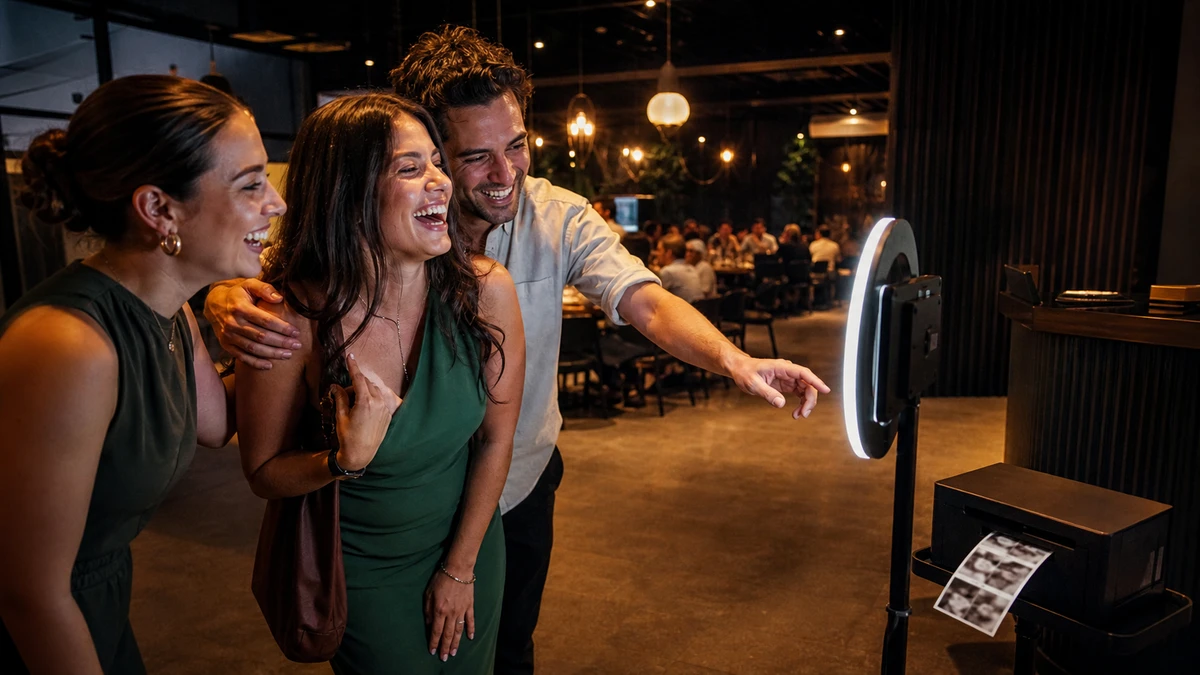
A four-top finishes dinner on a Friday night. The server drops the check, someone taps a card, and the table laughs its way out the door. The point-of-sale system now holds a clean record of that visit: four entrées, two desserts, a bottle of wine, the table number, the time, and a tokenized reference to the card that paid. What it does not hold is a single thing the restaurant could use to invite those four guests back. No name it can address, no email, no phone number, no permission to send anything.
That gap is the entire reason restaurant guest data capture is a separate job from running a POS. The goal is not to collect more data. It is to capture records the restaurant can contact, that the guest knowingly agreed to, and that the operator owns outright. Two questions decide whether a restaurant closes that gap: which moments in a visit produce a usable guest record, and what one of those records is worth. The harder problem, as operators interviewed for a 2026 industry report described it, is rarely collecting data. It is sitting on data nobody acts on.
Why the POS Sees Only Half the Room
Picture the same Friday night from the kitchen’s side of the pass. A large share of the room paid cash or tapped a card and walked out without leaving a name. Another batch of tickets came in from a delivery app. A few regulars the manager knows by face exist in the system only as anonymous ticket histories. By close, the POS has logged every dollar and almost none of the people.
Contact capture
This is not a software limitation that a better POS would solve. It is structural. When a guest pays by card, the restaurant’s terminal sends the card data straight to the payment processor and receives back a token, a random string that stands in for the card. The PCI Security Standards Council describes tokenization as a one-way substitution: no key turns a token back into a card number, and the cardholder’s name, email, and phone never reach the merchant at all. They sit with the issuing bank and the processor. A restaurant holding a stack of card tokens holds no contact information and no way to derive any.
Cash and walk-in guests leave even less behind. They appear in the POS as a total and a timestamp, indistinguishable from one another.
Third-party delivery is the trap that looks like data. An order from DoorDash or Uber Eats arrives with food to cook and money to collect, so it feels like a customer relationship. It is not. TryCactus, a restaurant software vendor, documented in 2024 what those platforms pass to a standard restaurant account: a first name and last initial, and the order itself. Full name, email address, phone number, and delivery address stay with the platform.
Only large enterprise chains negotiate access to more. Meanwhile the platform charges for the relationship it controls: DoorDash’s own merchant pricing runs three commission tiers at 15%, 25%, and 30% of the order. The restaurant cooks the food, absorbs the commission, and still cannot email the guest. As the trade publication Total Food Service noted as early as 2021, restaurants leaning on third-party delivery are steadily losing sight of their own customers.
So “beyond the POS” is not a marketing slogan. It is a description of where capture has to happen, because the POS, by design, was never going to capture a person.
Third-Party, First-Party, Zero-Party: The Distinction That Decides Everything
A marketing manager opens the guest database and sees twelve thousand rows. The next campaign still lands flat: low open rates, almost no attributable covers. The instinct is to blame the subject line or the send time. The real problem is usually that those twelve thousand rows are not one asset. They are three different kinds of data wearing the same spreadsheet.
Third-party data is rented
Third-party data is rented. It lives inside delivery apps, ad networks, and reservation marketplaces. A restaurant can pay one of these platforms to reach a segment, but it never holds the record, and it loses the audience the moment it stops paying.
First-party behavioral data is observed and owned, but usually anonymous. WiFi presence analytics, POS order histories tied to a card token, website traffic. This data is genuinely useful for spotting patterns, which nights run slow, which items sell together, but it often has no contactable identity attached. Knowing that a token visited four times does not produce an email anyone can send.
Zero-party data is the one grade built for outreach. Forrester analyst Fatemeh Khatibloo defined it in 2020 as data a customer intentionally and proactively shares with a brand. In a restaurant that means a preference, a birthday, or an email handed over on purpose, usually in exchange for something the guest wants. It is fully owned, marketable, and defensible if a regulator ever asks how the consent was obtained.
The reframe operators need is short: capture quality is consent quality. A database is worth roughly the proportion of zero-party records inside it, not the row count. Twelve thousand rows that are mostly observed or rented data make a smaller asset than three thousand records of guests who deliberately opted in.
The Capture-Moment Map: Where Guest Data Actually Enters a Restaurant
Follow one guest through one visit and the realistic capture points line up in order. A reservation gets booked online. The party arrives and someone connects to the WiFi. They scan a QR code to read the menu. They order, eat, and ask for the check. They pay, and a digital receipt may offer to email itself. On the way out, a host mentions the rewards program, or a small photo activation near the entrance invites the table to take home a printed picture.
The consent workflow
Every one of those moments can produce a guest record. They do not produce the same kind of record. The useful way to compare them is not by how easy they are to bolt on, but by the consent grade they yield and how willing the guest is at that exact moment.
| Capture moment | What it captures | Consent grade | Notes |
|---|---|---|---|
| Reservation / booking form | Name, email, phone, party size | First-party, rising to zero-party with a marketing opt-in box | The guest is already typing details; one clearly worded checkbox turns a booking into a marketing consent |
| WiFi splash / login | An email address, sometimes | Low. Often a throwaway address typed to clear the screen | High volume, weak consent |
| QR menu / QR order | An order, optionally an account | Depends entirely on whether the account is forced | A forced wall produces refusal; an optional account produces a real opt-in |
| Digital receipt opt-in | A working email | First-party, clean | Low friction, asked at a natural moment when the guest wants the receipt |
| Loyalty / rewards enrollment | Email, phone, birthday, preferences | Zero-party, high quality | Only as good as how deliberately staff offer it |
| Feedback / review request | Sentiment, sometimes contact | Mixed; review platforms keep most of it | Captures opinion more reliably than a contactable identity |
| In-venue experiential moment | Contact details volunteered to receive something | Zero-party, highest consent | The guest is motivated, not interrupted |
Two patterns fall out of that map. First, the highest-consent records come from moments when the guest wants something from the restaurant (the perk, the receipt, the photo) rather than moments when the restaurant interrupts the guest to ask. Second, loyalty enrollment looks like the obvious win, and adoption is broad: the National Restaurant Association’s 2024 technology report found 61% of limited-service operators and 52% of full-service operators planned to invest in loyalty and rewards systems. Enrollment only produces zero-party data, though, when a server actually offers it with intent rather than burying it in receipt fine print.
Why Most Capture Methods Quietly Fail
A guest sits down, scans the QR code for the menu, and watches a loyalty sign-up and a banner ad load before the food list appears. They are hungry. They dismiss everything as fast as they can. The restaurant has just trained that guest to treat its capture prompts as friction.
Most capture fails for two reasons, and both are predictable. The first is friction. A sign-up placed in front of something the guest is actively trying to reach (the menu, the WiFi, the check) produces refusal or junk addresses. The cost is not only a missed email. SevenRooms, a hospitality technology firm, reported in 2023 that restaurateur John McDonald of Mercer Street Hospitality found guests spent up to 20% less when ordering from QR code menus than from paper ones. A capture method that depresses the check is expensive before list quality even enters the conversation.
The second reason is false consent
The second reason is false consent. An email typed only to clear a WiFi login screen is not a guest who wants to hear from the restaurant. Neither is a phone number surrendered to a delivery app. These records inflate the list and quietly drag down every open rate, click rate, and deliverability score that follows, because the denominator grew while the interested audience did not.
A padded list is not a neutral mistake. It misleads the operator into thinking the audience is larger than it is, it wastes send budget on addresses that will never convert, and it carries legal exposure. Under GDPR, consent has to be documented and freely given before data is collected. Under California’s rules, the California Privacy Protection Agency sets administrative fines as high as $7,988 per intentional violation. A WiFi address typed to skip a login screen is hard to defend later as freely given consent.

The principle that fixes both problems: capture where the guest already wants something from the restaurant, so the exchange is voluntary and the record is honest. That is why a motivated moment outperforms an interruptive pop-up.
What a Captured Guest Is Actually Worth
Operators rarely undervalue guest data on purpose. They undervalue it because the arithmetic is never put in front of them. Here is the arithmetic.
Connectivity
Consider a restaurant that serves 1,000 covers a month. An interruptive capture method (a WiFi splash or a QR pop-up) might convert a small share of those guests into an email record, perhaps 10%. That is 100 records a month, 1,200 a year. A low-friction, motivated method (a marketing opt-in at booking, a digital receipt, a rewards offer a server actually makes) can reach far higher, perhaps 40%. Same dining room, same foot traffic: 400 records a month, 4,800 a year.
Hold the value of a record constant to isolate the effect of the method. Take an illustrative $40 in attributable annual revenue per email record, a figure each operator should refine against its own send data. The interruptive method yields 1,200 records, about $48,000 in addressable annual pipeline. The motivated method yields 4,800 records, about $192,000. The restaurant served the identical number of guests. The capture method alone moved the result by roughly $144,000.
That gap is actually understated, because the two methods do not produce records of equal value. A throwaway WiFi address rarely opens anything; a guest who joined the rewards program for a reason opens, clicks, and returns. Klaviyo, an email marketing platform, publishes benchmark data showing the size of that spread on the activation side: automated email flows (the welcome message, the win-back, the post-visit note) earn roughly 18 times the revenue per recipient of one-off broadcast campaigns, and click through at 5.58% against 1.69% for broadcasts. The records that feed those flows well are the consenting ones. Low-consent records mostly sit in the broadcast bucket and underperform even that.
So the lever is not “collect more data.” A restaurant that lifts its capture rate at the same cover count, and captures at higher consent, can multiply its addressable pipeline several times over without serving one additional guest. Volume is fixed by the size of the dining room. Capture quality is a choice the operator makes.
Building a Guest Database You Own, and Where to Start
A restaurant switches reservation systems after three years and discovers, mid-migration, that the guest list will not come along cleanly. Names export. The visit histories and notes that made the records useful do not. Three years of capture turn out to have been rented, not owned.
Capturing a record is step one
Capturing a record is step one. The record then has to land somewhere the operator controls. That place is usually a customer data platform (CDP), which is simply a database that takes the same guest arriving from a booking, a loyalty sign-up, and an in-venue moment and merges them into one profile instead of three fragments. Restaurant Business Online reported in 2026, drawing on interviews with leaders from 53 restaurant chains, that 38% of those brands were using or launching a CDP and another 48% were interested, largely because, as one loyalty director in the research put it, without one there is no way to compare members against non-members and therefore no baseline. Operators in the same study who measure properly find that loyalty members’ annual spending doubles or triples after joining, a figure invisible to a restaurant that cannot connect its own records.
That same research found the activation gap is wide: only about 25% of the restaurant brands surveyed use their loyalty data for targeted marketing, while roughly 45% say they lack the staff or resources to analyze it at all. Adoption is not activation. Owning a database is worth nothing until someone acts on it.
Two buying criteria follow
Two buying criteria follow. Treat data portability as a hard requirement: before signing with any reservation, loyalty, or POS vendor, an operator should confirm that the full guest list, histories and consent flags included, exports in a usable format. Data that cannot leave a tool is data the operator only rents. Treat consent records as infrastructure as well: the operator should be able to show, per guest, when and how that person opted in. Zero-party capture produces that proof automatically. Scraped or implied consent does not.
Where to start, ranked by consent earned per unit of friction rather than by ease of installation:
- Turn on a marketing opt-in at the reservation form and the digital receipt. Both moments already exist in the flow, so the added friction is near zero and the consent is explicit.
- Make loyalty enrollment a deliberate, staff-supported offer, not a line of small print. A server who explains the perk in one sentence captures a real zero-party record.
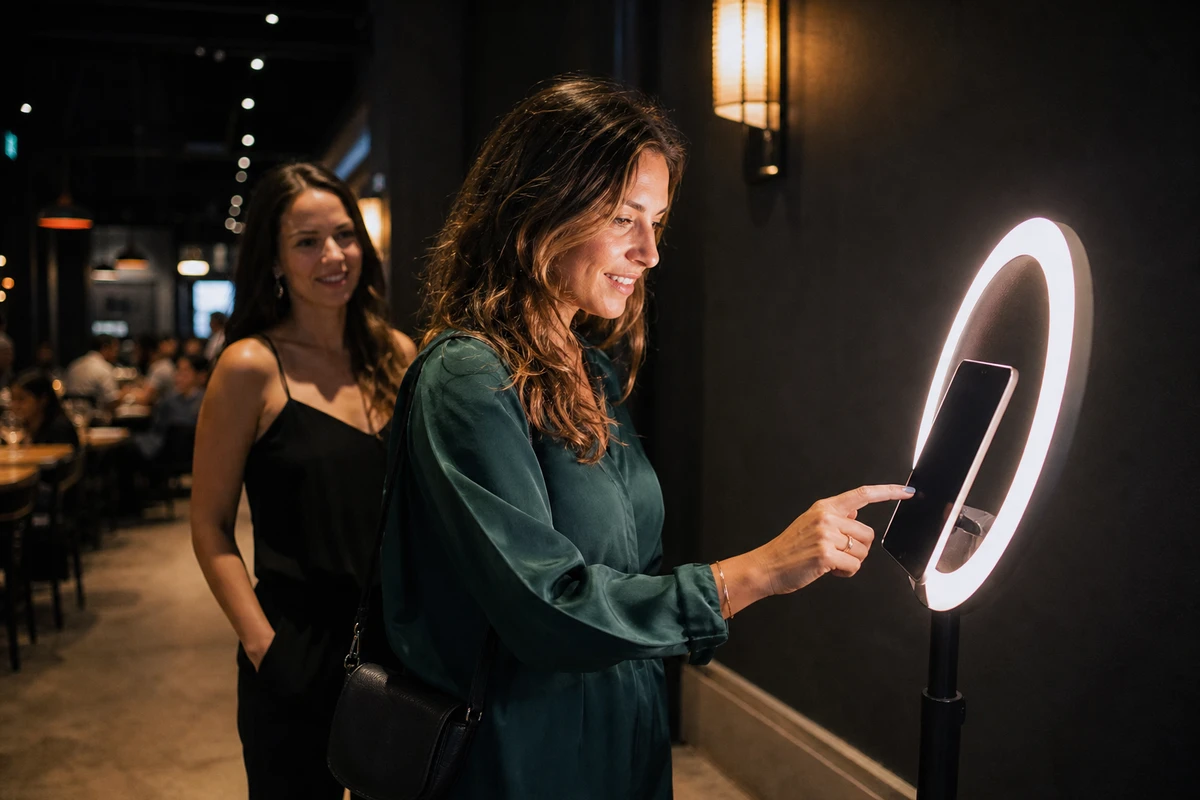
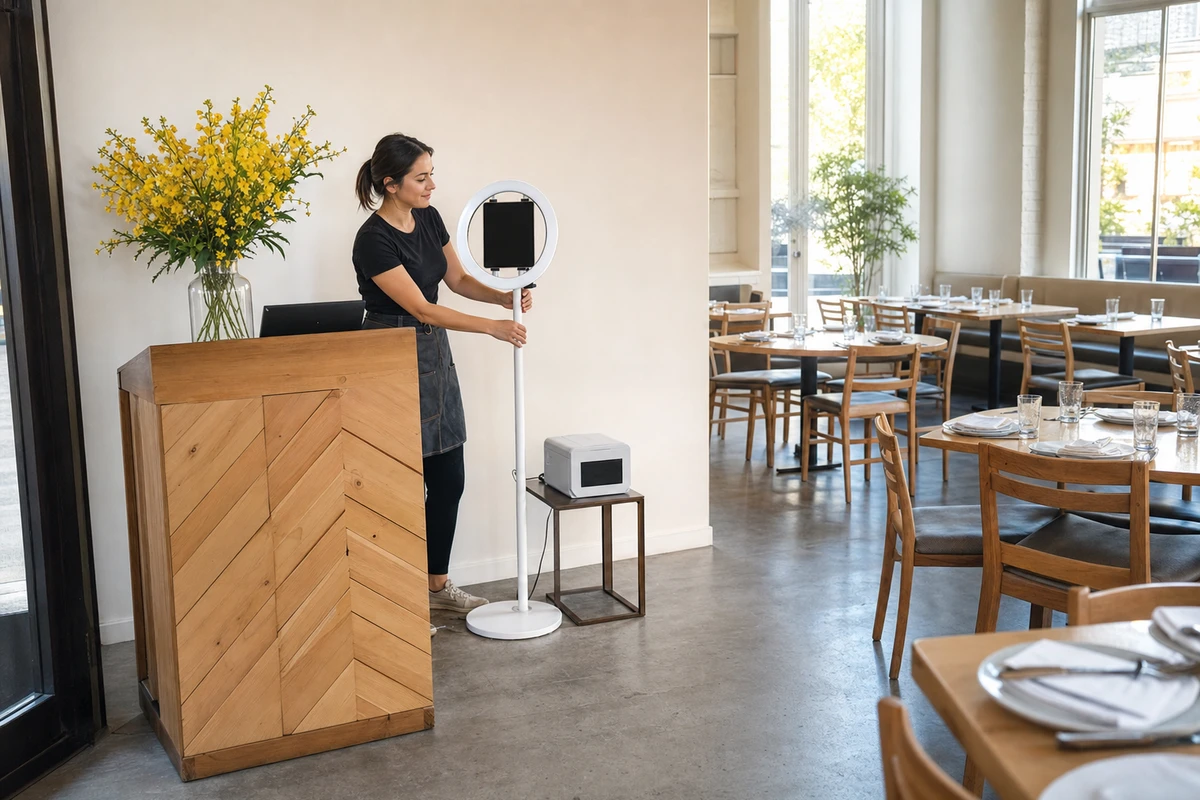
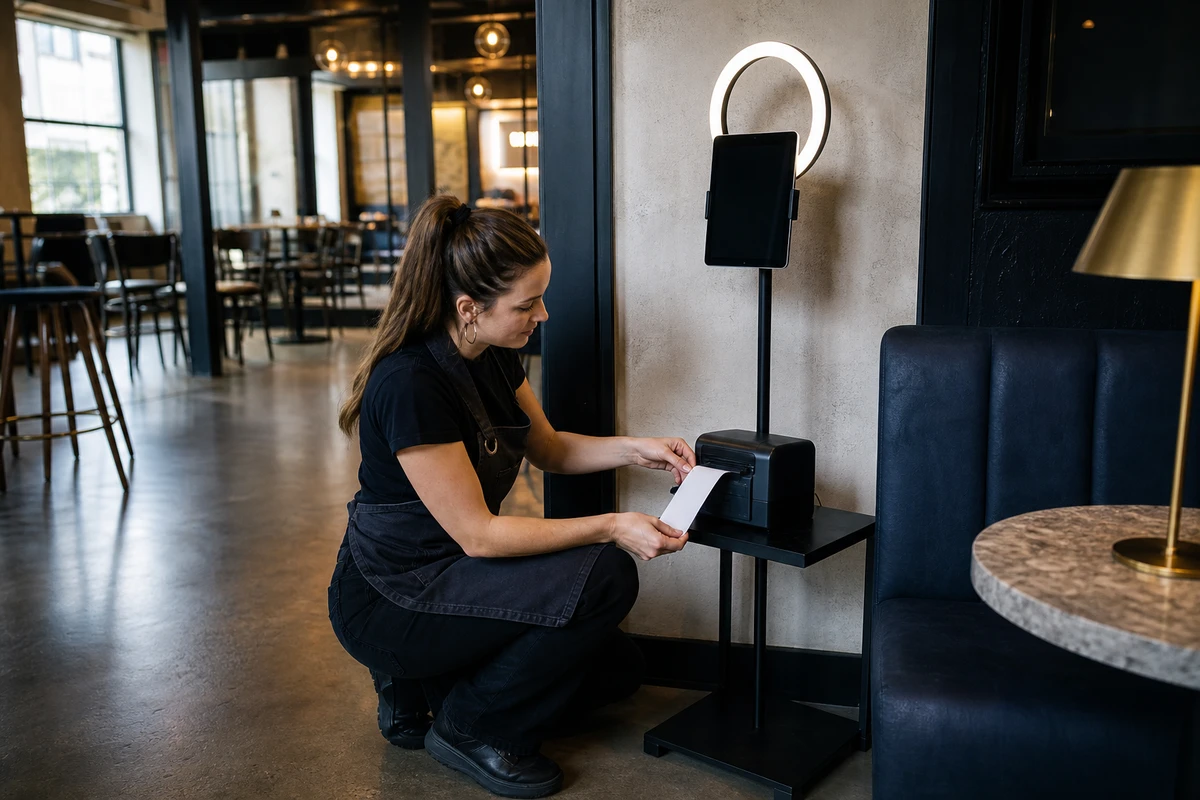
- Add one motivated in-venue capture moment (a contest, an event, or a photo activation) where the guest volunteers contact details to receive something they want. A branded photo station is one concrete version: the guest types in an email or phone number to receive their picture, and Simple Booth’s HALO kit delivers that photo by email, SMS, or QR code while the operator keeps the opt-in as a zero-party record. Entertainment chain Treetop Golf used the same lead capture to build 150,000 unique email addresses across its locations.
- Only then address WiFi and QR, and only with an honest, skippable ask. These channels are fine as long as nobody pretends a login email is a marketing consent.
The restaurant already serves the guests
The restaurant already serves the guests. The only open question is whether it walks away from each visit with a record it can use, or just another card token it cannot.
Sources
- Forrester Research (2020). “Straight From The Source: Collecting Zero-Party Data From Customers.” https://www.forrester.com/blogs/straight-from-the-source-collecting-zero-party-data-from-customers/
- PCI Security Standards Council. “Data Storage Do’s and Don’ts (tokenization and cardholder data).” https://listings.pcisecuritystandards.org/pdfs/pci_fs_data_storage.pdf
- TryCactus (2024). “How Delivery Apps Share Customer Data (And Why Your Own App Gives You More Control).” https://www.trycactus.ai/post/how-delivery-apps-share-customer-data-and-why-your-own-app-gives-you-more-control
- DoorDash (2026). “Merchant Products and Pricing.” https://merchants.doordash.com/en-us/products
- Total Food Service (2021). “Implications for Customer Data When Using Third-Party Restaurant Technology.” https://totalfood.com/implications-for-customer-data-when-using-third-party-restaurant-technology/
- National Restaurant Association (2024). “Restaurant Technology Landscape Report 2024.” https://restaurant.org/research-and-media/research/research-reports/2024-technology-landscape-report/
- SevenRooms (2023). “Restaurant QR Codes: Enhancing or Hindering the Dining Experience?” https://sevenrooms.com/blog/restaurant-qr-codes/
- California Privacy Protection Agency (2024). “Administrative fine adjustment announcement.” https://cppa.ca.gov/announcements/2024/20241217.html
- Klaviyo (2026). “Email Marketing Performance Benchmarks.” https://www.klaviyo.com/products/email-marketing/benchmarks
- Restaurant Business Online (2026). “Why Restaurant Loyalty Is Stuck.” https://www.restaurantbusinessonline.com/technology/why-restaurant-loyalty-stuck