A table of four finishes a Friday dinner, splits a dessert, pays, tips, and walks out into the parking lot. The kitchen cooked for two hours and the front of house ran the table all evening, and the restaurant has no idea who those four people were or how to reach them again. The same night, a delivery order goes out the back door. The restaurant cooks that meal too, hands a cut of the ticket to DoorDash, and DoorDash keeps the customer’s name and email.
An email list built inside the restaurant fixes the first loss and routes around the second. It is an asset the operator owns outright, a set of consented addresses that can be re-activated for the price of a send, with no commission and no algorithm deciding who sees the message. Most guides treat restaurant email capture as a volume problem and answer it with a flat menu of channels. The sharper question, and the one this article answers, is which of those channels produce a list actually worth sending to.
Why “in-house” is the point, not a detail
Start with the order that builds no list. A restaurant taking a delivery order through DoorDash, Grubhub, or Uber Eats cooks the food, packs it, and hands a share of the ticket to the marketplace. Restaurant Dive, reporting on DoorDash’s commission tiers, put that share at 15% to 30% depending on the plan, with marketplace rates “typically hovering around 30%” (Restaurant Dive, 2021). The restaurant never sees the customer’s email or name. New York City passed a law in 2021 to force delivery apps to hand restaurants their customers’ contact details; in September 2024 a federal judge struck it down on First Amendment grounds, and the apps kept the data (Restaurant Dive, 2024).
The scale makes this structural rather than occasional. The National Restaurant Association reports that 70% of restaurants offer third-party delivery and 60% of consumers used one in the past six months. For most of those orders, the restaurant earns revenue and zero owned customer data.
In-house capture is the opposite arrangement: collecting the email on a surface the restaurant controls, its own counter, receipt, Wi-Fi, or events. A consented address gathered that way is a lead the operator can re-activate at will, for the cost of a send. Guests are receptive to that direct line. In a Popmenu consumer survey, 71% named email as their preferred way to hear from a restaurant (Popmenu consumer survey, vendor-published).
The capture surfaces a restaurant already owns, ranked
An operator who searches for help here finds the same article a dozen times: a flat list of six or twelve ways to collect emails, every channel given equal billing. BackOfHouse.io’s guide, one of the more useful, walks through the reservation system, table QR codes, email receipts, the Wi-Fi portal, incentives, and the staff ask without ranking any of them. A flat list is the wrong tool. A manager with one free afternoon needs to know which surface to wire up first.
Rank the in-house surfaces on three things: how strong the consent is, how much the resulting addresses are worth, and how much setup the surface takes. They sort into three tiers.
Start here
Loyalty or rewards enrollment, the opt-in box on the restaurant’s own online-ordering checkout, and email capture at in-venue events. The guest is choosing a relationship, so the address is real and the person behind it wants to hear back.
Worth doing
The point-of-sale digital-receipt opt-in and reservation or waitlist capture. The guest is mid-transaction and the email is a genuine convenience, though intent to hear from the restaurant later is weaker. QR table tents sit here, and rise or fall entirely on the offer attached to them.
Handle with care
The Wi-Fi captive portal, the splash page that asks for an email before granting web access. Wi-Fi marketing vendors advertise that portals convert 60% to 80% of foot traffic into subscribers (MyPlace Connect, vendor claim). That is a login rate, not a subscriber rate.
The pattern is consistent and counter-intuitive: the surfaces that take the most setup and produce the fewest addresses tend to produce the best list.
Not all captured emails are equal
Picture two addresses captured on the same night. One came from a guest who typed an email into a Wi-Fi splash page because the page would not let them check their phone otherwise. The other came from a guest who, at the end of a good meal, joined the rewards program to claim a free appetizer next time. Both count as “an email captured.” They are not the same asset.
Captured emails sit on a consent spectrum. At one end is the coerced address, demanded as the toll for Wi-Fi access. In the middle is the incentivized address, traded for a discount. At the other end is the volunteered address, given by a guest who has already decided they want to hear from the restaurant. A coerced address is often a typo, a throwaway, or a never-checked spam-catcher account, because the guest wanted the internet, not a relationship. A volunteered address belongs to someone who does.
The mistake in every competitor listicle is treating the headline count as the score. More emails is not a better list, and the reason is deliverability. Coerced addresses bounce at high rates and draw spam complaints when the restaurant later emails people who forgot they opted in. Mailbox providers watch those signals. Google’s sender guidelines tell senders to keep their spam-complaint rate below 0.10% and never to reach 0.30%, the point at which Gmail starts filtering that sender’s mail (Google, 2024). The damage attaches to the sending domain, not to the bad addresses alone, so a few hundred junk Wi-Fi addresses can suppress inbox placement for every loyal regular on the same list. The metric that matters is not how many addresses were captured. It is how many deliverable, consented, engaged contacts the restaurant can actually reach.
What a captured email is actually worth
An operator who has been collecting addresses for six months wants one number: is this paying off? Email is usually sold with a single headline figure, somewhere near $44 returned for every dollar spent. Litmus’s 2025 State of Email survey puts the real distribution lower and wider, a return between 10:1 and 36:1 for most senders and 36:1 to 50:1 only for top performers (Litmus, 2025). The useful number is not that aggregate. It is the arithmetic on a restaurant’s own covers.
Connectivity
Take a neighborhood restaurant running two capture surfaces side by side for a year. Surface A is the Wi-Fi captive portal. Surface B is the rewards opt-in offered at checkout to guests who just finished a meal. The portal wins on volume: say it logs 6,000 addresses against the opt-in’s 1,200, a five-to-one edge.
Send one promotion through each, a free appetizer on the next visit, and follow the chain. Wi-Fi addresses carry a heavy share of typos and dead accounts, so perhaps 60% are valid and reach an inbox: 3,600. Because those guests never wanted the email, an open rate near 15% is generous, giving 540 opens. Redemption among openers of 8% produces about 43 visits. At an $18 margin per visit, Surface A returns roughly $770.
The opt-in list is smaller and cleaner. Around 95% of its 1,200 addresses are valid: 1,140. These guests asked to hear from the restaurant, so the open rate sits near the food-service benchmark of about 45% (MailerLite’s 2025 data puts agriculture and food services at 45.51%), roughly 513 opens. Redemption runs higher on real intent, say 14%, giving about 72 visits and roughly $1,290 in margin.
The list one-fifth the size returns more money. The figures here are illustrative except the open-rate benchmark. The direction holds as long as the opt-in surface produces cleaner addresses and higher redemption, which is what the consent spectrum predicts. There is also a cost the raw count hides: if both lists send from one domain, Surface A’s bounces and complaints drag that domain toward Google’s spam thresholds and pull down the open rate Surface B depends on. The volume list does not just earn less. It taxes the good one.
Make the sign-up ask convert
A worry shows up constantly among operators and servers: asking a guest for an email intrudes on the meal. It does, when the ask is built badly. Three things fix it.
The incentive
The first is the incentive. “Sign up for our newsletter” asks the guest to give something and get nothing, so it converts poorly. An offer the guest can picture converts: a free appetizer or dessert on the next visit, a set amount off the next check, a birthday reward. The strongest versions require a return visit to redeem, which wires capture and retention together. That link is worth more than it looks. Bain & Company’s research in Harvard Business Review found that cutting customer defections by 5% raised profits by 25% to 95%, depending on the industry (Reichheld and Sasser, 1990). An incentive that pulls the guest back through the door buys a slice of that.
Timing
The second is timing. An email asked for at the door, before the guest knows whether the food is any good, is an interruption. The same ask after a meal the guest enjoyed is welcome. BackOfHouse.io’s operator guide notes that guests are most willing to share contact details once they have already had a good experience. Capturing at peak satisfaction also lands the address higher on the consent spectrum.
Friction
The third is friction. Every field a guest does not want to fill in lowers completion. The limit is an email and at most one more genuinely useful field, a birthday or birth month that triggers an automated reward. Phone number, home address, and survey questions belong nowhere near a capture form.
Staff make or break all three
Staff make or break all three. A server’s quick, friendly suggestion converts far better than a passive table sign, and lands a better address because it comes with a human read on whether the guest enjoyed themselves. A light script helps. A small per-sign-up bonus keeps servers enthusiastic, with one caution: pay only for raw sign-ups and servers will pad the list with weak addresses to hit the bonus. Reward valid, engaged sign-ups instead.
Keep it legal, and keep the list deliverable
A restaurant sends its first promotional email and, knowingly or not, takes on a set of federal obligations. The CAN-SPAM Act governs every commercial email a U.S. business sends. The FTC’s compliance guide lists the requirements: no false or misleading “From” lines or subject lines, a clear way to opt out, a valid physical postal address in every message, and opt-out requests honored within 10 business days. The penalty for getting it wrong runs up to $53,088 per email (FTC, 2023). The same rules dispose of any temptation to buy a list. A purchased list is unconsented by definition: it bounces, draws complaints, and pushes the sending domain straight toward Google’s spam thresholds.
Restaurants serving guests in the EU or California take on extra duties under GDPR and CCPA: consent must be specific, and the guest must be able to see and delete what was collected. One practical move covers both. Record, with every captured address, a timestamp, the surface it came from, and for Wi-Fi sign-ups the IP. A provable consent record turns a complaint into a non-event.
A captured address with no follow-up is a wasted capture. The welcome email should go out within 24 hours, while the visit is fresh, because it confirms the address is real and sets the tone for what follows.
Lists also decay on their own
Lists also decay on their own. A meaningful share of any list goes stale each year as guests change jobs and abandon inboxes; the figure widely cited by email platforms, originating with Marketing Sherpa research, is around 22% annually. The fix is routine pruning: a contact who has not opened anything in a defined window gets suppressed or asked to re-confirm, not mailed forever. Hygiene is what keeps bounce and complaint rates low enough for the channel to keep working.
The capture surface most operators underuse
A restaurant’s email sign-up is usually a fixture: a tent card on the table, a splash page on the Wi-Fi, a checkbox on the receipt, each one sitting there waiting for a guest to notice it. The surface most operators never set up is a moment. A grand opening, a customer-appreciation night, a chef’s tasting, a seasonal event. At those moments a guest sits at the top of their goodwill toward the restaurant, and goodwill is what makes someone hand over a real address.
This is the consent spectrum at its strongest. An email captured at an event is volunteered, because the guest is the one asking the restaurant for something: an entry in the night’s drawing, a perk reserved for attendees, a copy of a photo from their evening out. The restaurant is not charging an email as a toll. It is giving the guest something they came for, and the address arrives as the byproduct.
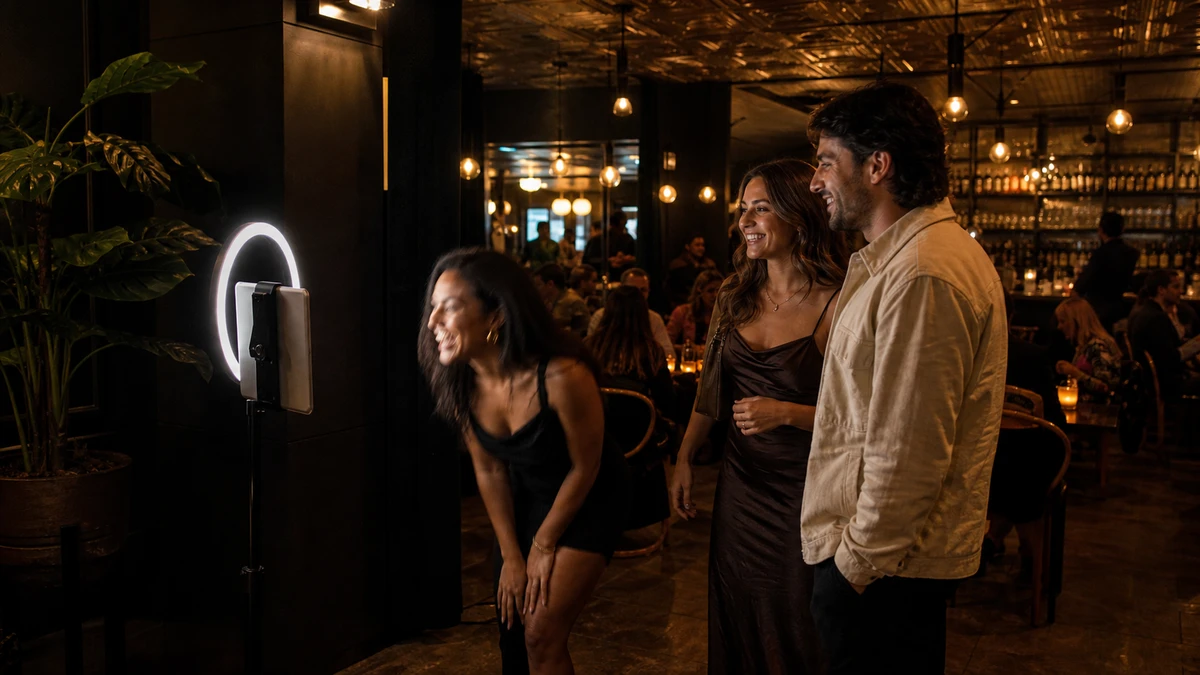
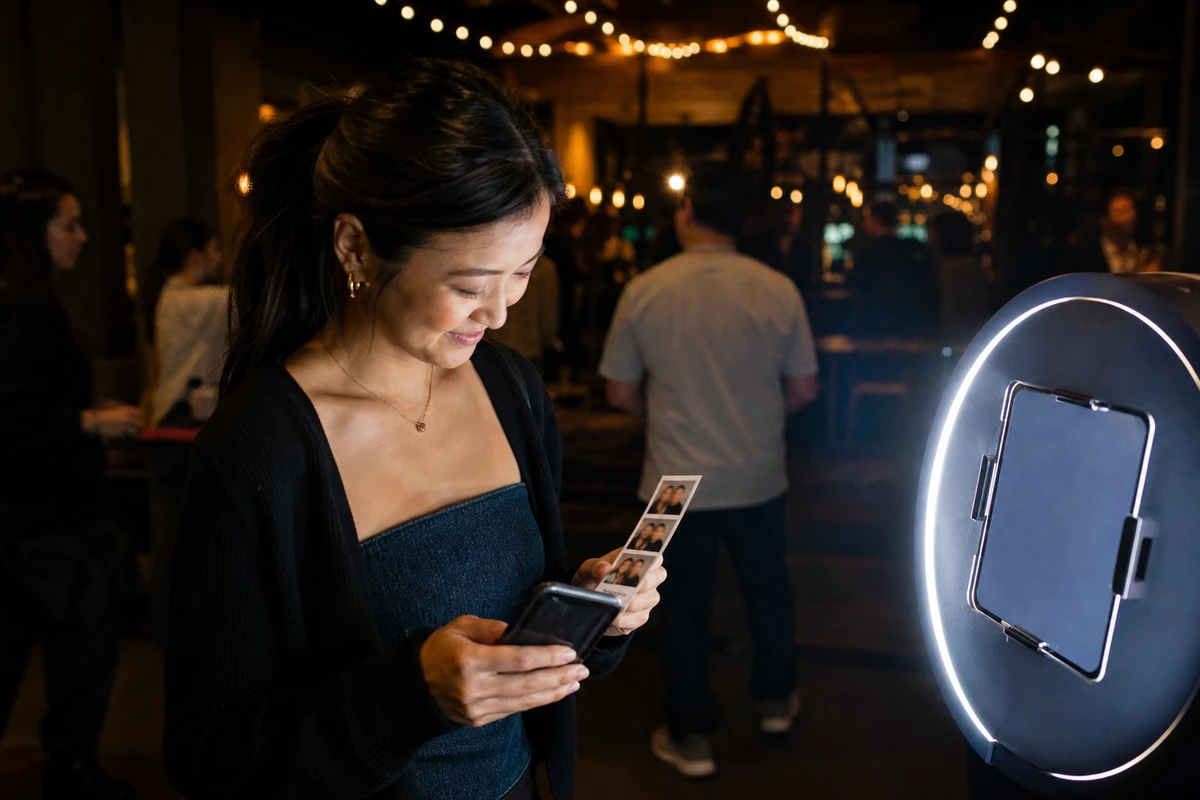
That last example points at the most natural capture device for a venue. An in-venue photo activation, a branded station where guests take a picture and have it sent to themselves, captures a high-consent email precisely because the guest wants the photo. They are not opting into a newsletter; they are asking for a keepsake, and the email is how it reaches them. An address captured that way engages later because it was attached to an experience the guest actively chose, not extracted as the price of Wi-Fi. Simple Booth’s HALO kit is one concrete version of that station: a guest takes a photo, chooses email delivery, and the address lands in the restaurant’s contact export with the opt-in recorded alongside it. The entertainment-venue chain Treetop Golf used that lead-capture flow to build 150,000 unique email addresses across its locations. For a restaurant willing to set up one capture surface properly, an event moment produces the list worth owning.
The work this week is small
The work this week is small. Pick the single highest-consent surface the restaurant already owns, usually the checkout opt-in or the rewards enrollment, attach an incentive a guest would genuinely return for, and switch on a welcome email that goes out within a day. That beats flipping on a Wi-Fi portal and calling the result a list. Counting addresses is the wrong scoreboard; ranking surfaces and protecting deliverability is the right one. A list built from guests who chose the restaurant is an asset no marketplace takes a cut of and no algorithm can throttle. It belongs to the operator, and it pays out every time they send.
Sources
- Federal Trade Commission (2023). “CAN-SPAM Act: A Compliance Guide for Business.” https://www.ftc.gov/business-guidance/resources/can-spam-act-compliance-guide-business
- Litmus (2025). “The ROI of Email Marketing [Infographic].” https://www.litmus.com/blog/infographic-the-roi-of-email-marketing
- MailerLite (2025). “Email Marketing Benchmarks by Industry and Region for 2026.” https://www.mailerlite.com/blog/compare-your-email-performance-metrics-industry-benchmarks
- Google (2024). “Email Sender Guidelines.” https://support.google.com/mail/answer/81126
- Restaurant Dive (2021). “DoorDash Launches 3-Tiered Commission Fee Structure.” https://www.restaurantdive.com/news/doordash-launches-3-tiered-commission-fee-structure/599088/
- Restaurant Dive (2024). “DoorDash, Uber Eats Win NYC Customer Data Court Battle.” https://www.restaurantdive.com/news/doordash-uber-eats-win-nyc-customer-data-court-battle/727994/
- Reichheld, Frederick F. and Sasser, W. Earl, Jr. (1990). “Zero Defections: Quality Comes to Services.” Harvard Business Review. https://hbr.org/1990/09/zero-defections-quality-comes-to-services
- National Restaurant Association (2025). “State of the Restaurant Industry.” https://restaurant.org/research-and-media/research/research-reports/state-of-the-restaurant-industry/
- Popmenu (2024). “How to Create (and Use) a Restaurant Email List.” https://get.popmenu.com/post/restaurant-email-list-guide
- BackOfHouse.io (2023). “Six Surefire Ways to Score Your Customers’ Email Addresses.” https://backofhouse.io/resources/restaurant-email-list
- MyPlace Connect (2026). “WiFi Email Capture: Capturing Emails Through Guest WiFi.” https://myplaceconnect.com/capture-email-on-wifi-for-restaurants-bars-and-hotels/