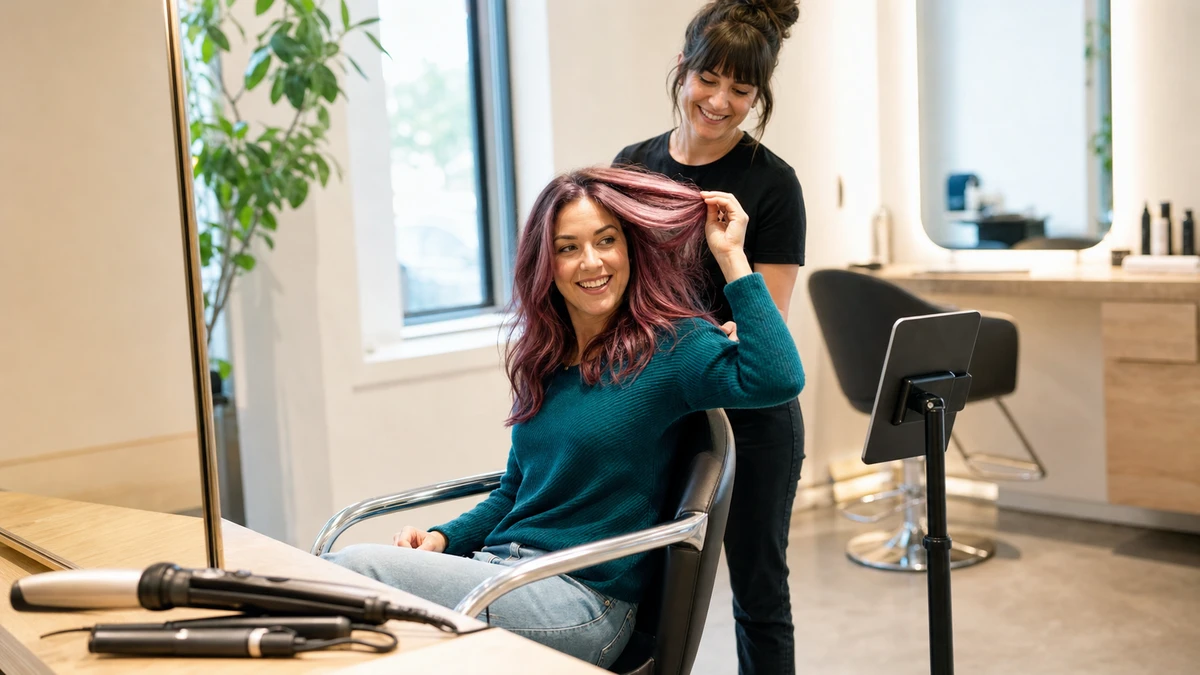
A colorist spins the chair so the client faces the mirror. The client turns her head, lifts a section of hair to watch the light catch it, and reaches for her phone to take a photo. That moment, while she is still in the chair admiring the work, is the best place for a salon to capture her email address. Not the front desk ninety seconds later.
Most advice on salon email capture treats it as a front-desk task: a clipboard, a checkbox on the intake form, a question squeezed in next to the card reader. Email deserves more care than that, because it is the one marketing channel a salon owns outright. A salon rents its audience on Instagram and pays for every visit it buys from Google. An email list is a direct line that no platform can throttle or charge for. Zenoti’s 2024 Salon & Spa Consumer Survey, a study published by a salon-software vendor, found that salon clients who receive regular email visit 20 to 30 percent more often than those who do not.
The real problem is timing and quality. Most salons do build a list. They build it at the wrong moment, and they never check whether the addresses on it work.
Why Checkout Is the Worst Moment to Ask for an Email
The ask competes with leaving, and loses
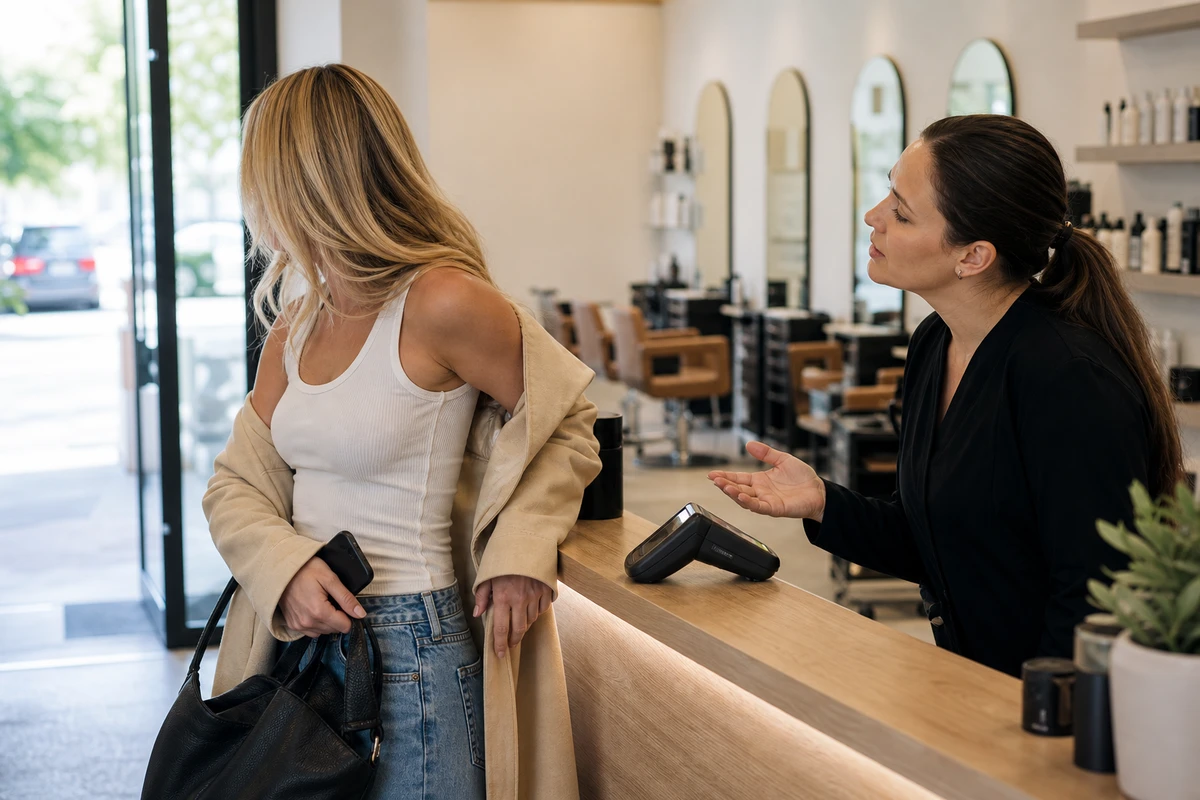
Picture the front desk at the end of a service. The client has her card out, her coat half on, and her attention already on the parking meter or the school pickup. The receptionist asks for an email address. At that moment the request is not an offer; it is one more step between the client and the door.
This is a mechanism, not a matter of a better receptionist. A request made while someone is trying to leave competes with leaving, and it usually loses in one of three ways. The ask gets skipped because the desk is busy. It gets declined because “no thanks” is the fastest way out. Or it gets answered with a fake or mistyped address, given politely to end the interaction without friction. StyleSeat’s stylist guide named this plainly back in 2018: “By the time your clients have paid, they are distracted and ready to leave, it’s easy to dodge the question.”
A mistyped address is worse than no address
The third failure is the expensive one, because it hides. A skipped or declined ask leaves the list honest. A junk address inflates it. The list appears to grow while a real share of it is dead on arrival.
Dead addresses do not sit quietly. Mistyped and disposable addresses hard-bounce on the first send, and a pattern of hard bounces signals to mailbox providers that the sender is mailing a low-quality list. That lowers inbox placement for the good addresses too. One bad capture moment at the desk quietly taxes every genuine subscriber the salon worked to earn. The fix is not a sharper script at checkout. It is moving the capture to a moment when the client is not trying to leave.
What One Captured Email Is Actually Worth to a Salon
Email earns its place on the math. Litmus’s 2025 State of Email report puts typical returns in the range of $36 to $42 for every $1 spent. That headline figure describes the channel in aggregate. A salon owner planning where to spend staff attention needs the figure one rung down: what a single captured address is worth.
What a single working address earns in a year
Take a salon where the average client spends $75 a visit and books four times a year. (The $75 ticket here is illustrative; haircut-only and full-color salons sit far apart, and each salon already knows its own average.) That client is worth $300 a year in service revenue.
Now apply the visit-frequency lift. Zenoti’s 2024 survey, the vendor study cited above, attributes a 20 to 30 percent increase in visit frequency to clients who receive regular email. For a client who moves from four visits to five, that is one additional $75 ticket. So a consented, active email address is worth roughly one extra visit a year. At this salon’s numbers, about $75 per address, recurring.
What the math looks like for a whole salon
Scale that to the business. Consider a salon with 800 active clients on its books. If it captures a real, consented address from 60 percent of them, that is 480 addresses. If the visit-frequency lift holds for the clients who actually read the mail, 480 extra visits a year at $75 is $36,000 in incremental annual revenue. The figure moves with each salon’s true ticket and base frequency; the structure of the calculation does not.
That $36,000 carries one condition, and it is the condition the rest of this article is about. It assumes the 480 addresses are real and their owners opted in. A list of 480 where 200 are mistyped, abandoned, or never wanted the mail does not produce 480 extra visits. It produces a fraction of them, plus a deliverability problem. Volume without quality is a different and worse asset.
Capture at the After-Look Reveal, Not the Transaction
The reveal is the one moment the client wants something back
At the front desk the salon asks the client for something: her address, her consent, her last scrap of attention, while she is trying to leave. At the reveal the relationship runs the other way. The client wants something from the salon. She wants a clear record of a result she is about to photograph badly herself in poor mirror light.
Offering to send that photo changes what the ask is. The salon is no longer extracting data from a distracted customer. It is handing over something the client asked for in all but words. The email address is the delivery detail, the way a courier needs a street number.
Sending the photo verifies the address for free
A front-desk form has no way to know whether an address is real. The reveal photo does. To receive the image the client has to give an inbox she actually checks, and a fake or mistyped address means the photo never arrives, something she will notice within the hour. The delivery step does the verification work no clipboard can. An address that received and opened a photo on the day it was collected is, by definition, a live inbox with an engaged owner.
In practice this means putting the capture where the reveal happens, at the styling station, not behind the desk. A tablet or photo tool at the chair can send the image and record the marketing opt-in in a single step, so the consent and the address are collected at the moment they are easiest to get and hardest to fake. Simple Booth’s HALO kit is one tablet-based version of this: the client receives the reveal photo by email or text, and a marketing opt-in field on the same screen records her consent in the same action. Treetop Golf, an entertainment venue chain, used HALO’s lead capture this way to build a list of 150,000 unique email addresses across its locations. The photo itself is a second asset: it gives the client a reason to remember the salon, and it doubles as content she may share or the salon may reuse later.
Why the timing works: the peak, not the exit
Behavioral research explains why this beats a checkout ask. Fredrickson and Kahneman (1993) described the peak-end rule: people judge an experience by its most intense moment and its final moment, not by an average of the whole thing. The finished-look reveal is the emotional peak of a salon visit. A request made at that peak reaches a client who feels good about the work and is open to staying in contact. The same request ninety seconds later, at the exit, reaches a client whose attention has already moved to payment, coat, and car. Same client, same salon, two different answers.
Rank Your Capture Points by Data Quality, Not Convenience
A salon owner who looks for ways to grow the list finds the same flat menu everywhere: ask at booking, ask at the desk, run an intake form, gate the Wi-Fi, push loyalty enrollment, set out a prize-draw bowl. The methods get presented as equals. They are not. A useful list ranks them by the quality of address and consent each one returns, then builds from the top down.
High quality: the reveal photo, intake forms, and membership enrollment
Three methods produce addresses that are both real and willingly given. The reveal photo, covered above, self-verifies. A new-client intake form completed before service catches the client unhurried and expecting to share contact details, which is the opposite of the checkout situation. Loyalty or membership enrollment works because the value exchange is explicit: the client signs up to get something specific, so the address and the consent are both deliberate.
Medium quality: online booking and front-desk check-in
Online booking and front-desk check-in reliably produce a working address, because the salon needs it to confirm the appointment. What they often miss is the marketing opt-in. The contact field gets filled; the “send me offers” box gets skipped or left ambiguous. These methods are worth using, but the consent has to be captured as a distinct, deliberate action, not assumed from the booking.
Low quality: Wi-Fi-gated email and prize-draw bowls
Wi-Fi-gated capture asks a client to enter an email address to get online, with no verification step and every incentive to type whatever is fastest. The result is the highest fake-address rate of any common method. Prize-draw and business-card bowls have the same weakness: low intent, low consent clarity, and a high share of entries from people who wanted the prize, not the mailing list. A method’s convenience for the salon is not the same as the quality of what it returns.
Train the Chair, Not Just the Front Desk
The front desk cannot capture a client it never sees
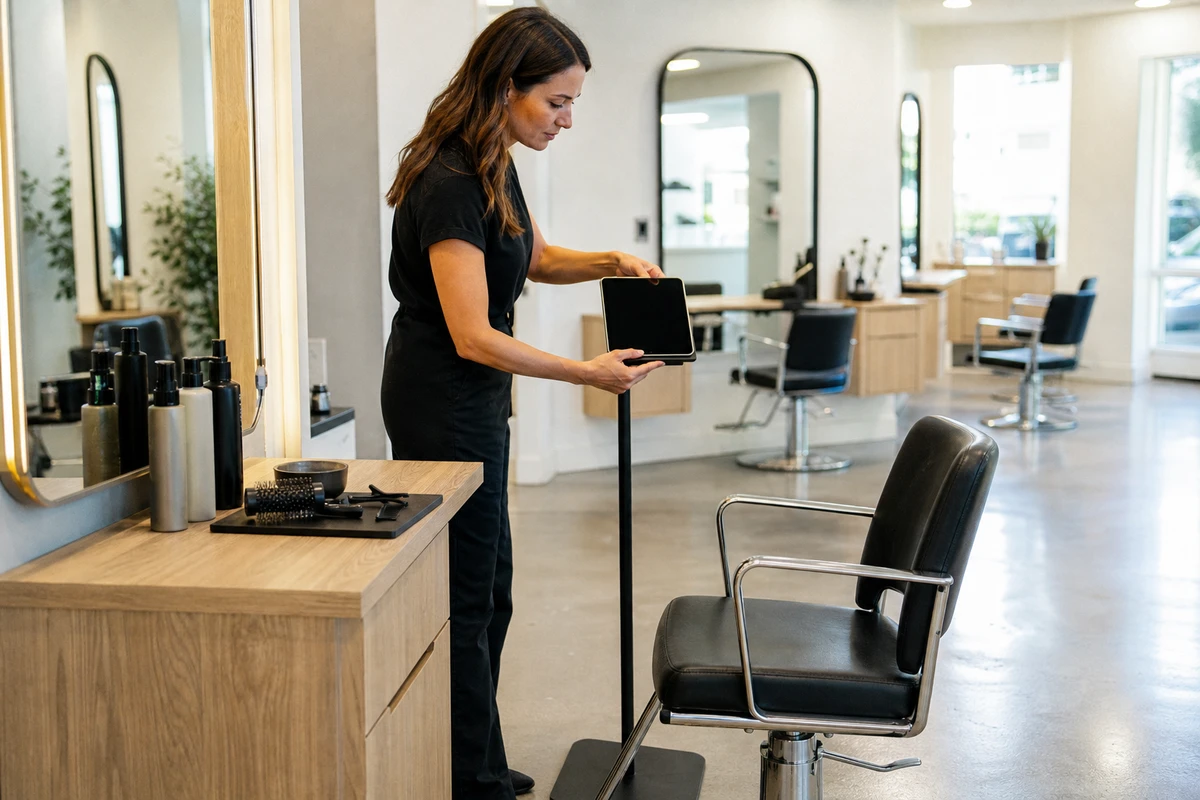
In booth-rental and commission arrangements, common across independent US salons, a client may book, pay, and leave through an app and barely speak to a receptionist. The stylist owns that client moment from greeting to reveal. Generalist email guides miss this. They assume one capture point, a front desk reviewing the contact details on file, and a list built on that assumption misses everyone the chair serves.
When a stylist leaves, whoever holds the email holds the client
There is a sharper reason to capture at the chair, into the salon’s own system. When a stylist leaves, whoever holds the client’s contact details holds the relationship. The salon-coaching publisher Strategies documented the tension in an account of a salon owner whose departing stylist texted former clients to rebook elsewhere, reasoning, “I thought it was OK to take your information because I thought you’d want to follow me.” The client’s reply was “It’s not OK,” and she described feeling “stuck in the battle of ‘who owns me.‘” An owner in the same discussion put it bluntly: “We don’t own customers, we owe them respect. It’s not OK to take off with their personal information.” Capturing into the salon’s own client system, at the chair, keeps the relationship where the client expects it and protects the business asset at the same time.
Reward accurate captures, not raw count
Staff incentives decide which behavior the salon actually gets. A bonus tied to raw sign-up count rebuilds the fake-address problem from the inside, because the fastest way to hit a number is to enter something. Tie any incentive to captures that are accurate and consented: an address that delivers, opens, and carries a real opt-in. That is the only count worth rewarding.
Make Consent Real, Because It Protects Deliverability
Wanted mail gets opened; coerced mail gets reported
Consent is usually filed under legal compliance. Its more immediate job is deliverability. A client who genuinely wants the salon’s email opens it, and opens train mailbox providers to place future mail in the inbox. A client who was pressured or pre-opted-in marks it as spam, and complaints do the opposite.
The threshold is concrete. Google’s Gmail sender guidelines, updated in 2024, ask senders to keep spam-complaint rates below 0.3 percent and ideally under 0.1 percent. A single campaign sent to a list of coerced or fake addresses can push past that line and damage inbox placement for every genuine subscriber. Real consent is what keeps the complaint rate low enough for the list to keep working.
The legal floor: CAN-SPAM, CASL, and GDPR
The compliance rules are the floor, not the ceiling. In the US, the FTC’s CAN-SPAM guidance requires a working opt-out, a physical mailing address, honest headers, and opt-out requests honored within ten business days. It does not require prior opt-in to email an existing customer, but best practice still does. Salons with Canadian clients face a stricter rule: Canada’s Anti-Spam Legislation requires express consent, with opt-in boxes unchecked by default. For UK and EU clients, the UK Information Commissioner’s Office is explicit that a pre-ticked consent box is not valid consent; the client must take an affirmative action to opt in.
The one line that does the work
The consent ask does not need a paragraph. It needs one honest sentence the stylist says at the reveal: “Want me to email you the photo? I can also send our seasonal offers, only if you’d like them.” Two things, separated, both optional. The photo is the reason the client says yes; the offers line is the real opt-in, given freely because it was asked for honestly. Double opt-in, a confirmation click on a follow-up email, adds a useful verification layer for addresses captured without a reveal photo, and adds needless friction where the photo already proved the address.
Measure List Health, Not List Size
A smaller list can out-earn a bigger one
The most common salon metric for email is the wrong one: the number of names. A 2,000-name list where 40 percent of addresses open something within 90 days will out-earn a 5,000-name list opening at 12 percent. The smaller list reaches more real people, keeps a cleaner sender reputation, and costs less to mail. List size flatters the dashboard. List health pays the bills.
The four numbers worth tracking
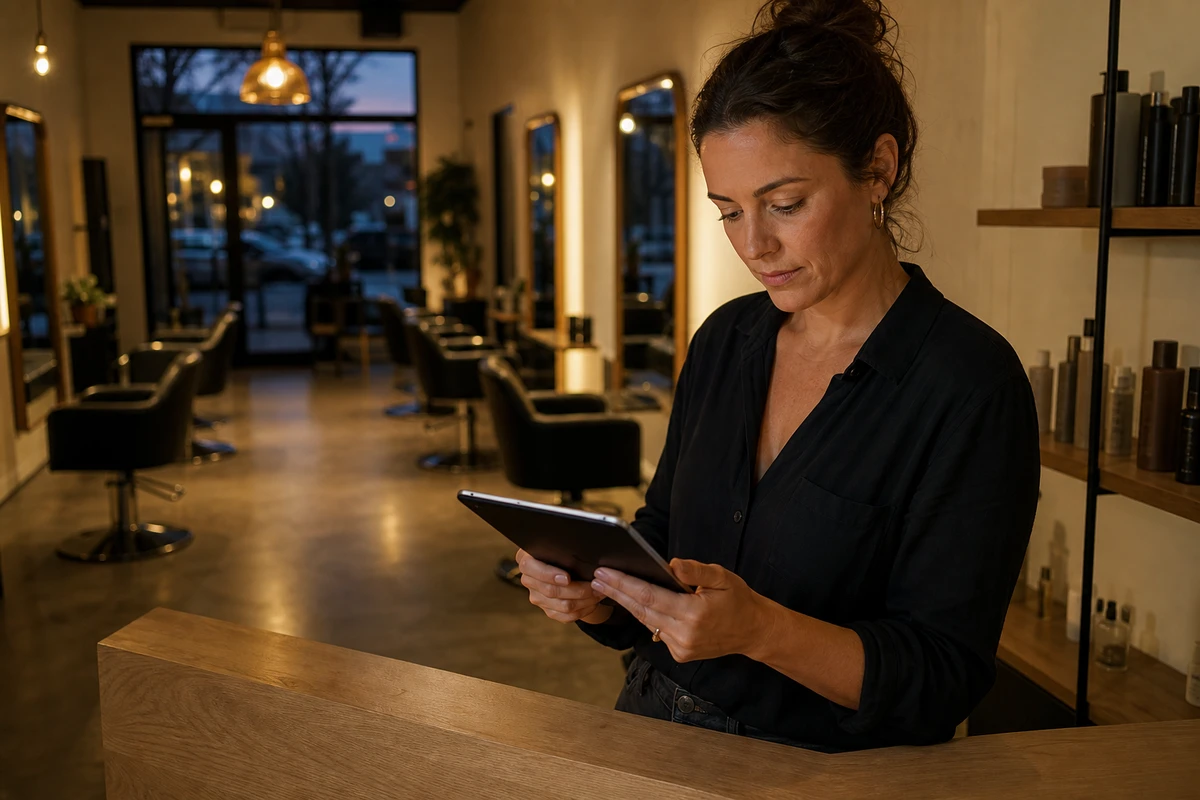
Four numbers tell a salon whether its list is an asset or a liability. Capture rate is the share of client visits that produce a consented, working address; it reveals whether the after-look reveal is actually being used. Bounce rate exposes the dead-address tax from bad capture moments. Active rate, the share of addresses that opened something in the last 90 days, is the real measure of reach. Email-attributed rebookings tie the list back to revenue. For a benchmark, Campaign Monitor’s 2022 data put healthcare-services open rates at 23.7 percent, the closest category proxy for salons, while Mailchimp’s benchmarks put the all-industry average near 35 percent. A salon list captured well should sit toward the upper end, because every address on it came from a client who wanted to be there.
Quarterly cleanup keeps the good addresses delivering
Email lists shed active addresses every year as people change jobs, abandon inboxes, or lose interest. Once a quarter, a salon should look at addresses that have not opened anything in 90 days and either send a single re-permission email or suppress them. Suppressing a cold address is not a loss. It protects the inbox placement of the clients who do read, and those are the clients the list exists to reach.
Capture at the chair, into the salon’s own system, with consent the client actually gave, and the list stops being a number on a dashboard and becomes the one thing a salon can use on a slow Tuesday to fill three chairs by Thursday.
Sources
- Campaign Monitor (2022). “Email Marketing Benchmarks.” https://www.campaignmonitor.com/resources/guides/email-marketing-benchmarks/
- Federal Trade Commission (n.d.). “CAN-SPAM Act: A Compliance Guide for Business.” https://www.ftc.gov/business-guidance/resources/can-spam-act-compliance-guide-business
- Fredrickson, B. L. & Kahneman, D. (1993). “Duration Neglect in Retrospective Evaluations of Affective Episodes.” Journal of Personality and Social Psychology, 65(1), 45–55.
- Google (2024). “Email sender guidelines.” https://support.google.com/mail/answer/81126
- Government of Canada (n.d.). “Canada’s Anti-Spam Legislation (CASL).” https://laws-lois.justice.gc.ca/eng/acts/E-1.6/page-1.html
- Litmus (2025). “Email Marketing ROI: What Every Marketer Needs to Know.” https://www.litmus.com/blog/email-marketing-roi/
- Mailchimp (2024). “Email Marketing Benchmarks and Statistics by Industry.” https://mailchimp.com/resources/email-marketing-benchmarks/
- StyleSeat (2018). “How to Convince Clients to Give You Their Email Address.” https://www.styleseat.com/blog/how-to-convince-clients-to-give-you-their-email-ad/
- Strategies (n.d.). “Who Owns Salon & Spa Client Data?” https://strategies.com/who-owns-salon-spa-client-data
- UK Information Commissioner’s Office (n.d.). “Guide to PECR — Electronic and Telephone Marketing.” https://ico.org.uk/for-organisations/direct-marketing-and-privacy-and-electronic-communications/guide-to-pecr/electronic-and-telephone-marketing/
- Zenoti (2024). “Salon Email Marketing” (vendor-published; 2024 Salon & Spa Consumer Survey). https://www.zenoti.com/salon-email-marketing