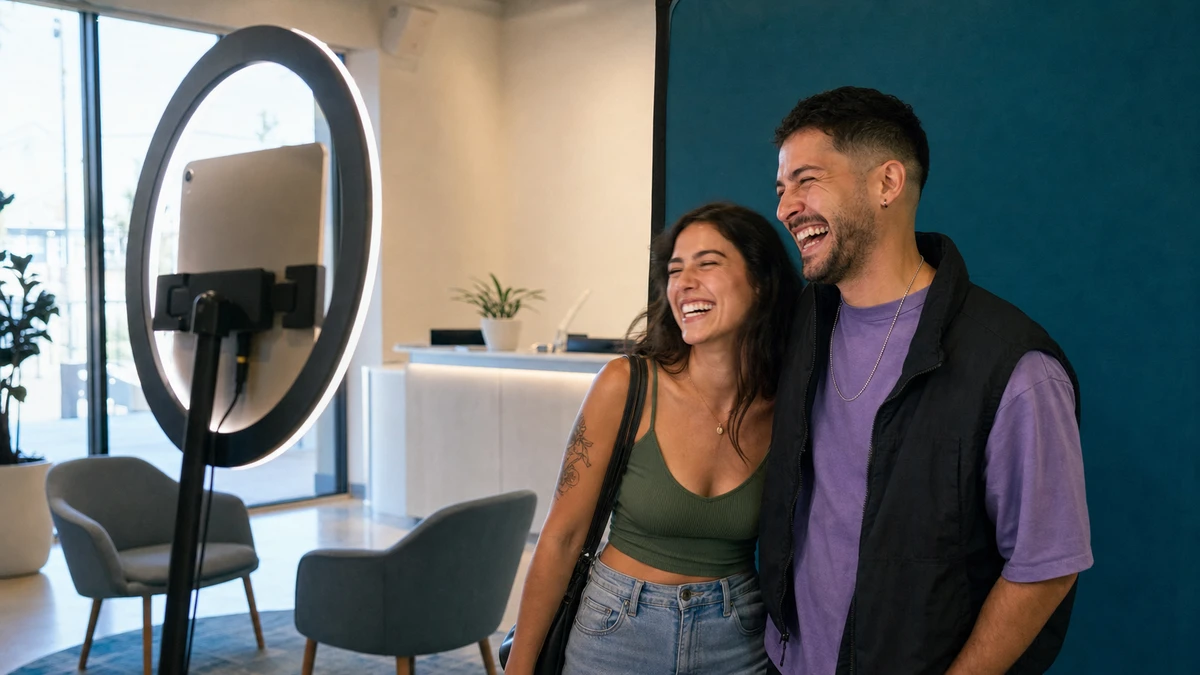
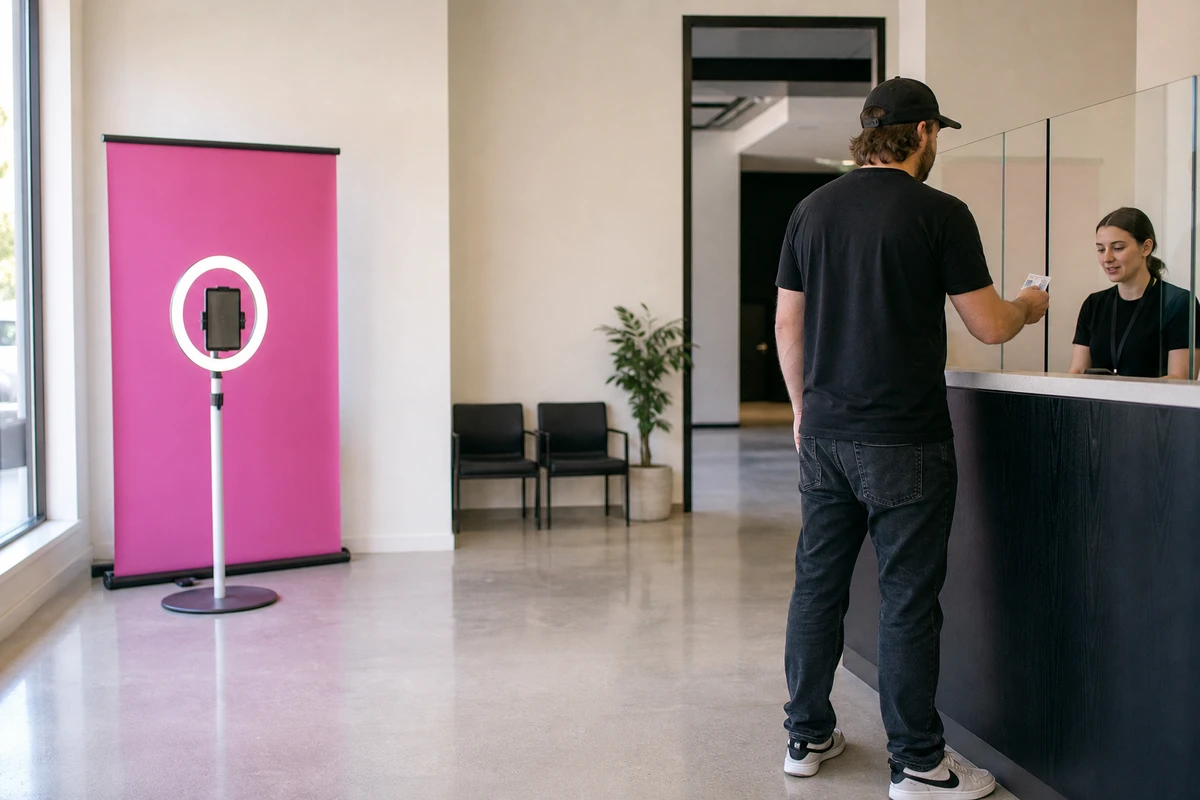
Inside a dispensary on a Saturday afternoon, the first thing in view is a waiting area. Customers stand near a check-in desk with their IDs out, before anyone reaches the regulated sales floor. For most stores that waiting room is dead time. A small number of dispensaries have started filling it with a photo booth.
The instinct is to treat that booth the way any other retailer would: pick the model with the fun features, the props, the instant prints. For a dispensary, that instinct points at the wrong product. A cannabis retailer cannot run the advertising other stores run, and that single fact changes what a booth is for, which in turn changes which booth is worth buying.
The best photo booth for a dispensary is the one built around cannabis marketing law, not party features. That reframing changes the whole shopping list. The booth has to capture content the customer owns and posts from a personal account, collect opt-in email rather than phone numbers, run unattended inside the 21-plus waiting area, and give the operator enough control over branding and overlays to keep every image compliant. The rest of this guide turns that into a working set of selection criteria and tests the real hardware options against it.
Why a Photo Booth Is a Different Tool for a Dispensary
A dispensary marketing manager who tries to boost a post on Instagram hits a wall fast. The major platforms do not sell cannabis retailers the reach they sell everyone else. A 2023 peer-reviewed review by Berg and colleagues, published in Substance Abuse Treatment, Prevention, and Policy, examined cannabis advertising policy across 11 major social platforms and found that 9 of them prohibit paid cannabis promotion, Instagram, Facebook, YouTube, TikTok, and Reddit among them.
Closed paid channels would be survivable if the dispensary’s own organic account were safe. It often is not. Even routine posts carry traps: Instagram counts contact information in a dispensary’s post (a phone number is enough) as a violation, and permits only a website link in the account bio. The exposure compounds across a whole feed. A 2024 study by Marinello and colleagues reviewed 10,461 social posts from 74 of the 75 licensed Illinois dispensaries and found that roughly a third of them had at least one Facebook post flagged as a compliance violation, for youth appeal or health claims; about a quarter had a similar violation on Twitter/X. That data is from 2020 and the rules have shifted since, so it reads best as evidence of how easily a brand account accumulates exposure, not as a current scoreboard. The point holds either way: posting as the dispensary is legally and operationally fragile.
Closed paid channels plus a fragile brand account push a dispensary onto a channel other retailers treat as a bonus: the customer’s own post. Facebook and Instagram police what a dispensary publishes from its business account, but they do not restrict a customer who posts about visiting a store. Berg and colleagues noted that Facebook explicitly permits “discussions about the sale of these goods in stores.” The customer’s account is open road. The brand’s account is a toll gate, lowered.
The asymmetry is not universal
The asymmetry is not universal. The same review found four platforms, Discord, Reddit, Snapchat, and TikTok, restrict unpaid cannabis content from any account, customer or brand alike. The open-road logic holds on Facebook and Instagram, where most dispensary customers share anyway.

A photo booth is, mechanically, a device for producing that customer post at volume. It manufactures, on the dispensary’s own floor, the single piece of marketing the platforms still allow to travel. In a vertical where paid discovery is mostly closed, word-of-mouth carries the load of finding new customers, and a booth gives that word-of-mouth something concrete to travel on. That is why a dispensary should not shop for a booth the way a restaurant or a retail boutique would, and it is the foundation for every selection criterion below.
How to Choose the Best Photo Booth for a Dispensary
An owner comparing two booth spec sheets sees the same headline features on both: prints, filters, GIFs, props, one-tap social sharing. Standard buyer’s guides rank those features by how fun they are. A dispensary has to re-rank them by what cannabis law permits and what it forbids. Seven criteria carry the decision.
Customer-owned, customer-posted output
The booth should make it trivial for a guest to post from a personal account, because that account is the channel platforms still allow. A booth whose main value is the dispensary collecting images to repost from its own account is the weaker model, for the reasons the section on compliant imagery makes concrete.
Email capture, not phone numbers
The contact field that matters is the email address. The instinct to collect mobile numbers for text promotions is the single most expensive mistake an operator can design into a booth in 2025, and it gets its own section below.
Fits a 21-plus, age-gated environment
Every interaction happens inside a licensed premise. A booth’s placement, prompts, and signage should reinforce the age gate the store already runs, never sit outside it or invite a passerby on the sidewalk.
Branding and overlay control
The operator needs real control over frames, overlays, backdrops, and on-screen prompts, because those elements are where compliance is enforced or lost. A booth that locks its overlays behind a fixed vendor template is a booth that cannot be kept compliant by the people responsible for compliance.
Consent and usage-rights capture
The booth flow should record a guest’s permission to be contacted and, separately, permission to reuse an image. A repost defended by a checkbox and a timestamp is a defensible repost. A repost defended by “they tagged us” is not.
Unattended retail-floor reliability
This booth runs every open hour, not for one evening. Durability, a security model for the hardware, and low staffing overhead matter more than a feature list built for a single catered event.
Clean data export
Captured emails should flow into the email tool the dispensary already uses. A booth that strands contact data inside a vendor portal has converted a marketing asset into a hostage.
These seven criteria, not a generic feature count, are what the rest of this guide measures a booth against.
Hardware Form Factors, Compared for a Retail Floor
A dispensary sales floor is small, securely zoned, and watched by cameras for reasons that have nothing to do with marketing. Floor space is revenue. Whatever a booth is, it has to earn a few square feet near the entrance without adding a staffing line or a theft risk. That constraint, more than image quality, sorts the options.
Footprint
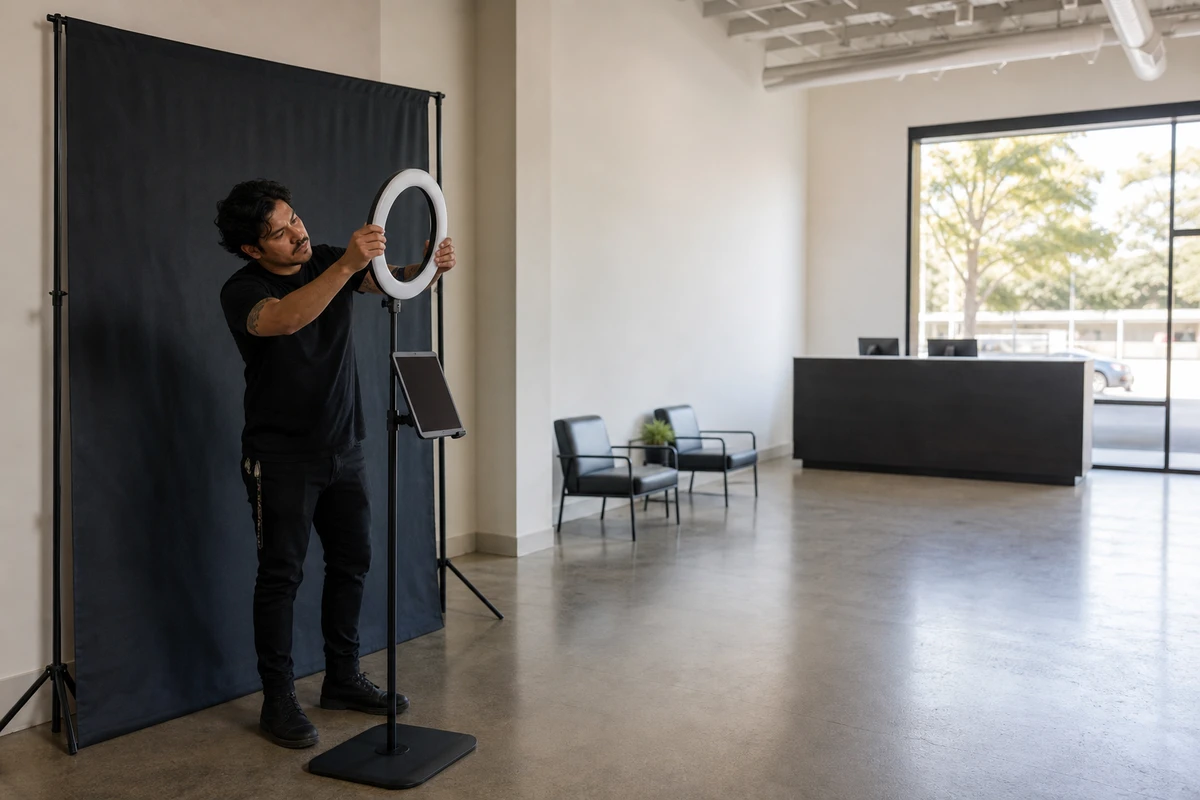
The open-air tablet booth is a tablet on a stand, with lighting and a backdrop, running booth software. Its footprint is small, it operates unattended, it captures email and offers digital sharing natively, and its overlays and prompts live in software the operator can edit. Measured against the seven criteria, it is the strongest everyday fit for a dispensary floor.
The enclosed booth, the cabinet a guest steps inside, is a larger object that reads as event furniture. It eats floor space a dispensary rarely has to spare, and it suits a one-night activation more than a permanent reception-area fixture.
Roaming setups, 360 platforms, and DSLR-staffed booths produce striking images, but the word “staffed” is the problem. They need an attendant, which turns a fixed-cost fixture into an hourly labor line. They belong at a 4/20 event, not in the daily waiting room.
The fishbowl of business cards, the analog default, deserves a direct comparison because many stores still run one. It collects handwriting of unknown legibility, no permission record, and nothing a customer would share. A digital booth captures a typed, opt-in email and a photo the guest actually wants to post. On data quality and on reach, the bowl loses.
Two practical notes apply to any digital choice. Security comes first: an exposed tablet on a retail floor is a theft target, so mounting hardware, a locked enclosure, and a position inside camera coverage are requirements, not upgrades. Throughput comes second: on a 4/20 or a grand opening, a single booth has a real ceiling on sessions per hour, and a line that stalls the check-in flow is worse than no booth at all. For a permanent dispensary install, the open-air tablet booth is the form factor that satisfies the whole criteria list at once: a small footprint, unattended operation, editable overlays, native email capture, and a photo the guest actually wants to post. The enclosed booth fails on footprint, the staffed formats fail on labor cost, and the fishbowl fails on data quality and reach.
Simple Booth’s HALO kit is one product in that category: an iPad booth with a built-in 2,100-lumen ring light, bright enough to light a guest well without the DSLR and paid attendant the staffed formats require. Its overlays, on-screen prompts, and consent checkboxes are editable settings in the app, which keeps the compliance controls this guide describes in the operator’s hands rather than locked in a vendor’s fixed template.
Buy vs Rent: Which Model Fits a Dispensary
An operator planning a single 4/20 activation and an operator rebuilding a permanent reception area both ask the same question, rent or buy, and the right answer is opposite for each.
When renting makes sense
The first case is a single high-traffic day: a 4/20, a grand opening, an anniversary sale. Renting fits here. A rental covers the one day, needs no storage, and carries no maintenance once the event ends. It also works as a pilot. An operator who rents for one 4/20 can record the real opt-in rate, the actual sessions per hour, and whether the line ever stalled check-in, then carry those measured numbers into a later buy decision instead of guessing at them. Renting is the cheapest way to replace an assumption with a measurement before committing capital.
The second case is the everyday fixture
The second case is the everyday fixture. ReLeaf in Las Vegas, named in a 2022 Dutchie article on dispensary user-generated content, put a photo booth in its reception area as a standing part of the visit. A booth used that way, every open hour, every week, is a purchase. The arithmetic favors buying once the booth is treated as an asset rather than an expense. A rental is re-paid in full at every event; a purchased booth is a fixed cost that spreads across every photo it takes and every email it captures over its working life, so the longer it runs, the lower the effective cost of each contact it adds to the list. Renting an everyday fixture means paying event-day rates fifty-odd weeks a year, which no spreadsheet supports.
On absolute cost, honesty beats precision
On absolute cost, honesty beats precision. Neutral public pricing benchmarks for commercial photo booths are thin, and most figures that circulate come from vendors quoting their own products. Rental quotes vary with duration, build quality, staffing, and local market; purchase prices vary with form factor and software terms. An operator should collect two or three real quotes for the specific use case rather than trust a published range. The decision rule survives the missing prices: rent to test or to cover one day, buy when the booth becomes part of the room.
The SMS Trap: Why Collecting Phone Numbers at the Booth Can Backfire
Ask an operator what a photo booth is worth and many will answer with a number: the count of phone numbers it collects, ready to receive texts about Friday’s deal. A mobile number feels like the more direct line to a customer. For a dispensary in 2025, it is also the contact field with the most legal teeth, and configuring a booth to chase numbers builds that exposure into the hardware.
Two rule changes landed in 2025
Two rule changes landed in 2025. The FCC’s one-to-one consent rule, effective January 27, 2025, requires written marketing consent to be specific to a single seller. A guest tapping “yes” at a booth no longer covers a shared list or a parent brand; each business needs its own explicit, standalone consent record. A separate revocation rule, effective April 11, 2025, requires that opt-out requests be honored immediately, through any reasonable channel the customer chooses.
Consent compliance is not even the hardest part. Mobile carriers classify cannabis as restricted “SHAFT” content (sex, hate, alcohol, firearms, tobacco), as the cannabis SMS compliance guidance sets out. A dispensary must register its messaging under the A2P 10DLC system, and even then carriers keep discretion to block cannabis messages. A booth can collect a flawless, fully documented consent record and still have the resulting texts silently dropped before they reach a single phone.
The penalty math should end the debate. TCPA violations run $500 per message per recipient, rising to $1,500 per message for willful violations, and class-action filings against cannabis brands have been climbing. A booth that quietly gathers 200 numbers over a busy weekend, attached to a consent flow that does not meet the one-to-one standard, is not a marketing asset. It is a six-figure liability waiting for a plaintiff’s attorney.
The fix is a configuration choice, not a different booth. Set the booth to capture email with a clear, explicit opt-in, and leave the phone-number field switched off. Email carries real obligations of its own, but nothing close to carrier-level content blocking or $500-per-message exposure. It is the durable first-party channel a dispensary actually controls, which is what the numbers section below is built on.
Keeping the Photos Themselves Compliant
A manager scrolling the store’s tagged photos finds a great one: a regular customer, grinning, holding up a branded tote outside the shop. The instinct is to repost it that afternoon. For a dispensary, that instinct is exactly where compliance problems start, because a dispensary’s images are regulated objects, and a booth produces images all day.
Risk control
Three rules shape what a booth photo may safely show. First, no depicted consumption. An image with visible smoke, a lit pre-roll, or active use creates both regulatory and platform risk, so backdrops, props, and overlays should steer away from it rather than toward it. Second, strictly 21-plus, no minors in frame. Placing the booth inside the age-gated waiting area handles most of this, though prop and signage choices still matter. Third, state rules vary more than operators expect. Ohio Administrative Code Rule 3796:6-3-24 bars a dispensary’s website from hosting user-generated content or reviews at all, which means the familiar “post your photo, tag us, we feature it on our site” loop is simply illegal on an Ohio dispensary’s own pages. California regulates dispensary advertising through its Department of Cannabis Control under a different set of rules again. The operating instruction is to check the specific state, not to assume a national norm.
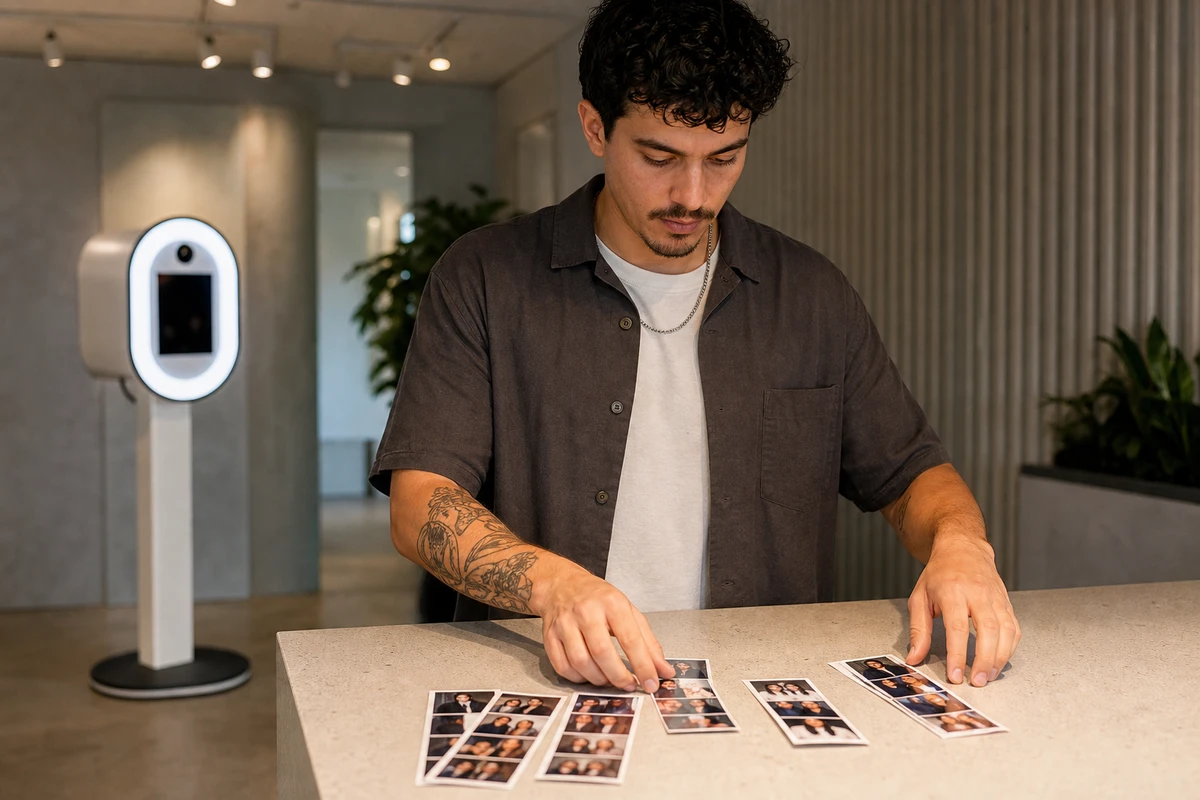
The reposting question deserves a direct answer. A flattering customer photo cannot always be republished by the dispensary, even when the customer tagged the store, and even when that customer would happily say yes. Reuse needs explicit permission and usage rights, captured as a record. This is precisely where the booth’s consent step earns its keep: a guest who checks a reuse box at the booth has handed the dispensary something a social tag never provides, documented permission tied to one specific image.
A booth’s software settings, its overlays, backdrops, on-screen prompts, consent checkboxes, and sharing destinations, are not decoration. They are the dispensary’s compliance controls. A booth that lets the operator set all of them can be kept legal. A booth that does not is a daily source of risk.
What an In-Store Booth Is Actually Worth: Run the Numbers
An operator deciding whether a booth deserves floor space wants the math. Here is a worked model, illustrative rather than a promise, with every input either cited or labeled as the operator’s own estimate.
Start with traffic
Start with traffic. 4/20 is the dispensary calendar’s peak. Cannabis-analytics firm Headset reported that on 4/20 2023, US pre-roll sales rose 153% against the prior four-week average, with concentrates up 177%. Those are sales figures, not headcounts, and a peak day inflates basket size as well as foot traffic, so the door count stays the operator’s own estimate: a location that serves 300 customers on a normal Saturday might reasonably see 600 on 4/20.
Now the booth
Now the booth. Suppose 35% of those visitors stop and finish a session with an email opt-in. That opt-in rate is the operator’s main lever, set by booth placement, the on-screen offer, and whether staff prompt guests, so it should be treated as an estimate to measure and improve, not a fixed constant. At 35%, 600 visitors produce 210 new email subscribers in a single day.
Now value
Now value. The 210 names are worth nothing on their own; they are worth what the dispensary’s email program does with them. The Litmus State of Email 2025 report found that 35% of surveyed companies earn between $10 and $36 for every $1 spent on email, and another 30% earn between $36 and $50. Take a modest dispensary email program costing roughly $1,800 across a year in software and design time. At the most common Litmus band, $10 to $36 per dollar, that program returns $18,000 to $64,800 over the year. The 210 names captured on one 4/20 are a single day’s contribution to the list that produces that return.
Set expectations honestly on the engagement side. Campaign Monitor’s benchmarks put the retail email open rate near 17%, below the 21.5% cross-industry average, and the retail click-through rate lower still, around 0.7% against a 2.3% cross-industry figure. A dispensary list earns its return through volume and consistency, not through unusually high engagement on any one send.
One part of this framing is unique to the vertical. A restaurant that wanted those 210 contacts could simply buy Meta ads to reach them. A dispensary, for the reasons established at the top of this guide, mostly cannot. The booth is not competing against a cheaper paid channel. For many dispensaries, it is the acquisition channel.
Setting It Up on the Dispensary Floor: A Practical Checklist
A booth that satisfies every criterion above still has to be placed and configured in a real store. Five decisions cover most of the work.
Placement
The reception or waiting area, before the regulated sales floor, is the spot. It is where customers already stand still with time to spare, it sits safely inside the age gate, and it is where the operators who run booths well have put theirs. The sales floor itself is for selling; the sidewalk sits outside the age gate entirely.
Branding
The backdrop, frame, and overlay should reinforce the dispensary’s brand and stay clear of anything that depicts consumption or reads as youth-appealing. Any disclaimer or age-gate language a state requires belongs on the branded overlay or microsite, designed in deliberately rather than bolted on later.
Print versus digital
An instant print is a physical souvenir a guest carries out, a useful touch for a 4/20 or a grand opening. For everyday use, digital-only sharing is cleaner, costs less to run, and routes straight into the email capture that matters. Many operators run digital as the default and switch prints on for events.
Data handoff
Captured emails should sync into the email or loyalty tool the dispensary already uses, on a schedule, without a staff member exporting a spreadsheet by hand. Confirm the booth can do this before buying; a booth that cannot is the vendor-portal hostage situation described earlier.
Event mode versus everyday mode
The same hardware can run two ways. For 4/20 or an opening, dial it up with prints, a themed overlay, and a staff member prompting guests. The rest of the year, run it lean: digital-only, unattended, a simple branded frame. One booth, two settings, no second purchase.
A dispensary that gets these five right has turned its waiting room from dead time into the most reliable marketing channel still fully open to it.
Frequently Asked Questions
Can a dispensary legally use a photo booth in-store? Yes. The booth itself is not a regulated object. What’s regulated is the imagery it produces and how you market with it. Keep photos free of depicted consumption and minors, capture opt-in consent, and check your own state’s advertising rules. Run that way, an in-store booth is a normal marketing fixture, not a legal gray area.
Should the booth collect phone numbers or email addresses? Email. As of 2025, the FCC’s one-to-one consent rule and the immediate-revocation requirement raise the compliance burden on SMS, and mobile carriers can block cannabis texts as restricted content even when your consent is flawless. TCPA penalties run $500 per message. Email carries far less risk and is the channel you actually control.
Can I repost a customer’s booth photo on the dispensary’s account? Only with explicit permission and documented usage rights, and only if the image shows no consumption and no one under 21. A customer tagging your store is not permission to reuse their photo in your marketing. This is why the booth’s consent checkbox matters: it gives you a record tied to that specific image.
Where should the photo booth go in the store? The reception or waiting area, before the regulated sales floor. Customers stand there with time to spare, it sits inside your 21-plus age gate, and it keeps the sales floor clear for selling. Avoid any placement that faces the sidewalk or sits outside the age-controlled zone.
Do I need a booth year-round or just for 4/20? Both models are valid. Rent a booth to cover a single high-traffic day like 4/20 or a grand opening, or to test the concept before committing. Buy one when the booth becomes a standing part of the waiting-area experience. Renting an everyday fixture means paying event rates all year, which rarely pencils out.
How much does a dispensary photo booth cost? It depends on duration, build quality, staffing, and software terms, and neutral public benchmarks are scarce. Rental quotes scale with the length and production of the event; purchase prices scale with form factor and software terms. Collect two or three real quotes for your specific use case rather than trusting a published range. Sources
- National Library of Medicine, PMC (2023). Berg et al., peer-reviewed analysis of cannabis advertising and content policies across 11 major social media platforms, published in Substance Abuse Treatment, Prevention, and Policy. https://pmc.ncbi.nlm.nih.gov/articles/PMC10278361/
- National Library of Medicine, PMC (2024). Marinello et al., peer-reviewed study of social media advertising compliance among Illinois cannabis dispensaries. https://pmc.ncbi.nlm.nih.gov/articles/PMC10762945/
- CannabisRegulations.ai (2025). “FCC 2025 SMS Rules and Cannabis Marketing.” https://www.cannabisregulations.ai/cannabis-and-hemp-regulations-compliance-ai-blog/fcc-2025-sms-rules-cannabis-marketing
- CannabisRegulations.ai (2025). “SMS Marketing for Cannabis and Hemp: TCPA, 10DLC and SHAFT Compliance in 2025.” https://www.cannabisregulations.ai/cannabis-and-hemp-regulations-compliance-ai-blog/sms-marketing-cannabis-hemp-tcpa-10dlc-2025
- Litmus (2025). “Email Marketing ROI (State of Email 2025).” https://www.litmus.com/blog/email-marketing-roi
- Campaign Monitor (2022). “Email Marketing Benchmarks.” https://www.campaignmonitor.com/resources/guides/email-marketing-benchmarks/
- Headset (2024). “Countdown to 4/20: Spotlight on Leading Cannabis Brands and Categories.” https://www.headset.io/blog/countdown-to-420-spotlight-on-leading-cannabis-brands-and-categories
- Dutchie (2022). “Promoting Your Cannabis Dispensary With User-Generated Content.” https://business.dutchie.com/post/promoting-your-cannabis-dispensary-with-user-generated-content
- Ohio Administrative Code (2017). “Rule 3796:6-3-24: Dispensary advertising and website requirements.” https://codes.ohio.gov/ohio-administrative-code/rule-3796:6-3-24