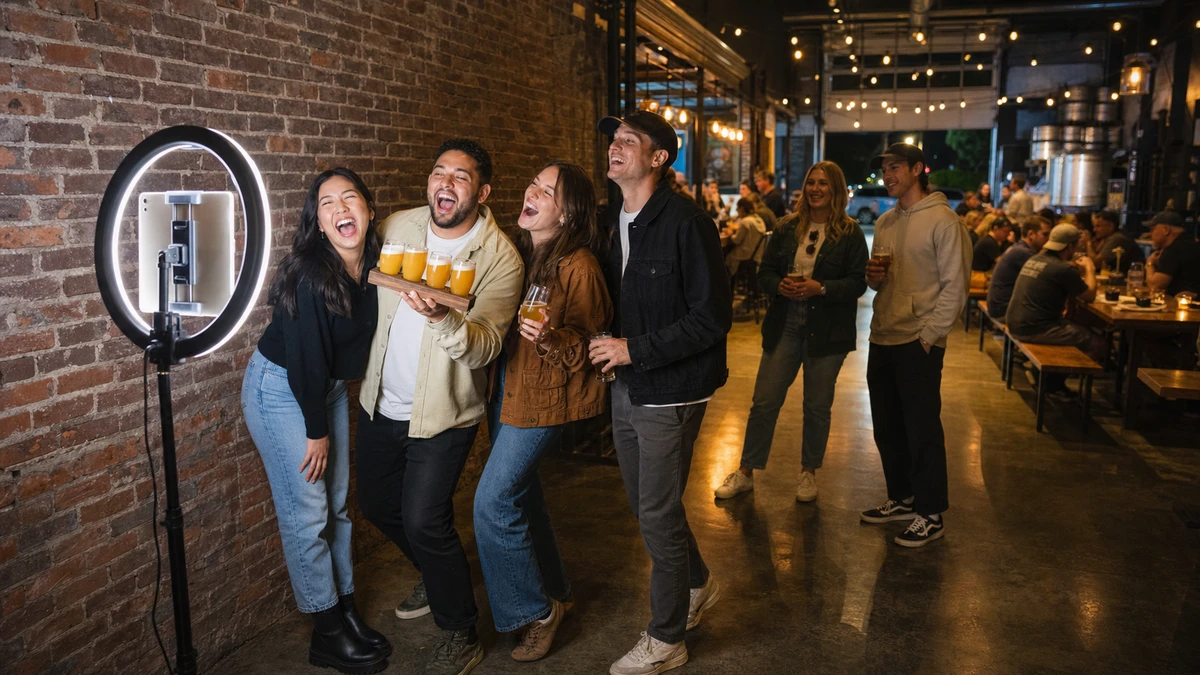
It’s 8:40 on a Saturday and the taproom is full. A group around the long communal table has just been handed a flight of the new hazy IPA, and two phones are already out. For about fifteen seconds, everyone at that table wants a photo of the beer and each other. Then the flight gets tasted, the conversation moves on, and the moment passes. Nobody tagged the brewery. Nobody’s email landed in a list. The night ends with a full till and an empty contact file.
The best photo booth for a brewery is the one that catches that fifteen-second moment and turns it into something the brewery keeps: an email address it owns and a branded photo that travels to a stranger’s feed. Most “best photo booth” advice written for taprooms misses this, because most of it is published by booth vendors who sell one model and want the taproom to take it.
A taproom shopping for a photo booth is really choosing between two products that happen to share a name. One earns the brewery a small monthly check. The other earns the brewery customers.
The Two Photo Booths a Brewery Can Actually Buy
The word “photo booth” hides two products with opposite business logic. Choosing well starts with knowing which one a vendor is actually offering.
The revenue-share placement booth
The first is the revenue-share placement booth. A company like Photomatica, Say Ya! Photobooth, or A&A Studios builds the booth, installs it in the taproom, and maintains it, all at no cost to the brewery. Guests pay to use it, commonly around $5 a session on a card swipe. The vendor collects the money, restocks supplies, services the hardware, and mails the venue a cut. Photomatica’s placement page describes a “no cost to you” arrangement with a representative visiting monthly to collect revenue and restock. Say Ya! markets the same idea to bars, with a $5 swipe and a quarterly check. The booth is, in plain terms, a vending machine. The vendor owns the hardware, the branding on the screen, the per-session revenue, and every email address and phone number a guest types in.
The brand-owned experiential booth
The second is the brand-owned experiential booth. The brewery buys or rents the booth, runs it free for guests, and brands every photo with its own logo and taproom name. When a guest finishes a session, the booth sends the photo to that guest by email or text, and in doing so records the contact and asks permission to use the image. The booth is not a vending machine. It is a marketing channel the brewery owns outright, sitting in the corner of the room collecting customer data every night it runs.
Cost, footprint, and feature lists only start to make sense once an operator knows which of these two jobs the booth is for. The vending booth is sold as found money. The owned booth is bought as a marketing asset. They are priced differently, placed differently, and judged on completely different outcomes. The search results for “best photo booth for breweries” lean heavily toward the first model, for a simple reason: the vendor profits every time a guest swipes a card, so the vendor has every incentive to recommend it.
What a Revenue-Share Placement Booth Really Pays a Taproom
The pitch for the placement booth is genuinely attractive on its face. The brewery spends nothing, lifts nothing, fixes nothing. A&A Studios frames its program as “passive income,” and the vendor handles permits, supplies, maintenance, and sales tax. For a taproom owner with no spare cash and no spare hours, a charming booth that someone else owns and a check that arrives by mail sounds like a clean win.
Placement Revenue Math
The honest question is how big that check is. A booth that guests must pay for gets used far less than a free one, so a realistic figure for a mid-size taproom is somewhere around 60 paid sessions in a busy month. At $5 a session, that booth generates $300. The venue’s share is a slice of that. One booth operator, asked in an r/photobooth thread (April 2025) what split bars typically get, said his company runs “a $1 flat profit share with the venue” and keeps the other four dollars.
That is one operator’s deal, not a published standard, but it lines up with how these programs are structured: the vendor carries the capital cost and the labor, so the vendor takes the large share. At a dollar a session, 60 sessions pay the taproom $60 for the month. A strong month at 120 sessions pays $120. Across a year, the placement booth is realistically worth a few hundred to perhaps a thousand dollars to the taproom.
That is the visible cost, a modest check. The invisible cost is the one that matters. In the placement model, every guest who types in an email address to receive a photo is handing that address to the booth vendor, not the brewery. The vendor builds a contact list of the brewery’s own customers, standing inside the brewery’s own taproom. The photos carry the vendor’s branding or a generic template. For a business whose single most valuable marketing asset is a list of people who have already chosen to walk in the door, trading that list away for $60 a month is the wrong trade.
None of this makes the placement booth worthless. It is a fine amenity. It gives guests something to do, photos to take home, and a bit of novelty in a slow corner, with zero capital outlay and zero staff burden. An operator who wants exactly that, and nothing more, can take the deal with open eyes. The mistake is calling it a marketing investment. It is not one. It is a vending machine that pays rent.
What a Brand-Owned Booth Is Worth: The Taproom Email-List Math
Set the placement booth’s monthly check next to what a brand-owned booth collects on the same nights, and the comparison stops being close.
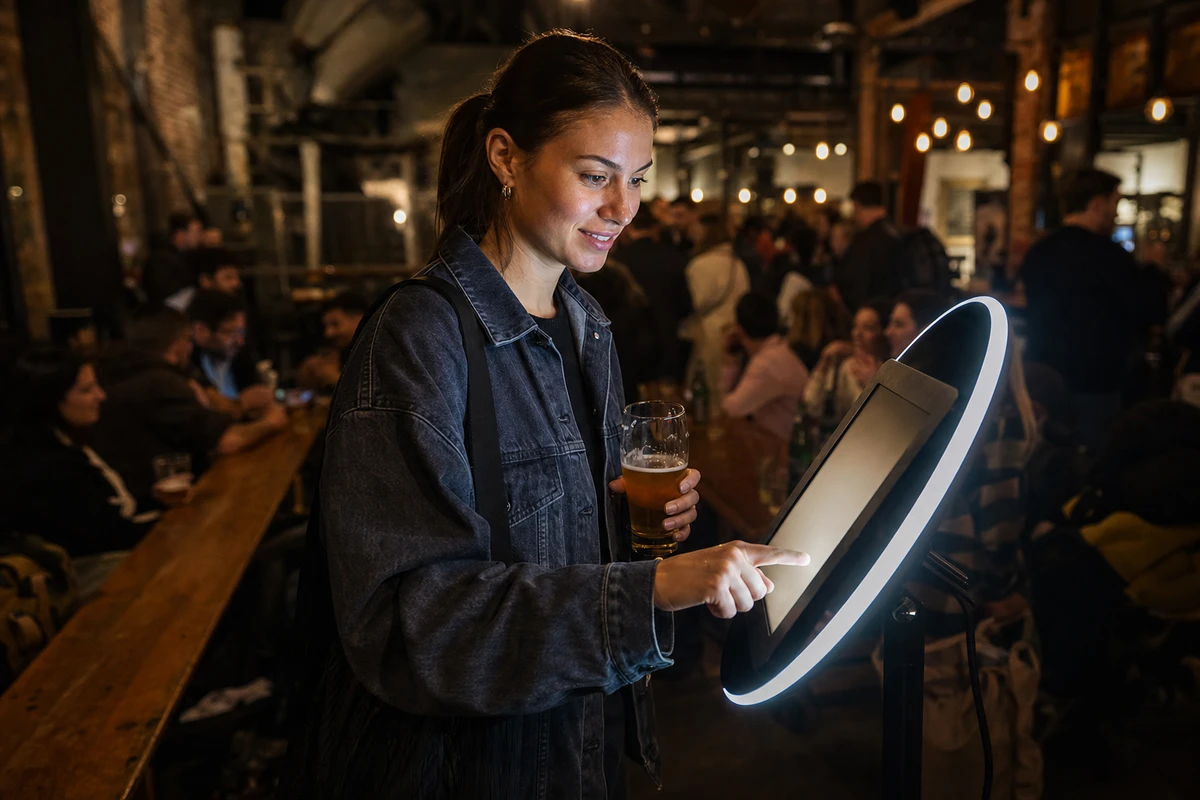
Start with a single busy night, a brewery’s anniversary party. Three hundred people move through the taproom across the evening. A free, well-placed booth might record 90 sessions, because a free booth gets used roughly the way a free booth should. Each session ends with the booth offering to send the photo by text or email. Suppose 40 of every 100 users enter a contact to get their copy. (That opt-in rate is the one number an operator should measure in their own room rather than assume, because it swings with booth placement, staff prompting, and how the offer is worded.) At that rate, one night produces about 36 new, permission-based contacts, plus 90 logo-branded photos, many of which guests post themselves.
Annual Contact Growth
Annualize it. A taproom running the booth across two strong weekend nights a week, plus the occasional event, can reasonably capture 60 to 100 contacts a month, on the order of 1,000 in a year. That is the asset: a list of 1,000 people who have already paid to be in the building once.
Here is the mechanism, because the number alone does not explain the value. Acquiring a customer the first time is expensive. It takes advertising, signage, a reason to visit, and luck. Reaching that same customer a second time, once their email or phone number sits in the brewery’s list, costs almost nothing. Email returns are high across industries, in large part because reaching an existing contact costs so little. In Litmus’s State of Email 2025 survey of around 500 marketers, most respondents reported between $10 and $50 in return for every $1 spent on email. The brewery has already paid to bring the guest in once. The captured contact lets it bring them back without paying again.
Put that to work on the channel a taproom struggles with most: the slow midweek night. Picture the brewery sending one email to its 1,000 captured guests announcing a Tuesday cask night. If 3 in 100 act on it, that is 30 guests through the door who would otherwise have stayed home. At a $22 average tab, the single email returns about $660, and it cost nothing to send. Run that twice a month and the booth’s captured list is worth roughly $15,000 a year in recovered midweek revenue. The inputs here are deliberately plain (a thousand contacts, a 3 percent response, a $22 tab) so the calculation stays honest and an operator can test each one against the taproom’s own books.
Fifteen thousand dollars of owned-audience revenue against a placement booth’s roughly $1,000 check is not a rounding difference. It is the difference between a booth that pays rent and a booth that builds a marketing channel. The branded photos are a second return stacked on top: every share is a geotagged image of the taproom on a feed full of people who resemble the guest who posted it.
Why Breweries Need an Owned Audience More Than Most Businesses
A coffee shop or a clothing store can lean on Instagram and paid social to pull people in. A brewery cannot lean on them the same way, and that is what makes an owned audience more valuable for a taproom than for almost any other brick-and-mortar business.
Start with advertising rules
Start with advertising rules. Beer is a regulated product. Beverage alcohol advertising falls under the federal Alcohol and Tobacco Tax and Trade Bureau, and the Brewers Association maintains its own marketing and advertising code, updated in January 2024, that member breweries follow. Social platforms add their own layer: alcohol brands face age-gating, targeting limits, and ad formats that are simply off the table. A brewery does not get to advertise as freely as the shop next door selling candles. An email or text list, by contrast, is a channel the brewery controls end to end, with no platform sitting between the brewery and a guest who already chose to be 21-and-up in its taproom.
Then there is the shape of taproom revenue. A taproom lives on foot traffic, and that traffic is lumpy: packed Friday and Saturday, soft Tuesday and Wednesday. The Brewers Association counted 9,796 craft breweries operating in the US in 2024, including 3,936 taprooms, and reported craft volume down 4 percent on the year even as dollar sales rose to $28.8 billion. The market is crowded and flat. In that environment, the breweries that fill seats on a quiet Tuesday are rarely the ones with the most followers. They are the ones that can contact past guests directly and give them a reason to come in tonight. A booth that captures contacts hands the brewery that lever.
Measurement is the third reason
Measurement is the third reason. A taproom can spend months posting to social media and never know whether a single post produced a single pour. There is no clean line from a like to a guest on a stool. A captured email list closes that loop: the brewery sends, counts who came, and learns what the channel is worth.
The branded photo is the fourth reason, and it works on the guests a brewery has not met yet. People research a place before they drink there. BrightLocal’s Local Consumer Review Survey 2026 found that 97 percent of consumers read online reviews for local businesses, that 85 percent are more likely to choose one after reading positive reviews, and that video and social platforms are an increasing part of how people discover local businesses. A brewery cannot buy that kind of credibility outright, but a booth that puts the brewery’s mark on every photo keeps its feed stocked with real customers in the real room, which is what a first-time visitor checks for before deciding to come in.
How to Judge a Photo Booth for a Taproom: The Criteria
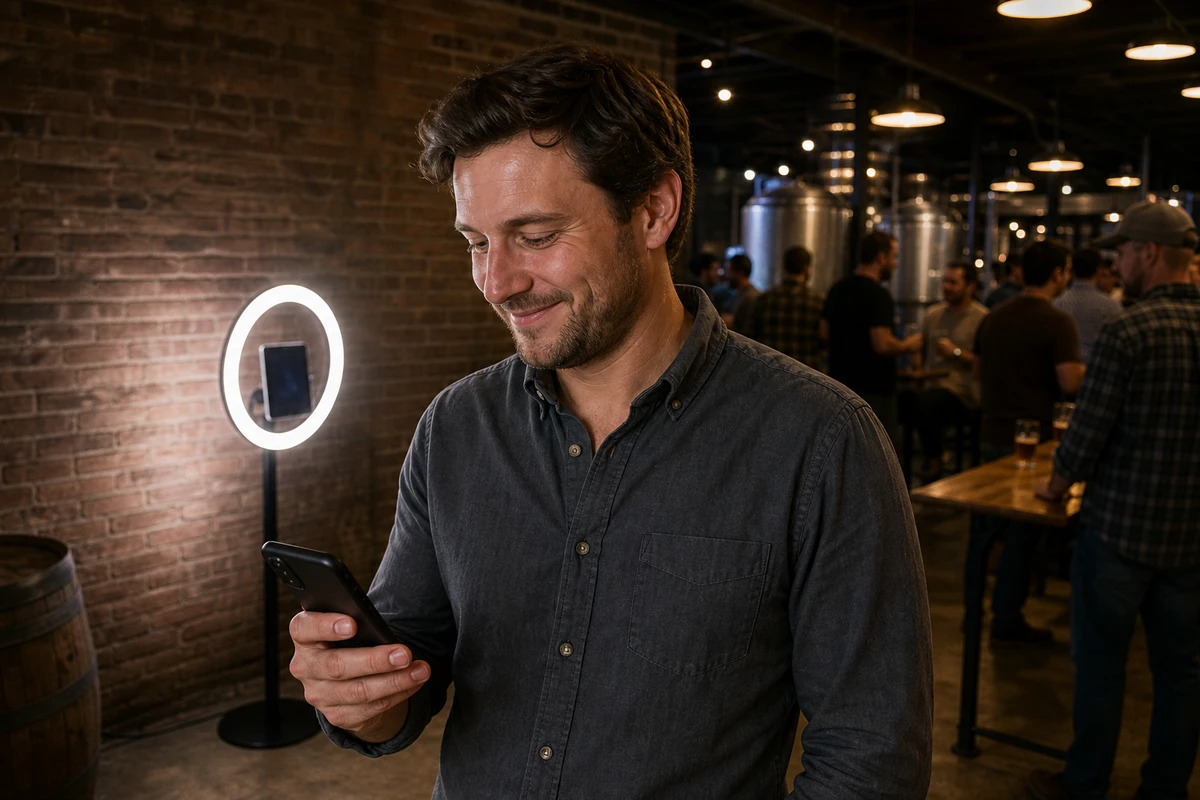
A booth that performs at a convention hall can still be wrong for a taproom. The room is different. The floors are concrete, the ceilings are open, the light is uneven, and the staff are pouring beer, not running equipment. The criteria below are the standard buyer’s checklist, sharpened for what a taproom actually puts a booth through.
Footprint
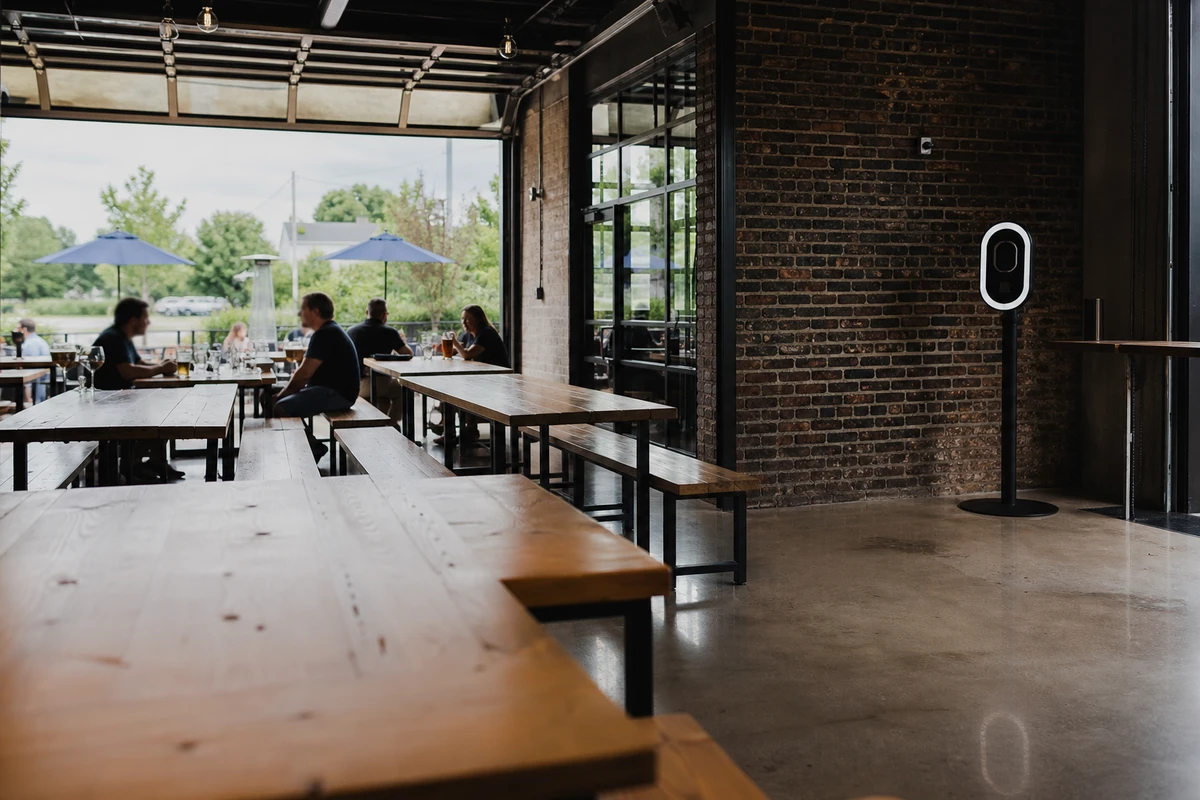
- Footprint. Taprooms run long communal tables and keep open floor space tight, because floor space that could hold a table is lost revenue. An enclosed vintage cabinet is a real commitment: A&A Studios lists its enclosed booths at five feet long and two and a half feet wide, and Say Ya!‘s compact bar model still occupies a 4.5-by-2.5-foot patch. A tablet or open-air station on a stand takes a fraction of that, which is why the corner should be measured honestly before a cabinet wins the argument.
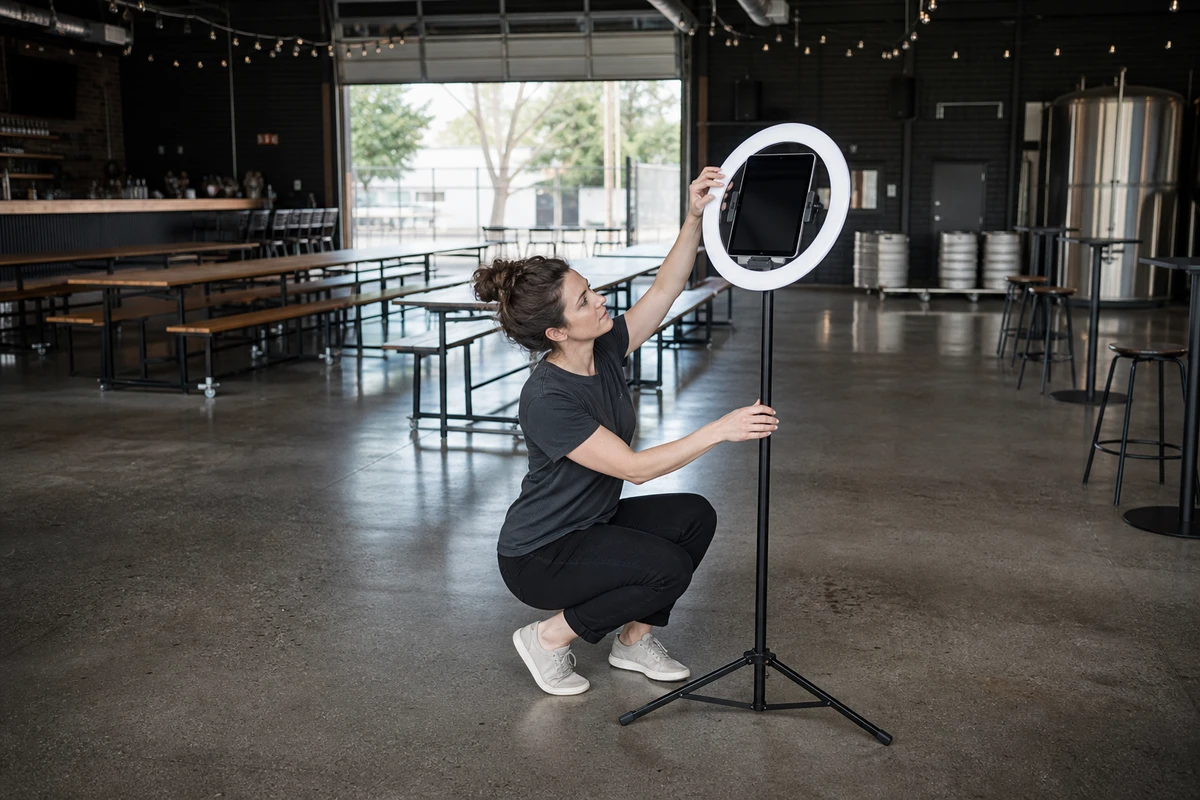
- Lighting. Taprooms are dim and industrial by design, with garage doors, edison bulbs, and mixed daylight that shifts all evening. A booth that relies on room light produces muddy photos after sunset. It needs its own consistent light source so a 9 p.m. photo looks as good as a 5 p.m. one. On many tablet booths that light source is built in as hardware rather than left to the room: Simple Booth’s HALO kit, for instance, pairs its iPad with a 2,100-lumen ring light, which is what keeps a late photo clean while the staff stay at the taps.
Unattended, self-serve operation
Unattended, self-serve operation. This is the criterion operators name first. A venue operator shopping in an r/photobooth thread (November 2025) put it plainly: the goal is “the most automated and hassle free system,” one that runs without an attendant. Taproom staff cannot babysit a booth on a busy night. It has to start, shoot, and deliver on its own.
Durability. Beer gets spilled, humidity is constant, and crowds are physical. A booth that lives in a taproom takes a harder beating than one wheeled out for a single event, and the hardware and its mount need to survive it.
Branding and overlays. Every photo the booth produces should carry the brewery’s logo, taproom name, and ideally a prompt to tag the venue. This is what converts a guest’s snapshot into a piece of advertising. A booth that cannot put the brewery’s mark on the image is leaving its main marketing job undone.
Data capture that routes to the brewery. The booth should deliver photos by email or text and record those contacts into a list the brewery controls and can export. This is the line between the two models above. If the contact data lands anywhere but the brewery’s own list, the booth is working for someone else.
Clean content in a mixed room. Taprooms are 21-and-up but often genuinely family-friendly, with kids and strollers on a Saturday afternoon. Props and on-screen prompts should suit that room, and the booth’s photos should be ones the brewery is happy to repost.
Connectivity. Taproom Wi-Fi is frequently weak, and a booth that drops photos when the signal dips frustrates guests and loses captures. A booth that queues deliveries and sends them once the connection returns protects every contact.
On form factor, three options cover the field. An enclosed or vintage cabinet delivers the most novelty and a strong physical presence, at the highest price and the largest footprint. An open-air kiosk on a stand is portable and flexible, and works well against a wall. A tablet or iPad-style station is the most compact and the lowest cost, and leans on software rather than spectacle. For most taprooms, the deciding factors are floor space and whether the booth needs to move for events, and together those usually point away from the permanent cabinet.
When a Taproom Photo Booth Earns Its Keep
A booth that sits in a corner on an ordinary Wednesday is a fixture. The same booth becomes a marketing engine on the nights a taproom already draws a crowd, because those nights produce the most shareable photos and the most captured contacts at once.
An anniversary party is the clearest case. The room is at capacity, guests are in a celebrating mood, and the booth can record dozens of branded photos across a single evening, each one leaving with a contact attached. Most of a taproom’s calendar offers a version of the same setup: seasonal releases and Oktoberfest pair a reason to visit with a reason to photograph it, can drops and collaboration launches pull in beer-tourist crowds who post and tag heavily, and tap takeovers, trivia, and live music give soft weeknights a crowd worth capturing. The common thread is simple. A moment that already gathers people, plus a booth that brands and delivers the photo, ends the night with new contacts and a feed full of geotagged images. An operator building the events calendar should treat the booth as a fixed part of every one, not a piece of equipment wheeled in occasionally.
Buy, Rent, or Place: Choosing a Model
Three procurement paths sit in front of a taproom, and they line up cleanly with three different intentions.
Renting suits a single large moment
Renting suits a single large moment. For a tenth-anniversary blowout or a major release party, a taproom can rent a booth for the event without committing capital. Day rentals are typically quoted in the hundreds to low thousands of dollars depending on configuration, and the brewery still owns the contacts and photos captured during that event. The limit is obvious: rent often enough and the recurring cost overtakes the price of owning.
Buying fits the taproom that wants the booth as a standing marketing channel. The capital outlay is real and varies widely by form factor. A tablet or iPad-style station runs roughly $1,000 to $5,000, an open-air kiosk fully equipped runs roughly $3,000 to $8,000, and a premium enclosed cabinet runs from around $15,000 upward, with A&A Studios listing its high-end vending-style cabinets from $40,000. Against those numbers, the email-list math earlier in this article is what justifies the spend: a booth that captures on the order of 1,000 contacts a year pays for an entry-level station quickly and a mid-range one within a season or two.
Revenue-share placement fits the taproom that wants a booth and explicitly does not want a marketing asset. Zero cost, zero effort, a modest check, and no data. It is the right answer for an operator who has weighed the trade and genuinely values the convenience over the contact list.
For most breweries, the decision is not close. A taproom’s hardest marketing problems (restricted advertising, unmeasurable social spend, and soft weeknights) are all problems an owned contact list solves and a vending machine does not. The best photo booth for a taproom is the one the brewery owns, runs free, brands with its own logo, and uses to capture guests it can reach again. The “free” booth is the expensive one.
Frequently Asked Questions
How much does a photo booth cost for a brewery? It depends on whether you rent or buy. Single-event rentals are typically quoted in the hundreds to low thousands of dollars per day depending on setup. To own one, a tablet or iPad-style station runs roughly $1,000 to $5,000, an open-air kiosk roughly $3,000 to $8,000, and a premium enclosed cabinet from around $15,000 up past $40,000.
Is the “free” revenue-share photo booth worth it for a taproom? It is worth it only as an amenity. The vendor owns and maintains the booth at no cost to you, but guests pay per use and you receive a small share, often around a dollar a session. More importantly, the vendor keeps the guest emails and photos. As novelty it works. As a marketing investment it does not.
Do I need a staff member to run a taproom photo booth? No, and you should not buy one that requires it. Modern booths are built for unattended, self-serve operation: the guest starts the session, the booth shoots and delivers the photo, and your staff keep pouring. Confirm self-serve operation before buying, since it is the feature taproom operators most often name as essential.
Will a photo booth fit in a small taproom? Usually, if you choose the form factor with care. An enclosed cabinet needs roughly a five-by-two-and-a-half-foot footprint, which is a real loss of seating. A tablet or open-air station on a stand takes a fraction of that space and can sit against a wall or in a corner. Measure before you commit.
Can guests get their photos without printing? Yes. Most current booths deliver photos digitally by text or email, and many breweries skip printing entirely. Digital delivery is also what lets the booth capture a guest contact, since the guest enters an email or phone number to receive the image. That capture is the point.
How does a photo booth help on slow weeknights? Indirectly but measurably. The booth captures guest contacts on your busy nights, building an email or text list you own. You then message that list directly to fill a quiet Tuesday with a cask night or a trivia event, instead of hoping a social post reaches anyone. It turns a busy Saturday into traffic on a slow Tuesday.
How do I keep photo booth content appropriate when kids are in the taproom? Choose a booth that lets you control props and on-screen prompts, and stock it with brewery-branded, family-safe options rather than generic party props. Many taprooms are 21-and-up but family-friendly during the day, so set the booth up for the room you actually run and review the photo template before launch.
Does a photo booth actually drive Instagram posts and new visitors? It drives posts when every photo carries your logo and taproom name and sharing takes one tap. Each share puts a geotagged image of your taproom in front of that guest’s friends, who tend to resemble your existing customers. No tool can guarantee new visitors, but a steady stream of real guest photos is among the most credible advertising a taproom can run. Sources
- Brewers Association (2024). “National Beer Sales & Production Data.” https://www.brewersassociation.org/statistics-and-data/national-beer-stats/
- Brewers Association (2024). “Brewers Association Marketing & Advertising Code.” https://www.brewersassociation.org/brewers-association-advertising-marketing-code/
- Alcohol and Tobacco Tax and Trade Bureau (n.d.). “Market Compliance Office: Advertising.” https://www.ttb.gov/business-central/advertising/market-compliance-office
- Litmus (2025). “Email Marketing ROI: State of Email 2025.” https://www.litmus.com/blog/email-marketing-roi/
- BrightLocal (2026). “Local Consumer Review Survey 2026.” https://www.brightlocal.com/research/local-consumer-review-survey/
- Photomatica (n.d.). “Permanent Photo Booth Installations” (vendor-published). https://www.photomatica.com/permanent-photo-booth
- Say Ya! Photobooth (n.d.). “Bar Booths” (vendor-published). https://www.sayyaphotobooth.com/barbooths
- A&A Studios (n.d.). “Photo Booth Vending” (vendor-published). https://www.aastudiosinc.com/photobooth-vending
- A&A Studios (n.d.). “Buy a Photo Booth” (vendor-published). https://www.aastudiosinc.com/buy-a-photobooth
- r/photobooth (2025). “Photobooth deals with taverns/bars/etc.” https://old.reddit.com/r/photobooth/comments/1jy2bq7/photobooth_deals_with_tavernsbarsetc/
- r/photobooth (2025). “Unattended photo booth for addon to venue.” https://old.reddit.com/r/photobooth/comments/1oztrjf/unattended_photo_booth_for_addon_to_venue/