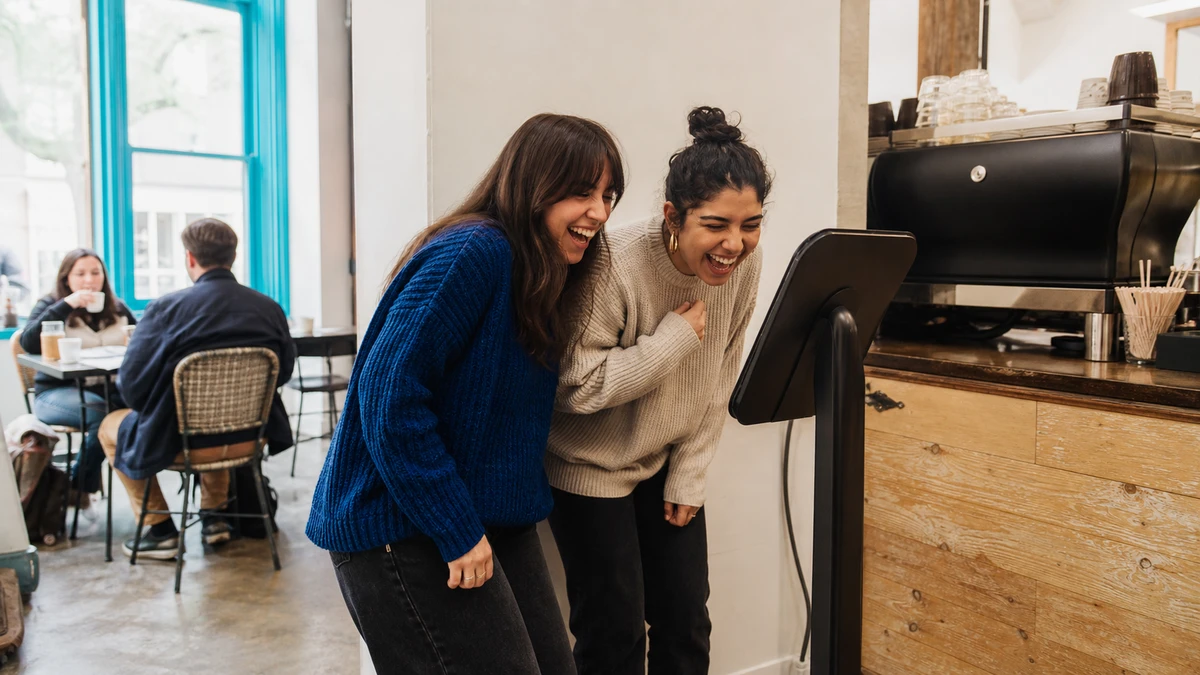
A customer stands third in the Saturday-morning line at a neighborhood cafe, latte ordered, phone already in hand, with nothing to do for the next ninety seconds. Two tables over, a pair of friends has finished their drinks and is in no hurry to leave. The wait at the counter and the lingering at the table happen in every coffee shop, every day, and they are the moments a photo booth is built to use.
The best photo booth for a coffee shop is not a brand or a model number. It is a format decision, and for a cafe that decision is driven almost entirely by footprint. A coffee shop is a small, permanent retail space, not an event venue, so the booth that wins fits a wall or a quiet corner, runs unattended through every open hour, and earns back its floor space by building an email list. What follows compares the four formats, sets out the buying checklist that matters for a small room, lays out real cost ranges, works through the payback math, and closes with an honest fit test. Some coffee shops should not buy a photo booth at all, and this guide will say which ones.
Why “Best” Means Something Different for a Coffee Shop
Most operators searching for the best photo booth picture the wrong object. The mental image is a curtained box with a coin slot, a green-screen backdrop, and a printer that spits out a strip of four small photos. That machine is real and still sold. Face Place, a long-running booth manufacturer, builds precisely that as its Scene Machine: a coin-operated, fully enclosed booth with a dye-sublimation printer (Face Place Photo). It is a capable piece of arcade equipment. It is also the wrong place for a cafe operator to start, because it collects coins and prints paper and captures nothing else. No email address, no phone number, no record of who walked up and used it.
The modern booth is a different product with a different job. It is a tablet running booth software, usually mounted in the open with no curtain, that takes a photo, an animated GIF, or a short video and sends it straight to the customer’s own phone by text, QR code, or email. It is self-serve, it carries the cafe’s branding on every frame it produces, and it asks for a contact detail as the natural price of delivering the image. Once those two objects are pulled apart, “best” stops being a yes-or-no question about novelty and becomes a buying question about format.
A coffee shop answers that question under three constraints an event venue never has to think about. The first is square footage. An independent cafe is a small room where seating is the scarce resource, and every square foot a fixture occupies is a square foot that is no longer a two-top. The second is margin. Coffee is a thin-margin business, so a permanent fixture has to pay its way, not merely decorate the room. The third is a traffic pattern with two modes: a counter line of people waiting to order, and seated guests lingering after they have been served. A booth built for a banquet hall or a trade-show stand can fail all three tests. The rest of this guide is a buying process built on them.
The Four Photo Booth Formats, Ranked for a Cafe
Four different things get sold under the words “photo booth,” and they are not interchangeable. Ranked against a coffee shop’s footprint, margin, and unstaffed-corner reality, they sort cleanly.
The wall-mounted or compact digital booth
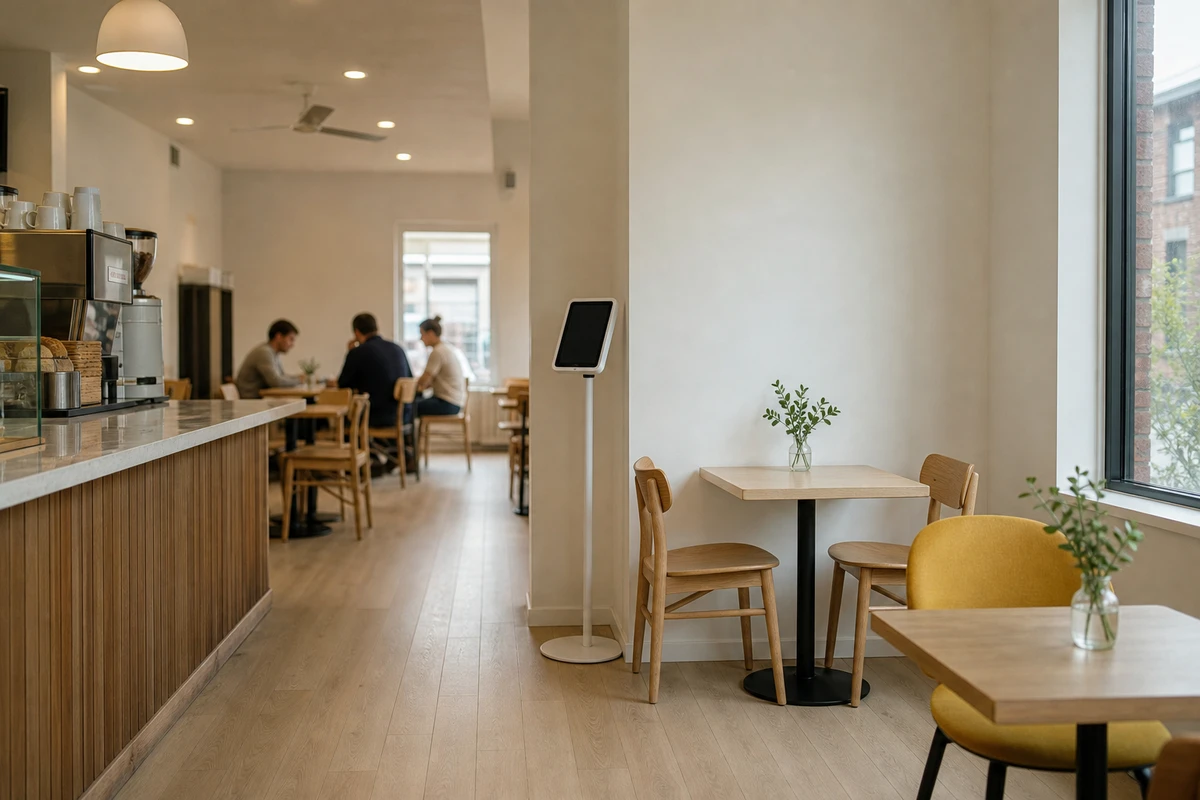
This is the modern booth in its smallest form: a tablet in a branded housing, fixed to a wall or sitting on a slim stand, occupying roughly the floor space of a coat rack. It runs unattended, applies the cafe’s overlay to every shot, and delivers images digitally. For the typical coffee shop this is the default choice, and the reason is footprint. It costs the room almost no seating, it survives in a corner with no staff assigned to it, and its all-day self-serve design matches how a cafe actually operates.
Compact tablet booths in this class are commonly sold to buy in the range of roughly $1,500 to $4,000 (Clear Choice Photo Booth, vendor-published). Simple Booth’s HALO kit is one booth built this way: an iPad in a branded housing that a customer operates alone, with an offline upload queue that holds any session captured while the cafe’s Wi-Fi is down and uploads the photo, along with the contact detail the customer entered, once the connection returns.
The freestanding floor booth
This is the open-air style: a camera and tablet on a stand with a backdrop, no enclosure, still self-serve. It has more physical presence than a wall unit, which can be a feature if the cafe wants the booth to read as a deliberate destination. The tradeoff is honest and unavoidable: it stands on the floor, so it costs real seating. Open-air booths of this kind are typically sold to buy from about $6,000 to $12,000 (Clear Choice Photo Booth, vendor-published). The freestanding booth is the upgrade for a roomier cafe, not the starting point for a small one.
The attended event booth
This is the booth built for staffed three-hour bookings: a roaming or full-service setup that an operator delivers, runs, and strikes. It is the wrong format for daily cafe use, and not by a small margin. It needs a person to run it and is not designed to sit in one place permanently. The only cafe scenario it fits is a one-off occasion, a grand opening or an anniversary night, where renting an attended booth for the event makes sense. Event rentals run roughly $300 to $1,200 for a single booking (Kruu and Clear Choice Photo Booth, both vendor-published). Buying one for everyday use means paying for a tool designed around a problem the cafe does not have.
The DIY selfie wall
The no-booth option is a mural, a neon sign, or a framed backdrop with the cafe’s name and a hashtag on it. Operator-education site Start My Coffee Shop suggests exactly this, a cardboard cutout frame or a colorful backdrop, as the low-budget alternative to a booth (Start My Coffee Shop). What it does is worth stating precisely. A selfie wall can generate social posts. It cannot capture a single email address or phone number, because there is no software in the loop and no delivery step where a contact detail is exchanged. That makes it a branding asset and not a marketing-list asset, which is a real distinction and the one the next sections build on.
For most coffee shops the order is clear. The wall-mounted digital booth is the default. The freestanding floor booth is the upgrade for a cafe with seating to spare. The attended event booth belongs at events and nowhere else. The selfie wall is the right answer only when the budget is genuinely minimal or the operator does not care about owning customer data, and that second condition deserves a hard look before it is accepted.
The Cafe Buyer’s Checklist: Features That Actually Matter
A cafe cannot evaluate a booth the way an event company does. An event operator has staff on site, a three-hour window, and a client who already wants the booth there. A coffee shop has none of that. The checklist below is short, and every item earns its place by tying to something specific about running a booth in a small, busy, lightly staffed room.
It has to run unattended
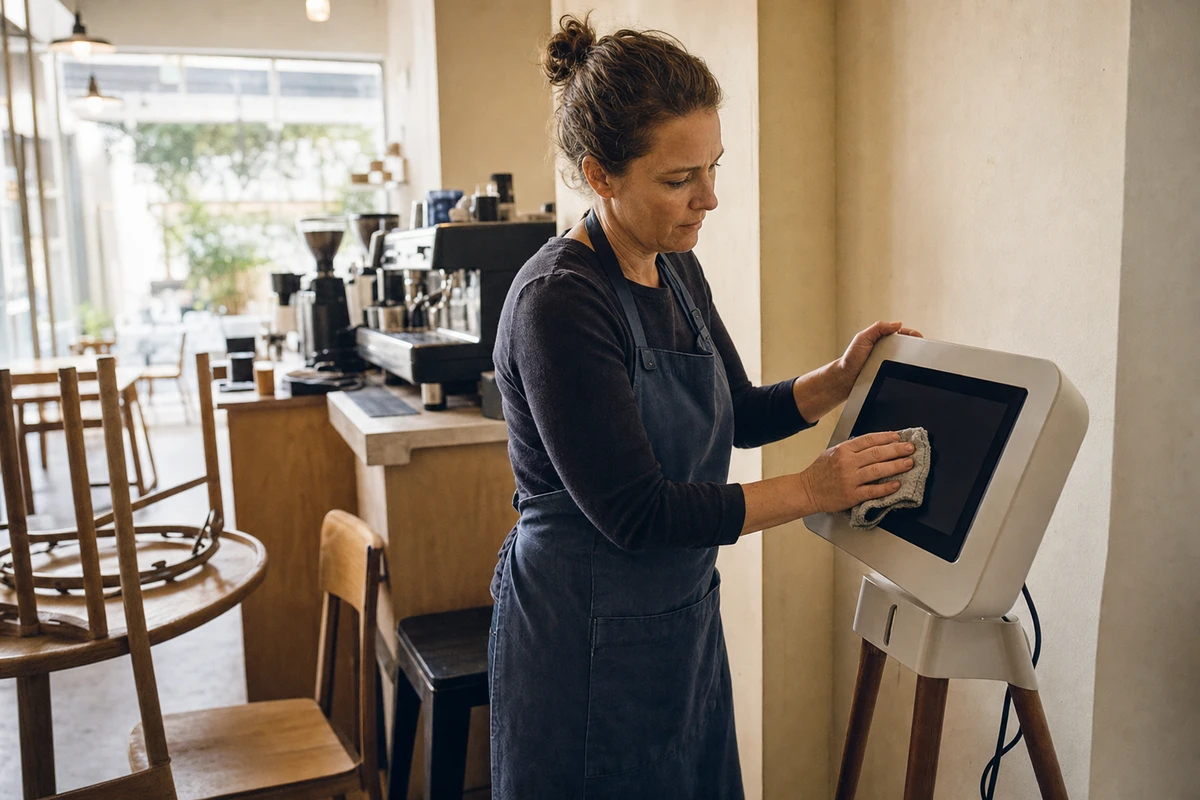
A cafe has no spare person to operate a booth. When a customer walks up alone, the booth must work on its own, recover from a mishandled session, and never pull a barista off the espresso machine. Self-serve reliability is the first filter, and a booth that needs hand-holding fails it.
It has to fit a wall or a corner
The footprint constraint becomes a hard buying criterion here. The sensible order of operations is to measure the available wall or corner first, then shop only for booths that fit it. A booth that would force out a table has to clear a higher bar than one that mounts above head height.
Every photo has to carry the brand
A branded overlay or template means each image leaves the cafe as a small, repeated impression of the logo rather than an anonymous selfie. This is the difference between a customer’s photo and the cafe’s photo.
Delivery has to be digital
Sending the image by text, QR code, or email removes prints, paper, ink, and printer jams from the daily routine. It also creates the moment where a contact detail is exchanged, which is the point the rest of this guide turns on.
It has to capture a contact with a clear
The booth should collect an email address or phone number as the natural cost of receiving the photo, with a genuine opt-in rather than a buried default. A booth that delivers a photo but captures nothing is doing half the job.
It should offer more than one output
Photos, GIFs, animated rebounds, and short videos give a regular a reason to use the booth more than once. A cafe lives on repeat customers, so a one-trick booth that a regular tries once and then ignores wastes its corner.
It has to survive an unstaffed corner
A tablet sitting in a public space with no attendant needs secure, anti-theft mounting. That is partly a loss-prevention point and partly a safety one, and it leads straight into where the booth should go.
Placement: Earning the Square Footage
The most common objection an operator raises is that an idle booth eats floor space that could seat paying customers (Start My Coffee Shop). Placement is the answer to that objection, and it follows directly from the cafe’s two-mode traffic pattern.
Put the booth where the waiting happens
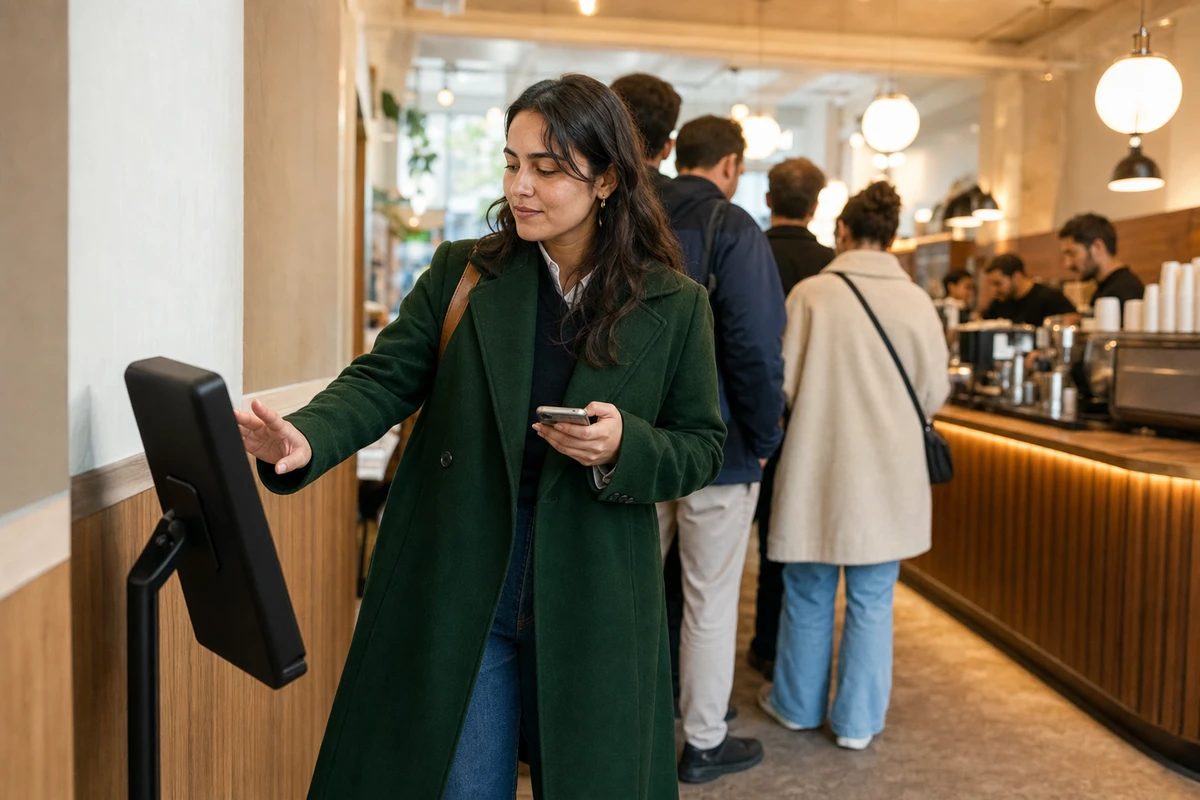
Put the booth where the waiting happens. The counter line is full of customers with ninety idle seconds and a phone already in hand, so a booth within reach of the line, positioned so it does not block the line, converts dead waiting time into branded content. The same booth should sit in sight of the seating area, because lingering guests at tables are the second group with time to use it. A spot that serves both the line and the room is doing double duty on the same square footage.
Keep it out of the doorway and out of the main traffic flow. A booth in a congested path is a booth people squeeze past instead of stopping at, and it becomes the trip hazard operators rightly worry about. Light matters too: a booth in a dim back corner produces poor photos and gets little use, so it belongs near a window or under even, deliberate lighting.
The safety questions have short, practical answers. Secure mounting handles theft and keeps a tablet from being knocked loose. A clear floor zone around the booth handles foot traffic and the worry about unsupervised children near equipment. The same operator-education source notes that liability coverage for a public-facing fixture exists and that low-cost options are available; a brief conversation with the cafe’s existing insurer usually settles it. None of this needs to dominate the decision.
That leaves the deeper version of the objection. A booth is only “idle” if it produces nothing while no one is using it. A booth quietly building an email list every hour it stands there is not idle floor space. It is working. What that work is worth is a math question, and the next section does the arithmetic.
What a Coffee Shop Photo Booth Costs (and How It Pays Back)
The cost figures circulating online were almost all written for event operators, and they need re-reading before they mean anything to a cafe. A cafe is not buying a booth to rent it out for profit; it is installing a permanent fixture in its own room. Three numbers matter.
Hardware
The first is hardware. A compact tablet booth, the format most coffee shops should buy, runs roughly $1,500 to $4,000 to own, and a larger open-air booth roughly $6,000 to $12,000. The second is software. Booth software is a subscription, commonly $30 to $100 per month (Kruu, vendor-published), and it is what turns a tablet into a booth that brands images and captures contacts. The third is the rent-to-test option. An operator unsure whether the cafe’s customers will use a booth can rent one for a single event for roughly $300 to $1,200 and watch what happens before committing to a purchase. That is the concrete answer to the “passing fad” fear: not a reassurance, but a low-cost test that produces real evidence from the cafe’s own customers.
Now the payback
Now the payback. Take a neighborhood cafe that installs a compact wall-mounted booth and sees 100 customers use it in a month. Not every user will hand over a contact detail, so assume a conservative 40% opt-in: 40 new email addresses a month, 480 over a year. Suppose each of those subscribers, over the year, comes back one extra time they would not otherwise have made, prompted by a cafe email, and spends $8 on that visit. That is 480 extra visits at $8, or $3,840 in incremental revenue from a single year’s list.
Set that against the cost
Set that against the cost. The booth’s software at $50 a month is $600 a year. A $2,000 compact booth spread over three years is about $667 a year. Annual cost lands near $1,267, and the first year’s list alone returns roughly three times that. The three inputs that move the result are the monthly user count, the opt-in rate, and the return-visit value; a busier cafe, a higher ticket, or a stronger opt-in rate pushes the figure up, and a slow corner pushes it down. Even cut in half, the scenario clears its cost.
Two things make this conservative rather than optimistic. The list does not reset each year; year two starts with year one’s subscribers still on it and adds another cohort on top. And the calculation counts only one extra visit per subscriber, when the actual purpose of an owned list is to prompt many. The point of the arithmetic is not the exact figure. It is the category: a photo booth that captures contacts is a customer-acquisition fixture with a measurable payback period, not an entertainment expense.
The Real Job: Turning One-Time Visits Into an Email List
A “join our newsletter” card by the register rarely earns a signup. The customer has no reason to care, and the card asks for something while offering nothing in the same moment. A photo booth inverts that exchange. A customer who has just taken a fun photo with a friend genuinely wants the file, and the booth delivers it to a phone by asking for an email address or phone number first. The customer gives the contact detail willingly, because the photo is a fair return for it. The data capture feels like a service, not a toll. That is the whole mechanism, and it works because the contact information is traded for something the customer wanted anyway, which is both the legal footing and the reason the resulting list actually responds to messages.
Coffee Shops Are Habit Businesses
This matters more for a coffee shop than for most businesses, and the reason is in how cafes make money. A coffee shop is a habit business. Its economics live in frequency, not transaction size: the same customer, returning often, at a small ticket each time. National Coffee Association data from spring 2025 shows how routine the behavior is, with 66% of American adults drinking coffee every day and daily drinkers averaging three cups (National Coffee Association, 2025). A cafe does not need to win a customer once; it needs that customer to choose it again on Tuesday, and Thursday, and the Tuesday after. An owned email or text list is the lowest-cost tool for exactly that. It lets the cafe send a single message to a lapsed regular, at almost no marginal cost, and pull them back through the door.
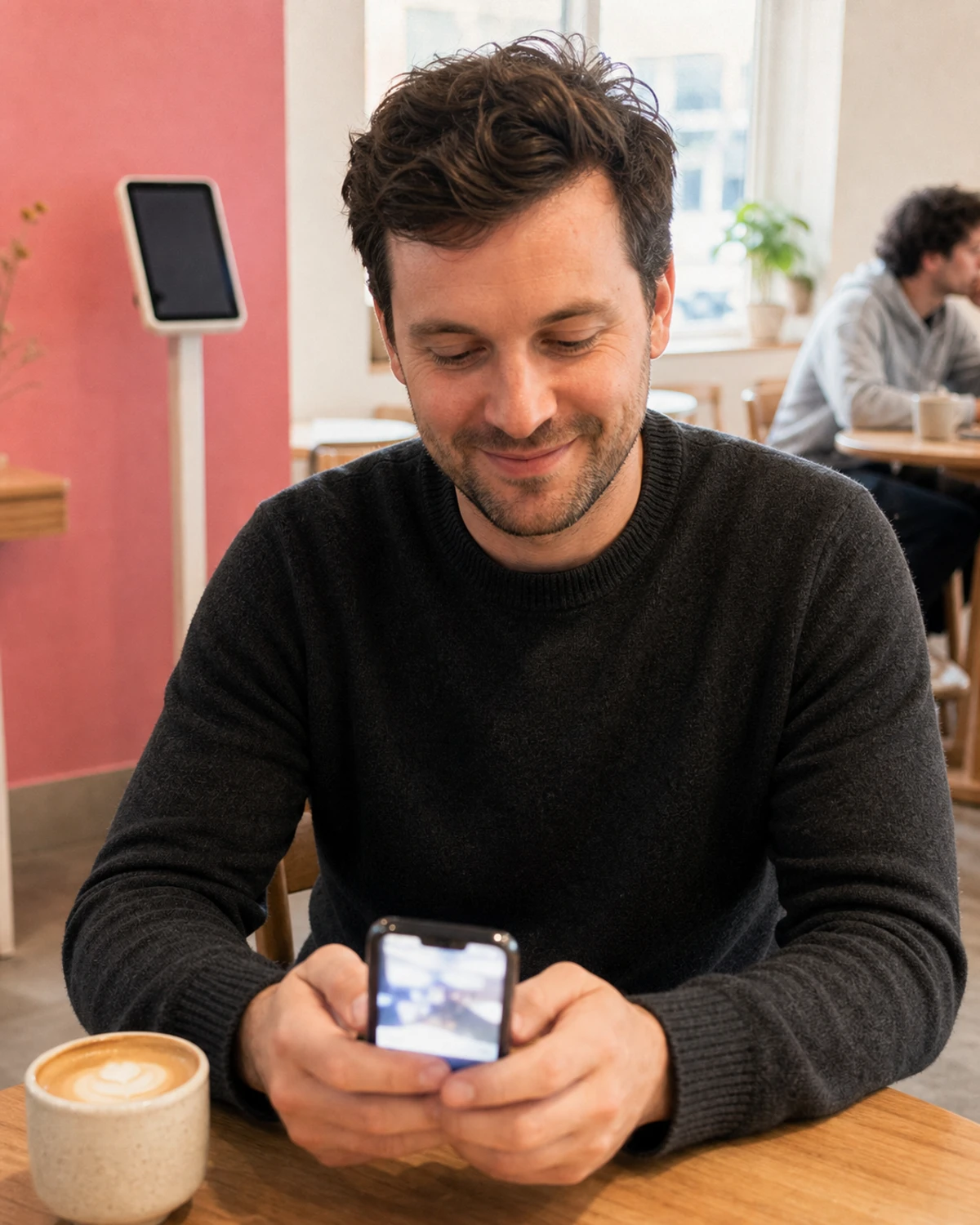
The word “owned” is doing real work in that sentence. Specialty coffee operators already understand designed-in shareability: Fresh Cup Magazine has reported on cafes such as Toronto’s FieldHouse Jones, whose murals get “Instagrammed five, six, seven times a day,” and Los Angeles roaster Dayglow Coffee, which found one in three customers discovered the brand through Instagram (Fresh Cup Magazine, 2022). That reach is real, and it is also rented. It depends on a platform deciding who sees a post. An email list does not. The cafe holds it, controls it, and reaches it directly, and the economics of doing so are strong: in Litmus’s State of Email 2025 survey, most companies reported between $10 and $50 in return for every dollar spent on email (Litmus, 2025). A mural builds reach the cafe rents. A booth builds a list the cafe owns.
The last advantage is quiet but compounding. A booth on the wall adds names every day it runs, with no added labor and no campaign to manage. A mural is finished the day it is painted. The list is never finished. It is larger this month than last, and the payback math from the previous section improves every week the booth keeps working.
Is Your Coffee Shop Actually a Fit?
The honest part of a buyer’s guide is the part that tells some readers to walk away. A photo booth is not right for every cafe, and four checks sort the strong fits from the weak ones.
Location and clientele
The first is location and clientele. Start My Coffee Shop puts this plainly: a booth tends to land well in cafes set in residential neighborhoods or near a university or high school, and to fall flat in commuter corridors and office parks, where customers grab a cup and leave without slowing down (Start My Coffee Shop). The test is dwell time. A cafe whose customers sit, talk, meet friends, and linger has the raw material a booth needs. A grab-and-go counter serving a 7:45 a.m. rush of commuters does not, and no booth will manufacture the dwell time the location does not produce. Destination and specialty cafes, where the visit is itself the occasion, are the strongest fits of all.
Brand readiness
The second is brand readiness. Every image the booth produces carries the cafe’s visual identity out into the world. A cafe with a sharp, defined look gets a real branded impression from each photo. A cafe with a vague or unfinished identity gets a vague impression multiplied. An operator in that position should fix the brand first and buy the booth second.
Traffic volume
The third is traffic volume. A booth needs a baseline of customers with time on their hands to be worth its corner. There is no single magic number, so the question is better asked directly: does the cafe have enough lingering guests and enough line-wait moments in a normal week to keep a booth in steady use? An operator who already knows the room is quiet most of the day has answered it.
Operational honesty
The fourth is operational honesty. Even an unattended booth is not a zero-attention object. Someone has to glance at it daily, wipe the screen, confirm it is online, and reset it if a session has hung. That is a small task, but a chronically short-staffed cafe where no one has thirty spare seconds should count the cost honestly before buying.
A cafe that passes these checks should move to the buyer’s checklist and choose a format. A cafe that fails most of them has two reasonable options: install the selfie wall and accept it as a branding piece with no data capture, or wait until traffic, staffing, or brand are in better shape. Buying the right booth for the wrong cafe still produces an idle booth.
The decision comes down to four moves in order. Pick the format that fits the footprint, which for most coffee shops means the wall-mounted digital booth. Hold it to the buyer’s checklist, especially unattended reliability and contact capture. Place it where the waiting happens, near the line and in view of the tables. Then judge it by the list it builds, not the novelty it adds. A photo booth treated as decoration becomes the idle fixture operators fear. A photo booth treated as a customer-acquisition tool, capturing contacts and feeding a list the cafe owns, is the version that earns back its square footage, and it is the only version worth buying.
Frequently Asked Questions
How much space does a photo booth take up in a coffee shop?
It depends entirely on the format. A wall-mounted or compact tablet booth takes up roughly the footprint of a coat rack and can be fixed above the floor, so it costs you almost no seating. A freestanding open-air booth stands on the floor with a backdrop and will cost you a table’s worth of space or more. Measure your available wall or corner before you shop, then look only at booths that fit it.
Do I need a photo booth, or is an Instagrammable wall enough?
Both produce social posts. Only the booth produces a contact list. A mural or branded backdrop generates photos that customers may share, but it captures no email addresses or phone numbers, because there is no software and no delivery step. A digital booth delivers the photo to the customer’s phone and collects a contact detail in the process. If you want owned, first-party customer data you can market to later, you need the booth. If you only want a photogenic backdrop, the wall is enough.
How much does a photo booth for a coffee shop cost?
A compact tablet booth to own typically runs about $1,500 to $4,000, and a larger open-air booth roughly $6,000 to $12,000, according to vendor-published price ranges. Booth software is a separate subscription, commonly $30 to $100 per month. If you want to test demand before buying, you can rent a booth for a single event for around $300 to $1,200 and see whether your customers actually use it.
Does a photo booth need staff or an attendant to run it?
A modern digital booth does not. It is self-serve by design: a customer walks up, takes a photo, and receives it on their phone with no one from the cafe involved. Attended event booths do need an operator, which is one of the main reasons that format is wrong for daily coffee shop use. For a cafe, choose a booth built to run unattended.
Will a photo booth actually bring in customers, or is it just a fad?
It works when it is treated as a data-capture and repeat-visit tool, and it fails when it is treated as decoration. A booth that collects an email or phone number as it delivers photos builds an owned list you can use to bring lapsed regulars back, which is a measurable return. A booth bought purely for novelty, with no contact capture and no follow-up, will sit idle and feel like a fad. The deciding factor is whether your cafe fits the use case: dwell-time clientele, enough traffic, and a defined brand.
Sources
- National Coffee Association (2025). “More Americans Drink Coffee Each Day Than Any Other Beverage; Bottled Water Back in Second Place.” https://www.ncausa.org/Newsroom/More-Americans-Drink-Coffee-Each-Day-Than-Any-Other-Beverage-Bottled-Water-Back-in-Second-Place
- Fresh Cup Magazine (2022). “How to Make an Instagrammable Café.” https://freshcup.com/how-to-make-an-instagrammable-cafe/
- Start My Coffee Shop (2023). “Photo Booths in Your Coffee Shop: Pros and Cons.” https://startmycoffeeshop.com/photo-booths-in-your-coffee-shop-pros-and-cons/
- Litmus (2025). “Email Marketing ROI: What It Is and How to Measure It.” https://www.litmus.com/blog/email-marketing-roi/
- Kruu (vendor-published). “Renting vs. Buying a Photo Booth.” https://kruu.com/us/blog/renting-vs-buying-a-photo-booth/
- Clear Choice Photo Booth (vendor-published). “Rent vs. Buy a Photo Booth: Cost Breakdown.” https://clearchoicephotobooth.com/blog/rent-vs-buy-photo-booth-cost/
- Face Place Photo (vendor-published). “Face Place Scene Machine.” https://faceplacephoto.com/face-place-scene-machine/