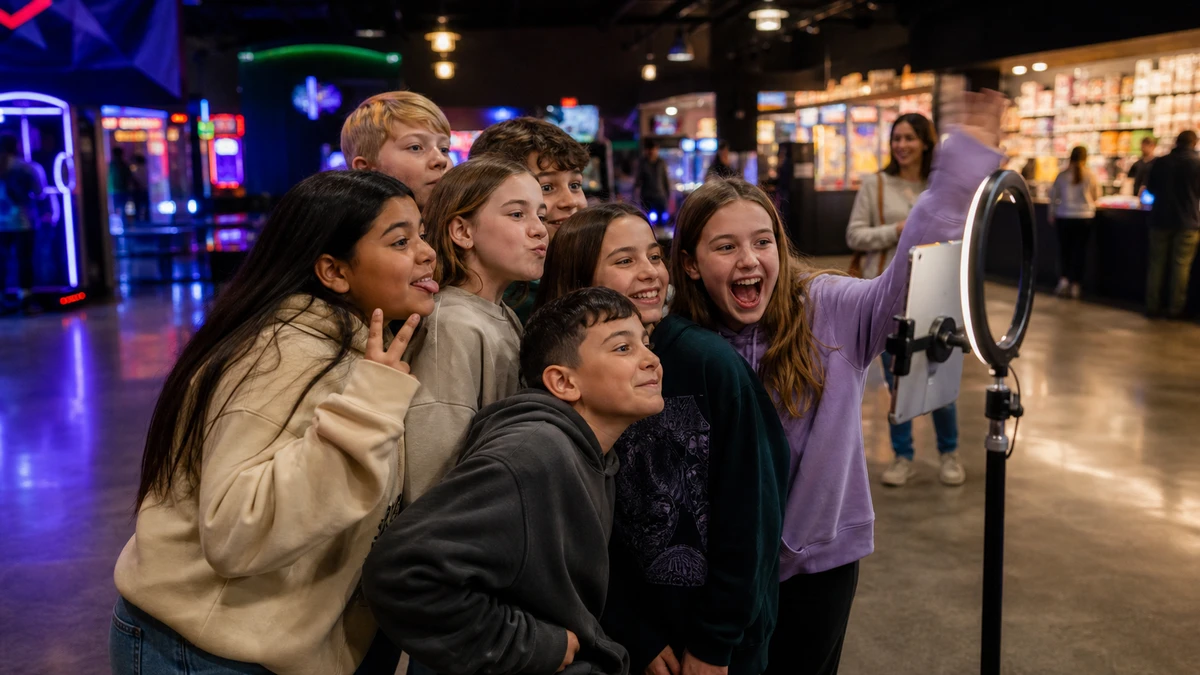
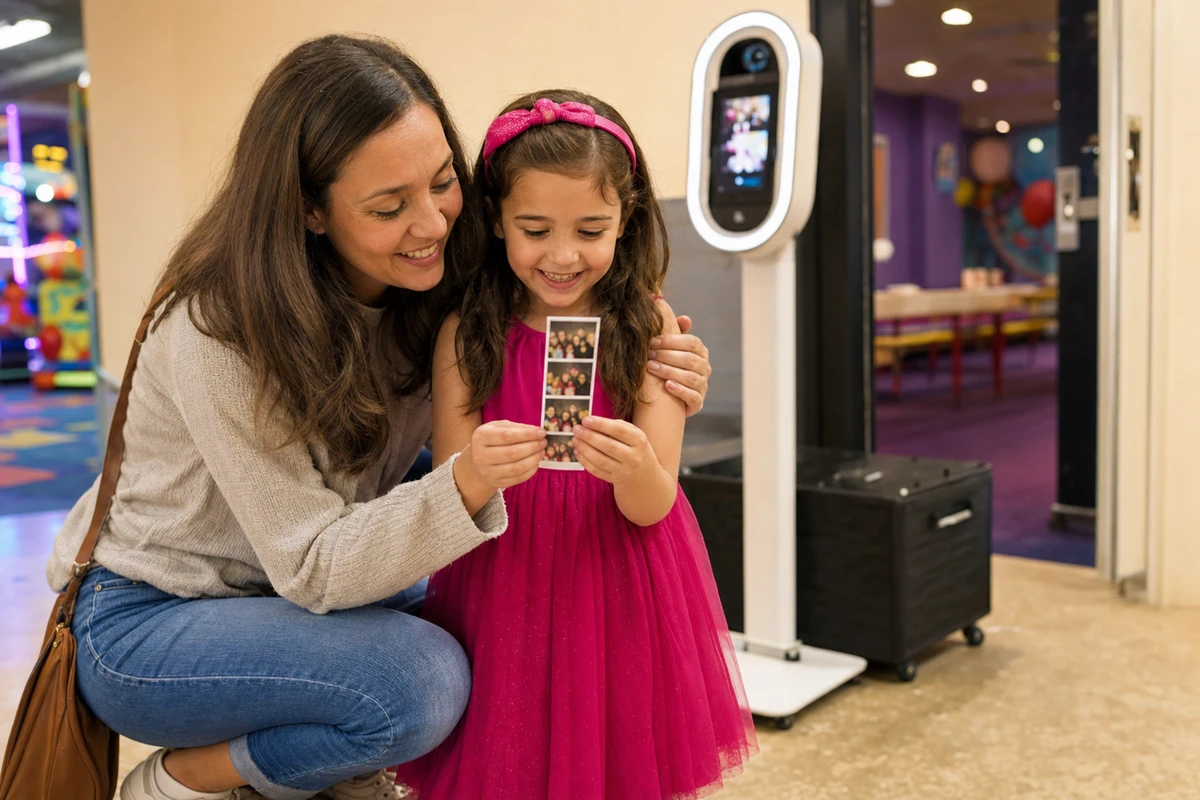
On a Saturday afternoon at a busy family entertainment center, a birthday group of nine-year-olds piles into the photo booth between laser tag and the redemption counter. They mug for the camera, grab the strip, and run back to the party room. While they go, one of the parents taps a phone number into the screen so the pictures arrive as a text. That small moment, a parent voluntarily handing over a contact to get a photo, is the most valuable thing the booth did all afternoon, and it has nothing to do with the coins in the slot.
The best photo booth for entertainment centers is not the one with the highest per-play coin yield. It is the one that captures the most guest contacts and produces the most shareable, venue-branded photos. A family entertainment center is a repeat-visit business, and the booth is the only attraction on the floor where guests willingly give up an email address or phone number. This guide covers what “best” should mean for an operator, an honest comparison of the booth form factors, the real economics behind the coin slot, and the operational traps that competing guides skip.
What “best” actually means for an entertainment center
An operator deciding where to put a photo booth usually compares it the way they compare any other machine on the floor. A claw machine earns this much per week and takes up this much space; does the photo booth beat it? That is the wrong scorecard, because it measures the booth against the one job it does worst.
A family entertainment center (FEC) does not live on
A family entertainment center (FEC) does not live on first-time walk-ins. It lives on guests who come back, on loyalty and membership programs, and on birthday-party and group bookings. The category is large and growing: Market.us (2025) estimated the global FEC market at USD 29.4 billion in 2024 and projects it to reach USD 87.3 billion by 2034, an 11.5% compound annual growth rate. Entry fees and ticket sales account for about 40.7% of FEC revenue, which leaves the majority in food, games, parties, and memberships. That spending scales with how often guests come back, not with how many first-time visitors walk through the door once.
Repeat visits are where the booth matters. Most FEC guests are first-time or infrequent visitors who come a handful of times a year at most. According to ROLLER’s 2026 Attractions Industry Benchmark Report, members at venues with active loyalty programs visit close to four times as often as non-members. The gap between a guest who comes once and a guest who joins a program is the difference between a single ticket and a year of tickets. Anything that helps move guests from the first group to the second is worth more than its floor revenue suggests.
So the booth has two jobs, not one. Job one is the obvious one: earn per-play revenue, the same way a redemption game does. Job two is quieter: capture marketing assets, meaning guest contacts and branded photos that travel. Most operators price only job one. They look at the coin box, compare it to the claw machine, and stop. The rest of this guide scores the booth on both jobs, because that is the only way the buying decision lines up with how an FEC actually makes money.
The coin-op attraction model vs. the marketing-engine model
Walk a regional amusement trade show and two machines get called “photo booth,” and they are barely the same product. One is an enclosed cabinet with a coin mechanism, a curtain, and a printer that spits out a strip. The other is an open stand with an iPad, a ring light, and no coin slot at all. Choosing between them is the real decision behind “which photo booth,” and it helps to name what each one actually is.
The coin-op vending booth is the machine the FEC
The coin-op vending booth is the machine the FEC equipment market is built around. Vendors such as Digital Centre and Foto Master sell enclosed or semi-enclosed cabinets that take payment per play and hand back a printed strip. The strength is direct and immediate: a guest pays, the coin box fills, and the guest leaves with a physical keepsake. The weakness is that the transaction ends there. The booth rarely captures a contact, the printed strip carries no data back to the operator, and the guest’s email address never reaches the venue’s marketing list. The booth earns its play fee and tells the operator nothing about who paid it.
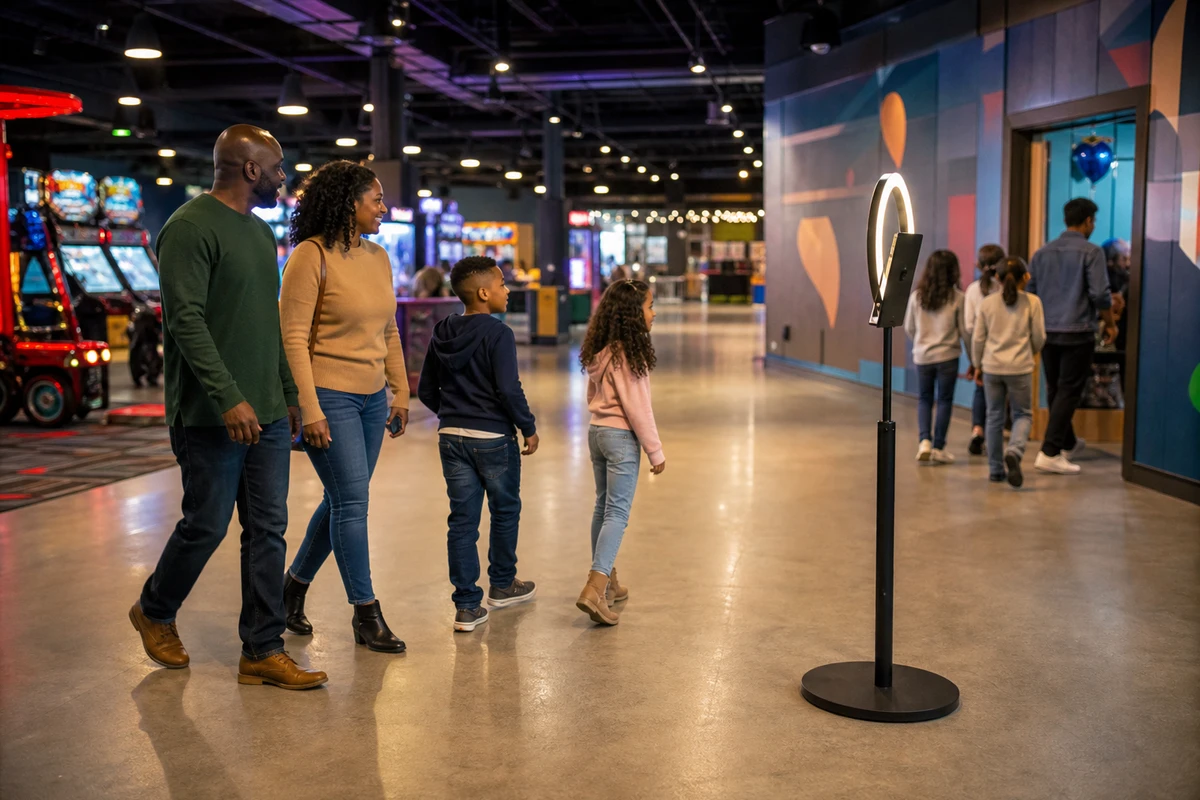
The marketing-engine booth is the open-air iPad station. It is often free to use or bundled into a birthday-party package rather than coin-operated. To deliver the photo, it asks the guest for an email address or phone number, which means every session creates a contact record. Every image it produces can carry the venue’s logo, a themed overlay, and a hashtag, so the photo markets the venue wherever the guest shares it. The weakness is the mirror image of the coin-op booth’s strength: little or no direct coin revenue. Its value shows up later and off to the side, in repeat visits and reach, which is exactly why operators who score only the coin box undervalue it.
Neither model is better in the abstract. They do different jobs. An arcade-forward FEC that wants a machine to pull its weight as a floor earner has a real case for a coin-op booth. A birthday-party-forward venue that wants a list of local parents has a real case for the open-air booth. Some operators run both: a coin-op booth out on the arcade floor as an earner, and a branded open-air booth in the party rooms as a capture point. The decision logic matters more than the verdict, and that logic is the two-job scorecard from the previous section.
How a photo booth pays for itself beyond the coin slot
An operator who has only ever counted the coin box has a fair question: if the marketing booth barely earns coins, how does it pay for itself? The answer is arithmetic, and it is worth walking through with real numbers.
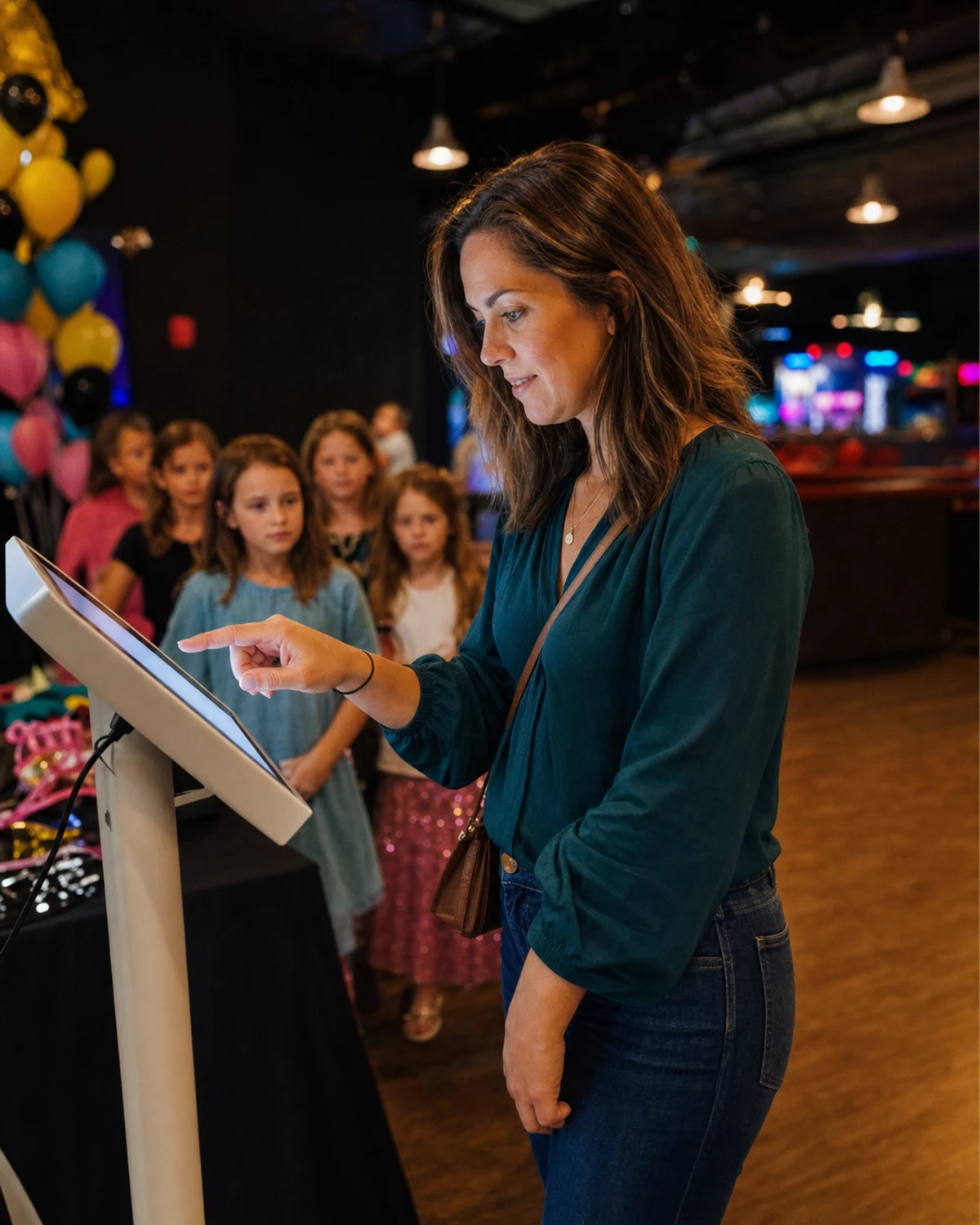
Take a mid-sized family entertainment center that sees about 400 guests across a busy weekend. Suppose 30% of them stop at the booth (120 sessions), and 60% of those guests enter an email address or phone number to receive their photo. That is 72 new contacts in two days, and across a year of weekends, roughly 3,700 names.
Set that against the coin revenue
Set that against the coin revenue. Party Center Software, citing Turfway Entertainment Management Group, puts average arcade-game revenue at $200 to $485 per game per week, with a well-run room reaching as high as $1,000. That benchmark is from 2014 and should be read as dated, but it remains the most-cited floor-economics figure operators have. A coin-op photo booth sitting in that merchandiser category earns somewhere in the band, call it $300 a week, or about $15,600 a year in gross coin revenue before media and maintenance.
Now value the contacts
Now value the contacts. If the venue’s email and SMS marketing brings even 6% of those 3,700 contacts back for a visit they would not otherwise have made, that is roughly 220 additional visits. FEC walk-in spend runs about $15 to $30 per guest before party packages, and a returning guest almost never arrives alone, they bring a family group. Counting only the contact-holder’s own spend lands near $3,300 to $6,600; counting the family group that comes with them, which is the realistic case, puts the figure at two to four times that.
The exact total is not the point, because it depends entirely on a venue’s own opt-in rate, conversion rate, and spend. The shape is the point. Coin revenue from the booth is a flat line: roughly the same $15,000 every year, and it resets to zero each January. The contact list is an asset that compounds. Year one closes with 3,700 names. By year three the venue is marketing to more than 11,000 past guests, and the coin booth still earns its flat $15,000. (These figures are illustrative, meant to be re-run against a venue’s own floor traffic, not quoted as a benchmark.)
Contacts are the first mechanism
Contacts are the first mechanism. The second is reach. When a booth puts the venue’s logo and hashtag on every photo, and the guest texts that photo to friends or posts it, the venue’s brand travels on the guest’s own social feed at no media cost. John Wikstrom, founder of the content company Magic Memories, framed the underlying behavior in ROLLER’s FEC attractions guide: “The ‘I was here, with these people I love’ has never been so in vogue thanks to our ever-present, always connected mobile phones.” A print-only booth leaves that reach on the table. The strip goes into a backpack, and it is seen by the guest’s household and no one else.
The third mechanism is the birthday party
The third mechanism is the birthday party. Every FEC party is booked by a parent, and that parent is a high-intent local lead: someone within driving distance, with children the right age, who has already paid the venue once. The booth is where that parent’s contact and a branded keepsake get created at the same moment. ROLLER’s 2026 benchmark found that venues running party programs see guests return 41% of the time, against 26% at venues without parties. A booth that captures every party parent’s contact, and sends each one home with a branded photo of their child’s celebration, feeds directly into that return rate.
The selection criteria that actually matter for an FEC
A rental booth gets wheeled in, set up for a four-hour party, and broken down the same night. An FEC booth stands in one spot, used by unsupervised children every open hour, for years. That difference changes which features matter, and the buying decision comes down to a handful of them, not the same handful a rental operator would weigh.
Contact capture
- Contact capture. Does the booth collect an email address or phone number, and is the opt-in simple enough that a nine-year-old or a distracted parent finishes it? This is job two of the scorecard. A booth that captures nothing is a coin box with a camera.
- Branding control. Can every photo, GIF, and shareable link carry the venue’s logo, a themed overlay, and a hashtag? Unbranded photos still entertain the guest, but they do no marketing work once they leave the building.
- Instant digital sharing. The marketing payload is the photo arriving on a phone, ready to text or post. Print-only booths skip this step and forfeit the free reach.
- Durability and kid-proofing. This is an unsupervised public install handled by children all day. Tempered screens, secured hardware, and no fragile or swallowable props are not optional.
- Unattended operation. The booth has to run every open hour with no staff member babysitting it. That means a locked-down kiosk mode so a curious child cannot exit the app and land on the iPad home screen.
- Throughput. A birthday rush sends ten kids at the booth at once. A booth that takes too long per session builds a line, and a line kills use. Fast capture beats elaborate capture on an FEC floor.
- Footprint and placement. Party Center Software’s benchmark allows roughly 75 square feet per arcade game. A booth has to earn its share of that floor without blocking sightlines or guest flow.
- Payment flexibility. An operator monetizing per play wants card and contactless payment, not just coins, because families rarely carry quarters. An operator using the booth as a free marketing draw wants no payment friction at all.
- Content variety. GIFs, boomerangs, and animated overlays travel further than a static photo, especially with the teen segment, who share novelty rather than a posed picture.
No single booth maxes out every line. The exercise is to weight the list against the venue’s model. A birthday-party-forward FEC puts contact capture and branding at the top. An arcade-forward operator may rank payment flexibility and coin throughput first.
Form factors compared for entertainment-center floors
An operator walking a vendor showroom will see several machines that all answer to “photo booth.” Here is each category measured against an FEC floor, not a four-hour corporate party or a one-night rental gig.
The enclosed coin-op vending booth is the classic arcade
The enclosed coin-op vending booth is the classic arcade cabinet: a curtain, a bench, a coin mechanism, a printer. It does one job well, standing on an arcade floor and earning per-play revenue with a physical strip as the prize. Its weaknesses are the ones already named, weak or absent contact capture and a printer that becomes an operational liability. Best fit: an arcade-forward FEC that wants the booth to behave like a redemption game.
The open-air iPad booth is a camera and screen on an open stand, usually with a ring light, no curtain, and no coin slot. It is the capture-and-branding workhorse. Because it asks for an email or phone number to send the photo, it does job two by default, and because the photo is digital, branding and sharing come built in. It is the strongest fit for the marketing job and the natural choice for party rooms. Simple Booth’s HALO kit is one open-air iPad booth built around that capture job: the entertainment chain Treetop Golf used HALO’s lead capture to build a list of 150,000 unique guest email addresses across its locations. Its weakness is that it generates little direct coin revenue, so an operator who needs the booth to earn its own floor space in cash will not love it.
The mirror booth is a full-length reflective panel that displays animations and prompts on its surface. It has a high visual draw and performs well with teens, who like the spectacle. It leans toward staffed operation, though, because the interaction is less obvious than tapping a screen, which makes it a weaker fit for an all-day unattended FEC install.
The 360 booth puts guests on a small platform while a camera arm spins around them, producing a short video clip. It is a genuine teen and social magnet. The constraint is throughput: a single session, including loading the group, shooting, and generating the clip, runs three to five minutes, and with groups of four to six during a birthday rush that builds 15-to-20-minute waits. The 360 booth works best as a premium party-package feature or a seasonal attraction, not an all-day fixture on a high-traffic floor.
The DSLR booth uses a dedicated camera for higher image quality. That quality comes with complexity: more hardware to fail, more maintenance, and more that an unattended kiosk cannot self-correct. For an FEC install that has to run itself, the image-quality gain rarely justifies the operational cost.
The right pick tracks the venue’s sub-type. An arcade-forward FEC focused on per-play floor earners has the clearest case for a coin-op booth, possibly paired with a branded open-air booth near the party rooms. A birthday-party-forward FEC should lead with the open-air iPad booth, where every party parent becomes a contact. The more specialized venues follow the same logic: a trampoline park, full of action and milestone moments, draws strong content from a 360 booth in a dedicated zone, while a bowling alley running corporate lane buyouts or an escape room with a triumphant exit shot both do well with a branded open-air booth that turns the moment into something guests share.
Operational realities operators underestimate
The booth is chosen, installed, and running. The costs and failure points that show up over the next year are the ones vendor profit guides leave out, and they decide whether it keeps earning.
Start with the margin claim
Start with the margin claim. Equipment vendors advertise attractive economics: AMA Amusement, a coin-op photo booth equipment vendor, has marketed gross margins above 85% and a payback period of two to three months. Those are vendor marketing figures, and they should be read as a sales pitch, not a benchmark. The instinct is to assume print consumables are what erode that margin. They are not. DNP dye-sublimation media, the standard for commercial booths, runs about $0.15 per 4x6 print, or roughly $0.07 to $0.08 per 2x6 strip in two-up printing mode (Buffalo Imaging; FotoClub Inc). At a $1-to-$3 play price, the media is the smallest line in the math.
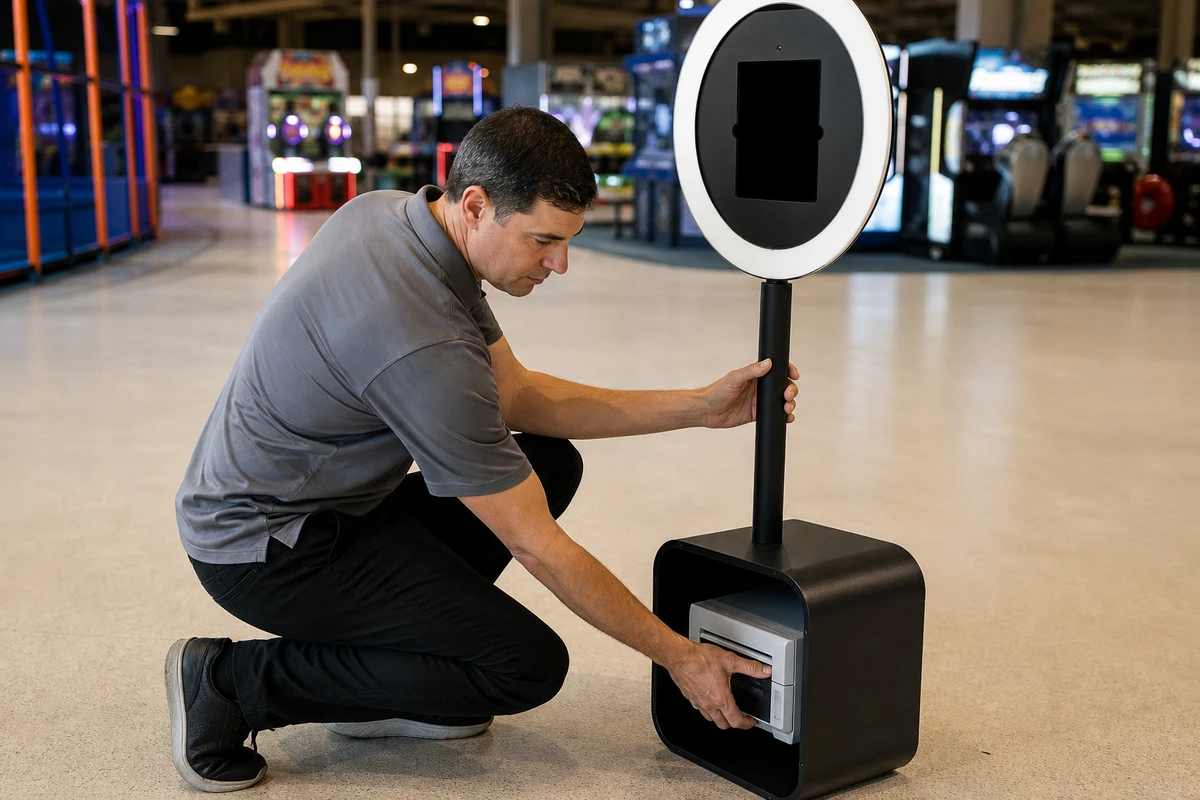
What actually erodes the margin is the printer itself. ROLLER’s FEC attractions guide lists “regular maintenance of photo printing equipment” as a standing operational consideration for photo pods, and that is the real cost: a jammed or failed printer means a dead booth, lost plays, a service call, and parts. The 85% figure quietly assumes the printer never breaks.
An unattended booth is a target. On coin-op machines, the cash box is the obvious one, and FEC operators on the International Arcade Museum forums trade stories about break-in attempts. On iPad booths, the tablet itself is the theft risk. Either way, the booth needs a locked, secured, anti-tamper mount, not a tablet resting in a stand a teenager could pocket.
Light and placement decide photo quality
Light and placement decide photo quality. A booth shot next to a bank of arcade screens or under a window picks up glare and color cast, and the photos look worse for it. The booth wants even, controlled light and a position away from direct window glare and the wash of nearby game screens.
A public self-service booth in the United States has to meet ADA accessibility standards. Per the Federal Register’s 2022 accessibility guidelines, as summarized by Kiosk Marketplace, interactive controls must sit between 15 and 48 inches above the floor, the booth needs a clear floor space of at least 30 by 48 inches for a wheelchair approach, and controls must work with one hand at no more than 5 pounds of force. This is a planning requirement, not legal advice, and an operator should confirm specifics with a local ADA coordinator before the install is fixed in place.
Two last ones
Two last ones. An iPad booth runs on software that needs updates, and someone has to own that, because an app left to drift will eventually break mid-shift. And the venue’s Wi-Fi will, at some point, drop. A booth that depends entirely on a live connection to function will fail a birthday party at the worst possible moment, so offline resilience, meaning the booth keeps capturing and queues the deliveries until the connection returns, is worth confirming before purchase.
Making the budget and buy-vs-rent call
The last decision is whether to buy a booth as a fixed installation or rent one for individual parties. For an FEC, the math usually favors buying. Renting makes sense for a venue that wants a booth only for occasional events, but an FEC has the booth in use every open hour, and per-event rental fees add up fast against a one-time purchase.
Cost bands vary by form factor. A coin-op vending cabinet is a substantial capital item, in the range of a mid-tier arcade game, which Party Center Software benchmarks at $10,000 to $12,000 for an average unit. An open-air iPad booth is generally lighter on capital, since much of the cost is a tablet and a stand rather than an enclosed cabinet and a coin mechanism. Operators who do not want the capital hit can finance the purchase the way they finance other floor equipment, spreading the cost against the revenue and the marketing value the booth generates.
Whichever way the buy-vs-rent call lands, the booth should be judged against the scorecard from the start of this guide. A booth evaluated only on coin revenue will always look like a marginal redemption game. A booth evaluated on both jobs, coin revenue and the marketing capture that compounds behind it, is one of the few machines on an FEC floor that keeps paying after the guest has left the building.
Frequently Asked Questions
How much does a photo booth for an entertainment center cost?
Cost depends on form factor. An enclosed coin-op vending cabinet is a capital item comparable to a mid-tier arcade game, which Party Center Software benchmarks at roughly $10,000 to $12,000. An open-air iPad booth is generally lighter, since most of the cost is a tablet and stand rather than a cabinet and coin mechanism. Financing is common for either.
Should the photo booth be coin-operated or free to use?
It depends on which job the operator wants. A coin-op booth earns per-play revenue and behaves like a redemption game. A free or package-bundled booth earns nothing at the slot but captures guest contacts and branded photos that drive repeat visits. Arcade-forward venues lean coin-op; birthday-party-forward venues lean free. Some run both.
How much can a photo booth earn per month in an FEC?
Equipment vendors advertise figures like 85% margins and fast payback, but those are marketing claims. Independent benchmarks (Party Center Software, 2014) put arcade-game revenue at $200 to $485 per unit per week, so a coin-op booth might gross $800 to $2,000 monthly. The larger value, harder to see, is the marketing pipeline from captured contacts.
Does a photo booth need a staff member to run it?
Most FEC booths are designed to run unattended every open hour. The requirement is a locked-down kiosk mode so a curious child cannot exit the app. Mirror and DSLR booths lean toward staffed operation, because the interaction is less self-explanatory or the hardware needs supervision. Open-air iPad booths are the easiest to run unattended.
Where should the photo booth go on the FEC floor?
Place the booth on a high-traffic sightline where guests pass it often, ideally near the party rooms or the redemption counter, where birthday groups and waiting families congregate. Keep it away from direct window glare and the wash of nearby arcade screens, which degrade photo quality, and leave clear floor space for accessibility.
Will kids damage the booth?
An FEC booth is handled by unsupervised children all day, so durability is a real specification. Look for tempered screens, securely mounted and anti-tamper hardware, and no fragile or swallowable props. A booth built for rental events, set up and broken down by an attendant, is often not built for that constant unsupervised use.
Should the booth print photos or deliver them digitally?
Prints give the guest an immediate keepsake but leave no data trail: the strip goes home and the venue learns nothing. Digital delivery requires the guest to enter an email or phone number, which captures a contact and lets the branded photo travel online. Most FECs are better served digital-first, with prints as an optional add-on.
How does a photo booth help birthday-party bookings?
Every FEC party is booked by a parent who lives nearby and has children the right age, a high-intent local lead. The booth captures that parent’s email or phone when they collect the party photos, and sends them home with a branded keepsake of their child’s celebration. ROLLER’s 2026 benchmark links party programs to noticeably higher guest return rates.
Sources
- Market.us (2025). “Global Family Entertainment Centers Market Size, Share, Growth Analysis — By Activity Type, Revenue Source, Ownership, Region, 2025–2034.” https://market.us/report/family-entertainment-centers-market/
- Party Center Software (2014). “Average Arcade Revenue and Budget” (data provided by Turfway Entertainment Management Group). https://www.partycentersoftware.com/blog/average-arcade-revenue-budget
- ROLLER Software (2025). “2026 Attractions Industry Benchmark Report.” https://www.roller.software/2026-benchmark-report
- ROLLER Software (2026). “11 FEC Attractions to Bring in More Visitors.” https://www.roller.software/blog/family-entertainment-center-attractions
- AMA Amusement (2025). “Photo Booth Business Profit Guide” (vendor marketing material). https://amaarcade.com/info-detail/how-much-income-can-you-make-from-a-photobooth-per-month
- Buffalo Imaging. “DNP DS620A 4×6 Media Kit — 800 Prints.” https://www.buffalous.com/product/dnp-ds6204x6-media-kit-ds620a/
- FotoClub Inc. “DNP DS620A 4×6 Print Kit — 800 Prints.” https://www.fotoclubinc.com/products/dnp-ds620a-4x6-print-kit-800-prints__ds6204x6.aspx
- Kiosk Marketplace (2025). “Navigating ADA requirements for self-service kiosks.” https://kioskmarketplace.com/articles/navigating-ada-requirements-for-self-service-kiosks/
- Federal Register (2022). “Americans with Disabilities Act Accessibility Guidelines for Buildings and Facilities — Architectural.” https://www.federalregister.gov/documents/2022/09/21/2022-20470/americans-with-disabilities-act-accessibility-guidelines-for-buildings-and-facilities-architectural
- International Arcade Museum Forums. “Photo booth takes picture of thief during break-in.” https://forums.arcade-museum.com/threads/photo-booth-takes-picture-of-thief-during-break-in.368433/