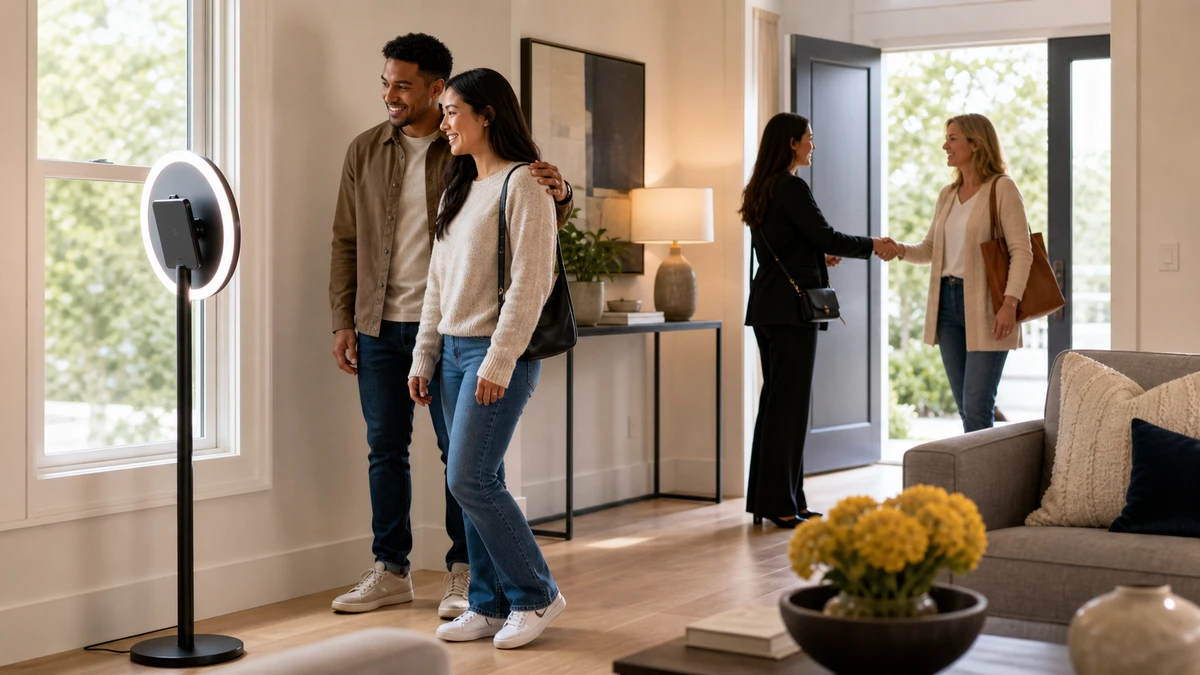
A Saturday open house draws a steady trickle of visitors. Couples drift from the kitchen to the back bedroom, a neighbor or two come to see what the house down the block might be worth, and the listing agent stands near the front door making conversation. On the kitchen island sits a clipboard with a paper sign-in sheet. By four o’clock it holds fourteen names. Maybe nine of them lead anywhere.
That gap, between the people who walked through the house and the contacts an agent can actually call on Monday, is the problem a photo booth is bought to solve. The best photo booth for a real estate agent or brokerage is not the one with the most props or the flashiest spin. It is the one that captures a name, a deliverable email, and a phone number before the guest receives their photo, then moves that contact straight into a CRM. The backdrop, the print layout, the slow-motion video, all of it is secondary to that single job.
Three buyers keep circling the same question: the solo agent deciding whether a booth is worth the bother, the team lead equipping several agents at once, and the brokerage owner weighing hardware as shared infrastructure. The decision splits four ways for all of them: which form factor suits a real estate setting, whether to rent or own, how the booth hands a lead to follow-up, and whether the numbers justify the spend. Judge a booth the way a sign-in process is judged, as a lead-capture instrument, and every other choice gets easier.
Why a photo booth out-captures the open-house sign-in sheet
A paper sign-in sheet asks the visitor to hand over something valuable, real contact details, and gives nothing back. The visitor knows precisely what a working email address buys: follow-up calls and a slow drip of listing emails. So the careful visitor pushes back. Some walk past the clipboard. Others write a name and a number that ring nowhere. Tom Ferry’s coaching team describes the sign-in sheet as a net, and warns that a weak net “lets too many slip away and fills up with fake names and phone numbers” (Tom Ferry, 2025). Real estate software vendors and practitioners consistently estimate that paper sheets lose somewhere between 30 and 40 percent of usable contacts to illegible handwriting, skipped fields, and deliberate fakes, though no independent industry survey has put a hard figure on it.
Contact capture
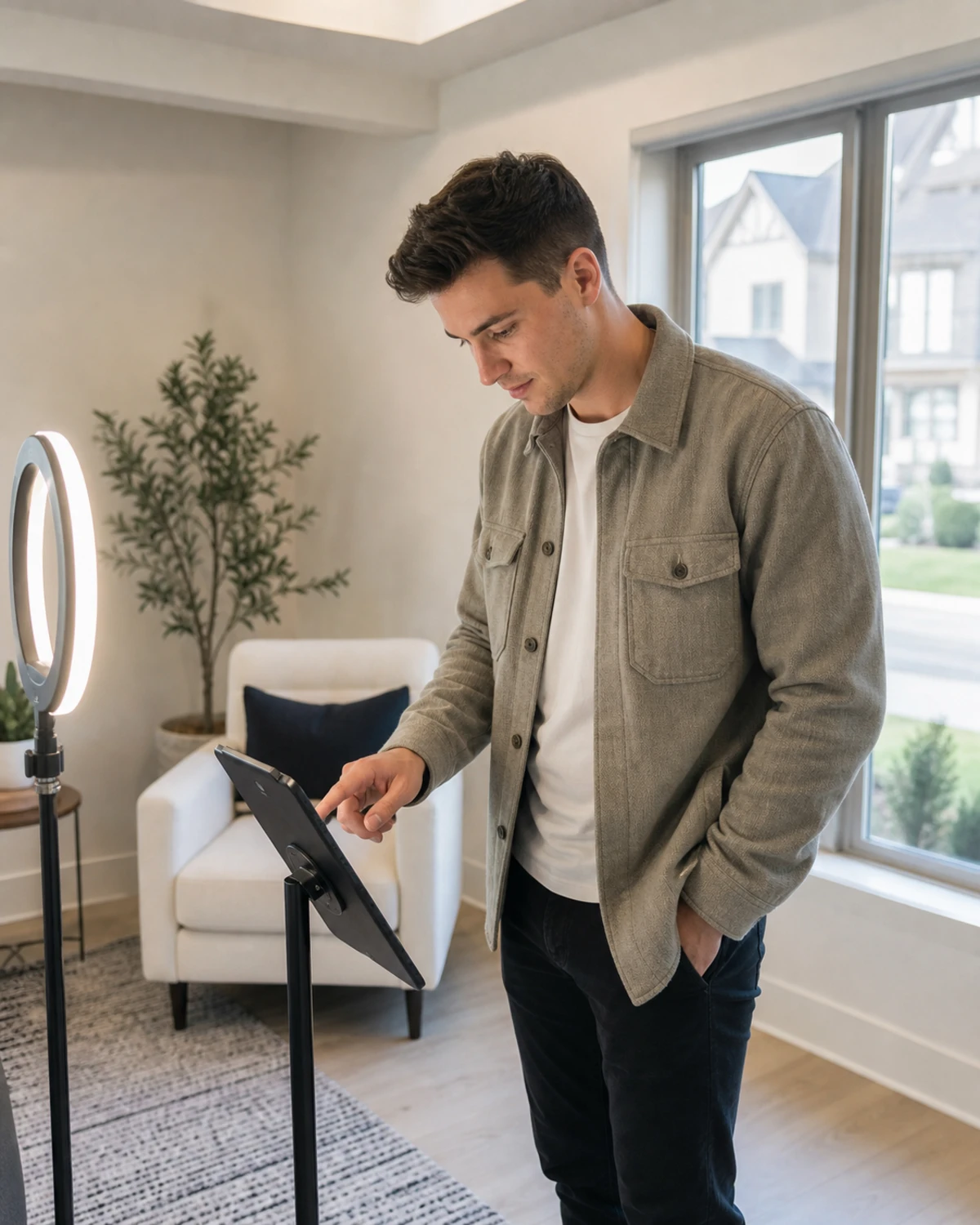
A photo booth reverses the exchange. The branded photo, whether printed, texted, or emailed, is the thing the guest genuinely wants, and an accurate email address or phone number is the price of receiving it. Type the address wrong and the photo never arrives. The guest is not surrendering data to a salesperson; the guest is finishing a transaction they chose to start. The agent no longer has to police honesty, because the delivery step does it: a guest who wants the photo has every reason to enter an address that works.
This is the link the rest of the internet keeps missing. Open-house advice runs on two tracks that never cross. One treats the photo booth as event decoration, a bit of fun for a listing. The other treats lead capture as a digital sign-in problem solved with QR codes and tablet apps. They are describing the same device. Vendors of digital sign-in tools report capture rates roughly two to three times higher than paper, mostly because a tablet form has required fields and no illegible handwriting. A photo booth keeps those gains and adds what a tablet form still lacks: a reason for the guest to enter a real address instead of a convincing fake.
The audience is already there. Half of home buyers attend open houses during their search (National Association of Realtors, 2024). Agents who doubt that traffic converts often point to a long-circulated claim that only a tiny share of buyers find their home at an open house; Curb Hero’s review of the data notes the figure misleads, because open houses are rarely a buyer’s first step but are common midway through a search (Curb Hero, 2026). The open house rarely lacks traffic. It lacks capture.
What counts as a “photo booth” for a real estate setting
A staged listing has no spare room. The living room is dressed to photograph well, the furniture is placed to move buyers through, and an agent arriving before guests has maybe fifteen minutes alone in the house. Whatever a photo booth is, it has to survive that constraint: set up fast by one person, sit quietly in a corner without fighting the staging, and run unattended while the agent works the door.
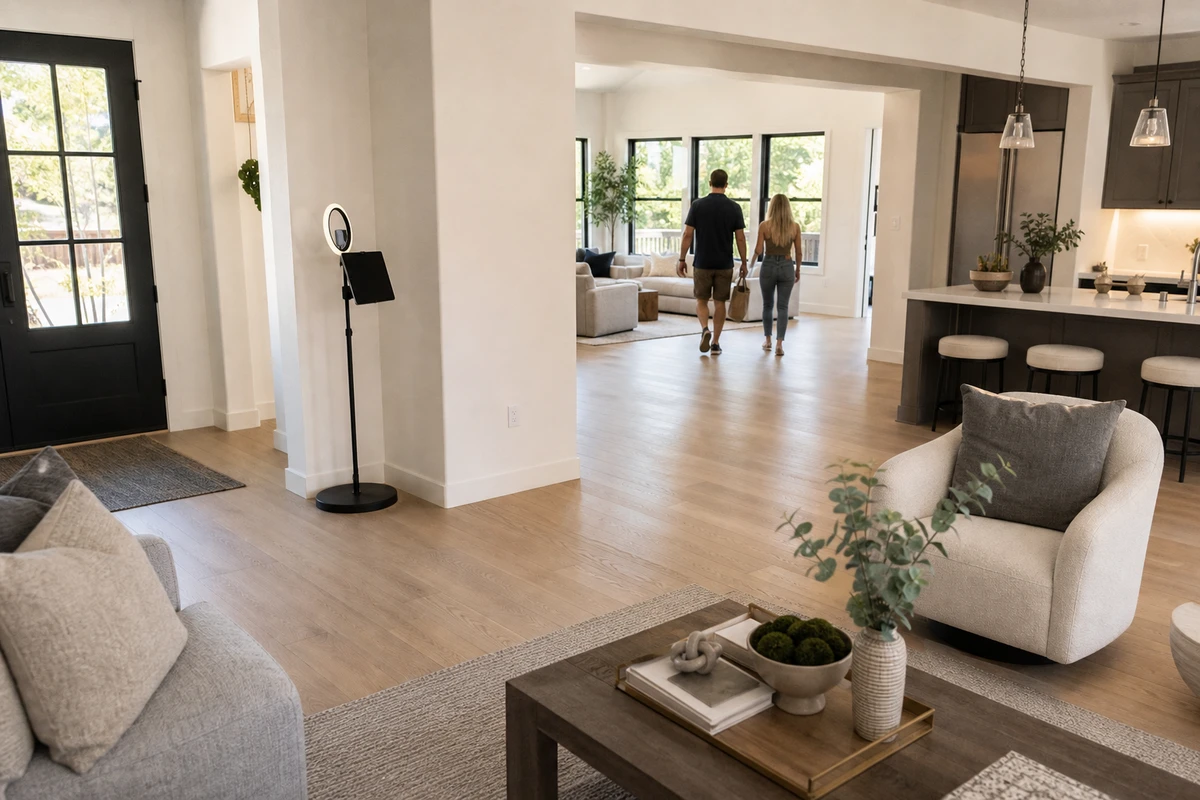
That rules a lot of hardware out. An open-air booth, an iPad or camera on a stand with a small backdrop, has a footprint near five by seven feet and goes up solo in ten to thirty minutes. It is self-service and handles a steady rotation of groups. Enclosed booths, the curtained boxes, take a similar footprint but seat only two to four people and read as a party fixture inside a home dressed for sale. A 360 booth, with its rotating arm and platform, needs a ten-by-ten clear area and usually an attendant; it is built for spectacle, and spectacle pulls the guest’s attention toward performing rather than quietly entering an accurate email. Mirror booths suit galas more than living rooms, and roaming selfie stations are built for crowds of hundreds, not fifteen groups working through a three-bedroom ranch.
One distinction clears up most of the confusion competing articles create. The booth is the capture-and-deliver device: the screen, the intake form, the photo, the delivery. The backdrop and props are optional set dressing. A “window view illusion” or a garden-themed corner is staging, not a booth, and a realtor can run a perfectly effective capture station with no props at all. For a furnished open house, a lightweight open-air booth tends to win, not because it photographs better, but because it is the only form factor that fits the room and the one-person reality of hosting.
The criteria that actually matter when choosing one
Most photo booth marketing sells the wrong things: backdrop variety, GIF effects, the spin. None of that decides whether a booth pays for itself at an open house. Five criteria do, and they are what separate the best photo booth for a realtor from the one that ends up in a closet.
Required, deliverable data capture
The booth must refuse to send the photo until the guest provides a real email or phone number, and it should allow one qualifier question on the intake screen. Asking timeline, pre-approval status, or whether the visitor already has an agent is not new friction; agents already ask it on paper and digital sign-in sheets (Amitree, 2025). A booth simply collects the answer with the contact attached.
CRM handoff
A contact trapped in a booth vendor’s dashboard is a contact nobody follows up. The booth should export or sync to the systems agents actually run, Follow Up Boss, BoldTrail (formerly kvCORE), BoomTown, and Lofty among them. HousingWire’s roundup of sign-in tools notes that agents favor digital options specifically because they hand off cleanly to a CRM (HousingWire, 2025), and the same logic applies to a booth. Follow Up Boss frames the open house as an “untapped lead source” precisely because capture and CRM sync, done together, keep a lead alive (Follow Up Boss, 2022).
Branding control
The agent’s logo and contact details should appear on the print overlay, the digital gallery, and the text or email that delivers the photo. A keepsake with the agent’s name on it keeps marketing for months after the open house ends.
Unattended reliability
A solo agent hosting an open house cannot also run a booth. If the booth needs a staffer to coax guests through it, it does not fit the job. Self-service operation is a hard requirement, not a nice extra.
Consent and compliance
The intake screen needs clear opt-in language naming the specific agent or brokerage that will follow up. Any marketing texts after the event fall under TCPA written-consent rules (Federal Communications Commission, 2025).
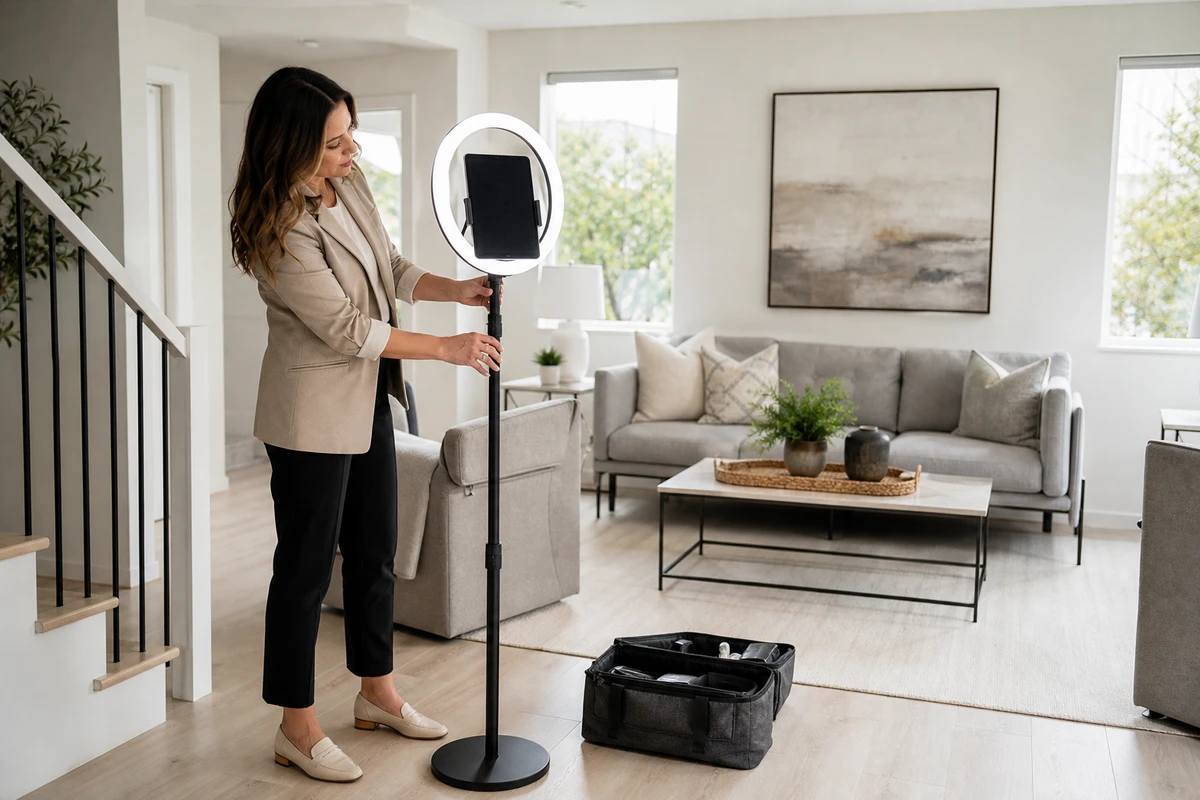
A booth built for commercial lead capture covers most of these by design. Simple Booth’s HALO kit holds back the photo until the guest enters a real email or phone number, puts the agent’s logo on the email or text that delivers it, and keeps captures in an offline upload queue when a house’s Wi-Fi drops, sending them once a connection returns.
The best booth is the one that scores well on all five, not the one with the longest feature list.
Rent for the event or own the hardware
A solo agent who hosts four open houses a year and a brokerage running ten a month look at the same hardware and should reach opposite decisions. The fork between renting and owning is a frequency question, not a taste question.
When renting makes sense
A 3-hour photo booth rental runs roughly $500 to $1,100 per event, with open-air booths averaging around $870, based on a 2025 survey of 89 rental vendors across 26 U.S. cities (Puddles Photo Booth, 2025). Owning shifts the cost to a one-time hardware purchase plus a software subscription. An iPad-based open-air setup starts around $2,499 and runs to roughly $4,000 for a sturdier rig, with booth software typically $29 to $49 a month, according to a 2025 market roundup (Selfie Booth Co, 2025). Year one of ownership lands near $3,000 to $4,500; every year after is just the subscription, under $600.
The crossover sits between roughly six and twelve deployments a year. Below that, renting is simpler and adds no idle hardware. Above it, the rental bill overtakes the purchase fast. Take a solo agent running two booth-equipped open houses a month. That is 24 events a year, somewhere between $12,000 and $26,400 in rental fees, against a one-time outlay near $3,500 to own. The decision is not close.
A brokerage with eight to ten open houses a month across its agents tilts even harder. Renting that volume would cost a five-figure sum every quarter, while two or three owned units cover the whole roster. For anyone past occasional use, owning costs less per deployment and removes the friction of booking a vendor for every Saturday. The sporadic agent who hosts a booth three or four times a year is the one genuine case for renting.
What an open-house lead is actually worth
The case for a booth holds up only if the arithmetic does, so here is the arithmetic, built step by step from figures any agent can check against their own market.
Start with a strong Saturday open house that draws
Start with a strong Saturday open house that draws about 30 people through the door in roughly 20 visiting groups. A paper sheet, losing 30 to 40 percent of usable contacts, captures maybe 12 deliverable contacts from those groups. A booth that withholds the photo until a real address is entered captures closer to 17 of them. Call the lift five additional usable, deliverable contacts per open house. That is the number that matters, and it is deliberately conservative.
Now the close rate, which is the soft part of this math, and honesty matters more here than a flattering figure. NAR tracks open-house attendance, not open-house lead conversion, and the conversion numbers in circulation come from software vendors. One open-house platform estimates that fewer than 2 percent of attendees convert into clients (RLTRsync, 2026). For captured leads specifically, treat the close rate as a wide band, somewhere between 1 in 50 and 1 in 100.
Five extra contacts at that band produce between 0.05 and 0.10 additional closed sides per open house. The value of a side comes from NAR’s 2025 member data, which puts median REALTOR® gross income at $58,100 across about 10 transaction sides (National Association of Realtors, 2025), or roughly $5,810 per side at the median. An experienced agent at a typical split on a median-priced home nets closer to $8,000 to $10,000. Multiply the band of extra sides by the band of side values, and the booth adds somewhere between $290 and $1,000 in expected commission per open house.
Run that across 24 open houses a year and the booth contributes a rough $7,000 to $24,000 in added expected commission. Even the pessimistic end of that range clears the $3,500 cost of owning the hardware several times over. The booth does not have to perform at its best for the math to work. It only has to capture the contacts the clipboard was losing.
One booth, many touchpoints across a real estate business
The open house is the core case, but a booth that only works at open houses is hard to justify owning. The same hardware earns its keep at several other moments in a real estate business, and that is what tilts the rent-versus-own math toward owning.
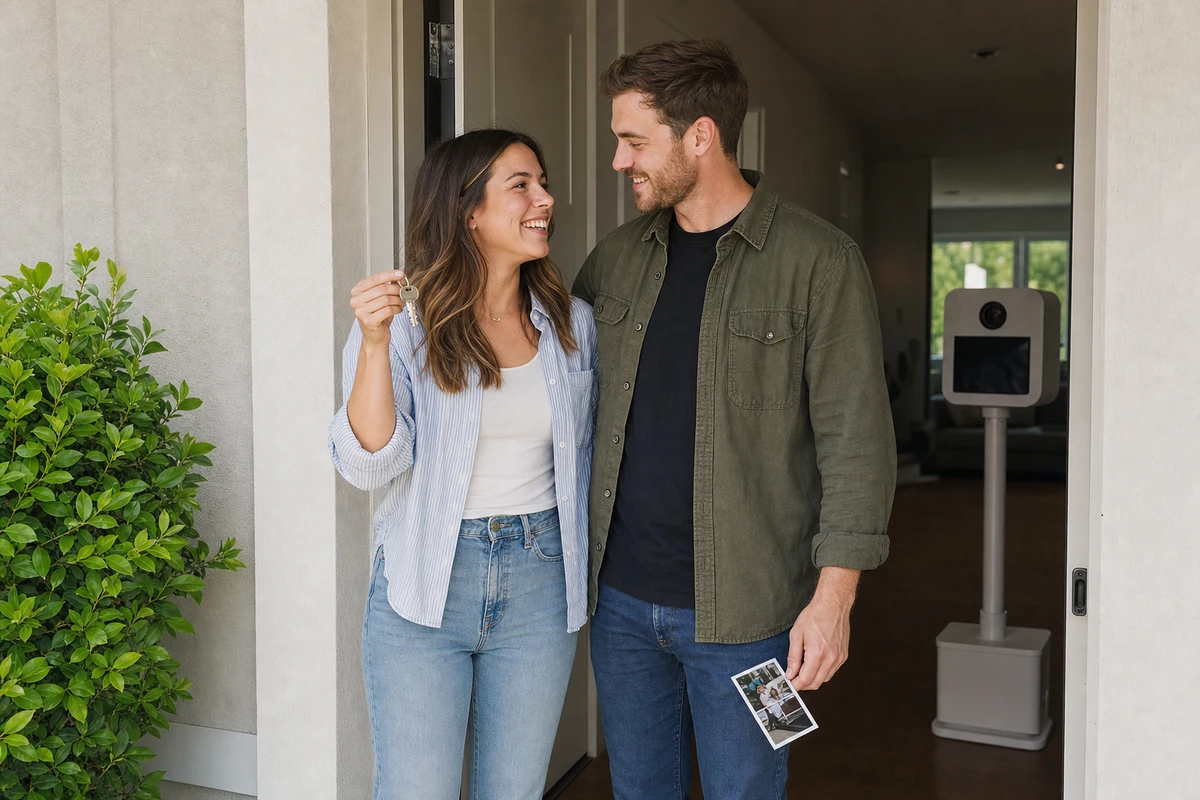
Closing day is the obvious second use
Closing day is the obvious second use. A branded photo of the new owners with their keys, printed on the spot, tends to end up on the client’s refrigerator, where it acts as quiet advertising for the agent every day for months. The same photo, shared by the client, reaches their friends and family, the exact people most likely to need an agent next. There is no study measuring the fridge-photo effect, so treat it as operator intuition consistent with what is known about physical keepsakes outlasting digital impressions, not a proven return.
Client appreciation events are a third use, and they come with one rule. RESPA Section 8 prohibits giving anything of value in exchange for a referral, but it explicitly permits ordinary promotional activity not conditioned on referrals (Consumer Financial Protection Bureau). A photo at a “thanks for being a great client” gathering is fine. A photo offered as a reward for sending a buyer is not. The line is whether the gift carries strings.
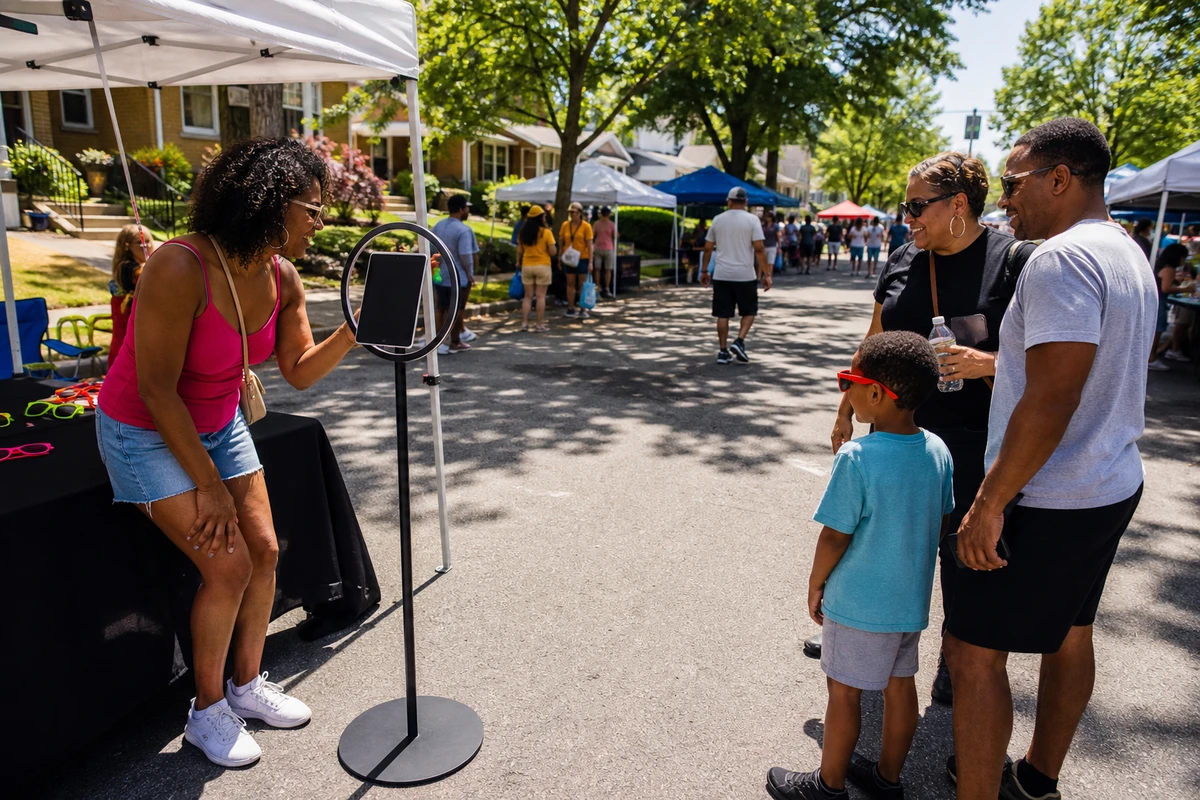
Community events and neighborhood farming put the booth to work as a brand-visibility tool. A booth at a street fair in a target ZIP code collects contacts from exactly the homeowners an agent wants as future sellers. One Toronto rental company reported over 100 contacts captured at a single sponsored community event (Revolve Event Services), though that figure came from a 300-person event and should not be read as an open-house yield.
Solo agent, team, or brokerage: matching the setup to the buyer
The right setup depends on who is buying. A solo agent purchasing for personal use, a team lead equipping five agents, and a brokerage owner outfitting three offices each need different hardware and a different rent-or-own call, so which buyer applies is the first thing to settle.
The solo agent is usually a low-frequency buyer
The solo agent is usually a low-frequency buyer. Renting a lightweight, unattended open-air unit per event is the sensible default until the calendar fills enough to cross the frequency line from the rent-versus-own math. Branding stays simple, because one logo and one phone number go on every print.
A team clears that crossover easily once usage is pooled across several agents, so a shared owned unit tends to pay off. The detail that matters is the branding overlay: the booth should let each agent swap in their own logo and contact details, so every listing carries the name of the agent who hosted it, not the team lead’s.
A brokerage should treat the booth as shared infrastructure. Two or three owned units circulating among offices cover every agent’s open house, double as assets for recruiting events and grand openings, and standardize how the brokerage’s listings present to a guest. For the owner, that hardware is also a modest recruiting perk, marketing support an agent does not have to fund alone.
Mistakes that turn a lead-capture tool back into a gimmick
A photo booth can be bought for the right reasons and still end up as decoration. A few deployment mistakes account for most of that.
Treating the booth as decoration
If entering contact information is optional, the booth is a toy. The required field is the entire point; without it, an agent has bought a party prop.
No follow-up sequence
Capture without a planned multi-touch follow-up wastes the lead. The booth fills the top of the funnel; an email, text, and call cadence still has to do the rest.
Over-propping
Pile on enough confetti and costumes and the photo reads as a party, not a branded real estate keepsake. The print should look like marketing the client is glad to keep.
Skipping consent
Collecting emails and phone numbers with no clear opt-in invites a compliance problem and erodes the trust the booth was meant to build. The intake screen is the place to get it right.
Strip those away and the rule that should drive the purchase is simple: the best photo booth for a real estate business is the one that wins on required data capture, branding control, and CRM handoff, and an agent who buys on those three will out-capture every clipboard in the neighborhood.
Frequently asked questions
How much does a photo booth cost for a real estate agent?
Renting runs roughly $500 to $1,100 for a 3-hour event, with open-air booths averaging around $870 (Puddles Photo Booth, 2025). Owning shifts the cost to a one-time hardware purchase, about $2,499 to $4,000 for an iPad-based open-air setup, plus booth software at $29 to $49 a month. If you host more than six to twelve events a year, owning costs less per use.
Do photo booths actually generate real estate leads, or just photos?
They generate leads when capture is required and the data exports to a CRM. The mechanism is simple: the booth withholds the branded photo until the guest enters a real, deliverable email or phone number, so the contact you collect is one you can actually reach. A booth with optional fields and no CRM sync produces photos and nothing else.
What is the best type of photo booth for an open house?
An open-air iPad or tablet booth. It sets up in ten to thirty minutes by one person, fits a corner of a furnished room without fighting the staging, and runs unattended while you work the door. Enclosed, 360, and mirror booths are heavier, need more space, and usually need a staffer.
Can a photo booth replace my open-house sign-in sheet?
Yes. It captures the same name, email, and phone number a sheet asks for, and it can ask one qualifier question too, but at a higher completion and deliverability rate, because the guest wants the photo and a wrong address means it never arrives. Many agents run a booth as their primary capture point and retire the clipboard.
Is it legal to collect visitor contact info at an open house this way?
Collecting contact details with clear consent is standard practice. Your intake screen should name the specific agent or brokerage that will follow up, and any marketing texts afterward require prior written consent under FCC TCPA rules effective January 2025. This is general information, not legal advice; confirm specifics with your broker or counsel.
Should a brokerage buy a photo booth or have agents rent?
Buy. A brokerage running eight to ten open houses a month across its agents crosses the rent-versus-own line many times over, and owned units double as recruiting-event and grand-opening assets. Two or three shared booths usually cover an entire roster for less than renting one for every event.
Sources
- National Association of Realtors (2024). “Home Buyers and Sellers Generational Trends Report 2024.” https://www.nar.realtor/sites/default/files/documents/2024-home-buyers-and-sellers-generational-trends-04-03-2024.pdf
- National Association of Realtors (2025). “Income Steady, Even as Market Slows: 2025 Member Trends.” https://www.nar.realtor/magazine/real-estate-news/sales-marketing/income-steady-even-as-market-slows-2025-member-trends
- Consumer Financial Protection Bureau. “Regulation X, § 1024.14: Prohibition against kickbacks and unearned fees.” https://www.consumerfinance.gov/rules-policy/regulations/1024/14/
- Federal Communications Commission (2025). “FAQs: One-to-One Consent Rule for TCPA Prior Express Written Consent.” https://www.fcc.gov/document/faqs-one-one-consent-rule-tcpa-prior-express-written-consent
- HousingWire (2025). “Open house sign-in sheets savvy agents are leveraging to get more leads.” https://www.housingwire.com/articles/open-house-sign-in-sheets/
- Curb Hero (2026). “What Percentage of Homes Sell from an Open House?” https://curbhe.ro/what-percentage-of-homes-sell-from-an-open-house/
- Follow Up Boss (2022). “10 simple rules for a lead-generating open house.” https://www.followupboss.com/blog/turn-every-open-house-lead-generation-machine
- Amitree (2025). “Sign-In Sheets for Open Houses: What Works, What Doesn’t & How to Optimize.” https://www.amitree.com/resources/blog/sign-in-sheets-for-open-houses/
- Tom Ferry (2025). “Open House Sign-In Sheet Tips.” https://www.tomferry.com/blog/open-house-sign-in-sheet-tips/
- RLTRsync (2026). “How to Convert Open House Visitors into Clients: A Data-Driven Approach.” https://rltrsync.com/article/convert-open-house-visitors-data-driven-approach/
- Revolve Event Services. “How a Branded Photo Booth Generated 100+ Leads at a Community Event.” https://www.revolveeventservices.com/blog/photo-booth-lead-generation-for-toronto-realtor
- Puddles Photo Booth (2025). “2025 Photo Booth Rental Cost Guide.” https://www.puddlesphotobooth.com/2025-photo-booth-rental-costs
- Selfie Booth Co (2025). “How Much Does a Photo Booth Cost to Buy?” https://www.selfieboothco.com/blog/how-much-does-a-photo-booth-cost-to-buy/