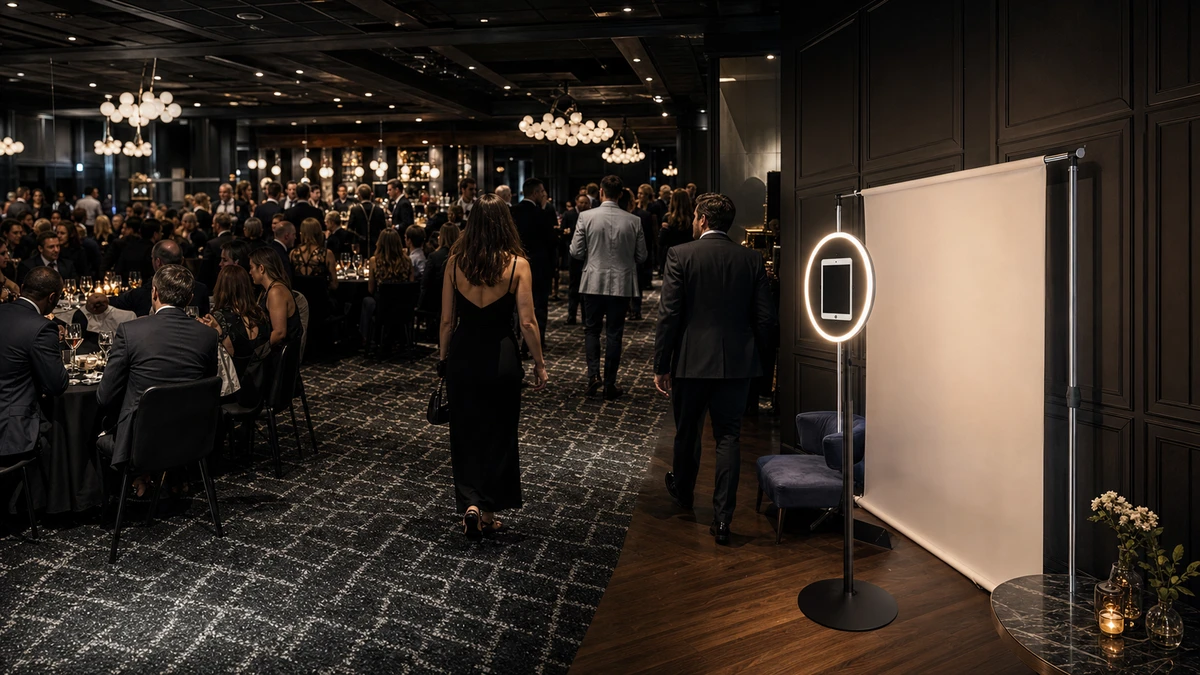
Picture a banquet hall on a Friday night. A 200-guest company holiday party is building toward its peak, and over by the bar a photo booth runs with nobody tending it. Guests walk up, tap a screen, pick a backdrop carrying the host company’s logo, and have the photo on their phones before they return to their tables. The event planner paid the venue $300 to fold the booth into the package. The venue bought that booth once, eighteen months ago, and it has since done the same job at more than a hundred other events.
That booth is the subject here. The best photo booth for an event venue is one the venue owns and runs as a standing in-house amenity: an open-air, iPad-app-based booth built for unattended commercial use, which staff can re-brand for each event host in a few minutes. It is not the four-hour rental that the popular “how to choose a photo booth” guides describe. Those guides are not wrong. They answer a different question, for a different buyer, and a venue operator who follows them will optimize for the wrong things.
Why “Best for a Venue” Is a Different Question Than “Best for an Event”
A couple booking a retirement party, or a corporate planner running one product launch, picks a booth for a single night. They are right to optimize for that night’s look: a mirror booth because the room is glossy and modern, a 360 platform because the launch needs a spectacle clip, a retro enclosed booth because the theme is nostalgic. They will use it once, hand it back, and never think about it again. Most of the top-ranking “how to choose a photo booth” articles, including Foto ATM’s venue guide, are written for exactly that person, and they compare booths by event vibe and quote four-hour rental rates.
Recurring Venue Operation
A venue does not host one event. It hosts fifty, or a hundred and twenty, or two hundred and fifty a year, and the booth is a fixed asset that has to perform across all of them. That single fact inverts every criterion. Novelty stops mattering and durability starts mattering, because the booth has to survive hundreds of receptions and guests of every age and sobriety. A polished staffed setup stops mattering and unattended reliability starts mattering, because no venue is going to assign an employee to babysit a booth through a five-hour reception. A single striking look stops mattering and fast re-skinning starts mattering, because the booth has to read as the host’s brand on Friday and a different host’s brand on Saturday.
The 360 Example
The 360 booth makes the point cleanly. It is the platform a single guest stands on while a camera arm spins around them, and for one splashy launch it can genuinely be the best booth in the room. As a permanent venue asset it is a poor pick: it eats floor space in a room that has to flex between layouts, it needs an attendant to run it safely, and it serves one guest at a time while a line forms. A booth can be excellent for an event and wrong for a venue at the same time. The consumer guides never separate those two verdicts, which is why a venue operator should not shop from them.
Two-Part Decision
So the venue’s question splits in two. First, how should a booth get onto the floor at all. Only then, which booth.
The Three Ways a Venue Can Put a Photo Booth on Its Floor
An event coordinator who fields the question “do you have a photo booth?” two or three times a month has three honest answers, and most venues drift into the first without ever weighing the other two.
Path One: Client Rentals
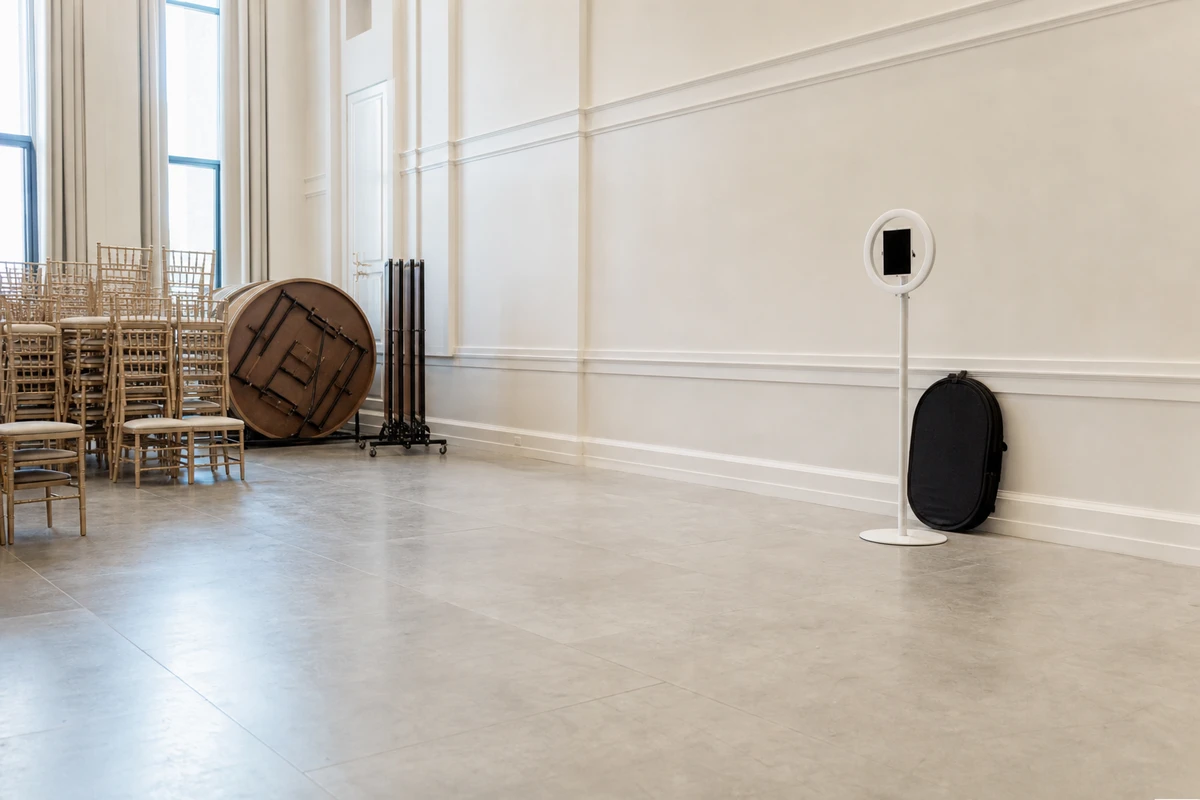
This is the status quo at most venues, and it costs nothing to maintain. The event host hires an outside operator, who rolls a booth in for the night and rolls it out again. Per-event rental rates run roughly $400 to $2,500 for four hours depending on booth type and add-ons, by Foto ATM’s pricing breakdown. The venue captures none of that. It also captures no guest data, no reusable content, and no control over how the booth looks, where it sits, or whether the operator shows up on time. Path one is the easiest answer and the lowest ceiling.
Path Two: Vendor Placement
A vendor installs and maintains a booth at the venue at no upfront cost, runs it, and pays the venue a share of revenue. The pitch is consistent and attractive across the market. Photomatica headlines its permanent-placement page “FREE FOR YOU. PURE REVENUE.” Majestic Photobooth markets a “Placement Partner” program that promises a fully custom booth “at no cost,” with installation, software updates, print systems, and performance monitoring all handled by the vendor. Face Place, from Apple Industries, runs a comparable revenue-share program for bars and restaurants. The UK operator The Flash Pack frames the same model as “Low Risk, High Reward.”
The honest treatment the vendor pages skip is what the venue gives up. Two things in particular. First, the split: no major placement program publicly discloses its revenue percentage. That opacity is deliberate, because splits are negotiated case by case and a published number would weaken the vendor’s hand. A venue should assume the share favors whoever owns and maintains the hardware, and should get the exact figure in writing before signing. Second, data and pricing control. Terms vary more than the pitches admit. Majestic’s program, for instance, advertises that the venue does receive guest email data through monthly ready-to-send lists, while other programs say nothing about data ownership at all. A venue cannot assume it will own the guest emails, set the per-event price, or control branding under a placement contract. It has to ask. Path two suits a low-traffic venue, or one unwilling to hold a capital asset, that simply wants a check it did not have to work for.
Path Three: Venue Ownership
This is a capital outlay, and it is the only path on which the venue keeps all of the upsell revenue, controls the per-event price, owns the guest content and the platform, and decides how the booth is branded for every client. It is the best fit above a certain event volume, and the rest of this article is mostly about getting path three right, because “which is the best photo booth” only becomes a real question once a venue has decided to own one.
The Seven Criteria That Actually Matter for a Permanent Venue Booth
A consumer guide grades booths on looks and price per night. A venue needs a different scorecard. Seven criteria carry almost all the weight.
Unattended reliability
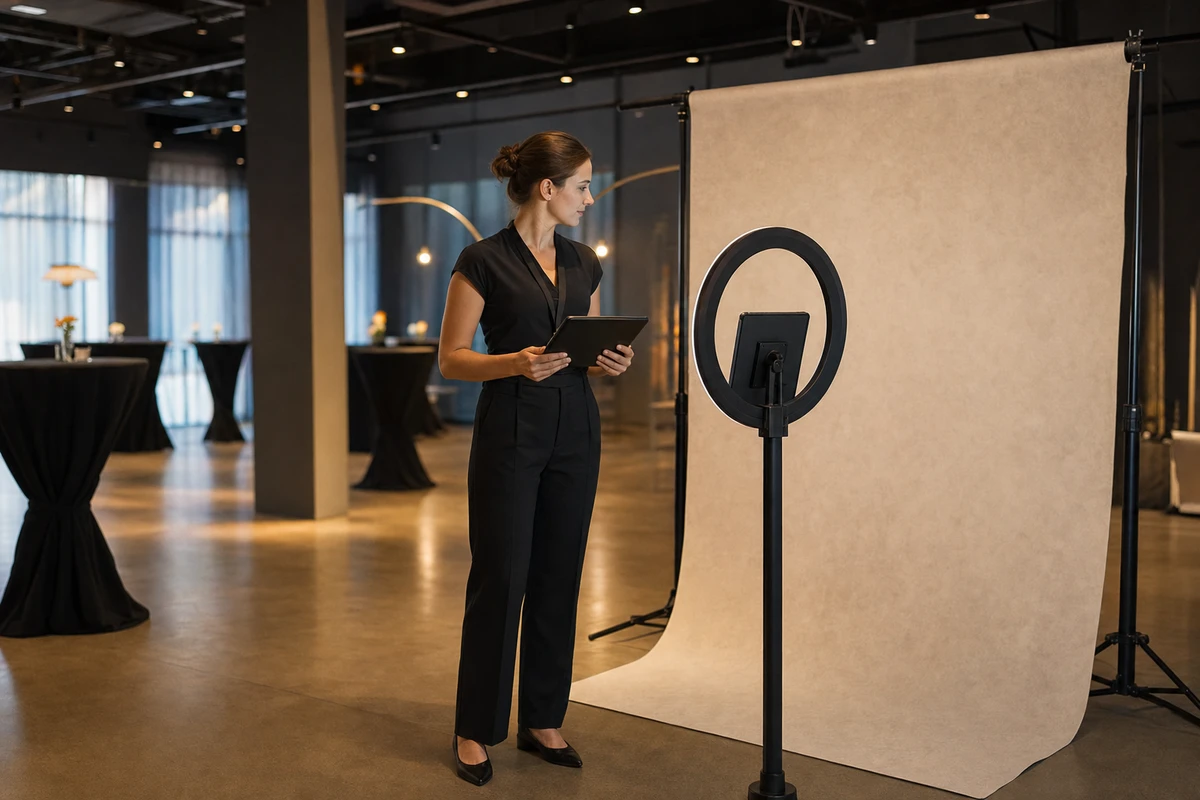
No venue staffs a booth. The event coordinator is managing the kitchen timeline and the bar, and the booth has to run a full five- or six-hour reception with nobody assigned to it. That means the booth’s software has to advance through its own flow, recover on its own if a guest cancels halfway or walks off mid-session, and never reach a state where it needs a laptop reboot or a password. This is criterion one for a venue and close to irrelevant for a one-night rental, where a paid attendant stands beside the booth the whole time. A booth that needs a human to keep it alive is a booth that will be dark for the back half of every event.
Per-event re-skinning
A venue cannot sell the same booth twice if it looks the same both times. On Friday it has to read as a tech company’s product launch; on Saturday, as a nonprofit gala. Re-skinning means changing the start screen, the photo overlay or frame, the print template, and the sharing page so the whole experience carries one host’s branding, then swapping it for the next. The capability itself is standard across commercial booth software. The Flash Pack notes plainly that its booths “can be reskinned to showcase updated designs and guest branding.” What separates a venue-grade booth is who can do the re-skin and how fast. If it takes a vendor work order and three business days, the booth is not sellable as a per-event upsell. If a coordinator can do it in a few minutes from an app, it is. This is the single capability that turns a permanent booth into a line item on the event quote.
Form factor and footprint
A permanent booth occupies the same square footage whether or not an event is running, so its footprint is a standing cost in a room that has to reconfigure constantly. Foto ATM puts the working minimum at roughly 6 by 9 by 10 feet, with 10 by 10 by 10 ideal, and notes that the booth needs a dedicated 110-volt, 10-amp circuit rather than a shared outlet. An open-air booth, which is a camera and screen on a stand with an open backdrop behind it, takes the smallest permanent bite and tucks against a wall between events. An enclosed booth or a 360 platform claims more floor and is harder to design around. Footprint is not a vanity concern for a venue; it is rentable space.
Data and content ownership
When a guest types an email address into a booth to get their photo, someone ends up holding that address. On a venue-owned booth, the venue decides who: it can keep the platform, hand the event host a copy of that night’s list, or do both. On a placement-program booth, the answer is set by a contract the venue may not have read closely. The default a venue should want is ownership of the platform and the content library, with the event host granted a copy of their own event’s data as a courtesy or a paid feature. That ordering matters because it is reversible the easy way (the venue can always share) and not the hard way (a venue cannot claw back data held on a vendor’s server).
Connectivity and offline resilience
Venue Wi-Fi is shared with the catering tablets, the card readers, the DJ, and 200 guests’ phones, and on a busy night it is slow or it drops. A booth that needs a live connection to take a photo will stall exactly when the room is fullest. A venue-grade booth captures and stores every photo and every email locally, then sends them out, including the guest’s copy by text or email, once the connection returns. Offline resilience is invisible on a vendor demo over good office Wi-Fi and decisive on a real event night.
Durability and physical security
A permanent booth lives in a public room and gets handled by hundreds of guests a year, some of them celebrating hard. The hardware has to be commercial-grade rather than a consumer tablet on a tripod, and the iPad or camera has to be physically locked down so it cannot be lifted between events or mid-party. Photo Booth Supply Co. lists VESA mount compatibility on its commercial iPad booths, specifically for long-term installs at venues such as restaurants, museums, and theaters, which is the kind of fixed, secured mounting a permanent install needs. A booth that is easy to pick up is a booth that eventually walks.
Total cost of ownership
The sticker price is the smallest part of the number. A venue’s real cost is the hardware plus a recurring software subscription, plus consumables if the booth prints, plus insurance, plus the few minutes of staff time each event takes to re-skin it. On hardware alone, the market sorts into three tiers worth keeping straight. A consumer or DIY iPad rig can be assembled for under $2,000 and is not built for hundreds of commercial events. A purpose-built commercial iPad booth starts around $3,000; Photo Booth Supply Co. lists its Salsa 2 at $2,999. A full commercial booth with a DSLR camera runs roughly $8,000 to $15,000, the bracket Photo Booth Supply Co.’s Guac & Chips line occupies at $7,999 to $14,399. Knowing which tier a quote sits in is the difference between buying an asset and buying a toy.
Form Factors Compared for a Permanent Venue Install
The consumer guides rank booth types by event mood. For a permanent venue install the ranking is different, because the booth has to work across every mood the calendar throws at it.
Open-Air Default
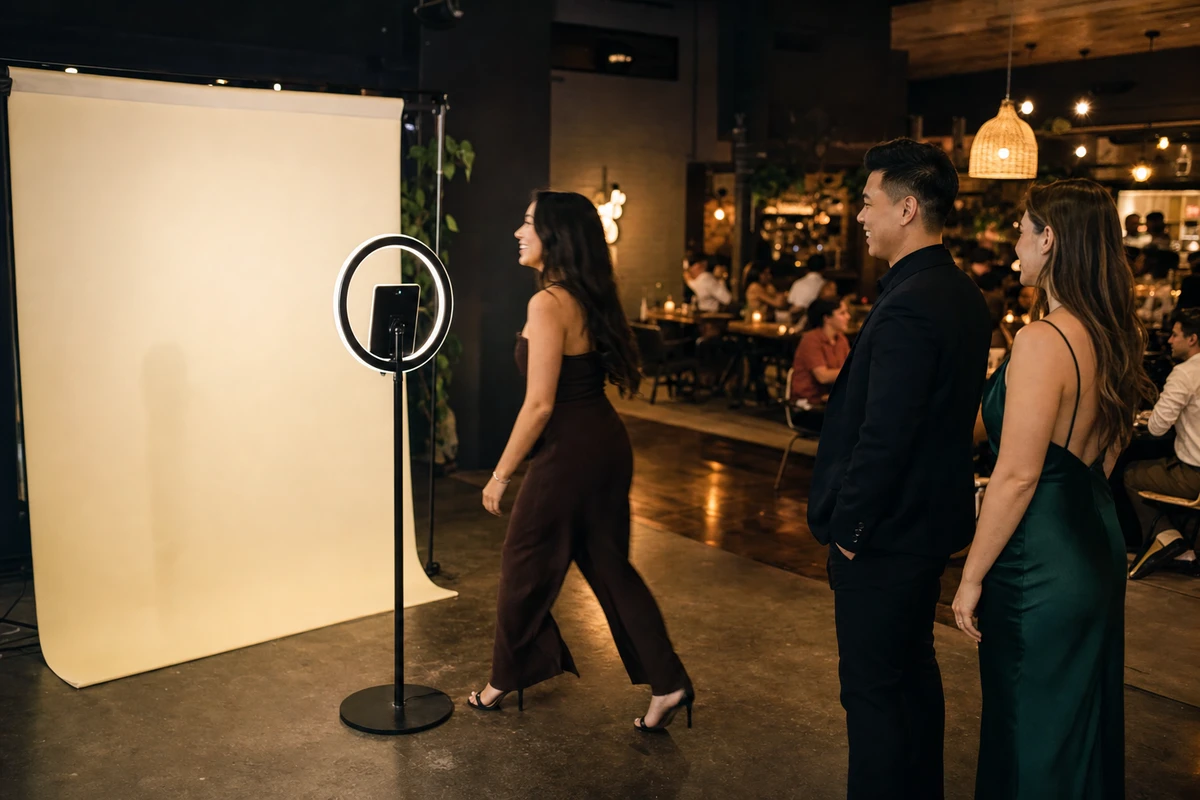
The open-air iPad booth is the default recommendation, and the seven criteria are why. It has the smallest permanent footprint, it re-skins fastest because the whole experience lives in an app, it is the simplest form for non-technical venue staff to operate and reset, and its features improve over time through software updates rather than hardware swaps. It is the form factor built around unattended, multi-event use. Simple Booth’s HALO kit is one booth built to that profile: an iPad-app booth that venue staff re-skin per event from the app, and whose offline upload queue holds each photo and email capture on the device, then sends the guest their copy by text or email once the venue’s shared Wi-Fi recovers.
Other Form Factors
Each of the other form factors loses on at least one venue criterion. An enclosed or classic booth offers privacy and a touch of nostalgia, but it claims a larger permanent footprint and carries more physical parts to maintain in a room that has to flex between layouts. The magic mirror photographs well and works as a one-night centerpiece, yet it tends to be a single-look asset that resists convincing per-client re-branding, and its large glass surface is fragile in a public room.
The 360 booth runs into the problem the earlier section already named: it delivers spectacle but needs floor space and an attendant and serves one guest at a time, which makes it a weak core booth for an unattended install even if it earns an occasional spot as an add-on. The true analog booth, the wet-chemistry kind, carries a strong aesthetic and one disqualifying flaw: it captures no digital data and no shareable content, so it can never build an email list or a photo library. Most “vintage” booths sold today, Photomatica’s included, are digital booths styled to look analog, and those keep the data capture.
The Practical Choice
The open-air iPad-app booth is not the most dramatic option in the room. It is the one still earning money in year three.
What a Permanent Booth Returns Across a Booking Calendar
Owning the booth only makes sense if the math closes. It does, and at a wider range of utilization than most operators assume. Here is the arithmetic, with the caveat that the event-count figure below is an illustrative scenario, not an industry benchmark, because no published source tracks how many events a typical banquet venue hosts in a year.
Booking Calendar Math
Take a venue running a full event calendar, say 120 bookings a year, that adds the booth to its package as a priced option. The revenue line is straightforward. At a $250 per-event upsell, that is 120 times $250, or $30,000 in gross upsell revenue a year. Bracket it for a different price point: at a conservative $150 the line is $18,000, and at a premium $400 it is $48,000. Set that against the hardware.
A commercial iPad booth around $3,000 is paid back inside twenty events even at the conservative $150 price, and inside a dozen at $250. A full $15,000 DSLR booth is paid back inside the first year at moderate utilization: 60 events at the $250 upsell, or 100 events at $150. The break-even is measured in events, not years, for any venue with a real booking calendar. The recurring software subscription and any print consumables come off the gross, so the figure is not pure profit, but the order of magnitude holds.
Data Line
The data line is real but easy to overstate, so treat it honestly. A booth that captures guest emails feeds a marketing channel with strong returns. Litmus’s State of Email 2026 benchmark puts the high-performer mark at a 36-to-1 return on email spend, and HubSpot’s email benchmarks place the typical range at 10-to-1 to 36-to-1. Those figures describe established email programs, not a list freshly built from booth captures, so they mark the channel’s ceiling rather than a venue’s first-year number.
A worked scenario: an event drawing 100 guests, a 35% opt-in rate, and an illustrative $40 lifetime value per subscriber produces 35 emails worth roughly $1,400 in attributable pipeline. But the honest flag is who owns that list. On a venue-hosted event run by an outside client, those guests belong to the event host’s world, not the venue’s, so the venue’s data value usually lies in offering capture as a paid feature of the package, plus full ownership of the lists from the venue’s own events such as open houses and tastings. The per-subscriber figure above is illustrative; no independent benchmark sets a single LTV for an email subscriber.
Content Line
The content line is the one operators undercount. Every event a permanent booth runs produces dozens of branded, guest-shot photos, and a venue that owns the booth keeps them. Over a year that is a standing library of real people enjoying real events in the space, which is the most persuasive marketing a venue can show a prospective client. An EnTribe survey, from a company that sells user-generated-content marketing software, found 84% of consumers are more likely to trust a brand’s marketing when it features that content, and 77% are more likely to buy a product they found through it. A venue that rents per-event accumulates none of this; the content leaves with the outside operator.

Placement Benchmark
For a sense of scale, Majestic Photobooth’s vendor-published case study of the TWA Hotel in New York reports 8,500 prints and 3,500 email captures a month from a single placement booth. That is a high-traffic hospitality lobby rather than a typical event venue, and the figure is vendor-claimed rather than independently verified, so it is a ceiling reference, not a forecast. It still shows what a well-placed permanent booth can move.
How a Venue Should Decide
The decision comes down to two numbers: how many events the venue hosts a year, and whether it will actively sell the booth or just let it sit there.
When Not to Buy
A venue hosting only a handful of events a year, or one that has no interest in holding and maintaining an asset, should not buy. It should either let clients bring their own rentals or take a placement-program deal, with the revenue split and the data terms pinned down in writing first. A venue with a full calendar that is willing to put the booth on every event quote should buy, and should buy an open-air iPad-app booth it can re-skin per client. The middle case, a venue with a moderate calendar, turns entirely on intent: ownership pays off only if staff will treat the booth as a product to sell, not a gadget in the corner.
Owned Booth Recommendation
For the venue that lands on owning, the recommendation is specific. The best photo booth for an event venue is an owned, open-air, iPad-app-based booth, built for unattended commercial use, that staff can re-brand for each event host in minutes. That profile beats the alternatives on every venue criterion, and it is the profile the consumer guides never name because they are not solving the venue’s problem.
Sales Discipline
The single move that determines whether any of this returns money is not the hardware choice. It is putting the booth on the event package as a named, priced option, every quote, every time, so the upsell is something a client declines rather than something they were never offered.
Frequently Asked Questions
How much does a permanent photo booth cost for a venue? Hardware sorts into three tiers. A consumer or DIY iPad rig runs under $2,000 and is not built for heavy commercial use. A purpose-built commercial iPad booth starts around $3,000. A full commercial booth with a DSLR camera runs roughly $8,000 to $15,000. On top of hardware, budget for a recurring software subscription, insurance, and print consumables if the booth prints.
Does a venue need staff to run the photo booth? No, if the booth is built for it. An open-air iPad-app booth can run an entire reception unattended, advancing through its own flow and recovering on its own if a guest cancels mid-session. The only staff time involved is the few minutes before each event to re-skin the booth for that host’s branding. Plan for the re-skin, not for an operator.
Can one booth be branded differently for each event? Yes, and this is the capability that makes a permanent booth worth owning. Re-skinning swaps the start screen, the photo overlay, the print template, and the sharing page so the booth carries each host’s branding. On a venue-grade booth, staff do this from an app in minutes. If a re-skin needs a vendor work order, the booth is not truly venue-ready.
Who owns the guest photos and emails, the venue or the event host? It depends on the setup. On a booth the venue owns, the venue controls the platform and can grant the event host a copy of their event’s data. On a placement-program booth, a contract decides, and terms vary widely between vendors. A venue should own the platform by default and treat data sharing as something it offers, then confirm the terms in writing before signing anything.
Is a profit-share placement program better than buying? It is better only below a certain event volume, or for a venue unwilling to hold a capital asset. Placement means zero upfront cost, but the venue gives up an undisclosed share of revenue and, often, control of pricing and data. Buying costs capital upfront but keeps all the upsell revenue and the content. Above a real booking calendar, owning wins.
Open-air or enclosed booth for a permanent venue install? Open-air, in almost every case. It has the smallest permanent footprint in a room that has to reconfigure between events, it re-skins fastest because the experience lives in an app, and it is the simplest form for non-technical staff to operate and reset. An enclosed booth offers privacy and nostalgia but claims more floor space and more upkeep.
Sources
- Foto ATM (2025). “How to Choose the Right Photo Booth for Your Venue.” https://fotoatm.com/how-to-choose-the-right-photo-booth-for-your-venue/
- Photo Booth Supply Co. (2025). “Salsa 2 Pricing.” https://photoboothsupplyco.com/pages/salsa-2-pricing
- Photo Booth Supply Co. (2025). “Find Your Perfect Photo Booth.” https://photoboothsupplyco.com/blogs/equipment/find-your-perfect-photo-booth
- Majestic Photobooth (2026). “Venue Placement Partner Program.” https://www.majesticphotobooth.com/venue-placement
- Photomatica. “Permanent Photo Booth Installations.” https://www.photomatica.com/permanent-photo-booth
- Face Place / Apple Industries. “Photo Booth Revenue Share Program.” https://faceplacephoto.com/photo-booth-revenue-share/
- The Flash Pack. “The Power of Revenue Share Photo Booths.” https://itstheflashpack.com/the-lens/the-power-of-revenue-share-photo-booths/
- Litmus (2026). “State of Email Reports 2025–2026: Email Marketing Trends.” https://www.litmus.com/landing-page/state-of-email-2026
- HubSpot (2026). Trovato, Stephanie. “Email Marketing ROI: Key Stats & Proven Effectiveness.” https://blog.hubspot.com/marketing/email-marketing-stats
- GlobeNewswire (2022). “New Survey from EnTribe Emphasizes Value of User-Generated Content in Marketing Initiatives.” https://www.globenewswire.com/news-release/2022/07/06/2475085/0/en/New-Survey-from-EnTribe-Emphasizes-Value-of-User-Generated-Content-in-Marketing-Initiatives.html