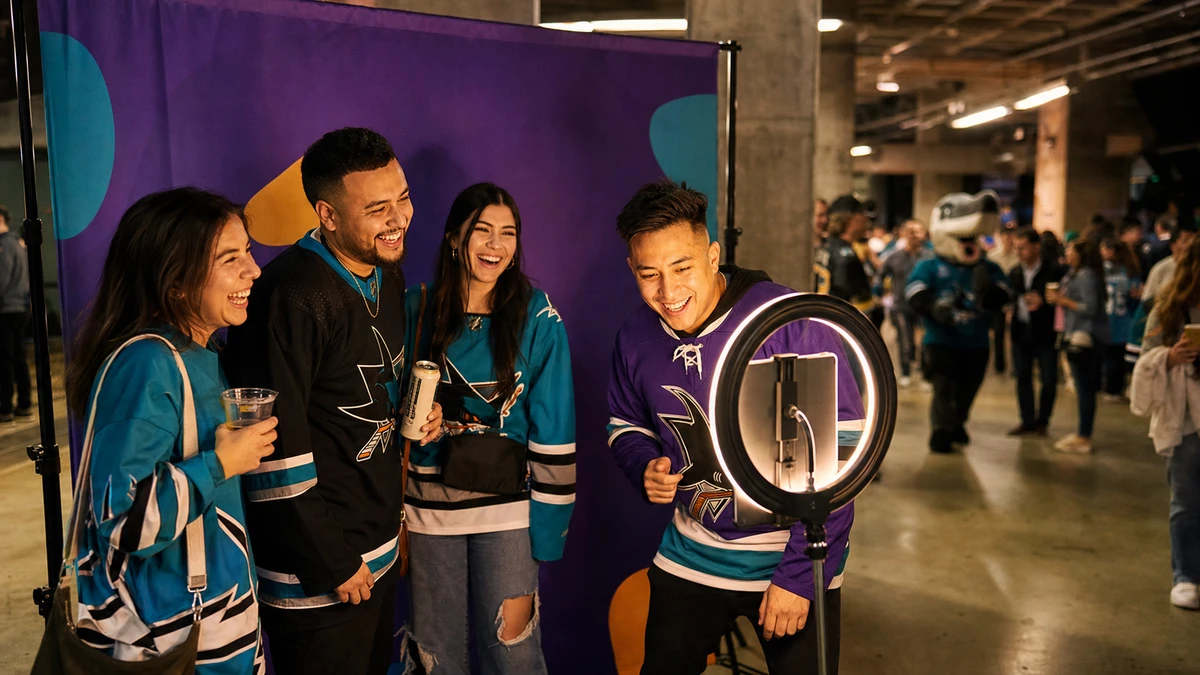
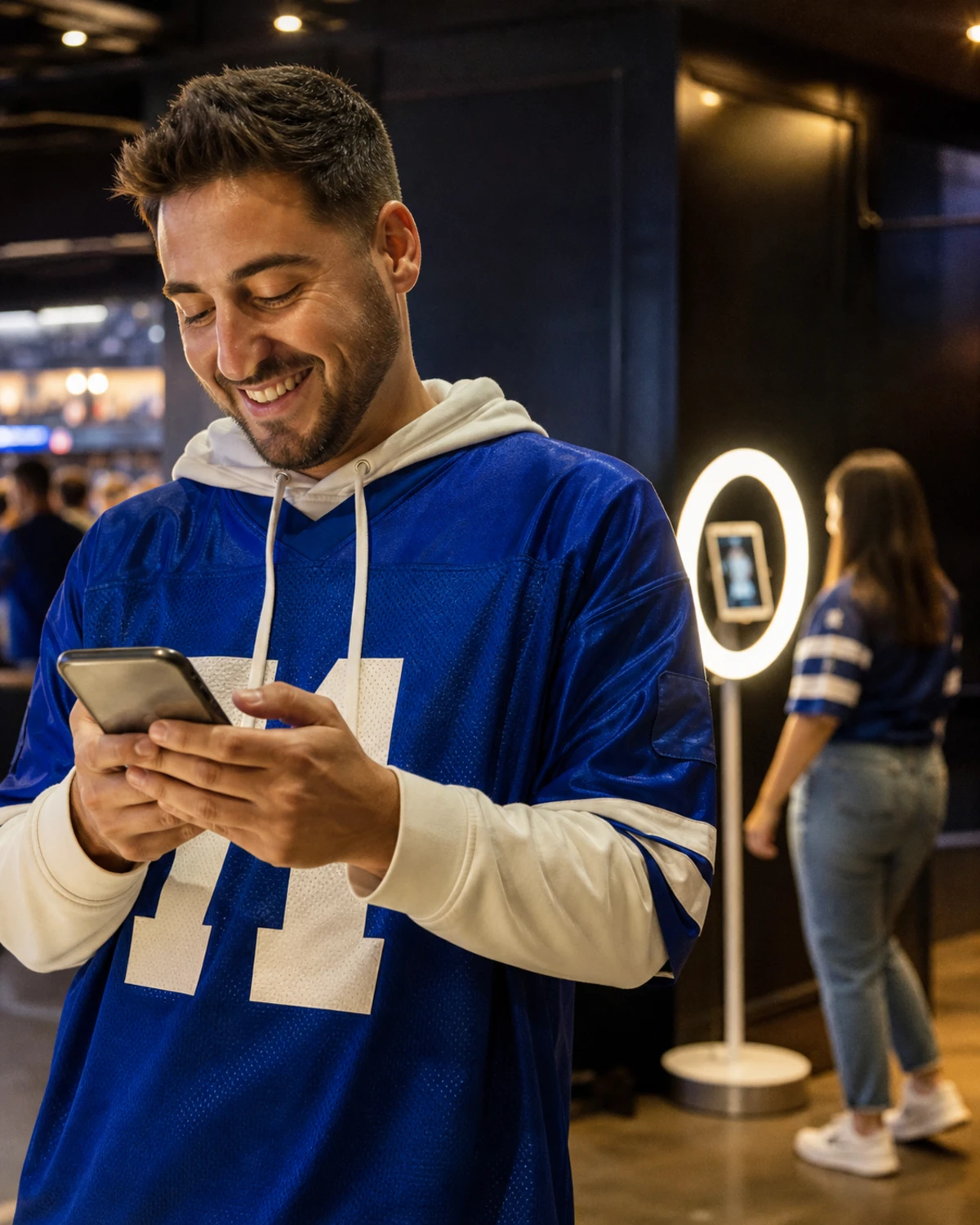
The line at the concourse photo station builds fast. It is the bottom of the third inning at a Double-A ballpark, the mascot just walked past, and forty fans want a picture in front of the team backdrop before they head back to their seats. Whoever runs that station made a choice months earlier, and that choice now decides whether the line moves or stalls.
For a stadium, a sports team, or a golf club, the best photo booth is not one rented for a single game. It is an owned, operator-run, tablet-based open-air booth: a unit the venue can re-brand for every game and every sponsor, that collects a fan contact with each photo, and that spreads its cost across a full season instead of charging a fee every night.
Most venues get this wrong because they search “best photo booth for sports venues” the way a one-time event planner would, and the results page answers them in kind. This article scores every booth format against the four constraints that decide it for a sports venue, then works the season math behind the buy-versus-rent question.
Why “Best Photo Booth” Is the Wrong Question for a Sports Venue
An event planner books a photo booth once. The booth arrives, runs for four hours, and leaves. For that planner, “best” is a fair question with a simple answer: the nicest booth available that night at a price the event budget allows. The entire search results page for photo booth queries is built for that buyer, because that buyer is the most common one.
Recurring Venue Job
A sports venue is a different kind of business. It does not host an event; it runs a schedule. A minor league baseball club plays between 66 and 75 home games a season depending on its level. On top of those game dates sit theme nights, fan fests, youth clinics, sponsor hospitality days, charity tournaments, and off-season private rentals. A golf club runs member mixers, junior programs, holiday events, and outside tournaments across a calendar that barely pauses. The industry increasingly frames this as a shift from a matchday-only building to a year-round programming platform, a venue that runs well over a hundred active event days.
Best Means Redeployable
For a recurring operator, “best” stops meaning “the nicest booth this Saturday.” It starts meaning something measurable: the booth that re-deploys cheapest, brands fastest, and keeps the data. A rented booth fails all three. It shows up branded by the rental company or generic, it leaves with the rental company, and every fan contact it captured leaves with it too. The venue paid for entertainment and kept nothing.
Two-Part Decision
So the real decision has two parts: owned versus rented, and which booth format. Both turn on one axis the search results page ignores: repeatability across a season.
Three Sports Venues, Three Different Buying Problems
A booth that earns its keep on a stadium concourse can be the wrong purchase for a traveling team or a golf club. “Sports” is a label, not a single buying problem. The constraint that decides the booth shifts sharply across three kinds of venue.
Stadiums and arenas
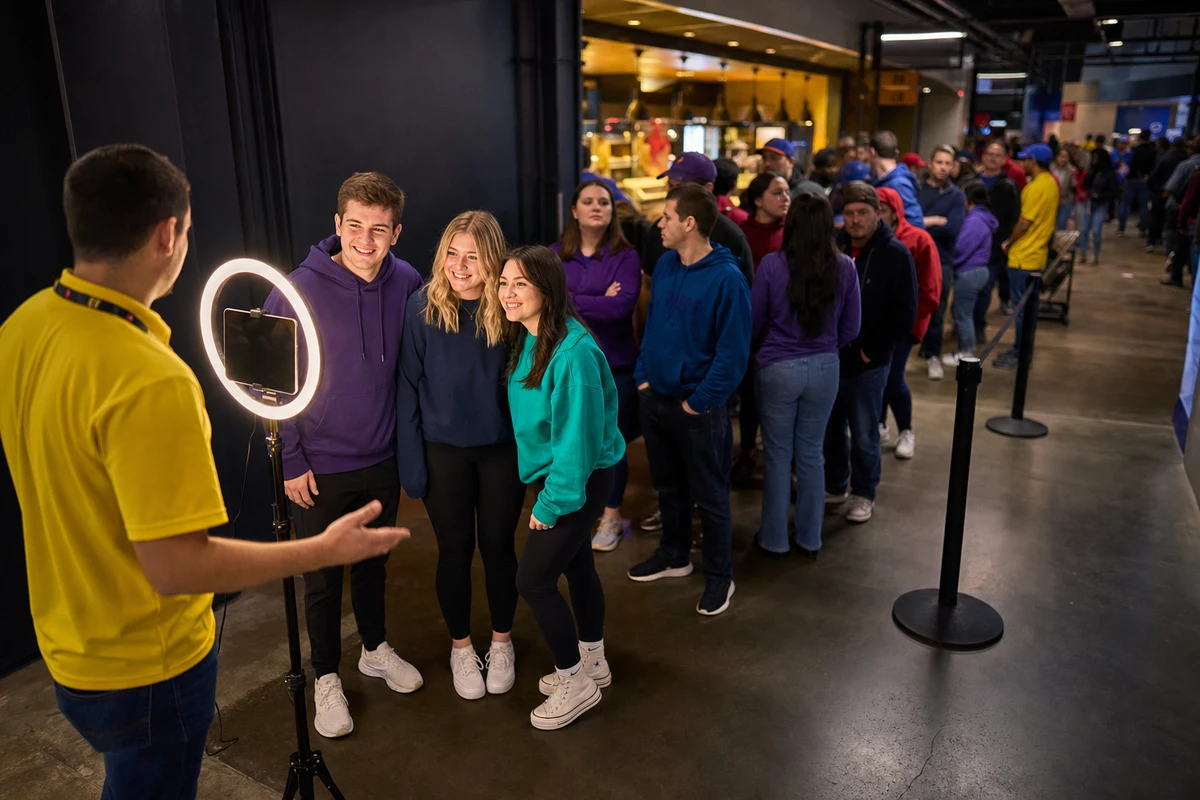
A concourse empties at halftime in a compressed rush: a thousand fans move through a narrow space in fifteen minutes, and the photo station competes with concession lines for those fan-minutes. A slow booth strands the line, and fans drift back to their seats unphotographed. Footprint compounds the problem, because every square foot the booth occupies is a square foot not selling beer and pretzels.
Minor league teams feel this most sharply. They run pro-level event frequency on a fraction of a major league budget. When Minor League Baseball restructured to 120 clubs in 2021, the remaining clubs tended to be better capitalized and more community-rooted, which tilts them toward deliberate, owned-asset purchases over ad-hoc rentals. For a minor league club, an owned booth that staff can run without hiring an attendant is not a luxury; it is the only model the budget supports.
One legacy option sits at the other extreme. The coin-operated, MLB-licensed Photoma unit sold by Apple Industries weighs 960 pounds and stands seven feet tall, with official team graphics fixed to the cabinet, according to its manufacturer’s product page. It is permanent stadium furniture: high-capacity, durable, and locked into one team’s look. It cannot be re-skinned for a sponsor night. For a stadium that wants a fixed install and a per-vend revenue split, it works. For everyone else, it answers the wrong question. The dominant constraint for stadiums and arenas is throughput.
Sports teams and athletic departments
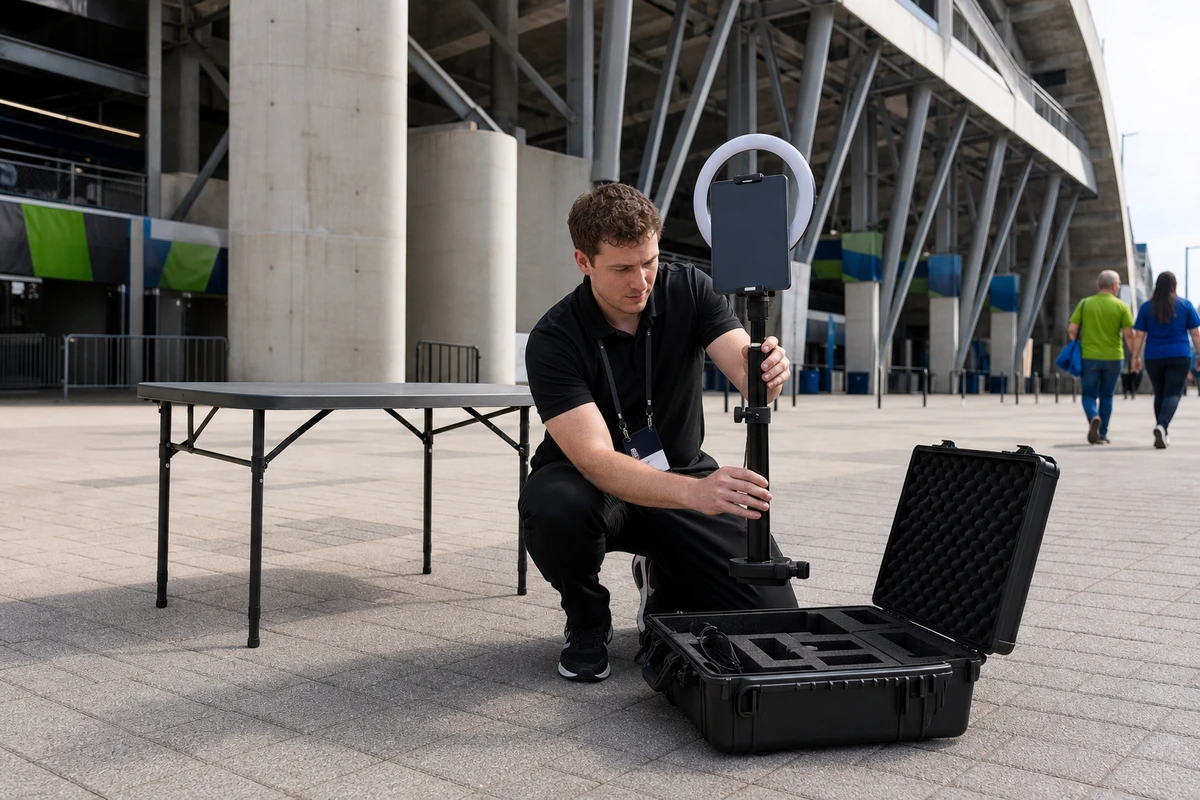
A team’s booth rarely sits still. It travels to pre-game plazas, fan zones, training-facility open houses, sponsor hospitality suites, youth camps, and recruiting events, belonging to the team as a marketing asset rather than to any single building. So it has to pack into a case, set up in minutes by one staff member, and carry a different sponsor’s overlay this week than it did last week. Because these activations exist to grow the team’s audience, the booth also has to hand every captured contact straight to the team’s CRM. A booth bolted to a concourse floor cannot do any of that. The dominant constraint for teams and athletic departments is portability paired with quick re-skinning.
Golf and country clubs
A golf club operates outdoors and nearly year-round. It runs member tournaments, holiday events, junior clinics, and outside charity outings. The booth there does two jobs at once: it keeps existing members engaged, and it generates leads. Open events bring non-members onto the property, and a booth that captures a name and email turns a charity scramble into a membership-sales prospecting list.
The market behind this is large and growing. The National Golf Foundation reports roughly 16,000 golf courses across 14,000 U.S. facilities, with more than 500 million rounds played in each of the past six years and 47.2 million Americans playing in 2024. New courses are opening at the fastest pace since 2010. A club deploying a booth at member events is operating in a healthy category, not a declining one.
Sun, power, and weather break a booth chosen for an indoor banquet. The dominant constraint for golf and country clubs is outdoor durability.
The Booth Formats, Scored for Sports Venues
Six formats turn up in any honest comparison. Each has a real use, and each fails somewhere.
Open-Air Tablet Booth
The open-air tablet booth runs a photo app on an iPad or tablet behind an open stand. It is light, packs into a case, and re-skins in software. The enclosed or classic curtained booth is the format most people picture: a private cabinet with a curtain. It is heavy, built for indoor banquets, and slow. The 360 video booth spins a camera around guests standing on a platform for a slow-motion clip. It draws a crowd and produces striking footage. The AR or green-screen mirror drops guests into a digital scene on a large screen. The roaming handheld plus hashtag printer skips the station entirely: staff walk the crowd with a camera and prints appear at a kiosk. The coin-operated licensed unit is the permanent cabinet described above.
Decisive Differences
The decisive differences:
| Format | Throughput (groups/hr) | Portable | Outdoor light | Per-event re-skin | Data capture |
|---|---|---|---|---|---|
| Open-air tablet booth | 40–50 | Yes, packs to a case | Workable with controlled lighting | Software, minutes | Built in (email/SMS) |
| Enclosed / curtained booth | 12–20 | Heavy, multi-person setup | Poor, built for indoors | Physical graphics swap | Varies |
| 360 video booth | 15–25 | Bulky platform | Poor in direct sun | Software overlay | Often app-based |
| AR / green-screen mirror | 25–40 | Moderate | Needs shade and a screen | Software | App-based |
| Roaming handheld + printer | No fixed queue | Highly portable | Camera-dependent | Print template only | Limited |
| Coin-op licensed unit | 20–30 | No, 960 lbs fixed | Indoor install | None, graphics fixed | Social share only |
Throughput Estimates
The throughput figures come from the photo booth operator community rather than a single lab study, and they are estimates, but the gaps between formats are wide enough to be reliable. An open-air tablet booth clearing 40 to 50 groups an hour serves two to three times the fans of an enclosed booth in the same halftime window.
The Pattern
Read across the table and a pattern emerges. For most sports venues the open-air tablet booth wins on the axes that compound across a season: it re-brands in software, captures data by default, redeploys to any venue type, and needs minimal staffing. The 360 booth wins as a premium attraction for a marquee night, a playoff game or an opening day, where spectacle matters more than line speed, but its 15-to-25-groups-per-hour pace and large platform footprint make it the wrong workhorse for a routine concourse. The coin-op licensed unit is a niche stadium-furniture choice that trades all flexibility for a fixed, durable, team-branded install. No single product is the answer here; the format is. And for a venue buying for a season rather than a night, the format that wins is the one that re-deploys.
The Four Constraints That Decide It
The comparison above tracks several attributes, but four of them carry the decision for a sports venue. Here is why each one outweighs a generic feature list.
Light and weather
A booth picked for a hotel ballroom fails on the back nine. Direct sun washes photos out or throws subjects into silhouette, and glare makes a touchscreen unreadable, so fans cannot even see the prompts. Photobooth Supply Co.’s outdoor-events guide describes exactly these failure modes and adds a second one: indoor venue power is not reliable for an outdoor activation, so operators bring a generator or run on battery. Battery booths deliver roughly four to six hours of continuous operation, less in cold weather, which covers a half-day charity scramble but not a full pro-am.
Durability has a measurable threshold. Operators running booths in open outdoor spaces (golf courses, tailgate lots, uncovered concourses) treat an IP54 rating as the practical minimum, which protects against limited dust and splashing water from any direction. For real exposure to rain, IP65 is the better target. A golf club buying a booth should confirm the rating before the first outdoor tournament, not after the first rained-on activation.
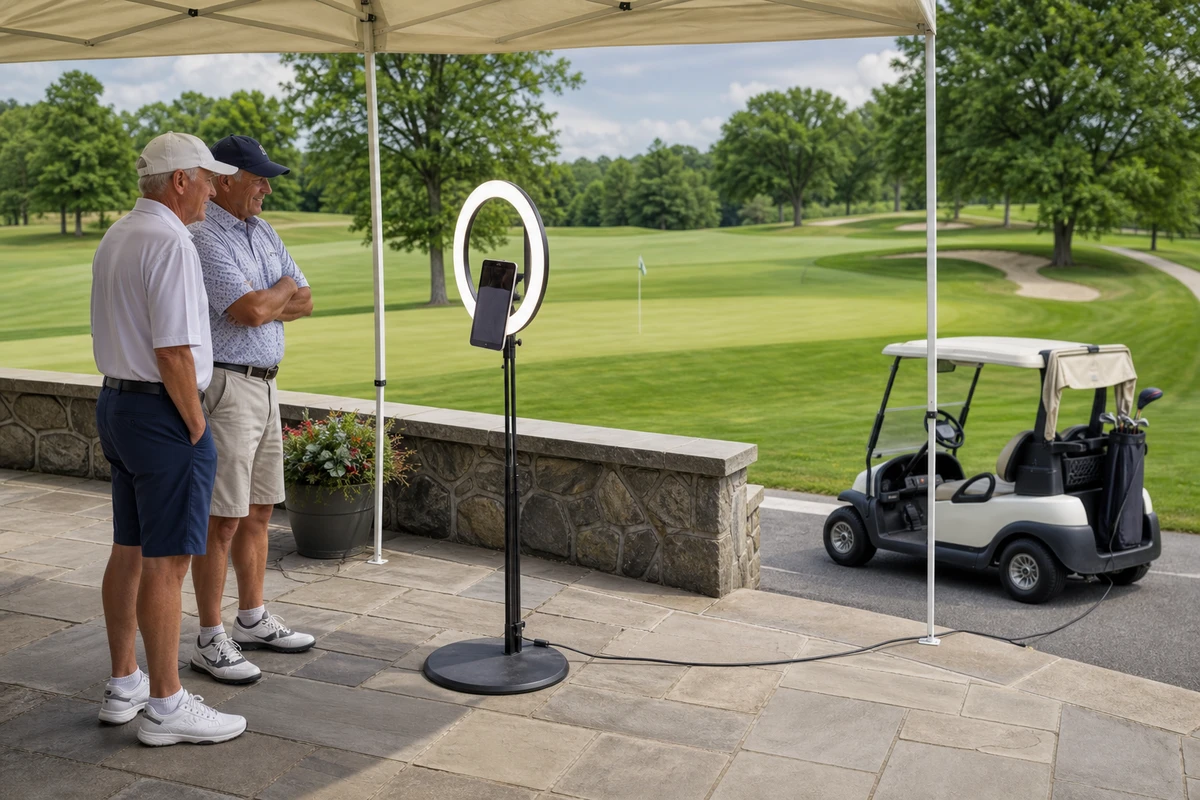
Throughput and footprint
Halftime is short, and the concourse fills fast. The booth’s pace decides how much of that line ever reaches the camera, and the arithmetic is simple. A booth clearing 45 groups an hour serves about 11 in a 15-minute window. An enclosed booth running at 16 an hour serves 4. Multiply that gap across a season and the slow booth strands thousands of fans who wanted a photo and a reason to come back. Footprint runs on the same logic in reverse: a 360 booth’s platform and operator zone occupy concourse space that could be selling concessions, so the booth has to earn that square footage in fan contacts and sponsor value.
Sponsor co-branding
To a venue’s sponsorship director, a photo booth is another line on the inventory sheet, the same category as a dasherboard or an outfield sign. Its commercial value rests on one thing: whether the venue can re-skin it. A booth whose start screen, photo overlay, and backdrop change in software can be sold to a different sponsor every night, so the same physical booth generates a new activation fee each game. A unit with fixed graphics, the coin-op cabinet being the clearest case, can be sold once and never re-sold.
Data capture and CRM handoff
A booth that delivers the photo by email or text turns every use into a consented contact record. A booth that only prints a paper strip sends the fan home with the keepsake and teaches the venue nothing. Sports marketers are blunt about why this matters: they want something concrete for the post-event report, and shares, reach, and opt-in rate are exactly what a delivery-based booth produces automatically.
Buy vs. Rent: The Season Math
Two quotes land on the desk: a rental company’s per-event price, and the all-in cost of buying a booth outright. The choice between them is arithmetic, and it pays to run it before signing either.
Rental Path
The rental path is straightforward. A staffed photo booth at a corporate or sports event runs roughly $1,400 to $2,500 for a three-to-four-hour package, with print-enabled trading-card formats reaching $3,200, based on pricing published by activation rental companies. A venue renting at a conservative $1,500 per event runs the meter every time the booth appears.
Owned Path
The owned path front-loads the cost and then nearly stops. An open-air app-based tablet booth runs about $3,000 to $8,000 for hardware, plus $500 to $1,200 a year for software depending on whether lead capture and analytics are included, plus consumables if it prints. Year one lands somewhere between $3,500 and $9,200 all in. Year two and beyond is just the software renewal and consumables.
Season Scenario
Consider a venue running 20 activations a season. The rental path costs 20 × $1,500, or $30,000, every season, forever. The owned path, taking a mid-range $5,500 booth and $900 software, costs $6,400 in year one, which works out to $320 per activation, and then roughly $900 plus consumables in every season after, well under $100 per activation. The crossover point is low: at $1,500 per rental, a $6,400 first-year setup pays for itself after four or five events. A venue with 8 events crosses it; a venue with 60 events crosses it before May.
Season-Math Caveat
The honest caveat: this only holds for a venue that activates often. A facility that runs a photo booth once or twice a year should rent, because the owned booth’s fixed cost never gets spread thin enough to win. The buy case is a direct function of frequency, and a sports venue’s defining trait is that its frequency is high. That is why the answer flips for stadiums, teams, and clubs and stays put for one-time event hosts.
Turn the Booth Into Revenue, Not a Cost Line
Golf tournament and fundraiser organizers ask one question more than any other: is a photo booth even worth it? The answer experienced organizers give is not “it pays for itself in fun.” It is structural: line up a sponsor to underwrite the booth, and it costs the organizer nothing.
Re-Skinning Mechanism
The mechanism is the re-skinning described above. A sponsor’s logo goes on the start screen, the photo overlay, the printed strip, and the email or text that delivers the photo to the fan. At the price of a single sponsorship slot, often $1,500 to $5,000 for a golf tournament, a sponsor can cover the booth’s full cost for the event, and the organizer nets the activation for nothing. The booth moves out of the expense column and into the sponsorship-inventory column.
NHL Proof
This works at scale, and the NHL is the clearest proof. NHL team sponsorship revenue climbed 21% in a single season to $1.28 billion in 2022-23, and the SponsorUnited report behind that figure names digitally enhanced dasherboards as a primary driver. The principle is the same one a photo booth runs on: a static painted board sells once a season at a fixed price, while a digitally flexible asset sells per event, per sponsor, per campaign, multiplying the revenue from one physical footprint. A re-skinnable booth is a micro-scale version of the dasherboard.
Sponsor Value
Sponsors get something back for that spend. EventTrack 2026, the longest-running benchmark study of experiential marketing, found that live brand experiences drive 70% higher brand recall than digital advertising alone. A sponsor whose name sits on a booth fans actively choose to use is buying recall, not just impressions.
Golf and Country Clubs
For a golf or country club, the same logic extends past sponsorship. A club-owned booth can be hired out by the hour for members’ private functions and run at the club’s own events, which turns it into a small recurring revenue line rather than a one-time purchase to justify.
Every Fan Photo Is a First-Party Data Record
A fan steps away from the booth and the screen asks one question: where should the photo go? They enter an email address or a phone number, because that is how the picture reaches them. No form, no friction, no sense of being marketed to. The venue ends that interaction with a consented contact record it owns outright.
Why the Exchange Matters
That exchange is worth more than it looks. Third-party tracking cookies have been dismantled across the web, which leaves a sports venue’s own audience list as its most durable marketing asset. A photo booth that delivers by email or text builds that list as a byproduct of entertaining people: the fan wants the photo, the booth wants the contact detail, and both get what they came for.
Compounding Math
The arithmetic compounds quickly. Take a single home game where 300 fans pass through the booth and 60% choose to receive their photo digitally. That is 180 consented contacts from one night. A minor league club with 70 home dates that runs the booth at even a third of them collects several thousand new local contacts in a season. If the club values an engaged local email or SMS contact at even a few dollars in future ticket and merchandise revenue, that contact list is worth more than the booth that built it, and it grows every season. One app-based booth built around that exchange, Simple Booth’s HALO kit, records the email or phone number as it delivers the photo and exports the list for the venue to keep; the golf-entertainment chain Treetop Golf used its lead capture to build 150,000 unique email addresses across its locations.
Downstream Behavior
The downstream behavior supports the model. Captured Celebrations, a managed activation company, reports an 89% social share rate among attendees who receive a digital image. That is a vendor-reported figure rather than independent research, but a directional one: a delivered photo tends to get shared, which extends the venue’s reach past the fans who were physically present. The same delivery mechanism produces the post-event report sports marketers keep asking for. Opt-in count, share rate, and total reach are not extra work; they fall out of the booth automatically. A print-only booth produces a stack of paper and no report at all.
How to Choose: A Shortcut by Venue Type
For an operator who skipped to the decision, here it is by venue type.
Stadiums and Arenas
prioritize throughput and per-night sponsor re-branding. An owned, app-based open-air booth handles the halftime rush and re-skins for a new sponsor each game. Reserve a 360 booth for marquee nights where spectacle outranks line speed.
Minor League and Athletic Departments
owned and self-run is non-negotiable on the budget. The booth has to operate without a hired attendant and pack down for the next event.
Sports Team and Brand Activations
portability and fast re-skinning per fan zone decide it, with data capture feeding straight into the team’s CRM.
Golf and Country Clubs
outdoor-rated, battery-capable, and weather-tolerant, IP54 at a minimum. The booth doubles as member engagement and a non-member lead source at open events.
Across all four, “best” means the same things: owned, brandable, data-capturing, and redeployable. A sports venue buys a photo booth for a season, not a night, and the booth that wins is the one still earning its keep at the last home game of the year.
Frequently Asked Questions
Should a stadium or sports team buy or rent a photo booth? Frequency decides it. At a typical staffed rental of about $1,500 per event, an owned app-based booth costing $3,500 to $9,200 in year one pays for itself after roughly four or five activations. If you run a booth 8 or more times a season, buy. If you activate only once or twice a year, rent, because the owned booth’s fixed cost never spreads thin enough to win.
Do photo booths work outdoors in direct sunlight? Yes, but not a booth chosen for an indoor banquet. Direct sun washes photos out, throws subjects into silhouette, and creates glare that makes the touchscreen unreadable. Outdoor use needs controlled lighting, a glare-tolerant screen, and a build rated IP54 or higher for dust and splashing water. Plan the booth’s placement to avoid facing into the sun.
How do you power a photo booth on a golf course? Two options. A battery-powered unit runs roughly four to six hours of continuous operation, less in cold weather, which covers a half-day scramble but not a full pro-am day. For longer events, plan on a generator or a battery swap, and place the booth where a cart can reach it for power support.
Can one photo booth serve both game-day crowds and smaller member events? Yes, and that redeployability is the entire buy case. An app-based open-air booth re-skins in software, so the same unit runs a sponsor-branded overlay at a Saturday game and a member-event theme at a Tuesday mixer. A booth with fixed physical graphics cannot do this, which is why format flexibility matters more than any single feature.
How many photos can a booth handle during a halftime rush? It depends on format. An open-air tablet booth clears about 40 to 50 groups an hour, while an enclosed curtained booth manages 12 to 20 and a 360 booth 15 to 25. In a compressed 15-minute halftime window, that gap means a fast booth serves two to three times the fans. For a busy concourse, throughput is the spec to check first.
Is a 360 booth a good choice for a sports venue? As a premium attraction for a marquee night, yes. It draws a crowd and produces striking video. As an everyday concourse workhorse, no. Its 15-to-25-groups-per-hour pace and large platform footprint strand the halftime line. Most venues are best served by an open-air booth for routine games and a 360 booth reserved for playoffs or opening day.
Sources
- Ad Age (2023). “NHL sponsorship revenue surges thanks to new virtual ads and jersey patches.” https://adage.com/article/marketing-news-strategy/nhl-sponsorship-revenue-surges-thanks-new-virtual-ads-and-jersey-patches/2498461/
- SponsorUnited (2023). “NHL Marketing Partnerships Report 2022-23.” https://www.sponsorunited.com/insights/nhl-2022-23-report
- Event Marketer (2025). “Exclusive Research: EventTrack 2026.” https://www.eventmarketer.com/article/exclusive-research-eventtrack-2026/
- National Golf Foundation (2025). “Golf Industry Facts.” https://www.ngf.org/golf-industry-research/
- Apple Industries (2024). “MLB Photoma by Faceplace.” https://www.appleindustries.com/photo-booths/mlb-photoma
- Photobooth Supply Co. “Mastering Outdoor Photo Booth Events.” https://photoboothsupplyco.com/blogs/tips-tricks/mastering-outdoor-photo-booth-events
- Captured Celebrations. “Photo Booth ROI for Corporate Events: The Complete Guide.” https://www.capturedcelebrations.com/post/photo-booth-roi-corporate-events-complete-guide