
A banquet manager takes the same call twice a month. A couple booking an anniversary party, a company planning a holiday mixer, a family organizing a 50th birthday: somewhere in the conversation, the client asks whether the venue has a photo booth on site. The manager says no. The client then arranges one through an outside vendor, who arrives on the event day, sets up in a corner the venue handed over at no charge, runs the booth, and leaves with a check the venue never touched.
The question that follows is the real one behind any photo booth break-even analysis at a venue: would owning a booth cost less than referring that revenue to a vendor several dozen times a year? It would, and usually far sooner than the photo-booth-business blogs suggest. But a venue has to stop borrowing those blogs’ math. A rental company breaks even by counting events. A venue breaks even by counting three returns at once.
Why the Rental-Operator Break-Even Formula Misleads Venues
A venue manager who searches for a photo booth break-even analysis will find dozens of them, and almost every one is written for the wrong reader. The formula is consistent across them: total startup cost divided by net profit per event equals the number of events needed to break even. Photo Booth International, a hardware vendor, runs the example plainly in its January 2026 profitability guide: a $10,000 investment at $950 net profit per event breaks even at about eleven events, with a six-to-twelve-month payback treated as the rule of thumb.
For a rental operator, that formula is correct. The rental company’s entire product is booth time. Every event is a sale the company had to find, quote, travel to, staff, and tear down. Events-to-break-even is the right unit because events are the only thing being sold.
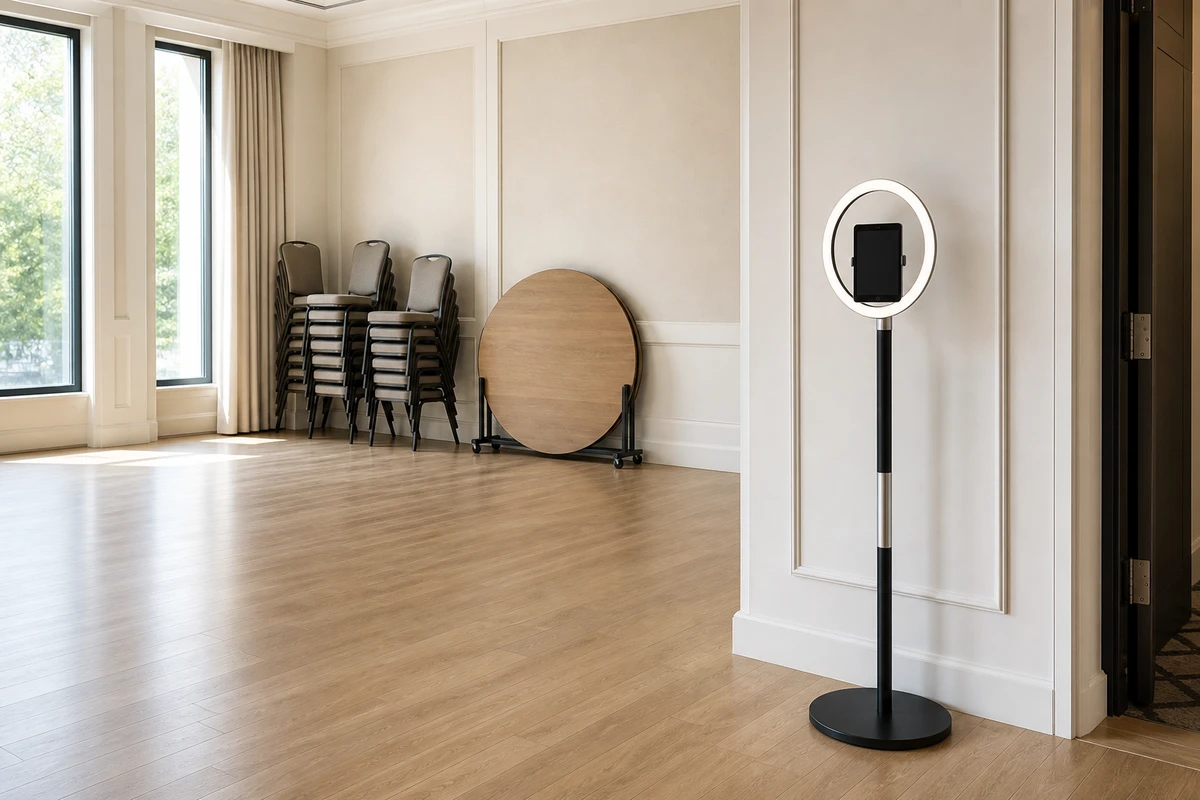
A venue sells something else. Its product is the room, the catering, the event itself. The booth is a capital amenity bolted onto events the venue was already hosting and already getting paid for. That difference erases three line items the rental formula assumes: there is no cost to acquire the booth sale, because the client is already booked; there is no travel or teardown, because the booth lives in the building; and there is no empty calendar to fill, because the events arrive on their own.
The break-even method itself is sound
The break-even method itself is sound. The U.S. Small Business Administration teaches the same arithmetic every operator should use: break-even units equal fixed costs divided by price per unit minus variable cost per unit. The trouble is the unit. For a rental company the unit is a booth event. For a venue it is not, and borrowing the rental unit counts the wrong things. A correct venue analysis throws the rental unit out and counts what the booth actually returns.
The Three Ways a Photo Booth Pays a Venue Back
A venue that owns a booth and treats it as one revenue line will undervalue it. The booth shows up on the books as a single figure, photo booth add-on income, and the manager compares that figure to the purchase price. That comparison misses two-thirds of what the booth does. A venue recovers a booth’s cost through three separate channels, running at the same time.
The upcharge
The first is the upcharge. The venue charges the event client for the booth, either as an a-la-carte add-on or as part of a higher-priced package. Because event clients can rent a standalone booth elsewhere for $500 to $1,500 (Photo Booth International, 2026), a venue can price its in-house booth as a $300 to $600 package add-on and the client still reads it as a fair deal. The venue keeps nearly all of that figure, because there is no vendor markup and no cost to win the sale. The rental blogs partly capture this channel; it is the only one their formula can see.
The booking lift
The second is the booking lift. An in-house booth is an amenity, and amenities help win bookings. Tripleseat, a hospitality management platform used by more than 19,000 venues, reports that event planners actively look for venues that offer more than a basic room (Tripleseat, 2023). The mechanism is what makes this channel large: when the booth tips a booking the venue would otherwise have lost, the venue does not earn a booth fee, it earns a full event fee. That is the channel the rental formula cannot see at all.
The marketing return
The third is the marketing return. Every booth session ends with branded photos that guests text and post, carrying the venue’s name with them, and with opt-in contact details, because guests hand over an email or phone number to receive their photo. Movebooth, a photo booth software vendor, reports capture rates of 70 to 90 percent of attendees at its installations, with 75 percent used as the conservative default in its own calculator, and cites a working subscriber value of $5 to $20 for consumer brands that actively email their list (Movebooth, 2026; vendor-reported). The high opt-in rate is believable because the guest wants the photo, so the data exchange feels like a fair trade. For a venue that lives on rebooking past clients and referral business, email ranks as the top-ROI marketing channel for consumer-facing brands in HubSpot’s 2025 research, which is the engine that gives a captured guest list real downstream worth.

These three channels stack. The break-even date is the day their combined annual return clears the booth’s fully loaded annual cost. So the cost side has to be honest.
What Actually Belongs in the Cost Denominator
A venue manager pricing a booth purchase will likely copy a cost checklist from one of those rental-business posts. That checklist is wrong in both directions for a venue. It counts costs a venue never pays, and skips one a venue definitely does.
Hardware and setup come once
Hardware and setup come once. A self-serve, digital-first booth built around an iPad starts near $2,500, and commercial software with lead capture runs roughly $1,500 a year on annual billing (Movebooth, 2026). A mid-range bundle with a better camera, ring light, backdrop, and flight case runs $3,500 to $5,000; DSLR and mirror booths cost more, into the $9,000 range (Photo Booth International, 2026).
Software is the line most cost lists forget. A booth without its subscription is a camera. The subscription is what turns it into a delivery and data-capture system, and it recurs every month whether the booth runs once that month or twenty times.
Consumables matter, but only if the booth prints. This is the cost lever most analyses flatten. A digital-only booth that texts and emails photos has a marginal cost per session near zero. A booth that prints carries a real per-print cost for dye-sublimation paper and ink, under $0.25 per 4x6 print as a working figure, multiplied by every print produced. Across a year of events, that is the difference between a negligible variable cost and a meaningful one.
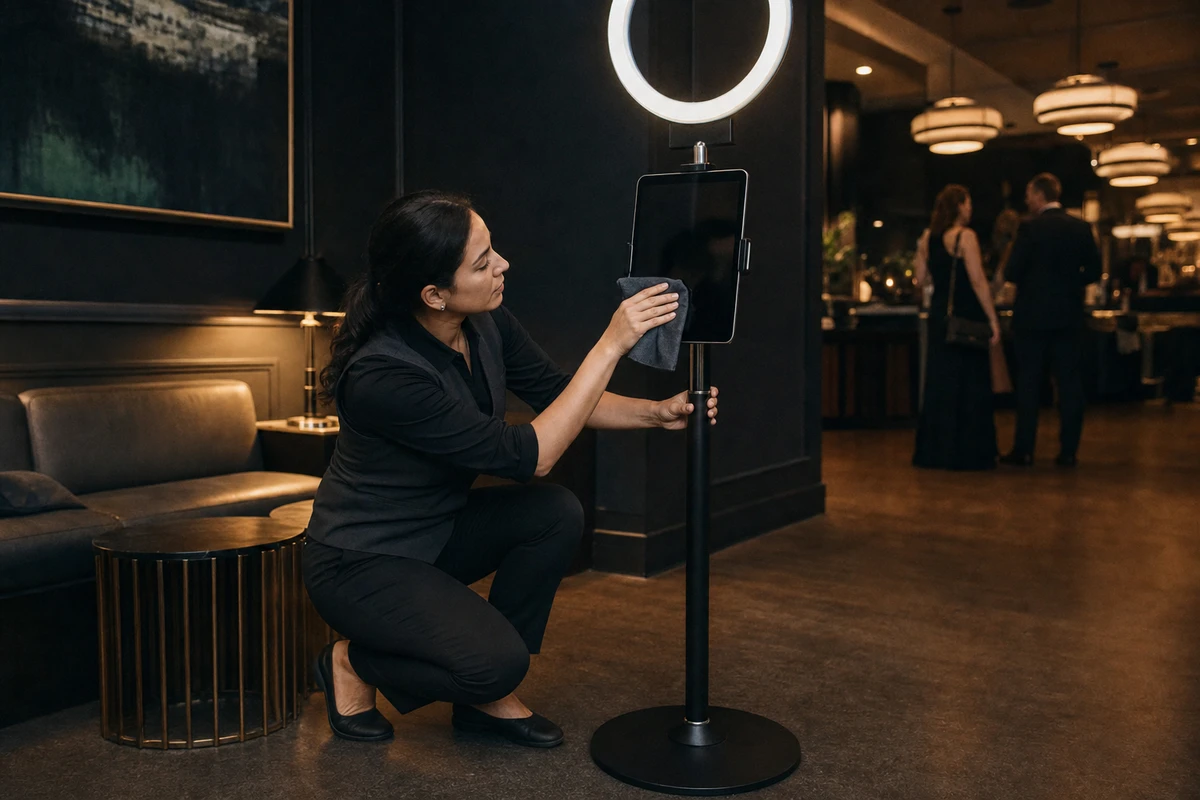
Labor is where the rental model overcharges a venue. A rental operator must staff every job, and that attendant cost dominates the rental formula. A venue running a self-serve booth does not hire for it; existing event staff point guests toward it. An attended booth adds a per-event labor cost and starts to look like the rental model again, so self-serve is the lower-cost venue path.
Depreciation should be annualized honestly rather than dropped into year one. The IRS classifies photographic equipment as five-year property under Publication 946. Straight-line over five years, a $4,500 booth costs $900 a year. A venue can also elect to expense the full purchase in year one under Section 179, where the 2026 limit easily covers a booth: a genuine tax-timing benefit, but a tax choice rather than a change in the booth’s real annual cost. For the break-even model, five-year straight-line depreciation is the honest annual figure.
What to leave out is as important. The rental formula includes travel, teardown, and the marketing spend a rental company needs to find bookings. A venue pays none of these. Stripping them out is a large part of why venue break-even arrives sooner. Add the venue’s real lines together and one number results: the fully loaded annual cost of ownership, which for a digital-first self-serve booth lands around $2,400 a year.
A Worked Break-Even Scenario Any Venue Can Copy
Take a mid-size venue that hosts about 100 private events a year: milestone birthdays, anniversaries, corporate mixers, retirement parties, social receptions. That figure is a defensible mid-range; Tripleseat’s 2026 Event Intelligence Report, drawn from 4.4 million events, is the most complete industry dataset, though its per-venue counts sit behind a form. Not every event suits a booth, so call 70 of the 100 booth-suitable. The venue buys a mid-range self-serve, digital-first booth and sets it up once. Every figure below is labeled so a venue with different numbers can run the same lines.
The cost denominator
The cost denominator. Hardware and setup: $4,500, depreciated straight-line over five years at $900 a year. Software with lead capture: $1,500 a year. Consumables: near zero, because the booth delivers photos by text and email. Fully loaded annual cost: roughly $2,400.
The utilization variable
The utilization variable. Not every booth-suitable event will add the booth. This take-rate is the single largest unknown, and operators name it as their main worry, since a booth can be a hit at one event and barely touched at the next. So the scenario runs two cases. Conservative: 40 percent of suitable events take the booth, or 28 events. Optimistic: 65 percent, or about 45 events.
Channel 1, the upcharge
Channel 1, the upcharge. The venue prices the booth as a $400 package add-on. Digital-only delivery keeps the per-event cost negligible, so close to the full $400 is margin.
- Conservative: 28 events at $400 each is $11,200 a year.
- Optimistic: 45 events at $400 each is $18,000 a year.
Set the conservative figure against the $2,400 fully loaded annual cost. The booth covers its full annual cost after six add-on sales. Even measured the rental way, as cash to recover the $4,500 hardware outright, eleven add-on sales clear it, roughly five months at this venue’s pace. Measured properly, against the annualized cost the booth actually carries, Channel 1 alone breaks even inside the first quarter, before the other two channels contribute anything.
Channel 2, the booking lift
Channel 2, the booking lift. Suppose the booth, listed as an amenity, tips just one extra booking a year that a competitor without one would have won. At a mid-size venue, a single event fee runs into the thousands of dollars, so that one booking on its own exceeds the booth’s entire fully loaded annual cost. The scenario holds this to a single booking on purpose, because no neutral source quantifies the close-rate lift. The point is only that the bar is low.
Channel 3, the data
Channel 3, the data. In the conservative case, 28 events with the booth, an average of 75 guests each, and a 75 percent opt-in rate produce about 1,575 new opted-in contacts in a year. Valuing each contact at $5, the floor of the subscriber-value range cited earlier, puts the list’s first-year worth near $7,900. This is the softest of the three numbers, because the value is realized only if the venue actually emails the list. Held to that floor, it still clears the booth’s annual cost on its own. That contact channel can scale well past one venue’s math. Simple Booth reports that Treetop Golf, an entertainment venue chain, built a list of 150,000 unique email addresses across its locations using the lead capture in its HALO kit, a self-serve iPad booth that keeps captured contacts in the operator’s own account.

Put the three together
Put the three together. The conservative case breaks even on the upcharge inside the first quarter, then spends the rest of year one stacking a booking-lift return and a five-figure contact list on top. The rental blogs’ six-to-twelve-month payback describes a business that had to find every event. A venue did not.
“Free” Venue Placement vs. Owning: The Hidden Trade
Before a venue buys anything, a vendor will offer to install a booth at no cost. The pitch is everywhere in this market, and it is genuinely appealing. The vendor installs a booth for free, handles maintenance, monitoring, repairs, permits, and taxes, services it after hours, and pays the venue a monthly share of the revenue (Majestic Photobooth, 2026). The venue’s logo goes on the photos. There is no purchase, no subscription, no break-even date to wait for.
The Placement Tradeoff
There is also no investment, which is exactly the trade. The placement model has no break-even date because the venue never spends anything, but it carries a permanently lower ceiling. The vendor owns the booth, so the vendor keeps the upcharge margin. Channel 1, the largest and most reliable return, goes to the vendor. The vendor also runs the data system. Placement booths do capture guest data (photobooth.co confirms collection is included), but the access a venue receives tends to be a curated monthly email export rather than ownership of the underlying database, which points to the vendor controlling Channel 3 as well. The venue is left with a slice of the smallest of the three channels.
The scale of what gets handed over shows up in the vendors’ own numbers. Majestic reports a placement booth at New York’s TWA Hotel producing 8,500 prints and 3,500 email captures a month (Majestic Photobooth, 2026; vendor-published, and the TWA Hotel is a high-traffic landmark property rather than a typical venue). Under a placement deal, that monthly list of 3,500 contacts lives in the vendor’s system.
Placement still wins in specific cases: a venue with low or seasonal event volume, no staff bandwidth to keep a booth stocked, no appetite for holding a capital asset, or a real wish to test demand before committing. Owning wins when event volume is steady, the event mix is booth-suitable, and the venue intends to build a marketing list or rebook past clients. The honest framing is not that placement is a trap. It is that placement trades the upside away for zero risk, and a venue with a full calendar is giving up the most upside.
Five Variables That Move the Break-Even Date
A venue that has run the scenario above can pressure-test it. Five variables move the break-even date more than any others, and each moves in a knowable direction.
Take-Rate and Event Mix
Take-rate is the share of booth-suitable events that actually add the booth. It swung the worked scenario from 28 events to 45. Anything that raises it, staff who mention the booth during the sales conversation or a visible demo at tastings and tours, pulls the break-even date forward.
Event mix is the share of the calendar a booth fits. A booth earns its keep at milestone celebrations, corporate socials, and reunions, and sits idle at board meetings and ceremonies. A calendar that skews toward celebration events has more booth-suitable events to draw on, which lifts the ceiling on every channel.
Printing versus digital delivery sets the variable cost. Printing adds guest appeal and a per-print consumable cost on every session. Digital-only delivery keeps the marginal cost near zero, so break-even arrives faster. A venue that wants prints should expect a later break-even date and decide whether the guest experience earns it.
Attended versus self-serve sets the labor line. An attendant is the cost that dominates the rental model. A self-serve booth removes it, since existing event staff are enough. Adding a paid attendant moves the venue’s cost structure toward the rental operator’s and pushes break-even out.
Pricing model sets both margin visibility and take-rate. An a-la-carte upcharge shows the client a line item, which keeps margin clear but can lower the take-rate as some clients decline. Folding the booth into a premium package raises the take-rate, because most clients accept the package as built, but hides the margin inside the package price. The first model makes Channel 1 easy to measure; the second usually books more booths.
A venue should not ask how many booth events it takes to break even. It should ask how fast three stacked returns clear one fully loaded annual cost. Running the worked scenario on a venue’s own calendar, take-rate, and upcharge usually puts the answer inside the first quarter, not the first year. The booth that gets there fastest is the one that is self-serve, digital-first, and leaves the guest data in the venue’s own hands.
Sources
- Photo Booth International (2026). “Is a Photo Booth Business Profitable? Real Numbers.” https://photoboothint.com/photo-booth-business-profitable-real-numbers/
- Movebooth (2026). “Photo Booth ROI Calculator.” https://www.movebooth.com/roi
- Tripleseat (2023). “9 Event Venue Amenities That Will Help You Book More Business.” https://tripleseat.com/blog/event-venue-amenities-that-will-help-you-book-more-business/
- Tripleseat (2026). “The 2026 Event Intelligence Report: Data, Benchmarks, and Blueprints for High Growth Venues.” https://info.tripleseat.com/new-handbook-the-2026-event-intelligence-report
- Majestic Photobooth (2026). “Venue Placement Program” and “What Is a Permanent Photo Booth? How It Works for Venues.” https://www.majesticphotobooth.com/venue-placement
- HeyOK / photobooth.co (2026). “Permanent Photo Booth Install and Venue Placement.” https://photobooth.co/permanent-install
- U.S. Small Business Administration. “Break-even point.” https://www.sba.gov/business-guide/plan-your-business/calculate-your-startup-costs/break-even-point
- Internal Revenue Service (2024). “Publication 946: How to Depreciate Property.” https://www.irs.gov/publications/p946
- HubSpot (2025). “Marketing Statistics.” https://www.hubspot.com/marketing-statistics