
A member finishes the last workout of a 12-week challenge, walks to the front of the gym, and stops in front of the logo wall to take a photo of the result. That photo is worth money to the gym. Whether the gym captures any of that money depends on what happens in the next thirty seconds.
Search “photo booth ROI” for a gym and the results answer a different question. Nearly every page that ranks for that query is written for someone starting a photo booth rental business, complete with figures like $600 to $1,500 per event and a payback period of three to six months. A gym operator does not run a rental business. For a gym, a booth is a fixed marketing asset, closer to signage or a referral program than to a revenue line, and its return shows up in two ledgers the operator already lives by: what it costs to acquire a member, and how many members survive the first 90 days. For community-driven gyms, the math can work. This analysis also covers the gyms where it does not.
Why “Photo Booth ROI” Means Something Different for a Gym
A gym owner researching this purchase finds page after page pricing a booth as inventory for an events company: book it out most weekends, collect $600 to $1,500 a night, recoup the hardware in a season. A gym will never rent its booth to anyone. The booth sits in the lobby and serves the gym’s own members, which makes the rental-business payback model irrelevant before the math starts.
Return here is indirect. A gym photo booth earns its keep the way a referral-card display or a transformation wall does: not by collecting a fee, but by changing member behavior in ways that show up in the numbers a gym already tracks every month.
One correction shapes everything that follows. A booth does not generate content on its own. Installing one produces member photos about as reliably as buying a treadmill produces fitness. The booth multiplies a habit the gym already has, or exposes the fact that it has none. Every figure in the analysis below depends on that distinction.
The Two Numbers a Gym Photo Booth Has to Move: CAC and Churn
Acquisition: replace some paid clicks with member proof
Two members join on the same Saturday. The first answered a paid ad, and by the time that click became a signed member, the gym had spent real money. WordStream’s 2024 analysis of more than 17,000 US Google Ads accounts put the cost of a single fitness lead at $61.56, and a lead is not yet a member. Once leads are worked and converted, blended acquisition costs for gyms commonly land between $50 and $200 per member. The second member joined because a friend who trains at the gym showed her a finish-line photo and said come along. That member cost the gym nothing in ad spend.

A photo booth is a machine for manufacturing the second kind of member. Every gym already knows referrals are its lowest-cost channel. What gyms lack is the prompt and the moment. Members rarely refer a friend, not because they are unwilling, but because no one asks them at a point when they have something to show. A member who takes a branded photo after a milestone and shares it is making a public, low-friction referral to her own network, at the moment she feels best about the gym.
That recommendation carries unusual weight: Nielsen’s 2013 Global Survey on Trust in Advertising, which polled 29,000 people across 58 countries, found that 84 percent of consumers trust recommendations from people they know above any other form of advertising. The effect also compounds. A 2024 study by Rachel Gershon and Zhenling Jiang in the Journal of Marketing Research found that referred customers go on to make 31 to 57 percent more referrals than customers acquired other ways, and that firms ignoring this undervalue their referral programs by 20 to 36 percent.
Retention: give the first 90 days a visible win
The second lever is churn, and specifically what operators call the 90-day cliff. Roughly half of new gym members quit within six months and about 30 percent are gone by month three, according to fitness industry data published by ABC Fitness on the Glofox blog. Retention is also where the lower-cost growth sits: Harvard Business Review, citing Bain & Company research by Frederick Reichheld, reports that acquiring a customer costs five to 25 times more than keeping one, and that raising retention by five percent can lift profits between 25 and 95 percent.
The first 90 days decide which way a new member goes. Those who hit an early win and feel they belong stay: research by fitness retention analyst Dr. Paul Bedford, cited by ABC Fitness, shows 87 percent of fully onboarded members are still active at six months against 60 percent of those with little onboarding, and at one year the gap widens to 70 percent against 38 percent. The touchpoints that move retention are small. The Health & Fitness Association found that just two staff interactions a month with a member produced an extra visit the following month and cut cancellation risk by about a third. A booth turns a milestone (a first month finished, a challenge completed, a personal record) into a celebrated, visible moment, and gives staff a natural reason to interact. That is exactly the early-win-and-belonging mechanism the retention data rewards.
Contact data is the smaller lever
A quieter third lever sits behind those two. A booth can capture a member’s email or phone number, with permission, at the moment of the photo, which feeds the gym’s own retention messaging. It helps, but it stays secondary to acquisition and churn.
What a Gym Photo Booth Actually Costs
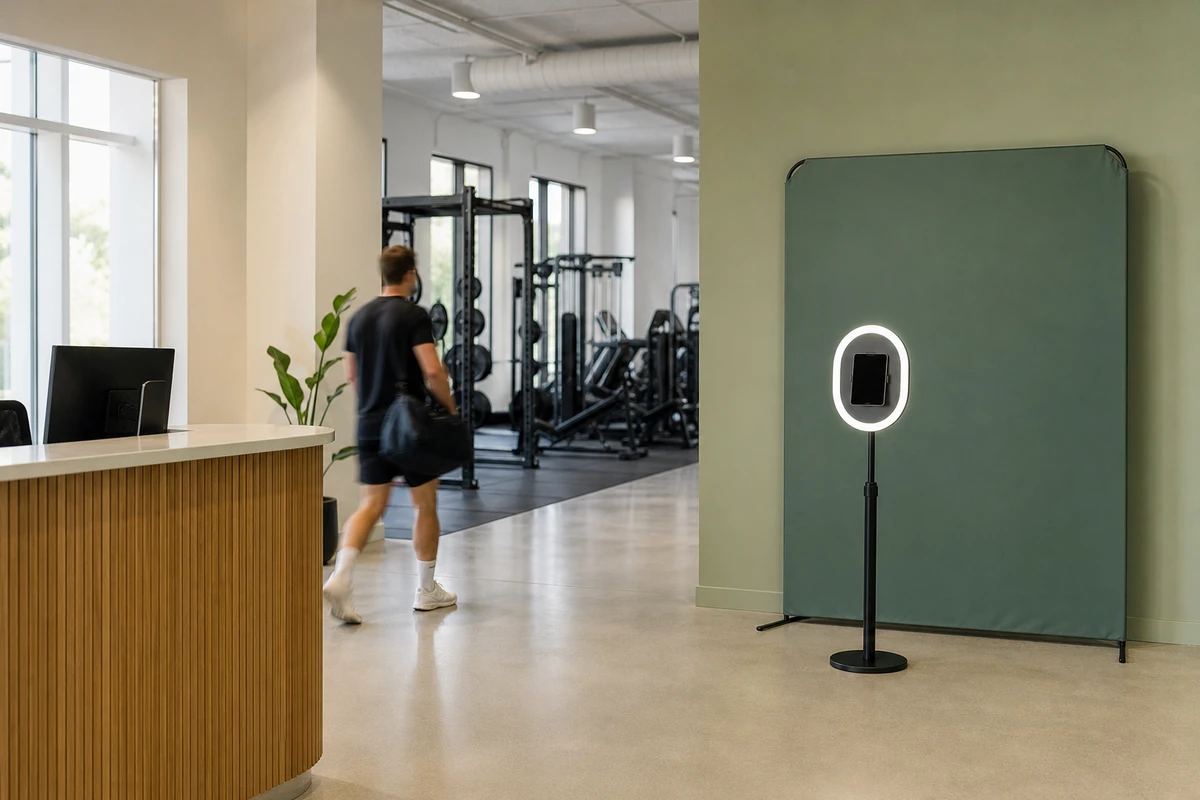
The booth itself is modest hardware: a stand or shell, a tablet or camera, a light, and a printed backdrop, placed near the front desk or the transformation wall. The cost question splits cleanly into what the gym pays once and what it pays every month.
Hardware and software are the visible costs
The upfront cost is the hardware, a software license, and a branded backdrop. Independent market pricing for this is thin, and the figures that circulate come mostly from vendors rather than neutral surveys, so they are best read as a range. A self-serve, unattended booth setup of the kind a gym uses generally runs in the low thousands of dollars, with enclosed booths and premium configurations running higher. A gym evaluating a specific booth should get the current price directly from the vendor and treat any blog figure as a rough guide.
The ongoing cost is the software subscription, a monthly fee for the app that runs the screen, captures contact details, and handles sharing. Simple Booth’s HALO app is one example: it runs the photo screen on an iPad, collects opt-in email or phone details through custom fields, and sends each member their photo by email, text, or QR code, with an offline upload queue that holds sessions when lobby Wi-Fi drops. Consumables are close to zero for most gyms, because gym use is overwhelmingly digital sharing rather than printing. Staffing is also close to zero: a self-serve booth runs unattended once it is set up.
Staff ownership is the hidden cost
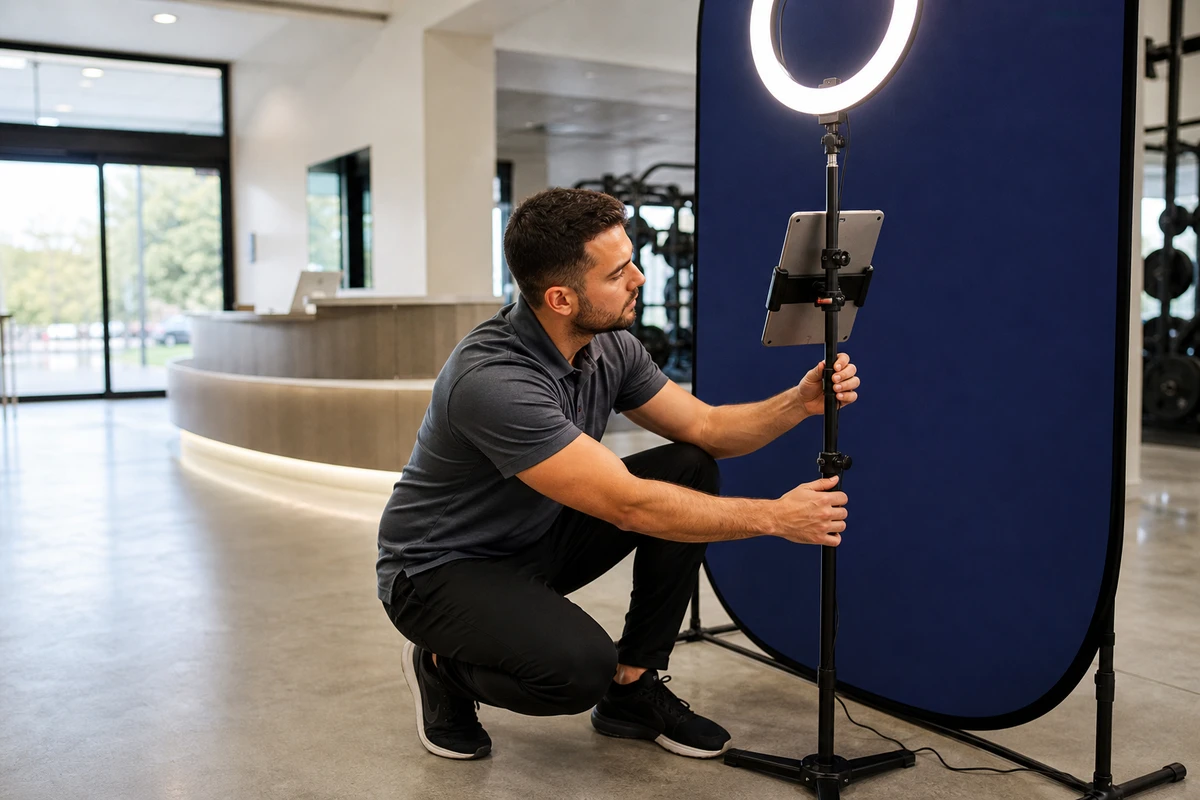
Then there is the cost that never appears on an invoice, and it is the one that decides the outcome. A booth needs floor space, ideally a few square feet near a high-traffic spot. More importantly, someone on staff has to own it: refresh the prompt, run the incentive, and repost what members create. A booth with no owner becomes expensive furniture within a month. That soft cost, a named person spending an hour or two a week, belongs in the budget even though it never shows up as a line item.
Renting and buying produce different cost structures, a decision the final section covers in full. The math below assumes a purchase, where the booth is a fixed asset spread across its useful life rather than a fresh cost at every event.
The ROI Math: A Worked Scenario Operators Can Run
Take a 600-member gym charging $69 a month, the 2024 US average in fitness industry benchmarking data. The gym buys a self-serve booth and wants to know when it breaks even. Here is one transparent way to run the numbers. Every input below is an assumption, labeled as one, and a gym with different traffic should expect different outputs.
The annual cost in this scenario
Start with the cost. Assume the hardware and backdrop cost $4,000 and last four years, which is $1,000 a year, plus a software subscription of about $100 a month, or $1,200 a year. All in, the booth costs roughly $2,200 a year to own and run.
The acquisition return
Now the acquisition return, built one step at a time:
- Sessions. Assume 80 booth sessions a month, drawn from new-member milestones, challenge finishes, and gym events.
- Shares. Assume half of those sessions end in a public share, so 40 shares a month.
- Inquiries. Shares are not leads. Conservatively, assume one share in eight sparks an inquiry from someone in that member’s network, which is 5 inquiries a month.
- New members. Referral leads convert far better than cold ones. ABC Fitness benchmark data published on the Glofox blog puts referral conversion near 41 percent against 1 to 3 percent for paid social. Round down to 40 percent, and those 5 inquiries become 2 new members a month, or 24 a year.
- Value. At a conservative blended acquisition cost of $100 a member, those 24 members represent about $2,400 a year in paid acquisition the gym did not have to spend.
That figure alone roughly covers the booth, before counting a dollar of the dues those 24 members pay.
The retention return
Now the retention return, which is the softer and harder-to-attribute half. Say the gym onboards 20 new members a month, 240 a year, and half are at risk of quitting within six months. If celebrating early milestones at the booth improves six-month retention across that cohort by just two percentage points, that is about 5 members a year who stay when they would otherwise have left. Value each save conservatively at eight additional months of dues, $69 times 8, or about $550 each. Five saves come to roughly $2,750 a year in retained revenue.
Add the two halves: roughly $2,400 in acquisition value and $2,750 in retention value, against a $2,200 annual cost. In this scenario the booth pays for itself inside the first year and returns more than twice its cost, with the break-even point landing around month five.
The caveat is utilization
One honest caveat keeps the model from flattering itself. If the gym is half as active, with half the sessions and half the shares, every output above halves and the payback period roughly doubles. And if no one on staff feeds the booth, the session count is not 80 a month, it is closer to zero, and there is no return to discuss. The arithmetic is only ever as good as the activity behind it.
When a Photo Booth Pays Off for a Gym, and When It Doesn’t
Two gyms buy the identical booth. In a 200-member strength studio that runs quarterly transformation challenges and posts a member spotlight every week, the booth is busy by its second week, because the gym already had the habit and the booth gave it a better tool. In a 24-hour access gym on a commercial strip, staffed by one person at peak hours and built around members who badge in, train alone, and leave, the same booth sits unused. The hardware is not the variable. The community and the operating discipline around it are.
Community-driven gyms have the mechanism
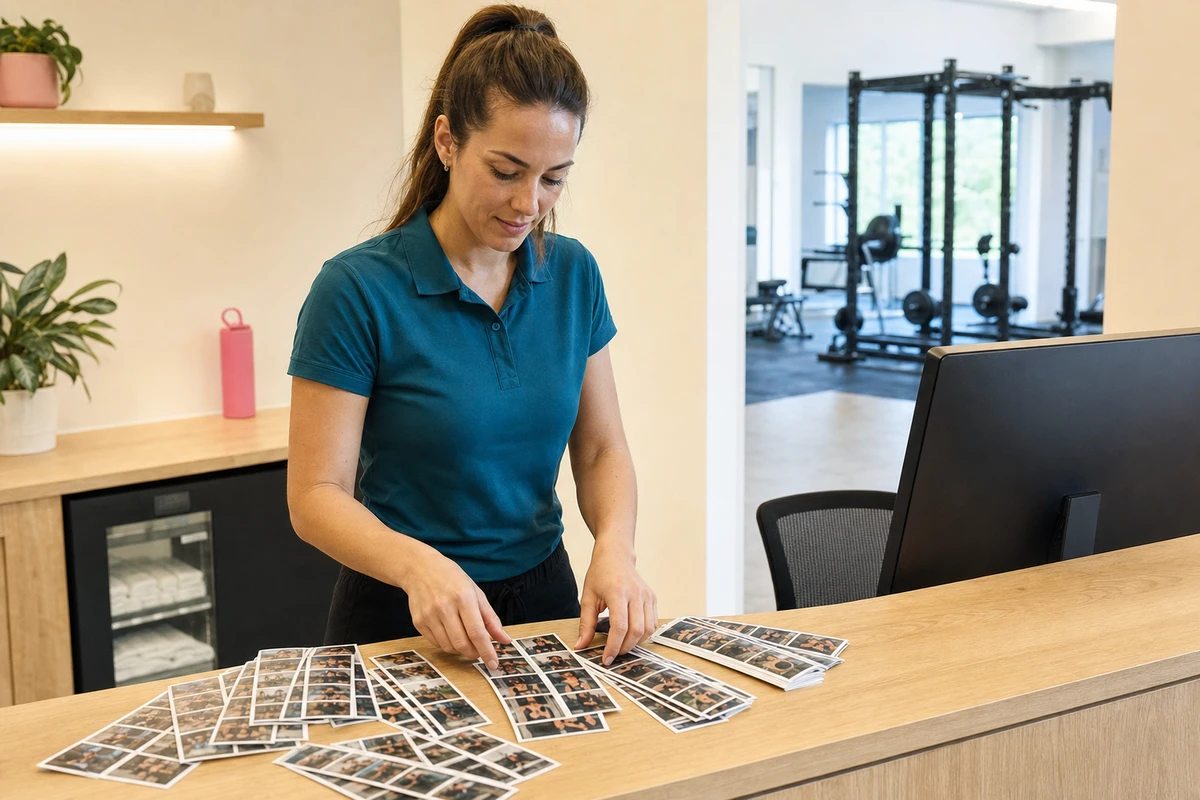
A booth pays off in gyms where members already want to be seen and the staff already runs the programming a booth amplifies: boutique studios, community-driven gyms, places with a transformation-challenge culture, gyms that already feature members and celebrate milestones. Social connection matters here because it is why many members joined in the first place. ABC Fitness’s Fall 2025 Wellness Watch report found that 57 percent of active consumers cite social connection as a primary reason for joining a fitness facility. A booth gives that connection something to do.
Access-only gyms usually do not
A booth underperforms in the opposite environment: budget and 24-hour access gyms with little staff presence, member bases who train to be left alone and will not photograph themselves, and any gym without the social-media discipline to repost what the booth produces. For those gyms the booth is a cost with no mechanism behind it.
Usage needs a prompt and a reason
This resolves the misconception named at the start. A booth does not create content by itself. Operators who have run a branded hashtag already know participation collapses without a prompt and a reason. Utilization needs both: a prompt, which is signage, a challenge, or a staff member asking, and an incentive, which is a feature on the gym’s page, a prize draw, or referral credit. Without them, session volume falls, and when sessions fall, every number in the scenario above falls with it. The deciding question is not whether the gym can afford the booth. It is whether the gym has the community and the discipline to feed it.
Buy or Rent? Matching the Decision to the Gym
Rent for one-off events and tests
A gym celebrating its fifth anniversary wants a booth for one Saturday night. It should rent. A photo booth rental for a single event commonly runs between $600 and $1,500 for a few hours, depending on the booth type and the local market. For a one-off, that is far less than owning, and it surrenders no floor space the rest of the year.
Renting is the right call for a gym testing the idea before committing, or capturing a single occasion: a grand opening, an anniversary, a member-appreciation night, the finale of a transformation challenge. The cost is per event, the commitment is zero, and the gym learns whether its members actually use the thing.
Buy when the booth has weekly work
Buying is the right call when the booth has steady, year-round work. A gym running recurring challenges, a regular flow of new-member milestones, and a weekly content habit will put the booth in front of members dozens of times a month. At that volume, repeated rental fees add up fast. The decision rule is plain arithmetic: estimate how many booth events the gym will realistically run in a year, divide the purchase-and-amortize cost by that number, and compare the result to the per-event rental price. If owning costs less per event, and the gym clears the utilization threshold from the scenario above, buy. If not, rent and re-evaluate after one full challenge cycle.
The threshold is utilization, not enthusiasm. A gym that runs three or four booth events a year should keep renting. A gym that can honestly project a booth in regular weekly use is past the break-even and should own one. The honest version of this decision starts with a realistic event count, not the hope of one.
Frequently Asked Questions
How much does a photo booth cost for a gym? It depends on whether you rent or buy. A single-event rental commonly runs $600 to $1,500 for a few hours. Buying a self-serve booth setup costs in the low thousands of dollars upfront, plus a software subscription, often around $100 a month. Get the current price from the vendor, since independent pricing data is thin.
Will gym members actually use a photo booth? Only if the gym gives them a reason. In community-driven gyms with challenges and member spotlights, usage is high. In access-only gyms where members train alone, a booth usually sits idle. Use needs a prompt and an incentive, not just the hardware.
Should a gym buy or rent a photo booth? Rent for one-off events or to test the concept. Buy when the booth will be in regular use year-round, the point at which repeated rental fees exceed the amortized cost of owning. Estimate annual events first, then do the arithmetic.
How do you measure the ROI of a gym photo booth? Track it against two numbers: referral leads acquired at little or no ad cost, and the 90-day retention of new members. Watch booth sessions, share rate, referral inquiries, and cohort retention. If those move, the booth is working.
Is a photo booth worth it for a budget or 24-hour gym? Usually not. Those gyms run on volume and low staffing, with member bases that rarely want to be photographed. Without community programming and someone to run the booth, it becomes a cost with no return.
Sources
- American Marketing Association (2024). “Referral Contagion: Capturing the Full ROI of Referral Programs” (summary of Gershon & Jiang, Journal of Marketing Research). https://www.ama.org/2026/03/02/referral-contagion-capturing-the-full-roi-of-referral-programs/
- ABC Fitness / Glofox (2025). “Gym Membership Statistics.” https://www.glofox.com/blog/gym-membership-statistics/
- ABC Fitness (2025). “New ABC Fitness Wellness Watch Report Shows 57% of Active Consumers Are Looking for Connection in Their Fitness Community.” GlobeNewswire. https://www.globenewswire.com/news-release/2025/10/16/3168015/0/en/New-ABC-Fitness-Wellness-Watch-report-shows-57-of-active-consumers-are-looking-for-connection-in-their-fitness-community.html
- Harvard Business Review (2014). “The Value of Keeping the Right Customers.” https://hbr.org/2014/10/the-value-of-keeping-the-right-customers
- Health & Fitness Association (2024). “How Gyms Are Using Member Data to Increase Retention.” https://www.healthandfitness.org/how-gyms-are-using-member-data-to-increase-retention/
- Nielsen (2013). “Global Survey on Trust in Advertising.” https://www.nielsen.com/insights/2013/under-the-influence-consumer-trust-in-advertising/
- WordStream / LocalIQ (2024). “Google Ads Industry Benchmarks.” https://www.wordstream.com/blog/ws/2016/02/29/google-adwords-industry-benchmarks