
A coworking space hosts an open house on a Thursday evening. The lounge is full, someone catered it, and three prospects are halfway through a tour. One member closed a new client that afternoon and wants a photo to mark it. Two others want a group shot before people drift off. They prop a phone against a monitor, get a crooked, half-lit frame, and the picture settles into one camera roll where no one else will ever see it. The space paid for the food, the promotion, and the staff hours, and walked away with nothing it could post.
The best photo booth for a coworking space closes that gap, and it is not what a search for the term returns. It is a compact, self-service, app-based open-air booth the space owns and leaves running. Not the soundproof privacy pod that dominates the results. Not the attendant-operated camera rig sold to rental operators. Not a booth hired for a single night. A shared workspace does not need party entertainment for one evening. It needs a fixed amenity that produces member content, captures contacts, and creates the small recurring moments that keep members renewing. This article defines that category, makes the business case on the two numbers operators live by, lays out the buying criteria, runs the math, and shows how to deploy the booth so it earns its corner.
What a photo booth actually means in a coworking space
An operator who searches for the best photo booth for coworking gets a strange results page. The top result is usually about soundproof pods for private calls. Below it sit pages coaching people on which camera hardware to buy, and beside those, companies that rent booths for corporate parties. Three different products, none of them an answer for someone who runs a shared workspace and wants to know whether a booth belongs in it.
The confusion starts with the word “booth.” In coworking, a booth is normally a Framery-style acoustic pod, a piece of furniture for taking calls. So the first thing to set aside is the privacy pod. It solves a real coworking problem, noise, but it has nothing to do with member content or engagement, and it comes out of a different budget.
Staffing
The second category is attendant-operated camera hardware: enclosed booths with print kiosks, strobes, and a DSLR, marketed to rental operators who book booths at events for a living. That gear is overbuilt for a fixed install. It needs a trained person standing next to it, and it is optimized for portability between weekend bookings, not for sitting in a lounge.
The single-day rental
The third is the single-day rental. A space can rent a booth for one open house. That is a legitimate trial, covered later, but it leaves no asset behind and no recurring value.
The category this article evaluates is the fourth: a branded, self-service, open-air photo experience installed in the space. It runs on a tablet, needs no attendant, and members operate it themselves. It works in two modes. In always-on mode it idles in the lounge and members use it whenever they want. In event mode it becomes a featured station for member nights, open houses, and mixers. Judged correctly, this is an amenity purchase, evaluated the way an operator evaluates a good coffee machine or a podcast room, not the way a planner books a DJ for one night.
Why a coworking space should own one: the churn and tours case
A coworking space can be at 90 percent occupancy and still be in trouble. Occupancy measures who is in the building this month; it says nothing about who quietly gives notice next month. The Deskmag 2025 Global Coworking Survey found that only 54 percent of coworking spaces are profitable and 18 percent are operating at a loss, against an average occupancy of 68 percent. Filling desks is not the same as keeping the business healthy.
Operators feel that split directly
Operators feel that split directly. In a May 2026 analysis, the coworking platform Optix reported that 47 percent of operators name occupancy as their top priority, while 53 percent say member retention is a daily challenge. Optix puts a healthy year-over-year retention rate at 65 to 85 percent. A space at the bottom of that band replaces roughly a third of its members every year, and replacement is expensive: the marketing, the tours, the onboarding, all run again.
This is where retention economics matter. Research by Frederick Reichheld of Bain & Company, cited in Harvard Business Review, found that increasing customer retention rates by 5 percent increases profits by 25 to 95 percent, and that acquiring a new customer costs five to 25 times more than keeping an existing one. The same article cites Murphy and Murphy’s finding that a 2 percent gain in retention does as much for the bottom line as cutting costs by 10 percent. A coworking membership is a recurring subscription, so small movements in churn move real money.
What keeps a member from leaving when a rival space undercuts the rent is rarely the desk; it is the community, the sense that leaving would cost them something. The Coworks 2024 operator and member survey found that 71 percent of members come to their space specifically to network and 64 percent have made professional connections through it. That survey measures why members show up, not directly why they stay, but the two connect: a member with working relationships in the building has more to lose by leaving than one who only rents a desk. The same survey found 86 percent of operators consider referrals from current members an important source of income, so community is the acquisition channel as well as the retention lever.
Most operators already act on this without naming it. They run a “Headshot Day.” Cowork Frederick negotiates a guaranteed minimum fee with a local photographer, then offers members headshot packages at $100 for basic and $150 for deluxe; the space handles scheduling and promotion and frames the result plainly: look good on LinkedIn, a company website, and marketing materials. The page even cites the psychology behind it, the Willis and Todorov finding (Psychological Science, 2006) that people form a trust judgment of a face in roughly a tenth of a second.
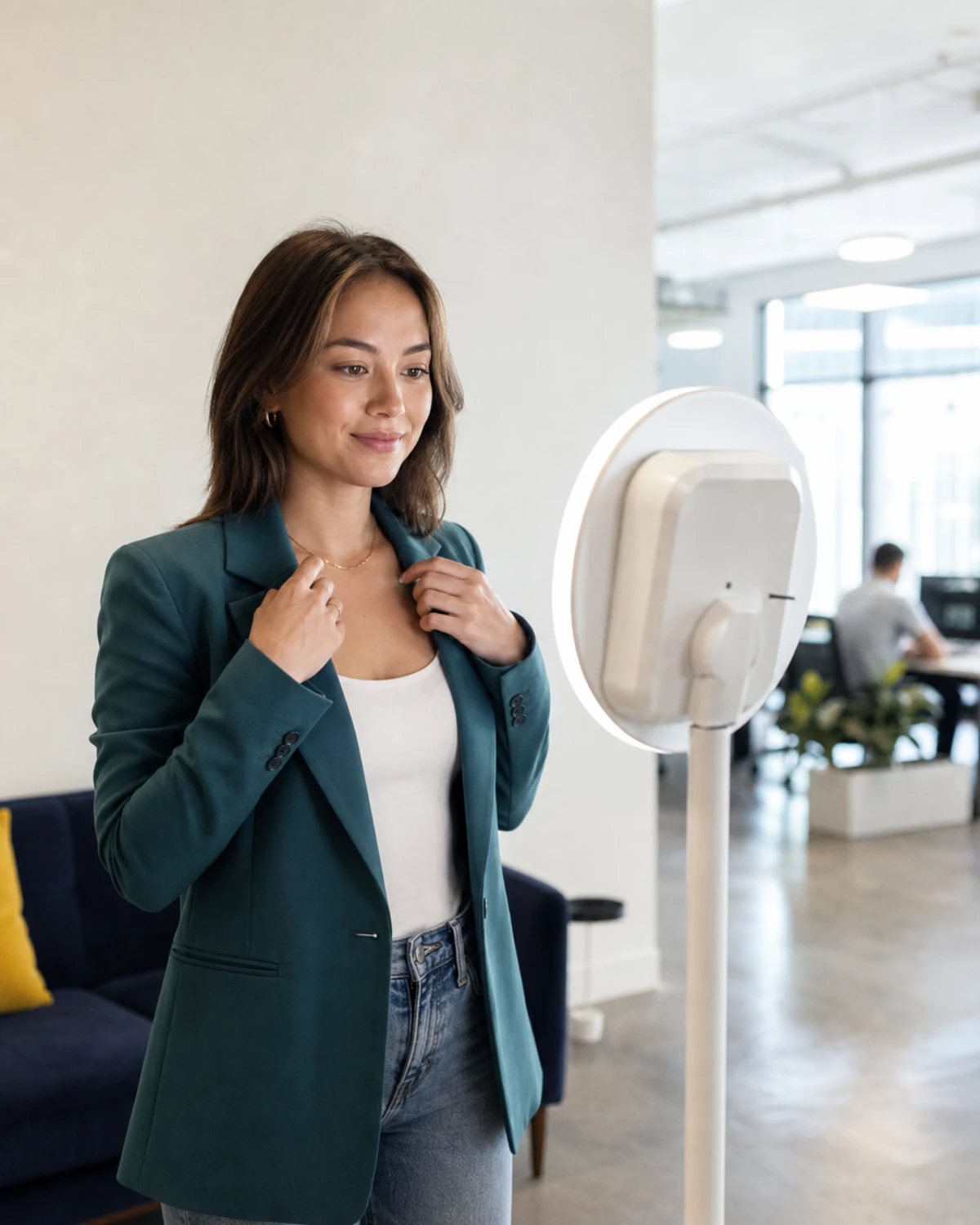
ThriveCo ran a Professional Headshot Day for members in May 2024 and made it free, a membership perk rather than a revenue event. Two economic models, one shared insight: members genuinely want current professional photos, and a space that supplies them creates a reason to stay. Cat Johnson, a coworking community strategist, lists photo and headshot days among more than 120 proven event formats, so this is established operator practice, not an experiment.
A photographer booking happens once or twice a year. An owned booth is the always-on version of the same event, available the week a member updates a title or closes a deal, with no photographer to schedule.
Tour-to-Join Rate
The second number is the tour-to-join rate, and it now turns on content the space does not control. Spacebring, writing in February 2026, put it bluntly: prospects “search on TikTok to see the vibe and Google Maps to see the proximity,” and “if they can’t ‘virtually walk’ through your space in 15 seconds, they won’t book a tour.” What convinces them is not polished promo. Nexudus, citing Nielsen, notes that 92 percent of consumers trust peer recommendations over advertising. Member-shot photos with the space’s name on them are exactly that signal, produced continuously and at no extra cost.
So an owned booth pays back three ways at once: member-made content the space can repost to win tours, an opt-in list of members and visitors, and recurring recognition moments that raise the odds a member renews. The rest of this guide is about choosing and deploying a booth that delivers all three.
What to look for: the coworking buyer’s criteria
A coworking space runs on a skeleton staff. On a normal afternoon there may be one community manager handling tours, member questions, and the front desk at the same time. Any amenity that needs babysitting will not get used, because no one has a free hour to babysit it. That single fact does most of the filtering. Here is what an operator should evaluate before buying.
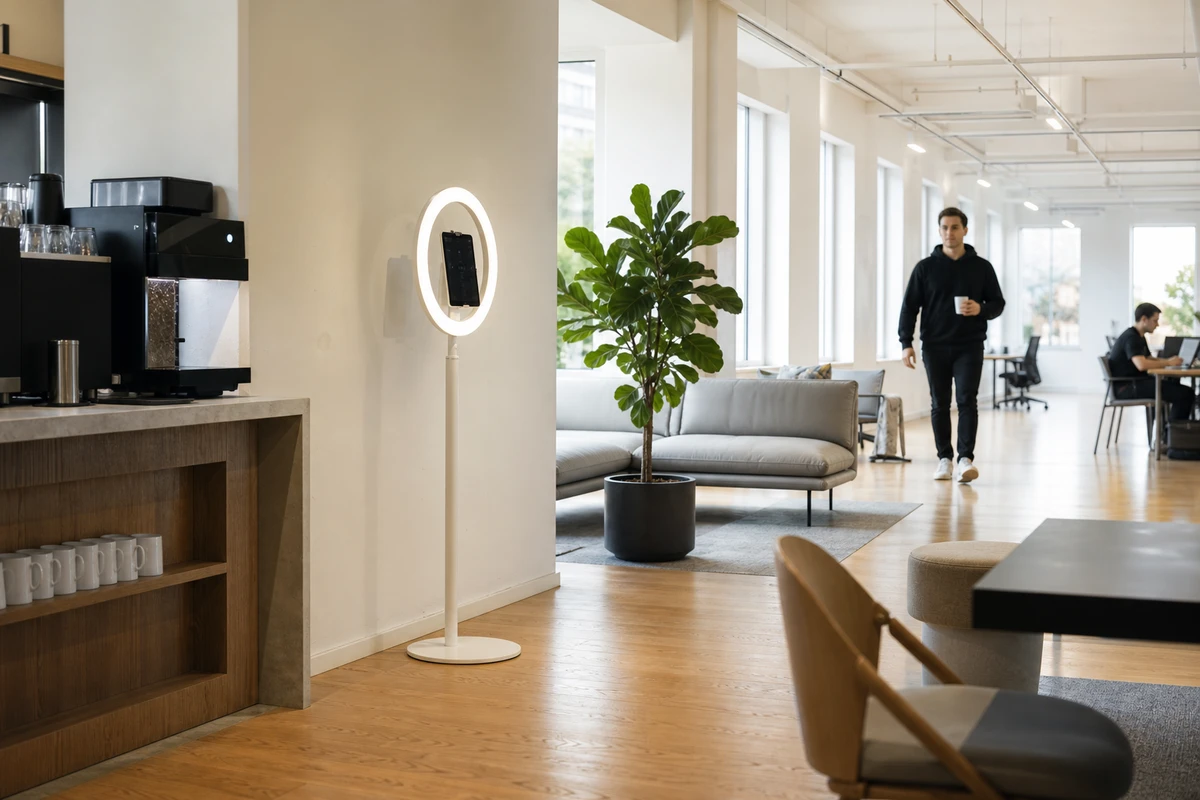
Self-service, unattended operation
The booth has to work with zero staff involvement: a member walks up, taps a screen, and is done. This criterion alone eliminates most rental-business hardware, which assumes a paid attendant. For a coworking space, unattended is not a nice-to-have, it is the whole premise.
Footprint and aesthetics
An open-air booth, not an enclosed curtained box, fits a lounge or an event corner without dominating it. It should match the space’s brand and furniture rather than clash with them. A booth that looks like carnival equipment will sit unused.
Always-on plus event mode
The booth should idle quietly as a daily amenity and switch to a featured station for member nights and open houses. A booth that only makes sense during events is just a rental the space happens to own.
Branded photo overlays
Every photo the booth produces should carry the space’s logo and social handle. This is the mechanism that turns a member’s snapshot into distributed marketing. When a member posts a booth photo to LinkedIn, the space’s name travels with it into a feed full of that member’s professional contacts, the exact audience a coworking space wants to reach. Without the overlay, that reach is anonymous and wasted.
Digital sharing over prints
For a workspace, digital delivery by QR code, text, or email beats a printer. There are no consumables to restock, no paper jams to clear, and the photo lands on the member’s phone already formatted to post. A print ends up in a bag.
Contact capture with opt-in
The delivery step is where a photo quietly becomes a marketing contact. To receive the image, a member or guest enters an email or phone number, and the booth records clear consent at the same moment. Over a year, that builds a list of engaged members and everyone who visited for an event, a direct line for renewals and tour follow-up.
Content export for the space’s own channels
The operator needs a gallery or feed to pull from for Instagram, the website, and tour follow-up emails. A booth that captures content but locks it away solves only half the problem.
Member-proof reliability and support
The booth will be used unsupervised by hundreds of people. It needs durable hardware, software that updates remotely, and real support behind it. A dead booth in the lounge is worse than no booth, because it signals a space that does not maintain things.
The filter is short. A booth that is self-service, branded, digital-sharing, and capture-enabled belongs on the shortlist. A booth missing any one of those is the wrong tool for this vertical, however good it looks. Simple Booth’s HALO kit is one product shaped to that filter: a self-service, open-air booth that runs on an iPad, brands every photo, delivers images digitally, and logs an opt-in contact at the delivery step. Its integrated 2,100-lumen ring light covers the lighting itself, so a member’s photo comes out evenly lit rather than as a half-lit phone frame.
Buy, rent, or build: which model fits a shared workspace
An operator weighing this for the first time usually frames it as a single question, “should we get a photo booth,” when there are three distinct commitments behind it.
Rent per event
Renting a booth for a single open house or anniversary night is the lowest-commitment option, and a genuinely useful test: it shows whether members engage with a booth at all before any money is tied up. But a rental leaves nothing behind. No asset, no recurring content, no captured list. A single-day rental typically runs from several hundred to a few thousand dollars depending on the market and the package, and every event starts that meter again.
Build it yourself
A backdrop, a ring light, and members’ own phones is a real option and the least expensive one. It will produce photos. What it will not produce is marketing or data: there is no branded overlay, so the photos circulate with no attribution to the space; there is no contact capture, so no photo becomes a lead; and there is no gallery, so the operator has nothing to repost. DIY is fine if the only goal is a fun corner at one event. It fails the moment member content or list-building is the point.
Own an app-based open-air booth
This is one capital outlay followed by unlimited use, week after week, at no marginal cost. It is the only model that compounds: every month adds more content to the gallery, more contacts to the list, and more recognition moments for members. For any space past its first year, with a stable membership and a regular event calendar, this is the model that fits.
A simple decision rule covers most operators. Rent once to test whether members actually use a booth. If they do, and especially if they use it twice, buy, because from that point renting repeatedly costs more than owning and still produces no asset. Skip DIY entirely if member content or a contact list is a goal, because it structurally cannot deliver either.
Running the numbers: a worked ROI scenario
Abstract arguments do not survive a budget meeting, so here is a worked example with every assumption stated. Take a coworking space with 120 members paying an average of $350 a month. That is $42,000 in monthly revenue, roughly $504,000 a year. Suppose the space retains 76 percent of members year over year, near the middle of the 65 to 85 percent band Optix cites, so it loses about 29 members a year, a little over two a month.
Start with retention
Start with retention. The booth is not magic and will not halve churn. But recognition moments move renewal decisions at the margin, and the margin is where churn lives. Assume the booth and the moments built around it (a welcome photo at onboarding, a milestone wall, headshots on demand) cut annual churn by two percentage points, from 24 percent to 22 percent. On 120 members that is between two and three people who stay instead of leaving. Each retained member is worth $4,200 a year, so two and a half of them protect roughly $10,500 in annual revenue. Set that against the Reichheld arithmetic above: by Murphy and Murphy’s measure, a two-point retention gain does as much for the bottom line as a 10 percent cut in costs.
Now content
Now content. The same space already considers paying a photographer for a Headshot Day. An owned booth produces professional-grade member photos every week instead of once a year, which folds that recurring photographer cost into a one-time purchase and removes the scheduling entirely.
Now tours
Now tours. If member photos circulating with the space’s handle lift the tour-to-join rate even slightly, say two extra members joining per quarter who would otherwise have toured and drifted, that is eight members a year at $4,200, another $33,600 in annual revenue. It is the largest of the three lines and the hardest to predict, so a cautious operator should treat it as upside rather than budget.
The exact totals are not the point; a space with 300 members at $500 will see larger numbers, a 40-member space smaller ones. The shape is the point. An owned booth is a one-time purchase. The protected and added revenue in this scenario, conservatively, runs into the five figures a year and recurs. The honest test for any operator is to run those three lines with their own member count, price, and retention rate and see whether the first year alone clears the cost of the hardware. In most spaces past their first year, it does, and comfortably.
Deploying it so it actually gets used
The fastest way to waste a booth is to install it in a back hallway and wait. A booth members forget about within a month is a write-off, however good the hardware. Deployment is what separates the two outcomes.
Placement
The booth belongs where members already gather: near the coffee, in the lounge, at the edge of the event space. Foot traffic does the marketing. A booth in a quiet corner has to be sought out, and almost no one will.
Programmed moments
The booth should be tied to specific occasions rather than left as a vague option. A day-one photo in the member onboarding flow makes the first interaction a small welcome. A recurring “LinkedIn refresh” session gives the booth a headshot purpose on a schedule. Milestones and work anniversaries become a reason to use it again. At mixers, open houses, and workshops it becomes the featured station. Each of these is a moment a member is glad to be seen, which is exactly when they will post.
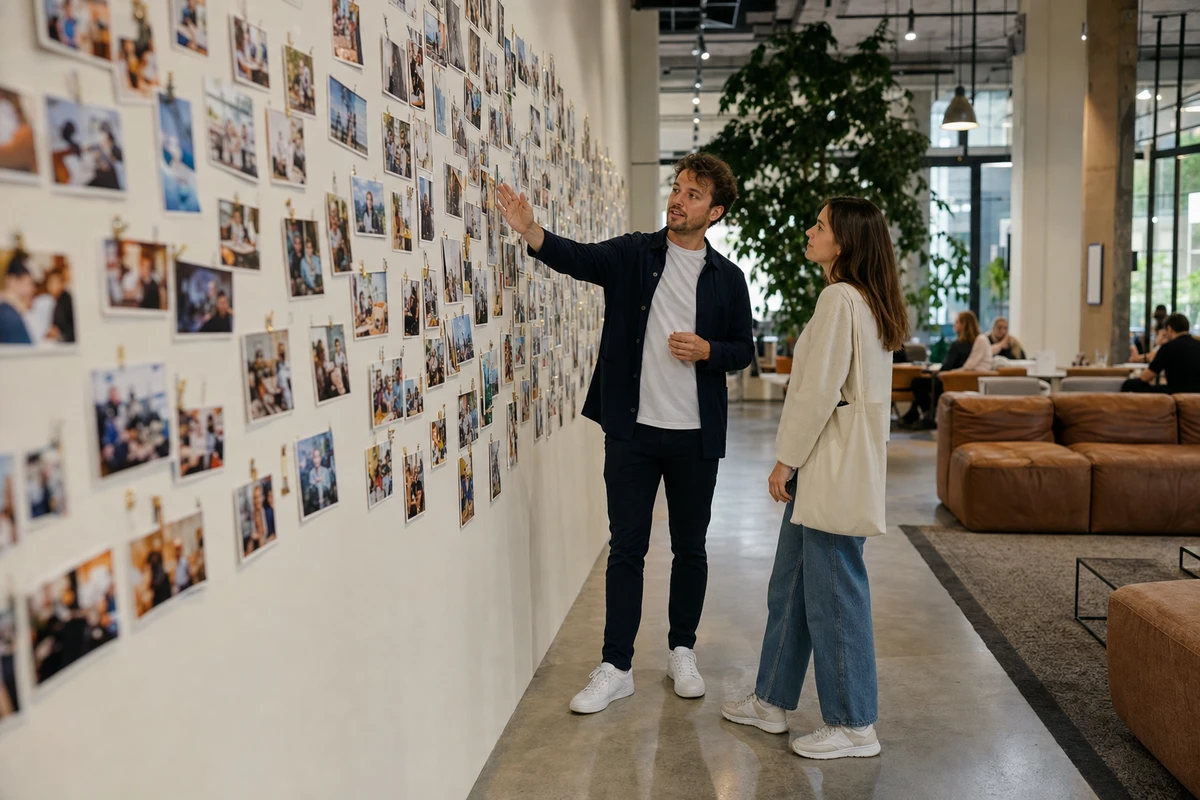
The member wall
A physical and digital wall of member photos does two jobs at once. For prospects on a tour it is immediate social proof, real people visibly comfortable in the space rather than stock imagery. For members it is a small status reward, a sign they are part of the place.
Calendar integration
Booth moments should sit inside the community programming calendar so the booth becomes a habit, not a novelty that fades. Refreshing the props and the photo overlay seasonally keeps it from going stale.
Closing the marketing loop
None of the content benefit is automatic. It takes a simple weekly routine: someone pulls the best photos from the gallery, reposts them to the space’s own channels with its handle, and drops a few into tour follow-up emails. Fifteen minutes a week turns a pile of member photos into the social feed that, by Spacebring’s account, decides whether a prospect books a tour at all.
Mistakes coworking operators make with photo booths
The booth fails in predictable ways, and every one of them is avoidable.
The common mistake
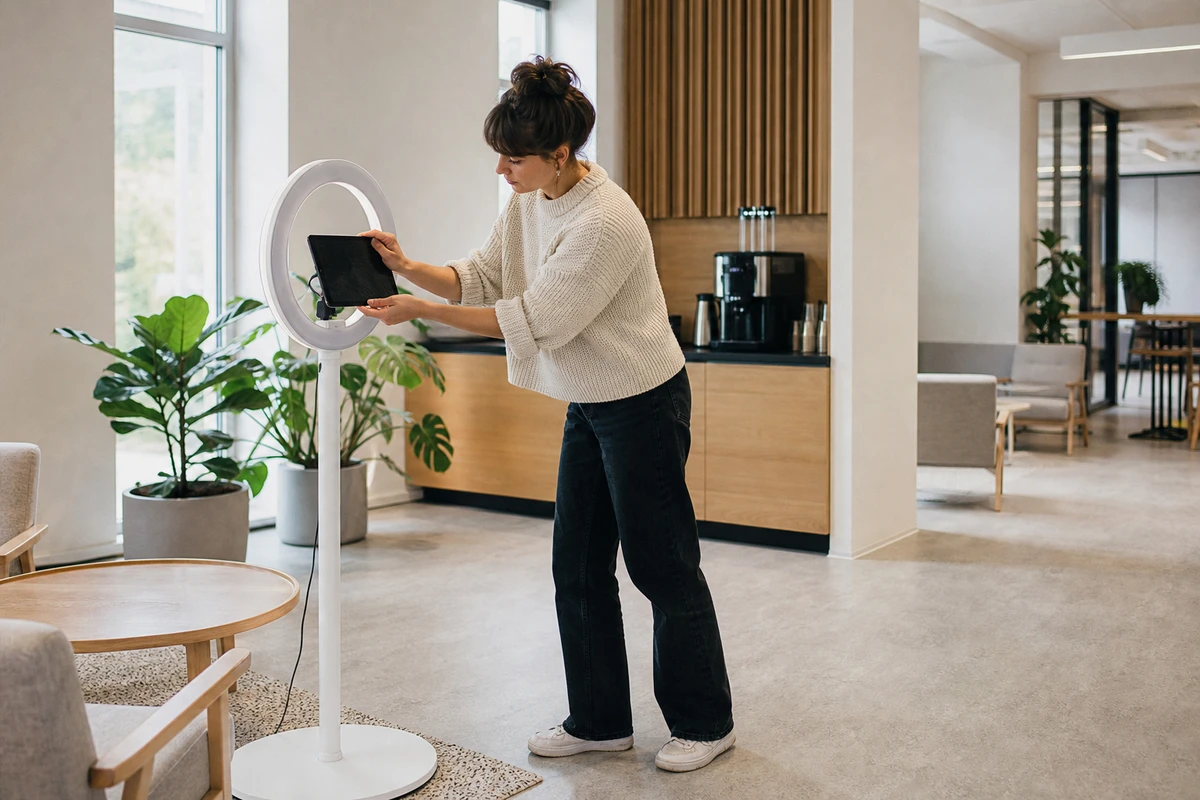
The most common mistake is treating the booth as one-night party entertainment. An operator hires a rental for an anniversary, the night goes well, and the conclusion is “photo booths are fun.” That framing, borrowed from the corporate-event rental market, is the trap. A booth treated as event decor stays decor; a booth treated as standing infrastructure produces content and contacts every week. The format is the same. The decision to own it and keep it running is what changes the return.
A second mistake is buying the wrong category. An operator who buys attendant-operated rental hardware ends up with a machine that needs a trained person beside it, which a coworking space does not have. The gear is built for a different buyer.
A third is skipping the branded overlay. Member photos then circulate with no attribution, and the clearest marketing benefit, the space’s name traveling into members’ professional feeds, is given away for free.
A fourth is not capturing opt-in contacts. Without the email or phone step, a photo is just a photo. With it, every photo is also a member or visitor the space can reach again.
A fifth is never reposting the content. A booth can fill a gallery for months while the space’s social feed stays empty. The tour-conversion benefit exists only if someone closes the loop.
The last is neglect: props, backdrop, and overlay left unchanged until members stop noticing the booth. A booth is a living amenity. Refreshed occasionally it stays in use. Ignored, it becomes the dusty gadget in the corner that a back-hallway placement was already inviting.
Frequently asked questions
How much does a photo booth for a coworking space cost? There are three price tiers, and they are not comparable. A single-day event rental runs from several hundred to a few thousand dollars per event and leaves no asset behind. An owned, app-based open-air booth is a one-time purchase that you then use indefinitely at no marginal cost. Attendant-operated rental-business hardware is a larger purchase still, and it is built for a different buyer, so a coworking space should not be pricing it at all. For a space that wants recurring value, the owned app-based booth is the only tier worth comparing against rental.
Do we need staff to run it? No, if you choose a self-service open-air booth. Unattended operation means a member walks up, taps a tablet screen, takes the photo, and receives it themselves. What that requires is the right category: a tablet-driven open-air booth, not attendant-operated camera hardware. Confirm with any vendor that the booth is designed to run with no staff present, because that is the one feature a coworking space cannot do without.
Is this the same as a soundproof phone booth or privacy pod? No. A privacy pod is acoustic furniture for taking calls, and it is the product most search results return for “booth” in a coworking context. It is a reasonable purchase for noise, but it has nothing to do with member content, engagement, or marketing. A photo booth and a privacy pod solve unrelated problems and come out of different budgets.
Photo booth or hiring a photographer for Headshot Day, which should we do? They are complementary, not competing. A hired photographer still suits an annual premium-headshot event, where the polish and the personal direction are the point. An owned booth is the always-on layer between those events, available the week a member needs a current photo. Many spaces will run both: the booth for everyday and milestone moments, the photographer once a year.
How do we get members to actually use it? Placement and programming. Put the booth where members already gather, near the coffee or the lounge, not in a side room. Then tie it to specific moments: a welcome photo during onboarding, milestone and anniversary shots, a recurring headshot session, and featured use at every event. A booth attached to occasions gets used; a booth left as a vague option gets ignored.
Can we use member photos in our own marketing? Yes, with consent. The cleanest way is to collect permission at the moment the photo is shared. The booth’s delivery screen, where a member enters an email or phone number to receive the image, is also where it records opt-in and reuse permission. Get that step right and the space builds a library it can repost freely. Skip it and every good photo carries legal uncertainty.
The right photo booth for a coworking space is owned, self-service, branded, and capture-enabled, and it should be judged by whether it lowers churn and helps win tours, not by how it performs at a single party. Carried into a vendor conversation, that is a four-point checklist: the booth must run unattended, brand every photo with the space’s name, deliver images digitally, and capture opt-in contacts. A booth that misses one of those is the wrong tool. The booth that meets all four is amenity infrastructure, the always-on version of Headshot Day, working every week the space is open.
Sources
- Deskmag (2025). “2025 Global Coworking Space Trends.” https://www.deskmag.com/en/coworking-news/2025-global-coworking-space-trends-europe-north-america-market-business-survey-analysis-report
- Optix (2026). “Coworking Occupancy vs. Member Retention.” https://www.optixapp.com/blog/coworking-occupancy-vs-member-retention/
- Harvard Business Review (2014). Amy Gallo, “The Value of Keeping the Right Customers.” https://hbr.org/2014/10/the-value-of-keeping-the-right-customers
- Coworks (2024). “Operator Survey Reveals the Heart of Coworking Community Building.” https://www.coworks.com/blog/operator-survey-reveals-the-heart-of-coworking-community-building
- Cowork Frederick. “Headshot Day.” https://www.coworkfrederick.com/headshot-day/
- ThriveCo Coworking (2024). “Professional Headshot Day at ThriveCo.” https://www.thrive-coworking.com/events/professional-headshot-day-at-thriveco
- Spacebring (2026). “Coworking Content Marketing Guide.” https://www.spacebring.com/blog/tips/coworking-content-marketing-guide
- Nexudus (2025). “How to Market Your Coworking Space and What to Avoid.” https://www.nexudus.com/blog/how-to-market-your-coworking-space-and-what-to-avoid/
- Cat Johnson. “Coworking Space Event Ideas.” https://www.catjohnson.co/coworking-space-event-ideas/
- Willis, J. and Todorov, A. (2006). “First Impressions: Making Up Your Mind After a 100-Ms Exposure to a Face.” Psychological Science.