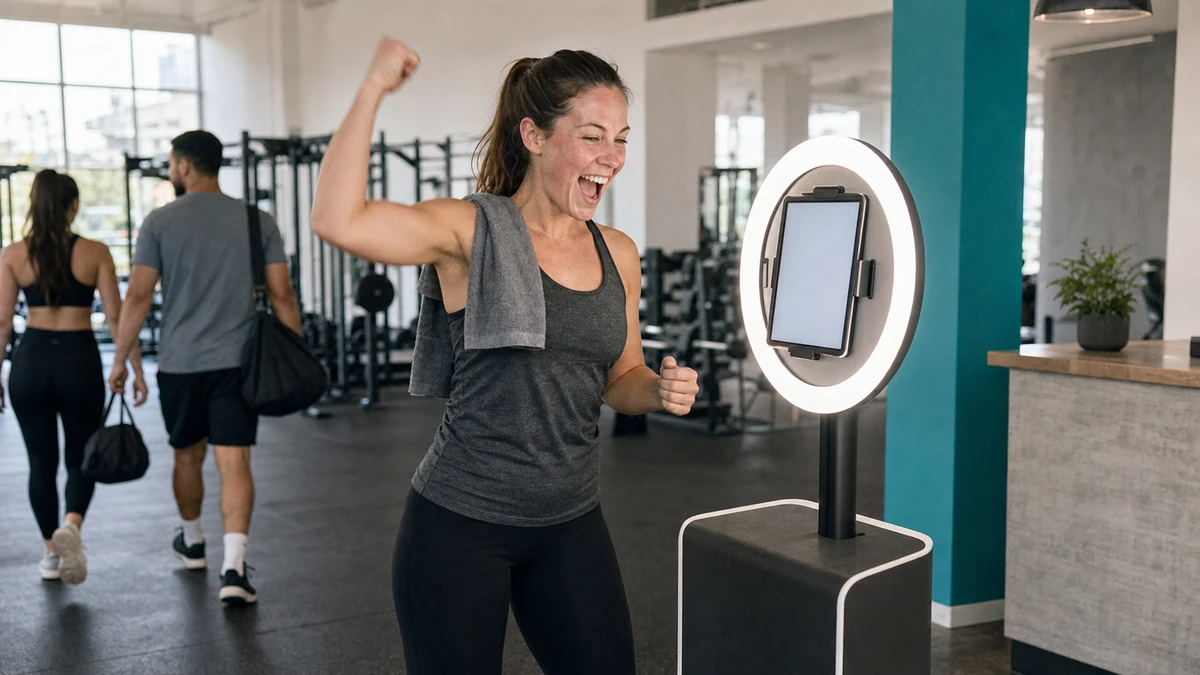
A member finishes the class that takes the studio’s wall chart to 100. She is flushed and proud and reaching for her phone before she has caught her breath. She finds a clean stretch of mirror, angles the shot to crop out the cable rack, takes three tries, picks the best one, and posts it. The gym’s name appears nowhere in the frame.
That moment repeats dozens of times a week in any busy gym, and most of it leaves the building uncaptured. An operator who searches “best photo booth for gyms” is trying to fix exactly that. The results mostly describe the wrong machine: the enclosed party booth wheeled into a corporate event for a single night. The best photo booth for a gym is the opposite of that. It is a permanent, self-serve, branded fixture that runs every hour the doors are open, and it earns its place by capturing content members are already making. This guide lays out the buying criteria that apply to a gym, not the rental-operator criteria the other guides use, and the arithmetic for deciding whether the purchase pays.
Why a Gym Needs a Different Photo Booth Than an Event Does
An operator who reads the top-ranking “best photo booth” guides will find detailed, confident advice written for somebody else entirely. Photo Booth Hustle, the main resource for the photo-booth rental trade, ranks booths the way a rental-business owner needs them ranked: how fast two people can break the rig down, how cleanly it packs into a car, how many setup-and-teardown cycles the shell survives, whether the product line scales into a fleet. Those criteria are real, and they matter to the person buying for a rental business. They describe a different job than the one a gym is hiring for.
The Gym Job
A gym buys the opposite job. One location. The booth never moves. It sits near the front desk or on the exit path, and it stays there for years. Nobody packs it down and nobody sets it up. The questions that decide a rental purchase (weight, case design, teardown speed) carry almost no weight for a gym, and the questions that matter most to a gym (does it run without staff, does it survive a humid room, does it brand every photo) barely appear in a rental guide at all.
The Audience Difference
The deeper reason the criteria diverge is the audience each booth serves. An event booth meets a room full of strangers once and never sees them again. A gym booth serves the same few hundred people, two or three times a week, for years. A single install accumulates thousands of sessions from a known, recurring group. Value compounds in a way it never can at a one-night event, which is why the honest frame for the purchase is in-house marketing infrastructure rather than party equipment.
Existing Product Category
This is not a hypothetical category. A distinct class of permanent, unattended photo-booth installations already exists, with vendors such as PermaBooth and Photomatica building products specifically for fixed venue placement rather than event rental. The gym buyer’s real task is to evaluate that class against a gym’s particular conditions, which is what the rest of this guide does.
What Gym Members Already Make, and Why It Leaks
On a gym floor at six in the evening, the photography is already happening. A member checks her form in the mirror and keeps the photo. Another lines up a post-lift shot at the squat rack, and a third logs a before-and-after in the same corner every Monday. Members are prolific content creators inside the four walls, and none of it costs the operator anything to produce. Multiply that across the roughly 72 million Americans who hold gym memberships, a record high by the Health & Fitness Association’s 2024 count, and it adds up to an enormous volume of free content created inside gyms every week.

Where Content Leaks
The problem is where that content goes. It leaves the building un-branded and un-tagged. No logo in the frame, no gym handle, no hashtag, and no moment where the member hands over an email address. The gym produced the result the member is proud of and gets none of the asset that result generated.
Manual Recovery
Operators who try to recover that content end up doing manual, lossy work. The common method is to search the gym’s hashtag, watch for posts that tag the location, and repost what looks good. Every member who posts without the tag is invisible to that process, and most members forget the tag most of the time. Putting the hashtag on the mirrors, the lockers, and the staff shirts helps a little, and it still depends on the member remembering at the exact moment they post.
Multiply Existing Behavior
A booth does not create the photo behavior. It intercepts it. The member takes the same milestone photo they were going to take anyway, except now it carries the gym’s logo and colors because the overlay is fixed, it reaches their phone in seconds, and the share step records consent and an email address. The gym ends the interaction with a branded image, a contact, and documented permission, instead of hoping to find an untagged post later.
Milestone Content
The highest-value version of this is the milestone. A first unbroken set of pull-ups, a goal weight reached, a 100th class, a one-year anniversary. Those moments carry the most emotion, and emotion is what drives a member to actually post and to say something specific about the gym when they do. A photo a member’s friend sees is a local person, similar to them, getting a real result, which is a different and more persuasive thing than an ad. That is the mechanism by which member content recruits members. A booth’s best job is not generic selfies. It is being the machine that catches the milestone while the member is still standing in the glow of it.
The Gym Photo Booth Buyer’s Checklist
A rental buyer’s guide ranks booths by how well they travel. None of that helps a gym owner standing on the floor with a tape measure, working out whether a booth will survive the room and run without someone watching it. These are the criteria that decide the purchase for a gym, each with what to look for and why it matters on the floor.
Unattended, self-serve operation
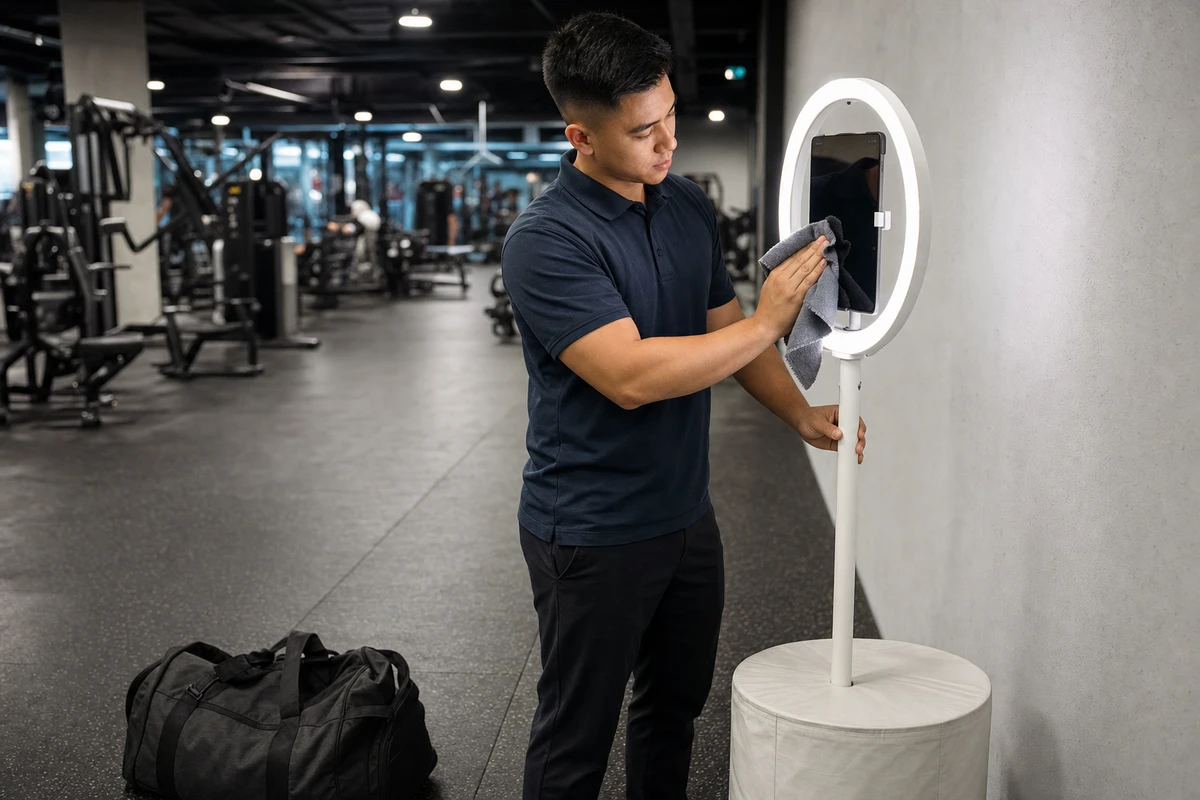
A rental booth assumes a paid attendant stands beside it. A gym cannot staff that. The front desk is lean, and many gyms run 24-hour access with nobody on shift for long stretches. The booth has to run itself: a member walks up, the screen prompts them, they take the photo and send it, and no employee is involved. Good means a member can complete the whole session, capture through delivery, without a staff member touching anything.
Built for the gym environment
A gym is humid. There is sweat, chalk dust, rubber-floor vibration, and the steady traffic of gym bags getting set down near anything at floor level. An event booth is built for a hotel ballroom, not for that. Good means a durable shell and a wrap or finish that survives daily contact and regular cleaning, rated to live in the room rather than visit it.
A small, fixed footprint
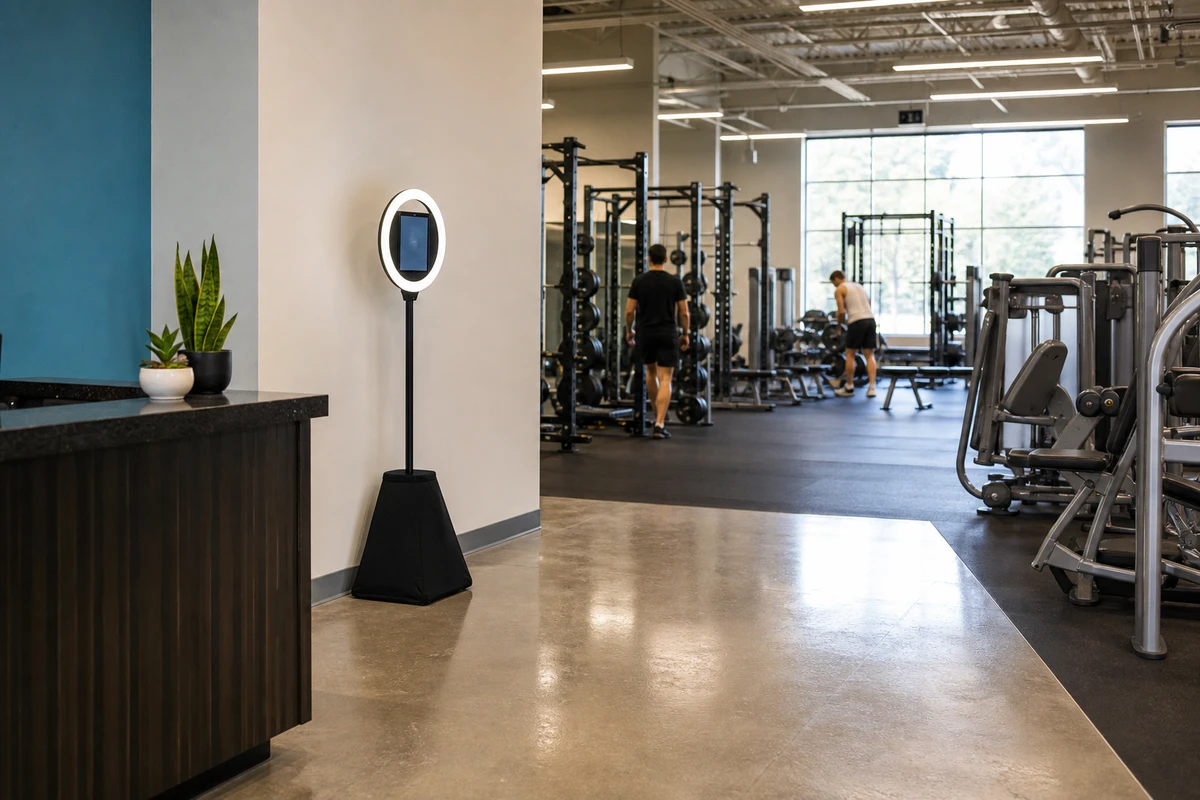
Floor space in a gym is revenue space. Every square foot holds equipment members pay to use. A booth that needs a large clear zone is competing with a rack. Good means a compact, fixed footprint that tucks against a wall or beside the desk, measured honestly against the floor plan before purchase.
Branding on every frame
The whole point is to stop content leaving un-branded. A booth fixes this in two places: a wrapped exterior that reads as the gym’s, and an on-screen overlay (logo, colors, hashtag) baked into every photo. Good means the branding is automatic and consistent, so it never depends on a member remembering to tag the gym.
Instant sharing
A milestone photo is most shareable in the minute after the workout, while the member is still proud and still has their phone out. A booth that delivers by text, email, or a QR scan puts the image on the member’s phone within seconds. Good means delivery is immediate, not a batch the member receives the next day, when the moment and the impulse to post have both passed.
Data capture with built-in consent
This is the criterion that separates a booth from a backdrop. At the share step, the member enters an email or phone number and ticks a clear opt-in box. That feeds the gym’s CRM or email list and records permission to reuse the photo. Good means capture and consent are part of the normal flow, exportable, and explicit, not an afterthought.
Software, support, and total cost of ownership
A permanent install lives or dies on the vendor behind it. The booth runs on software that needs updates, and hardware eventually needs a fix. Good means a clear subscription, a known update cadence, and a real support path with someone who repairs or replaces the unit. The support arrangement should be settled before signing, not discovered after the screen goes dark.
Analytics
A booth nobody measures becomes a vibe rather than a channel. The software should report sessions, shares, opt-ins, and busy times. Good means the operator can open a dashboard and see what the booth produced this month, the same way they would judge any other marketing spend.
Form Factors Compared for the Gym Floor
With the criteria settled, the buyer still has to pick a physical shape, and most of the shapes on the market were built for an event, not a gym floor. Five come up when a gym buyer goes looking. Only one of them belongs in a gym.
Open-Air Tablet Booth
The open-air tablet booth is a tablet on a stand, with a wrapped base and a light. It has the smallest footprint, runs self-serve, brands every frame through the screen overlay, and needs no attendant. For the large majority of gyms it is the right answer, because it solves the floor-space problem, the staffing problem, and the branding problem at once. Simple Booth’s HALO kit is one product in this shape: an iPad in a stand built around a 2,100-lumen ring light, with photo delivery and the opt-in capture step run from the app.
Classic Enclosed Booth
The enclosed “classic” booth, the curtained box, is large and heavy and reads as event nostalgia. It eats floor space a gym cannot spare and it signals “party” rather than “training.” Poor fit.
360 Booth
The 360 booth, with its rotating arm, needs a clear surrounding zone and an attendant, and a spinning arm on a busy gym floor raises a safety question worth taking seriously. It can be worth renting for a one-off challenge finale. As the always-on fixture, it is the wrong choice.
Mirror Booth
The mirror booth, a large touchscreen mirror, looks premium and is built around a sheet of glass. Glass, a sweat-and-chalk room, and bumped gym bags are a bad combination. Niche at best.
DIY Selfie Wall
Then there is the option most gyms reach for first: the do-it-yourself selfie wall, a branded backdrop with a neon sign. It deserves a fair hearing. It is inexpensive, it is genuinely on-brand, and it gives members a clean place to shoot. What it cannot do is anything that happens after the shutter. There is no instant delivery to the member’s phone, no email captured, no consent recorded, no overlay stamped onto the image, and no analytics. It is a nicer mirror. Most of the “gym photo booth ideas” content online stops exactly here, at the decorated wall, and never addresses capture, consent, or measurement. That gap is the entire reason a gym would buy equipment instead of hanging a banner.
The Privacy and Consent Question
More cameras in a gym sounds, to a lot of operators, like more conflict. The worry is legitimate. Phone and camera etiquette on the gym floor is genuinely contentious, some members resent being filmed during a workout, and chains have at various times publicized restrictions on unsolicited photography to protect members. An operator who has already fielded a complaint about someone’s phone is right to be cautious about anything that puts more cameras in the room.

Why the Booth Helps
The misconception is that a photo booth makes that worse. It does the opposite. A permanent, self-serve booth in a designated spot is the most consent-respecting way a gym can collect content. The member chooses to walk up to it. No staff member points a phone at anyone. Nobody in the background of someone else’s set gets caught in the frame, because the booth points at the person standing in it and nowhere else. And it sits in a fixed, public spot, never in a changing area.
Cleaner Consent
The consent is also cleaner than the alternative. When a gym reposts a member’s tagged photo, it is treating a tag as if it were permission, which it is not. A booth’s share step asks the member to enter contact details and tick an opt-in box before the photo goes anywhere. That is explicit, documented permission to send the photo and to reuse it. The gym moves from “a member tagged us, so we assume it is fine” to a recorded yes.
Placement Rules
A few placement rules keep the line clean: site the booth on the gym floor or by the desk and well away from the changing rooms, put up plain signage that says what it is, and run a one-line consent prompt on screen at the share step. Handled that way, the booth becomes the part of the gym’s marketing that is easiest to defend, not the part that invites a complaint.
Does a Gym Photo Booth Pay for Itself?
A booth is a fixed cost, so the question is whether the content and contacts it produces are worth more than that cost. The way to answer it is to model the booth, conservatively, against one gym’s numbers.
Member Scenario
Take a mid-size gym with 600 members. Members come and go through one entrance, and a booth on the exit path catches a slice of them. Say 200 booth sessions a month, roughly a third of the membership using it once, which is modest for a fixture that prompts milestones. At the share step, say 35% of those members leave an email address. That is 70 new opted-in contacts a month, 840 a year, on a list the gym owns outright and can email without depending on a social platform.
Referral Effect
Now the referral effect. Of those 200 sessions, suppose 150 produce a photo the member shares publicly. Referral is the swing variable, and the input most worth testing against a gym’s own experience, so keep it conservative: assume just 1 shared photo in 50 brings in a friend who joins. That is 3 new members a month, 36 over a year. Using the Association of Fitness Studios’ 2018 benchmarking report, which put average revenue near $774 per studio member, those 36 members represent roughly $27,900 in annual member revenue from the referral effect alone.
Cost Side
Set against that, the cost. Permanent-install booths are priced differently from event rentals: upfront hardware, or hardware plus a software subscription, rather than a per-event fee. Vendors quote a wide range and an operator should get real numbers before deciding. As a round figure to model against, assume the booth costs the gym $300 a month all in, or $3,600 a year. Even on these deliberately cautious inputs, the referral revenue clears the cost by close to eight times, and the 840 annual email contacts have not been priced in yet.
Retention Side
The retention side is where the math gets more serious. Average gym retention sits around 72%, according to IHRSA trend data compiled by Wellness Creative Co, which means more than a quarter of members leave every year and have to be replaced. In a 2014 article summarizing Reichheld and Bain’s research, Harvard Business Review reported that a 5% increase in customer retention can raise profit by 25% to 95%. A booth does not retain members on its own.
What it does is mark the milestones (the first pull-up, the goal weight, the anniversary) that build a member’s emotional connection to the gym, and put a branded record of each one in the member’s hand. A 2015 HBR article on customer emotions shows how much that connection can be worth: one retailer that concentrated on its emotionally connected customers grew same-store sales roughly three times faster than before. A photo booth is one input to that connection, not the cause of it. But milestone capture is not a soft benefit. It works on the single most valuable number in a gym’s P&L.
Combined Return
Put the two halves together and the booth is a fixed-cost channel touching both acquisition (referrals and an owned email list) and retention (milestone emotion). Unlike paid ads, its cost does not rise with results, so every additional session lowers the gym’s blended cost to acquire and keep a member. That is the case for treating the booth as infrastructure rather than decoration.
Rolling It Out: Placement and Member Adoption
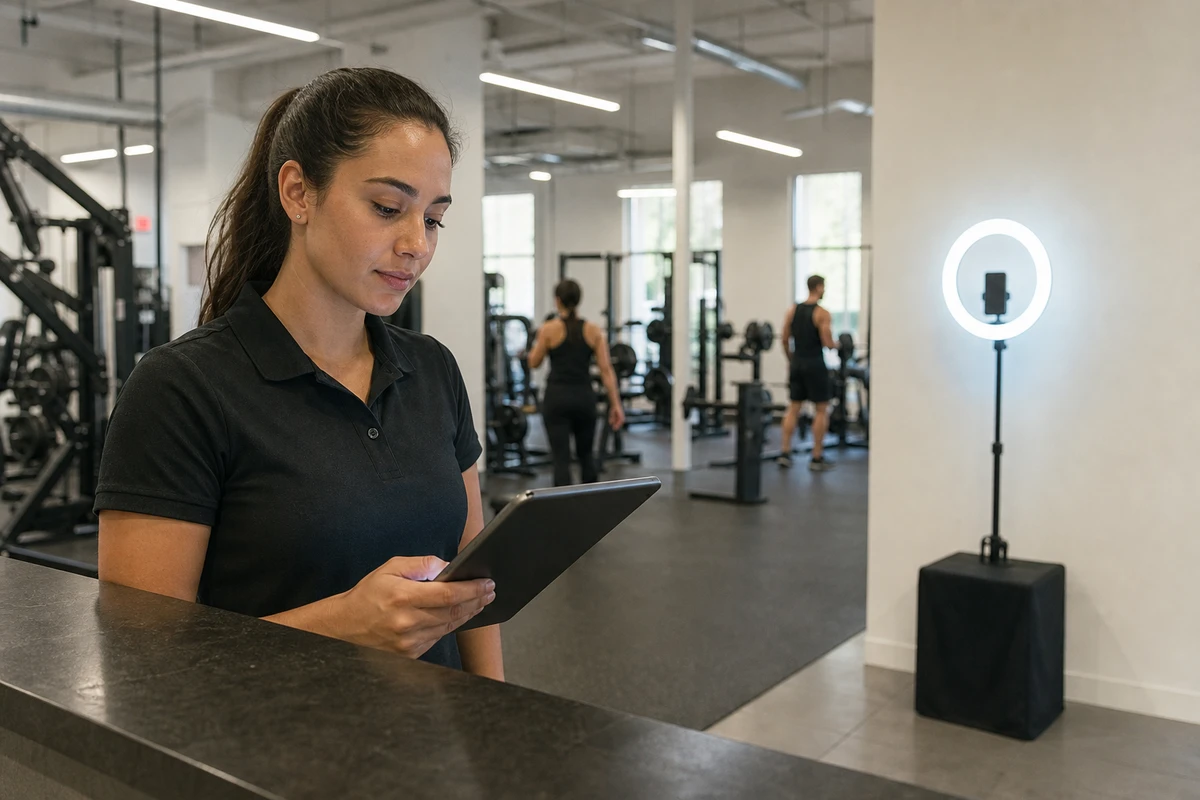
A booth earns nothing in a corner nobody walks past. The best spot is on the natural exit path or beside the front desk, ideally next to whatever the gym already uses to celebrate members, the PR board or the member-of-the-month wall, with lighting good enough to shoot in. It should not sit in the middle of the workout floor, where it interrupts circuits, and it should never be near the locker rooms.
Program Use Cases
The booth also needs reasons to be used. The strongest are the milestones already worth celebrating: a challenge finish line, a 100th class, a membership anniversary, a before-and-after check-in, a day-one photo for every new member. On-screen prompts for those occasions turn a blank screen into an invitation.
Staff Habit
Adoption is mostly staff habit. A front-desk team that mentions the booth at check-in (“grab a photo, it’s your one-year today”) drives more sessions than any sign. The branded hashtag belongs in the overlay so it travels automatically. A recurring incentive, a monthly draw from booth photos, or a tie-in with a seasonal challenge keeps usage from fading once the novelty does.
Measurement
Then measure it. The booth’s analytics report sessions, shares, and opt-ins by month. An operator should review that the same way they review any other channel, watch which prompts and which weeks produce the most, and adjust placement and staff prompts accordingly. A booth treated as a measured channel keeps earning. A booth installed and forgotten becomes furniture.
Frequently Asked Questions
What kind of photo booth works best in a gym?
A permanent, self-serve, open-air tablet booth, not an event rental. A gym needs a fixture that stays in one place, runs without staff, brands every photo, and captures member contacts. The enclosed party booths that dominate “best photo booth” searches are built to be transported and staffed, which is the opposite of what a gym is buying.
How much does a photo booth for a gym cost?
Permanent-install booths are priced differently from event rentals. Instead of a per-event fee, you are looking at hardware (bought or financed) plus an ongoing software subscription. Pricing varies widely by vendor and configuration, so get quotes from two or three permanent-install vendors and compare total cost over several years, not just the sticker price.
Do I need staff to run it?
No. A booth built for a gym is self-serve by design. A member walks up, follows the on-screen prompts, takes the photo, and sends it to their phone without anyone from the gym involved. That is essential for lean front desks and for 24-hour gyms with unstaffed hours.
Will members actually use it?
They are already taking the photos. Members shoot progress selfies, post-lift pictures, and milestone shots on the gym floor every day. A booth does not have to create that behavior, only give it a better home. Placement on the exit path, milestone prompts on screen, and a staff mention at check-in are what drive steady use.
Is it a privacy problem to put a camera in my gym?
A self-serve booth is more consent-respecting than the alternatives, not less. The member chooses to step into it, no staff member points a phone, and nobody in the background gets caught in the frame. Place it away from changing areas, add clear signage, and use an on-screen opt-in at the share step, and the booth becomes the easiest part of your marketing to defend.
Can a photo booth help member retention, or is it only marketing?
Both. The sharing and email capture feed acquisition, through referrals and an owned contact list. The milestone capture feeds retention, because celebrated milestones build the emotional connection that keeps members renewing. Given that gym retention averages around 72%, anything that strengthens the reasons members stay is working on the most valuable number in the business.
Sources
- Health & Fitness Association (2024). “U.S. Fitness Facility Membership Reaches Historic High.” https://www.healthandfitness.org/about/media-center/press-releases/u-s-fitness-facility-membership-reaches-historic-high/
- Wellness Creative Co (n.d.). “Gym Member Retention Strategies” (citing IHRSA Trend Reports). https://www.wellnesscreatives.com/gym-member-retention-strategies/
- Association of Fitness Studios (2018). “Fitness Studio Operating and Financial Benchmarking Report.” https://member.afsfitness.com/content/2018-fitness-studio-operating-and-financial-benchmarking-report (member access required)
- Gallo, Amy, Harvard Business Review (2014). “The Value of Keeping the Right Customers.” https://hbr.org/2014/10/the-value-of-keeping-the-right-customers
- Magids, Scott, Alan Zorfas, and Daniel Leemon, Harvard Business Review (2015). “The New Science of Customer Emotions.” https://hbr.org/2015/11/the-new-science-of-customer-emotions
- Photo Booth Hustle (n.d.). Buyer’s guide content for the photo booth rental trade. https://photoboothhustle.com/