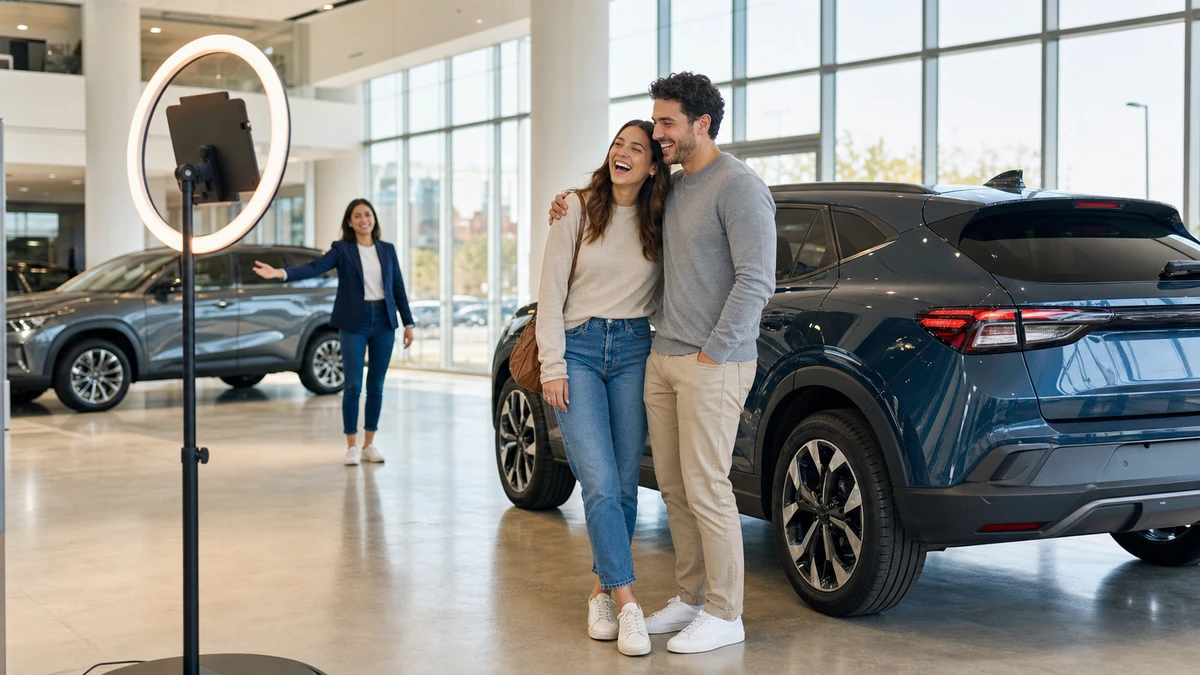
A customer pulls onto the lot on a Saturday morning, walks through the showroom doors, and spends forty minutes with a salesperson comparing two trim levels of the same SUV. They sit in it, ask about lease terms, then say they want to think it over and leave. If no one wrote down a name, an email, or a phone number, that visit is now gone.
That walk-in was the best lead the dealership saw all day. Showroom visitors close at 20 to 25 percent, the highest conversion rate of any lead source, against roughly 14 percent for phone leads and 6 percent for internet leads. They are also the lead a store loses most often, because the walk-in is the only lead source with no capture event built into it. A website form submits an email address. A phone call leaves a number on the log. A chat session saves a transcript. A walk-in produces a record only if a busy, commissioned salesperson decides to create one.
Most advice on car dealership showroom lead capture answers a different question: how to get more leads from the website. This article stays on the floor. It covers how to turn every walk-in into a named, consented record in the CRM, and how to measure how well that system performs.
Why the Showroom Walk-In Is the Best Lead a Dealership Gets, and the One It Loses Most Often
The close rate puts the walk-in at the top
A sales manager reviewing a month of deals can usually see the pattern without a report: the people who bought were disproportionately the ones who showed up in person. The benchmarks confirm it. Urban Science, analyzing live new-lead and sales data from May through July 2025, put the 30-day showroom close rate at 25 percent, phone leads at 14 percent, and internet leads at 6 percent. The 2026 benchmark guide from Dealer Conversion, drawing on Foureyes and Urban Science data, lists the showroom range at 20 to 25 percent against a blended close rate of 10.2 percent across all sources.
The walk-in also closes fast. Foureyes, studying more than eight million sales opportunities in the first half of 2025, found that 83.7 percent of walk-in sales happen within the first three days of an opportunity being created. After day three the close rate falls off sharply. A walk-in that leaves no record does not sit in a nurture queue waiting to be worked. It decays within seventy-two hours.
High intent, almost no data
The reason the walk-in converts is also the reason losing it hurts. A person who drives to a dealership has spent a weekend morning, fuel, and effort to be there. That is the strongest intent signal in automotive retail, stronger than a form fill, which costs the visitor nothing. Yet the same visit produces almost no data: no email submitted, no form completed, no cookie the dealership owns. High intent, low data. A store can have its best prospect of the day standing in the building and, an hour later, no way to reach them.
A lead the dealership already paid for
An uncaptured walk-in is not a missed lead. It is a lead the dealership already paid for. Advertising, signage, the inventory on the lot, and the floor itself carried the cost of getting that person through the door. The marginal cost of recording their contact information is close to zero. The cost of not recording it is the entire acquisition spend with nothing to show.
The loss compounds with the be-back. A customer who wants to “think about it” is a prospect a store can chase only if it has the number. Without a record, a be-back is a stranger who might walk into a competitor’s showroom next. Urban Science found the showroom defection rate reached 20 percent in 2025, meaning one in five people who visit a dealership goes on to buy from a different one. An uncaptured visitor who defects cannot even be identified, let alone won back.
What Dealerships Mistake for Lead Capture: People Counters and the Up Log
Ask a GM how the store captures showroom leads and the answer usually points to one of two things: a people counter at the door, or the up log. Neither one captures a lead.
People counters measure bodies, not names
A people-counting sensor over the showroom entrance tracks footfall volume, how many visitors are present at a given time, how long they stay, and which parts of the floor they linger in. Vendors such as V-Count also layer in demographic estimates and the effect of a marketing campaign on traffic volume. This is genuinely useful for staffing decisions and floor layout. It is not lead capture. A sensor that records 400 visitors in a week cannot produce a single name, email, or phone number. It gives a dealership a denominator, not a prospect.
The up log was built for turn order, not contact data
The up log has a different job. When a customer (an “up”) walks in, the up system assigns them to the next salesperson in the rotation, and the log records whose turn it was. Nextup, which sells up-management software, describes the system’s purpose plainly: to make sure one person is responsible for each customer and that every salesperson gets an equal, defined level of service. It was built for accountability and turn-taking, not to build a marketing database.
That design has a structural side effect. A logged up that does not close counts against a salesperson’s recorded close rate, so there is a rational incentive to under-log the marginal “just looking” walk-through that obviously will not buy today. Add a busy Saturday floor, shift handoffs, and open-floor stores that keep no log at all, and the manual record systematically misses the visitors a follow-up system would most want to reach.
Tracking traffic is not capturing leads
A dealership can know exactly how many people came through the door and still have a near-empty CRM. The two facts are not the same. Capturing a lead means producing a named, contactable, consented record. Everything short of that is a proxy. The size of the gap shows up even where a record should be automatic: Foureyes’ 2026 benchmark report found that 15.2 percent of qualified digital leads were never logged to the CRM, a figure that has risen every year for six straight years. For walk-ins, where nothing logs itself, the uncaptured share is structurally worse.
Why Walk-In Prospects Resist Handing Over Their Information
“Just looking” is a defense, not a status update
Every salesperson has heard it within ten seconds of greeting a customer: “just looking.” It is rarely a literal description of intent. It is a defense. The visitor is signaling that they do not want to be handed off, qualified, and walked toward a desk.
The ask signals that the pitch is starting
There is a clear mechanism behind the resistance. A direct request, “can I get your number?”, is read by the prospect as the formal start of the sales process. The request benefits the dealership and, phrased that way, gives the prospect nothing in return. A one-sided, transactional ask invites a one-sided, transactional refusal. Capture fails most reliably when the contact-data request stands alone, attached to no value the visitor actually wants.
Warier visitors, higher stakes
The prospect also arrives more guarded than they used to be. Buyers now do extensive online research before setting foot in a showroom, and trade coverage describes a broader shift toward digital-first interactions across the buying process (Digital Dealer, 2026). Even so, buyers still want that visit: Urban Science’s 2025 Harris Poll found auto buyers continue to prefer visiting a dealership and taking a test drive. The combination raises the stakes on every walk-in. Each one is more deliberate and worth more, and the person doing it walks in expecting to be sold. That is the constraint a capture system has to design around. The contact-data exchange has to become the price of something the visitor genuinely wants, not a toll they are stopped to pay.
Designing a Low-Friction Showroom Capture System
The license and insurance check before a test drive already collects a prospect’s name, address, and phone number. On most floors that information goes onto a paper form on a clipboard, gets a quick photocopy, and never leaves the drawer. The data was captured. It just was not captured into anything useful.
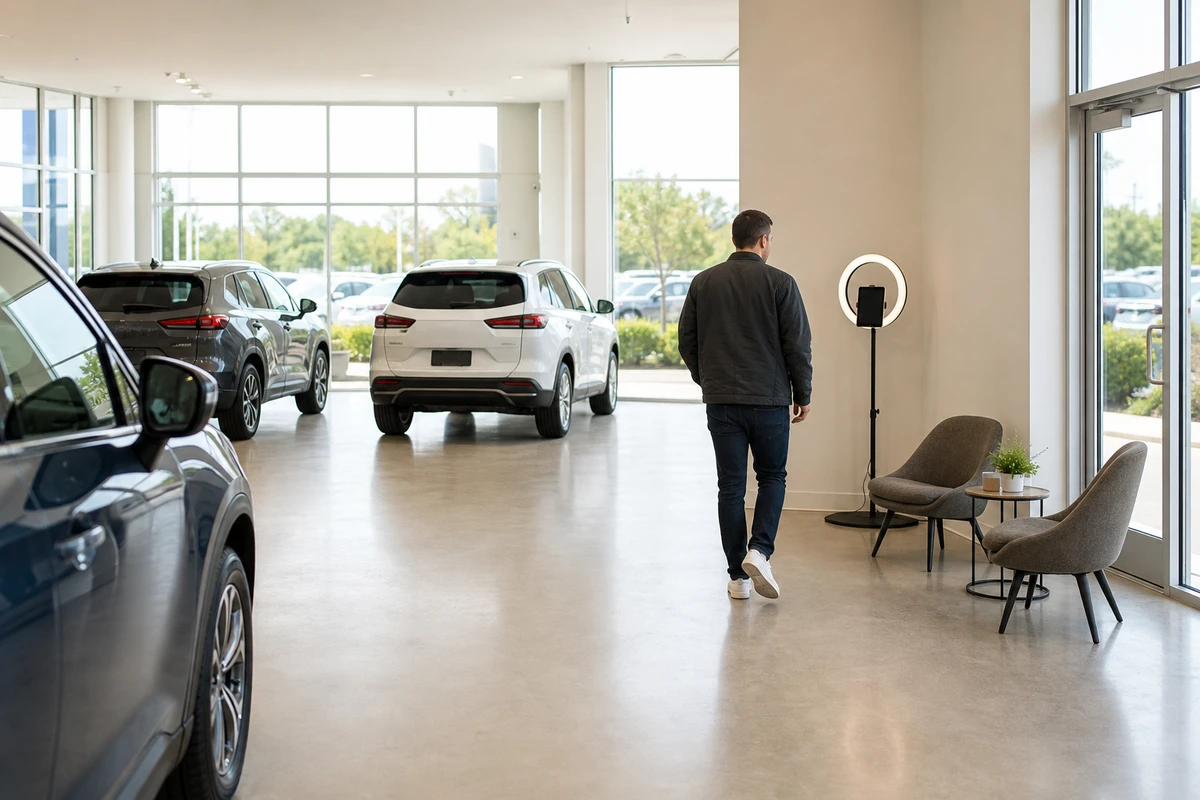
That gap points to the principle behind a working system: collect contact data as a byproduct of value the prospect receives, not as a gate they have to pass. Friction drops in proportion to what the visitor gets back. A request that delivers something useful gets answered. A request that delivers nothing gets “just looking.” No single mechanism does the whole job. A store can run several, and the strongest ones attach capture either to a moment that is already happening or to something the prospect actively wants.
Attach capture to a step that already happens
Two routine showroom moments already collect prospect information and then waste it. The test drive is the clearest. Capturing the registration digitally, once, and routing it straight to the CRM turns a compliance step into a lead with no added friction for the customer. The trade-in appraisal is the other. A prospect who wants to know what their current car is worth has a real reason to hand over contact details, because the valuation is what they get in return. The ask is naturally justified, and the resulting record arrives tagged with a strong buying signal.
Attach capture to something the prospect wants
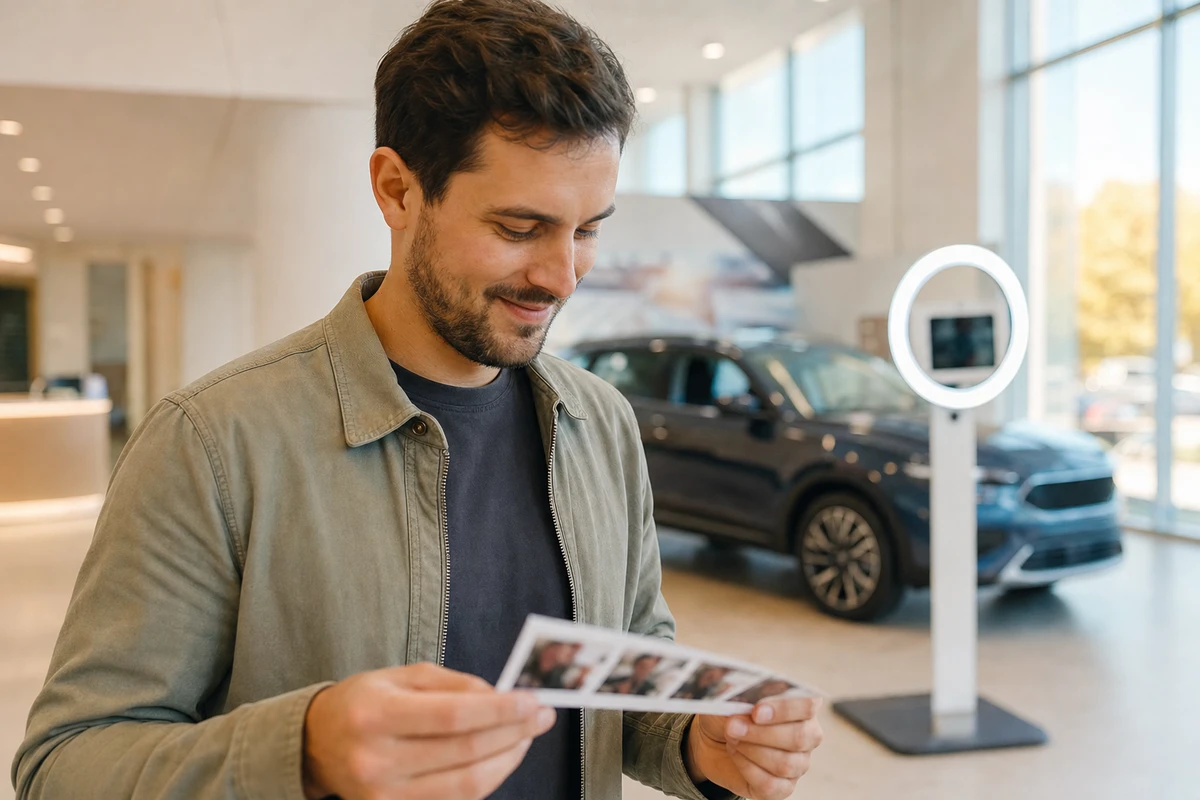
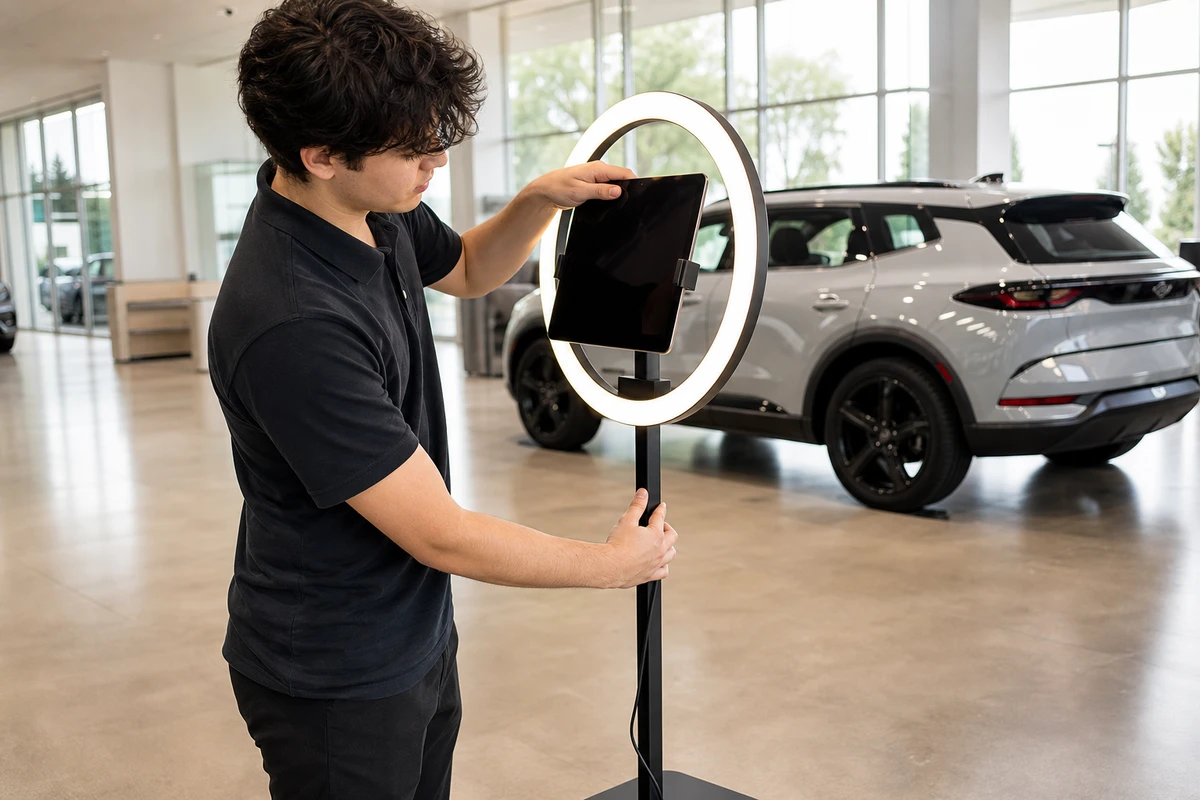
Other mechanisms create the value rather than borrow it. A QR code on a vehicle’s window sticker can link to a full digital spec sheet for that exact unit, and when the prospect chooses to have it sent by email or text, the delivery choice captures both a contact channel and the specific vehicle of interest. A branded photo experience on the floor works the same way: a visitor poses with the model they are weighing, the photo is delivered digitally, and the delivery step records a contact point and a marketing opt-in in a moment that reads as a perk rather than a pitch. A prize draw tied to a test-drive event uses its entry form as the capture event. Simple Booth’s HALO kit is one packaged version of the branded-photo approach: a visitor enters an email or phone number to receive their photo, and the same screen carries the marketing-consent checkboxes, so the contact channel and the opt-in are recorded together. The entertainment venue chain Treetop Golf used that capture step to build a list of 150,000 unique email addresses across its locations.
What every mechanism has to do
Whatever a store picks, three requirements hold. Capture has to be fast, taking under about thirty seconds of the prospect’s time. It has to collect a delivery channel and marketing consent in the same step, not as a later phone call. And it has to record the vehicle of interest, so the follow-up can reference a specific car instead of a generic “thanks for visiting.”
Routing Captured Data Into the CRM Fast Enough to Matter
A record in a silo is not a lead
A trade-in kiosk by the appraisal desk can collect forty valuation requests in a week, and every one of them can sit inside the kiosk, unseen by anyone who follows up. A clipboard at the test-drive desk, a standalone tablet that exports a spreadsheet once a week, and a salesperson’s phone notes share the same flaw. Each is a place data goes to be forgotten. A captured record has to land in the dealership’s DMS or CRM, the same VinSolutions, eLeads, or DealerSocket environment the team already works in, as a real lead, tagged with a source of “showroom walk-in” so the volume can be measured later.
Speed-to-lead, and the three-day window
Routing also has to be fast. The foundational study on lead response, by Oldroyd, McElheran, and Elkington in the Harvard Business Review in March 2011, found that firms contacting a prospect within an hour were about seven times more likely to have a meaningful conversation with a decision maker than firms that waited even one hour longer, and far more likely than those that waited a day. The dealership-specific version is sharper. Dealer Conversion’s BDC benchmarks report that a lead contacted within five minutes is 21 times more likely to convert than one contacted after thirty minutes, and that 78 percent of customers buy from whoever responds first.
Set that against the walk-in’s three-day close window and the requirement is plain. A captured record cannot wait in a queue until the next morning. It has to reach a salesperson, with an assigned follow-up task, within minutes. Auto-assign the record to the salesperson who worked the up, or to the BDC if no one owns it, create the task, and start a cadence. A captured lead with no owner and no task converts no better than a lead that was never captured.
Consent is part of capture, not paperwork afterward
Capturing a phone number or an email also takes on an obligation to follow up legally. The capture step itself has to record explicit opt-in for calls, texts, and email. Email follow-up falls under the CAN-SPAM Act, which the Federal Trade Commission enforces and which requires honest sender identification and a working opt-out. Calls and texts to a mobile number fall under the Telephone Consumer Protection Act, which requires documented prior consent before automated outreach. The consent checkboxes belong inside the capture mechanism, collected in the same thirty seconds, not chased down later.
The Capture-Rate Math, and Making It a KPI
Define the number the search results never name
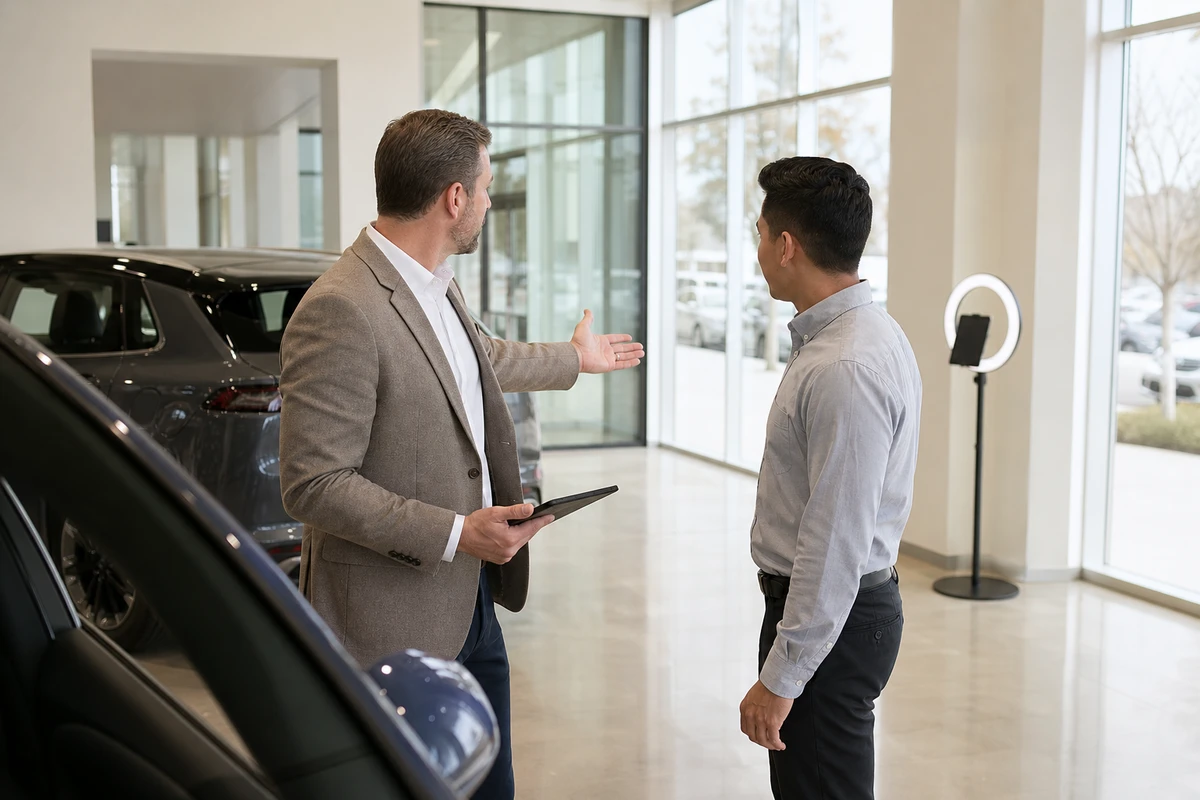
A general manager can usually recite the store’s close rate from memory. Ask the same manager what share of last month’s walk-ins left a contact record, and the answer is a guess. The metric is straightforward: showroom capture rate equals the number of walk-ins with a contact record in the CRM divided by the total number of walk-ins counted. This is the one job the people counter is good for. It supplies the denominator. The capture system supplies the numerator. The ratio between them is the size of the leak, expressed as a number a manager can move.
A worked scenario
The two figures that decide the outcome belong to the store: how many walk-ins it actually gets, and how many currently leave a record. The numbers below stand in until a dealership measures its own. Take a single-rooftop store that counts 250 showroom walk-ins in a month and, on an honest audit, finds that 40 percent of them produce a CRM record.
| Input | Value |
|---|---|
| Monthly showroom walk-ins (counted) | 250 |
| Current capture rate | 40% (100 records) |
| Target capture rate | 75% (188 records) |
| Incremental captured records per month | 88 |
| Conservative follow-up close rate on those records | 8% |
| Incremental units retailed per month | 7 |
| Combined front-end and F&I gross per unit | $4,500 |
| Incremental gross per month | $31,500 |
| Incremental gross per year | ~$378,000 |
The follow-up close rate here is deliberately cautious. These are visitors who left without buying, so 8 percent assumes most still do not return. The gross figure of $4,500 sits within the combined front-end and F&I range reported in NADA Data; a store should run the math with the actual number for its brand and market. Even with conservative inputs, lifting capture from 40 to 75 percent produces roughly $378,000 in additional annual gross, because the leads were already on the lot and already paid for.
Make it a managed KPI
A number that is not reviewed does not change. Showroom capture rate should be read weekly alongside close rate, posted by salesperson, and owned by a manager. The accountability question shifts from “did the salesperson log their ups,” which the up system already pressures people to game, to “did the visit produce a usable record.” What gets measured against a denominator gets fixed.
The asymmetry is the whole point. The showroom walk-in is the highest-converting lead a dealership has and the one it loses most often, because it is the only lead with no capture event of its own. Buying a people counter or pushing staff to log more ups does not close that gap. A capture step attached to something the visitor wants, routed into the CRM within minutes, does. The first move costs nothing: count one week of walk-ins, count how many became a contact record, and divide. That percentage is the size of the leak, and it is the number to start improving.
Sources
- Urban Science (2025). “Close Rate vs. Defection Rate: What Both Metrics Reveal About Dealership Performance.” https://www.urbanscience.com/resources/close-rate-vs-defection-rate-what-both-metrics-reveal-about-dealership-performance/
- Urban Science (2025). “2025 Urban Science Harris Poll Report.” https://www.urbanscience.com/harris-poll-report/
- Dealer Conversion (2026). “Dealership Conversion Rate: The Complete 2026 Benchmark Guide.” https://dealerconversion.com/conversion-benchmarks
- Dealer Conversion (2026). “BDC Performance Benchmarks: Appointment Set Rates, Response Times, and Close Rates.” https://dealerconversion.com/bdc-benchmarks
- Foureyes (2025). “Data Study: Every Lead Counts: Inside the 30-Day Close Rate Curve.” https://www.foureyes.io/blog/30-day-dealer-close-rate
- Foureyes (2026). “2026 Automotive Dealer Benchmarks Report.” https://www.foureyes.io/blog/2026-automotive-dealer-benchmarks-report
- Nextup (2024). “Auto Dealerships: Up System or Open Floor? Which Is Best?” https://thenextup.com/dealerships-up-system-open-floor/
- V-Count (2026). “Car Showrooms — People Counting Solutions.” https://v-count.com/industries/car-showrooms/
- Harvard Business Review (2011). Oldroyd, J. B., McElheran, K., and Elkington, D. “The Short Life of Online Sales Leads.” https://hbr.org/2011/03/the-short-life-of-online-sales-leads
- Federal Trade Commission (2023). “CAN-SPAM Act: A Compliance Guide for Business.” https://www.ftc.gov/business-guidance/resources/can-spam-act-compliance-guide-business
- NADA (2025). “NADA Data 2025 Full-Year Report.” https://www.nada.org/nada/nada-data
- Digital Dealer (2026). “The Shifting Sands of the Auto Buyer Journey.” https://digitaldealer.com/news/the-shifting-sands-of-the-auto-buyer-journey/170750/