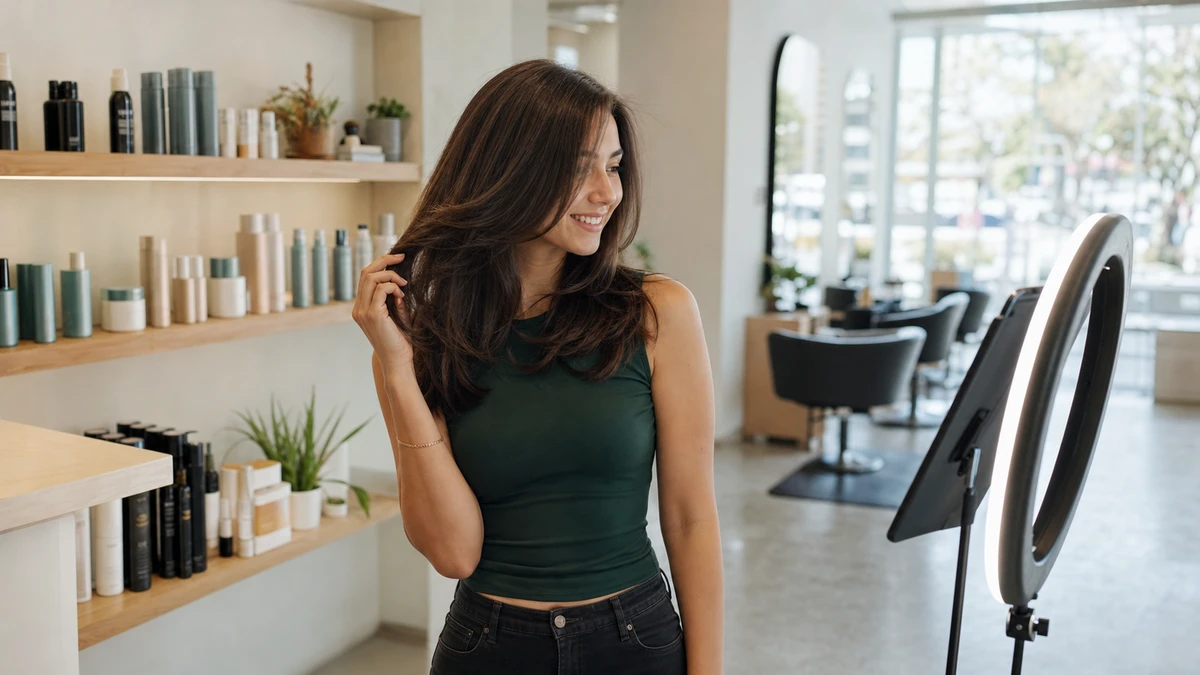
A stylist spins the chair toward the mirror, the client studies the new color, and the appointment ends the way good ones usually do: “This looks great, I’ll definitely be back.” Then the client pays, says goodbye, and is gone. Six weeks pass, then ten, and the booking never comes.
That gap is the real problem behind most salon promotion ideas. The work is good. The return is the leak. A promotion earns the word “loyalty” only when it does one specific thing: hand the client a concrete reason, and a concrete moment, to book the next visit. Most promotion lists optimize the first appointment and forget the second. The 15 ideas below are sorted instead by how each one affects the gap between visits, with the plain rebooking math to tell which are worth running.
What separates a promotion that builds loyalty from one that just fills a chair
Two salons run a promotion in the same week. One offers 30% off a first cut. The other offers a free deep-conditioning treatment to any client who books the next appointment before leaving. A month later the first salon has served a stranger once. The second has more appointments on the calendar. Same effort, opposite results, because the two promotions were not doing the same job.
Every promotion does one of two things. It buys a transaction, or it shortens a cadence. A discount on a first visit buys a transaction. The client comes in once, the salon pays for the privilege with margin, and then the odds take over. Phorest, a salon software company, surveyed 716 hair and beauty salon guests in the UK and Ireland at the end of 2024 and found that only 29% of new clients rebook for a second visit. Seven in ten do not. A first visit bought with a discount, statistically, is a coin the salon has already paid to flip.
A promotion that builds loyalty changes the interval instead. It pulls one of two levers. The first is timing: whether the next appointment is booked now, while the client is still in the building, or left to memory and good intentions. The second is frequency: whether the client returns every ten weeks or every seven. The 15 promotions below are grouped by which lever they pull, so an operator can choose by what the salon actually needs rather than by what sounds appealing in a list.
Promotions that lock in the next visit before the client leaves
The checkout counter is the most valuable promotional slot a salon owns, and most salons waste it. The client is standing there with fresh hair, a good mood, and a mirror’s worth of evidence that the money was well spent. That is the easiest moment all year to book the next appointment, and it closes the second the client walks out the door. Stylists who retain clients well treat that moment as routine; a common refrain in hairstylist forums is some version of “I rebook clients before they pay me at the end of the service.” There is data behind the instinct.
Salon Today, reporting on Boulevard research, found first-time clients who booked their first appointment online returned for a second visit about 78% of the time, against roughly 39% for walk-ins, close to double. Booking method is not the same thing as a checkout rebook, but the pattern points the same way: an appointment that exists on a calendar holds far better than one that lives only in a client’s good intentions.
1. The pre-booking perk
Offer a small, fixed reward for booking the next appointment before leaving: a complimentary add-on, bonus loyalty points, first pick of a Saturday slot. The reward is not the point; the moment is. An add-on works better here than a few dollars off, because a discount quietly resets what the client expects to pay next time and a one-time treatment does not.
2. The prepaid service block
Sell a set of recurring visits upfront, six blowouts or four color-maintenance appointments, at a modest bundled value. Once a client has prepaid the cadence, the rebooking decision is already made. The salon is no longer asking the client to choose to return; it is scheduling something already bought.
3. The membership offer
A monthly recurring plan, a flat fee covering a defined service or a service credit, is the strongest cadence lock a salon can sell, because the next visit stops being a decision and becomes the default. Memberships are now standard practice rather than a fringe experiment; every major salon platform builds dedicated tools for them. This is a promotion to enroll, distinct from a one-off price cut.
4. The dated next-visit credit
Hand the client a credit toward a named next service, a root touch-up or a gloss or a cut, dated to their maintenance window, rather than a generic “money off your next visit.” Stylists are blunt about why specificity wins: setting an actual date for the rebooking beats a vague timeframe, and a vague timeframe beats nothing. A credit tied to a real service and a real week is a booking three-quarters made.
Promotions that give clients a reason to return on a schedule
Salon services come with a built-in expiry date. Color shifts at six to eight weeks, a haircut loses its shape at five or six, a fill is due on its own cycle. That biology is a gift. A 2022 Boulevard consumer survey reported by Salon Today found that 54% of female clients already visit a salon at least once every six to eight weeks. The cadence exists. A promotion aligned to it does not have to create demand, only catch it on schedule, and the client tends to agree, because the maintenance does not feel optional. In Mindbody’s 2023 survey of more than 17,000 Americans, 44% called services like haircuts and facials a necessity rather than a luxury.
5. The maintenance-window offer
Price an offer for the exact week a service is due: a root touch-up rate that applies only inside the six-to-eight-week window. A client who books on time gets the rate; a client who drifts to twelve weeks does not. It rewards the cadence the salon wants without ever reading as a markdown, because the price is a function of timing, not of haggling.
6. The visit-frequency punch card
The “tenth visit free” card is a loyalty tool only when the reward depends on frequency, not on eventually accumulating visits. A card that pays out after ten visits whenever they happen rewards a client who took three years to get there. Set the threshold so it only pays if the visits land inside a window, six visits in twelve months, and the card starts pulling the interval shorter instead of just recording it.
7. The points-based loyalty program
Clients earn points per dollar spent, redeemable for services or retail products. GlossGenius describes four common structures for these programs: points, tiered rewards, punch cards, and social engagement. The sharpening most salons miss is what the points reward. A program that awards points only for spend rewards the client who was coming anyway. Award bonus points for booking the next visit on time and for referrals, and the program starts paying for the two behaviors that actually compound: cadence and advocacy.
8. The birthday or anniversary offer
A dated, personal, recurring reason to book is worth more than a blanket sale. An offer in the client’s birthday month, or on the anniversary of their first visit, gives the salon a once-a-year prompt that reads as attention rather than promotion. It works because it is specific to one person and tied to a date, which is exactly what a blast email to the whole list is not.
9. The win-back offer
Some clients quietly slip past their normal interval. A targeted, time-limited message can catch them before the drift becomes permanent. Meevo, a salon software company, defines new-client retention by whether a client returns within 90 days of the first visit, a useful line for deciding who counts as lapsed. The trigger matters: the message should fire when a specific client passes their own average interval, not as a generic monthly blast to everyone. A client who normally returns every seven weeks and has been gone eleven is the one to reach, with a reason to come back now.
Promotions that fill quiet slots without training discount behavior
Every salon has dead air. Bookedin reports that Tuesdays and Wednesdays tend to be the quietest days for most beauty salons, and that the weeks after the holidays, especially late January through February, run noticeably slow. The reflex is to discount those slots. The better move is to fill them with offers that shift behavior or add value without teaching the whole client book to wait for a sale.
10. The off-peak booking perk
Attach a perk, not a price cut, to the slowest blocks: a free add-on for any Tuesday appointment before 3pm. The discipline is in the scoping. Pull the actual slow window from booking history first, then make the offer narrow enough that it moves a client who would otherwise book Saturday, rather than handing a perk to demand that already exists.
11. The themed event day
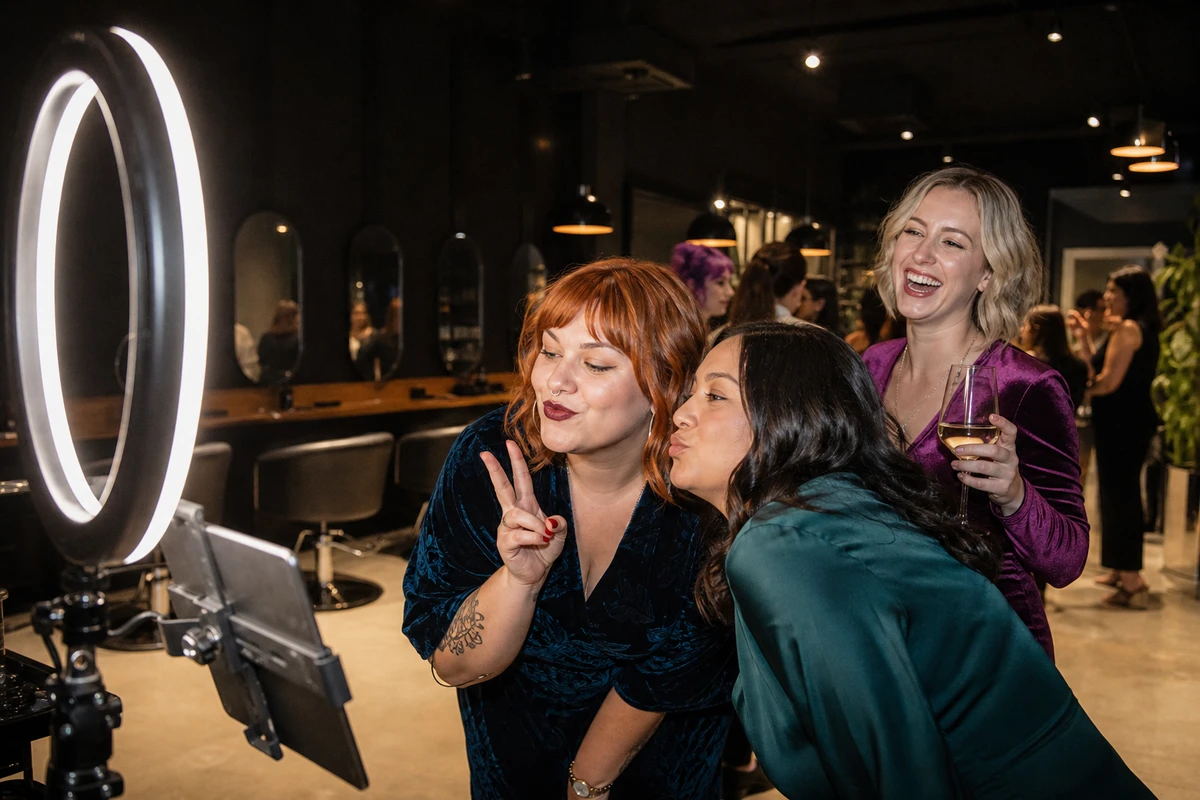
A recurring slow day can become an occasion. A color-education evening, a self-care afternoon, a stylist Q&A: the event itself is the draw, not a markdown, and it creates something a client wants to talk about and photograph. A reason to show up beats a reason to save money, and it does not reset anyone’s price expectations.
12. The new-service bundle
Pair a service the client books regularly with one they have never tried, at a slight bundled value. The margin on the bundle is not the point. The point is that the client now has a second service in their routine, a treatment or a gloss, with its own maintenance cycle, which widens how often they have a reason to return.
13. The value-add upgrade
When the instinct says “20% off,” substitute a complimentary enhancement instead: a deep-conditioning treatment, a scalp massage, an express add-on. To the client it reads as generous. To the salon it usually costs less in real margin than the equivalent discount, and unlike a discount, it never teaches the client that the service has a lower acceptable price.
Promotions that turn one happy client into the next booking
The least expensive new client a salon will ever get is the friend of a current one. Nielsen’s 2015 Global Trust in Advertising survey, fielded across 60 countries, found that 83% of consumers trust recommendations from people they know, ahead of every other advertising format. The Boulevard survey points the same way: more than a quarter of clients pick a new stylist primarily on a friend’s recommendation. Two promotions turn a happy client into that recommendation.
14. The two-sided referral offer
Reward both people: a credit for the client who refers, and a genuine reason to try for the client who is referred. One-sided programs either ask an existing client to spend social capital for nothing, or ask a stranger to trust an offer with no warm introduction behind it. Rewarding both sides removes both objections. Make the referrer’s reward a service credit rather than cash, because a credit books another visit while cash just leaves the building.
15. The reveal-moment share offer
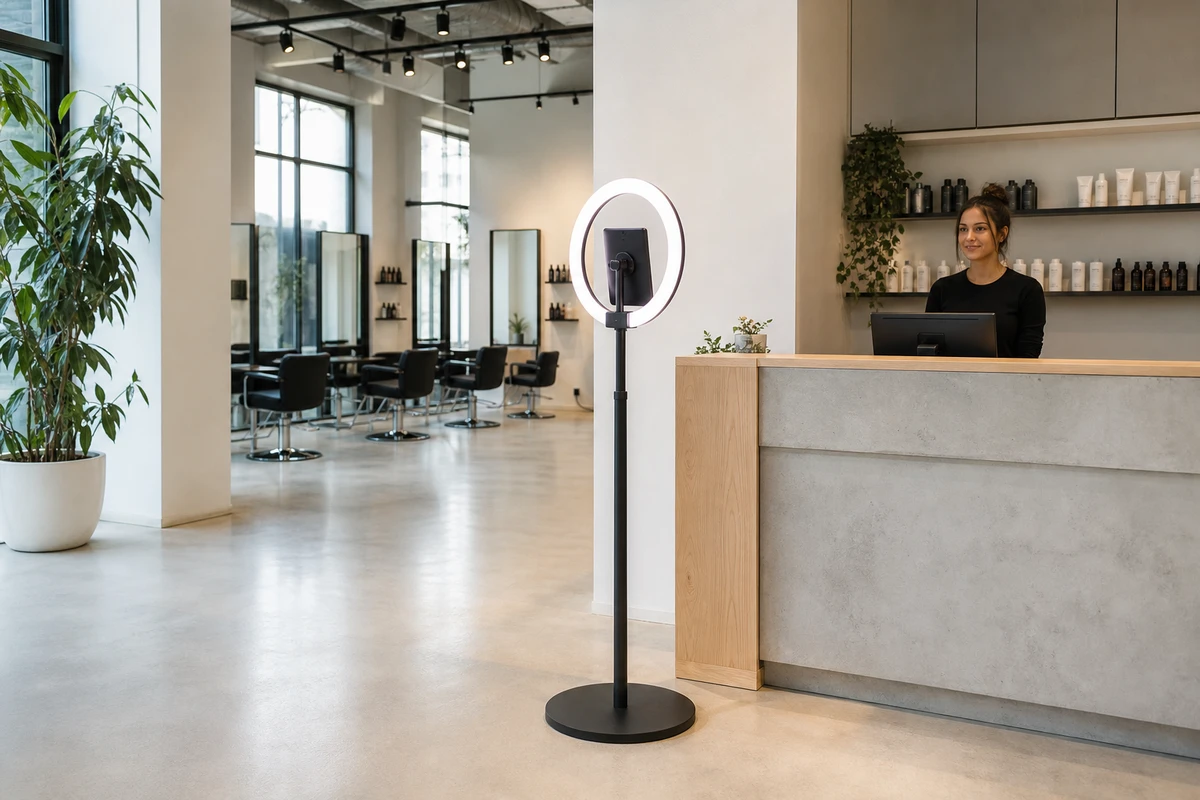
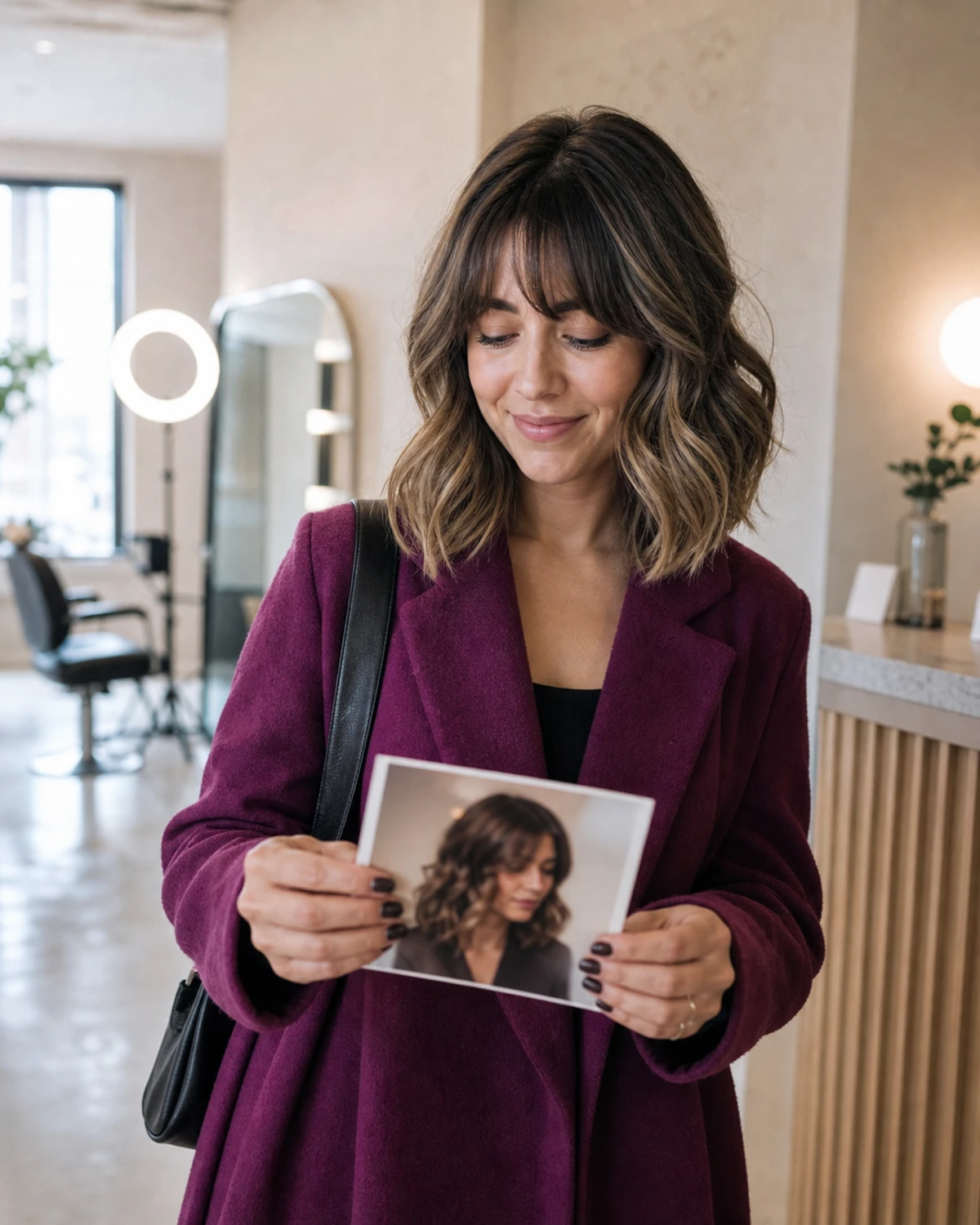
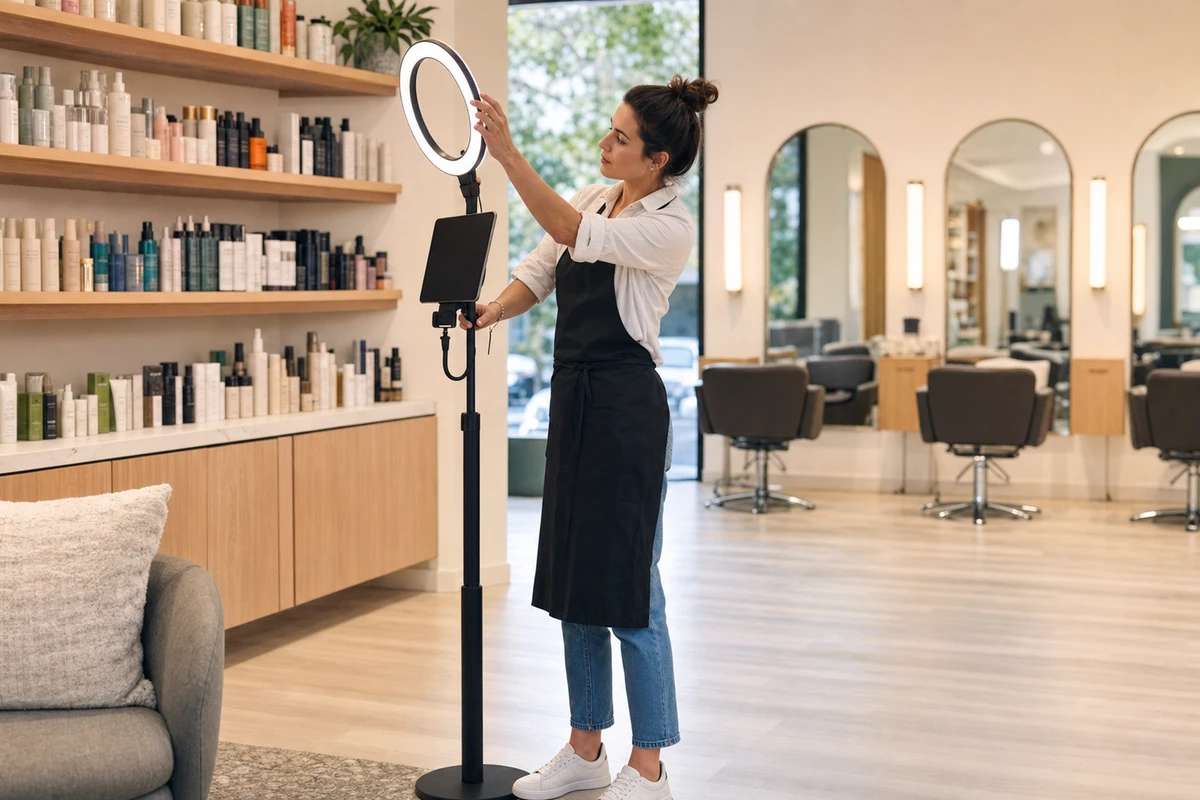
A salon’s most underused promotional asset is the transformation itself: the before-and-after, the moment the chair turns toward the mirror. A promotion built around that moment, a perk for a client who shares and tags the result, a polished photo of the finished look to take away, converts a single appointment into reach, social proof, and a soft referral to everyone who sees it. The visible result is already the salon’s best advertisement. A promotion just gives the client a reason to publish it. Running it well takes a spot where the photo actually looks good, since the overhead lighting most salons use tends to flatten color on camera. Simple Booth’s HALO kit is one device built for that moment: it pairs an iPad with a 2,100-lumen ring light so the finished color reads true, then sends the client the photo by text or email before they leave the chair, ready to post and tag.
The rebooking math: what a shorter visit interval is actually worth
Here is why the interval is the number that matters, with figures kept deliberately round and clearly illustrative. Take a color client on a $120 average ticket.
At a ten-week interval, that client comes in 52 ÷ 10, about 5.2 times a year, worth roughly $625. Move the same client to a seven-week interval with the cadence promotions above, and the visits rise to 52 ÷ 7, about 7.4 a year, worth roughly $890. The gap is around $265 a year from one client, before a single referral or retail product enters the math. Across a 200-client book, compressing the average interval from ten weeks to seven is worth on the order of $53,000 a year.
Now price the alternative
Now price the alternative. A 20% discount on that first $120 visit gives away $24 of margin. It does so for a client who, on Phorest’s finding that only 29% of new clients rebook, has a roughly seven-in-ten chance of never coming back. Spending $24 to acquire a coin-flip, then spending more to acquire the next one, is a slower and more expensive path than spending little or nothing to move existing clients three weeks closer together.
A real salon should re-run this with its own average ticket, its own interval, and its own client count. The figures will move. The direction will not.
The discount trap: why most salon promotions quietly lose money
Why do so many salon promotion lists still lead with a percentage off? Because asking a client to rebook can feel like a hard sell, and a discount feels easier to offer than a sentence. A recurring thread in the r/hairstylist community has operators asking how to request the rebook without sounding pushy. The best answer is to reframe it: not “do you want to book again,” but “let’s get something on the books for around six weeks out.”
The discount is the easy escape from that discomfort, and it quietly does three expensive things. It sets a new, lower reference price the client now expects to see again. It selects for the most price-sensitive clients, who are also the least loyal, because the next salon running a cheaper deal will take them. And it teaches the whole client book to wait for a sale before booking. The same 2022 Boulevard survey reported by Salon Today found only 3% of consumers say discounts or deals are crucial to their choice of salon. The deal-hunter a discount attracts is a 3% sliver, and not the loyal one.
The economics of keeping clients are well documented. In their 1990 Harvard Business Review paper “Zero Defections,” Frederick Reichheld and W. Earl Sasser found that cutting customer defections by 5% raised profits substantially, by 25% to 85% depending on the industry. None of this makes discounts useless. A discount has one narrow job: a genuine trial of a new service, or a tightly scoped nudge into a dead slot. It is an acquisition tool. Used as a loyalty tool, it is the most common and most expensive mistake in this list.
How to choose, run, and measure the right promotion
No salon should run all 15 of these at once. The better move is to run one, matched to a diagnosis. A salon whose stylists end appointments with “see you soon” and nothing on the calendar needs the checkout group. A salon watching loyal clients stretch from seven weeks to eleven needs the cadence group. A salon with a packed Saturday and an empty Tuesday needs the slow-day group. A salon with steady regulars but a flat total client count needs the advocacy group.
Then measure the right thing. The number that matters is not how many coupons were redeemed. It is the rebooking rate at checkout, the average days between a client’s visits, and the share of clients who return at all. Phorest’s benchmarking data across more than 10,000 salons puts the industry-average rebooking rate near 55%, with top performers above 70%, which gives any salon a concrete figure to measure itself against.
The through-line holds for all 15: a promotion earns its place only if it secured a booking or shortened a cadence. Everything else is a sale dressed up as a strategy.
Sources
- Phorest (2025). “Salon Consumer Insights Report 2025.” https://www.phorest.com/us/resources/salon-consumer-insights-report-2025/
- Phorest (2025). “Phorest Insights: Data and Learnings from Over 10,000 Salons.” https://www.phorest.com/us/blog/phorest-insights-data-and-learnings-from-over-10000-salons/
- Salon Today (2022). “Consumers Seek Value, Reputation and a High-End Experience When Selecting a Hair Salon” (coverage of Boulevard consumer survey). https://www.salontoday.com/1079743/consumers-seek-value-reputation-and-a-high-end-experience-when-selecting-a-hair-salon
- Salon Today. “Boulevard Report Reveals Top-Performing Salons Retain 56% More First-Time Visitors.” https://www.salontoday.com/1088748/boulevard-report-reveals-top-performing-salons-retain-56-more-first-time-visitor
- Harvard Business Review (1990). Reichheld, F. F. & Sasser, W. E. “Zero Defections: Quality Comes to Services.” https://hbr.org/1990/09/zero-defections-quality-comes-to-services
- Nielsen (2015). “Global Trust in Advertising.” https://www.nielsen.com/insights/2015/global-trust-in-advertising/
- Mindbody (2023). “Top Beauty and Wellness Findings for 2023.” https://www.mindbodyonline.com/business/education/blog/top-beauty-and-wellness-findings-2023
- GlossGenius (2025). “Salon Loyalty Programs: How to Create One (With Examples).” https://glossgenius.com/blog/salon-loyalty-program
- Bookedin (2026). “10 Beauty Salon Promotion Ideas to Fill Slow Days.” https://bookedin.com/blog/beauty-salon-promotion-ideas/
- Meevo (2026). “How to Improve Salon & Spa Client Retention.” https://www.meevo.com/blog/salon-spa-client-retention-tips/
- Reddit, r/hairstylist. Operator discussion on rebooking language at checkout. https://www.reddit.com/r/hairstylist/comments/1rxzhwf
- Reddit, r/hairstylist. Operator discussion on how to ask for the rebook. https://www.reddit.com/r/hairstylist/comments/1iudk47