A colorist finishes a balayage, turns the chair toward the mirror, and the client lights up. Someone grabs a phone, takes a before-and-after shot, and the client leaves happy. Six weeks later the color has shifted, the roots have grown, and the client still has not booked again. The photo is sitting in a stylist’s camera roll, untagged, and nobody will ever look at it again.
Salon rebooking campaigns built around that photo work for one reason: the photo is proof of a result the client is actively losing. A generic “it’s been a while” reminder asks the client to remember why the salon was worth the money. Their own before-and-after shows them. Most salons already take these photos and then waste them as feed content. The hard part is the system, not the copywriting: how the photo gets captured, attached to the right client record, merged into an automated sequence, kept compliant, and measured. Building that system once is what separates the salons that run this campaign from the salons that only mean to.
Why a Transformation Photo Beats a Generic Rebooking Reminder
A standard win-back message points at time. “It has been a while since your last visit” tells the client that a calendar number has changed and asks them to supply the reason it matters. A transformation-photo message points at the result decaying instead. Hair color, balayage, lash fills, and gel manicures all degrade on a visible and fairly predictable clock. The photo re-anchors the client to the moment they looked exactly how they wanted to, which is also the moment furthest from how they look now.
Loss Aversion Supports Rebooking
That difference is a mechanism, not a matter of tone. The client is not deciding whether to acquire something new. They are watching something they already paid for disappear. Loss aversion, the tendency to weigh losses more heavily than equivalent gains, is one of the most replicated findings in behavioral economics. A reminder framed as a fresh purchase competes with every other call on the client’s money. A photo framed as restoring a result the client already bought changes what they are being asked to decide.
The retention math is why this matters. According to Boulevard’s 2023 salon industry report, covered by Salon Today, top-performing salons convert 70% of first visits into a second appointment, while average salons convert roughly 45%. More than half of first-time clients at an average salon never come back. Industry-wide new client retention sits near 35%, a figure Strategies.com and the software vendor Meevo report independently. Chairside rebooking is supposed to catch these clients, but SalonIQ notes that stylists often find the chairside ask “too pushy” and quietly let it lapse. Clients who leave without a next appointment booked have to start the rebooking themselves, and most don’t. A photo-driven campaign is the safety net under every client the chair missed.
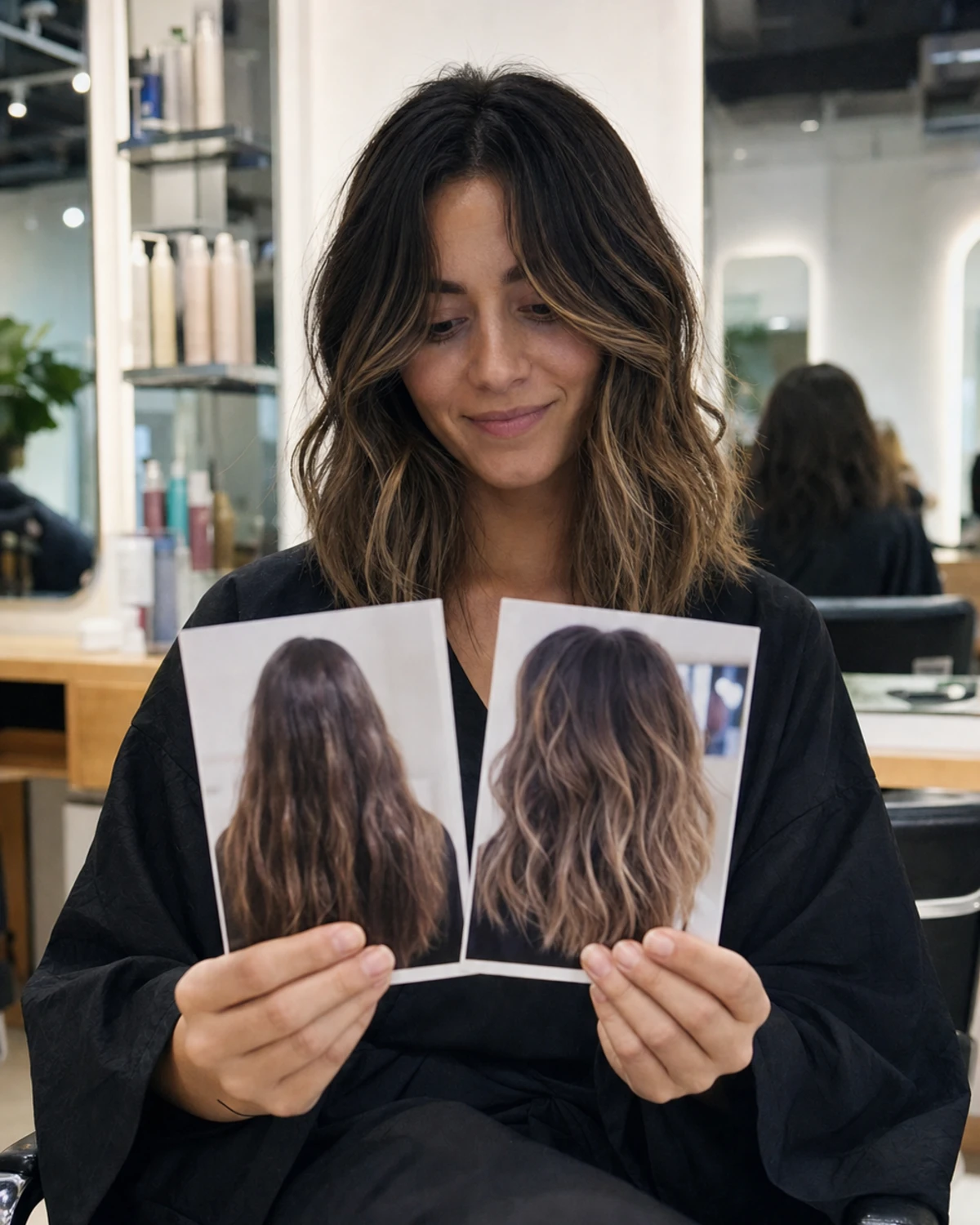
The misconception worth correcting: transformation photos get filed under “social media content,” judged by reach and likes. Their highest-value use is the opposite of public. The same photo, pointed at one client’s inbox instead of a feed, is a retention asset.
The Capture Workflow: Getting a Usable Photo Attached to the Right Client
Walk into most salons and ask where the last month of transformation photos are. They are spread across four or five personal phones, mixed in with lunch pictures and screenshots, named nothing, linked to nobody. A campaign cannot run on photos it cannot find. The capture problem is not that salons fail to take photos. It is that the photos never become findable, and a photo nobody can locate for a specific client is worth zero to a rebooking sequence.
A usable capture workflow has four requirements
A usable capture workflow has four requirements. The framing and lighting need to be consistent enough that the image reads as proof rather than a casual snapshot. Capture has to happen at a fixed point in the visit, ideally checkout, so it is not left to whoever remembers. Both a before and an after shot should be taken and kept as a pair, because the contrast is the persuasion. And the photo has to be associated with the client’s name or profile at the moment it is taken, not sorted later, because later never happens.
Treat the capture device as a technology decision with honest tradeoffs. A stylist’s personal phone costs nothing and is always available, but the framing is inconsistent, the photos get lost, and the salon has a real ownership problem when that stylist leaves and walks out with a year of client images. A shared salon tablet improves control and keeps the photos on a salon-owned device, but a manual sorting step still stands between the photo and the client record.
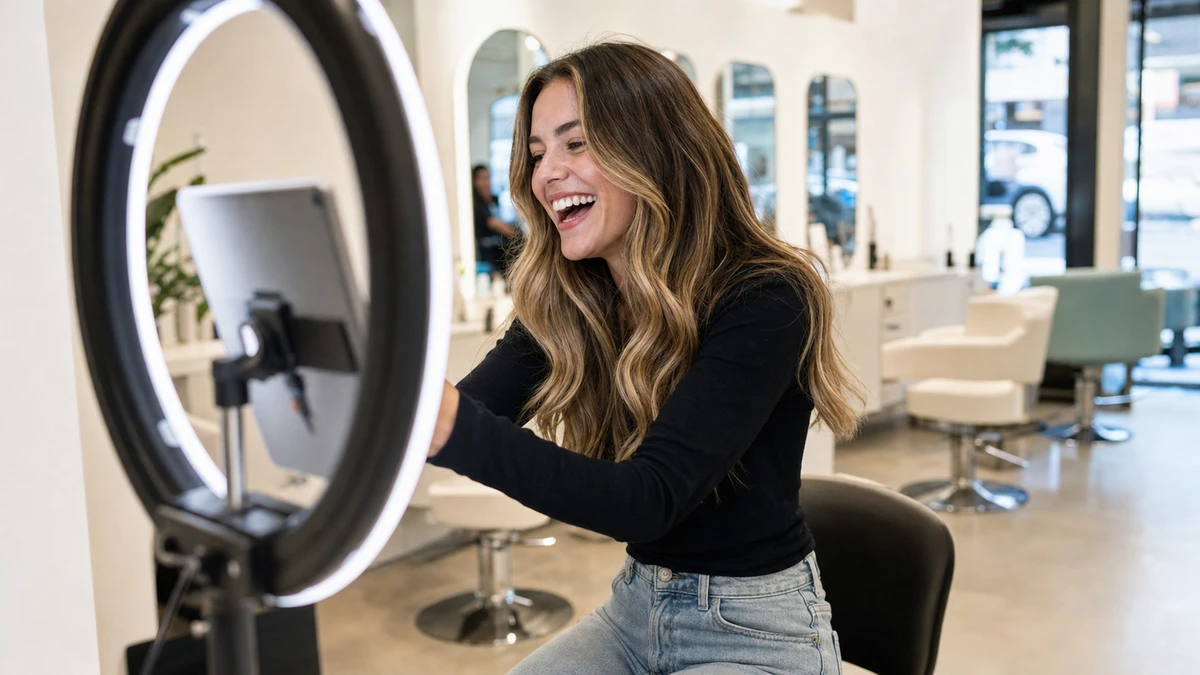
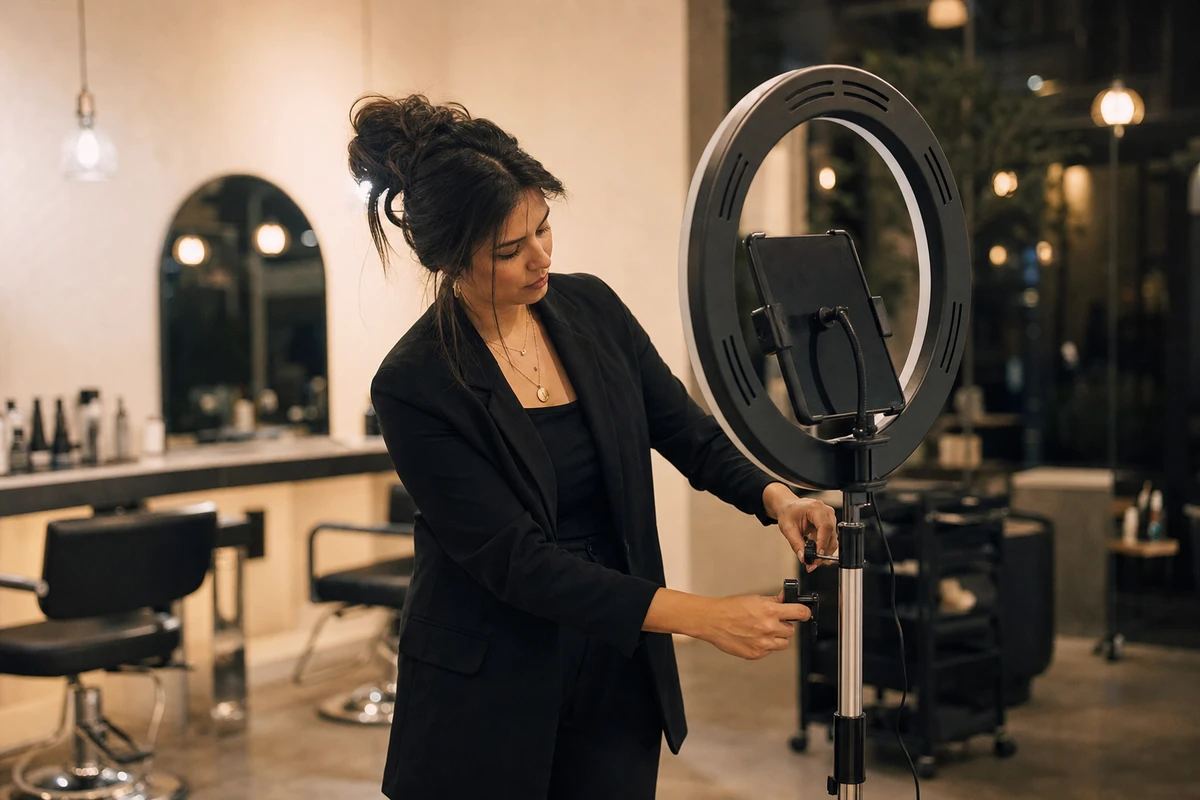
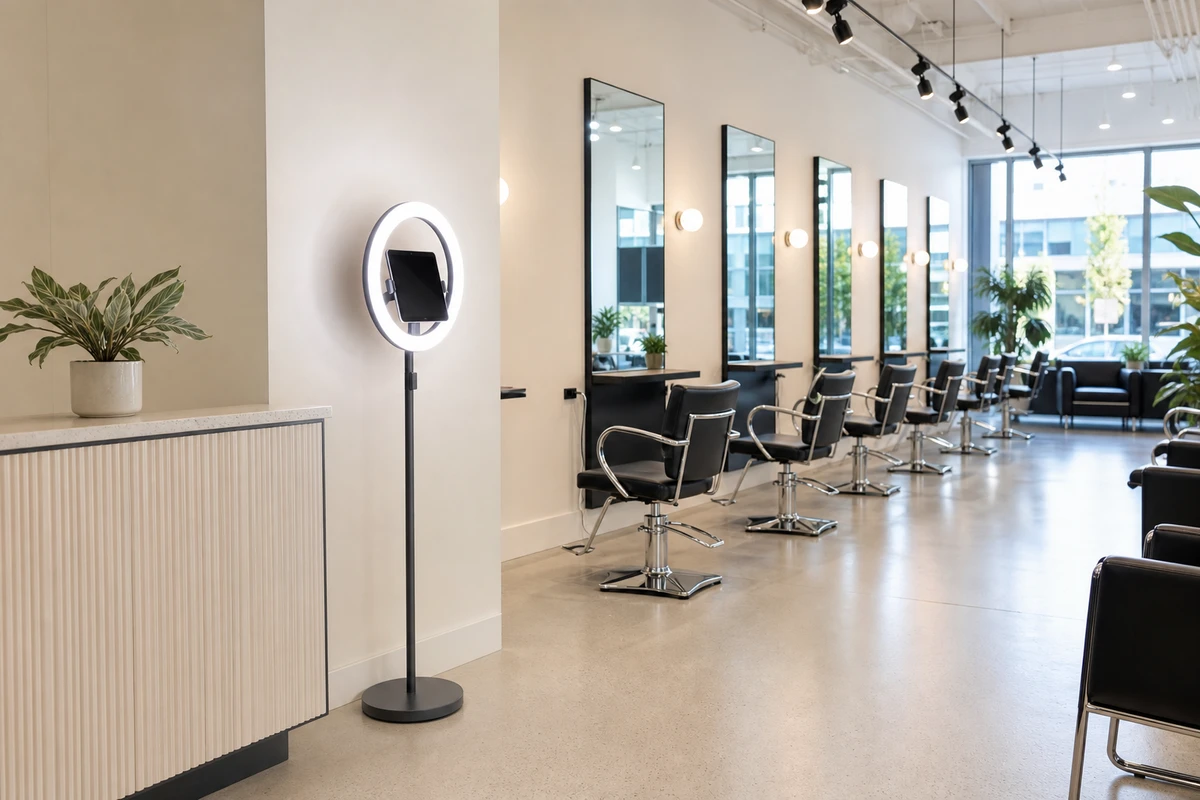
A dedicated capture station near the front of the salon, where the client photographs their finished look against branded and controlled lighting, produces the most consistent images, removes the sorting step, and turns capture into a moment the client takes part in rather than a chore done to them. The station is the upgrade path for a salon that wants this to run without depending on individual staff habits. Simple Booth’s HALO kit is one version of that station: an iPad in an integrated ring light that lights every client at the same 2,100-lumen output, so a photo taken in morning sun and one taken near closing read as the same controlled image rather than two shots of two different rooms.
The capture step is also the right moment to collect permission to use the photo, far easier to build in here than to chase down later.
Wiring the Photo Into the Client Record
A campaign that sends each client their own photo has to answer one question for every message it sends: which photo belongs to which client. If the answer lives in a stylist’s memory, the campaign does not scale past a handful of names. The photo has to stop being a file in a folder and become an attribute of the client, the same kind of stored field as a phone number or a last-visit date.
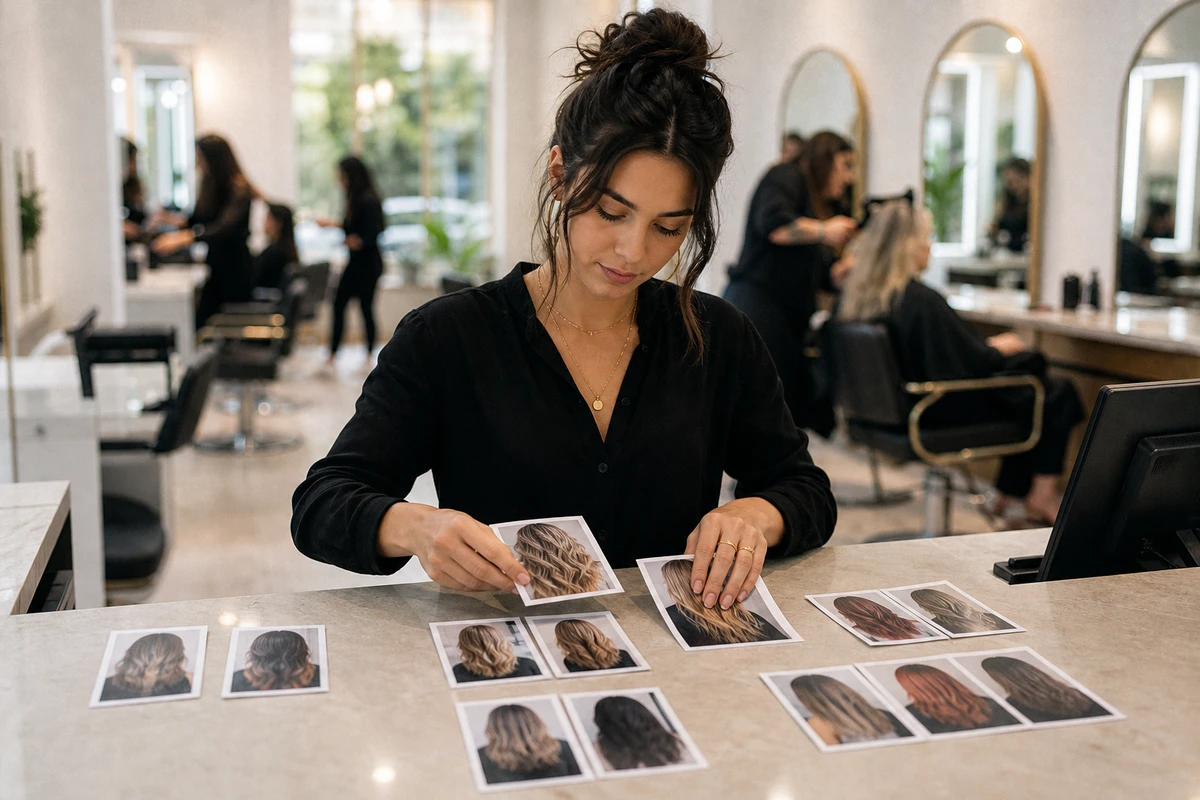
In practice the client record needs three things
In practice the client record needs three things. It needs a photo field or attachment on the client’s profile in the booking or CRM system, so the photo is retrievable by client rather than by date. It needs the photo tagged by service type (color, balayage, extensions, lash lift, gel set), so the campaign can segment. And it needs the photo linked to the last-service date, so the automation can calculate each client’s individual rebooking window.
The data handoff is worth describing plainly. Salon booking software stores the appointment and the client. The transformation photo either lives natively inside that client record or in a connected tool that passes the image and its tags back to the record. Salon platforms differ in whether they expose a client-photo field directly, so an operator should confirm that capability before assuming it, and treat any cross-tool connection as a data handoff to verify rather than a guaranteed native feature.
Service-type tagging is the part most operators skip, and it is the part that makes the campaign work. A color client and a lash client are on completely different decay clocks. One undifferentiated win-back list cannot time itself correctly for both, so it ends up mistimed for everyone. Tagging by service is what lets a single campaign behave like several, each firing on its own schedule. The prerequisite to fix before any of this runs: if photos are still split across personal phones with no shared client record, that gap gets closed first. Everything downstream depends on it.
Building Salon Rebooking Campaigns Around the Photo
A client who has not rebooked receives three messages over roughly three weeks. Simple Salon describes this win-back structure well: a warm check-in around day one of the lapse window, a second touchpoint roughly ten to fourteen days later, and a soft final message near day twenty-one. The structure is sound. The photo changes what each message does.
Maintenance
The first message leads with the client’s own after photo and a plain line: this is the color the client left with. The second message is the decay message. It pairs the same photo with the maintenance window for that specific service, noting that color like this is usually ready for a refresh around a particular week. The third message carries a soft offer, photo still present, with no countdown-timer urgency gimmicks. The photo does the persuading across all three; the copy stays short.
Timing has to follow service-specific cycles rather than one blanket interval, which is the payoff of the tagging done earlier. Simple Salon reports an average rebooking cycle near eight weeks for color clients and around six weeks for cuts. Longer-interval color work like balayage often runs eight to sixteen weeks between appointments depending on technique. Lash fills sit on a much tighter clock, typically replaced every two to three weeks as natural lash growth carries the extension out, and gel manicures chip or lift on a similar two-to-three-week window. A campaign tagged by service fires each of these on its own schedule from one shared setup.
Service tagging also draws a natural outer limit on who belongs in the campaign at all. A color client four weeks past the rebooking window is a strong win-back target. A client who has not booked in eight months has effectively churned, and a photo of a result that faded long ago carries less weight. Omnisend’s win-back research puts most recovered purchases within three to six months of a client going quiet, so the trigger should pull from that recent window rather than the entire client history. A salon messaging every name it has ever recorded dilutes its own rebook rate and irritates people who moved on years ago.
Channel choice is a technology decision with real tradeoffs. SMS reaches fast: Omnisend reports SMS open rates in the 90 to 98% range, far above email. But a plain SMS cannot carry an image. Embedding the photo directly means MMS, which costs more per message than SMS and can deliver less reliably across carriers. The alternative is an SMS with a link to a hosted image, which keeps SMS economics but requires the client to tap before they see anything. Email carries the photo natively and suits the longer decay message; Mailchimp’s benchmarks put the health and beauty vertical near a 34% open rate. A combined sequence, email for the visual message and SMS for the fast nudge, covers both.
The per-client photo gets inserted by a merge field, the same way a first name is dropped into a greeting. That is the line between a campaign and a craft project. Manual selection and photo attachment, one client at a time, is exactly the workflow salon owners report starting and then abandoning. Automation removes the friction that kills consistency, so it is not an optional polish on the campaign. It is the campaign.
Consent, Storage, and Privacy for Face-Forward Campaigns
A salon cannot photograph a client’s face, store it, and drop it into a marketing text simply because the client smiled when the photo was taken. A transformation photo is a photograph of an identifiable person used for marketing, and that makes the salon responsible for it as personal data.
The consent workflow
The reassuring part is that the obligation is ordinary, not exotic. Under the GDPR’s definitions in Article 4, a portrait of a client is personal data, but it is not biometric data. Biometric data requires “specific technical processing” that allows the unique identification of a person, and GDPR’s Recital 51 states plainly that photographs are not automatically biometric. A photo only crosses into that special category when it is run through facial recognition. The California Attorney General’s CCPA guidance draws the same line: a photograph is personal information, and it becomes sensitive biometric information only when processed to uniquely identify a consumer. A rebooking campaign never needs facial recognition, so the practical rule is simple. The photo is personal data, so handle it as personal data, with consent, controlled storage, and a deletion path.
Consent should be collected and recorded at the point of capture, as a checkbox on a digital intake form or a signed line. Two permissions belong on that form, kept separate: permission to use the photo in messages sent to that client, and permission to post the photo publicly. They are different decisions, and bundling them means a client who is glad to receive a copy of their own photo accidentally signs away a public post they never wanted.
Storage belongs inside controlled salon software, not a camera roll on a personal phone. Controlled storage is what makes access control, deletion on request, and a clean answer to “what happens to the photos when a stylist leaves” possible at all. A retention policy should cap how long photos are kept (a defined period after the last appointment is a defensible standard), and a client who asks for removal should have a straightforward path to it.
Measuring Whether the Photo Campaign Actually Works
Run a photo-driven rebooking campaign for a quarter and the honest question arrives: did the photo do anything, or would those clients have rebooked anyway? A campaign that cannot answer that question is running on faith.
The answer requires a control
The answer requires a control. Run the photo version of the sequence against a no-photo version of the same sequence, sent to a held-out segment of comparable lapsed clients. The gap in rebook rate between the two groups is the photo’s actual contribution. Without a held-out group, a salon only knows that some clients came back, not that the photo brought them. The metrics that matter are the rebook rate of recipients versus control, revenue recovered, the opt-out rate (a photo campaign that feels intrusive shows up as elevated unsubscribes), and the cost to run.
A concrete scenario fixes the arithmetic. Take a salon with 200 clients sitting in that recently lapsed window. Win-back campaigns recover 20 to 40% of inactive customers, according to research cited by Omnisend, and a real salon win-back run reported by SalonIQ converted 377 contacted clients into 61 bookings, a 16% rate. Using a conservative 18% recovery on the 200-client list gives 36 clients back. At a $95 blended average service ticket, that is $3,420 recovered from a single campaign cycle. The formula is lapsed client count multiplied by recovery rate multiplied by average ticket, and a salon with different numbers gets its own figure from the same three inputs.
That $3,420 understates the return. A recovered client does not rebook once and vanish. They re-enter the rebooking cycle, so the campaign’s true value is each recovered client’s forward worth, not a single appointment. Omnisend’s data notes that 47% of won-back customers go on to generate more revenue than they did before lapsing. The economics favor this work heavily: Harvard Business Review reported in 2014 that acquiring a new customer costs five to twenty-five times more than retaining an existing one.
The asset already exists in the salon. It is taken every working day and dropped into a camera roll. The work ahead is not photography, it is plumbing: a field on the client record, a tag for the service, a trigger tied to the last visit, a consent box, and a held-out segment to prove the photo earned its place. A salon that builds that pipeline once runs every future rebooking campaign on proof instead of on a calendar reminder. Sources
- Salon Today (2023). “Boulevard Report Reveals Top-Performing Salons Retain 56% More First-Time Visitors.” https://www.salontoday.com/1088748/boulevard-report-reveals-top-performing-salons-retain-56-more-first-time-visitor
- Strategies.com (n.d.). “What Client Retention Rates Say About Your Salon or Spa.” https://strategies.com/what-client-retention-rates-say-about-your-salon-or-spa
- Meevo (n.d.). “Calculating Client Retention Rate” (vendor-published). https://www.meevo.com/blog/calculating-client-retention-rate/
- SalonIQ (n.d.). “Increase Your Salon Bookings” (vendor-published). https://www.saloniq.com/article/increase-your-salon-bookings/
- Simple Salon (n.d.). “Win Back Lapsed Salon Clients” (vendor-published). https://www.simplesalon.com/win-back-lapsed-salon-clients/
- Omnisend (n.d.). “Win-Back Email Campaigns” (citing WinBack Labs research). https://www.omnisend.com/blog/win-back-email/
- Omnisend (n.d.). “SMS Marketing Statistics.” https://www.omnisend.com/blog/sms-marketing-statistics/
- Mailchimp (n.d.). “Email Marketing Benchmarks and Statistics by Industry.” https://mailchimp.com/resources/email-marketing-benchmarks/
- European Union (GDPR-info.eu). “Art. 4 GDPR — Definitions.” https://gdpr-info.eu/art-4-gdpr/
- California Office of the Attorney General (n.d.). “California Consumer Privacy Act (CCPA).” https://oag.ca.gov/privacy/ccpa
- Harvard Business Review (2014). “The Value of Keeping the Right Customers.” https://hbr.org/2014/10/the-value-of-keeping-the-right-customers