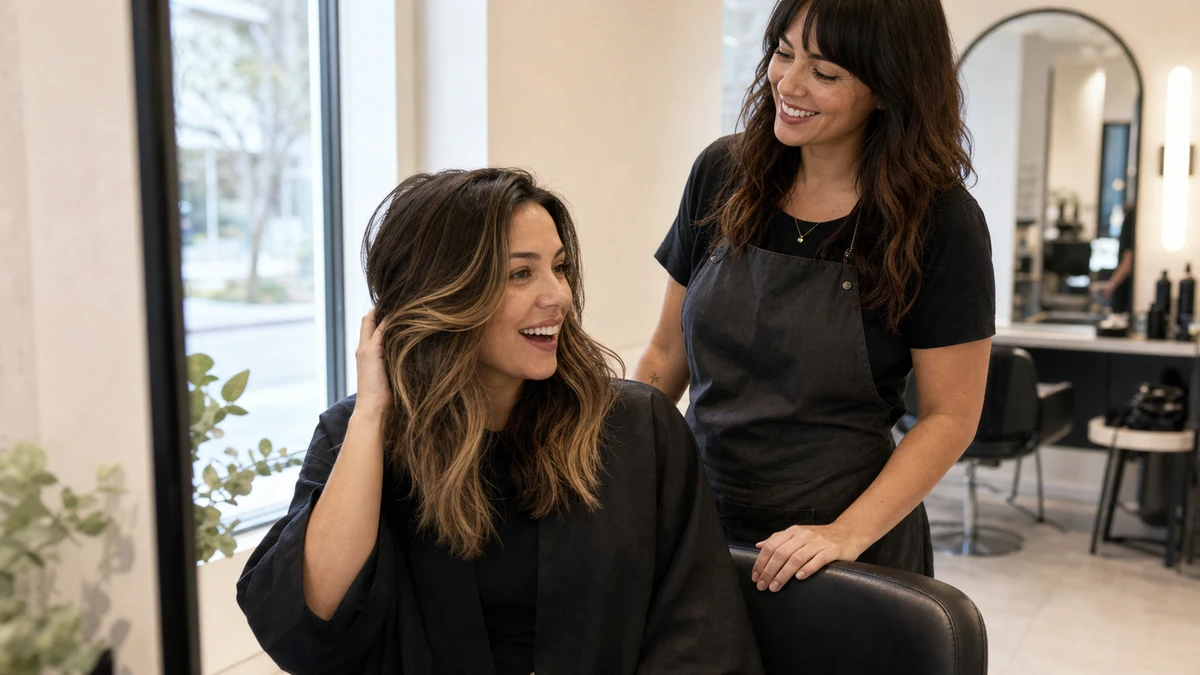
A colorist spins the chair, lifts the cape, and the client sees her finished balayage for the first time. Her hand goes to her hair; she smiles at the mirror. For about ninety seconds she is happier with how she looks than she will be all week. Then she pays, tips, rebooks, and leaves. Three days later she might take a bathroom-mirror selfie in worse light, or not bother at all.
That is the core problem with salon social media UGC, the customer photos and clips that bring strangers through the door: the client is willing to post, but she walks out with nothing worth posting. The fix is not a sharper incentive or a louder sign. It is handing her a finished, salon-grade photo before she leaves, the salon’s handle already on it, so sharing becomes a five-second afterthought instead of a chore.
Why Clients Don’t Post Their Hair (And It Isn’t Motivation)
Every salon-marketing article treats this as a willingness problem. The client could post, the thinking goes, she just needs a nudge: a loyalty point, a contest entry, a hashtag on the mirror. So salons add “tag us” to the receipt and wait. The content does not come.
It does not come because motivation was never the bottleneck. The client carries one thing out of the salon: a memory. To post, she has to recreate the look herself, find good light at home, hold the phone to flatter both her face and a back-of-head she cannot see, and do it before the excitement fades. Most will not. The “tag us” sign asked her to do unpaid production work, and she declined.
A second group declines for a reason salons rarely plan for. Plenty of clients are mildly camera-shy, unwilling to put a face-forward selfie on a public feed or to look like they are bragging. But many of them will gladly allow a photo of the hair alone, a back-of-head or slow 360 that shows the work and not the face. The standard “post a selfie” framing offers them nothing they are comfortable sharing.
The cost of this is concrete
The cost of this is concrete. Phorest’s 2025 consumer survey of US and Canadian salon clients found 42% of new clients discover salons through social media, and BrightLocal’s 2024 Local Consumer Review Survey found 34% of consumers use Instagram and 23% use TikTok to research local businesses. A client’s post is a storefront a stranger walks past, and it outperforms anything the salon publishes about itself: Nielsen’s 2021 study of more than 40,000 respondents found 88% of people trust recommendations from people they know above any other channel.
So the asset is the bottleneck, not the will. Fix the photo, and most of the posting problem dissolves.
Give Clients the Asset, Not the Assignment
The competitor playbook hands the client a job: post a selfie, use this hashtag, tag the salon. That is an assignment, and it depends on the client doing the salon’s marketing for free, well, and promptly. Usually at least one of the three fails.
A better split puts each side on the part it does well. The salon does the skill-dependent work, capturing a genuinely good photo or short clip while the hair is fresh and the stylist is right there. The client does the trivial part, tapping share on something that already looks good and already credits the salon. Client-shot content is unreliable, often poorly lit, and impossible to plan around; salon-captured content is consistent, on-brand, and steady enough to build a habit on. One is a wish, the other a process.
The payoff is documented. Emplifi’s platform data for Q3 2025, aggregated across tens of thousands of brands, found posts featuring user-generated content drove roughly 10x higher conversion rates than non-UGC posts. That is vendor-reported data, not an independent trial, so the exact multiple deserves caution. But the direction holds across credible sources: content that looks like a real customer beats content that looks like an ad. The salon’s job is to make sure that content exists.
Capture at the Reveal, Not the Checkout
Watch the front desk as an appointment ends. The client is tapping a card, working out a tip, half-listening, already in the car in her head. This is when most salons ask for a photo or a tag, and it is the worst moment in the visit. A follow-up text hours later is worse still: it lands after she has gone and asks her to shoot the photo herself, the unpaid assignment that already fails.
The moment that works is the reveal
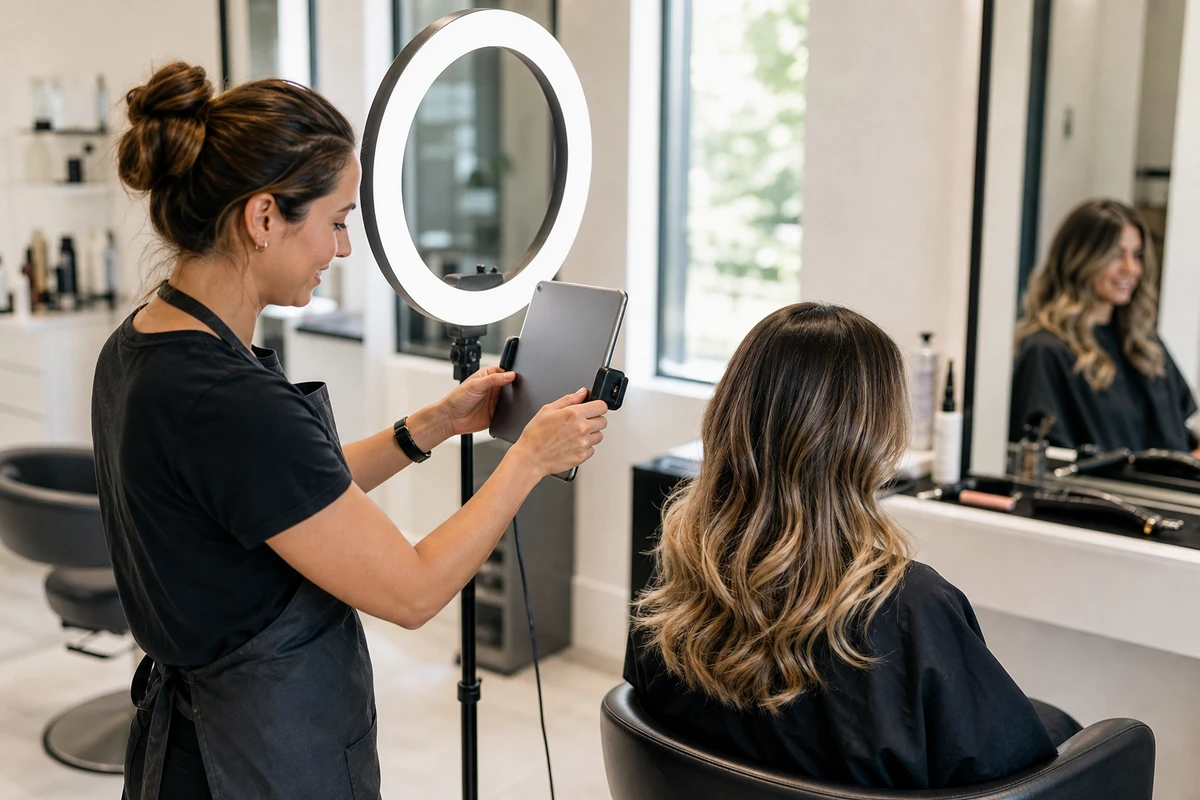
The moment that works is the reveal. When the chair turns and the client sees the result, three things line up that line up nowhere else: her reaction is genuine, the stylist is right there with hands free, and the hair is at its peak, freshly cut and styled, before a night of sleep or a windy walk home flattens it.
Capturing it should be a defined step of the service, assigned to the stylist or an assistant, not improvised at the desk. The ask is plain and said out loud: “That came out great, want me to grab a photo of the back so you can see it?” Framed that way, the photo is for the client first (most people cannot see the back of their own hair); the post is secondary.
What to shoot takes under two minutes: a clear shot of the finished cut from the back or in a slow 360, a before-and-after pair when the transformation was real (the contrast persuades more than a final-only image), and optionally a short clip of the chair turn. For the camera-shy client, lead with the hair-only shot; it asks nothing of her face and still shows the work. The whole capture adds sixty to ninety seconds to an hour-long appointment, one more step, like the blow-dry.
Make the Photo Good Enough That She’s Proud to Post It
A captured photo still will not get posted if the client thinks it makes her look bad. That quiet failure point, between capture and sharing, comes down to a few things the salon controls.
Light Comes First
Light comes first. Standard salon lighting is overhead and harsh, built so stylists can see their work, not so faces look good, and a phone flash is worse. One soft, consistent source, a large window or a fixed softbox, flatters skin and renders hair color accurately. Background is second: a shot at a cluttered station, foils and bottles and a stranger mid-haircut behind, reads as a snapshot, while a clean, repeatable spot reads as a brand.
Use a Fixed Capture Spot
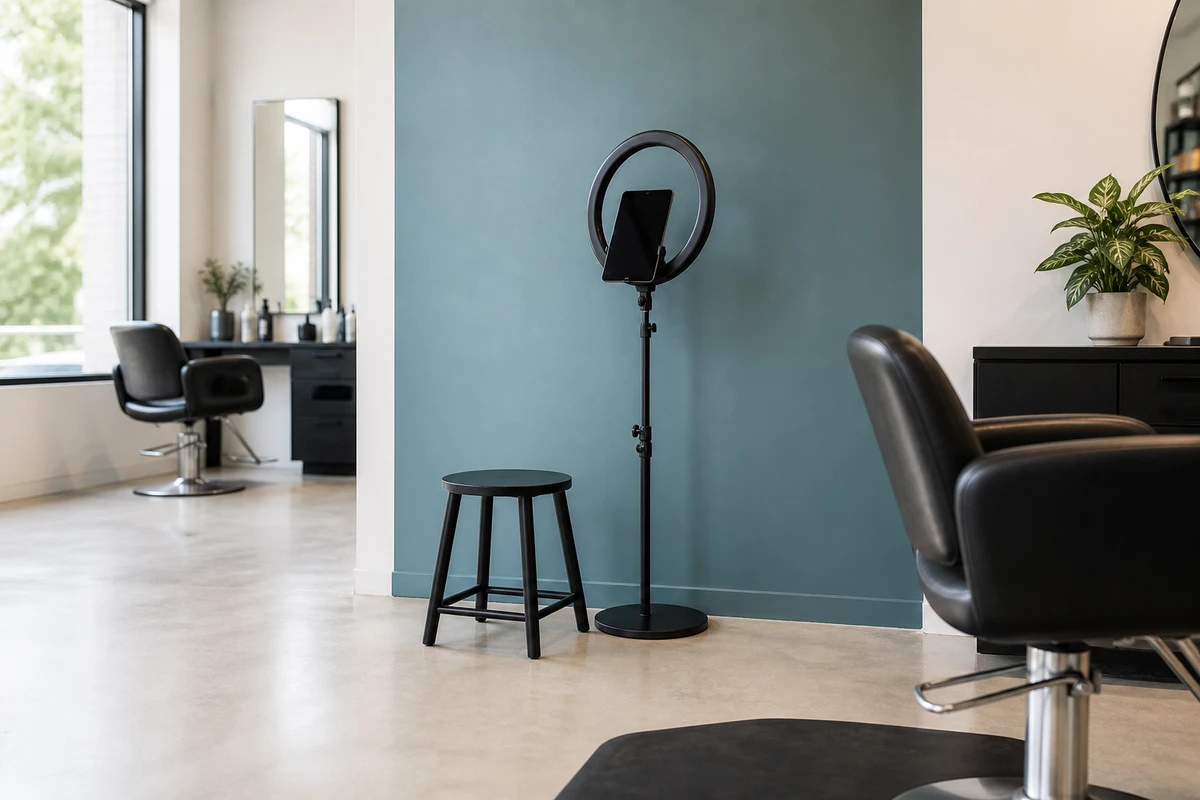
So the salon needs a fixed capture spot: one place, set up once, with good light and a simple branded backdrop, where every reveal photo gets taken. Consistency does two jobs. It removes the daily “where do we shoot this” hesitation that kills the habit, and it makes the salon’s feed and the clients’ posts look like they came from the same place, because they did. Some salons formalize this with a self-serve branded photo station that handles lighting and framing on its own, so the result holds no matter who holds the phone.
Simple Booth’s HALO kit is one iPad-based version: its built-in 2,100-lumen ring light gives every reveal photo the same bright, even light, so a stylist or assistant just frames the back of the head and taps. A window, a painted wall, and a rule about where photos get taken go most of the way for free. The point is not the equipment, but that the photo a client posts should never be a gamble.
Deliver the Photo to Her Phone Before She Leaves
A perfect photo trapped on the stylist’s phone is worth nothing as social content. For the client to post it, the photo has to reach her phone, and it has to get there before she walks out the door.

The handoff is the step most playbooks skip, and it is not complicated. Text or email the finished shot to the client while she is still in the chair; a QR code or an instant-transfer station does the same without anyone typing a phone number. Send it ready to post, lightly corrected for light and color, not a raw file she would have to fix. Put the credit on it first: the salon’s handle in a small overlay, plus a suggested caption, so she is never hunting for the username.
“We’ll text it to you later” undoes all of this. It puts the delay back, and delay is where the excitement fades and the post never happens. The reveal is the peak; an hour later it is a nice memory; a day later it competes with everything else in her life. The photo has to move while the feeling is still warm.
What a Posting Client Is Actually Worth: The Math
Sixty to ninety seconds on every client is a real cost, and an owner is right to ask what comes back for it. Here is the arithmetic, built to run against the real figures from the front desk.
Take a salon doing 60 client visits a week. Suppose stylists capture a reveal photo for half of them (30 photos), and 30% of the clients who get one post it. That is 9 posts a week, roughly 450 a year.
For reach, Instagram’s platform-wide average is about 3.5% of a follower count, per Socialinsider’s May 2025 benchmark, but big brand accounts drag that average down. The small personal accounts salon clients have reach more, because their followers are real-life acquaintances; 5 to 10% is a fair working estimate. A client with 300 to 600 followers then reaches roughly 15 to 60 people per post, call it 30. Nine posts a week generate around 270 local impressions, and roughly 14,000 across a year, every one a person who personally knows someone whose hair visibly turned out well.
The formula is short: weekly visits × capture rate × post rate × reach per post = weekly impressions. The two levers this system moves are capture rate and post rate. A salon drifting on client-shot selfies might see a post rate of 2 or 3%; handing clients a finished photo turns that into 30%, and impressions scale straight off it.
Value depends on conversion, and here honesty matters more than a big number. Most viewers are not in the market this week, but the audience is unusually well-qualified: local, and shown the work by someone they trust. If even 0.5 to 1% of 14,000 annual impressions become a visit, that is 70 to 140 new visits a year at zero ad spend, worth $4,000 to $13,000 at an average ticket of $55 to $95 (a range consistent across recent industry benchmarks), before any rebooking.
Rebookings are where it compounds
Rebookings are where it compounds. Zenoti’s 2025 benchmark report, drawn from more than 30,000 North American businesses, found 42% of loyal clients drive 80% of total revenue, and new-guest visits fell 9% industry-wide in 2024. New clients are getting harder and costlier to win, and the ones who stay are worth multiples of their first ticket. A referral channel running on photos the salon was taking anyway is the cheapest acquisition it has.
Consent, Credit, and Photo Rights Without the Legal Mess
A stylist finishes a striking color correction, photographs it, and the salon posts it that night. A week later the client spots herself on the feed, unhappy that nobody asked. “Always get permission” is the standard one-line answer, and it hides three separate problems, each with a clean fix.
Comfort
The first is comfort. People dislike discovering their face on a business account they never agreed to. The consistent consumer preference, visible across hair and beauty forums, is a plain, direct, in-the-moment ask, not a quiet photo used later. The fix is the verbal ask already built into the reveal step, backed by a one-time consent checkbox on the digital booking or intake form. Once that checkbox exists, the ask at the chair is a friendly confirmation, not the legal basis, which takes the awkwardness out of the stylist’s job.
A genuine misconception
The second is a genuine misconception. Many operators assume that if a client tags the salon, the salon may repost her freely. It may not. As the Stanford Copyright and Fair Use Center explains, commercial use of a person’s image, which includes featuring her on a business’s marketing channels, rests on the right of publicity and generally requires a release. A tag is not a release: it signals the client is happy, but does not hand over permission to use her likeness in marketing. A short written consent, the booking-form checkbox or a brief release, closes that gap. (Rules vary by jurisdiction, and the UK and EU handle this differently under GDPR; this is operational guidance, not legal advice.)
The third problem is internal
The third problem is internal. On the Salon Geek operator forum, an owner described finding staff posting clients’ photos to personal accounts without tagging the salon: “I consider all clients to be salon clients… Surely there must be a way to protect these photos.” The photo gets made and the salon gets none of the credit. The fix is a plain staff rule: any photo taken in the salon, on salon time, of a salon client carries the salon’s handle. Personal reposting is fine on top of that, not instead of it.
Closing the Loop: Repost, Feature, and Track What Books
Getting clients to post is the engine; what the salon does next makes it compound. Repost client content to the salon’s own channels with a visible tag back to the client. That tag is not a courtesy; it tells every other client that posting gets her noticed by a business she likes. Make it a recurring client feature, so the behavior has a predictable reward. A one-off contest buys a spike of content and then silence; a standing feature builds a habit, and a habit is what a referral channel runs on.
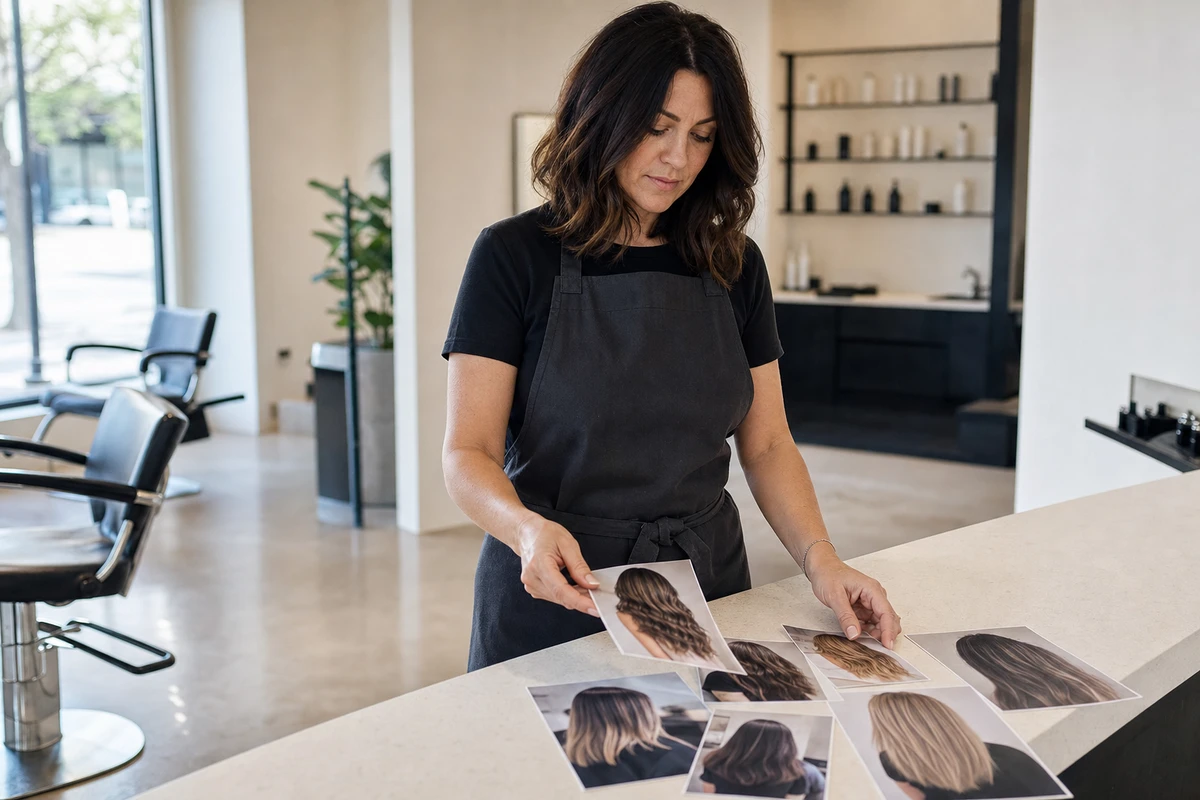
Then watch what the content does. Most platforms show which posts drove profile visits, link taps, and messages. An owner who checks that monthly learns which photos book appointments, the bold color transformations, the precise cuts, the before-and-afters, and aims the capture effort at what converts instead of guessing.
The reason this beats a contest is structural. Every photo a client posts reaches mostly people who live near her and trust her, and some grow curious enough to book. Those new clients sit in the chair, see their own reveal, and get handed their own photo. The system recruits the next client from the last one. The salon’s only standing job is to make sure every good result leaves the building as a good photo, credited, on a phone, ready to post before the feeling fades.
Sources
- Nielsen (2021). “Beyond martech: building trust with consumers and engaging where sentiment is high.” https://www.nielsen.com/insights/2021/beyond-martech-building-trust-with-consumers-and-engaging-where-sentiment-is-high/
- BrightLocal (2024). “Local Consumer Review Survey 2024.” https://www.brightlocal.com/research/local-consumer-review-survey-2024/
- Phorest (2025). “The Phorest Consumer Insights Report 2025.” https://www.phorest.com/us/resources/salon-consumer-insights-report-2025/
- Emplifi (2025). “Q3 2025 Social Media Benchmarks Report.” https://emplifi.io/press/ugc-delivers-10x-higher-conversion-rates/
- Socialinsider (2025). “Social Media Reach Has a 12% YoY Decrease on Instagram.” https://www.socialinsider.io/blog/social-media-reach/
- Zenoti (2025). “Beauty & Wellness Industry Statistics 2025: Benchmarks from N. America Businesses.” https://www.zenoti.com/thecheckin/beauty-wellness-industry-statistics-2025
- Stanford Copyright and Fair Use Center (2013). “When to Use a Release.” https://fairuse.stanford.edu/overview/releases/when/
- SalonGeek (2016). “Staff using clients photos on their personal Instagram.” https://www.salongeek.com/threads/staff-using-clients-photos-on-their-personal-instagram.305368/