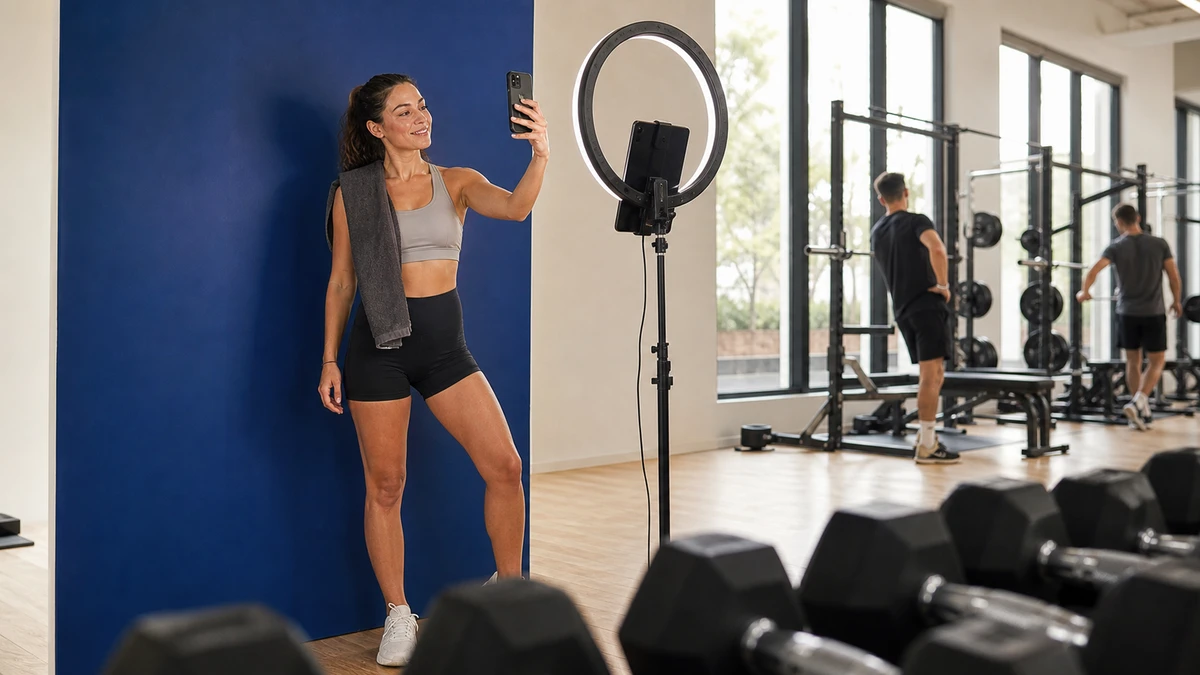
A gym at 6:45 on a weekday morning is full of people who just did something hard. A member racks the last set, glances in the mirror, sees the result of three months of showing up, and reaches for a phone. The photo gets taken. Almost always it goes nowhere useful for the gym: it lands in a camera roll or a private story, with no logo in the frame, no @mention, no location tag. The member documented a workout. The gym got nothing.
A selfie station fixes the part the gym can control. It is a fixed, branded, well-lit spot on the floor built for one job: to be photographed and posted. The argument here is narrow and practical. The highest-return move in gym social media marketing is usually not publishing more posts from the front desk, it is giving the hundreds of members who already walk in each day a reason and a place to post for the gym.
Why “post more” advice keeps failing gym owners
Most advice on gym social media marketing arrives as the same list. Pick two or three platforms. Post three to five times a week. Follow the 80/20 split of value to promotion. Run a contest each quarter. Find a few micro-influencers. Encourage members to tag the gym. The guides from gym-software vendors and social agencies are close to interchangeable on this point, and none of the advice is wrong. It is incomplete in a way that costs the operator.
The output treadmill
Every item on that list is something the operator has to produce, this week and every week after. The content calendar never stops asking. One competitor page is titled, almost word for word, “what gym owners should post when they’re too busy to post.” A gym-software vendor built a search-optimized page around the exhaustion its own advice creates, which is a fair sign the pain is real and widely felt. Output stalls the week the owner gets busy, and the owner always gets busy.
The posts that do get made barely travel. Instagram’s average engagement rate sat at 0.48% in 2026 (SocialInsider), and RivalIQ’s 2025 benchmark put health and beauty, the category that now absorbs fitness, at the lowest median engagement of the 14 industries it tracks on Instagram. A gym posting into its own modest follower base is pushing content through the weakest channel it has.
A gym is a building, not a media company
A gym is not a publishing operation with a studio and an editorial team. It is a physical building that hundreds of people enter every day, on purpose, in a documented and emotional state. The Health & Fitness Association recorded 7 billion gym visits across U.S. facilities in 2025, an all-time high. Each of those visits is a potential post. The shift this article argues for is small to state and large in practice: stop measuring gym social media marketing by the posts the gym publishes, and start measuring it by the posts members publish about the gym. A selfie station is the lever that moves the second number.
What a selfie station is, and the mechanism that makes it work
Walk most gyms and there is already a wall members photograph: a mural, a logo decal, a row of windows with good light. That is not a selfie station. It is a nice wall, and the difference matters. A nice wall is passive and hopes. A selfie station is a designated, branded, consistently lit zone that is placed on purpose, carries the gym’s branding inside the frame, and tells the member exactly what to do. The gap between the two is the gap between decoration and infrastructure.
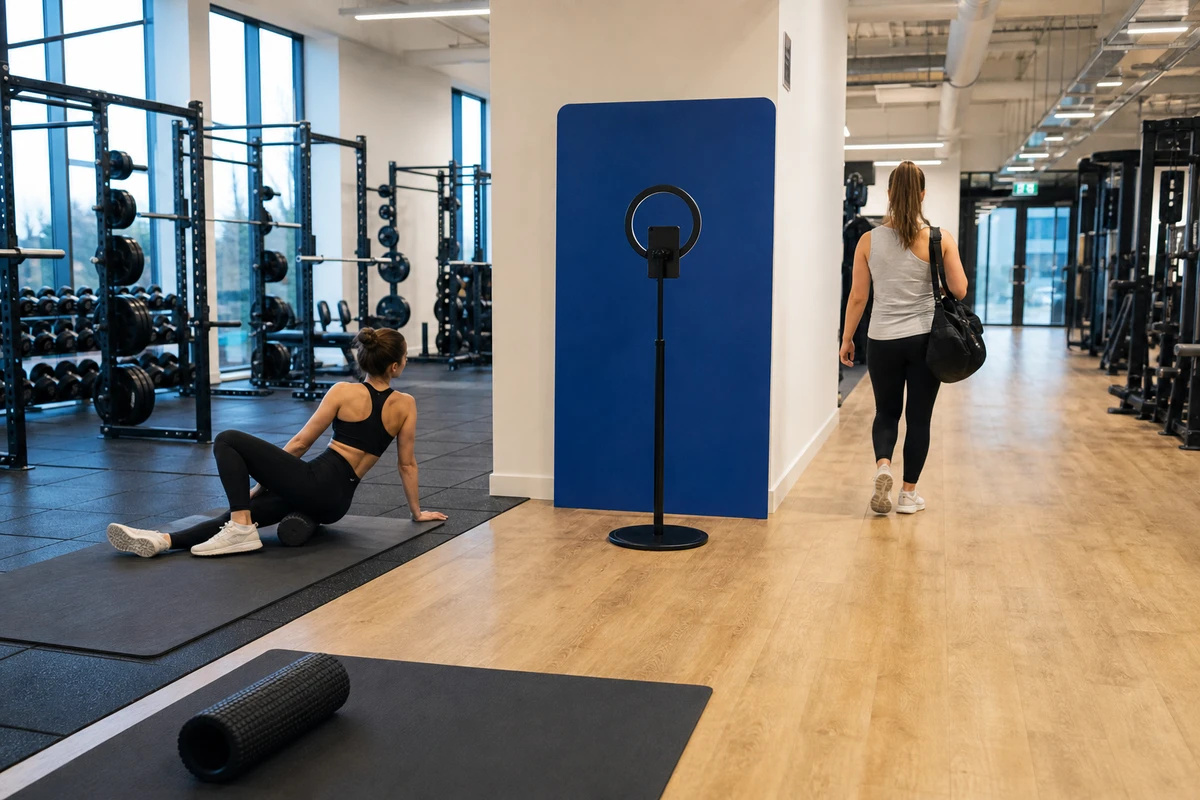
Why members make gym photos but the gym gets no credit
Members already take gym photos constantly. The reason almost none of those photos help the gym comes down to three specific failures, and a station is built to remove all three.
The first is quality. Locker-room and floor mirrors produce photos members are not proud enough to post, or proud enough to post but not proud enough to attach a business to. A station gives a photo worth posting in the first place.
The second is branding. An untagged, unbranded photo credits nothing, and members rarely think to fix that themselves. A station puts the logo, the handle, and a location cue inside the shot, so the brand travels with the image even when the member writes no caption at all.
The third is the missing prompt. The intention to tag a business evaporates in the seconds between finishing a workout and opening an app. A station is the prompt: signage at the exact moment and place the photo gets taken.
This is also where a common operator mistake shows up. Many gyms believe a branded hashtag is itself the UGC strategy. It is not. A hashtag with no station, no prompt, and no repost loop produces almost nothing, because nothing intercepts the member at the moment they would take and post the photo. A selfie station converts a private, unbranded habit into a branded distribution channel. The member still does what they were going to do. The gym just stops losing the credit.
Why gym members will actually stop and use it
Adoption is the question every operator asks of an idea like this, and the honest answer is that a station does not ask members to do anything new. It intercepts something they already do, at the moment they are most likely to do it.
The post-workout moment
The minutes right after a hard workout are the highest-propensity-to-post window a gym ever gets. The member feels accomplished, the endorphins are up, and the “I showed up today” satisfaction wants an audience. A station placed on the post-workout path, near the exit or the stretching and cooldown area, catches the member while that feeling is still hot. A station buried in a back corner catches them never. Placement is not an aesthetic decision, it is a timing decision.
Progress is a series, and the station is the backdrop
Members already shoot progress photos: the same pose, weeks apart, to track change. When the station becomes the default backdrop for that series, the member’s personal progress documentation quietly brands the gym in every frame, for months. The gym is in the first photo, the latest photo, and every check-in between, without producing any of them.
The habit already exists at scale
This behavior is not hypothetical. An Instagram account devoted entirely to member-shot gym mirror selfies, @gym_mirrors, has built a following in the tens of thousands from nothing but photos people took, unprompted, in gyms that got no tag for them. At the higher end of the market, gyms design directly for it. Gymage opened in Miami Beach billing itself as an “Instagrammable gym,” with “selfie sticks, ring lights, and tripods” throughout the floor (Miami New Times, 2021), and still markets itself as “a selfie spot” as much as a gym. The design trade reads the same way: biofit’s analysis of boutique fitness interiors notes that “as people look for unique, ‘Instagrammable’ fitness experiences, these studios offer aesthetically pleasing environments that encourage social sharing.” A selfie station is the systematized, budget-accessible version of what a Miami Beach flagship pays an interior designer to build in.
How to build a selfie station that earns posts
A station that gets ignored is worse than no station, because it occupies prime floor space and signals that the gym tried something and it did not work. Five elements decide whether it earns posts or gathers dust.
Location
Put it on the post-workout path and in real traffic: near the exit, the smoothie bar, or the stretching and cooldown area. Those are the spots members pass in the accomplished, documented state the station is designed to catch. Two placement mistakes are common. The first is burying it in a corner where it is technically present but psychologically invisible. The second is putting it where a photo-taking member blocks equipment flow or a walkway.
Lighting
Lighting is the most common failure point and the least expensive to fix. Daylight shifts through the day and gym overheads are usually unflattering, so without a fixed light source a photo taken at the station at 6 a.m. will not look like one taken at 9 p.m. A ring light or a panel light mounted at the station delivers that consistency. Inconsistent lighting is exactly what sends members back to the locker-room mirror.
Branding inside the frame
A sign next to the station does nothing once the photo leaves the building. The branding has to sit inside the shot: the logo and the gym’s handle rendered on the backdrop, plus a short location or hashtag cue. When the brand is in the frame, the image markets the gym even if the member forgets the caption, posts to a story that disappears in a day, or has a following the gym would never have reached on its own.
The prompt
The prompt is the most-skipped element, and it is not optional. Members will not guess what the gym wants. Signage at the station should say exactly what to do and what the member gets for it: tag the gym’s handle, add the location, and featured posts get reposted to the gym’s page. Specific instruction, specific reward. A station without a prompt is a backdrop. A station with one is a request.
The capture format, from DIY to dedicated
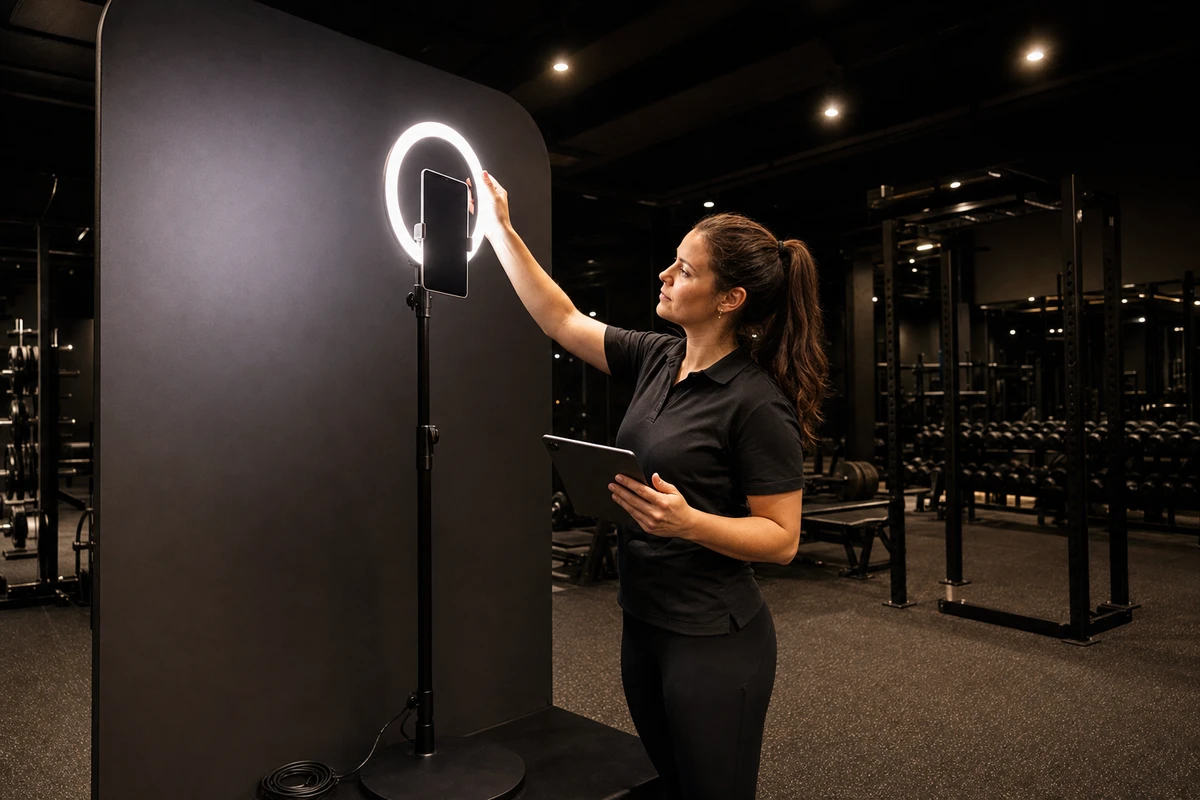
There is a spectrum of ways to handle the actual capture. At the simple end, a branded backdrop and a fixed ring light, with the member shooting on their own phone, costs little and goes up in an afternoon. The trade-off is friction and inconsistency: the member has to frame the shot, the branding depends on them keeping it in frame, and there is no automatic overlay. At the other end, a dedicated photo-station setup handles capture, applies a branded overlay to every shot automatically, and offers instant sharing, which raises consistency and lowers friction at a higher cost. Simple Booth’s HALO kit is one concrete version of that dedicated end: an iPad station with a built-in 2,100-lumen ring light, where the branded overlay lands on every shot and the photo is sent to the member’s phone by QR code, text, or email before they leave the floor. The right choice depends on member volume and how much the gym wants to leave to chance. Comparing specific dedicated equipment is its own decision and sits outside this article.
The reach math: what one selfie station is worth per month
Before an operator gives up a corner of the floor, the fair question is what the corner produces in a month. The math is simple enough to run on a napkin.
A worked example
Take a mid-size gym with roughly 1,300 active members. At the Health & Fitness Association’s reported average of about 81 visits per member per year, a little under 7 a month, that gym sees on the order of 300 member visits a day. Assume a conservative 5% of those members stop at a well-placed station and post. That is 15 posts a day, around 450 a month.

Now attach an audience. A member who posts a workout photo carries a following of their own. Use a deliberately conservative 500 followers per posting member. At 450 posts a month, that puts the gym in front of a combined follower base of 225,000. Every post carries the gym’s branding in the frame, most are tagged to it directly, and all of them travel through a locally trusted account rather than the gym’s own page. The formula is plain: daily visits, times post rate, times 30, times average follower count.
That 225,000 is potential reach, not guaranteed views. Organic reach is always a fraction of follower count, which is the same reason a gym’s own posts struggle to travel. The comparison holds anyway, for two reasons. Those followers are an audience the gym’s account has no path to on its own, and each post arrives as a member’s personal content rather than a brand broadcast. A gym with heavier traffic, a better station lifting the post rate, or a more-followed membership produces more; a smaller gym produces less. The variables belong to each operator.
What that reach would cost to buy
Two things make 225,000 in monthly reach more valuable than the raw number suggests. The first is cost. Fitness businesses pay roughly $0.80 per click on traffic campaigns and $2.64 per click on lead campaigns on Meta (WordStream/LocaliQ, 2025). Impression pricing varies too much by targeting and creative to quote a single honest CPM, but the direction is not in question: replacing that reach with paid spend is a real, recurring budget line, and the station produces it for the cost of floor space and a ring light.
The second is that member posts are not merely equivalent to paid reach; they tend to convert better. Bazaarvoice, citing EnTribe’s 2022 consumer survey, reports that 84% of consumers trust campaigns featuring user-generated content over brand-made content. When brands have rebuilt their own ad creative around that kind of content, the gap shows up in the numbers: GoPro saw three times the conversion rate, and home-goods brand Parachute saw 35% higher click-through with 60% lower cost per click. Those gains came from customer content used as paid creative, not from organic posts, so they are not a like-for-like promise. But the mechanism carries. A member’s station photo reads as a real person’s experience rather than the gym’s marketing, and that is why it is worth more than the paid-equivalent figure suggests.
From member photos to a marketing system, and what kills a station
The first week a station goes up, member photos start appearing in other people’s feeds and stories. Scattered there, they still do nothing for the gym. The marketing return comes from the loop the gym builds around the station, and the loop is short.

The repost loop
The gym monitors its @mentions, its location tag, and its station hashtag, then reposts the best member photos to its own feed and stories with credit. This is how a starved content calendar fills itself without the owner producing anything new. The operator’s job shifts from creating posts to curating them. The 80/20 rule and the three-posts-a-week target stop being a treadmill, because the raw material now arrives on its own.
Consent, handled in one line
A gym cannot lift a member’s photo and run it as a paid ad just because the member tagged the location. Permission belongs in the workflow, not in a scramble after a manager finds something good. In practice this is one line on the station signage, that tagging the gym means a photo may be featured on its page, plus the standard norm that a public tagged post implies consent to a credited repost. For anything beyond a repost, a paid ad especially, a short direct message asking the member is enough. It does not need to read like a contract.
Featuring members is the fuel
A visible featuring cadence, a member-of-the-week slot and a reliable repost-with-credit habit, raises the post rate because members now have a concrete reason to tag. Being featured by the gym is a small status reward, and it compounds: the more members see others featured, the more they post hoping to be next.
What kills a station
Most failed stations fail for reasons easy to name in advance, and the first four are simply the build elements done wrong: a corner the post-workout moment never reaches, no prompt so members never learn what the gym wants, weak or absent branding so the posts that happen credit nothing, and inconsistent lighting that drives members back to the mirror. The fatal one is different. When a member tags the gym and nothing ever comes of it, they stop tagging. The loop has to close on the gym’s side, or the input dries up.
Build the corner, prompt the post, repost the result, and a gym’s social media marketing starts running on the momentum of the people already in the building instead of the willpower of the person running it.
Sources
- Health & Fitness Business (2026). “Member Stats: Q1 2026.” https://www.hfbusiness.com/the-business-of-health/member-stats-q1-2026/
- Bazaarvoice (2024). “The Complete Guide to User-Generated Content.” https://www.bazaarvoice.com/blog/ugc-guide/
- SocialInsider (2026). “Instagram Engagement Rate Benchmark Report.” https://www.socialinsider.io/blog/instagram-engagement-rate-benchmark/
- RivalIQ (2025). “Social Media Industry Benchmark Report.” https://www.rivaliq.com/blog/social-media-industry-benchmark-report/
- WordStream / LocaliQ (2025). “Facebook Advertising Benchmarks.” https://www.wordstream.com/blog/ws/2017/02/28/facebook-advertising-benchmarks
- Miami New Times (2021). “Gymage, an Instagram-Friendly Gym, Opens in Miami Beach.” https://www.miaminewtimes.com/arts-culture/gymage-instagram-friendly-gym-opens-in-miami-beach-12663436/
- Gymage. Official website. https://gymage.com
- biofit. “Top Boutique Studio Fitness Gym Interior Design.” https://biofit.io/news/top-boutique-studio-fitness-gym-interior-design