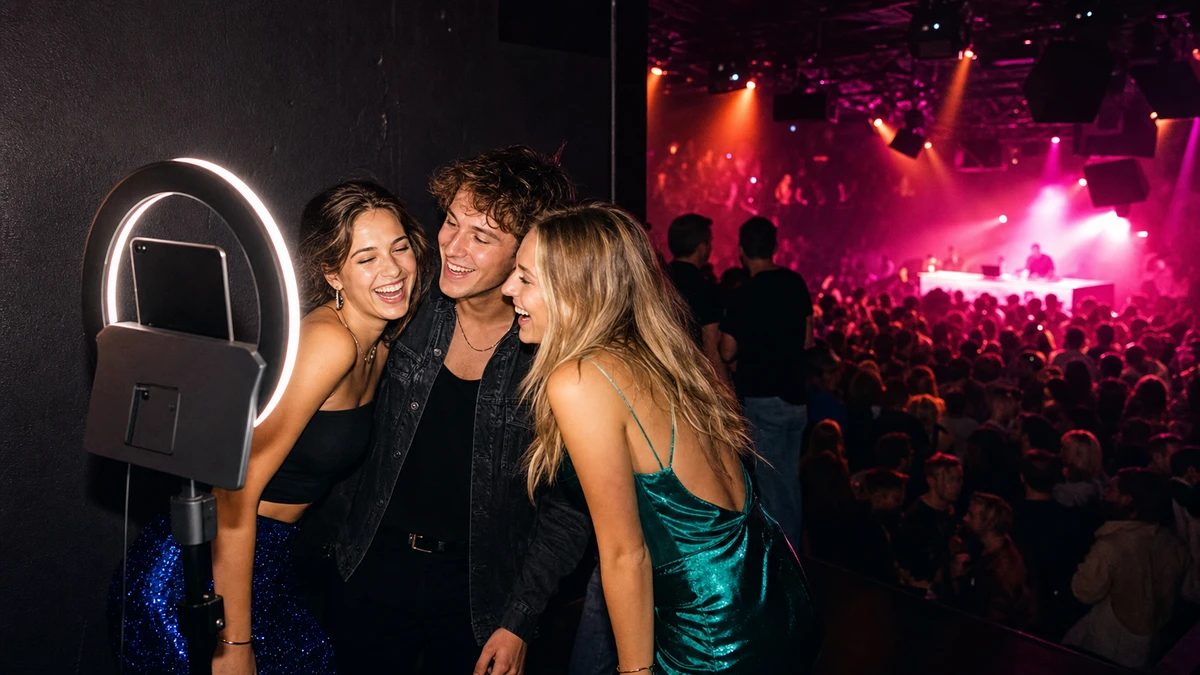
It is 1 a.m. on a Saturday and the floor of a 400-capacity club is full. Phones go up when the DJ hits the drop. A group at a banquette films the sparklers on a bottle-service tray. Two friends back up against the LED wall by the bar to get the light right. By the time the house lights come on, the room has made several hundred photos and short clips, and nearly all of them leave in a guest’s pocket. Sunday afternoon, the manager opens Instagram hoping to find something worth posting, scrolls a few tagged stories from the same handful of regulars (most already expired), and starts the week with an empty calendar.
A nightclub automates its user-generated content by moving the point of capture inside the building and clearing usage rights at the moment a guest makes the photo, so one Saturday night produces a finished, publishable library by Sunday morning instead of a Monday scramble for reposts. The shift is small to describe and large in effect: stop prompting guests to post and hope, and start collecting content on purpose at one fixed point in the room. The hard part of nightclub UGC was never getting guests excited about taking photos. They already are. It is keeping what the room makes. The fix has four parts (capture, rights, data, and republishing), and a venue can test all of them in a single busy night.
Why “Post and Tag Us” Leaves Most of the Night’s Best Content on the Floor
A search for nightclub marketing advice returns the same user-generated content section almost everywhere: build a photo-worthy corner, invent a branded hashtag, run an occasional photo contest, and repost whatever guests publish. The hospitality trade press frames it the same way. In a representative 2019 piece, Modern Restaurant Management called UGC “basically free advertising” and told operators to repost it and “credit the creator as a thank you.” The advice is not wrong so much as incomplete, and the gaps cost a venue most of its content.
The first gap is collection
The first gap is collection. Pew Research Center found in 2015 that 70% of smartphone owners took a photo or video at their most recent social gathering, a floor that has only risen since. A nightclub night gives guests more reason to photograph than an average gathering, so most of the room is making content. But the path from a guest’s camera roll to the venue’s feed is long: the guest has to post publicly, tag the correct handle, keep the post public, and say something the venue can reuse. Almost no one completes that chain. A hashtag strategy collects from a venue’s most enthusiastic regulars and from nobody else, even though the other few hundred guests had an equally good night and photographed it too.
The second gap is speed
The second gap is speed. Manual reposting depends on a staffer hunting tagged posts the day after, so the content already trails the night by a full day before anyone decides what to publish. In a feed that rewards fresh posts, a day-old recap competes against everyone else’s newer content, and the energy of the night it captured has already cooled.
The third gap is rights, and it gets its
The third gap is rights, and it gets its own section below, because reposting a guest’s public photo to promote the venue is a legal exposure, not a free tactic.
Put together, these gaps are a content leak. The venue paid for the DJ, the lighting, the security, and the whole production, and walked away with a few screenshots.
What One Saturday Night Actually Contains
Take that 400-capacity club on a full Saturday. If 70% of the room photographs the night (the Pew baseline), that is roughly 280 guests making content over the night. A 2026 Walls.io survey of 102 marketing professionals found that 67% of event attendees actively create and share content during an event. That sample skews toward B2B conferences, but nightlife, with its visual culture, is unlikely to run lower. The raw material from one night is not scarce. It is enormous.
Follow it through the manual model
Follow it through the manual model. Of several hundred photos and clips, the share that ever gets posted publicly and tagged to the venue is small. No reliable independent figure exists for that rate at a nightlife venue, so it is safest to call it a sliver and move on. A staffer scrolling tags on Sunday salvages perhaps ten usable images. Of those ten, the ones with clean permission to use commercially are fewer still, often two or three.
Now the automated model
Now the automated model. One fixed capture point inside the venue. If a quarter of the room engages with it across the night, that is 100 sessions; if half does, 200. Each session produces one photo or clip that is already cleared for use. The honest comparison is not a marginal gain. It is ten salvaged photos against a hundred cleared ones, an order of magnitude, and the hundred can run as paid ads while the ten cannot.
Capture rate and door count are the two numbers a specific venue should replace with its own. A 250-capacity room on a quieter Thursday scales the arithmetic down, but the multiple holds: a destination capture point collects in one night what tag-hunting collects in a month.
What “Automating Venue UGC” Actually Means
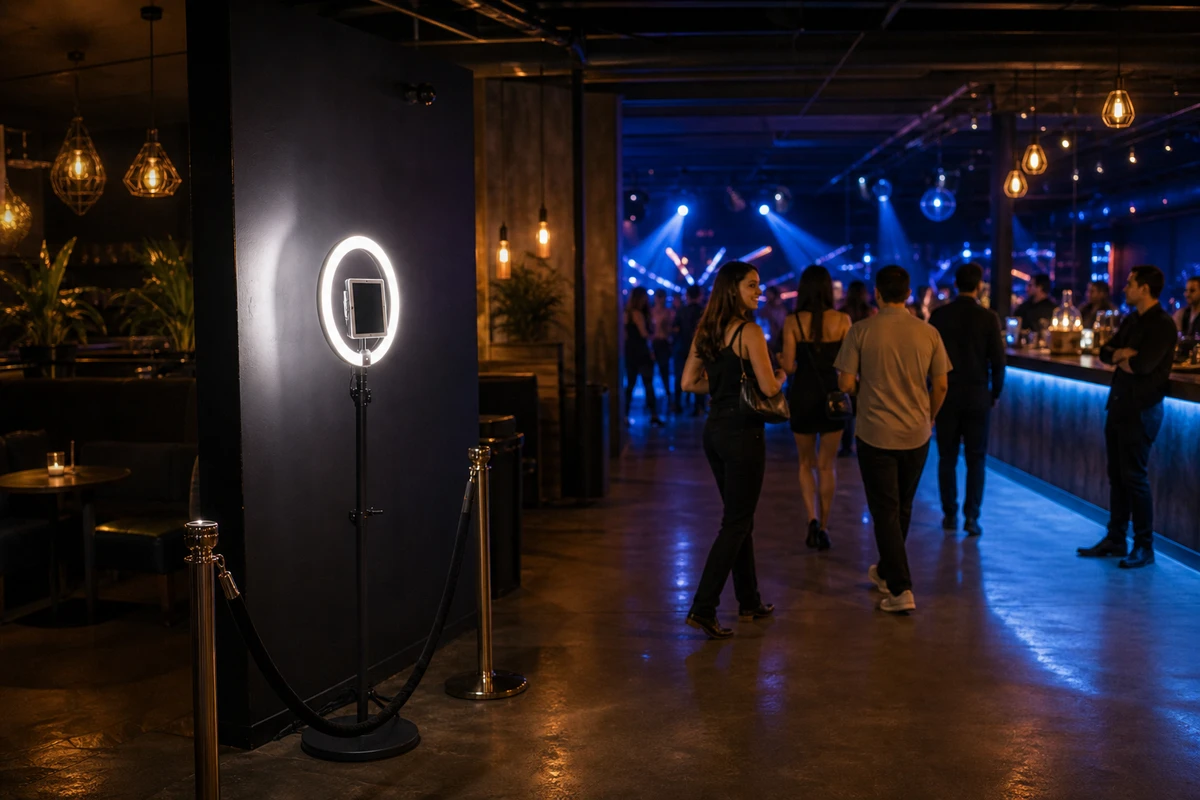
Automation here is not a bot posting on a schedule. It is the removal of the manual, lossy, and legally fragile steps from four layers of the same process. Naming them is worth a moment, because the rest of the article takes them one at a time:
- Capture — content is created at a fixed point in the venue, on purpose, rather than left to whether a guest remembers to post.
- Rights — permission to use the content commercially is granted at the moment of capture, not chased afterward.
- Data — the same moment collects a contact (an email, a phone number, a birthday) with the guest’s opt-in.
- Republishing — every captured photo and clip lands in one library that feeds a posting schedule.
In the manual version, each layer leaks. Capture depends on guest initiative. Rights are never cleared. Data is never collected. Republishing starts from an empty folder every week. In the automated version, the four happen together, in seconds, at one station, every time a guest steps up.
This is an operations problem, and a nightclub already knows how to solve operations problems. Nobody runs door cover on memory or asks a bartender to total tabs from recollection. Venue UGC is the one revenue-adjacent process most clubs still run on goodwill and a staffer’s spare attention. Automating it puts content on the same footing as everything else the venue already meters.
The Capture Layer: Creating Content on Purpose
A branded hashtag only converts the guest who already planned to post. Everyone else, the larger group, needs a reason and a place. A destination capture point gives them both: it turns a vague intention to remember the night into an actual file the venue holds.
The practical options do not depend on any one
The practical options do not depend on any one product. The most visible is a fixed attraction guests walk toward: a photo or video booth, or a selfie station with a screen and a prompt that makes capture part of the night rather than an interruption. Around it, QR codes placed where guests are already idle (the bar rail, table tents, the back of restroom doors, coat check, an entry wristband) catch the rest of the room, and a roaming venue photographer can feed the same shared library instead of a private camera roll someone has to chase down later. Whatever the mix, the point is the same: every photo lands somewhere the venue holds it, not in a guest’s camera roll.
Two things drive how many guests actually engage: placement and a reason to do it now. The Walls.io survey found 29% of would-be contributors blame a lack of clear instructions for not participating. A station tucked in a dark corner with no prompt collects little. A station on a traffic path, with a clear call to action and an immediate payoff (an instant copy of the photo sent to the guest, a branded overlay, a short GIF), collects a great deal. Capture hardware built for venues handles the dark-corner half of this directly. Simple Booth’s HALO kit, for example, is an iPad station with a built-in 2,100-lumen ring light, so it carries its own light instead of relying on a dim room.
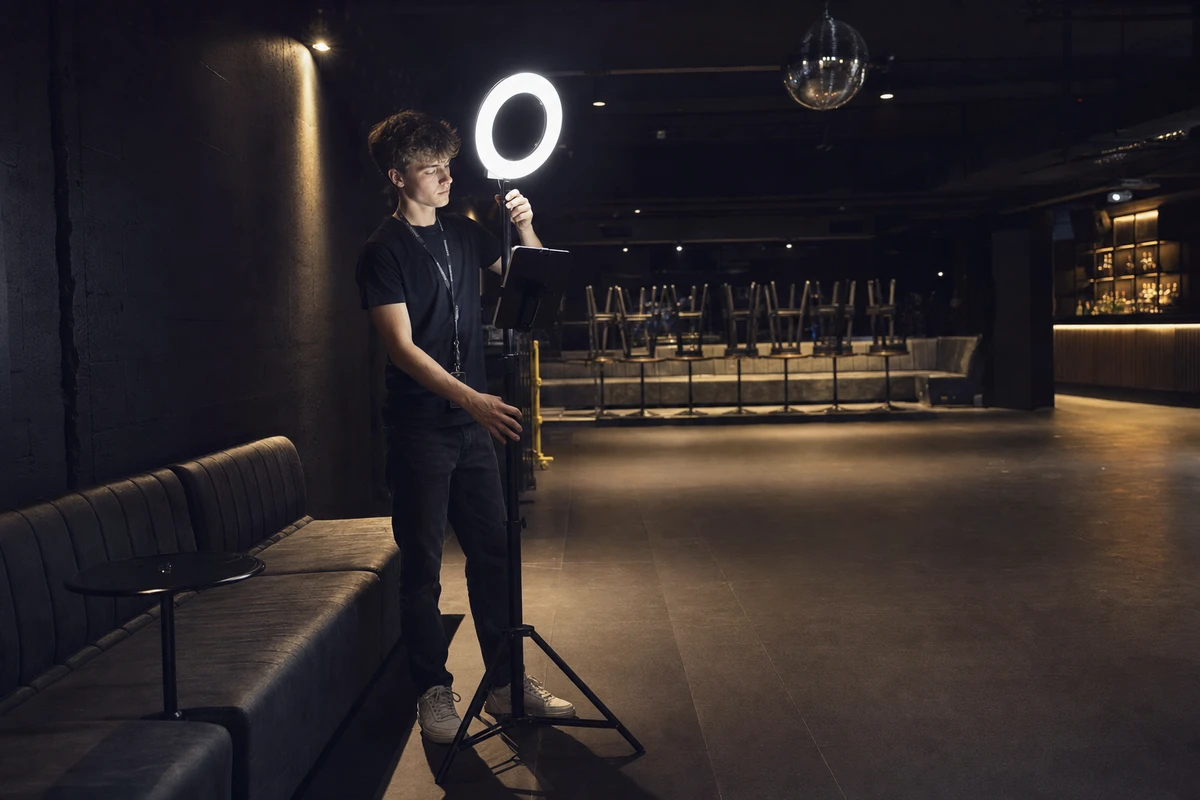
For operators weighing the floor space, the category is no longer exotic. Straits Research projects the U.S. photo booth market growing from $593 million in 2023 to $1.23 billion by 2032. On-site capture is becoming standard venue infrastructure, not a novelty.
The Rights Layer: Permission Built Into the Moment of Capture
A club cannot safely pull a guest’s photo from an Instagram tag and run it as a paid ad just because the guest tagged the venue’s location. That feels counterintuitive to operators who have been told a tag is an invitation, so it is worth being precise about why.
Insureon’s small-business guidance is blunt: anything a business posts from its account is treated as commercial use, regardless of the caption, and using a customer’s image that way without written consent creates real legal exposure. FindLaw adds the copyright half: the photo belongs to whoever took it, a tag or an @mention is not a license, and statutory penalties for infringement run from $750 to $30,000 per image, up to $150,000 if the infringement is willful. A caption credit is good manners. It is not a license. The Modern Restaurant Management advice to repost and “credit the creator” describes, almost exactly, the practice that creates the exposure.
There is one narrow safety valve
There is one narrow safety valve. Native re-shares inside a platform (resharing a guest’s post to the venue’s own Instagram Story) are covered by that platform’s terms. Downloading a guest’s photo and re-uploading it as a fresh venue post is not. Most operators are doing the second thing.
Automation closes the gap by changing where permission happens. When a guest submits content through the venue’s own capture point, a usage license is part of that submission: a checkbox, an accepted set of terms, a clear opt-in screen the guest sees before the photo is theirs to download. Rights get cleared at volume, automatically, instead of one awkward direct message at a time.
The payoff is concrete
The payoff is concrete. Meta and other ad platforms require an advertiser to hold usage rights for every piece of creative. Rights-cleared UGC can run as paid social; a folder of tag screenshots cannot run as paid creative at all. That is the real difference between a content library a venue can build a campaign on and a folder it hopes no one objects to.
The Data Layer: Every Captured Photo Is Also a Captured Contact
The same screen that takes a guest’s photo can ask where to send it. An email address, a phone number, a birthday, given so the guest receives a copy of the photo they wanted anyway. The exchange is fair and the guest gets something immediately, which is why opt-in at the point of capture tends to be high.
So one night produces two assets, not one: a rights-cleared content library and a permission-based marketing list. The arithmetic is easy to size. A night with 100 capture sessions, an opt-in rate the venue measures for itself, and a value per contact gives a real pipeline number. If half of those 100 guests opt in and each contact is worth a modest $40 in repeat-visit value, that is $2,000 in pipeline from a single Saturday, alongside the content. Birthday data is the sharpest piece: a club that knows when its guests turn a year older can fill a slow Tuesday with booked tables instead of guesswork.
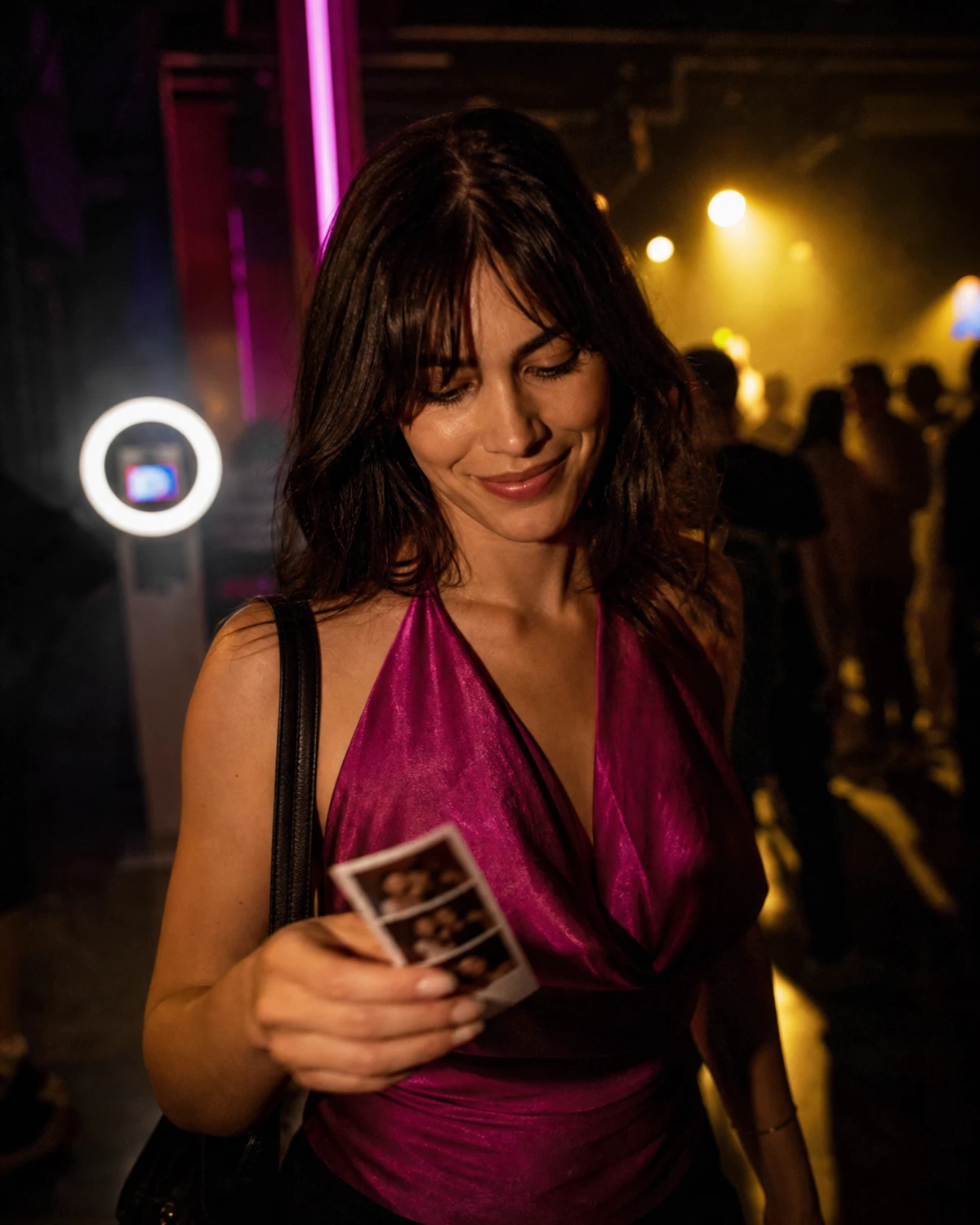
Opt-in rates above 80% or 90% circulate in vendor materials for capture stations. Those are vendor-reported, not independent benchmarks, so the rate belongs in the model as something a venue verifies on its own floor rather than a number to assume. The structure of the claim holds regardless of the exact figure: capture sessions times opt-in rate times contact value is a measurable revenue line, which is what moves venue UGC out of the vanity-metric column.
The Republishing Layer: From a Night’s Library to a Month of Posts
Monday’s real problem is not a shortage of content. It is the person assigned to find it. A social coordinator opening an empty calendar has to go source material before anything gets scheduled, and that sourcing is the slow part.
The Content Workload
Sprout Social’s 2024 productivity survey, reported through MarketingProfs, found content creation and approvals take an average of five hours a week for full-time social marketers. A nightclub’s coordinator is often part-time, but a large share of those hours goes to the least productive task in the job: scrolling tags, screenshotting, and sending messages to ask permission. Automated capture deletes that task. The assets are already in one dashboard, already tagged by night or event, already cleared.
With a stocked library, the calendar pulls instead of begs. One strong Saturday can supply two or three weeks of posts: a weekend recap, a mid-week teaser, a throwback, a promo for the next event.
Guest content also outperforms the polished alternative. Nosto’s research reports 79% of consumers say UGC influences their purchasing decisions and that shoppers find UGC roughly 2.5 times more authentic than brand-made content; Bazaarvoice found 86% of brands believe more authentic UGC would lift the performance of their paid and owned media. The Sprout Social bar and restaurant guide adds the audience side: 88% of people are influenced by reviews and social content when choosing a bar, and the brand behavior they find most annoying is too many promotional posts. A library of real guest photos fixes the empty calendar and the over-promotion problem in the same move.
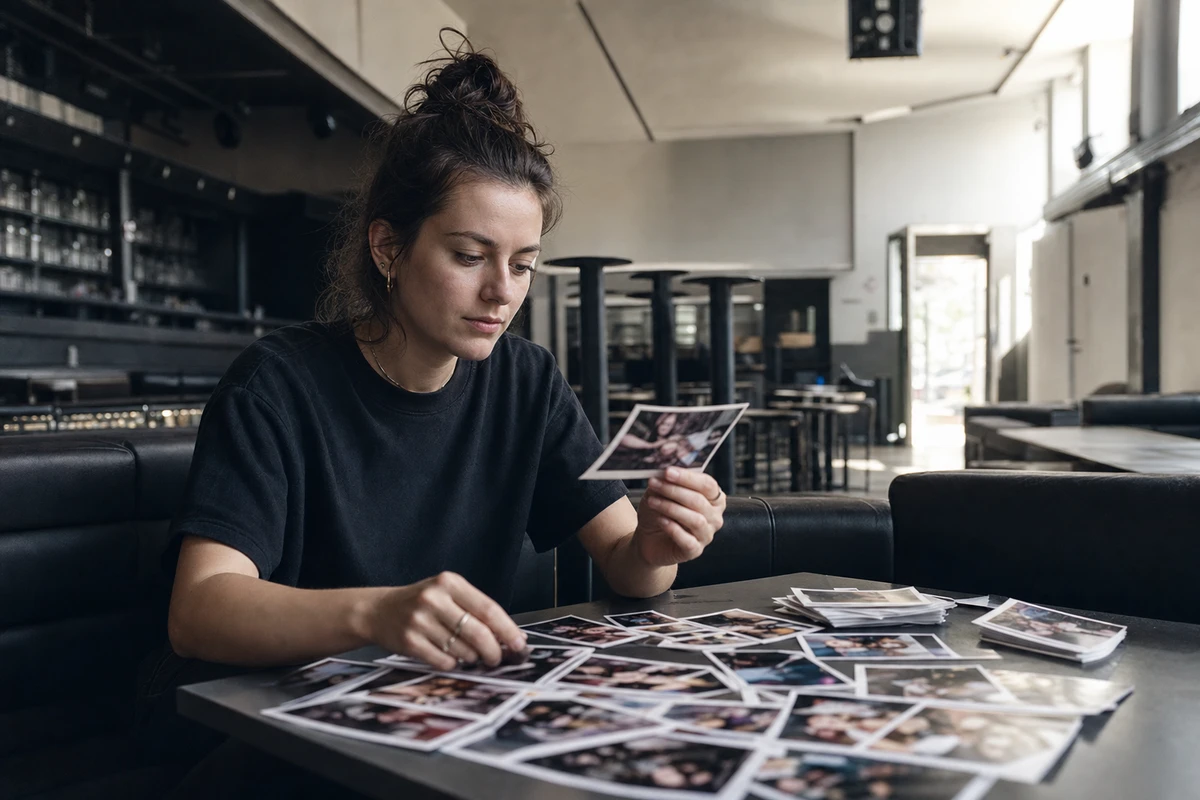
Reposting a guest does more than fill a slot. Nosto also found 51% of consumers are more likely to engage with or buy from a brand that shares their photo, so putting a guest on the venue’s feed pulls that guest back toward the door.
Rolling It Out: One Capture Point, One Night, Then Measure
None of this needs a venue-wide rollout to start. The sensible test is one capture point, placed on a traffic path, run for one busy night. A single Saturday generates enough data to tell an operator whether to expand or move the station.
Five numbers answer that question. Capture rate is the share of the room that engaged with the station. Opt-in rate is the share that left a contact. Rights-cleared assets per night is the count the venue can actually publish and boost. Cost per asset weighs the station’s run cost against what the same volume of paid or studio creative would cost, and it usually comes out ahead once one station serves several nights. Staff hours removed is the sourcing time the coordinator gets back, measured against that five-hour-a-week baseline.
A nightclub already meters everything that matters. Cover is counted at the door, drinks are rung at the bar, capacity is tracked all night. The content the room produces is the one asset of comparable value still left to chance. Treat it like the others: give it a fixed point, a permission step, a contact field, and a library, and a Saturday night stops being something to scramble after on Monday. The next busy night is the whole test. One station, one night, and a Sunday-morning count of rights-cleared assets settles whether the room was ever short on content or just short on a way to keep it.
Sources
- Pew Research Center (2015). “Chapter 4: Phone use in social gatherings.” https://www.pewresearch.org/internet/2015/08/26/chapter-4-phone-use-in-social-gatherings/
- Modern Restaurant Management (2019). “Stop Yelping About User-Generated Content and Start Leveraging It.” https://modernrestaurantmanagement.com/stop-yelping-about-user-generated-content-and-start-leveraging-it/
- Walls.io (2026). “Walls.io Releases the 2026 Event Engagement Index: Report on Audience Participation at Events.” https://www.globenewswire.com/news-release/2026/03/11/3253886/0/en/Walls-io-Releases-the-2026-Event-Engagement-Index-Report-on-Audience-Participation-at-Events.html
- Insureon (2022). “Can businesses use customer photos on social media?” https://www.insureon.com/blog/can-businesses-use-customer-images-on-social-media
- FindLaw (2017). “Can You Use User Social Media Photos to Promote Your Business?” https://www.findlaw.com/legalblogs/small-business/can-you-use-user-social-media-photos-to-promote-your-business/
- MarketingProfs (2024). “What Social Media Marketers Spend Their Time Doing” (citing a Sprout Social survey of 500 social media marketers). https://www.marketingprofs.com/charts/2024/51018/what-social-media-marketers-spend-their-time-doing
- Nosto (2022). “43 Statistics About User-Generated Content You Need to Know.” https://www.nosto.com/blog/42-statistics-about-user-generated-content-you-need-to-know/
- Bazaarvoice (2023). “64 user-generated content statistics to know.” https://www.bazaarvoice.com/blog/user-generated-content-statistics-to-know/
- Sprout Social (2020). “The complete guide to social media for restaurants & bars.” https://sproutsocial.com/insights/bars-restaurants-social-media-guide/
- Straits Research (2024). “Photo Booth Market Report.” https://straitsresearch.com/report/Photo-Booth-Market