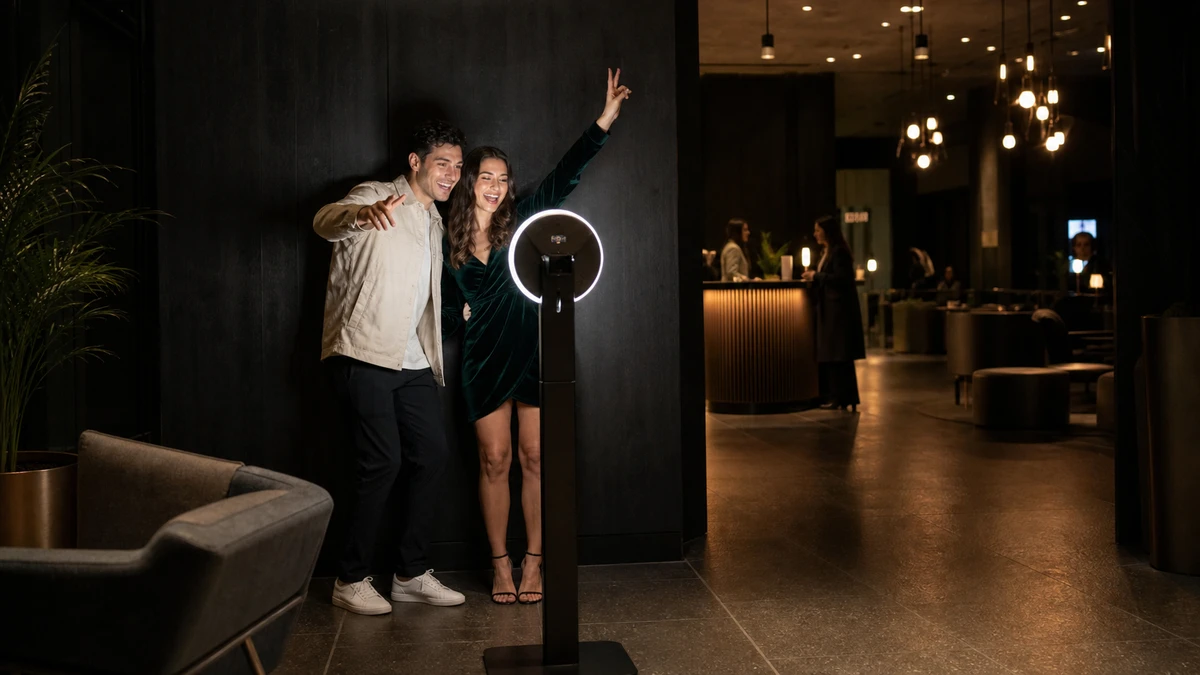
A photo booth arrives at a hotel lobby. In the demo the operator watched before buying, every frame was crisp and bright. A week after install, the manager pulls up the weekend’s captures and they look wrong: faces are dark, the texture is speckled, one guest’s skin reads faintly orange. Nothing in the room looks broken. The lobby feels warm and inviting to anyone standing in it. So the bad photos feel inexplicable, and the first instinct is to blame the camera or the app.
It is almost never the camera. The cause is the light in the building that the operator does not control: the lobby’s track lighting, the daylight through the front windows, the warm lamps over the seating. Photo booth lighting for venues is not really a camera problem. It is a placement problem. Uncontrolled venue light degrades an image in four specific ways, and the right placement can neutralize all four.
The Eye Lies About How Dark a Room Is
A manager walks the floor before the booth goes live, looks around, decides the room is bright enough, and signs off. That walk-through is the problem. Human vision is not a fixed instrument. The pupil dilates, the retina adapts over several seconds, and the brain quietly rebalances color and brightness. A room that reads as “comfortable” is a room the eye has already corrected. A camera locked to fixed settings does no such thing; it records one slice of whatever light is actually present.
The numbers show how wide that gap is. Away from windows, a room interior can sink to 20 to 50 lux, the level Engineering Toolbox lists for dim public areas. A restaurant dining room held at an atmospheric level runs about 5 to 10 foot-candles, roughly 54 to 108 lux, by lighting levels compiled from Illuminating Engineering Society standards (Electrical Marketplace). A hotel lobby on general lighting sits near 10 to 20 foot-candles, about 107 to 215 lux. By contrast, the area just inside a large window on a clear day can reach around 1,000 lux (Engineering Toolbox).
A clean photo at base sensitivity, taken without resorting to a slow shutter, needs far more than the room offers. By standard exposure math that is somewhere in the range of 300 to 640 lux. A dimly atmospheric bar at 30 lux is ten to twenty times too dark for the camera, even though it feels perfectly pleasant to everyone in it. The operator’s glance is not a measurement. The only honest check before launch is a test photo.
The Four Ways Ambient Light Breaks a Photo
A manager scrolls a folder of weak booth photos and the complaints blur together: they all just look bad. They are not the same problem. “Bad” is four distinct faults, each with its own cause and its own tell in the frame. An operator who cannot name which fault they are looking at ends up adjusting everything and fixing nothing.
Color cast comes from white balance failing
Color cast comes from white balance failing. A camera sets a single white point for the whole frame and renders every color relative to it. Cambridge in Colour’s white balance tutorial notes that auto white balance works only “within a limited range, usually between 3000/4000 K and 7000 K,” and that some mixed-light scenes “may not even have a truly ‘correct’ white balance.” A venue routinely mixes sources: warm track lighting near 2,500 to 3,000 K and daylight through a window near 5,500 to 6,000 K (ProGrade Digital, Mark Lewis, 2024).
The warm end sits below the floor where auto white balance even begins to function, and no single white point can be correct for both sources at once. The camera settles on an average, so anything lit by the outliers turns orange or blue. Fluorescent tubes add a green spike that no Kelvin setting removes, and the colored uplighting a DJ runs is worse again: it sits off the Kelvin scale entirely, so the camera cannot correct for it at all. In the photo, skin reads tinted, often visibly worse on one side of the face than the other.
Motion blur comes from too little light. To gather a full exposure in a dim room, the camera holds the shutter open longer. Guests in a booth do not hold still; they lean in, laugh, and throw an arm up. Below roughly 1/60 to 1/125 second, a moving face smears while the still backdrop behind it stays sharp. DigiBooths, a Pittsburgh rental operator, describes the same effect from the floor: enough light lets the camera “operate at higher speeds,” which eliminates “the blurry shots that guests won’t want to post.”
Noise and grain come from the camera’s other escape route. Rather than slow the shutter, it can raise ISO. Cambridge in Colour’s image noise tutorial explains the trade plainly: raising ISO amplifies the image signal, “however this also amplifies noise.” Tablet-class cameras, common in booths, use small sensors that show visible speckle early, often by ISO 400 to 800. The result is a muddy, grainy texture with dull color, and it is always worst in shadows and dark clothing.
Flat or uneven exposure comes from the angle ambient light arrives at. Venue fixtures are usually overhead or strong on one side. Light from straight above carves shadows into eye sockets and under the nose; light from one side leaves half a group bright and half dull. Orange Box Photo Booth, an Orange County operator, names the symptom in operator language: “the person on one side looks bright and the other looks dull.” Faces come out flat and shapeless, or the frame splits into a bright half and a dark half.
These are four faults with four causes. A booth turning dark jackets into speckled mush has a noise problem; a booth tinting one cheek orange has a white balance problem. Naming the specific fault is what points to the actual fix, instead of adjusting everything at once and correcting none of it.
Why a Venue Is Harder Than an Event
A touring rental operator gets one instruction repeated across every guide: scout the room. Booth.events tells operators to “scope out the venue a few days before the event at the same time of day” (Calvin Sims, 2023). For a booth carried into a ballroom for a single Saturday night, that works. One room, one evening, one lighting state to plan around.
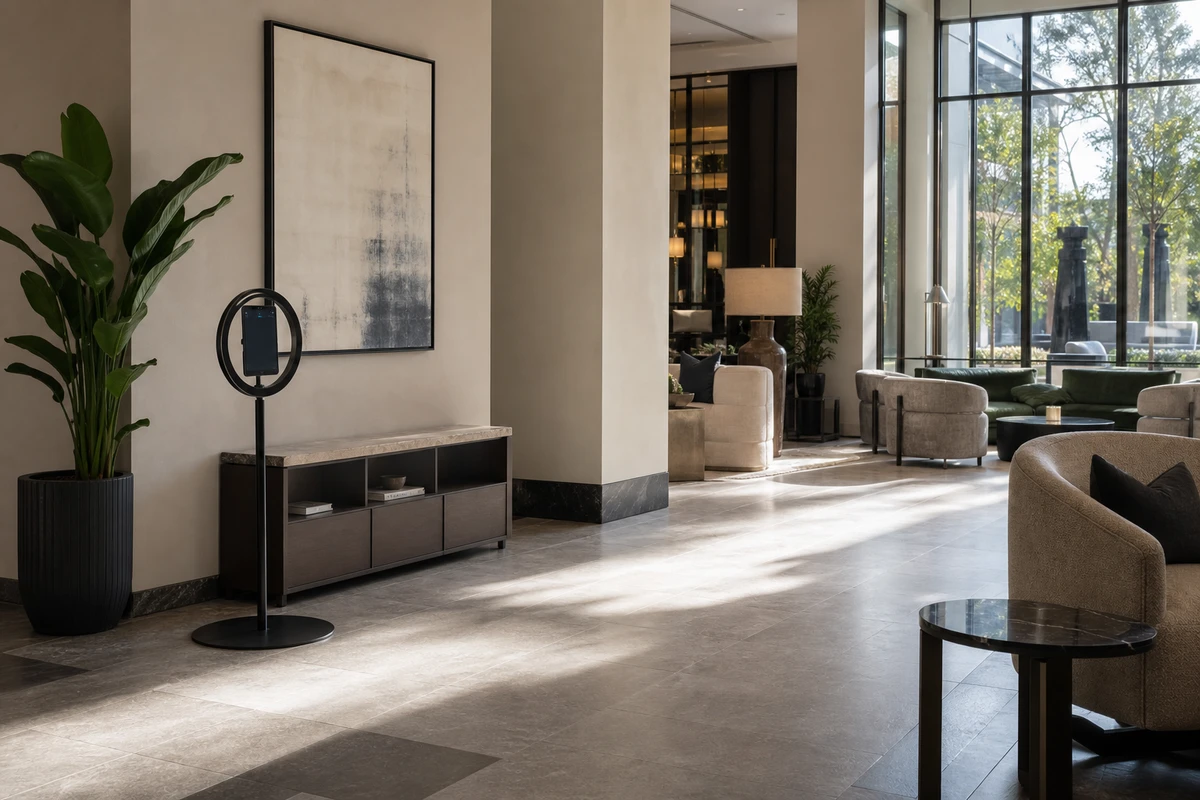
A booth that lives inside a venue has no single state to scout. The light in the operator’s own building moves constantly. Daylight tracks across the windows hour by hour. Most venues run different lighting for lunch service, dinner service, and late night. A DJ or event planner brings colored uplighting on weekends. The booth also cannot go where the light happens to be best; the floor plan, foot-traffic flow, fire egress, and power outlets decide its spot. So the venue operator cannot follow the standard advice, because there is no “same time of day” to scout. That is what makes photo booth lighting for venues a different discipline from lighting an event. The operator is solving for many rooms at once, all inside the same physical space, and the booth has to hold up in every one of them.
Siting the Booth So Ambient Light Stops Mattering
The venue operator’s one real lever is where the booth goes. Three placement decisions do most of the work.
Windows come first
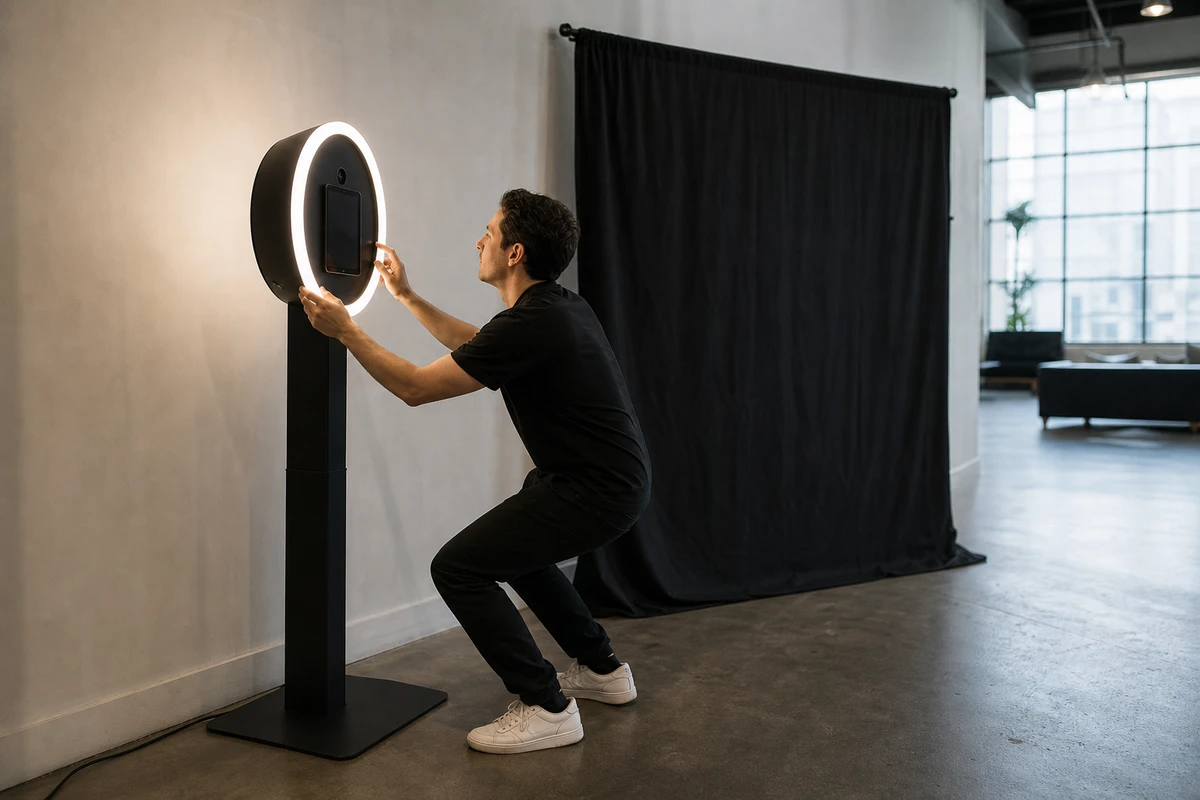
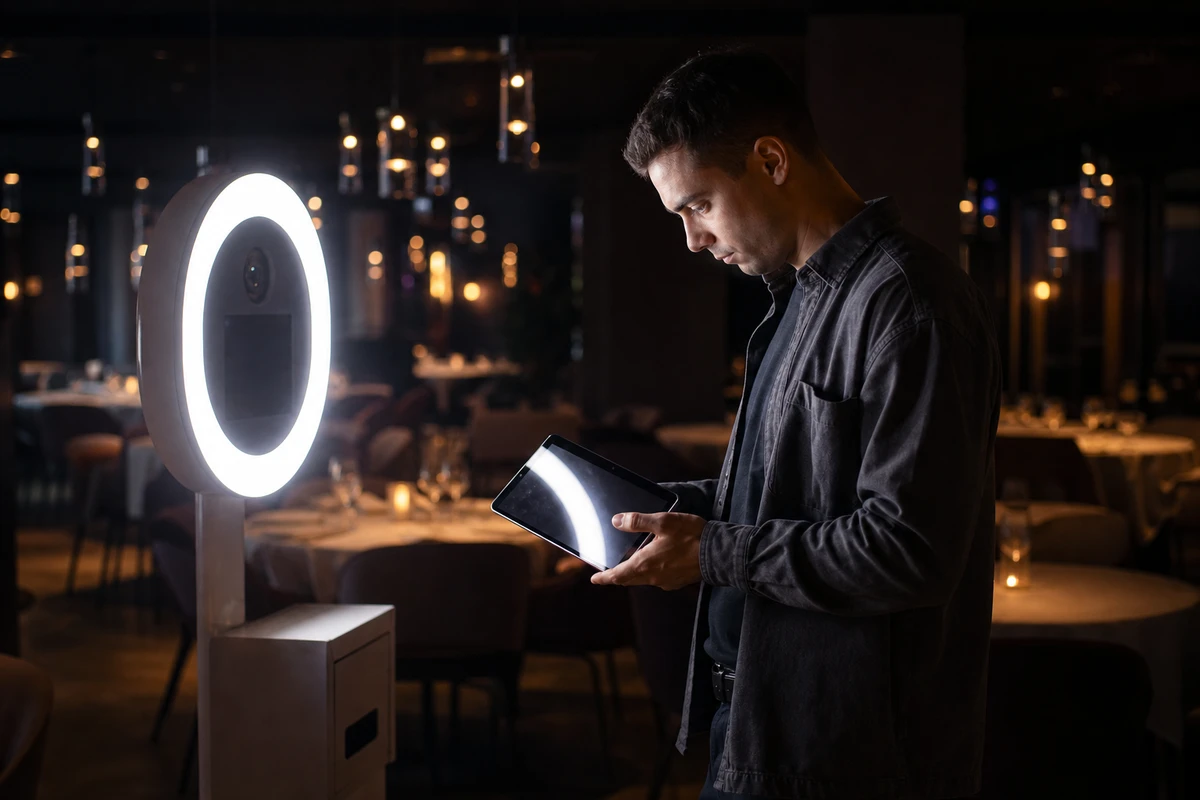
Windows come first. A booth facing a window photographs guests as silhouettes against the bright glass, and direct sun crossing the capture zone drags the color temperature around all day. The booth belongs against a windowless wall, or oriented so window light never falls on the subject. Overhead light is the second decision. Light from straight above is the venue’s default and the least flattering angle on a face. The fix is not to switch off the venue’s fixtures but to place the booth’s own light near the lens, where it reaches the face from the front and overrides the overhead contribution. Some venue booths build that front light into the hardware instead of leaving it to a separate fixture. Simple Booth’s HALO kit wraps a 2,100-lumen ring light around the iPad lens, which puts the controlled light exactly where the placement rule wants it and gives staff nothing extra to aim or knock out of position.
The third decision is distance, and here physics does
The third decision is distance, and here physics does the operator a favor. Light falls off with the square of the distance it travels. Digital Photography School’s primer on the inverse square law (Jeff Guyer, 2013) states it concretely: “Doubling the flash-to-subject distance reduces the light falling on the subject to one-quarter.” Run that backward and a controlled light moved close to the subject gains enormous strength. A 1,000-lumen light four feet from a guest’s face delivers the same illuminance as a 4,000-lumen light at eight feet. The venue’s ambient fixtures are typically ten to thirty feet away from the booth, so a modest light source held two or three feet from the subject can simply outrun every one of them.
The goal of all this is a controlled zone: a small, repeatable pocket of the room where the booth’s light wins regardless of what the venue does elsewhere. A non-reflective backdrop placed close behind the subject helps that pocket twice. It does not bounce ambient light back into the frame, and being close to the booth’s own light, it stays evenly lit while distant ambient light barely reaches it.
Overpower or Balance? Pick the One That Survives an Unattended Booth
Operators split into two camps on how to handle the venue’s light. One camp says overpower: make the booth’s light so dominant that ambient becomes a rounding error. The other says balance: expose for the room, add booth light only as fill, and keep the venue’s atmosphere in the shot. Balance can produce a beautiful photo. It is also fragile, because it assumes someone is watching the captures and re-adjusting as the room changes through the day.
A permanent venue booth has no one watching. It runs on fixed settings, unattended, for months. For that reality, dominance plus a locked white balance is the choice that survives, because it produces the same result at a sunny Tuesday lunch and a Saturday night with red uplighting running. Dominance has a rough threshold. When the controlled light reaches about four times the ambient at the subject, ambient contributes only around a fifth of the total and color cast fades; at roughly eight times, ambient’s share drops near a tenth and its color becomes visually negligible. In a photographer’s terms that is two to three stops of controlled light above ambient, not merely a bit brighter.
The cost of getting this wrong is countable. Consider a venue booth that runs 300 sessions a month. The booth exists to turn guest visits into shareable photos and marketing opt-ins. If a third of those sessions come back color-cast or grainy, that is 100 sessions a month producing a photo the guest does not want to share, post, or keep. Snapbar reports that 67% of event attendees say they are very likely to create and share content during an activation; Orange Box notes the flip side, that quality problems “lead to photos that guests don’t love, don’t share, and sometimes don’t even keep.” Over a year that booth gives up roughly 1,200 sessions’ worth of organic reach and list growth. Nothing in the software failed. The booth was placed and set on day one in a way that could not hold across the room’s real lighting states.
A Pre-Launch Lighting Test Any Staff Member Can Run
Since the room cannot be scouted as a single state, it has to be tested as several. Before the booth goes live, a staff member shoots test frames from the booth’s actual capture position at each lighting state the room will pass through:
- Opening, with whatever daylight the windows give at that hour.
- Midday, at peak daylight.
- Dinner service, with the evening lighting set.
- An event night with colored uplighting running, if the venue hosts those.
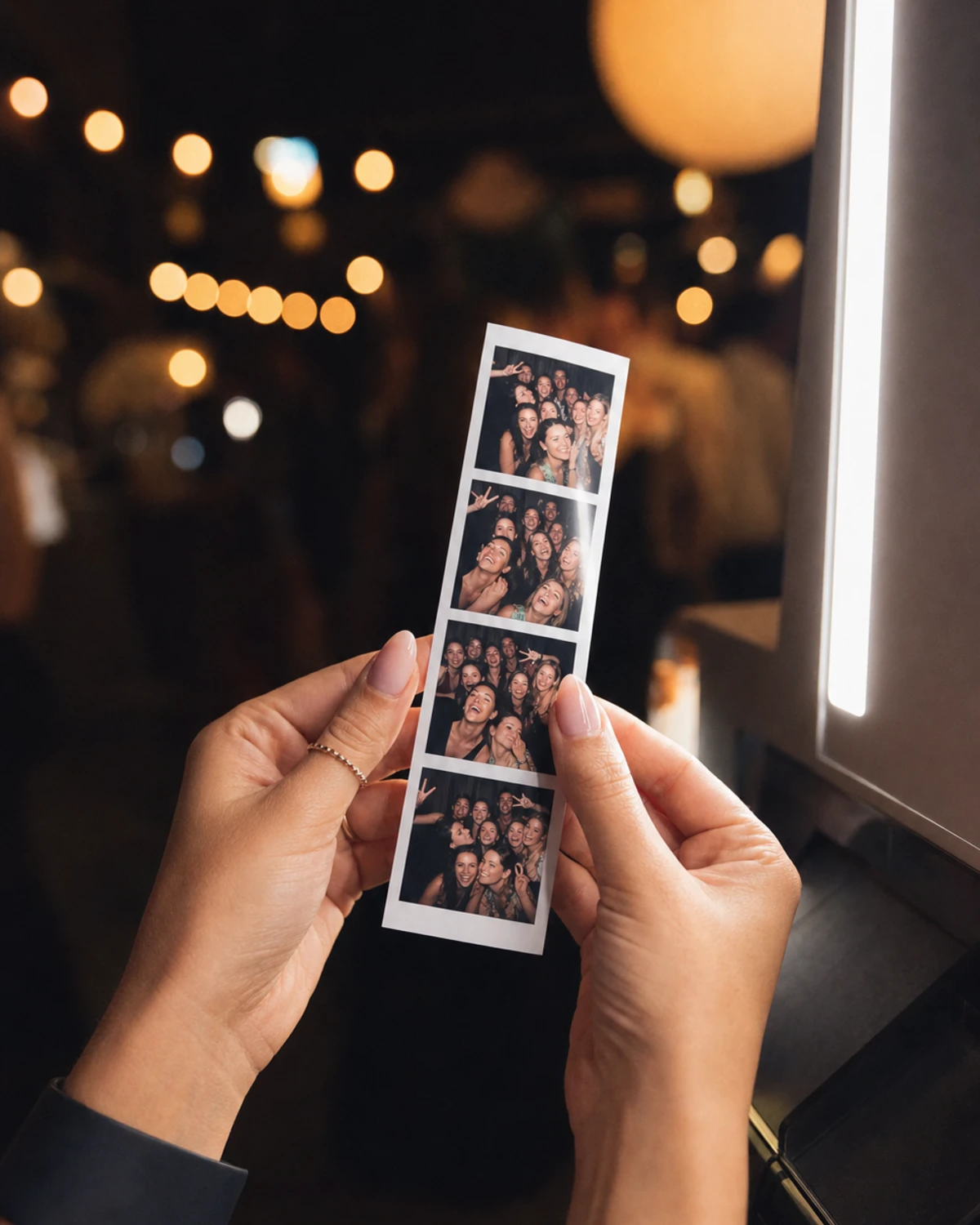
For every frame, the check is the four failure modes by name, not a vague sense of whether it looks good. Is skin a natural tone, and the same tone on both sides of the face? Photograph a guest mid-wave: is the moving hand sharp? Look hard at dark clothing and shadow areas: is there any speckle? Is the light flat or one-sided, or does the face show gentle modeling? A short go or no-go sheet with those four questions is something a manager can run in ten minutes.
The booth placement passes only when all four checks pass in every lighting state, not just the easy daytime one. If the dinner-service frame casts orange or the event-night frame turns grainy, the booth moves or its light runs harder before launch, not after a month of disappointing photos. A venue booth earns its keep only when its photos are good enough that guests want to share them, and that outcome is settled by where the booth sits and how hard its light runs, long before the first guest ever steps in.
Sources
- Cambridge in Colour (2005–2020). “Understanding White Balance.” https://www.cambridgeincolour.com/tutorials/white-balance.htm
- Cambridge in Colour (2005–2020). “Digital Camera Image Noise: Concept and Types.” https://www.cambridgeincolour.com/tutorials/image-noise.htm
- Engineering Toolbox. “Illuminance: Recommended Light Levels.” https://www.engineeringtoolbox.com/light-level-rooms-d_708.html
- Electrical Marketplace. “IES Recommended Lighting Levels By Application.” https://www.electricalmarketplace.com/pages/recommended-lighting-levels
- ProGrade Digital (2024). Mark Lewis. “Understanding and Using Color Temperature in Photography.” https://progradedigital.com/understanding-and-using-color-temperature-in-photography/
- Digital Photography School (2013). Jeff Guyer. “An Introduction to the Inverse Square Law.” https://digital-photography-school.com/an-introduction-to-the-inverse-square-law/
- DigiBooths (2025). “How To Get The Best Lighting In A Photo Booth.” https://digibooths.com/how-to-get-the-best-lighting-in-a-photo-booth/
- Booth.events (2023). Calvin Sims. “How to Properly Light a Photo Booth.” https://booth.events/blog/lighting
- Orange Box Photo Booth (2026). “Why Lighting Matters More Than the Camera in Photo Booth Experiences.” https://orangeboxphotobooth.com/blog/why-lighting-matters-more-than-the-camera-in-photo-booth-experiences/
- Snapbar (2026). “UGC at Events: How Experiential Activations Generate Marketing Fuel.” https://snapbar.com/blog/ugc-at-events-marketing-fuel