
A cashier scans the last item, the customer’s card is already out, and the cashier asks, “Can I get a phone number for our rewards program?” Two people wait in line behind. The customer recites a number, or declines, and the receipt prints. That five-second exchange is what most retailers mean by retail loyalty data capture. It is also the lowest-yield moment in the entire store.
Two things improve when the ask moves off the checkout counter: the quality of the data and the consent behind it. The register is rushed, watched, and pressured by the queue. Retailers who build customer lists worth using treat data collection as a store-floor design question instead: they create voluntary opt-in moments away from the register, in spots where the shopper has spare attention and a real reason to want in.
Why the Checkout Counter Is the Worst Place to Ask
A store manager reviews the month’s loyalty sign-ups and the number looks thin. The instinct is to blame the cashiers or rewrite the two-sentence script. The harder truth is that the spot on the floor where the ask happens works against everyone standing in it.
Start with the line
Start with the line. A queue behind the customer puts a clock on both people in the exchange. The cashier wants the transaction closed and the next person served. The customer feels the wait they are causing. Neither has any incentive to slow down for a considered opt-in, so the ask gets compressed into the smallest version of itself.
Attention is already spent
Attention is already spent. By the time a shopper reaches the register they are in completion mode: card out, bag in hand, mentally on the way to the door. A request for personal data at that moment competes with finishing the purchase, not with idle curiosity. It loses.
Then there is the plain discomfort of saying an email address or phone number out loud to a stranger while other shoppers listen. Retail Dive reported in 2017 that 57% of consumers were unwilling to share personal information with retailers at all, and that figure measures baseline reluctance before line pressure and a listening audience are added on top. The customer-facing keypads many chains installed exist to route around this exact friction. They replace the spoken answer; they do not make the register a better place to ask.
The result is a quiet data-quality problem. A pressured ask produces area-code-only entries, a transposed digit, “I don’t have email,” a number given just to end the conversation. A capture rate that looks tolerable on a report hides a usable rate that is markedly lower. The register ask is an interruption, not an invitation, and an interruption can only ever extract a rushed identifier.
What Retail Loyalty Data Capture Actually Means: Three Layers
Ask a retailer how loyalty data capture is going and the answer is usually about the program: the points, the tiers, the app. The program is the reward shell, the thing that gives a customer a reason to identify themselves. It is not the capture mechanism, and treating the two as one hides what is actually being collected. Loyalty data comes in three distinct layers, and they are worth far from the same amount.
The consent workflow
The first layer is the identifier: an email address or a phone number. It is the join key, the thing that links one person to their records. It is necessary, and on its own it is close to worthless for marketing. An email with nothing attached to it is a name on a list.
The compliance check
The second layer is zero-party data: the preferences, sizes, household details, birthdays, and intentions a customer states on purpose. The term comes from Forrester Research analyst Fatemeh Khatibloo, who defined it as data a customer intentionally and proactively shares with a brand (Khatibloo et al., 2017, as cited in Polonioli, 2022, in Frontiers in Big Data). The word intentionally is doing real work, and parts of the industry ignore it. Some vendors describe zero-party data as information gathered without the customer knowing, which is the exact opposite of the definition and, as the Frontiers paper notes, an ethical problem of its own. This layer is what lets a retailer send something that fits the customer, a restock alert for a category they named, a sizing note, a birthday offer, instead of a generic blast. It cannot be extracted, only offered.
The ownership question
The third layer is behavioral data: transaction history, visit frequency, basket contents. It accrues automatically once an identifier exists and is tied to the point-of-sale system. No one has to ask for it.
The register, at its very best, produces a rushed first layer and nothing else. The two layers that carry the value need either time and willingness, for zero-party, or an identifier already in place, for behavioral. The program motivates the exchange. It does not perform it.
The Capture Surfaces Beyond the Register
If the register is the wrong place, the store still contains better ones, and most retailers walk past them every day. The pattern that connects them is simple: the shopper has spare attention and is not under transaction pressure.

Dwell-time zones are the easiest to find. A customer waiting outside a fitting room, standing at a service or returns counter, or sitting in a pickup area is idle by definition. They are not reaching for a card or counting the people behind them. An ask placed here, on signage or by an associate who is not also running a till, lands on someone with a free minute. It still tends to yield an identifier rather than a full profile, because the moment is short, but it is a calmer identifier than the register produces.
Self-serve kiosks and QR codes change the dynamic more. A code on a shelf-edge, a display, a hangtag, or the back of a receipt lets the customer pull out their own phone, move at their own pace, and type their own data with no audience and no clerk waiting. That removes the social-friction cost almost entirely. Because the customer controls the interaction, this surface can carry a slightly longer ask: a short preference question, a size, a category they care about.
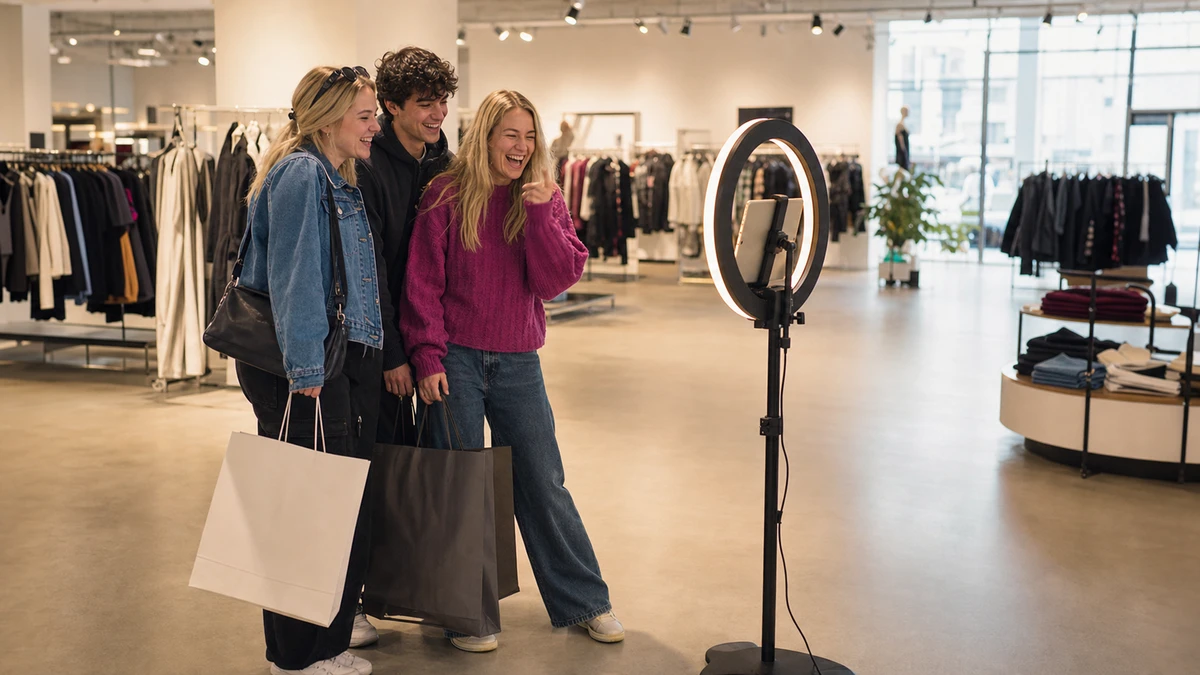
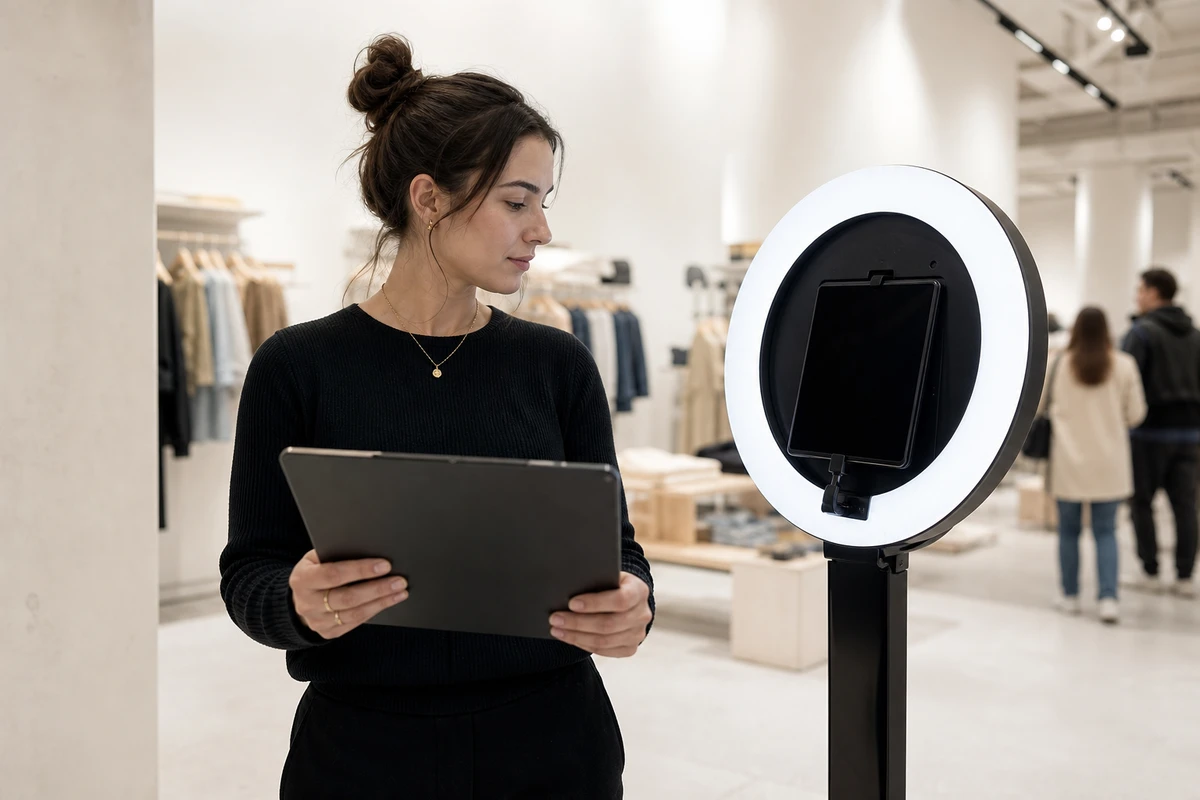
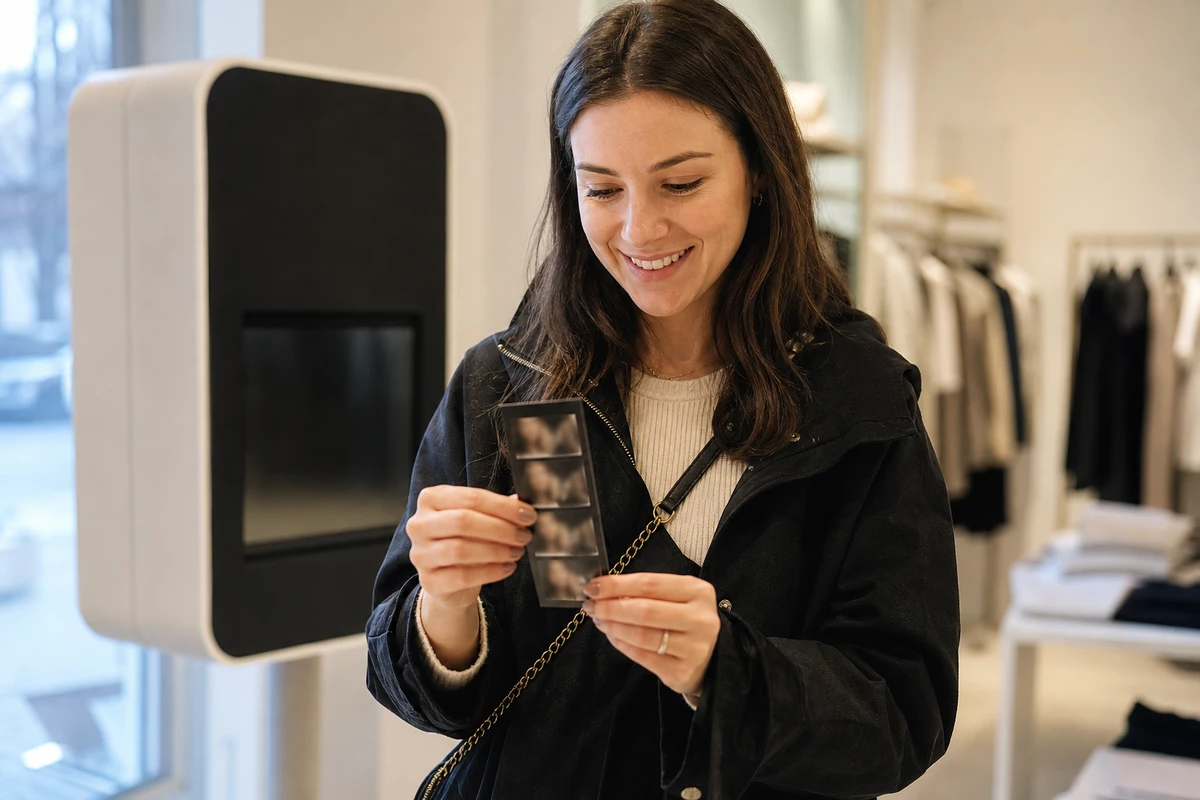
In-store experiences and activations are the highest-trust surface of all. A product demo, a class, a sampling station, a branded interactive moment: here the customer opts in because they want the experience itself, and handing over an email or a preference is a natural byproduct rather than the price of entry. The value is delivered first and is obviously real, which is why this surface can collect a fuller profile than any other. Simple Booth’s HALO kit is one concrete form: a branded photo station where the customer steps up because they want the picture, and the app collects an email and an operator-defined preference field as it sends the photo to them. The entertainment chain Treetop Golf used HALO’s lead capture this way, building about 150,000 unique email addresses across its locations. The exchange feels fair because it is.
Unhurried staff-led moments round out the set. A stylist consultation, a personal-shopping appointment, an associate booking a fitting: these are staff-mediated, like the register, but without the line. The associate has time to explain what the program does and why a birthday or a size preference is worth sharing. The conversation can breathe.
Each surface offers a different trade
Each surface offers a different trade. Dwell-time zones and quick QR scans get an identifier with low effort. Kiosks and staff-led moments get a partial profile. A genuine experience gets the fullest, most willing record. Matching the ask to what the surface can bear is the whole game.
Designing the Value Exchange So the Opt-In Is Genuine
A kiosk survey that asks for email, phone, home address, birthday, and three preferences on one screen will be abandoned halfway, the same way the register’s all-at-once ask is. Off-register surfaces buy room, but room is not unlimited. The opt-in stays genuine only when the operator designs the exchange instead of stacking fields.

The governing relationship is plain
The governing relationship is plain. The quality of what a customer shares rises with the value they expect in return and falls with the cost of sharing, where cost means effort plus privacy risk. The register loses on both terms: little visible value, high friction. An off-register surface lets the operator push value up and friction down at the same time. That is the entire reason it works.
Progressive profiling is the practical method
Progressive profiling is the practical method. Ask for two or three fields at the first moment, an email and one preference, then request more later, at a point when the customer has already opted in and has a reason to stay. In practice that runs as a sequence: the first scan takes an email and a favorite category, a later visit adds a size while the shopper is already browsing as a member, and a birthday gets collected only once there is a birthday perk to attach it to. A returning shopper who already gets useful recommendations will answer a sizing question the second time that they would have ignored as a stranger. The register, by contrast, has one shot and tries to take everything in it.
Order matters as much as length
Order matters as much as length. Value delivered before the ask, a genuinely useful recommendation, a real perk, the experience itself, earns a fuller answer than the same value promised after. Off-register surfaces make before possible. The register can only promise.
The working rule: design the moment first, then design the ask to fit what that moment can carry. Most retailers do it backward, fixing the ask and forcing it into the worst moment in the store.
A Capture Scenario Any Store Can Run
Take a store that rings up 1,000 transactions in a week. The arithmetic below is illustrative, and the point of running it is to measure the real figures rather than guess at them.
Suppose the register converts 8% of those transactions into a loyalty identifier. That is 80 records a week. Now apply the data-quality discount: a share of those are area-code-only entries, transposed digits, or numbers given to end the conversation. If a third are unusable, the store has about 53 real identifiers, and that is all they are. No preferences, no sizes, no stated intent. Bare first-layer records.
Now add one off-register surface, a QR-code preference survey at the fitting rooms and a kiosk near a demo station. Fewer shoppers pass these spots and stop to use them than reach the register, so the raw count is lower, perhaps 30 records in the same week. But these are voluntary, typed by the customer with no audience, and they carry a zero-party field or two. Almost none are junk. The store now holds roughly 30 profile-complete, consented records against 53 bare identifiers.
Which set is worth more
Which set is worth more? Email platform Klaviyo’s 2026 benchmark analysis, drawn from more than 183,000 accounts, found that automated, behavior-triggered email flows generate 18 times the revenue per recipient of one-size broadcast campaigns. That figure compares flows against broadcasts, not enriched records against bare ones, but it points at where the revenue sits: messages that fire on something specific about the customer. A record with a stated preference can be slotted into a flow that fires when that preference becomes relevant, often before the customer has bought anything. A bare identifier can still be triggered on purchase history once it is tied to the point of sale, but it offers fewer and later hooks. A junk identifier, the transposed digit or the throwaway number, triggers nothing at all, because it never reaches a real person.
That is the case against raw capture rate as a scoreboard. The register optimizes the count of identifiers collected. The number that compounds is usable, enriched, consented records. Most retailers are counting the first and quietly losing the second.
Where the Data Goes: The Handoff Into the Loyalty Stack
A kiosk collects 200 preference records in a month and they sit in the kiosk. A stack of paper sign-up cards waits in a drawer for someone to key them in. A capture surface that connects to nothing is a slower version of no capture at all. The record has to move automatically into the loyalty platform, CRM, or email-and-SMS tool that actually sends to customers.
Moving it cleanly depends on identity resolution, which sounds technical and is not. When an off-register record arrives, the system decides whether this person already has a loyalty account and, if so, attaches the new record to it instead of creating a duplicate. Once matched, the point-of-sale transaction history, every purchase tied to that identifier, attaches to the same profile. That is how the three data layers end up on one person rather than three fragments.
A single consistent join key makes the match possible, which is a concrete reason to standardize on one identifier. If some surfaces collect email and others collect phone, the identity graph splits, the same customer lands as two half-built profiles, and one of them receives a new-member offer they already used. The retail CDP vendor Lexer treats email capture below 50% as a commercial priority worth flagging, a sign of how routinely the join key goes uncollected. It matters because shoppers cross channels constantly: the Harvard Business Review study of 46,000 shoppers found 73% used multiple channels in a single shopping experience, and without one stable key those channels never reconcile.
Right-size the stack honestly
Right-size the stack honestly. A large multi-location retailer reconciling ecommerce, several stores, and outside data feeds needs a customer data platform. A single-location operator does not, and a clean automatic sync from the capture surface into the loyalty or email tool already in use is enough. The point is that the record never stops at the surface.
Consent: Why Voluntary Capture Is Also the Safer Capture
A few years ago a retailer could collect contact details at the register and assume the goodwill held. Then a run of consumer-news reporting on retailers selling loyalty data spread the idea that a loyalty program can be a form of surveillance. The ask got more expensive overnight, and not because anything about the data itself changed.
The consent workflow
This is where off-register, value-first capture pays a second time. A phone number extracted under line pressure is consent in name only. The customer agreed to end an awkward moment, not to a relationship. As privacy expectations tighten, that kind of record ages into a liability. A preference a customer typed into a kiosk because they wanted a better recommendation is the opposite: explicit, proactive, and durable. It will still be defensible in two years.
There is a practical side to this beyond reputation. A kiosk or an experience-based capture can log the moment itself: when the customer opted in, what they were shown, which boxes they checked. A verbal yes at a register leaves no such trail. When a customer later asks what a store holds on them, or asks to be removed, the off-register record is the one with an answer attached, and the retailer is not reconstructing a consent it never documented.
The trend is structural, not a one-chain story. Salesforce’s State of the Connected Customer research found 71% of consumers say they are more protective of their personal information than they were five years ago, and 64% feel most companies are not transparent about how customer data is used. Against that backdrop, capture built on a genuine exchange is the only kind that holds up over time.
Each of these pressures points the same way. Move the ask off the checkout counter and the data gets better, the consent behind it holds up, and a loyalty list starts to be worth what the program spends to build it. The retailers who see that stop rewriting the cashier’s script and start treating the store floor itself as the place where loyalty data is actually won.
Sources
- Retail Dive (2017). “43% of consumers willing to share personal information with retailers.” https://www.retaildive.com/news/43-of-consumers-willing-to-share-personal-information-with-retailers/447958/
- Polonioli, A. (2022). “The Ethics of Zero-Party Data.” Frontiers in Big Data, 5:815980. https://www.frontiersin.org/articles/10.3389/fdata.2022.815980/full
- Klaviyo (2026). “Email Marketing Benchmarks and Statistics for 2026.” https://www.klaviyo.com/marketing-resources/email-marketing-benchmarks
- Lexer (2026). “How to Unify POS, Loyalty and Ecommerce Data with a Retail CDP.” https://www.lexer.io/blog/how-to-unify-pos-loyalty-and-ecommerce-data-with-a-retail-cdp
- Sopadjieva, E., Dholakia, U.M., & Benjamin, B. (2017). “A Study of 46,000 Shoppers Shows That Omnichannel Retailing Works.” Harvard Business Review. https://hbr.org/2017/01/a-study-of-46000-shoppers-shows-that-omnichannel-retailing-works
- Salesforce. “State of the Connected Customer.” https://www.salesforce.com/resources/research-reports/state-of-the-connected-customer/