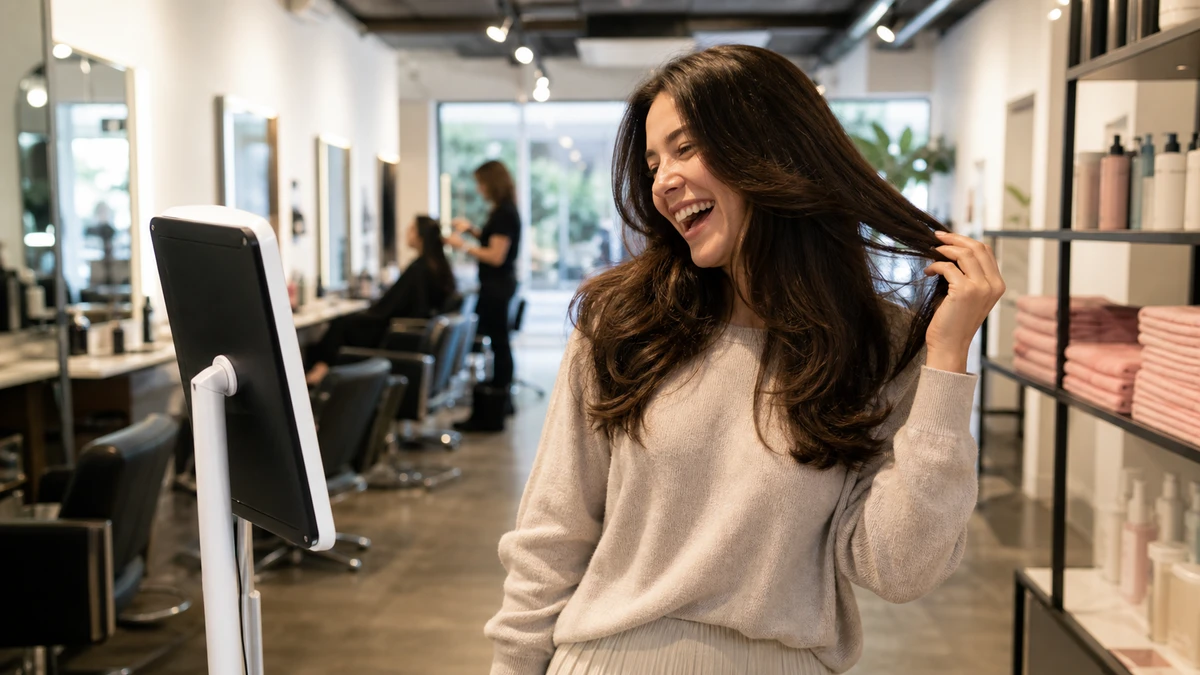
A client in the chair turns their head and watches the new color catch the light in the mirror. For about thirty seconds they are happier with how they look than they will be at any point in the next six weeks. Then they pay, rebook, and leave. The salon did the visible work, and almost none of it reaches anyone who was not in the room.
For a salon or med spa, the best photo booth is a compact, wall-mountable or slim free-standing open-air booth, built around an iPad and an app, that runs with no staff operating it and sends the finished photo to the client’s phone before they reach the door. This guide explains why that form factor wins, weighs it honestly against mirror booths, 360 booths, and the do-it-yourself backdrop most salons start with, sets out the criteria that matter for a fixed location rather than a touring event, and covers the consent question a med spa cannot skip.
What “best” means for a salon or med spa (it is not what event guides optimize for)
Most of the “best photo booth” guides online were written for a different buyer. The photoboothhustle.com guide, aimed at rental operators, judges booths on transportability, how quickly they break down, and whether they survive being packed into a vehicle week after week. Those are the right questions for an operator who hauls a booth to one venue on Saturday and a different venue on Sunday. They are close to useless for a salon. A salon does not need a road case. It needs the opposite: something that gets installed once and never moves.
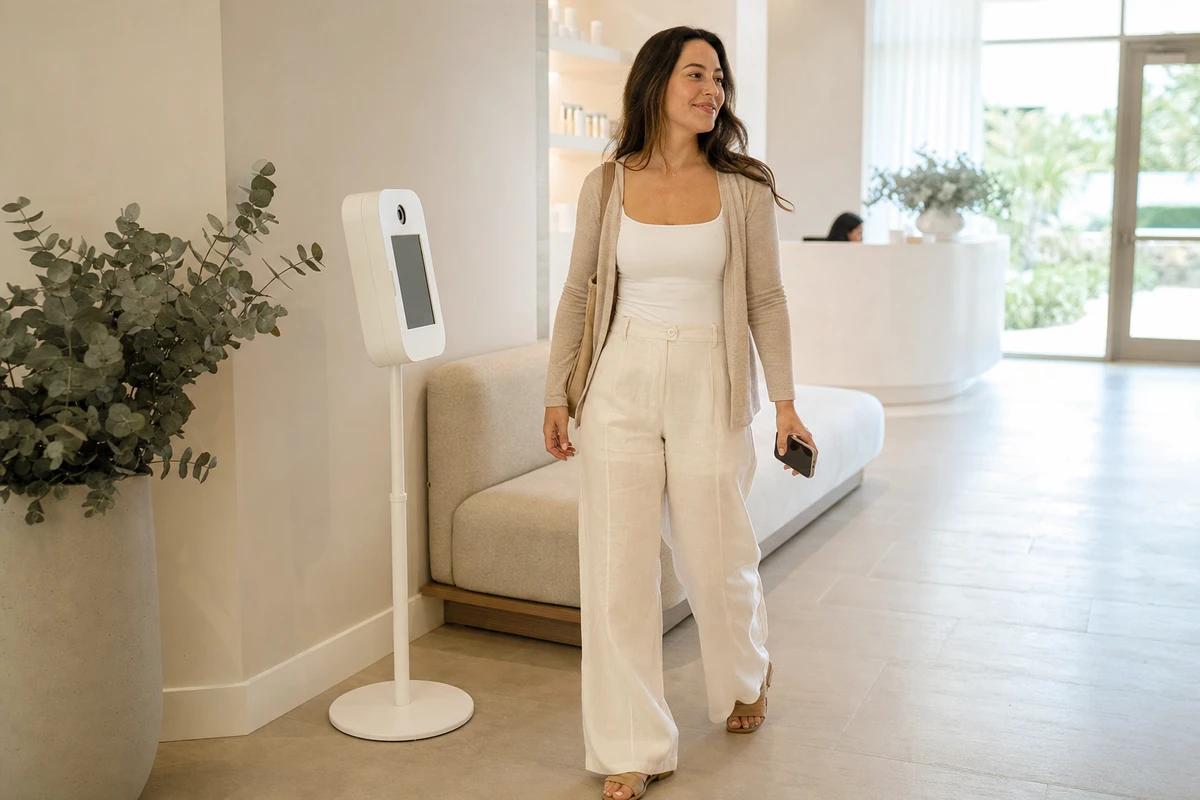
A salon photo booth is a permanent, unattended fixture. It goes on a wall or in a corner, it runs every business day, and it is used by clients with no staff member operating it. That single fact rewrites every buying criterion. Durability stops meaning “survives a thousand teardowns” and starts meaning “resets itself cleanly between two strangers.” Size stops being about trunk space and becomes about salon floor space, which is the most expensive real estate the business owns.
What a Salon Booth Is Not
The second thing to get straight is what a photo booth is not. A lot of salon-facing content, including listicle posts of the kind published on salonist.io, files photo booths alongside floral walls, neon signs, vintage frames, infinity mirrors, and decorative swings under one heading: the “selfie corner.” A backdrop is passive. It sits there and hopes a client points a phone at it. A photo booth is active. It captures the photo, brands it with the salon’s logo and colors, delivers it to the client, and, set up correctly, records a marketing opt-in in the same motion. Treating the two as the same purchase is how operators end up paying for a wall that decorates the room and collects nothing.
The economics work differently too
The economics work differently too. Event guides calculate returns one booking at a time: one event, a few hundred dollars, several events a month. A salon’s booth does not work that way. It earns a small amount of value many times a day, every day the doors are open. The right question is not what a single event pays, but what a year of daily walk-in traffic produces when a fraction of it leaves a branded photo and a contact behind.
The form factors worth comparing for a salon floor
Walk the salon floor with a tape measure before reading any spec sheet. The space between the last styling station and the retail shelf, or the few feet beside the reception desk, is what the booth has to live in. That constraint, more than price or features, sorts the options.
Open-air iPad booth, also sold as a selfie station
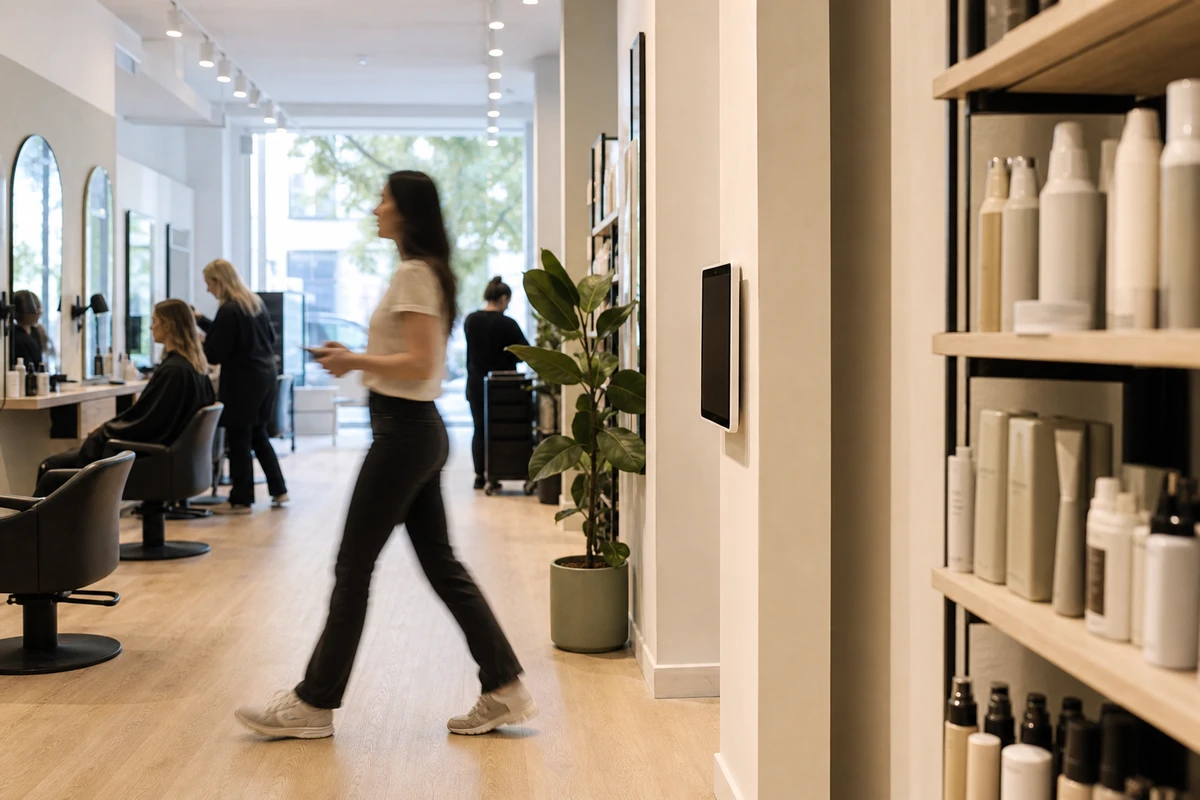
This is a touchscreen on a stand or a wall mount, running a photo app, with the camera built into an iPad. It is the strongest fit for a salon for the obvious reason: it is small. Snapbar’s vendor-published specifications put its Selfie Station footprint under two feet by two feet, with pricing starting around $1,995. The wall-mounted version of the category is smaller still and costs less. Mobibooth lists a VESA-mounted iPad booth at $1,595 (also vendor-published), and it occupies zero floor space because it hangs on the wall like a mirror. The honest trade-off is image quality. An iPad camera is good, not a studio DSLR, so a salon that wants editorial-grade portraits will be disappointed. For a client capturing a fresh blowout to send to friends, it is more than enough.
Mirror booth
A full-length interactive mirror that displays animations and prompts on the glass. It photographs well and draws attention, which is the appeal. The cost of that presence is space and money. Vendor-published ranges put mirror booths at roughly $4,999 to $10,000 and up, and they take up six to nine square feet of floor that a salon could otherwise fill with a styling chair or a retail display. Striking, but space-hungry.
360 booth
A platform the client stands on while a camera arm spins around them to capture video. The novelty is real, and it is genuinely fun, but it needs a clear activation area of roughly ten by ten feet plus safety clearance around the moving arm, and vendor-published prices start near $7,000. It suits a one-off grand opening, not a permanent spot on a working salon floor.
Enclosed or classic booth
The curtained box. It needs most of a small room, it reads as an occasion-night novelty, and it is rarely sold into salons for good reason. For a fixed retail floor, rule it out.
The do-it-yourself backdrop
A printed wall, or a ring light with a “tag us” sign taped beside it. This is where many salons land first, because it costs almost nothing to assemble. The problem is that it does almost nothing. It captures no photo, brands no image, delivers nothing to the client, and records no contact. It depends entirely on the client remembering to shoot, post, tag the correct handle, and keep the post public. Many salons quietly outgrow it once they notice how little of that actually happens.
The verdict is not close. For the large majority of salons and med spas, the open-air iPad booth, and specifically the wall-mounted version where floor space is tight, is the right category. A mirror booth is a defensible choice for a large, design-led salon with floor space to spare. A 360 booth is an event rental, not a fixture. The backdrop is a starting point people leave.
The buying criteria that matter for a fixed location
Two open-air iPad booths can read almost identically on a spec sheet and still behave completely differently once they are bolted to a salon wall. The choice between specific units comes down to a short list of criteria, and they are not the criteria an event-rental guide would put first. They are worth ranking, because a salon rarely needs to optimize all of them.
Footprint and mounting
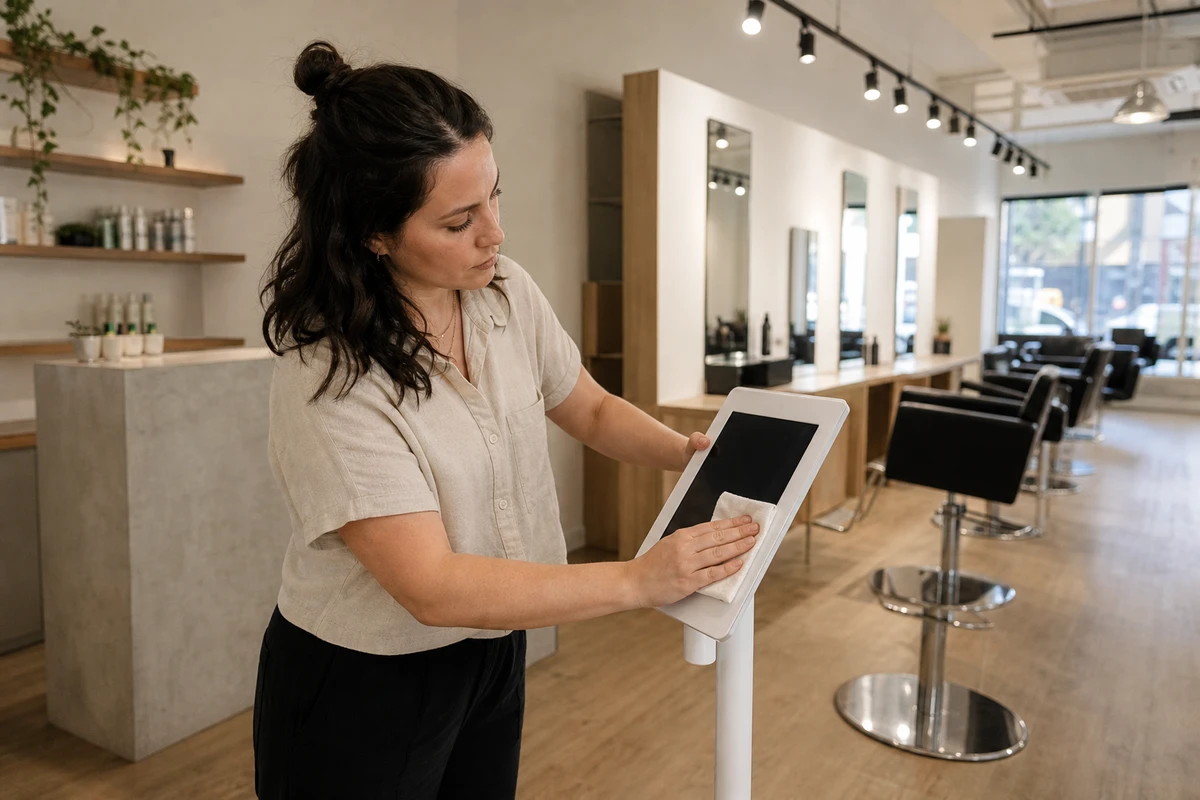
Salon floor space converts directly into revenue. Every square foot holds a chair, a shelf, or a client. A booth that hangs on a wall costs the business nothing in floor area, which is why the wall-mount option deserves a hard look before any free-standing unit. A slim free-standing station is the fallback when no suitable wall exists.
Unattended reliability
The booth has to work with zero staff input, because there will be no staff input. That means it resets itself between users, shows prompts a first-time client can follow without help, locks the tablet into a theft-resistant mount, and stays stable in a warm, busy, product-laden room. The quiet fear behind every permanent install is a booth that freezes, breaks, or simply sits unused. Reliability answers the first half of that fear; placement and prompting, covered further down, answer the rest.
Branding and customization
Every photo the booth produces should be unmistakably the salon’s: logo, brand colors, a custom frame or overlay, and a share screen carrying the salon name and booking link. A booth that emails a client a plain, unbranded snapshot has discarded the entire marketing point of owning one.
Instant sharing
This is the mechanism that fixes the core problem. The booth should deliver the photo to the client’s own phone, by text, QR code, or email, within seconds, while they are still in the building. A salon owner’s recurring frustration is that clients do not post or tag the salon on their own. The gap between the work and the share is where the marketing value leaks out. Closing it is not about nagging the client afterward. It is about putting the finished, branded photo in their hand at the moment they are proudest of how they look.
Data capture and marketing opt-in
This is the part that turns a fun amenity into a business asset, and the mechanism deserves to be stated plainly. A client who wants their photo will, in exchange, willingly enter an email or phone number and tick a consent box. The booth converts a service the client already wanted into a first-party contact the salon owns outright and can reach without paying a platform for access. That matters because customer-made content carries weight that salon-produced advertising does not: a 2026 Bazaarvoice survey of shoppers found that 55% say they are unlikely to buy a product that carries no user-generated content at all, no reviews and no customer photos (Bazaarvoice Shopper Experience Index, 2026). A booth manufactures that content, with permission, on the salon’s own floor.
Software, not frozen hardware
App-based booths receive new features, security patches, and sharing options over time. A booth running fixed firmware stays whatever it was on the day it shipped. The gap shows up in practical ways: a new option for clients to receive their photo, a security fix for a tablet sitting on the salon’s network, or a consent field added as privacy expectations shift. Simple Booth’s HALO app is one case in point: a November 2025 update added WhatsApp delivery alongside the QR code, email, and SMS clients could already use, something a salon running the booth picked up without touching the hardware. Favor a platform that updates over a device that does not.
Fit with the salon’s existing tools
Captured contacts are only useful if they reach the salon’s email tool or booking system. Treat this as a data-handoff question, whether the booth can export contacts in a format the salon’s marketing software accepts, rather than assuming a specific one-click integration exists. Confirm exactly how the data moves before buying, not after.
If a salon optimizes only three of these criteria, they should be footprint, unattended reliability, and instant sharing. Branding and opt-in make the booth pay. Those first three decide whether it gets used at all.
The med spa layer: consent, before/after content, and privacy
A hair salon photographing a fresh cut and a med spa photographing a client just after an injectable are doing two different things, even with the identical booth on the wall. The hardware decision is the same. Everything around it is not.
The med spa market is large and serious. The U.S. medical spa industry turns over more than $17 billion a year and is adding upward of $1 billion in revenue annually (American Med Spa Association, 2026). It is also a market where client images can sit close to a medical or aesthetic procedure, and that proximity changes the buying conversation. The booth itself is fine. The question is consent and context.
Treat the booth’s opt-in screen as a documented consent step, not a checkbox afterthought. A clear prompt should say, in plain language, what the photo will be used for: that the client is receiving their own copy, and, separately and explicitly, whether they agree to let the med spa use the image in its own marketing. Those are two different permissions. The booth should capture them as two different choices, not one bundled “I agree.”
Before-and-after content needs its own line
Before-and-after content needs its own line. A booth is a natural fit for the celebratory “after” moment, the client who is delighted and wants a photo to take with them. It is not the tool for clinical before-and-after documentation, which in aesthetics is a standardized, regulated category with its own lighting, framing, and consent requirements. Keep the two separate. A client-shareable selfie at the booth and a clinical comparison photo in a treatment file are different things governed by different rules.
On privacy more broadly, med spa operators should confirm that any photo-capture deployment is covered by their existing patient consent and photo-release protocols, which are already a standard part of med spa intake paperwork. A med spa operating under medical oversight may carry records and privacy obligations a hair salon does not, and booth content should never include anything that could be read as protected health information. That is a question for the practice’s own legal counsel, not a detail to settle from a buyer’s guide.
The practical takeaway is simple
The practical takeaway is simple. The booth belongs in the lobby or retail area, never in the treatment room. It captures the happy result on the way out, not the procedure. A med spa can hand the front desk a short checklist:
- The booth lives in the waiting or retail area only.
- The consent screen separates “send me my photo” from “the med spa may use my photo.”
- Staff never encourage a client to photograph a treatment in progress.
- Anything resembling clinical documentation stays in the medical record system, not on the booth.
Where to put the booth, and how to get clients to use it
A booth nobody uses earns nothing, and the most common way a permanent install fails is not breakage. It is silence. The fix is placement and prompting, not hardware.
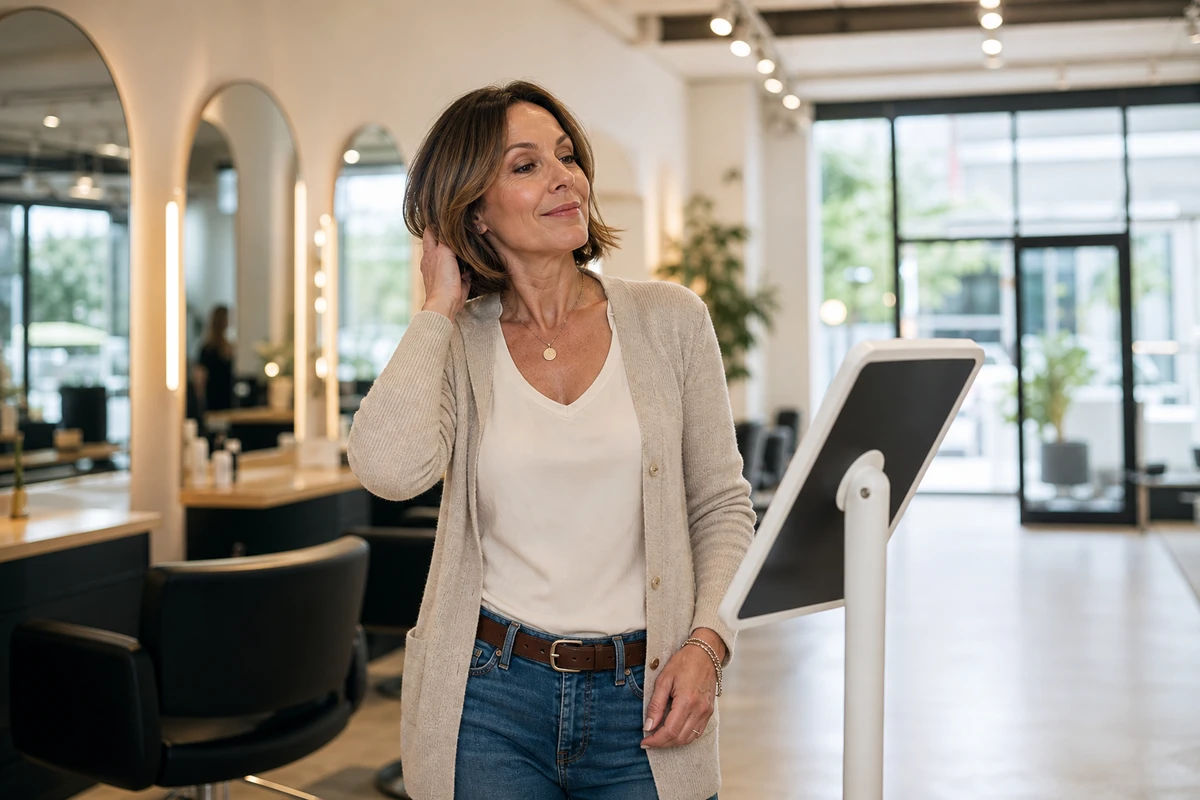
Placement follows the reveal
Placement follows the reveal. The moment a client most wants a photo is the moment the transformation is freshest: standing at the styling mirror with the finished look, or passing through the lobby on the way out still feeling it. Put the booth on that path. A booth tucked into a back hallway, away from the reveal, will sit idle no matter how good the unit is.
In practice, the single biggest lever is one sentence from a staff member. A stylist or front-desk person saying “Grab a photo at the booth before you go, it’s set up with our frame” lifts usage far more than any sign, because it arrives at the right second from a person the client already trusts. Signage alone is close to invisible. The prompt should be trained into the checkout routine the same way rebooking already is.
Lighting rarely needs work
Lighting rarely needs work. A salon is already lit well for seeing hair and skin accurately. The one thing to avoid is placing the booth so the client faces a bright window or backlight, which turns every photo into a silhouette.
A small, tasteful incentive helps without discounting the service. Entry into a monthly draw for a retail product, or a few loyalty points, for using the booth and opting in, is enough to move the fence-sitters. Keep it light. The photo is most of the motivation already.
Finally, make the share itself frictionless
Finally, make the share itself frictionless. The photo should land on the client’s phone in seconds, already branded, with the salon’s social handle and booking link attached, so a client who wants to post has nothing left to do but tap.
What it costs, and how to know it is working
The pricing below, broken out by form factor, comes from vendor-published figures and is best read as reference ranges, not firm market-wide averages. A wall-mounted iPad booth starts around $1,595 (Mobibooth, vendor-published). A free-standing open-air iPad station starts near $1,995 and runs to roughly $3,000 depending on configuration (Snapbar and third-party vendor comparison). Mirror booths run roughly $4,999 to $10,000 and up. 360 booths start near $7,000. On top of the hardware, an app-based booth carries a recurring software subscription. Budget that as a separate monthly line, not a one-time cost.
Buy versus rent is a short decision
Buy versus rent is a short decision. Rent for a genuine one-off, a grand opening or a single launch event. Buy for a permanent fixture. The math turns over quickly. Vendor comparison pricing puts open-air booth rentals at $800 to $1,200 per event, so a salon that runs even four to six branded events a year spends $3,200 to $7,200 on rentals. That is more than buying an open-air booth outright, and the rented booth goes home with the vendor afterward. For daily in-salon use, renting does not make sense at all.
The return, though, comes from daily traffic, not events, and that is the calculation no event-focused guide runs. Take a single-location salon that books 25 clients a day, six days a week, which is 150 client visits a week. Suppose 30% of those clients stop at the booth on the way out (45 a week) and 40% of the ones who use it tick the box to receive offers and updates from the salon (18 new opted-in contacts a week). Across a 50-week year that is roughly 900 first-party contacts the salon did not have before, each one an existing client who liked the result enough to photograph it.
The formula behind that number is plain: weekly visits × booth-use rate × opt-in rate × operating weeks = annual contacts. A busier salon, a more visible booth, or a better-trained staff prompt push the two middle rates up. A quiet location pushes them down. A med spa with fewer daily clients but a far higher average ticket runs the identical formula with smaller traffic and a larger per-client value.
What those 900 contacts are worth depends on the salon’s own figures. If follow-up texts and emails to that list bring back just 3% of them for one extra visit a year (27 visits) at a $120 average ticket, that is $3,240 in revenue the salon would not otherwise have booked, set against a wall-mount booth that cost about $1,595 plus its software subscription. Even on that conservative reactivation rate, the booth clears its first-year cost, and the contact list keeps compounding after that.
That ticket-versus-traffic gap is where a booth fits the current salon economy precisely. Commission salons grew revenue about 3.65% year over year in early 2026, but the trade group’s data partner found that the growth came mostly from higher prices and service mix, not from more visits. Client counts were roughly flat and visits slightly down (Professional Beauty Association / KIM Report, 2026). Salons are getting more out of each visit and not getting more visits. A booth that captures contacts and feeds repeat bookings works on exactly the side of that equation that is not improving on its own.
To know whether the booth is working, track a short list and resist the urge to instrument everything: booth uses per week, opt-in rate, photos shared, posts that tag the salon, and bookings traceable to a booth-captured contact. Those five tell the whole story. Anything beyond them is noise.
How to choose: a quick decision framework
The criteria matter differently to different buyers, and the decision collapses into three cases.
Footprint
A single-location hair or nail salon should prioritize the smallest possible footprint, a wall mount where a wall is available, instant text or QR sharing, and simple, clean branding. An open-air iPad booth is almost always the answer, and the wall-mounted version is the answer when floor space is tight.
A med spa or aesthetics clinic chooses the same hardware but weights consent handling, lobby placement, and a clean separation from clinical before-and-after documentation above everything else. The form factor is the easy part. The protocol around it is the real decision.
A multi-location salon group or franchise should prioritize the software side: a platform that lets a head office control templates and branding centrally so every location’s photos look consistent, plus a reliable data handoff into the group’s marketing stack. At that scale the booth is a fleet, and consistency matters more than any single unit’s spec.
For the large majority of salons and med spas, the recommendation barely changes. A compact, wall-mountable, app-based open-air booth, with instant sharing and a consented marketing opt-in built in, is the best photo booth for the job.
Frequently Asked Questions
How much does a photo booth for a salon cost? Vendor-published pricing puts wall-mounted iPad booths around $1,595 and free-standing open-air stations near $1,995 to $3,000. Mirror booths run roughly $4,999 to $10,000 and up, and 360 booths start near $7,000. Budget separately for the recurring software subscription that app-based booths carry, which is a monthly cost on top of the hardware itself.
Do I need staff to run a salon photo booth? No, and that is the point. A salon photo booth is built to run unattended. It resets between users, shows prompts a first-time client can follow alone, and needs no operator. Staff have one job: a single sentence at checkout pointing the client to the booth. The booth handles capture, branding, and sharing on its own.
How much space does a salon photo booth need? Less than most operators expect. A wall-mounted iPad booth uses no floor space at all, since it hangs like a mirror. A free-standing open-air station needs roughly a two-by-two-foot footprint. Mirror booths need six to nine square feet, and 360 booths need around a hundred, which is why the iPad form factor suits salons best.
Is a photo booth worth it for a small single-location salon? Usually yes. A booth used by even 30% of daily clients, with 40% of those opting in, can produce hundreds of first-party marketing contacts a year. If follow-up brings back a small fraction of them for one extra visit, the booth clears its cost within the first year. The return scales with daily traffic, not with events.
Do med spas need client consent to use a photo booth? Yes. A med spa should treat the booth’s opt-in screen as a documented consent step, separating “send me my photo” from “the med spa may use my photo in marketing.” Booth photos should stay clear of clinical before-and-after documentation, which has its own rules, and the deployment should fit existing patient consent and photo-release protocols. Confirm the specifics with legal counsel.
Should I buy or rent a photo booth for my salon? Rent for a true one-off, such as a grand opening. Buy for a permanent fixture. At vendor-published rental rates of $800 to $1,200 per event, running four to six events a year costs more than buying an open-air booth outright. For daily in-salon use, ownership is the only option that makes financial sense. Sources
- Bazaarvoice (2026). “The Complete Guide to UGC (Shopper Experience Index, Vol. 17).” https://www.bazaarvoice.com/blog/the-complete-guide-to-ugc/
- American Med Spa Association (2026). “Medical Spa State of the Industry: Med Spa Statistics.” https://www.americanmedspa.org/med-spa-statistics
- Professional Beauty Association (2026). “Pro Beauty Pulse, April 2026 (KIM Report data).” https://www.probeauty.org/pro-beauty-pulse-april-2026-insights/
- Snapbar (2026). “Selfie Station: product specifications and pricing (vendor-published).” https://www.snapbar.com/selfie-station
- Mobibooth (2026). “Aura Wall Mount: product specifications and pricing (vendor-published).” https://www.mobibooth.co/wallmount
- Selfieboothco (2026). “Photo booth purchase and rental pricing comparison (vendor-published).” https://www.selfieboothco.com/