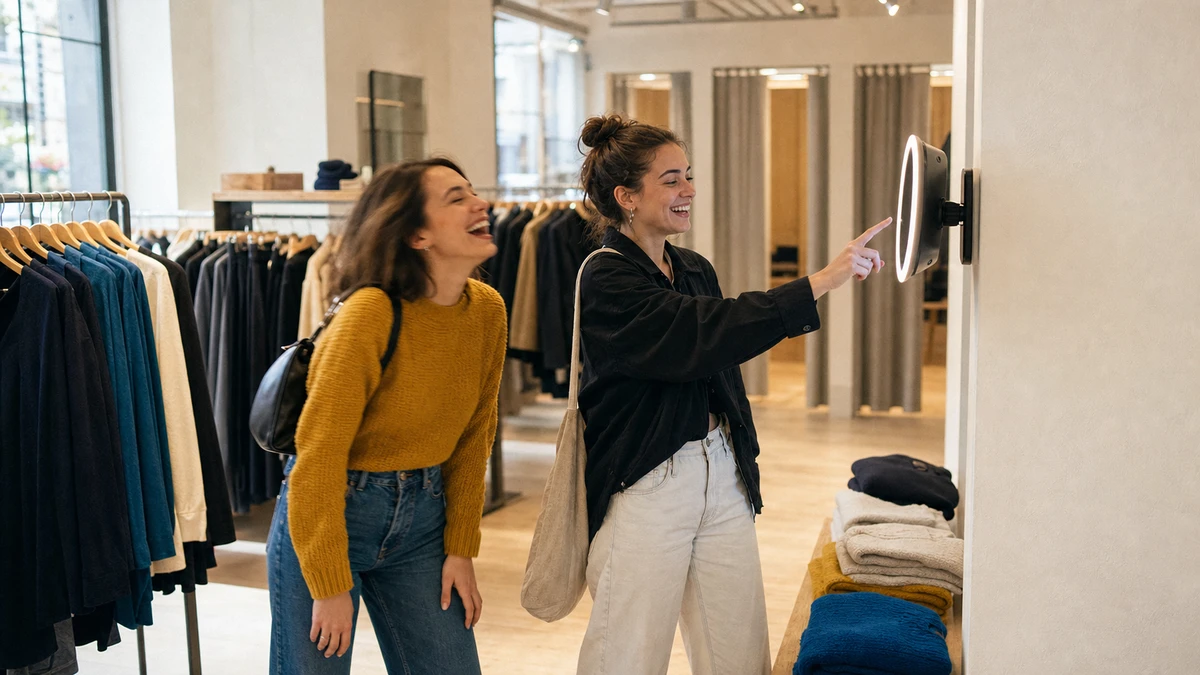
A customer in a boutique pulls a jacket off the rack, tries it against the fitting mirror, and likes what she sees. For about ten seconds she is happy, on her feet, and holding her phone. Then the moment passes. She buys the jacket or she doesn’t, and she leaves. The store never learns her name, never gets a photo of that jacket on a real person, and has no way to reach her again.
A photo booth is one way to catch that moment before it disappears. The best photo booth for retail, for most stores, is a lightweight, app-based selfie station that mounts permanently, runs all day without an attendant, and delivers each photo by email or text so the store collects a contact in the process. That is the short answer. The longer answer is the point of this guide, because the right choice is decided by form factor and the demands of permanent unattended operation, not by brand name.
One clarification first. This guide is for a store owner or marketer adding a booth as a fixture inside their own location. It is not for someone buying a booth to rent out to events, which is a different business with different math. Search results for this topic mix the two badly, and a buyer who follows event-rental advice into a retail decision will choose the wrong machine. For a booth that lives on a retail floor and works every day the doors are open, the real question is not which model wins an award. It is which booth to choose, and whether it will hold up on the floor.
What “Best” Means on a Retail Floor (And Why Event Advice Misleads Retailers)
Picture two booths side by side. One sits in a hotel ballroom on a Saturday night. A hired attendant stands next to it, hands out props, coaxes guests into frame, refills the printer, and packs the whole thing into a van at midnight. It runs for four hours, once. The other sits near the register of a clothing store. It is bolted to the floor or mounted on the wall, nobody stands beside it, and it has to work on a quiet Tuesday afternoon and a packed Saturday alike, every day the store is open, for years.
Staffing
Those are not two versions of the same product. They differ on four axes that decide everything else. The first is permanence: a fixture versus a one-night rental. The second is staffing: unattended versus attendant-run. The third is usage pattern: daily across 300-plus open days versus a single event. The fourth is maintenance: store staff fitting it between other duties versus a paid operator whose only job that night is the booth.
This matters because most advice a retailer will find is event-rental advice wearing a retail label. It optimizes for peak-night spectacle, props, and an attendant who keeps the line moving. A permanent retail install needs the opposite: something quiet, reliable, and nearly invisible in its upkeep.
The commercial logic for putting an attraction on the floor is sound. Longer time in a store tracks with more spending. A six-year study of 43,326 shoppers by Li and colleagues, published in the Journal of Retailing and Consumer Services in 2021, found that longer shopping visits were associated with an immediate increase in the amount customers spent. One widely cited UK mall study by the analytics firm Path Intelligence put a number on the same effect: a 1 percent rise in dwell time tracked a 1.3 percent rise in sales. Both findings are correlational, and neither tested a photo booth specifically; they point to the channel, not the size of any single fixture’s effect. Experience pays in a broader sense too. McKinsey’s 2016 analysis “Linking the Customer Experience to Value” (Maynes and Rawson) found that improving the customer experience raised sales revenue by 2 to 7 percent.
So the question is not whether an in-store attraction can earn its keep. It is which booth survives retail conditions while doing so.
Selfie Wall vs. Photo Booth: Don’t Confuse the Backdrop With the System
The realistic first move for most small retailers is not a booth at all. It is a wall. INVISIONMAG documented this in a 2019 feature on optical retailers: Siobhan Burns of The Eyeglass Lass in New London commissioned a graffiti-style eye mural on a street-visible wall, and as she put it, “the next day I asked someone to pose in front of it for their glamour shot and boom: the selfie/eyeball wall was born.” The wall runs on nothing more than portrait mode on her phone, and it works as curb appeal. Passersby stop.
Contact capture
A wall like that is décor. A photo booth is a system, and the difference is not cosmetic. A wall produces photos the customer takes on a personal phone and posts to a personal account. The store sees those photos only if it happens to be tagged, only while the post stays public, and never owns the right to reuse them. It collects no email address and no phone number. A booth, by contrast, runs a camera through a branded template, prompts the customer on screen, delivers the finished photo digitally, and records a contact and a permission in the same interaction.
The same INVISIONMAG feature shows the other end of the spectrum. Eye Love Optometry in Pinole runs an iPad-based selfie station; its branded galleries stay consistent with the practice’s identity, and the owner receives marketing reports that track how the station performs. He called it “a wonderful word-of-mouth marketing tool.” That is the line a bare wall cannot cross. It can pull people off the sidewalk, but it cannot hand the store a list, a usage right, or a number to measure.
A wall is genuinely enough when the only goal is street-level appeal and the store has no marketing use for what happens next. It becomes a false economy the moment the store wants the email list, the right to repost customer photos in its own ads, or any way to tell whether the thing is working. Most retailers default to the wall because it is inexpensive and visible, then discover months later that it captured nothing they can act on.
The Five Photo Booth Form Factors, Ranked for Retail
Walk into a vendor conversation and the options sort into five formats. The best photo booth for a retail floor is rarely the most impressive one in the room, so it helps to rank them against retail conditions rather than event spectacle.
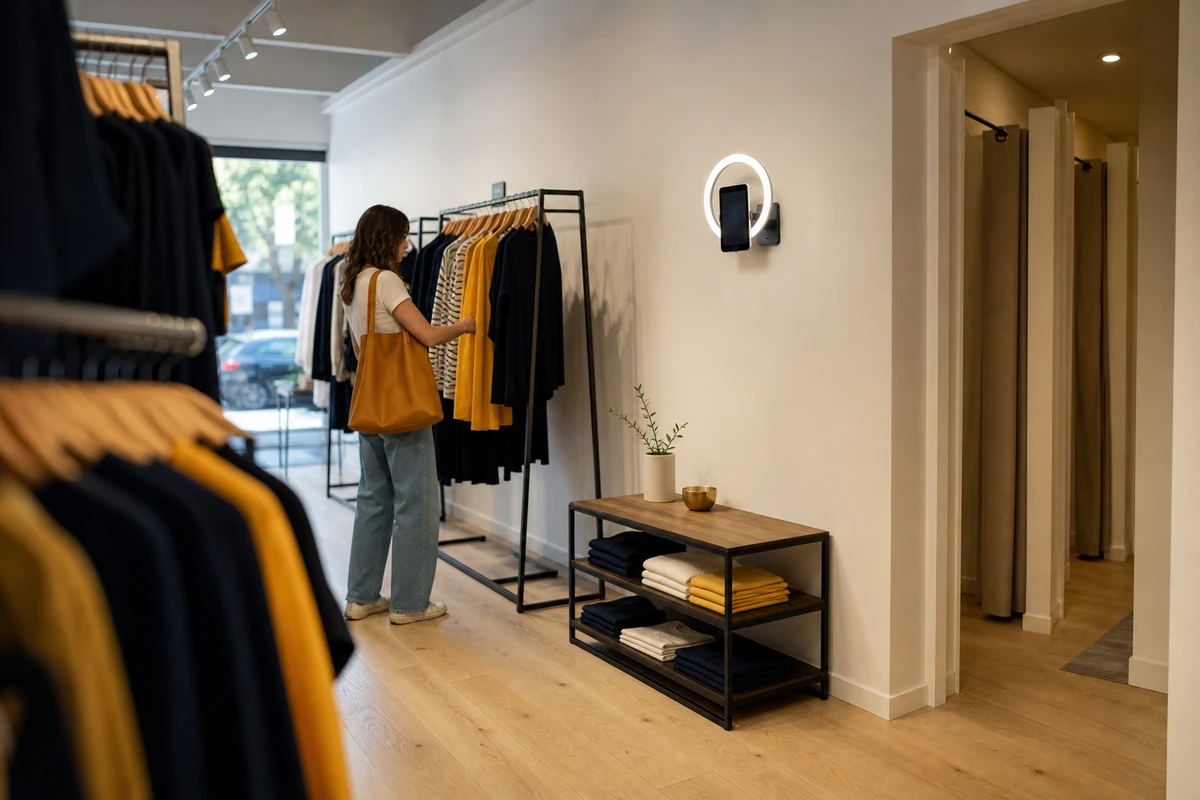
The app-based selfie station is an iPad or tablet running booth software, on a pole stand or a wall mount. Its device footprint is roughly 2 by 1.5 feet, and a wall-mounted unit takes almost no floor space. It runs unattended by design, mounts permanently, and has the lowest maintenance load of any format. For most boutiques and standard stores, this is the answer.
The enclosed kiosk is a self-contained cabinet, often with a built-in payment slot, a screen, lighting, and sometimes a printer. It needs about 64 square feet of clear setup space. The cabinet is theft-resistant and tidy, which earns its larger footprint in high-traffic, high-exposure locations such as mall storefronts and large flagships, where a payment-capable, hard-to-tamper-with unit can stand on its own.
The remaining three are event formats
The remaining three are event formats. A mirror booth is a full-length reflective panel with animated touchscreen prompts, typically needing about 49 square feet of operating space and built around fragile glass. A 360 booth puts a customer on a raised platform while a camera arm spins around them, and it needs 64 square feet at a minimum, more once a queue forms. An open-air DSLR rig is a backdrop, a tripod, and a camera, usually claiming around 100 square feet. All three are designed to be set up, staffed, and struck down. They reward an attendant and a one-night audience.
Some retailer-facing buyer guides still recommend mirror or DSLR booths for stores. That advice is imported wholesale from the event world. A mirror booth’s glass and a DSLR rig’s exposed camera both assume someone is watching them, and a 360 booth without an operator is closer to a liability than an attraction. The footprint alone rules them out for a small store. The honest ranking for a permanent retail fixture is the app-based station first for the majority of stores, the enclosed kiosk second for large or mall-based locations, and the three event formats not at all.
The Footprint Math: What Floor Space Actually Costs
Floor space is the scarcest and most expensive resource a store owns, and a booth competes for it against ordinary inventory. The way to choose a format is to price that competition.
Take a specialty apparel boutique that does $500 in sales per square foot of selling space each year. That is a defensible midpoint of the $400 to $600 range Shopify reported for standard specialty retailers in 2024, where Old Navy sat near $411 and Hollister near $551. Premium lifestyle brands run far higher, but $500 is a fair working number for an independent store.
Price Each Format
Now price each format against it. A freestanding app-based station occupies about 6 square feet of floor that can no longer hold a rack or a fixture. At $500 per square foot, that space was producing roughly $3,000 a year in selling-space productivity, so $3,000 is the booth’s opportunity cost. Wall-mount the same station and that cost falls to nearly zero, because the unit hangs above merchandise rather than displacing it. An enclosed kiosk is a different story: its cabinet alone displaces around $5,000 a year, and the 64 square feet of clear space it needs is room a 600-square-foot boutique simply does not have. The mirror, 360, and DSLR formats, at 49 to 100 square feet of operating space, are not even candidates for a small store.
Set that cost against the return
Set that cost against the return. Suppose the station captures 6 email or phone opt-ins a day across 300 open days, which adds 1,800 contacts a year. Credit each contact with a deliberately conservative $5 in attributable email and text revenue over the year. That figure sits well under what an active retail email program tends to return per subscriber: Litmus put retail email ROI at $45 for every $1 spent in its 2025 State of Email survey. At $5 a contact, the year’s 1,800 opt-ins come to roughly $9,000 in captured-contact value, enough to clear the freestanding station’s $3,000 floor-space cost three times over. The wall-mounted version carries almost no floor-space cost to clear at all. Longer dwell time and foot traffic from shared photos sit on top of that as upside.
A retailer with different numbers, a higher sales-per-square-foot figure or a lower capture rate, can re-run the same three steps and get an honest answer. The structure is what matters: footprint times sales-per-square-foot is the cost, captured contacts times contact value is the return. The app-based station wins this math because it consumes the least selling space, and wins it outright when mounted on a wall.
Built to Run Unattended: Reliability, Theft, and the No-Attendant Test
Here is the test every retail booth has to pass and every event booth gets to skip. It is 6 p.m., the last salesperson is helping a customer at the register, and the booth is on its own. What happens when the printer jams, the software freezes, or someone decides the unattended iPad would look good at home?
Start with paper
Start with paper. A printer is the single most failure-prone part of any booth, and a jammed or empty printer with no attendant means a dead booth until someone notices. For a retail install, digital-first delivery should be the default: the photo goes to the customer by email or text, and a physical print, if offered at all, is an extra rather than the core mechanism. That one decision removes the most common unattended failure entirely.
Software is next
Software is next. A booth left on a customer-facing screen needs to stay on the booth app and nothing else. The standard tool here is single-app or kiosk mode, which locks the device to one application so a curious customer cannot exit into settings, the browser, or the home screen. Jamf, an Apple device-management vendor, documents single-app mode as the baseline for customer-facing iPad deployments, and it is what keeps a retail booth from quietly becoming an unsupervised web tablet.
Then theft
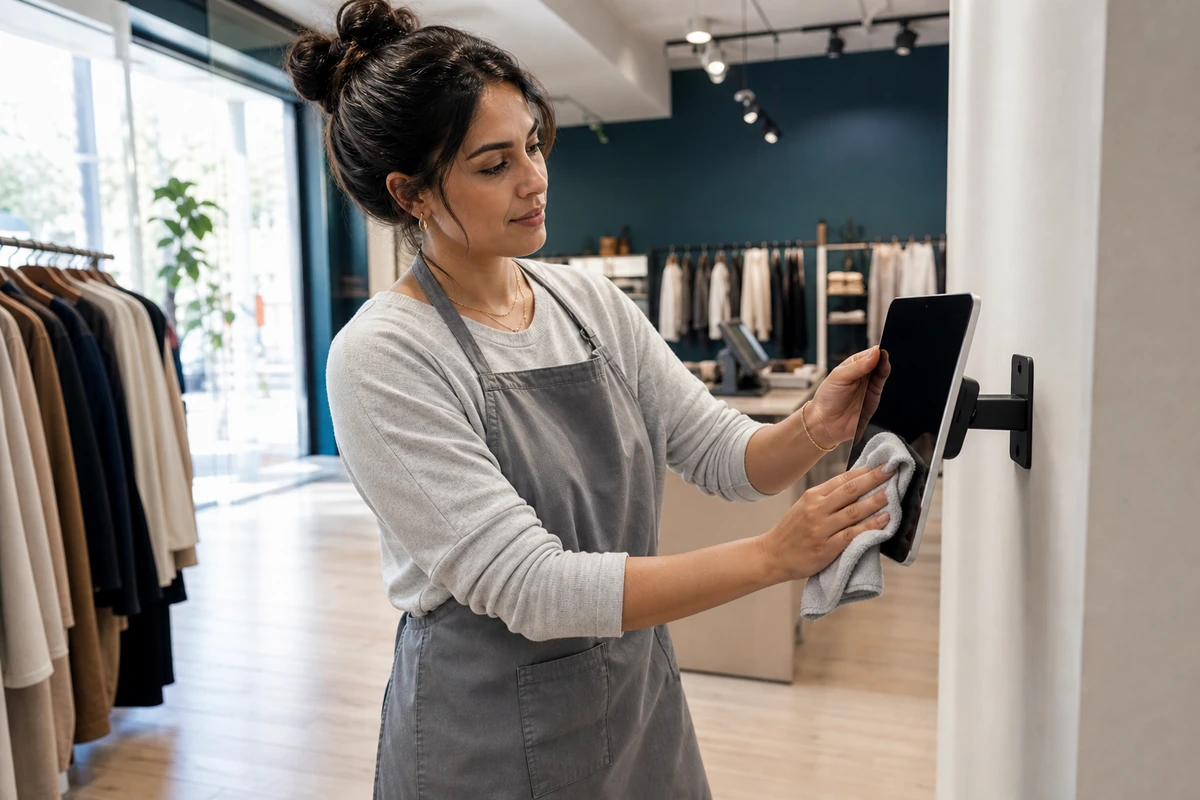
Then theft. An unattended iPad near a door is a target, and the mitigations are mature, off-the-shelf products, not custom work. The standard layer is three parts: a locking physical enclosure around the device, a permanent mount (a wall mount via a VESA bracket is harder to walk off with than a floor stand), and mobile device management software. Device management adds the part that matters most after a theft: Apple’s Managed Lost Mode lets a supervised device be located and remotely wiped even with location services switched off, so a stolen booth becomes a tracked brick rather than a data leak.
The last constraint is human
The last constraint is human. Whatever maintenance the booth needs has to fit into the gaps of a retail employee’s day, between customers and restocking. A booth that demands daily attention will be neglected within a month. The takeaway for the buyer is counterintuitive but firm: a retail booth should be boring and reliable, not impressive and fragile. The format that asks the least of an absent staff is the format that survives.
Data Capture That Feeds the Store’s Marketing Stack
Strip away the photos for a moment and look at what the booth is really doing. After the picture is taken, the screen asks the customer how they would like it delivered, and the customer enters an email address or a phone number. That exchange is the asset. The photo is the reason the customer hands over a contact, and the contact is what the store keeps. How large that kept asset can grow shows in one example: the multi-location entertainment chain Treetop Golf built a list of 150,000 unique email addresses across its venues using Simple Booth’s HALO kit, an app-based selfie station, to collect a contact with every photo.
The consent workflow
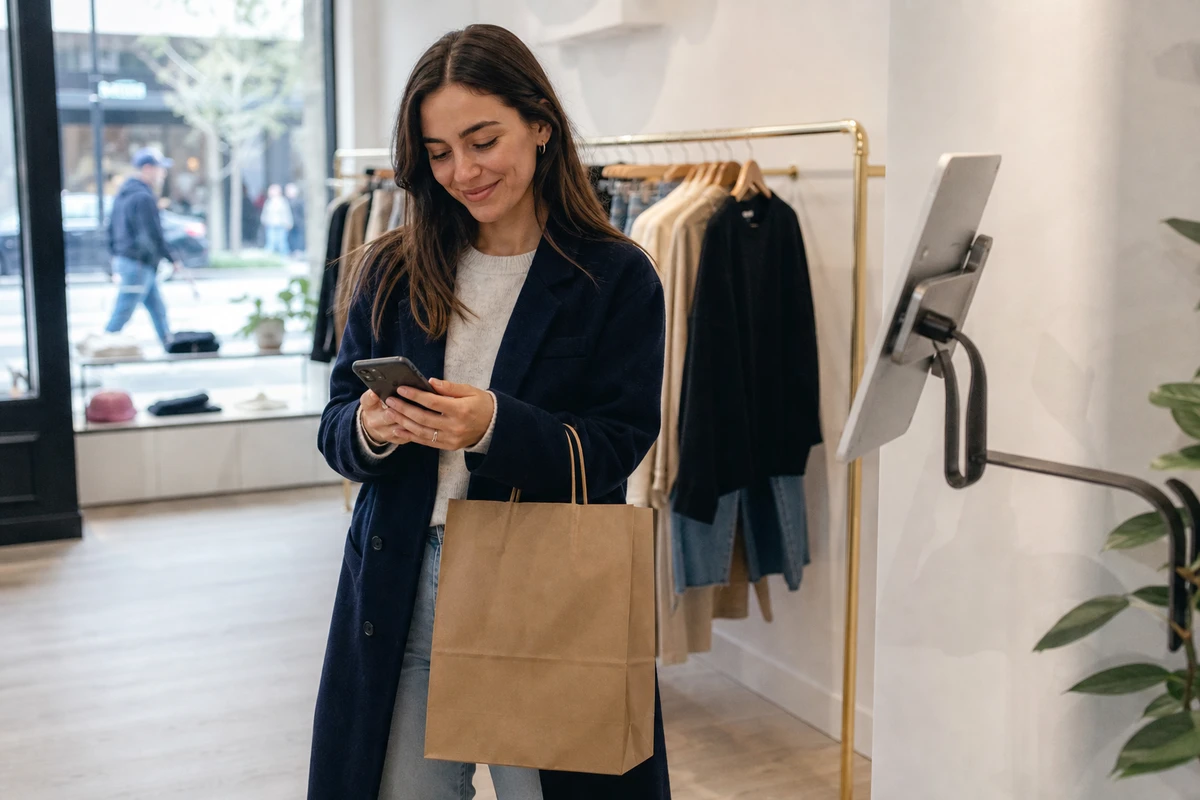
This is what Forrester named zero-party data: information a customer “intentionally and proactively shares with a brand,” as the firm’s analysts have defined it since 2018. It is different from data inferred from browsing or purchase behavior. The customer initiated the exchange, understood what they were giving, and got something of clear value in return. A contact collected this way comes with consent built in, provided the on-screen opt-in clearly states that the store may use the address for marketing, not only for sending the one photo.
That consent is the difference between a booth and a wall, and it compounds. A booth with a properly built opt-in captures the email, the phone number, and the right to reuse the customer’s photo in the store’s own marketing, all in one interaction. That last part is worth real money. Bazaarvoice’s 2025 Shopper Experience Index, conducted by the research firm Savanta across more than 7,000 consumers, found that 65 percent of shoppers rely on user-generated content in buying decisions and that shoppers who engage with that content convert 144 percent more often. PowerReviews, in a 2021 survey of 6,538 grocery shoppers, found 91 percent more likely to buy a product when reviews include customer photos and videos. Authentic customer images sell. A store that owns them can use them.
The argument gets sharper given where organic reach is headed. RivalIQ’s 2025 Social Media Industry Benchmark Report found that retail brands’ Instagram engagement fell by nearly 30 percent in 2024. Relying on customers to post, tag the right account, and keep the post public is a thinning channel. Capturing the photo and the permission directly is not.
When evaluating a booth on this axis, the buyer should check four things: that it delivers by both email and text, that every delivered photo carries a branded template and microsite so the store’s identity travels with it, that consent is recorded clearly enough to satisfy marketing-permission rules, and that the captured data can be exported into the store’s existing email, SMS, or CRM tools rather than stranded in a vendor dashboard. A list the store cannot reach is not a list. The retention payoff follows from there: a captured shopper can be invited back next season, and an anonymous one cannot.
Buy vs. Rent for a Permanent Installation
Renting a booth is structurally an event decision. Rental pricing is per event or per day, and the 2025 cost guide from Puddles Photo Booth puts a three-hour selfie-station rental near $556 and an open-air rig near $870, with the broader market commonly cited at $600 to $1,200 per event. That pricing model fits a one-off pop-up, a product launch, or a seasonal activation perfectly well.
A booth that lives on the floor every day the store is open is not an event, and renting one repeatedly is the expensive way to own one slowly. Buying an app-based selfie station outright runs roughly $2,000 to $7,000 depending on whether the package includes a printer and software, and some vendors offer a monthly subscription instead. Against an $870 rental, a permanent station pays for itself within a handful of rental-equivalents, which a daily-use fixture passes in its first month or two. The category is mature enough to make this a safe purchase: Global Market Insights valued the photo booth market near $400 million in 2020 and projected $1 billion by 2027, so a buyer is choosing among established vendors, not betting on a fragile niche.
The full cost-and-return picture, including depreciation, software fees, and refresh costs over a multi-year horizon, deserves its own analysis. The decision rule for this guide is simpler: rent for episodes, buy or subscribe for fixtures.
How to Get Customers to Actually Use It
A booth nobody uses is the most expensive décor in the store. This is the fear operators raise most often after a purchase, and it is well founded, because adoption does not happen on its own. It is a placement and prompting problem with practical levers.
Placement comes first
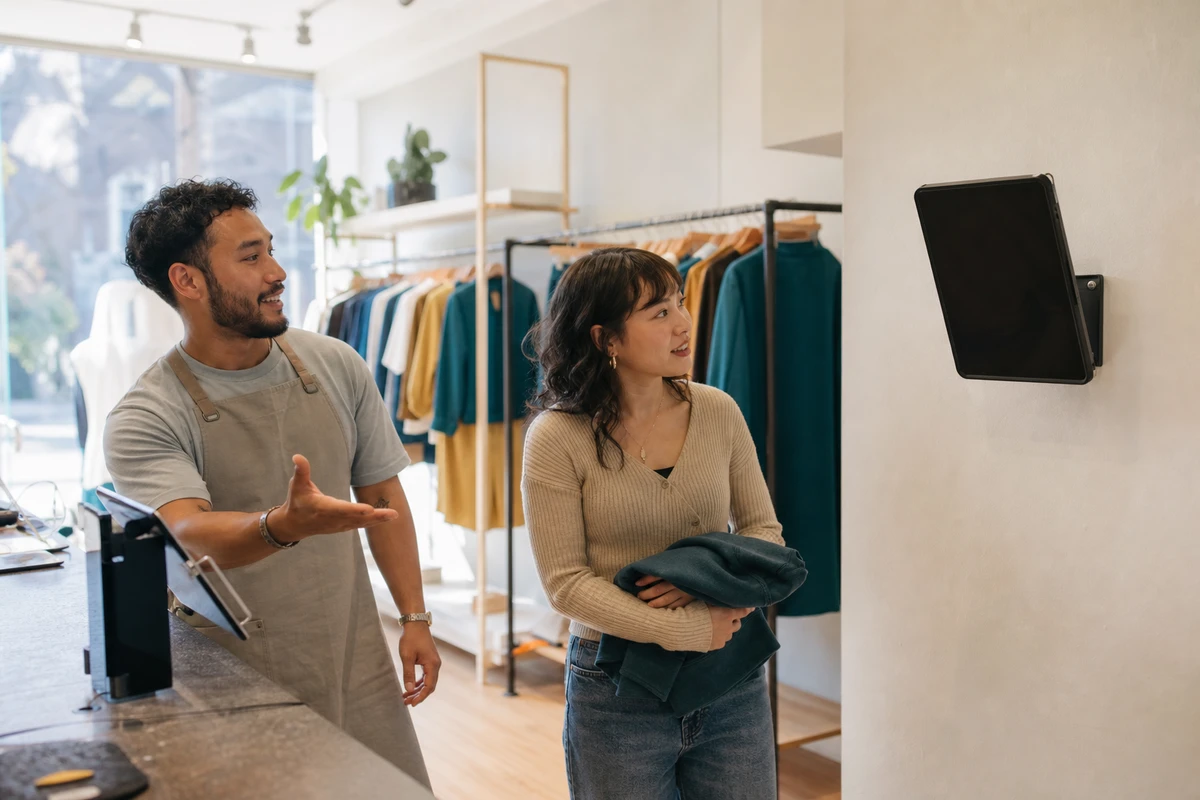
Placement comes first. A booth in a dead corner is invisible; a booth in the customer’s natural path is not. The strongest spots are visible from the front door and close to where customers already pause, near the register or the fitting rooms, where waiting is already happening. Signage and a clear on-screen prompt do the next part of the work, telling the customer what the booth is and what they get.
Staff are the multiplier
Staff are the multiplier. In the INVISIONMAG feature, Eye Candy’s team actively invites customers to use the station when they pick up new eyewear, and that single spoken cue (“grab a photo before you go”) lifts use far more than a sign alone. A reason to participate helps too: a small discount, a giveaway entry, or a loyalty perk tied to taking a photo turns a nice-to-have into a transaction.
The last lever is cadence
The last lever is cadence. A booth is not install-and-forget. A repeat customer who used it in spring needs a new reason to use it in autumn, which means swapping the backdrop, the template, or the on-screen campaign by season. There is no published study putting a number on the refresh effect, so treat it as operational logic rather than a statistic: people do not repeat an experience that has not changed. A retail booth is a small recurring marketing chore with an outsized return, and the chore is the part most buyers underestimate.
A Retail Photo Booth Buying Checklist
Everything above condenses into a short list to carry into any vendor conversation:
- Confirm the use case: a permanent in-store fixture, not an event rental.
- Match the form factor to the store. App-based selfie station for most boutiques and standard stores, enclosed kiosk for large flagships and mall storefronts, none of the event formats for a small floor.
- Check the footprint against floor economics, and prefer a wall mount to push the floor-space cost toward zero.
- Confirm it runs unattended and passes the no-attendant test: digital-first delivery, single-app lockdown, no daily babysitting.
- Secure it against theft with a locking enclosure, a permanent mount, and device-management software that can locate and wipe it.
- Require digital delivery by email and text, with a branded template and content the store has the right to reuse.
- Verify the captured data exports into the store’s existing email, SMS, or CRM tools.
- Have an activation and refresh plan, placement, signage, a staff cue, an incentive, and a seasonal cadence, in place before launch day.
A booth chosen against this list does one job well: it turns the ten seconds a customer is happy and holding a phone into a photo the store owns and a contact the store can reach again.
Frequently Asked Questions
How much does a photo booth for a retail store cost?
A permanent app-based selfie station typically runs $2,000 to $7,000 to buy outright, depending on whether it includes a printer and software, and some vendors offer a monthly subscription instead. Enclosed kiosks cost more, roughly $8,000 to $15,000. Event rentals are priced per event and suit pop-ups, not permanent installs.
How much floor space does an in-store photo booth need?
A wall-mounted iPad selfie station needs almost no floor space. A freestanding version takes about 6 square feet for its base, plus shared circulation room around it. Enclosed kiosks need roughly 64 square feet of clear setup space. Mirror, 360, and DSLR formats need 49 to 100 square feet, which most small stores cannot spare.
Do I need a staff member to run an in-store photo booth?
No, if you choose the right format. An app-based selfie station runs unattended by design: customers tap the screen, take a photo, and enter an email or phone number to receive it. Mirror, 360, and DSLR booths are built for staffed events and work poorly as unattended retail fixtures.
What is the difference between a selfie wall and a photo booth?
A selfie wall is décor: a branded backdrop with no technology. Customers photograph themselves and post to their own accounts, so the store collects no contact details and no reuse rights. A photo booth is a system that captures the photo, delivers it digitally, and records a consented email or phone number in the same interaction.
How do I get customers to actually use the photo booth?
Place it where customers already pause, near the register or fitting rooms, and make it visible from the door. Add clear signage and a simple on-screen prompt. Give staff a one-line cue to mention it. A small incentive, such as a discount or giveaway entry tied to the photo, reliably lifts participation.
Is it better to buy or rent a photo booth for a permanent store installation?
Buy or subscribe. Rentals are priced per event, which fits a one-off pop-up or launch party. A booth used every day the store is open crosses the cost of a few rentals within a month or two, so renting repeatedly for a permanent fixture wastes money.
Sources
- Li, Xi; Dahana, Wirawan Dony; Ye, Qiongwei; Peng, Luluo; Zhou, Jiaying (2021). “Shopping Duration and Purchase Behavior.” Journal of Retailing and Consumer Services, Vol. 62. https://www.sciencedirect.com/science/article/abs/pii/S0969698921001739
- Retail Sensing / Path Intelligence (2007). “Retail Dwell Time as a Performance Metric.” https://www.retailsensing.com/people-counting/retail-dwell-time-metric/
- McKinsey & Company (2016). “Linking the Customer Experience to Value” (Joel Maynes and Alex Rawson). https://www.mckinsey.com/capabilities/growth-marketing-and-sales/our-insights/linking-the-customer-experience-to-value
- Shopify (2024). “Retail Sales per Square Foot: Benchmarks and How to Improve.” https://www.shopify.com/retail/sales-per-square-foot
- Litmus (2025). “The ROI of Email Marketing” (State of Email Survey 2025). https://www.litmus.com/blog/infographic-the-roi-of-email-marketing
- Bazaarvoice (2025). “Shopper Experience Index 2025, Vol. 18” (survey conducted by Savanta). https://www.bazaarvoice.com/blog/bazaarvoice-sei-2025-why-75-of-young-shoppers-trust-ai/
- PowerReviews (2021). “Survey: The Importance of Product Reviews in Driving Purchase Behavior.” https://www.powerreviews.com/survey-importance-product-reviews-drive-purchase-behavior/
- Forrester Research (2020). “Straight From the Source: Collecting Zero-Party Data From Customers” (Stephanie Liu). https://go.forrester.com/blogs/straight-from-the-source-collecting-zero-party-data-from-customers/
- RivalIQ (2025). “2025 Social Media Industry Benchmark Report.” https://www.rivaliq.com/blog/social-media-industry-benchmark-report/
- INVISIONMAG (2019). “Harnessing the Power of the Selfie to Boost Social Media Engagement, Drive Foot Traffic … and Have Fun” (Heath Burslem). https://invisionmag.com/harnessing-the-power-of-the-selfie-to-boost-social-media-engagement-drive-foot-traffic-and-have-fun/
- Puddles Photo Booth (2025). “2025 Photo Booth Rental Costs.” https://www.puddlesphotobooth.com/2025-photo-booth-rental-costs
- Global Market Insights, Inc. (2021). “Photo Booth Market to hit $1 Bn by 2027.” https://www.globenewswire.com/news-release/2021/02/18/2177740/0/en/Photo-Booth-Market-to-hit-1-Bn-by-2027-Global-Market-Insights-Inc.html
- Jamf. “Enhance the Customer Experience With iPad and Single App Mode.” https://www.jamf.com/blog/enhance-the-customer-experience-with-ipad-and-single-app-mode/
- Apple. “Managed Lost Mode and Remote Wipe.” https://support.apple.com/guide/security/managed-lost-mode-and-remote-wipe-secc46f3562c/web