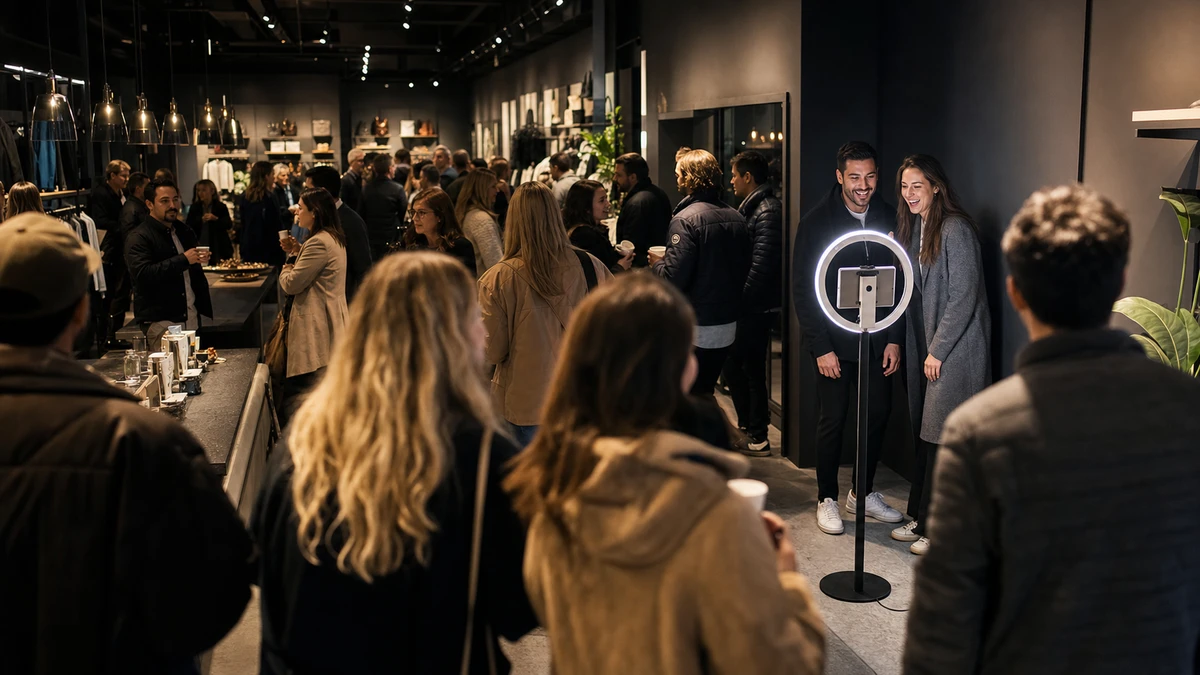
A running store turns off regular sales for a Thursday evening and fills its floor with eighty people there for a shoe launch. A rep from the brand works the demo table, there is free coffee, and a raffle drum sits by the register. For two hours the room is loud and warm. Then the crowd thins, the last few linger near the door, and by Friday morning the store has a strong register total, a tray of leftover pastries, and almost no record of who was actually in the room.
That gap is the problem worth solving. Retail event lead capture is the work of turning the people who attend an in-store event into named, dated, consented records inside the store’s email or CRM platform, before they leave. One constraint separates it from every other kind of event work: a store hosting its own event has no attendee badges, no registration list, and no business cards. There is a burst of walk-in shoppers and a short window to earn their details. What follows is the event-day system that closes that window.
Why “Event Lead Capture” Tools Weren’t Built for the Store as Host
A store marketer planning a customer-appreciation night sits down to find a tool for the job, searches the obvious phrase, and gets a screen of badge scanners. The first page of results for retail event lead capture is lead-retrieval software: Cvent, Blinq, Captello, vFairs and their peers. Every one is built for the same buyer, an exhibitor who has rented a booth at someone else’s trade show and wants to scan attendee badges into a sales CRM.
That buyer is not a retailer hosting an event
That buyer is not a retailer hosting an event in its own store, and the difference is structural, not cosmetic. A trade-show exhibitor starts with a registered, badged, pre-qualified professional audience. A store hosting a launch night or a pop-up starts with anonymous walk-in consumers. The volume arrives in a burst, dozens to a few hundred people inside a two-to-four-hour window, not a steady trickle across a three-day conference. The visitor has no badge to scan and no built-in reason to identify herself, so every contact has to be earned rather than collected. And the destination is a retail email, loyalty, or POS platform such as Klaviyo, Mailchimp, Shopify, Square or Constant Contact, not a B2B sales pipeline.
The term itself is ambiguous, because a retailer can also be the exhibitor at a retail expo. This article scopes to the harder and worse-served case, the store as host. The reframe matters because it changes the unit of work. For the trade-show tools, the unit is a scanned badge. For a store-hosted event, the unit is a consented contact record, and nothing about the badge-scanning playbook produces one.
The exhibitors those tools serve do not have it easy either. Enable Services, citing Trade Show Labs data, reports that only 6% of trade show exhibitors feel confident they convert leads effectively (Enable Services, 2025). A retailer copying that playbook inherits its failure rate without even having the badges it depends on. Operators feel this directly: threads in the HubSpot Community asking for the best way to capture lead information at an event get answered with badge-scan integrations and CSV imports, advice aimed at a buyer the retailer is not.
What a Captured Contact Has to Contain to Be Worth Anything Later
A store finishes its launch night with sixty email addresses collected on a tablet, and the manager feels the night worked. Six weeks later, nobody can tell which sixty. The addresses synced into the general newsletter audience, got the same Tuesday promotions as everyone else, and the event that produced them is now invisible in the data.
Consent
A captured contact is only worth something later if it carries three things. The first is an identifier, an email address or a mobile number. The second is an explicit consent status, recorded as a field rather than assumed. The third is the field nearly everyone skips: a source tag naming the event, plus the date. The event tag is load-bearing. Without it, the contact dissolves into the general list the moment it syncs, and the store loses the ability to measure what the event produced, send its attendees a different first message, or keep them out of campaigns meant for warm regulars.
momencio, which sells event lead software, gives the discipline plainly in its CRM best-practices guide: create one consistent field or tag for the event name and year, and do not let staff invent their own versions, because consistency is what makes the reporting usable later (momencio, 2026). The advice is written for trade shows, but the tagging rule transfers cleanly to a store.
One distinction the title invites clearing up: in a retail email or loyalty platform, the event visitor becomes a contact or subscriber carrying a source attribute, not a “lead” sitting in a sales pipeline with a stage and an owner. The heavier discipline of owner, notes and a defined next step is worth borrowing only for high-value events, a VIP preview for a big-ticket category where a named salesperson can realistically follow up with each attendee. For a general launch night, a clean tagged contact is the right and sufficient target. A workable minimum record looks like this:
- Identifier: email and/or mobile number
- Consent status: explicit marketing opt-in, recorded as its own field
- Event tag and date: one consistent name, applied to every contact from the event
- Capture method: how the contact was collected (QR form, kiosk, loyalty signup)
- Optional note: one line of interest or context, for high-value events only
Capture Methods When There’s No Badge to Scan
A shopper at a Saturday in-store event has a coffee in one hand and a demo product in the other. Nobody gave her a badge at the door, she has no business card, and she did not register to get in. If the store wants her email address, it has to give her a reason to hand it over. Every workable capture method is a version of that trade: the store offers something the visitor wants, and the contact record is the byproduct.
The methods sort cleanly from worst to best for an event. A paper sign-up sheet or a fishbowl of slips is the worst, not because paper is dated but because the handwriting is illegible, there is no real record of consent, and someone has to retype every line later, which is where the delay begins. A QR code on event signage pointing to a mobile form costs nothing in hardware and works when the incentive is clear, though it leaves the typing to the visitor. A staffed tablet or kiosk is faster and lets the store control which fields are required. POS-linked capture at the register is reliable but only reaches the minority of visitors who buy. Loyalty or VIP enrollment performs well when it reads as a genuine benefit rather than a marketing ask.
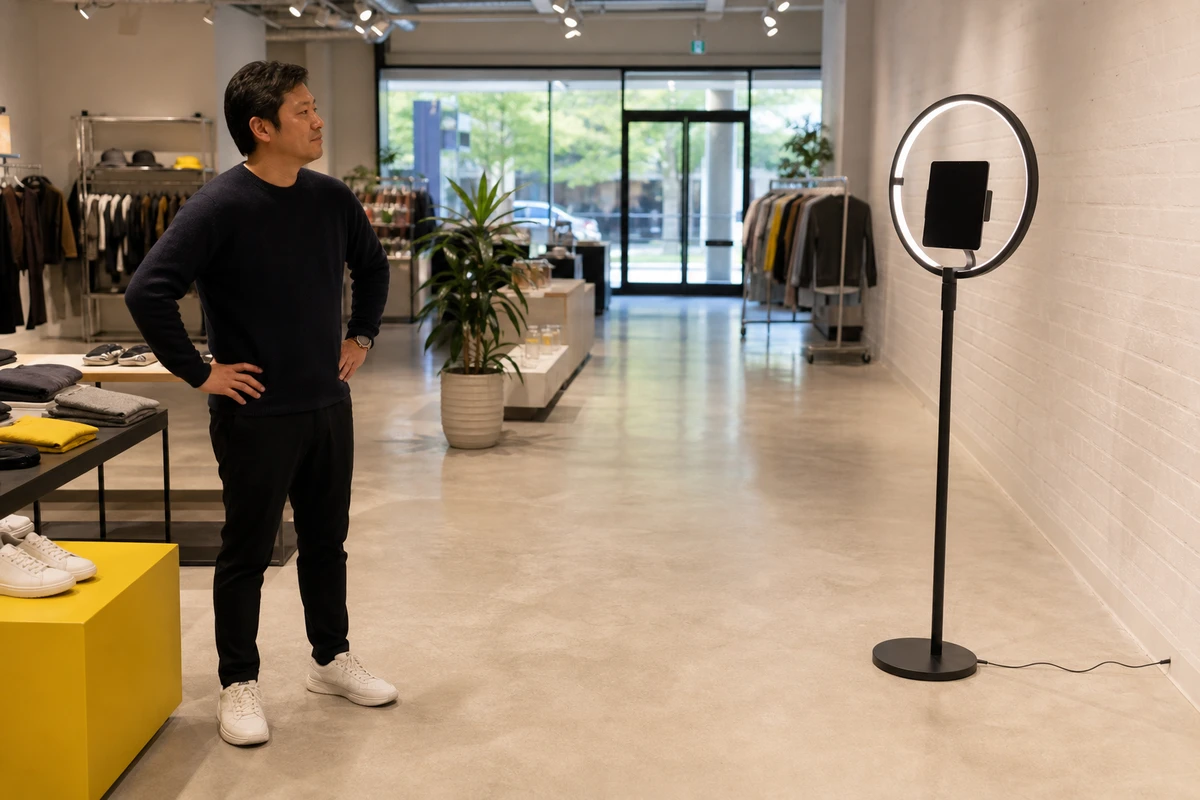
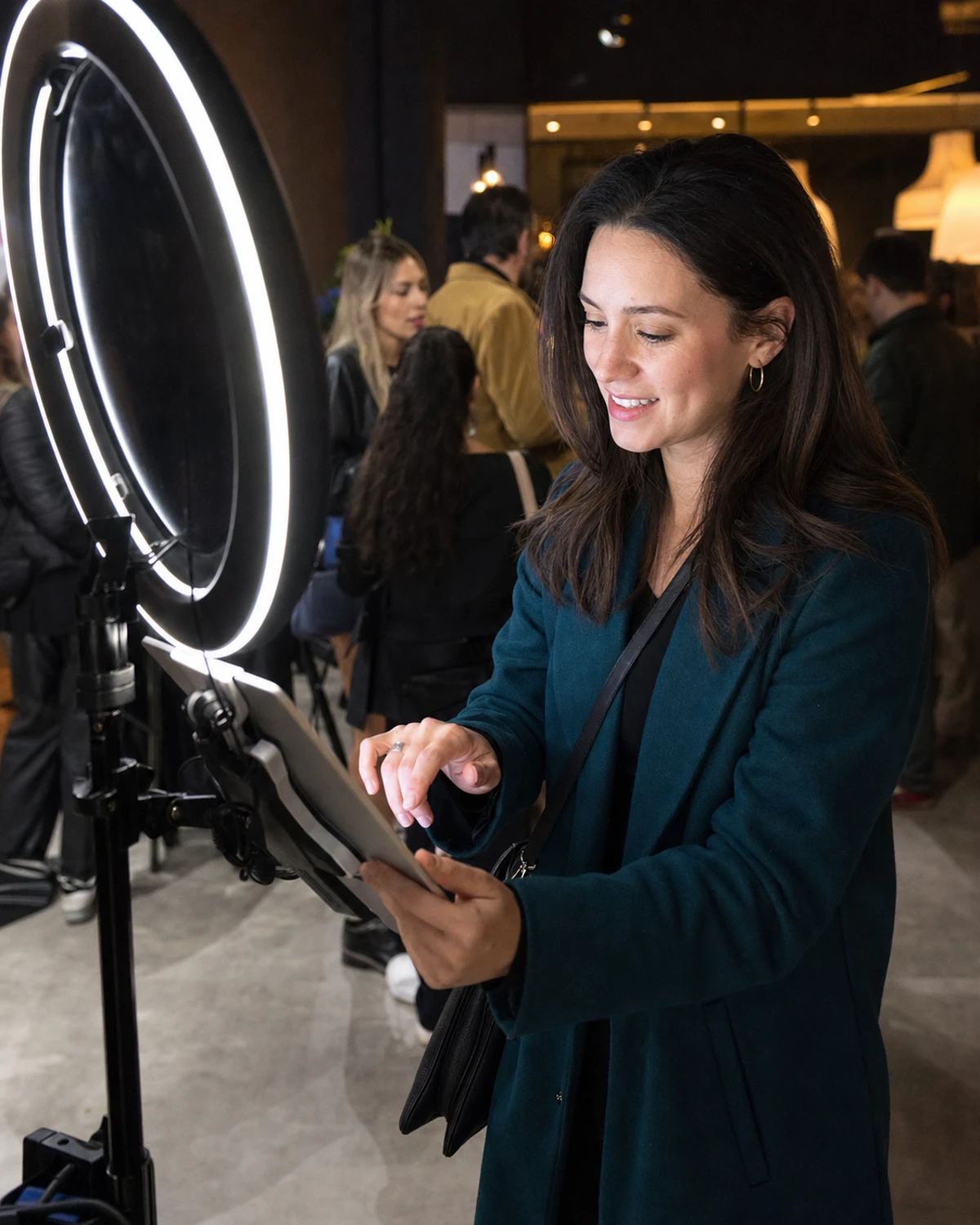
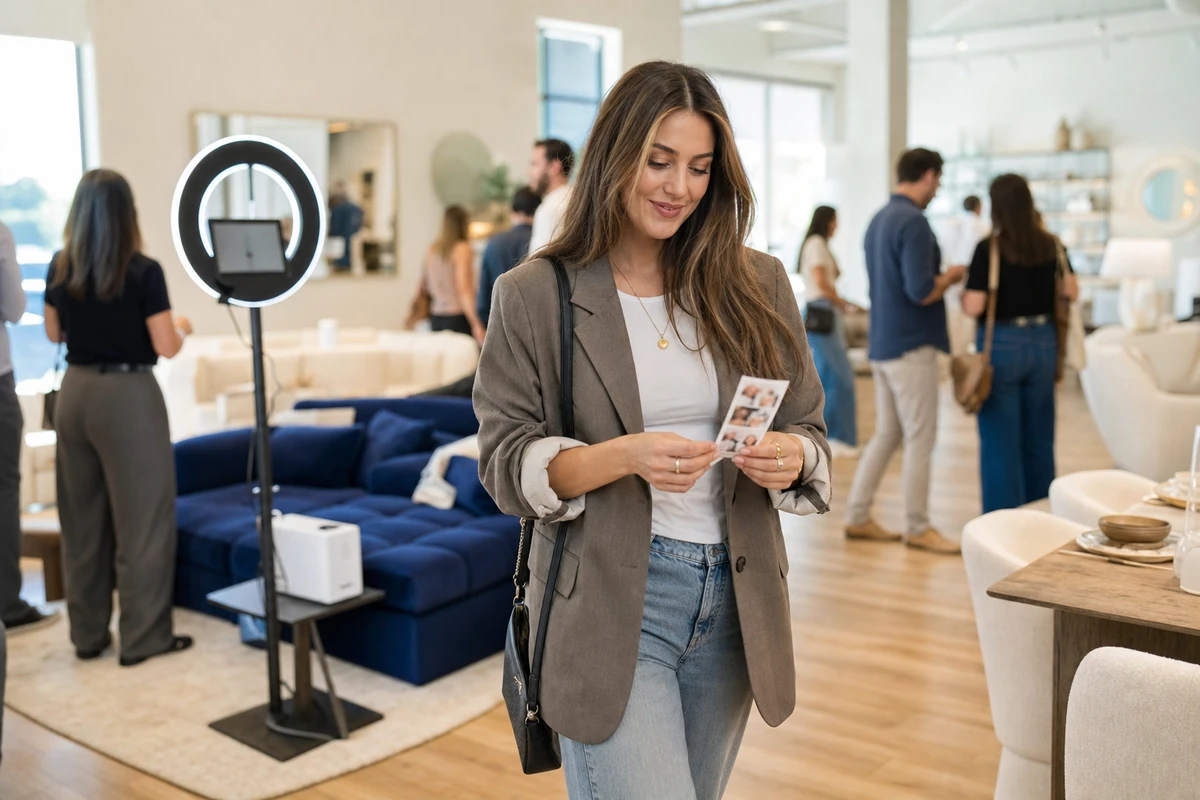
The best method for an event is the one where handing over an email feels like nothing at all, because the visitor wanted whatever sits on the other side of it. A branded photo activation or interactive station works this way: the email or phone number is simply the delivery address for something the visitor actively wants (a photo of herself, a short clip, a discount code), so the contact record is collected without the visitor ever feeling an “ask”.
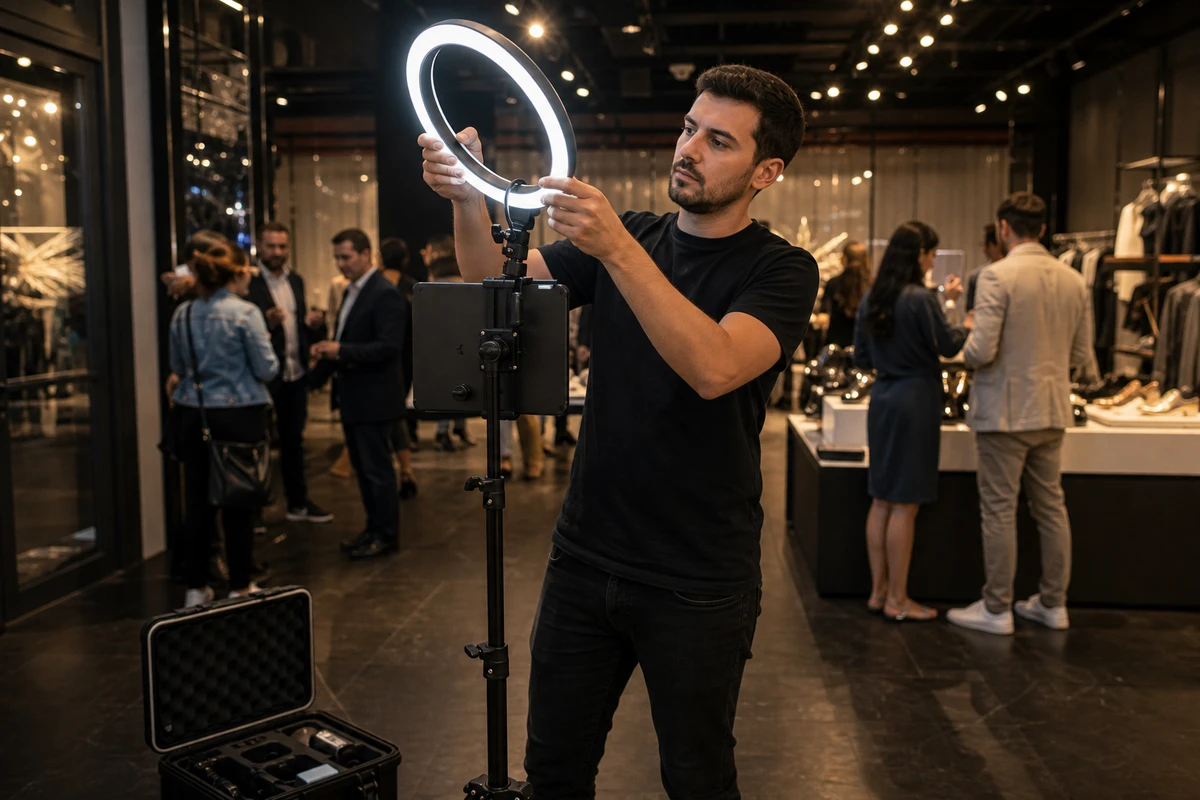
That is the mechanism underneath every capture rate: an extraction feels like a tax, and a byproduct feels free. Simple Booth’s HALO kit is one version of this built for in-store events: an iPad photo station where the visitor enters an email or phone number to receive the photo, and the venue can add a separate marketing opt-in checkbox on the same screen, so the contact and its consent are captured in one motion. The entertainment-venue chain Treetop Golf built a list of 150,000 unique email addresses across its locations this way.
Framing decides the rest
Framing decides the rest. In-store email-capture guidance from operators converges on one point: customers share an email readily when the value is obvious and immediate (OnSpot Social, 2023). The failure mode is familiar too. Data Axle records a cashier undermining the entire program in one breath: “I’m just supposed to ask … it’s just a scam, and we’re going to send you a ton of spam” (Data Axle, 2020). Staff who are not briefed and not bought in will quietly cap the opt-in rate no matter which tool is on the counter. Operators trade stories of 90-percent-plus yes-rates when the ask is folded into something useful, but those stories are encouraging signal, not a benchmark to plan against.
The Data Path: From the Store Floor Into the CRM the Same Day
The clipboard of handwritten emails sits on the manager’s desk on Monday. By Wednesday it is a half-finished spreadsheet. The week after the event, the list finally uploads to the CRM. momencio describes this exact decay: leads “manually compiled into a spreadsheet, cleaned up days later, and finally uploaded to the CRM a week after the event. By then, any urgency is gone” (momencio, 2025).
The cost of that lag is measurable
The cost of that lag is measurable. Research widely cited in B2B marketing, originally from MarketingSherpa, puts the share of marketing leads that never convert for lack of follow-up at 79%. Speed is the lever. Harvard Business Review research by Oldroyd, McElheran and Elkington found that companies attempting to contact a lead within an hour were nearly seven times more likely to have a meaningful conversation with a decision-maker than those who waited more than two hours (Harvard Business Review, 2011). The study covered online sales leads rather than retail event contacts, but the direction is not in doubt: a contact cools fast, and first responders win a disproportionate share of the attention.
Getting the contact into the platform fast comes down to three tiers. Direct sync is the most reliable: a form, kiosk app or loyalty tool writes the contact and its event tag straight into the CRM in real time, with no human handling in between. Batch export is acceptable when it genuinely happens the same evening, a clean CSV pulled at the end of the event and imported that night, with the field mapping tested before the doors opened rather than improvised at 9pm. Manual entry from paper is the tier to avoid, because it carries both the highest error rate and the longest delay.
One physical constraint governs all of this. A store’s wifi buckles when a hundred guests’ phones compete for it, so any capture tool used at an event has to queue contacts locally when the connection drops and sync them when it returns. Enable Services confirms the requirement plainly: capture tools should collect on mobile devices even without wifi and sync later (Enable Services, 2025). Offline queuing is not optional for event use; it is the difference between a complete list and a list with a two-hour hole in it. The rule that ties the section together is simple: the contact, its consent flag and its event tag should land in the platform before staff leave for the night, because same-day sync is what makes a same-day follow-up possible. The field-by-field mechanics of mapping data into a particular CRM are a separate matter, worth their own treatment.
What One In-Store Event Is Actually Worth (and What the Lag Costs)
Take a furniture and home goods store hosting a Saturday designer-collaboration preview. The event draws roughly 120 visitors across three hours. At a 45% capture rate, a realistic figure when the ask is built into something visitors want, the store ends the day with 54 new consented contacts.
What is a retail email contact worth in a year? No single clean industry benchmark exists, so the honest approach is to build a floor. Omnisend’s 2026 email statistics put campaign emails at $0.18 in revenue per send and automated flow emails at $2.87 per send (Omnisend, 2026). A store sending one campaign email a week earns roughly $9 per contact per year from campaigns alone, before any automated welcome or post-purchase flow is counted. Call the all-in figure a conservative $15 per contact per year for a typical retail program; higher-AOV categories and stores with strong automation run well above it.
The arithmetic, then: 54 contacts at $15 each is about $810 in first-year email-driven revenue from a single afternoon, and those contacts keep producing in year two. A store that knows its own revenue-per-subscriber can replace $15 with its real number, and its own visitor count and capture rate, without the structure of the calculation changing.
Now the lag
Now the lag. The 54 contacts are worth $810 only if they actually receive email. A thank-you sent within 24 hours, while the event is still a clear memory and the demo product is still on the visitor’s mind, lands in a warm context. The same list uploaded eight days later reaches people who have half-forgotten the night, and it does so after the decay the Harvard Business Review research describes has already run. The list does not lose its addresses; it loses its timing, which is most of its value.
That a contact attached to an in-store moment carries real revenue is not theoretical. According to Shopify’s own platform data, retailers using its POS email capture see an average 9% increase in orders with a customer email attached, and an 11% increase when the order includes both an email and a marketing opt-in (Shopify, 2025). Shopify’s case study on Little Words Project, a jewelry retailer with 14 locations, reports a 33% increase in POS orders carrying both an email and a marketing opt-in across all stores once in-store capture became systematic. That is register data rather than event data, and it is vendor-published, but it points the same way: a named, opted-in contact is worth measurably more than an anonymous transaction.
Consent, Segmentation, and the First Email
A store runs a raffle at its launch night. Every visitor drops an email address into the drum to enter, and on Monday all of those addresses are added to the weekly newsletter. The store has just created a compliance problem and a deliverability problem in one move.
The consent workflow
A checkbox to receive a photo, or an email address dropped in to enter a giveaway, is not marketing consent. The UK Information Commissioner’s Office is explicit: consent must be specifically requested, given by a clear affirmative action, cover the particular organisation and type of communication, and be obtained separately from any other consent, and pre-ticked boxes do not count (ICO, 2024). A raffle entry buys the right to run the raffle. Sending marketing email needs its own opt-in, captured at the same moment, recorded as its own field, and carried into the CRM alongside the contact. Jurisdictions vary: US CAN-SPAM is an opt-out regime for email, while the TCPA requires prior express written consent for marketing texts. The practical detail belongs in a dedicated treatment of event data privacy rather than here. The operating point holds everywhere: capture the marketing opt-in deliberately, and store it.
Segmentation is where the event tag finally pays off. The 54 contacts from the preview should not get the same Tuesday promotion as the general list. They should get a first message that names the event, thanks them for coming, and arrives within 24 hours, and they should be held out of generic campaigns until that first message has warmed them up. This is not a stylistic preference. Omnisend’s data shows automated flow emails, the category a triggered post-event thank-you belongs to, generating $2.87 per send against $0.18 for broadcast campaigns (Omnisend, 2026). The event-aware welcome is the single highest-value email those contacts will receive, and it only exists if the contact arrived tagged and consented.
That is the whole system in one line: a contact that lands in the platform tagged, consented and contacted within a day is worth several times one that lands untagged a week late, and that difference is decided entirely on the event floor, in the few hours the doors are open.
Sources
- Enable Services (2025). “Capturing leads at events using your CRM.” https://www.enable.services/2025/07/18/how-to-capture-leads-at-events-using-your-crm/
- HubSpot Community (2023). “Best process to capture lead information at an event?” https://community.hubspot.com/t5/CRM/Best-process-to-capture-lead-information-at-an-event/m-p/743120
- momencio (2026). “CRM best practices to manage event leads.” https://www.momencio.com/crm-best-practices-to-manage-event-leads/
- momencio (2025). “The trade show leads aftermath: don’t waste your leads.” https://www.momencio.com/the-trade-show-leads-aftermath/
- OnSpot Social (2023). “How to Capture Email Addresses In Store: 7 Tips for Success.” https://onspotsocial.com/how-to-capture-email-addresses-in-store-7-tips-for-success/
- Data Axle (2020). “3 Strategies to Collect Customers’ Emails In-Store.” https://www.data-axle.com/resources/blog/3-strategies-to-collect-customers-emails-in-store/
- Harvard Business Review (2011). Oldroyd, J. B., McElheran, K., & Elkington, D. “The Short Life of Online Sales Leads.” https://hbr.org/2011/03/the-short-life-of-online-sales-leads
- Omnisend (2026). “Email Marketing Statistics for 2026.” https://www.omnisend.com/blog/email-marketing-statistics/
- Shopify (2025). “What is Shopify Email Capture? How it Works & Examples.” https://www.shopify.com/blog/email-capture-at-pos-checkout
- Information Commissioner’s Office (2024). “Electronic and Telephone Marketing: Guide to PECR.” https://ico.org.uk/for-organisations/direct-marketing-and-privacy-and-electronic-communications/guide-to-pecr/electronic-and-telephone-marketing/