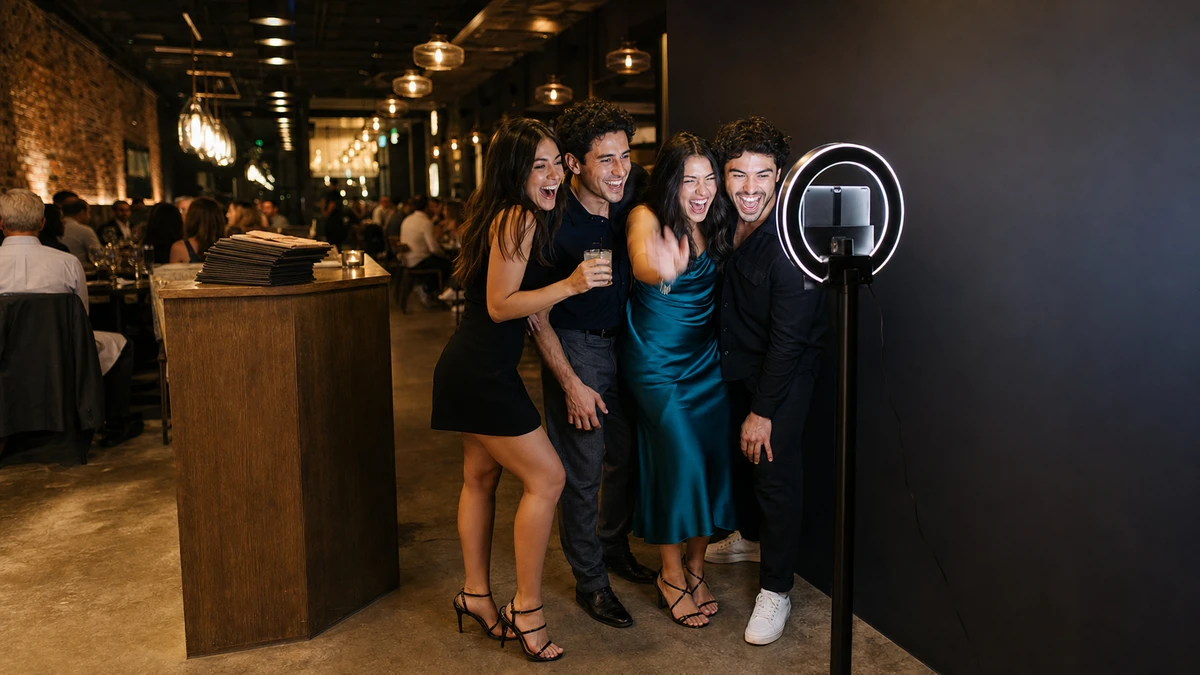
A booth stands near the host stand of a neighborhood restaurant. On a Friday night a table of six finishes dinner, spots it on the way out, and crowds in for a photo. The screen asks for an email so it can send the picture, three of them tap one in, and the image lands in their inbox with the restaurant’s name printed across the bottom. That thirty-second moment is what an operator is actually buying when they price a photo booth. The real question is what owning the moment costs.
A permanent photo booth for a restaurant costs roughly $2,500 to $15,000 or more to buy outright, depending on the type of booth. On top of that sits a software subscription, usually $20 to $100 a month, and several hundred to a couple thousand dollars a year in upkeep. Restaurant photo booth costs come down to three line items (hardware, software, and maintenance), and most operators only budget the first one.
The purchase price is the part operators get wrong. It is the most visible number and the least useful one. The figure that decides whether the booth was a good idea is the three-year total cost of ownership, and that total changes completely depending on which of three ways the restaurant acquires the booth. What follows breaks the cost into line items and works out a three-year total for a typical restaurant, so an operator can hold a vendor quote up against something honest.
Three Ways a Restaurant Gets a Photo Booth (and Why Each One Changes the Price)
Before any number means anything, the operator has to settle one question: who owns the booth. There are three answers, and “cost” means something different under each.
Buy outright
The restaurant pays the full hardware price once, owns the booth, keeps every dollar of any revenue it generates, and owns the guest data it collects. This is the highest cash outlay on day one and the lowest cost over the life of the booth.
Finance or lease
The restaurant spreads the hardware cost across monthly payments. The total runs modestly higher than buying because of interest, but the cash stays in the business instead of leaving in one lump. The booth is still the restaurant’s.
Revenue-share, often marketed as “no-cost” placement
A provider installs and maintains the booth for little or no upfront fee, then keeps the majority of the money the booth earns. Magbooth, one of the few vendors to publish its split, lists an 80/20 division of pay-per-use revenue on its bar-booth page, with the venue keeping 20 percent. Photomatica markets a similar permanent placement model but does not disclose the percentage publicly. The upfront price is the lowest of the three options. The total cost, as the worked numbers below show, can be the highest.
One distinction decides which of these models even applies. Revenue-share works only when the booth is a paid attraction, a pay-per-play machine that charges guests for each session. A restaurant running the booth as a free amenity, which is the more common goal (collecting guest emails, generating shareable content, pulling in repeat visits), produces no session revenue to share. For that restaurant there is nothing for a revenue-share provider to take a cut of, so the realistic path is to buy or finance. The rest of this breakdown assumes the booth is a marketing amenity, and treats revenue-share as the comparison case rather than the default.
Hardware Costs: What the Price Actually Covers
A restaurant pricing the physical kit is paying for a bundle, not a single device: the capture device (a tablet or a DSLR camera), the enclosure or stand, lighting, a touchscreen, an optional printer, a branded wrap, and floor signage. The price tier is set mostly by the capture device and the enclosure.
Three tiers cover almost every restaurant installation. An open-face tablet or iPad station, the lightest form factor, runs roughly $2,500 to $7,000. Fotomaster lists its Pylon iPad booth from $2,950 to $6,950, the spread between a base unit and one with a ring light and elevated stand, and Selfie Booth Co. shows comparable tablet booths in a similar band. A full-length interactive mirror booth sits higher: Fotomaster’s Mirror Air series spans $4,999 to $15,950 depending on the accessory kit. A DSLR-based or fully enclosed commercial booth typically lands between $8,000 and $15,000 or more, with Selfie Booth Co.’s DSLR kiosk listed at $8,990.
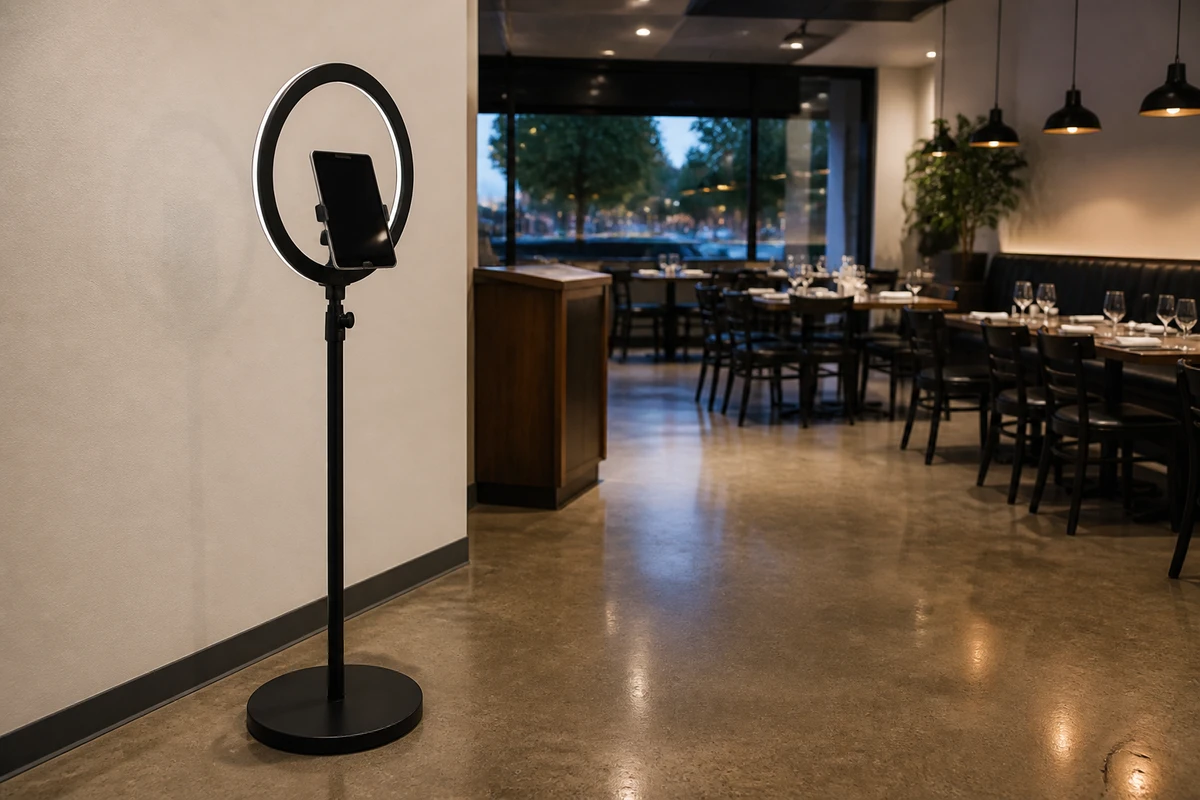
These are vendor list prices, not an independent price survey, and a restaurant ordering one or two units should treat them as a starting point and request a written quote. What pushes a quote toward the top of its range is predictable: a DSLR camera instead of a tablet, instant-print capability, a heavier enclosure, and a custom-branded wrap. None of those choices is wrong, but each one is a line the operator is choosing to add.
The purchase is not permanent
The purchase is not permanent. A tablet ages, a printer wears, and a screen that looked current in 2026 will look dated in a few years. The honest way to budget hardware is to assume a partial refresh every two to three years rather than treating the first invoice as the last.
Software Costs: The Line That Turns a Camera Into a Marketing Asset
This is the cost that “how much does it cost” articles leave out, and it is the one that matters most to a restaurant. Booth software is a subscription. It is billed monthly or annually, and it does not stop while the booth runs.
Published pricing spreads across a wide range. Entry plans are inexpensive: dslrBooth and its iPad counterpart LumaBooth start around $17 to $18 a month on an annual plan, with a limited free tier. Mid and pro plans add genuine capability: the Fiesta app from Photo Booth Supply Co. lists a Plus plan at $49 a month and a Pro plan at $99 a month, and Touchpix prices its annual licenses at roughly $37 and $73 a month equivalent. A realistic annual software budget for a restaurant is $500 to $1,200, depending on the tier.
The tier is the trap
The tier is the trap. The features that do the marketing work (email and SMS capture, custom branding, removing the vendor’s logo from the photo, an analytics dashboard, video and GIF formats) are almost never on the entry plan. They sit on the mid or pro tier. A sports bar operator on the r/photobooth forum spelled out exactly what a venue wants from a booth: a setup that “runs continuously so no staff interaction,” with “no printing, just digital sharing,” plus “kiosk-mode support,” “custom branding,” “cloud storage,” and “usage analytics.” Strip out the operating preferences and what is left (kiosk lockdown, branding, cloud storage, analytics) is a list of higher-tier features. An operator who budgets the headline entry price and then needs that feature set has mispriced the booth.
Why this line outranks the others for a restaurant: software is what turns the booth from a camera into a customer-data channel. The hardware takes the picture. The software captures the guest’s email, stamps the restaurant’s brand on the image, and pushes a shareable file to the guest’s phone. Simple Booth’s HALO app, for one, delivers each photo by QR code, email, or text and logs the guest’s contact details in the same step. The entertainment chain Treetop Golf used that lead capture to build a list of 150,000 email addresses across its locations. Without the right tier, the restaurant has bought an expensive way to take pictures it cannot use.
Maintenance and Operating Costs: The Recurring Drip
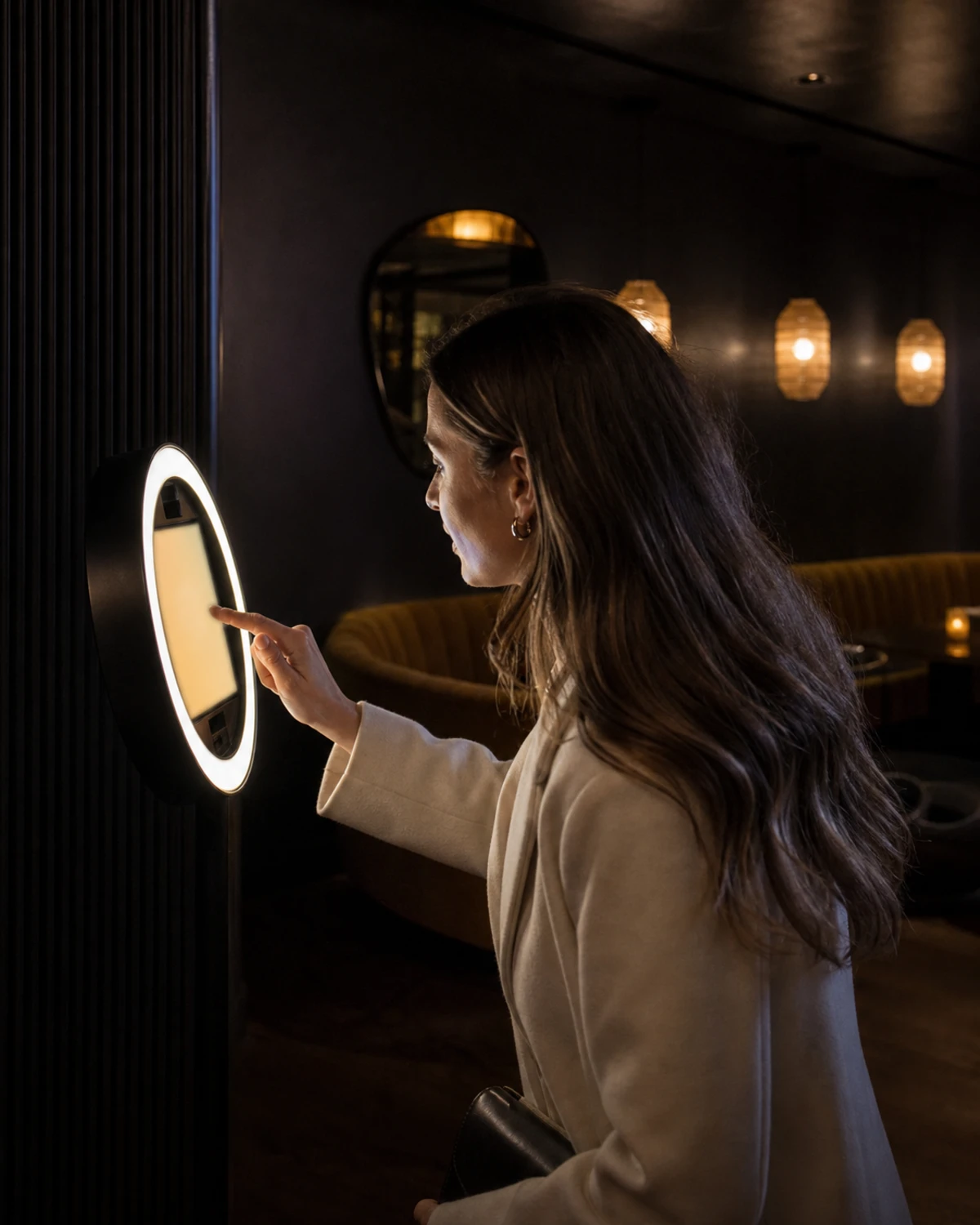
A manager who budgeted the purchase price and the subscription still has a third column to fill, and it is the one operators most often forget. Keeping the booth running has its own slow drip of costs.
Printing and Consumables
If the booth prints, consumables are the largest variable line. On one retailer listing, media for a common commercial dye-sublimation printer, the DNP DS620, runs about $154 for 460 prints, roughly 33 cents a print. A booth printing 50 strips on a busy night spends about $16.50 that night, close to $500 a month at that pace. A digital-only booth that sends every photo by email or text spends nothing here.
The rest of the column is smaller but real. Printers need servicing and cables and chargers wear out. Cloud storage is sometimes bundled into the software tier and sometimes billed on its own. The operator should add the booth to the restaurant’s business equipment coverage, a line worth confirming with the insurer rather than guessing at, since per-item premiums are not published. The floor space the booth occupies is not free, since it could hold a table. And a public-facing tablet in a busy dining room is a target for both accidental damage and theft, which is why reliability and lockdown belong in the budget conversation, not just the spec sheet.
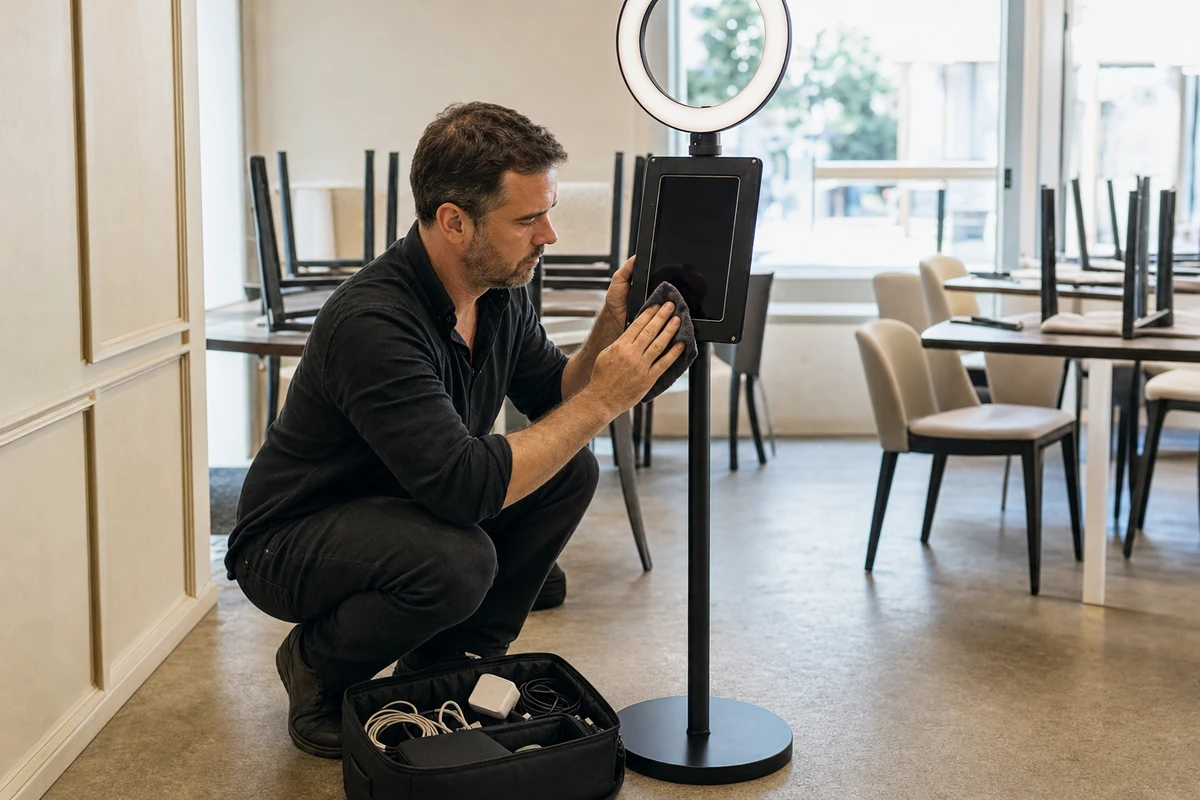
Labor is the line operators leave off entirely. Someone resets the booth, wipes the screen, restocks supplies, helps a confused guest, and reboots it when it freezes. That is real staff time, and over a year it adds up to a cost even if no one writes it on an invoice. A reasonable planning figure for everything in this column is $300 to $500 a year for a digital-only booth used at a normal pace, rising past $1,800 for a print-enabled booth running hard.
The Real Number: A Three-Year Total Cost of Ownership
Put the three columns on a multi-year horizon and the picture an operator needs finally appears. Consider a restaurant that buys a mid-tier tablet booth outright and runs it digital-only, no printer, because the goal is an email list and shareable content rather than printed strips.
| Line item | Buy outright (digital-only) | Revenue-share placement |
|---|---|---|
| Upfront hardware | $3,500 one-time | $0 to $3,500 |
| Software, 36 months | about $2,900 | included |
| Maintenance and tablet refresh, 3 years | about $1,500 | included |
| Share of session revenue the venue keeps | 100% | about 20% |
| Three-year cost to the venue | about $7,900 | low upfront, plus forgone revenue |
Bought outright, the booth costs the restaurant roughly $7,900 over three years, which amortizes to about $220 a month or under a dollar per session at a moderately busy booth. That number is fixed and knowable on day one.
The revenue-share column looks less expensive until the forgone revenue is filled in. Suppose the placement booth is a pay-per-play machine charging $5 a session and running 500 sessions a month. That is $2,500 in monthly gross. At an 80/20 split the provider keeps $2,000 of it, and the venue keeps $500. Over three years the provider collects $72,000 and the venue collects $18,000. The venue avoided a $7,900 outlay and handed the provider $72,000 to do it. Even a quieter booth at 150 sessions a month sends the provider more than $21,000 across three years.
This is the misconception the “no-cost” label is built on. A no-money-down placement is not a discount. It is a financing arrangement, and an expensive one whenever the booth performs well. Revenue-share earns its keep in exactly one situation: when the operator genuinely doubts the booth will draw a crowd and wants to offload that risk onto the provider. When the booth is expected to do well, the lowest upfront price becomes the highest total cost.
One caveat keeps the comparison honest
One caveat keeps the comparison honest. The revenue-share column only exists when the booth charges guests. For a booth run free as a marketing amenity, the real decision is buy versus finance, and the roughly $7,900 three-year figure is the number that matters.
Cost Versus Return: When the Booth Pays for Itself
For a restaurant the booth is not a vending machine that earns coins. It is a customer-data and content channel, and its return shows up in emails captured and in branded photos traveling onto guests’ social feeds at no media cost.
The math is simple enough to do on a napkin. A booth used in 60 sessions a week, with about 3 guests per session and a 40 percent email opt-in rate, captures roughly 72 emails a week, close to 3,700 a year. Set those against the amortized cost. At about 260 sessions a month and a $220 monthly cost, the booth costs roughly 85 cents per session. Each session produces a little over one new email plus a branded photo the guest shares or keeps.

That gives the operator a single decision rule, sharper than any ROI essay. The cost is justified when the value of one session (the captured emails plus the shareable branded content) is worth more than the cost of one session. An operator who believes a captured guest email and a branded photo are worth more than 85 cents has already answered the question, without a spreadsheet.
The wider context matters here
The wider context matters here. The National Restaurant Association projects $1.55 trillion in industry sales for 2026 but only 1.3 percent real growth once menu-price inflation is stripped out, and advises operators to respond with “more creativity and technology.” A flat-growth year does not make discretionary equipment a bad idea. It makes the per-session math more important, because every capital line has to defend itself.
How to Avoid Overpaying
The fastest way to overpay is to buy a printer the restaurant does not need. A printed strip walks out the door and is never seen again. A captured email lets the restaurant invite the guest back. For an operator building a list and a stream of shareable content, digital sharing serves the goal better than printing, and skipping the printer removes both a hardware line and the 33-cents-a-print consumable drip.
Three more habits keep a quote honest. Do not over-buy hardware: a tablet booth handles ordinary dining-room use, and DSLR-grade equipment is built for high-end branded photography, not a fixture by the host stand. Confirm the software tier in any quote actually includes lead capture and branding, not just the base app, because the gap between the entry plan and the marketing-capable plan is exactly where buyers get surprised. And watch for costs quoted separately from the headline price, such as delivery, setup, branded wrap, and staff training.
The most important clause sits in the revenue-share contract, for any operator weighing that route. Read the term length and any exclusivity clause, then find the line on data ownership. If the provider owns the guest emails the booth collects, the restaurant has given away the single most valuable thing the booth produces and is left with a machine that takes pictures for someone else’s list. A booth that does not feed the restaurant’s own marketing is a cost with no matching return, whatever its sticker price.
Frequently Asked Questions
How much does a photo booth cost for a restaurant?
To buy outright, expect roughly $2,500 to $15,000 or more depending on type: $2,500 to $7,000 for a tablet or iPad station, $5,000 to $16,000 for a mirror booth, and $8,000 to $15,000-plus for a DSLR or enclosed commercial booth. Add software at $20 to $100 a month and maintenance of a few hundred to over $1,800 a year. A realistic three-year total for a mid-tier digital-only booth is around $7,900.
Is a “no-cost” or free photo booth installation really free?
No. A no-cost placement means the provider covers the hardware and then keeps the majority of the money the booth earns. One published example, Magbooth, splits pay-per-use revenue 80/20 in the provider’s favor. These deals also frequently retain ownership of the guest data. You pay in forgone revenue and lost data, not in an invoice, which is often the most expensive way to get a booth.
How much does photo booth software cost per month?
Entry plans run about $17 to $20 a month, mid plans about $40 to $50, and pro plans roughly $73 to $99, based on published pricing from dslrBooth, Photo Booth Supply Co., and Touchpix. The catch is that email capture, custom branding, and analytics, the features that make the booth useful for marketing, usually sit on the mid or pro tier rather than the entry plan.
Do restaurants need a printer for a photo booth?
Usually not. If the goal is an email list and shareable content, digital sharing by email or text serves that goal better than a printed strip, because the photo arrives with the restaurant’s branding and the guest’s contact details get captured. Skipping the printer also removes a recurring consumable cost of roughly 33 cents per print.
How long does it take a restaurant photo booth to pay for itself?
It depends on the model and how heavily the booth is used. A bought-outright digital booth amortizes to under a dollar per session at a moderately busy pace, so it pays for itself as soon as the value of one session’s captured emails and branded content clears that figure. A revenue-share booth never becomes the restaurant’s asset, so it does not pay itself off in the same sense; the provider keeps earning from it for the life of the contract.
Sources
- Fotomaster (2026). “Pylon iPad Photo Booth.” https://www.fotomaster.com/pages/pylon-ipad-booth
- Fotomaster (2026). “Mirror Air Photo Booth.” https://www.fotomaster.com/pages/mirror-air-booth
- Selfie Booth Co. (2026). “Photo Booth Hardware and Pricing.” https://www.selfieboothco.com
- Magbooth (c. 2022). “Bar Booth: Revenue-Share Placement.” https://www.magbooth.com/bar-booth
- Photomatica (2026). “Permanent Photo Booth Placement.” https://www.photomatica.com/permanent-photo-booth
- dslrBooth (2026). “dslrBooth and LumaBooth Pricing.” https://dslrbooth.com/pricing/
- Photo Booth Supply Co. (2026). “Fiesta App Pricing.” https://www.photoboothsupplyco.com/pricing/
- Touchpix (2026). “Touchpix Pricing.” https://www.touchpix.com/pricing/
- National Restaurant Association (2026). “2026 State of the Restaurant Industry / Industry at a Glance.” https://restaurant.org/research-and-media/research/restaurant-statistics/industry-at-a-glance/
- r/photobooth (2026). “iPad photobooth software for a continuous self-serve kiosk.” https://old.reddit.com/r/photobooth
- Amazon (2026). “DNP DS620A Dye-Sublimation Printer Media listing.” https://www.amazon.com