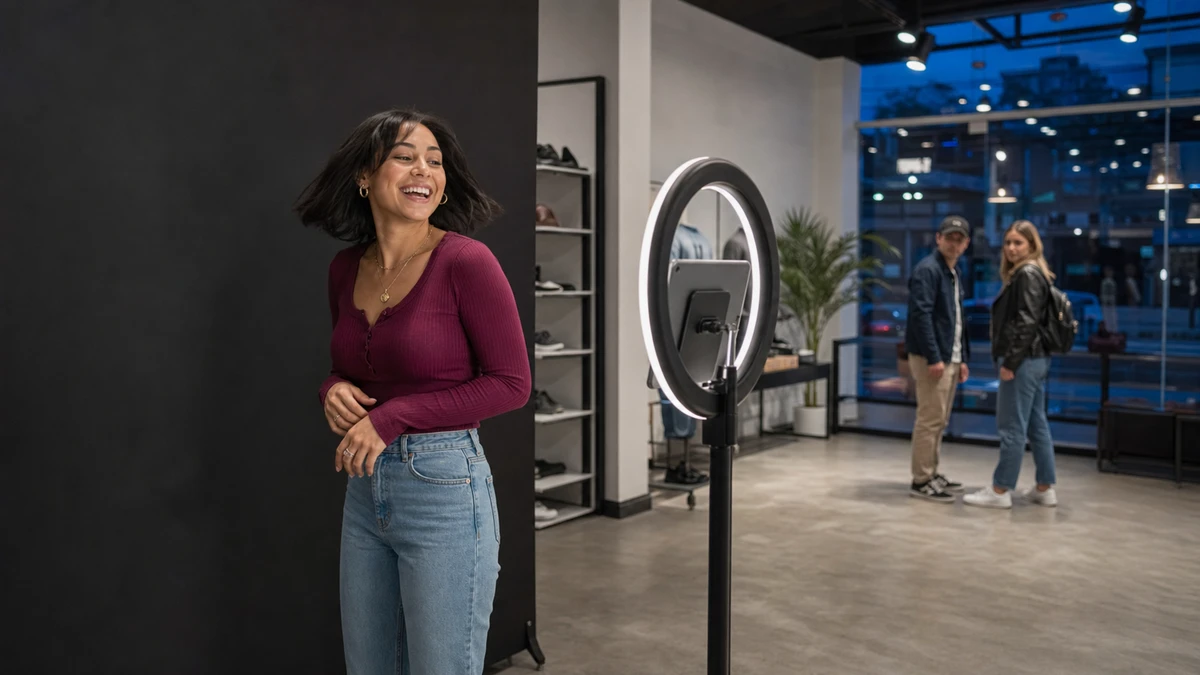
A guest walks past the front of a store, sees a tablet glowing on a slim stand with a bright ring of light around it, steps in, taps the screen, poses, and leaves with the photo already on her phone. No attendant set it up for her. No curtain, no booth walls, nothing to wait for. That setup is an open air ring light photo booth: a self-service photo station built around a tablet (usually an iPad) ringed by a circular LED light, placed in the open with no enclosure.
It is the form factor most people now picture when they hear “photo booth,” and for most indoor brand activations it is the right default. It sets up fast, runs unattended, and fits spaces a walled booth never could. But the same ring light that makes it work in a dim room is also its sharpest limitation, and the pros-and-cons lists on party and event rental sites tend to skip the parts that decide whether a commercial deployment actually pays off. The buyer in question is an operator weighing a permanent or recurring brand activation, not someone choosing a booth for one evening.
What “Open-Air” and “Ring Light” Actually Mean
A store manager clearing a corner for an activation is making two separate decisions, even if the booth arrives as one unit. “Open-air” describes the structure. “Ring light” describes the lighting. They travel together so often that the combined product has become a single category, but they are independent choices.
Open-air means no enclosure: no curtain, no walls, no
Open-air means no enclosure: no curtain, no walls, no roof. The hardware is a stand or tower holding a camera and a screen, facing a backdrop, fully exposed to the room. That is the contrast with an enclosed booth (a full structure guests step inside, walls and roof, two to four people at a time) and a semi-enclosed or curtain booth (partial walls or a curtain for limited privacy, open at the top).
The ring light is a circular LED fixed concentrically around the camera lens. Its defining trait is geometric: the light leaves from the same axis the lens points down. Photographers call this on-axis lighting, and as StudioBinder’s ring light guide explains, it produces “little shadow because the origin of light is close to the optical axis of the lens.”
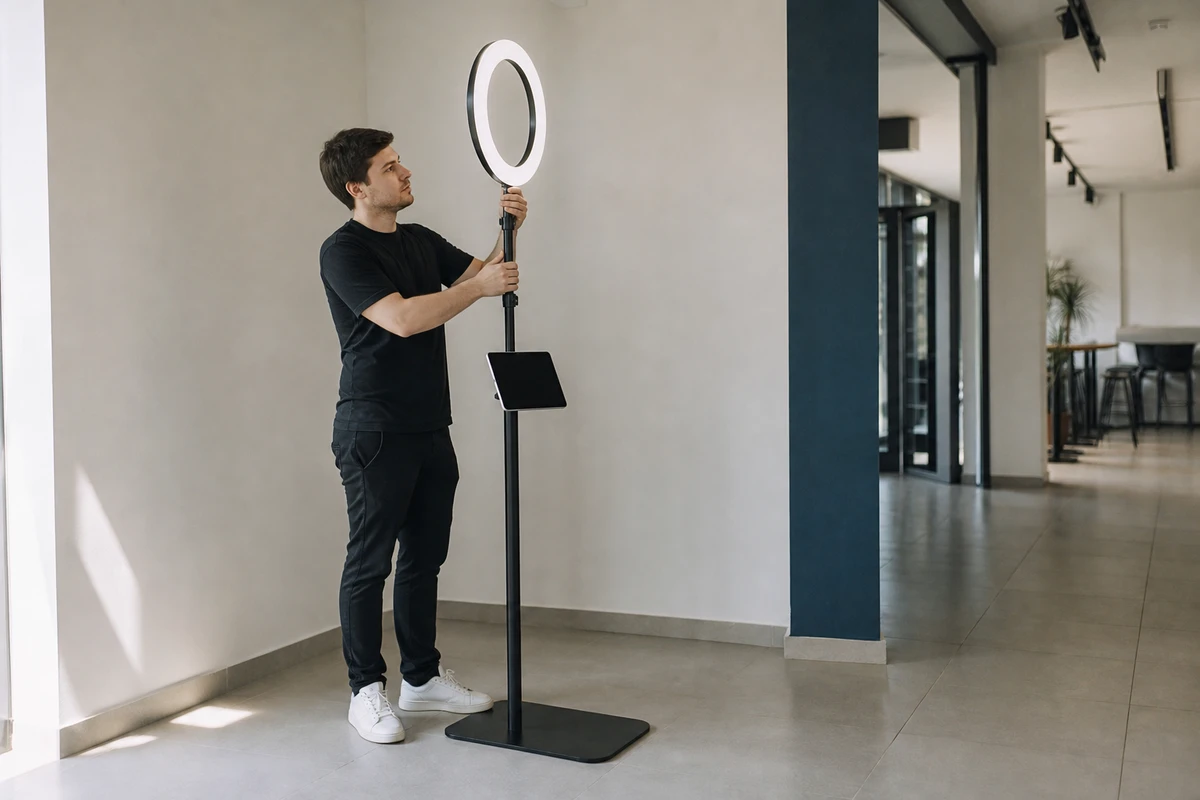
Put together, the two choices produce the integrated, tablet-based, self-service booth that now dominates commercial photo-booth use. The label still gets stretched, though. A ring light can sit on an enclosed mirror booth, and an open-air booth can be lit with a softbox instead of a ring. Mirror booths, glam booths, 360 booths, and DSLR-based booths are separate form factors with their own footprints and price points. A handheld “roaming” version, where an attendant carries the ring and tablet through a venue, is a deployment variant of the same form factor, not a new category.
Why the Open-Air Ring Light Booth Became the Default
Walk a trade-show floor or a mall concourse and the booths in use look nearly identical: a tablet on a stand, a lit ring, an open backdrop. That convergence is not fashion. Four mechanics pushed this combination ahead of the alternatives for commercial use.
Visibility
The first is visibility. An open setup advertises itself: every guest using it is seen by everyone nearby, and operators consistently report that watching someone else do it is what prompts participation. An enclosed booth hides the activity inside four walls; an open one runs as a continuous demonstration.
Why the Ring Light Works
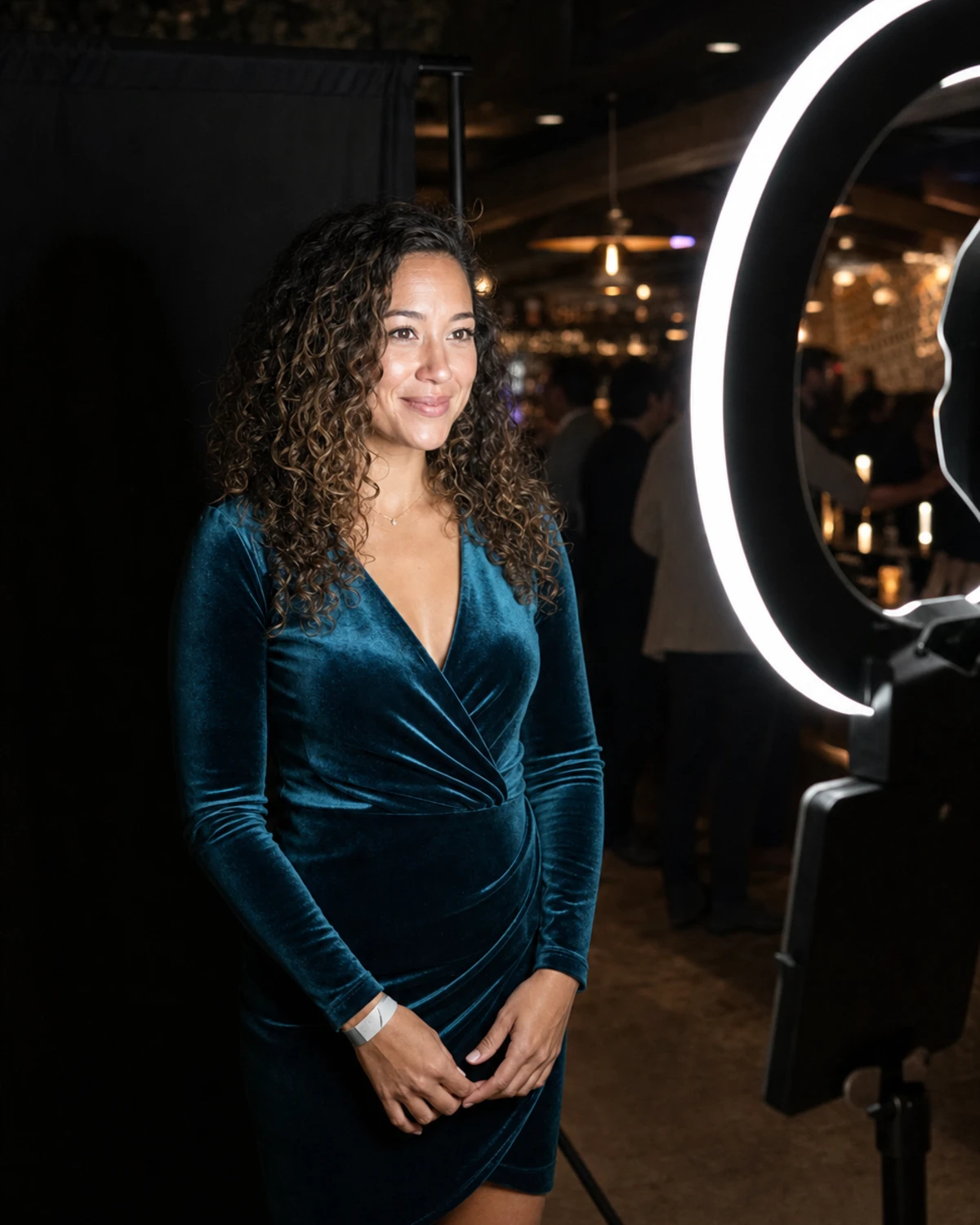
The second is the reason it produces a usable photo without a photographer. A tablet camera has a physically small image sensor, and as Cambridge in Colour’s sensor-size tutorial explains, a smaller sensor has smaller photosites that collect fewer photons. In a dim room the tablet compensates by raising its ISO, and raising ISO, in Cambridge in Colour’s words on image noise, “amplifies the signal from the sensor, but along with it amplifies the noise.” The result is grainy, blotchy images. A ring light floods the subject with even light so the tablet can shoot at a low ISO and return a clean, flattering frame. That is what makes an unattended booth viable: the light does the job a photographer’s lighting setup would otherwise do.
Footprint
The third is footprint. The booth occupies the floor space of its stand plus a backdrop, which fits a store entryway, a lobby corner, or a trade-show table. A walled booth needs far more. Megalux Photo Booth cites roughly a 10-by-10-foot allowance for a traditional booth, a footprint most real commercial spaces cannot spare.
Integration
The fourth is integration. An earlier setup meant assembling a camera, a light, and a computer into a working rig; the open-air ring light booth folds all of it, plus the sharing software, into one unit a person can carry in and switch on. A booth that used to be an event production becomes something a venue can place and forget.
The Pros for a Commercial Operator
The rental-site pros lists are written for someone booking one party. Reframed for an operator running a recurring or permanent activation, the advantages sharpen.
The footprint makes permanent placement possible
The footprint makes permanent placement possible. Because the booth needs only a few square feet against a wall, it can become a fixture near a store entrance rather than a one-day rental. It sets up and breaks down faster than an enclosed booth, which matters when the same unit moves between locations on a schedule. It runs unattended, so there is no per-event staffing cost, and it stays live all day. Throughput is higher: Clear Choice Photo Booth describes open-air sessions accommodating up to 15 people at once against an enclosed booth’s typical two to four, with guests drifting in and out instead of queuing for the enclosure to empty. The open backdrop is brand-visible to everyone in the room, not just the person inside. One operator can also redeploy a single unit across a portfolio of locations.
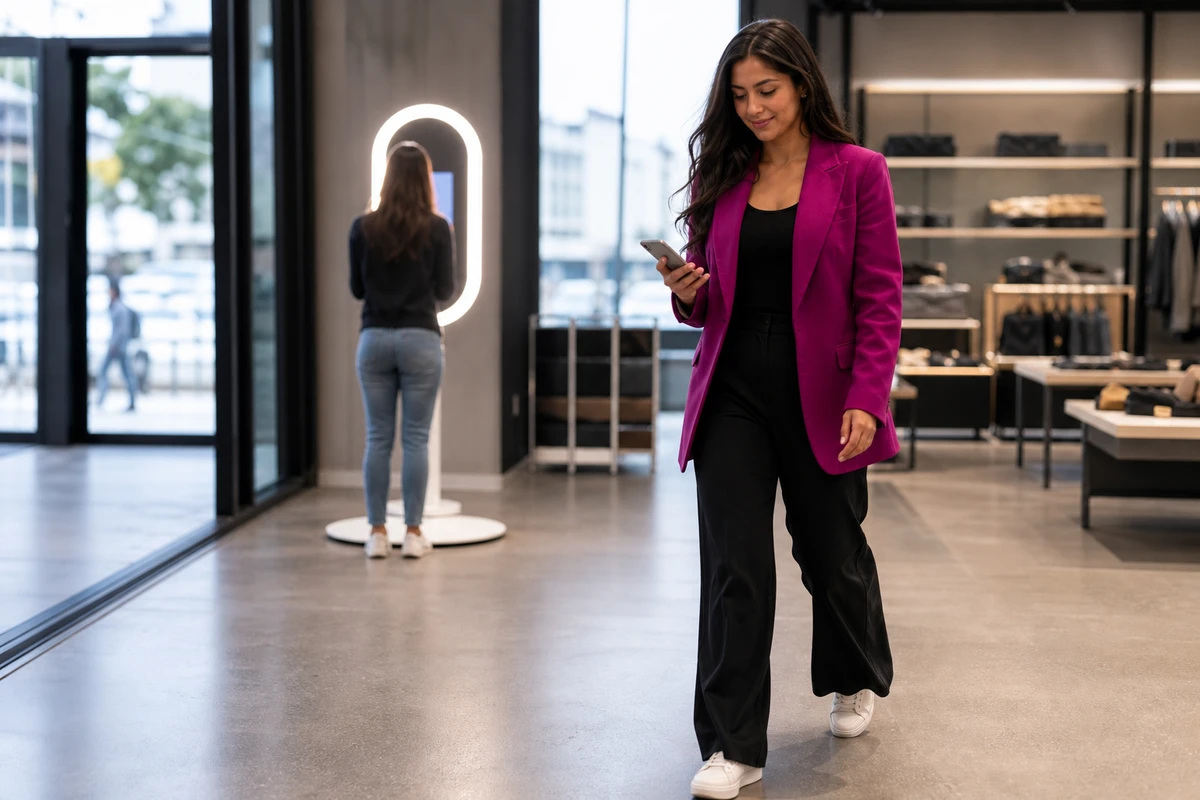
Here is where the footprint advantage turns into money. Take a retailer with a 1,500-square-foot store and almost no spare floor. An enclosed booth, at the roughly 10-by-10-foot allowance Megalux cites, is not an option. An open-air ring light booth needs the space of its stand and a backdrop, so it can live near the entrance permanently.
Now run the capture math
Now run the capture math. Say the booth records 80 sessions on a busy Saturday, and a third of those guests choose to receive their photo by text or email, the same moment the store collects a contact and reuse permission. That is roughly 27 new opted-in contacts in a single day from a fixture occupying a few square feet of an entryway. If the retailer values a new contact at $40 in eventual revenue, the day’s capture is worth about $1,080. The opt-in share is the figure to pressure-test against real numbers, because it swings the result more than anything else, but the structure holds: a small-footprint fixture converts ordinary foot traffic into a measurable contact list.
The Cons, Including the One the Rental Sites Skip
A brand books a two-week activation in a glass-walled mall atrium. The booth photographs beautifully at 8 a.m. setup. By noon, with daylight pouring through the glass, every photo is washed out or shows a guest as a dark silhouette. Nothing broke. The form factor was deployed into the one environment it cannot handle, and no one warned the operator.
This is the misconception worth correcting plainly: a ring light is not a flash, and operators routinely treat it as if it were. A ring light is a continuous LED, always on at a modest output. A flash is a single high-intensity burst that can briefly outshine the sun. The gap is enormous. Engineering Toolbox’s illuminance tables put typical indoor office and retail lighting at 300 to 500 lux, full daylight at around 10,752 lux, and direct sunlight near 107,527 lux. A ring light that lifts a subject from dim indoor levels to perhaps a thousand-odd lux is decisive indoors and irrelevant against daylight.
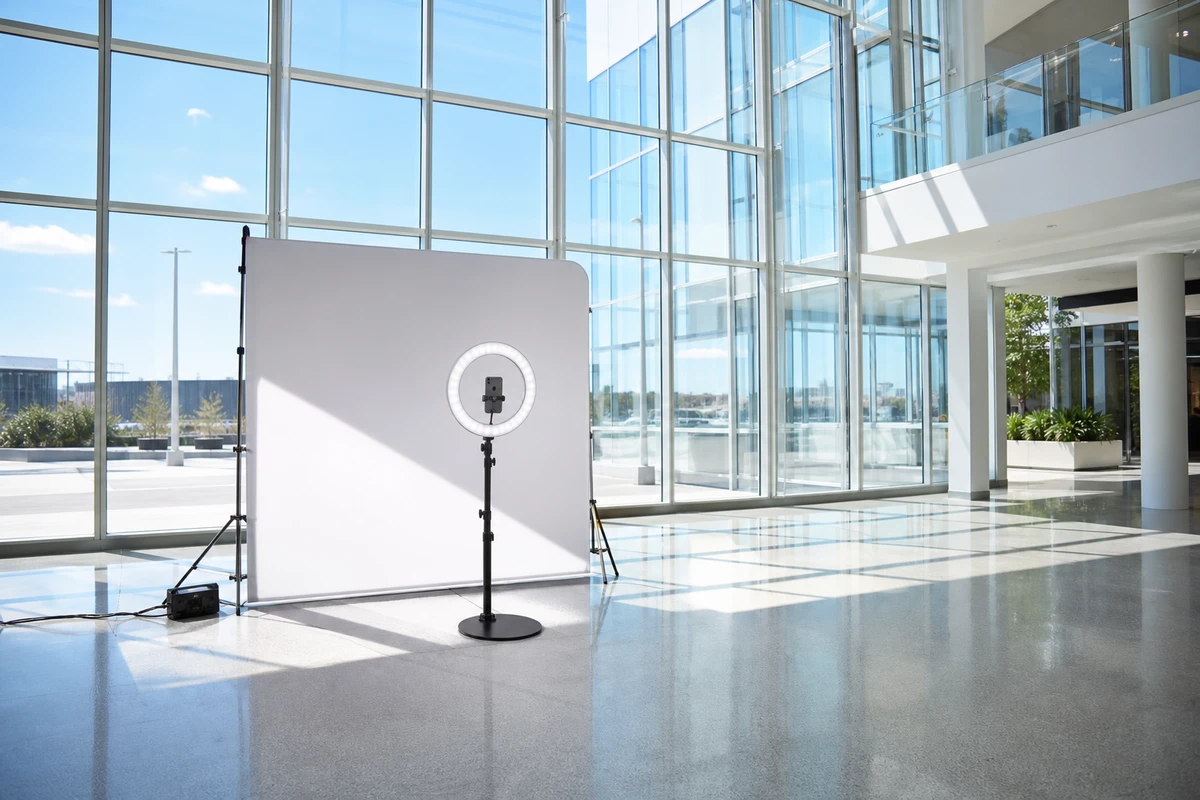
Photobooth Supply Co’s outdoor guide documents the result directly: when the sun hits the lens “you get washed-out photos,” and back-lit guests “turn into dark silhouettes.” Its recommended fix for bright conditions is a DSLR with a strobe, which is an admission that the standard ring-light tablet booth cannot do the job outdoors. Even Designer Party Rentals concedes the point, buried in a subordinate clause: ring-light photos “might not come out as nice… because there is no flash.” The catch is that bright, sunlit, glass-walled spaces are often exactly the spots operators want for a permanent activation.
The second con is glasses glare, and it comes
The second con is glasses glare, and it comes from the same physics that makes the booth flattering. PetaPixel’s explanation of catchlights notes that the bright reflection in a subject’s eyes takes the shape of the light source, so “a ring light creates a circular catchlight.” That circular catchlight in the eye is the look operators want. But an on-axis light shining straight down the lens reflects off any specular surface in its path, and eyeglass lenses are specular surfaces. The same ring that prints a circle in the eye prints a circle on the glasses. With no attendant and no enclosure, nobody tilts the light or repositions the guest, so every bespectacled visitor gets the reflection.
Three smaller cons round out the honest list. On-axis light has almost no direction, so images come out flat, with little depth, fine for a playful GIF and weak for premium editorial brand imagery. The open setup offers no privacy, so camera-shy guests opt out, which Megalux notes plainly when it warns that “camera shy guests may not participate,” a direct hit to participation rate. The surrounding room appears in every frame unless a backdrop is properly staged. Mixed venue lighting, warm tungsten in one corner and green-tinted fluorescent overhead, shifts skin tones in ways a small ring cannot fully correct, which is why color-temperature matching shows up on the spec checklist below.
When to Choose It, and When to Reach for Something Else
The open-air ring light booth is the right call when the space is dim to moderate and controllable indoors, when the activation needs to run self-service on a permanent or recurring basis, when throughput and footprint matter, when one unit will roll out across multiple locations, and when the backdrop earns its keep as branding.
When the Ring Light Struggles
Reconsider it when the space is sunlit, glass-walled, or simply bright, when the activation is true outdoor daytime, when the brand needs polished editorial imagery, or when the audience skews privacy-sensitive. For those situations an enclosed booth, a DSLR-based booth, or a dedicated lighting rig with a flash will serve the goal better.
Before signing a purchase order or a rental contract, an operator should check a short list of specifics: whether the ring light is bright enough and dimmable; whether its color temperature is adjustable to match venue lighting; the color rendering index (CRI) of the LEDs, since a low CRI distorts skin tones; the tablet size and camera quality; mount stability and theft security for an unattended placement; whether it runs on mains power or battery; whether a backdrop is included; and what data-capture and sharing options it offers, email, SMS, or QR code. For a concrete reference against that checklist, Simple Booth’s HALO kit is an iPad-based open-air booth built around a 2,100-lumen ring light, and it hands the finished photo to the guest by QR code, email, or SMS, the same step where the venue records that guest’s opted-in contact.
The open-air ring light booth is not better or worse than an enclosed booth or a DSLR rig. It is a fit decision, and the fit is settled mostly by the light already in the room it will stand in. Sources
- StudioBinder (n.d.). “What is a Ring Light, How Does it Work, and Should You Use One?” https://www.studiobinder.com/blog/ring-light/
- Cambridge in Colour (n.d.). “Digital Camera Sensor Sizes.” https://www.cambridgeincolour.com/tutorials/digital-camera-sensor-size.htm
- Cambridge in Colour (n.d.). “Understanding Image Noise.” https://www.cambridgeincolour.com/tutorials/image-noise.htm
- Engineering Toolbox (n.d.). “Illuminance - Recommended Light Level.” https://www.engineeringtoolbox.com/light-level-rooms-d_708.html
- PetaPixel (n.d.). “What Are Catchlights in Photography?” https://petapixel.com/glossary/catchlights/
- Photobooth Supply Co (n.d.). “Mastering Outdoor Photo Booth Events.” https://photoboothsupplyco.com/blogs/tips-tricks/mastering-outdoor-photo-booth-events
- Megalux Photo Booth (n.d.). “Enclosed vs Open-Air Photo Booth.” https://megaluxphotobooth.com/photo-booth/enclosed-vs-open-air-photo-booth/
- Clear Choice Photo Booth (n.d.). “Open-Air vs Enclosed Photo Booths.” https://clearchoicephotobooth.com/blog/open-air-vs-enclosed-photo-booths/
- Designer Party Rentals (n.d.). “DSLR Photo Booth vs Ring Light Booth: Which One Is Right for Your Event.” https://www.designerpartyrentals.com/blog/dslr-photo-booth-vs-ring-light-booth-which-one-is-right-for-your-event