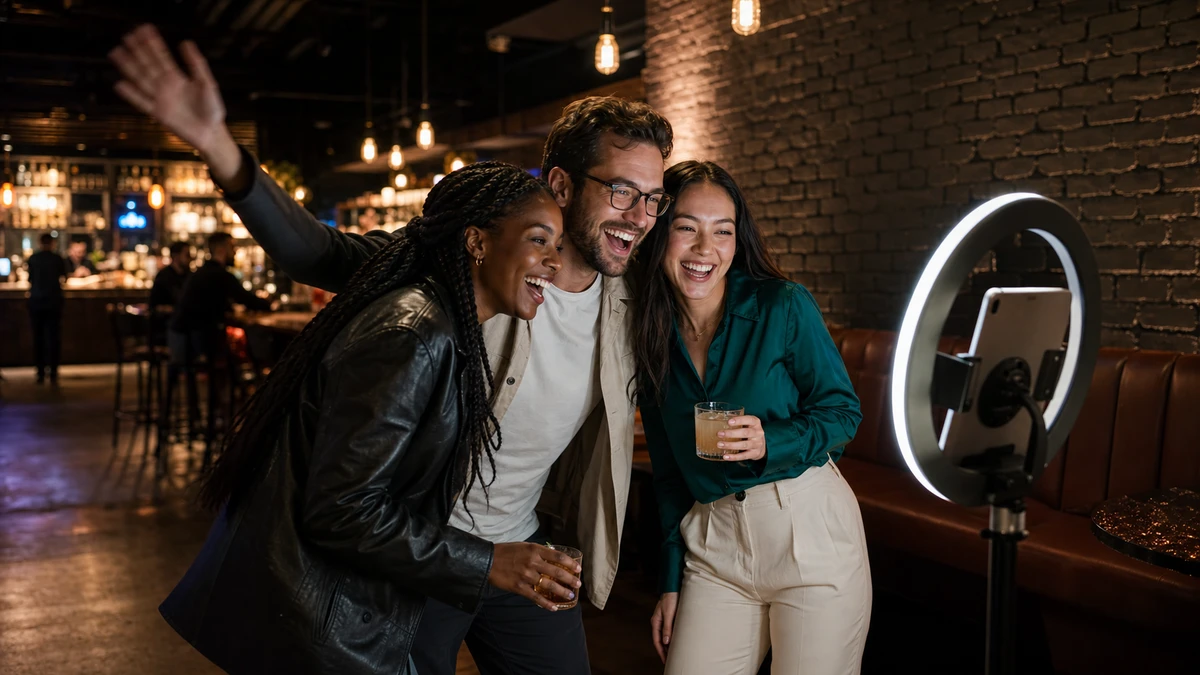
Most consumer comparisons of iPad photo booths and DSLR rigs answer the wrong question for the only people who buy at scale. Ranking pages chase one Saturday night: how the 4x6 print looks at the reception, how much one evening costs, whether guests are amused. A rental operator running 200 events a year, a venue running a permanent activation, or a multi-location brand rolling out a branded experience faces a different decision. For that buyer the form factor is a three-year operating-cost question with reliability, throughput, and data-pipeline fit baked in. Sensor size barely makes the top five.
This piece reframes the choice through the operator P&L. It corrects two misconceptions: that DSLR equals better photos in every commercial context, and that the rugged-looking pro rig is the more reliable one in transport. It names the narrow band where DSLR is still the right purchase order.
The consumer comparison vs the commercial comparison
A consumer comparison optimizes for a single deliverable: the photo. A commercial comparison optimizes for five overlapping line items. Operator hours per event. Attendant cost. Fleet uptime and recovery time. Software economics across a multi-year fleet. Fit with the downstream data pipeline the client is paying for. Sensor size influences two of those five at the margin. The other three decide whether the booth is profitable to run.
The bias in most articles tracks the writer’s incentive. Rental operators clear larger margins on DSLR packages: the New Jersey operator djtaso, who has been running booths since 2014, charges $450 for his iPad booth and $850 for his DSLR rig (OurDJTalk, 2021). Vendors selling DSLR-only software have a categorical incentive to talk up image quality. A flat reading of sensor specs without a setup-time, attendant-cost, or software-stack adjustment will misprice the operator’s actual margin by thousands of dollars per booth per year.
Image quality: closer than vendor articles admit
The spec gap is real. The iPad Pro M4 ships a 12MP rear camera at f/1.8 (Apple, 2024) on a sensor format around 1/3 inch, roughly 17 mm² of capture area. A commercial mirrorless body like the Canon EOS R50 carries an APS-C sensor at 22.3 by 14.9 mm, or 332 mm² (Canon via Wikipedia, 2023). Roughly 19 times the sensor area for APS-C, and closer to 50 times for full-frame.
The gap closes in practice for one reason: image
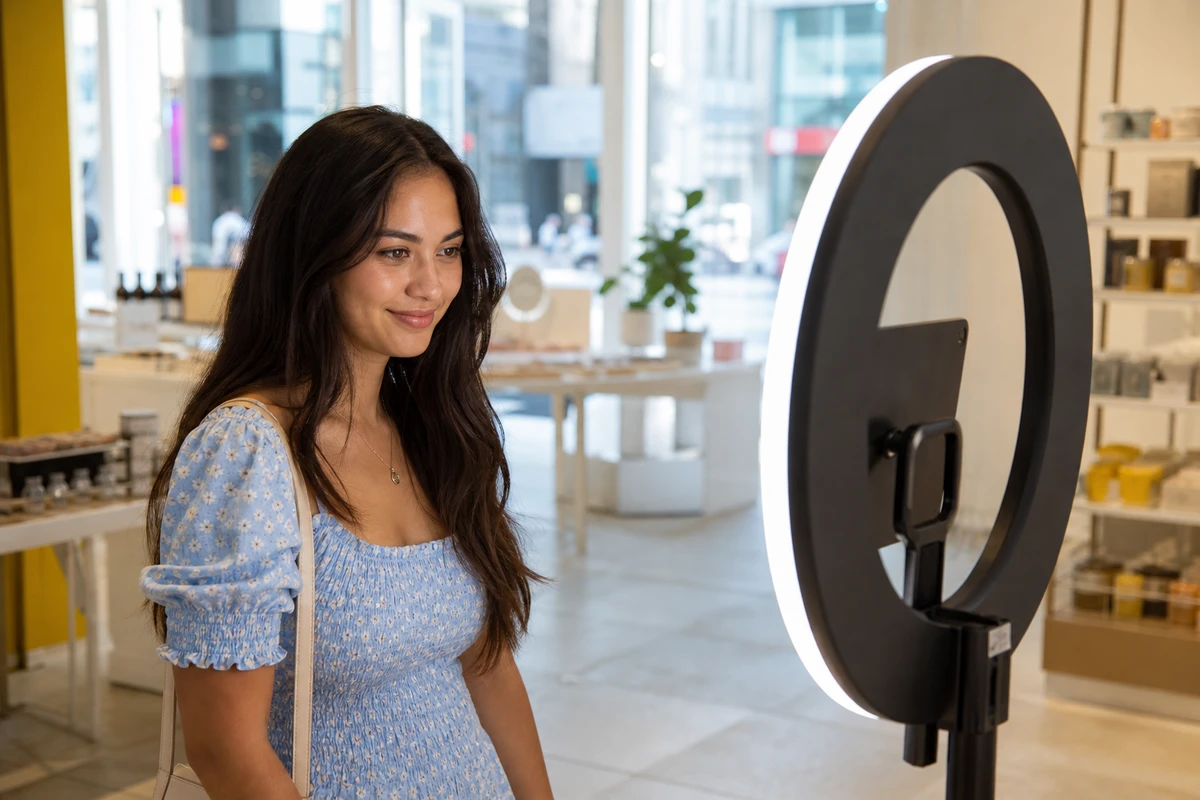
The gap closes in practice for one reason: image quality is the product of sensor, lens, light, and subject distance. In a commercial activation three of those four are clamped. A fixed LED ring handles the light, the lens is mounted on the rig, and the subject stands at a known distance on a mark. What remains is the sensor, and a high-output ring light lets a tablet-class sensor shoot at base ISO with short exposure. The output reads as professional on 1080-wide social posts and 4x6 prints viewed at arm’s length.
This is the misconception worth correcting up front. DSLR does not equal better photos in commercial use. DSLR equals more headroom in low-light or shallow-depth-of-field applications. In a controlled-light retail or venue activation, the bottleneck is lighting design, throughput pipeline, and operator coaching.
The sensor gap still shows in low-light venues with no controlled fill, in non-flash candid portraiture at variable subject distance, in large-format print at 8x10 and up, and in editorial portraiture where shallow depth of field is part of the brand look. The gap disappears in well-lit retail and lobby activations, in digital-only delivery, and in 4x6 prints viewed at arm’s length.
A Massachusetts operator running three different booths confirmed both halves on a forum thread: the enclosed DSLR booth produces “the best image quality,” and the iPad ring-roamer with added lighting produces output that is “quite good” and “the easiest to use, hands down” (OurDJTalk, 2021). The phrase that matters is “easiest to use.” That is the operating-cost variable, not the photographic one.
Form factor and footprint
The iPad rig is monolithic. Tablet, integrated LED ring, single power cable, optional printer on a side table. It fits in a car trunk, sets on a selfie stand, and disappears into a 6 by 6 retail aisle.
The DSLR rig is a chain. Body, lens, strobe or flash, tether cable, tether-capture PC or print server, router or hotspot, printer. Operators describe it as “more moving parts” across forum threads, and the phrase is doing real work: each link is an additional driver, an additional power cable, and an additional component that can fail at 9pm on a Saturday. For an enclosed curtain booth, the DSLR-and-PC stack is the only architecture available, and the footprint expands to include the enclosure.
Footprint decides deployment. A retail pop-up or trade-show install needs a rig that drops into a 6 by 6 space and comes out without a truck. A black-tie gala with an attendant-managed curtain booth has space for the larger DSLR stack. Deploying the wrong form factor at the wrong venue does not lose on photo quality. It loses on whether the rig physically operates.
Setup, throughput, and the operational dimensions that compound
Four operational dimensions separate iPad and DSLR rigs at scale. Each compounds across a season.
Setup time
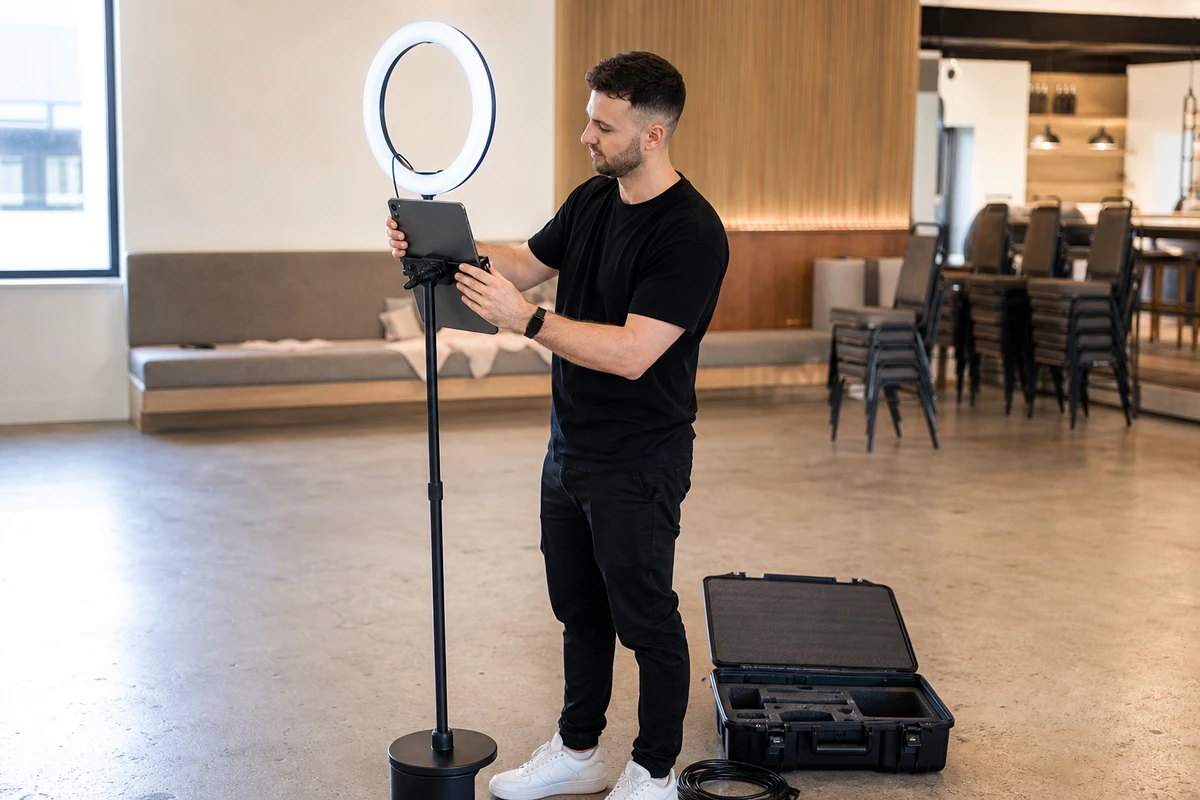
A western-Pennsylvania operator describes his enclosed DSLR rig plainly: “it takes 45 min of setup and a trained worker” (OurDJTalk, 2021). An iPad rig with selfie stand and printer lands in 10 to 15 minutes end to end, single operator. On a four-hour booking, 45 minutes of setup is 19% of the shift.
Throughput per hour
A controlled iPad booth with a one-tap interface and immediate digital delivery typically processes 60 to 90 capture sessions per hour at peak. A DSLR rig with print delivery is gated by printer throughput (DNP DS620A media runs roughly 8 to 12 seconds per 4x6) and by the attendant’s coaching pace. Forty to 60 print sessions per hour is a realistic peak. The sensor is faster on the DSLR. The pipeline is faster on the iPad.
Learning curve for a swapped operator
A new attendant on the DSLR stack has to learn camera exposure and flash sync, tether-capture software (LumaBooth, Breeze Remote Pro, or equivalent), printer driver and paper swap, SMS gateway configuration, and a router or hotspot fallback. Operators describe 8 to 12 hours of hands-on training plus a shadowed event before a hire can run a Saturday solo. The iPad stack is app configuration, network join, and CRM field mapping. Two to three hours plus one shadowed event puts a new hire on the floor.
Software-update frequency
iPad photo-booth apps ship feature updates on roughly monthly cadences; an iOS release that breaks an app’s USB driver can take a fleet down for 48 hours. DSLR-software cadences are slower, but every Windows update introduces its own surface: USB enumeration, printer driver loss, dependency drift. The iPad stack concentrates risk in one ecosystem; the DSLR stack distributes it across three (Windows, camera vendor SDK, printer driver).
The setup-time delta alone has a price tag. Across a 200-event year, 45-minute DSLR setup runs to 150 shift-hours of pre-event labor. Twelve-minute iPad setup runs to roughly 40 shift-hours. At a $25 to $40 hourly rate for event-services labor, the gap is $2,750 to $4,400 per booth per year on setup alone, and teardown roughly doubles it. Invisible on a per-event invoice. Lethal on the year-end P&L.
What actually breaks first
The misconception in the maintenance column is that a DSLR rig is the more reliable option in commercial deployment because the body is rated to 100,000-plus shutter cycles. It is the assembly that fails, not the body.
The shutter rating tells the operator what the camera
The shutter rating tells the operator what the camera can do under controlled conditions. The actual failure path on a commercial DSLR rig is the chain. The most-named failure point in operator threads is the USB tether cable, followed by flash trigger desync, printer firmware hang, and driver conflicts after a Windows update. Cameras get dropped in transport. Tether cables fray. Routers lose their config after a hotel power blip. None of these are shutter-count failures.
iPad rigs survive 1,200-plus capture sessions per year in typical commercial deployment, with failure modes concentrated in three components: battery cycle degradation (Apple publishes a 1,000-charge-cycle to-80%-capacity figure for current iPads), the USB-C charge cable, and the LED driver board. App-update surprises after an iOS release add a fourth surface but typically resolve inside a vendor patch cycle.
On-site recovery tells the rest of the story. An iPad swap from a spare runs about five minutes. Restoring a DSLR chain (body diagnostics, tether cable replacement, capture-PC reboot, printer driver reinstall, paper feed reload) can take 30 minutes or more, and recovery often ends with the operator discounting the booking because the guest line has collapsed.
A Wifibooth operator posted a one-year review of an iPad-plus-tethered-DSLR rig: at a corporate event sharing a venue with a k-pop concert, WiFi contention destroyed the camera-to-iPad link, and he migrated to a Surface Pro and Windows booth to hard-wire camera and printer (Wifibooth community, 2019). Hybrid rigs inherit that failure surface. Pure iPad rigs avoid it.
The attendant question
The attendant line is the single largest commercial difference between the two form factors, and it almost never appears in consumer comparisons.
DSLR rigs need an on-site attendant by default. Driver issues, printer paper swaps, guest coaching, tether reconnects, SMS gateway troubleshooting. Budget $200 per event on the US event-services labor market and the operator is in a normal range. Across a 200-event year that is $40,000 per booth.
IPad rigs often run unattended
iPad rigs often run unattended. The NJ operator who priced his DSLR at $850 noted plainly that the iPad version runs as a stand-alone machine with no attendant required (OurDJTalk, 2021). Photobooth Supply Co markets its Salsa 2 iPad booth on “drop and roll” unattended operation (Photobooth Supply Co, 2025).
The $40,000 is the number a buyer should hold in mind when someone says the DSLR rig earns $400 more per booking. Revenue is not margin.
Unattended and roaming deployments
DSLR is structurally disqualified from a category of commercial deployment that consumer comparisons skip entirely. The category is large.
- Retail pop-ups and flagship-store activations running a full trading day.
- Salon receptions, gym check-ins, coworking lobbies, member-club entry points, restaurant waiting areas.
- Corporate lobby brand moments and always-on venue activations where the booth is part of the room, not an event rental.
- Franchise multi-location rollouts where no one at the location is a trained photographer.
- Trade-show and conference sponsorship installs.
DSLR does not work here for one mechanical reason: the chain has no human to recover it. Paper feeds run out with no one to reload. Tether drivers drop with no one to restart. Camera bodies become a theft incentive on exposed gear. Each link assumes an attendant. Take the attendant away and the chain fails on the third Saturday.
IPad works for the inverse reason
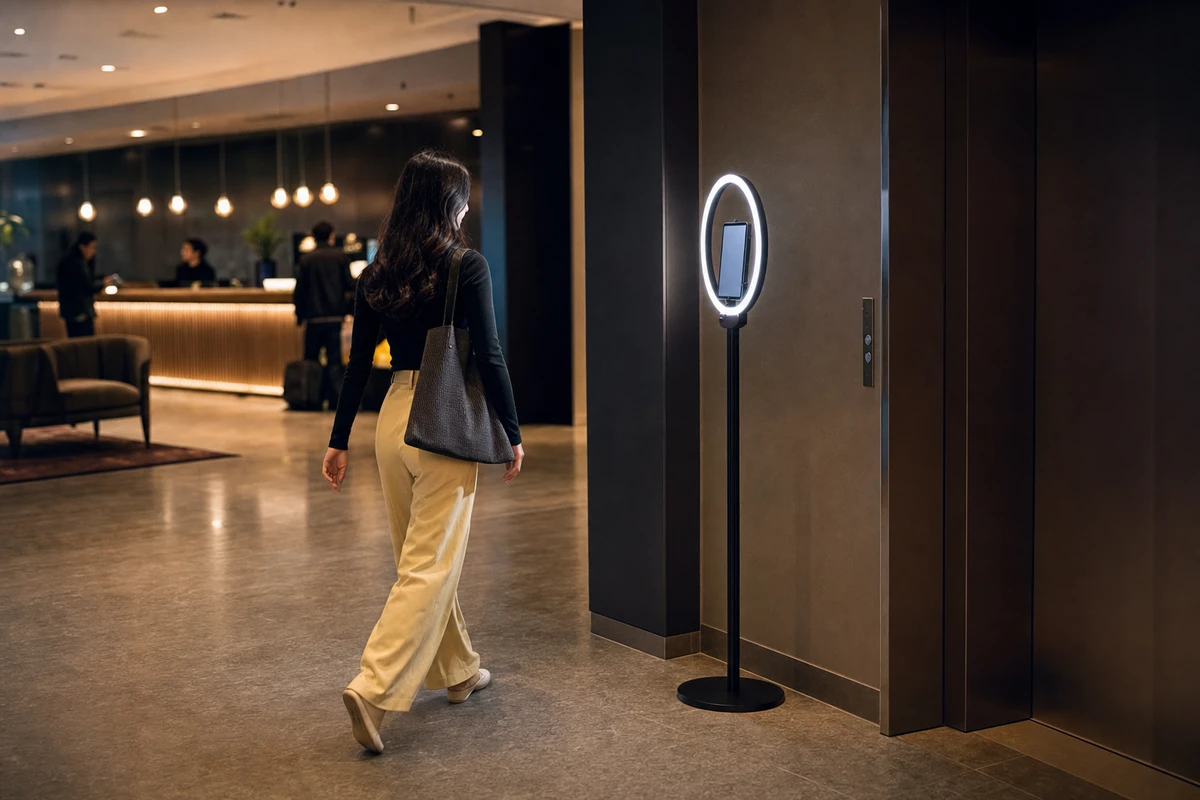
iPad works for the inverse reason. Single-device lockdown is supported at the operating system layer through Guided Access. Apple Business Manager handles fleet provisioning, remote wipe, Find My tracking, and activation-lock controls that mean a stolen device becomes a brick (Apple, 2025). Apps relaunch on reboot. The single-tap capture flow does not need a coach.
A multi-location hospitality operator running a country-music bar chain placed always-on photo booths near elevators and high-traffic areas, capturing guest first name, email, and ZIP code before delivering each photo. According to the vendor case study, opt-in ran 89% across the deployment (Simple Booth, 2024). That deployment is impossible with a DSLR stack. It is a fixture, not a rental. The fixture model is what franchise marketers buy when they ask for “photo booth” and mean “always-on first-party data capture surface.”
Software economics: the subscription has eaten both sides
The “perpetual license vs subscription” framing from 2020-era blog posts is out of date. Both sides of the market have largely moved to subscription. The differentiator now is what the subscription buys.
LumaBooth, the rebrand of the long-standing dslrBooth product, moved to subscription in 2024. LumaBooth for Windows runs $17 per month billed annually ($204 per year). LumaBooth for Apple, which supports DSLR tethering on iPad, runs $18 per month billed annually ($216 per year). Both include the first two devices (LumaBooth, 2025). Breeze Systems, with its Remote Pro product (formerly DSLR Remote Pro), appears to still offer a one-time purchase model based on the checkout flow (Breeze Systems, 2025).
A five-year cash-out for LumaBooth Windows is $1,020. The categorical difference is no longer subscription vs perpetual. It is whether the software ships a managed cloud backend. iPad platforms typically include cloud dashboards, analytics, CRM hooks, remote fleet management, and feature cadence. Windows DSLR booth software typically ships as capture-and-print without that wrapped in. For a single-booth owner-operator who integrates nothing, the backend is wasted. For a multi-booth fleet, it is often the reason the platform gets bought.
Data capture, CRM integration, and the actual deliverable
This is the axis where iPad wins decisively. The deliverable for most brand-activation work is not a photo. It is a captured email, an SMS opt-in, a zero-party-data record with demographic or preference fields, a branded microsite URL, and UGC posted to the client’s hashtag. The photo is the incentive. The data is the product.
iPad booths are designed around that pipeline. On-device consent flow, email and SMS capture, native integrations into Mailchimp, Klaviyo, HubSpot, ActiveCampaign, and Zapier for the long tail. The 89% opt-in figure cited above for the multi-location bar chain is vendor-published and named-operator. Operators planning their own deployments should anchor a target in the 60-to-85% range and treat the upper end as a high benchmark, not the norm.
DSLR rigs bolt this pipeline on. A PC-side script, a separately configured SMS gateway, or a tethered iPad as the guest-facing UI. More failure points, slower to deploy, harder to support across a fleet. The DSLR rig was designed for the photo. The iPad rig was designed for the list. For a multi-location operator, data-pipeline fit usually dominates the form-factor decision before image quality is weighed.
Hybrid rigs: the honest middle path
The iPad-versus-DSLR binary is false. Several vendors now ship iPad-UX-with-DSLR-camera products, a market signal that the iPad operator interface has won the argument that mattered.
- Photobooth Supply Co’s Guac & Chips runs an iPad and Fiesta software with a tethered mirrorless camera. Financing listed from $194 per month (Photobooth Supply Co, 2025).
- LA Photo Party’s Venture Go pairs iPad Pro running Landmark software with Canon DSLR optics. Launched February 2024 and marketed as an “iPad-powered DSLR photo booth” (LA Photo Party, 2024).
- LumaBooth for Apple is an iPad app with USB-tethered Canon, Nikon, and Sony support included in the subscription (LumaBooth, 2025).
The tradeoff is honest. The buyer gets iPad UX, sharing, and data capture, and inherits DSLR tether-driver failure modes plus higher gear cost. An attendant is usually still required. Hybrid makes sense for high-end rental packages where the client pays for DSLR-quality prints and the data pipeline still has to ship.
A fourth path is worth naming. A PC with a high-resolution webcam, ring light, and touchscreen monitor is a common unattended setup. A Tennessee operator runs this configuration with a DNP RX1 dye-sub printer on USB and reports that “the system just works” without a technician on site (OurDJTalk, 2021). Lower image quality than a DSLR, more wired reliability than a WiFi-tethered hybrid.
Insurance, theft, and fleet controls
An exposed activation in a public venue is a theft surface. Per-unit replacement runs roughly $600 to $1,200 for a tablet, and $1,500 to $3,500 for a DSLR body, lens, and strobe combined. The control surface is more lopsided. Apple Business Manager and MDM tooling provide remote wipe, Find My tracking, lock-to-app via Guided Access, and activation-lock controls on stolen devices (Apple, 2025). DSLR bodies have none of those. A stolen body resells on the used market with no usable trace. For a multi-location rollout, the math favors the form factor that can be locked down and remote-recovered. Insurance underwriters reflect that on always-on deployments.
Print workflow: the slice where DSLR still wins
For a small slice of commercial work, DSLR is the correct purchase order. A high-volume physical-print workflow on a DNP DS620A or RX1 dye-sublimation printer runs cleaner on a DSLR-plus-PC driver stack than on an iPad-plus-wireless-print-server chain. DNP’s DS620A media ships at 400 prints per roll, 800 per case (DNP, 2025), at a per-print cost operators typically quote at $0.15 to $0.25 at commercial reorder volume.
The DSLR-plus-DNP stack is the right call for galas and fundraisers where the physical printed takeaway is the brief, for luxury-retail and editorial campaigns where the branded strip matters more than email capture, and for high-volume print events at 300-plus prints per event where wired PC-to-DNP driver stability earns its place. Below 100 prints per event with digital-primary delivery, iPad wins on setup, recovery, and operator hours. Between 100 and 300 prints, attendant cost and venue type decide.
A worked operator P&L: 50 events a year, 100 guests per event
The numbers below assume an operator running 50 commercial events a year, roughly 100 guests per event. Operator-reported pricing is sourced from public forum posts; labor rates use the middle of the US event-services band.
IPad rig, three-year cost
Hardware: $4,500 (iPad Pro, integrated LED ring stand, travel case, secondary printer, spare iPad). Software: $216 per year for an iPad commercial subscription with cloud dashboards and CRM hooks. Year one: $4,716. Years two and three: $216 each. Three-year total: $5,148.
DSLR rig, three-year cost
Hardware: $7,200 (mirrorless or DSLR body, lens, strobe, tether cable, capture PC, router, DNP printer, enclosure). Software: $204 per year for LumaBooth Windows. Maintenance reserves: $400 per year for shutter servicing, tether replacements, flash bulb cycles. Year one: $7,804. Years two and three: $604 each. Three-year total: $9,012.
Attendant cost
At $200 per event, a DSLR rig with an attendant runs $10,000 per year, or $30,000 across three years. An iPad rig running unattended runs $0. A half-attendant model on the iPad side, $100 per event for a venue helper, runs $15,000 across three years.
Three-year total cost of ownership
- iPad, fully unattended: $5,148 plus $0 attendant = $5,148.
- iPad, half-attendant model: $5,148 plus $15,000 = $20,148.
- DSLR with attendant: $9,012 plus $30,000 = $39,012.
The fully unattended iPad runs at roughly one-eighth the cost of the staffed DSLR over three years. With a venue helper attached, it still runs at roughly half. The DSLR can earn a higher gate per booking, often $300 to $400 per event in operator-quoted markets, which across 50 events per year for three years is $45,000 to $60,000 of additional revenue. That recovers the operating-cost gap on a strict revenue line. It does not recover utilization.
Utilization is the second-order lever consumer comparisons ignore. A booth that takes 45 minutes to set up and 45 to tear down cannot run back-to-back same-day bookings. An iPad rig with 12-minute setup can cover a morning retail activation, a lunchtime brand moment, and an evening event on the same day. Break-even on a gross-margin basis lands between event 35 and event 75 of any given year. After break-even the iPad’s utilization advantage compounds and the DSLR’s per-event revenue advantage flattens.
The single largest mistake commercial buyers make is reading a consumer comparison and forgetting the two line items that decide operator margin: attendant cost and setup labor. Add those back in and the form-factor decision stops being about sensors.
When DSLR is the right commercial choice
- Galas, fundraisers, black-tie, and member-club activations where the client pays for physical prints as the primary takeaway.
- Studio-adjacent operators who already own the camera gear and can cost the capital at zero.
- Editorial or “glamour-style” activations where the branded look is DSLR-signature: shallow depth of field, strobe fill, deliberate bokeh.
- Venue operator packages where a large-volume print run is contracted.
When iPad is the right commercial choice
- Retail activations, pop-ups, flagship-store deployments.
- Restaurant waiting-area and bar-promotion installs.
- Salon, med-spa, gym, and coworking lobby installs.
- Trade-show and conference sponsorship activations.
- Venue and hospitality lobby installs.
- Multi-location franchise rollouts.
- Brand-activation campaigns where the deliverable is UGC and email capture.
- Any deployment that runs unattended.
The take
The right commercial question is not which form factor takes better photos. It is which matches the client’s P&L and the data pipeline they are paying for. On operator hours, attendant cost, unattended operation, and data capture, iPad wins. On high-volume physical print and editorial-quality output, DSLR wins a narrow slice.
A buyer walking into a vendor demo should leave with five numbers: a setup time, an attendant assumption, a three-year software cost, a recovery-time estimate, and a CRM-integration list. If those numbers do not add up to a profitable rig under the buyer’s actual booking calendar and labor market, the photograph at the end of the demo is the wrong thing to be evaluating.
Sources
- Apple (2024). “iPad Pro — Technical Specifications.” https://www.apple.com/ipad-pro/specs/
- Apple (2025). “Intro to Apple Business Manager.” https://support.apple.com/guide/apple-business-manager/intro-to-apple-business-manager-tml1110184/web
- Breeze Systems (2025). “Remote Pro — Photo Booth Software for Windows.” https://www.breezesys.com/remote-pro
- Canon via Wikipedia (2023). “Canon EOS R50.” https://en.m.wikipedia.org/wiki/Canon_EOS_R50
- DNP Imagingcomm America (2025). “DS Series Media.” https://dnpphoto.com/en-us/Media/DS-Series
- LA Photo Party (2024). “LA Photo Party Unveils Revolutionary Venture Go: iPad-Powered DSLR Photo Booth.” https://laphotoparty.com/venture-go-ipad-powered-dslr-photo-booth/
- LumaBooth (2025). “Pricing for our photo booth apps.” https://dslrbooth.com/pricing
- OurDJTalk (2021). “Photo Booth” forum thread (operator posts by djtaso, IceBurghDJ, B-Sharp, rickryan). https://ourdjtalk.com/djchat/photo-booth.51780/
- Photobooth Supply Co (2025). “Salsa 2.” https://photoboothsupplyco.com/pages/salsa-2
- Photobooth Supply Co (2025). “Guac & Chips.” https://photoboothsupplyco.com/pages/guac-booth
- Simple Booth (2024). “Ole Red Uses Modern Photo Booths as a Tool to Grow Its Customer Database.” https://www.simplebooth.com/blog/ole-red-venue-photo-booths-grow-customer-database/
- Wifibooth community (2019). “An honest review after a year… i am moving on.” https://wifibooth.com/community/viewtopic.php?t=1696