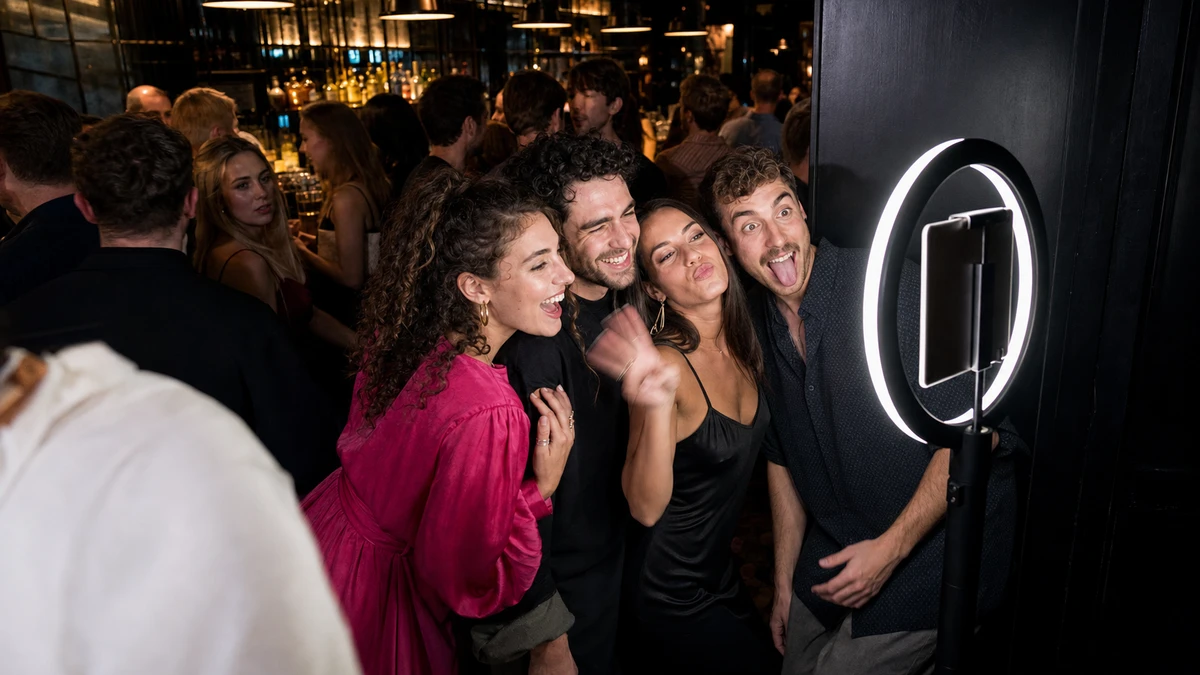
It is 11 p.m. on a Saturday. The bar is three deep, the music is loud, and against the back wall five people have crowded into a lit booth, pulling faces while a camera counts down. Thirty seconds later they spill back onto the floor, order another round, and the photo is already on three phones heading for Instagram. That booth is doing two jobs at once. It is keeping a group parked inside the venue, and it is carrying the bar’s name to a few hundred people who were never invited.
For most bars and nightclubs, the best photo booth is one the venue owns and operates itself, in an open-air format. The booth’s real job in a nightlife venue is filling the room and building a customer list, not collecting coin-op print revenue. Once an operator accepts that, the buying question changes. It stops being “which booth type looks best” and becomes “which arrangement keeps the room full and leaves the venue holding the customer list.”
That reframing matters because most published advice points the other way. The “free” profit-share booth that vendors promote hardest is usually the worst fit for a bar, because it hands the vendor the revenue, the branding, and the customer data. This guide compares the three real ways a venue can put a booth on its floor, and the three form factors, against how a working bar actually operates on a busy night.
What “Best” Means When the Booth Lives in a Bar, Not at an Event
An event planner choosing a booth for one night looks at the sample photo strips and the four-hour rate. A bar owner cannot stop there. A booth bolted into a venue for a two-year run is judged by a different test: it has to earn its floor space every weekend.
Three things decide whether it does
Three things decide whether it does. The first is foot traffic and dwell time: does the booth give groups a reason to stay longer and pull new groups toward the back of the room. The second is data capture: does it collect emails and phone numbers the venue can message later. The third is cost of ownership: how much it takes out of revenue, staff attention, and liability exposure across the contract.
“Best” is also venue-specific
“Best” is also venue-specific. A craft cocktail bar wants a compact booth that matches its room and does not shout. A high-volume nightclub wants throughput, because a slow booth on a Saturday becomes a line that blocks the bar. A neighborhood bar wants something low-cost to run and hard to break. The highest-rated booth on a generic list answers none of those questions, because generic lists are written for event renters, not venue operators.
Two decisions structure everything that follows: the ownership model (how the venue gets the booth and who keeps what it produces) and the form factor (the physical type of booth). The ownership model is where most of the money and nearly all of the strategy live, so start there.
The Three Ways to Put a Photo Booth on a Bar Floor
A bar owner calling around for a photo booth quickly hears three different pitches. They differ less in hardware than in who ends up holding the valuable parts.
Profit-share, or vending, is what most of the search results sell. A vendor installs and owns the booth at little or no upfront cost (Magbooth’s published bar-booth page lists a $3,500 entry fee for its profit-share option), keeps the majority of per-use revenue, and handles maintenance, permits, and taxes. A&A Studios states plainly that “all maintenance, monitoring, repairs, permits, and taxes are handled by our team,” and Photomatica and VendNation describe the same arrangement. The venue provides floor space and a power outlet.
Lease sits in the middle
Lease sits in the middle. The venue pays a fixed monthly fee for the hardware and software, operates the booth itself, and keeps the revenue, the branding, and the data. Lease pricing is rarely published; it varies by vendor and contract term.
Buy and self-operate means the venue owns everything. That can mean a turnkey commercial booth (Magbooth lists a purchase price of $13,500) or an assembled iPad rig: an iPad, a photo booth app, a light stand, and an optional print dock. Simple Booth’s HALO kit is one version of that iPad path, with a 2,100-lumen ring light built into the body so the venue does not source a separate light stand. The venue pays a software subscription and keeps the revenue, the branding, the data, and the asset itself.
| Profit-share / vending | Lease | Buy and self-operate | |
|---|---|---|---|
| Upfront cost | $0 to a few thousand (Magbooth lists a $3,500 entry fee) | First month plus deposit | ~$800–$1,500 (iPad rig) to ~$13,500 (turnkey booth) |
| Ongoing cost | None direct; paid through the revenue split | Fixed monthly hardware and software fee | Software, roughly $20–$190/month |
| Who keeps use-revenue | Vendor keeps the majority | Venue | Venue |
| Who owns the customer data | Not stated publicly by any vendor | Venue | Venue |
| Who controls branding | Strip branding usually offered; share screen often the vendor’s platform | Venue | Venue |
| Who handles maintenance | Vendor (plus permits and taxes) | Vendor or shared | Venue |
| Contract lock-in | Multi-year term, negotiated | Lease term | None |
| Who owns the asset | Vendor | Lessor | Venue |
The cell in that table that should worry an operator most is data ownership under profit-share. No vendor states publicly who owns the emails and phone numbers the booth collects.
Why the “Free” Photo Booth Usually Costs a Bar the Most
A vendor’s pitch leads with one word: free. No upfront cost, the booth installed and serviced for nothing. For a bar, that is the most expensive word on the contract, and one vendor’s own published numbers show why.
Venue Revenue Math
Magbooth’s payback model assumes a venue-installed booth runs 500 to 800 sessions a month. Take the low end. Five hundred sessions at the $3 per session in Magbooth’s own scenario is $1,500 in monthly gross revenue. Under the 80/20 split Magbooth publishes (the only specific split any vendor on the first page of results discloses; the rest call their splits “customized”), the venue keeps $300 a month and the vendor takes $1,200. Over a two-year contract, the venue has handed the vendor $28,800, on top of any entry fee.
A purchased booth changes that picture. A $13,500 turnkey booth plus roughly $100 a month in software costs about $15,900 across the same two years, and the venue keeps every dollar the booth earns. An iPad rig costs far less up front. The profit-share booth was never free. It was financed out of revenue the venue never saw.
The deeper problem is what the model is built to do. A vending booth is engineered to maximize coin-in, because per-use payment is how the vendor earns. For a bar, per-print revenue is small and beside the point. The booth’s value to a venue comes from two things the vending model does not optimize: branded photos leaving the building, and customer contacts entering a list the venue controls. Under profit-share, the share screen often runs on the vendor’s platform, and any captured emails and phone numbers sit in the vendor’s system. The booth can be busy every weekend and still leave the venue with nothing it can market to on a Tuesday.
This does not make profit-share a trap. For a venue with no upfront capital, no staff bandwidth, and no marketing program to feed a list into, a profit-share booth is a legitimate way to put an amenity on the floor at no cost and no effort. It should be chosen with open eyes about the split, the branding, and above all the data, not accepted as a gift.
Open-Air, Enclosed, or 360: Which Form Factor Survives a Saturday Night
The curtain that makes an enclosed booth feel private at a formal event makes it a problem in a bar. An enclosed booth on a nightlife floor is an unsupervised room with a door, in a building full of people who have been drinking. One bar owner on r/BarOwners described what a built-in booth invited: “soooo many people would flash” in it, and worse, until the final straw came when two guests were caught “butt naked” inside. The booth came out. An enclosed booth also bottlenecks throughput, because only the people behind the curtain can tell whether it is occupied.
An open-air booth has no curtain. It is a camera, a screen, and a light, with the room able to see in. That visibility does three useful things. It supervises itself, because misuse happens in front of everyone. It advertises itself, because a booth in mid-session is social proof that pulls the next group over. And it moves faster, because there is no enclosed space to clear between groups. For most bars, open-air is the default answer.
A 360 platform, where a camera arm spins around guests on a riser to produce a short video, makes excellent content and draws a crowd. It also serves one group at a time, cycles slowly, and needs a large clear footprint. On a peak night that combination becomes a long line and a lost square of floor. A 360 works better as a feature wheeled out for a marquee event than as an always-on fixture. A high-volume nightclub can run an open-air booth every night and bring in a 360 for special programming.
The Nightlife Durability and Liability Checklist
One operator on r/BarOwners summed up the nightlife hardware problem in three words: a bar is “basically drunk toddlers.” Equipment that survives a four-hour catered event does not automatically survive a Saturday at 1 a.m. A booth for a bar has to be specified for that crowd.
Intoxicated users mean spill-resistant surfaces, no fragile exposed parts, a forgiving touchscreen, and cameras and screens mounted out of grab-and-yank reach. Theft is a specific risk for the lowest-cost path: an iPad rig puts a resellable consumer device on the floor of a crowded room. The fix is inexpensive and worth naming. Mobile device management software (Hexnode prices its entry tier at $2.20 per device a month) locks the iPad to the booth app even across restarts, and adds remote lock and remote wipe so a stolen iPad becomes a brick rather than a payday. Apple Business Manager, the layer that makes a stolen device impossible to reactivate without the venue’s own credentials, is free.
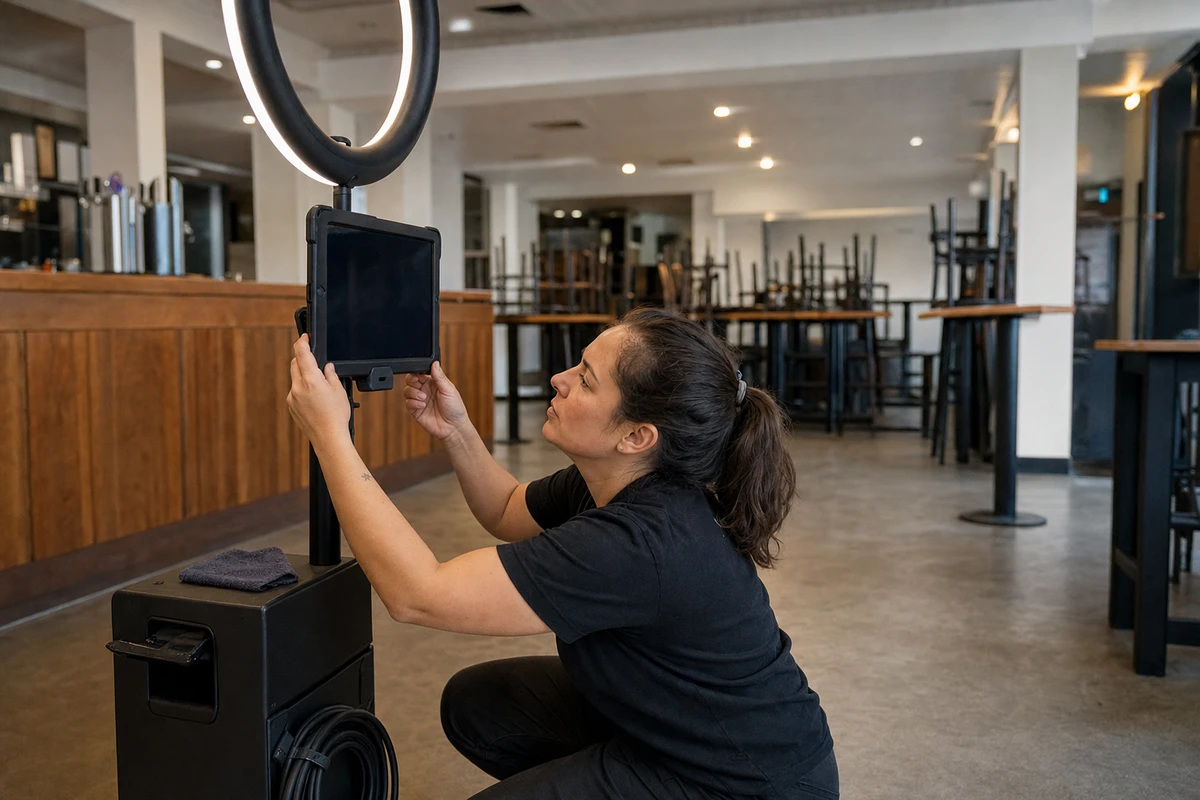
A bar is also dark, so the booth has to bring its own light. A built-in or ring light that flatters guests without blinding the room is not optional. Heat, power, and noise matter too: a booth running for hours needs thermal headroom and a dedicated circuit, and any printing flow has to work over loud music. The liability layer ties back to the form factor. Open sightlines deter misuse. Clear signage on photo capture and data use is basic protection, and any booth that collects emails or phone numbers creates a privacy-notice obligation the venue should handle before the booth goes live, not after a problem surfaces.
What the Booth Actually Earns a Venue: Foot Traffic and a Customer List
Picture the back-wall booth from the start of this guide at the end of the night. It has run a few dozen sessions and printed a stack of strips. The strips are not where the money is. Two returns are, and both of them only reach the venue’s pocket when the venue owns the branding and the data.
Branded content leaving the building
The first is branded content leaving the building. When a guest shares a booth photo, the venue gets exposure it did not buy. Social Insider’s 2025 social media benchmarks put average Instagram reach at 3.5% of a follower count per post. A guest with 800 followers who shares a photo reaches roughly 28 people. A typical session of two or three guests, each sharing once, puts the venue’s name and tagged location in front of perhaps 60 to 90 people. Run 30 sessions on a busy night and that is a couple of thousand local impressions, at no media cost, from accounts the venue’s own customers chose to post from.
Contact capture
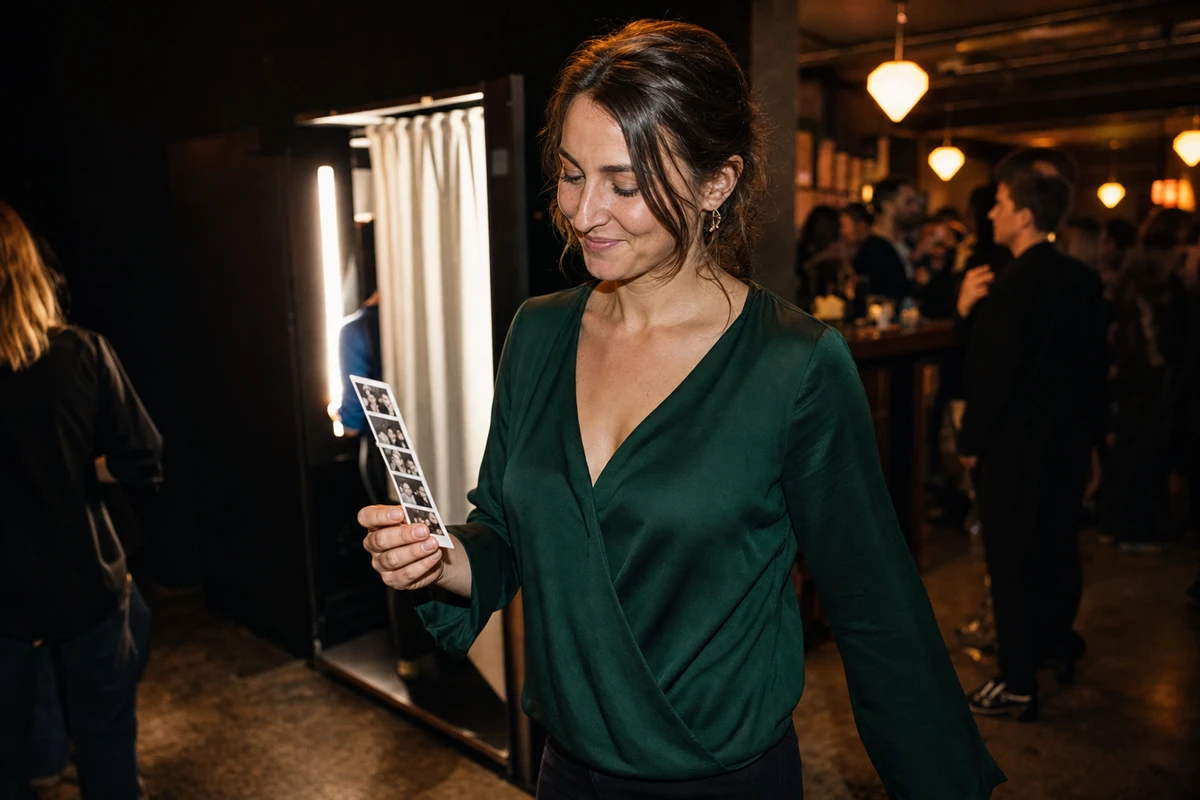
The second return is the customer list, and it is the larger one. A booth that offers to text or email the photo asks the guest to enter a contact to receive it. No independent survey establishes how many bar guests opt in, so treat that rate as something the venue measures rather than a number to borrow. Even on a cautious assumption the math is worth running. An open-air booth cycles roughly six to eight sessions an hour. Across four peak hours that is around 30 sessions and 75 guests through the booth. If one in three enters a contact, the venue captures about 25 new contacts a night, or 50 across a Friday and Saturday. American Nightlife Association data notes that Friday and Saturday carry roughly 70% of a bar’s weekly foot traffic, so most of that capture happens in two nights.
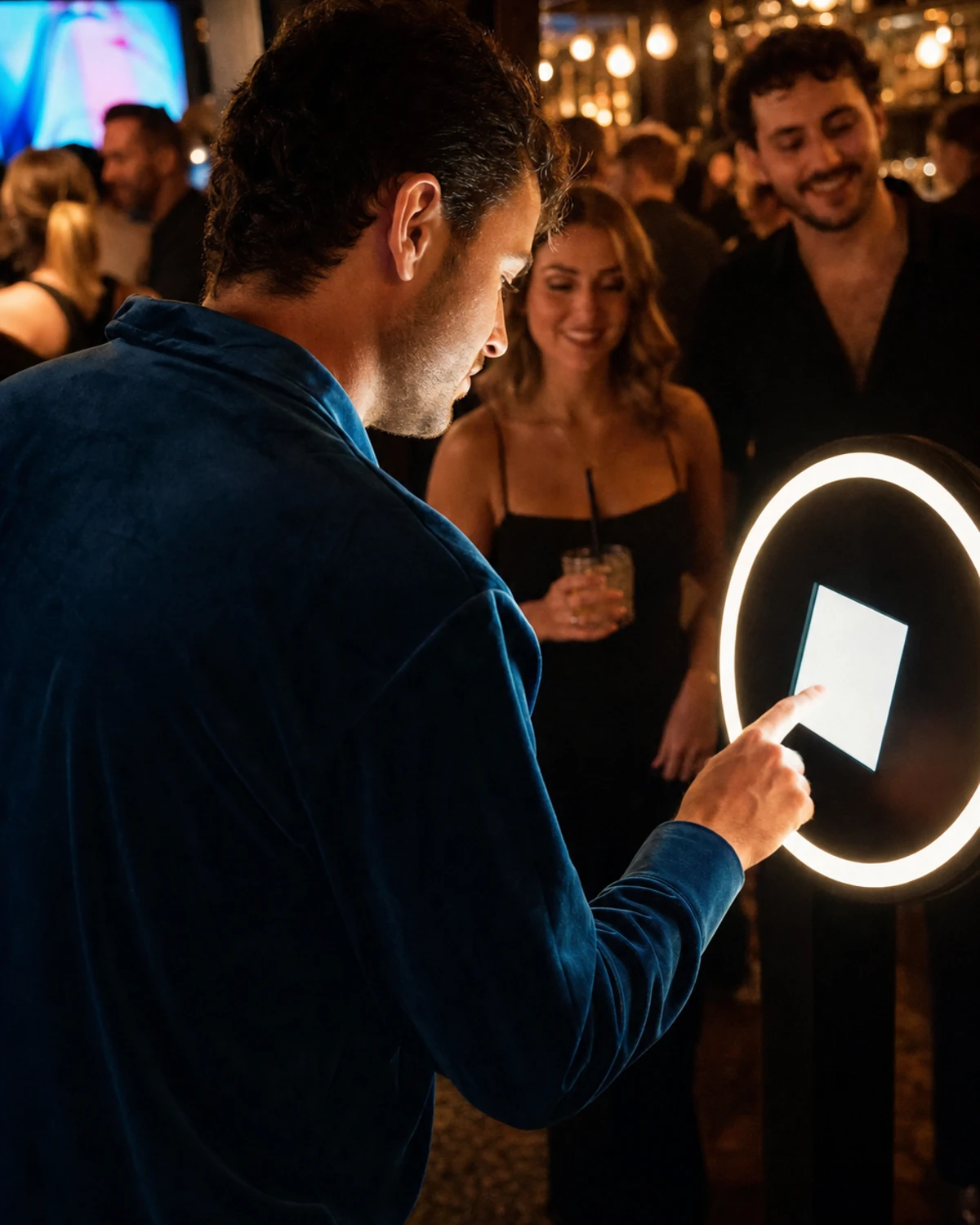
After a few months the venue holds a list of more than a thousand people who have stood inside the building. That list is a channel the venue can fire for free. Klaviyo’s 2026 email marketing benchmarks, drawn from more than 183,000 brands, put food-and-beverage campaign open rates at 31.2% and click rates at 1.7%, with automated, behavior-triggered flows reaching a 5.8% click rate. One email to a list of a thousand brings roughly 310 opens and around 17 clicks.
Not every click becomes a visit, but each one is a past guest choosing to look at what the venue is promoting that week, and the message cost nothing to send. Eventbrite’s nightlife research puts the average all-in spend for a night out around $81, so even a small share of those clicks converting into slow-Tuesday visits is real revenue, and the venue can send a fresh message every week.
A second effect runs alongside the list, though it is harder to measure directly. Reporting in the Morning Advertiser on CGA’s December 2025 sector analysis found that live music keeps pub guests in the room “an extra two or three beers, which is an hour or more longer than usual.” That research covers live music, not photo booths, but the logic of amenity-as-destination carries over: a visible, busy booth gives a group a reason to stay, and a reason to come back. The National Restaurant Association’s 2026 industry report found 83% of operators say technology gives them a competitive advantage, and a booth that builds an owned customer list is a concrete version of that.
None of it accrues to the venue under a profit-share deal where the vendor keeps the data. One bar owner on r/BarOwners put the goal in plain terms: “Better to have direct access to customers via Facebook or even text than pay [for ads] every time I wanna do something.” That instinct is correct. The ownership model decides whether the venue gets to act on it.
Fitting a Booth Into a Working Bar: Space, Light, Power, and Placement
A booth needs a real footprint, and a bar floor is already spoken for. Foto ATM’s venue specifications, the most consistent figures across the published guides, call for a minimum of about 6 by 9 feet and an ideal of 10 by 10, with 8 feet of ceiling clearance for a backdrop and at least 6 feet between camera and backdrop for proper framing. Power is a 110-volt, 10-amp, three-prong outlet on a dedicated circuit, not one already carrying a cooler or part of the sound system.
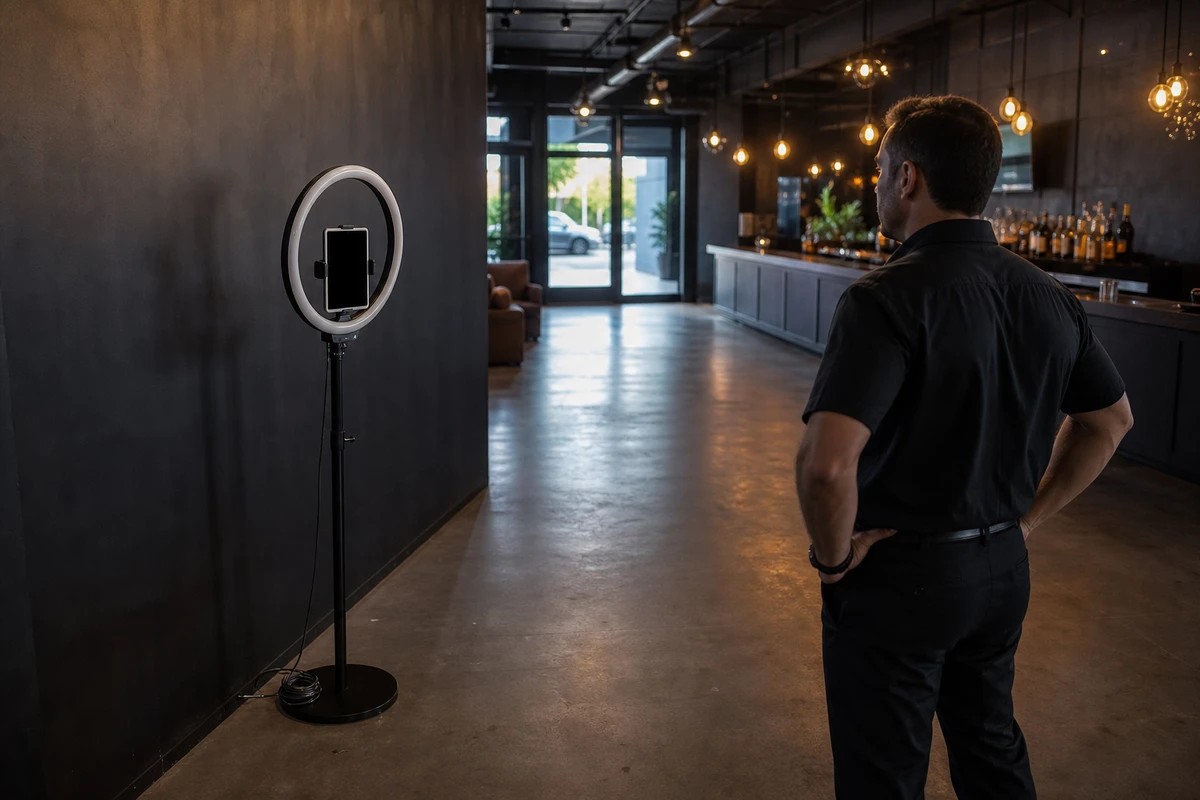
Placement decides whether the booth advertises itself. It belongs somewhere with a clear sightline from the entrance and the bar, so arriving guests see it in use, but off the main traffic artery, so a line never blocks the bar rail or a fire exit. The dark, loud crush of the dance floor is the wrong neighborhood for it.
The line is the real constraint at scale. One booth and 300 guests is a queue. At six to eight sessions an hour, a single open-air booth serves a few hundred people across a night, which is comfortable for most bars and tight for a packed nightclub. A venue that consistently runs that hot has two answers: a second booth, or a 360 brought in for the nights when the volume genuinely justifies the floor space.
Photo Booth Costs by Ownership Model
A bar owner comparing quotes will see numbers that do not line up, because the three models hide their cost in different places.
Profit-share has the lowest entry cost: zero to a few thousand dollars up front (Magbooth’s $3,500 entry fee is the published example), with no direct monthly bill. The cost is the revenue split, and it runs for the whole contract term. Lease is a fixed monthly fee for hardware and software; it is rarely published, and one operator on r/BarOwners priced a bar selfie kiosk at “over $100 a month” before deciding it was “too rich for my blood.” Buying is a one-time hardware cost plus software. A turnkey commercial booth runs up to Magbooth’s $13,500; an assembled iPad rig (an iPad at $329 to $599, a stand and optional print dock at $200 to $500) lands closer to $800 to $1,500. Photo booth software runs roughly $20 to $190 a month, from a basic license near $20 to a mid-tier event plan.
Break-even depends on a single question: will the venue actually use the data and the branding. A bar that puts the captured list to work recovers the hardware cost inside a year or two of revenue it would otherwise have split away, and keeps a growing contact list on top. A bar that will never send the email is buying hardware it does not need, and a profit-share booth it can ignore is the more honest choice.
How to Choose a Photo Booth for Your Bar
Strip away the hardware brochures and the choice comes down to two things a bar owner already knows about the venue: how much it markets, and how much capital and staff time it can spare.
Staffing
A venue with marketing intent and any staff bandwidth should own or lease, choose an open-air booth, and keep control of the data and the branding. This is the best fit for most bars and the headline recommendation of this guide.
A venue with no capital and no bandwidth can take a profit-share deal without apology. The move there is to negotiate: get the revenue split in writing, secure venue branding on both the strip and the share screen, push for the shortest contract term available, and pin down who owns the captured contact data before signing.
A high-volume nightclub should weigh throughput and durability above all, run an always-on open-air booth, and reserve a 360 for marquee nights.
Whatever the model, five questions belong in front of any vendor before a signature. Who owns the customer data the booth collects? Whose branding appears on the strip and the share screen? What is the contract term, and what is the exit clause? Who pays for maintenance and consumables? And what is the revenue split, in writing? A booth earns its floor space when the room stays full and the venue, not the vendor, walks away owning the customer list.
Frequently Asked Questions
How much does a photo booth for a bar cost? It depends on the model. A profit-share booth can cost nothing up front, though some vendors charge an entry fee (Magbooth lists $3,500); you pay instead through a revenue split. A lease is a fixed monthly fee, often around or above $100. Buying runs from roughly $800 to $1,500 for an assembled iPad rig up to about $13,500 for a turnkey commercial booth, plus $20 to $190 a month for software.
Should a bar buy a photo booth or use a profit-share company? Buy or lease if you have any marketing intent and the staff bandwidth to operate the booth, because that is the only way you keep the customer data and the branding. Choose profit-share only if you have no upfront capital and no bandwidth, and even then, get the revenue split and the data ownership in writing first.
Do photo booths actually bring customers into a bar? They work in two ways. A visible, busy booth gives groups a reason to stay longer, the same amenity-as-destination effect CGA data has documented for live music. And every shared photo carries your venue’s name and tagged location to the guest’s followers at no media cost. The larger payoff is the contact list the booth builds, which lets you message past guests directly to fill a slow night.
Open-air or enclosed booth for a nightclub? Open-air. An enclosed booth on a nightlife floor is an unsupervised private room, and bar owners report guests using them to flash, hook up, and worse. Open-air booths supervise themselves because the room can see in, move faster between groups, and double as advertising when guests watch a session in progress.
Who owns the customer emails and photos a booth collects? That depends entirely on the ownership model, and it is the single most important term to settle. If you own or lease the booth, you own the data. Under profit-share, no vendor states publicly who owns the captured contacts, so it must be an explicit written term in the contract. Do not sign without it.
How much space does a photo booth need in a venue? Plan for a minimum of about 6 by 9 feet and ideally 10 by 10, with 8 feet of ceiling clearance and at least 6 feet between camera and backdrop. It needs a dedicated 110-volt, 10-amp outlet and enough surrounding room that a line never blocks the bar or a fire exit.
Sources
- Klaviyo (2026). “Email marketing benchmarks 2026: open rates, click rates and conversion rates by industry.” https://www.klaviyo.com/uk/blog/email-marketing-benchmarks-open-click-and-conversion-rates
- National Restaurant Association (2026). “State of the Restaurant Industry 2026.” https://restaurant.org/research-and-media/research/research-reports/state-of-the-industry/
- American Nightlife Association. “Market Overview.” https://www.nightlifeassociation.org/market-overview
- Morning Advertiser / CGA (2025). “How live music can drive sales uplift and dwell time for pubs.” https://www.morningadvertiser.co.uk/Article/2025/12/12/how-live-music-boosts-pub-sales-dwell-time-and-weekly-revenue-according-to-new-data/
- Social Insider (2025). “Social media reach benchmarks.” https://www.socialinsider.io/blog/social-media-reach/
- Eventbrite (2024). “The Nightlife Industry: How Much Do People Spend on a Night Out?” https://www.eventbrite.com/blog/academy/the-nightlife-industry-how-much-do-people-spend-on-a-night-out/
- Hexnode (2026). “UEM Pricing.” https://www.hexnode.com/pricing/uem/
- Apple. “Apple Business Essentials documentation.” https://support.apple.com/guide/apple-business-essentials/
- r/BarOwners (2024). “How best to setup a photobooth for an event.” https://old.reddit.com/r/BarOwners/comments/1gj2l5x/how_best_to_setup_a_photobooth_for_an_event/
- r/BarOwners (2025). “Buzzy Booth ezperience.” https://old.reddit.com/r/BarOwners/comments/1i85t5f/buzzy_booth_ezperience/
- Magbooth. “Bar Booth” product page (vendor; cited for purchase price, profit-share entry fee, revenue split, per-session price, and session-volume figures).
- A&A Studios. “Photobooth Vending” page (vendor; cited for the profit-share maintenance, permit, and tax model).
- Photomatica. “Permanent Photo Booth Installations” page (vendor; cited for the revenue-share install model).
- VendNation. “How do business photo booths work? The Ultimate 8-Step Guide” (vendor; cited for the profit-share contract model).
- Foto ATM. “How to Choose the Right Photo Booth for Your Venue” (vendor; cited for venue space and power specifications).