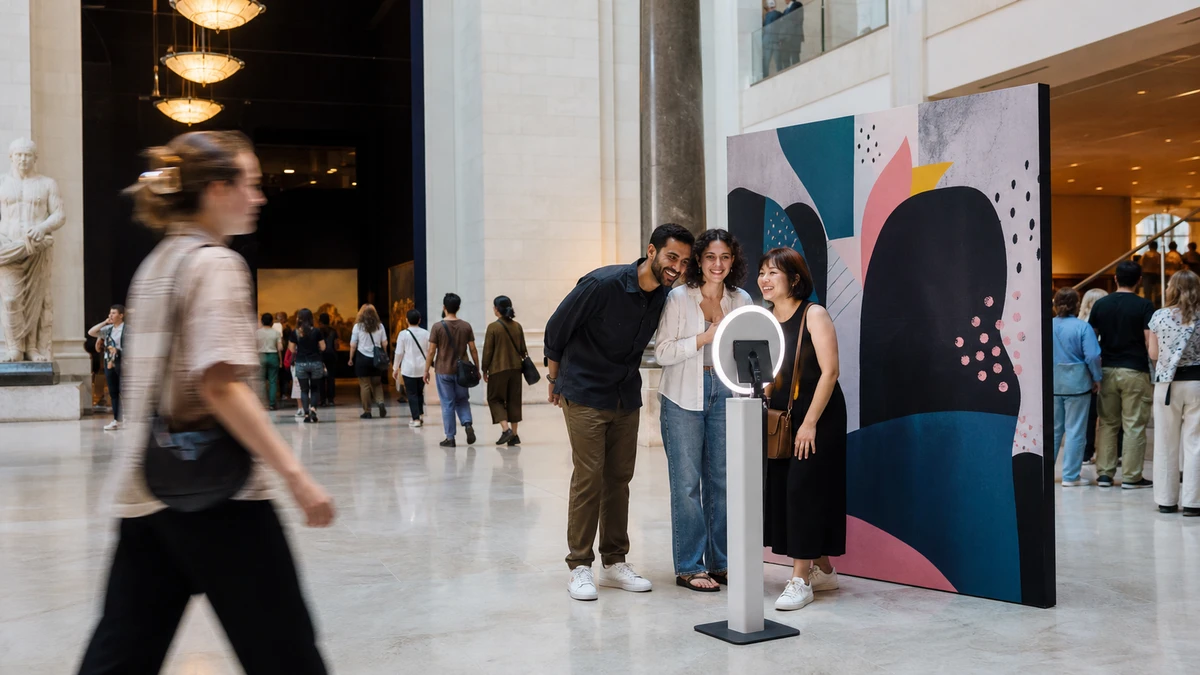
A family files out of a touring exhibition on a Saturday afternoon, still talking about what they saw. Near the doors, a compact booth invites them to step in front of a backdrop printed with the exhibition’s name and dates. They tap the screen, pose, and a minute later they walk away with a branded photo on their phones. The museum walks away with their email address.
That second exchange is the point. The best photo booth for a museum is not the one with the sharpest camera. It is the one that runs unattended every open hour, rebrands itself for each new exhibition without a service call, and routes visitor contact details into the membership pipeline. Most buying advice online misses this. It treats a museum booth like a one-night event rental and argues about hardware, when the decision that actually determines what the booth is worth is how the institution acquires it.
Why a Museum Booth Is a Different Purchase Than an Event Rental
A wedding venue rents a photo booth for one evening, with an attendant standing beside it and a teardown at midnight. A museum installs one and expects it to work for years. Those are different products bought against different constraints, and generic photo-booth advice, written mostly for the event-rental market, fails on all four of the constraints that matter to a cultural institution.
Unattended Operation
The first is unattended operation. A museum will not assign a staff member to babysit a booth. It has to be self-service from the first tap, legible to a visitor who has never seen one, and reliable enough to run open-to-close without anyone checking on it. An event booth assumes a paid attendant solves every problem; a museum booth has to solve them in software and signage.
Accessibility
The second is accessibility. A museum is a place of public accommodation, which means a permanently installed, public-facing fixture is held to a regulatory standard a one-night private event never faces. (More on the exact numbers later, in its own section.)
Exhibition Rotation
The third is exhibition rotation. A restaurant’s brand sits still. A museum’s effectively changes every few months as exhibitions turn over, and a booth whose graphics, backdrop, and photo overlays still advertise a show that closed in spring is working against the institution.
Visitor Data
The fourth is visitor data. Museums run on memberships, donations, and repeat visits, and the audience is large enough to be worth pursuing: the American Alliance of Museums’ 2024 survey of museum-goers found that 33% of U.S. adults had visited a museum in the past year. A booth that hands back nothing but a printed strip leaves its most valuable output, the visitor’s contact details and demonstrated interest, on the floor.
Decision Criteria
These four constraints, not megapixel counts, should drive the decision: a booth that nails camera quality but fails on unattended reliability or exhibition rotation is the wrong purchase, however good the photos look.
The Three Ways to Get a Photo Booth Into a Museum
A development director and a facilities manager can look at the same booth and disagree completely on whether the museum can afford it, because they are not really talking about the booth. They are talking about how it gets paid for. There are three ways to get one into the building, and they differ far more than the hardware does.
Buy It Outright
Vendors in this category typically quote $20,000 to $40,000 for a custom-built booth, a figure cited by Majestic Photobooth’s leadership as the going rate among its competitors. That is a vendor’s characterization rather than an independent market study, but it is plausible for an enterprise-grade kiosk with professional camera hardware, a custom enclosure, and branded software. On top of the purchase sit maintenance, content updates, and consumables. What the purchase buys is control: the museum owns the visitor data outright, sets its own branding calendar, signs no exclusivity clause, and can change vendors whenever it wants. What it carries is the capital line item and the maintenance burden.
No-Cost Vendor Placement
The vendor installs, brands, maintains, and updates the booth at no charge. Majestic Photobooth’s “Venue Placement” program is the clearest example, marketed as zero capital risk for the institution, with named clients including the Museum of Fine Arts, Boston and the Brooklyn Museum. Turnkey and free is a real offer. The hidden cost is not a fee; it is the set of questions the marketing page does not answer. Who owns the visitor email addresses the booth collects? Who controls the branding calendar? Is the placement exclusive, blocking the museum from other booths or activations? How long is the contract, and what happens to the data and the booth when it ends? None of the vendor pages reviewed for this article answered the data-ownership question, which is itself informative.
Revenue-Share Placement
The vendor places the booth at no upfront cost and the institution takes a cut of per-print or per-session revenue. This is the model ThisPlays International has built across zoos and aquariums. The attractions trade publication blooloop reported in 2024 that the company ran roughly 300 installations, with 94 of them (about 30%) in zoo and aquarium settings, all on free placement, with the attraction sharing revenue and the vendor handling artwork, construction, content, and maintenance. The appeal is obvious: a new revenue line, no capital, no operational burden. The trade-off is an incentive conflict. A revenue-share vendor optimizes for paid prints, because prints are what it earns on. Free, frictionless digital sharing is what generates social reach and email opt-ins, and a paid-print model quietly works against both.
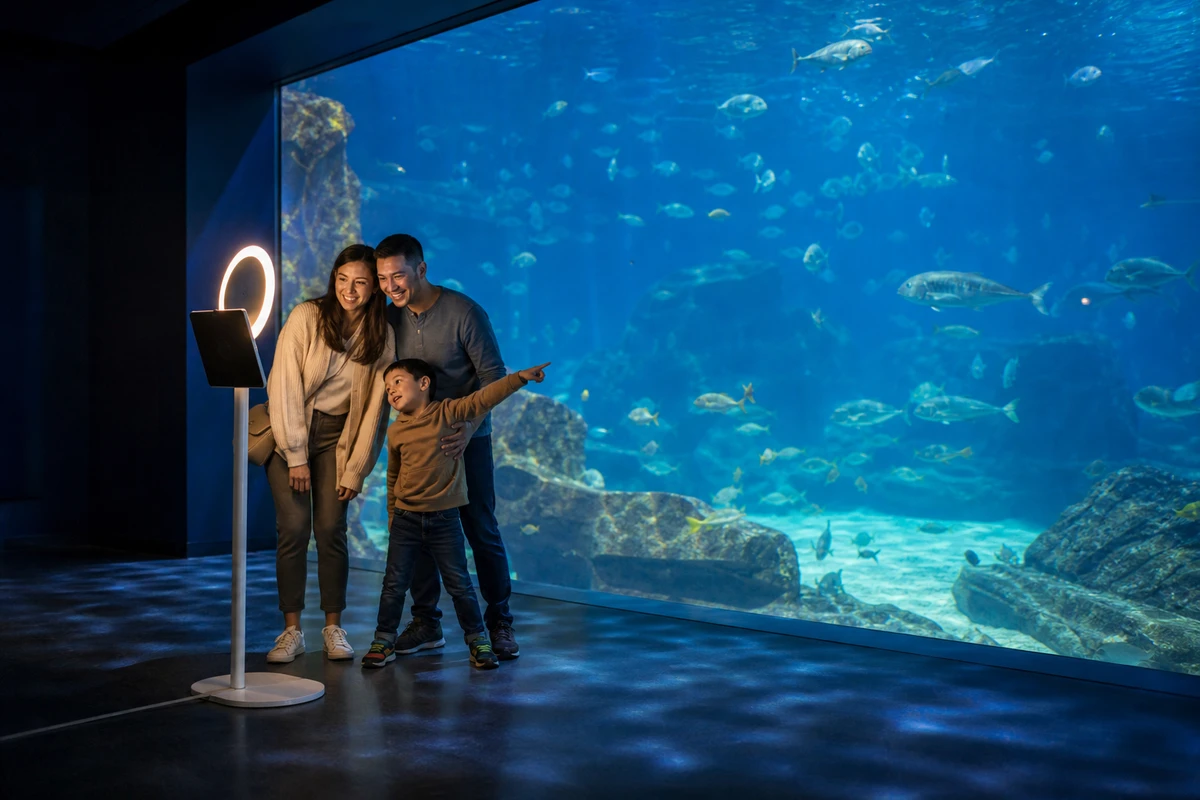
The decision rule follows from what the booth is for. If its job is visitor data and earned marketing reach, ownership or a placement contract with explicit, written data rights wins, because both keep the list and the branding in the museum’s hands. If its job is purely a visitor amenity or a modest revenue line, and the institution does not intend to market off the contacts, a placement model is defensible. The mistake is accepting a “free” booth without deciding which job it is doing, then discovering a year later that the most valuable thing it produced belongs to someone else.
The Museum Feature Checklist: What Actually Matters
A facilities manager measures the lobby alcove and finds it smaller than expected. A marketing lead wants to know whether staff can change the on-screen graphics before the next exhibition opens, or whether that means a support ticket and a wait. Picking the best photo booth for a museum, once the acquisition model is settled, comes down to a short list of practical questions like these.
Form Factor And Footprint
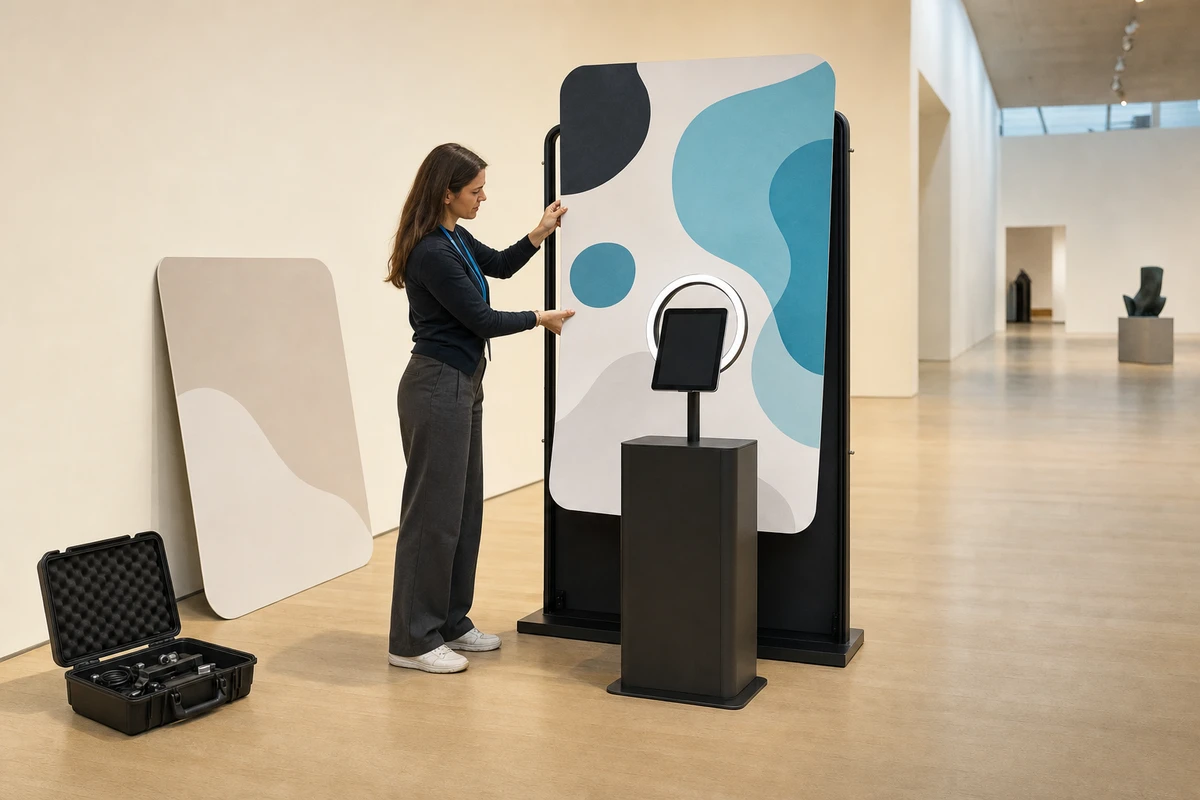
Booths come in three broad shapes. Enclosed booths built around a professional camera deliver the mini-studio look and the most controlled lighting, and take the most floor space. Tablet booths, an iPad mounted on a stand or plinth, have the smallest footprint and the lowest capital cost, which suits a fixed installation in a tight lobby. Simple Booth’s HALO kit is one tablet-form example built for fixed placement: an iPad in a 6.5-pound housing with a 2,100-lumen ring light integrated into the body, so a lobby installation gets even lighting without a separate light stand for staff to position and visitors to knock into.
Full-length mirror booths suit larger event spaces. Foto Master, which sells booths to museums in all three form factors, files the museum sector under an “amusement” category alongside family entertainment centers. For most museums the practical truth is modest: a few square meters and a power socket, the same minimum ThisPlays cites for its zoo installations, will hold a booth.
Self-Service Reliability
The interface has to be obvious to a first-time user with no attendant. Remote monitoring matters more than it sounds: staff should be able to see that the booth is up, out of paper, or offline from a dashboard, rather than from a visitor complaint. Ask any vendor for guaranteed uptime and a support-response commitment in writing.
Exhibition-Rotation Tooling
This is the feature that separates a museum-grade booth from an event one, and it should be evaluated as a workflow, not a checkbox. Majestic has described a booth planned for the Brooklyn Museum, designed to rebrand with each major show: a Monet look one season, a Picasso one the next. The question to press: can museum staff swap the backdrop graphics, screen design, and photo overlays themselves, ideally remotely, or does every exhibition change require a paid vendor visit? A booth that needs a service call for every rotation will, in practice, often be showing last season’s exhibition.
Sharing And Delivery
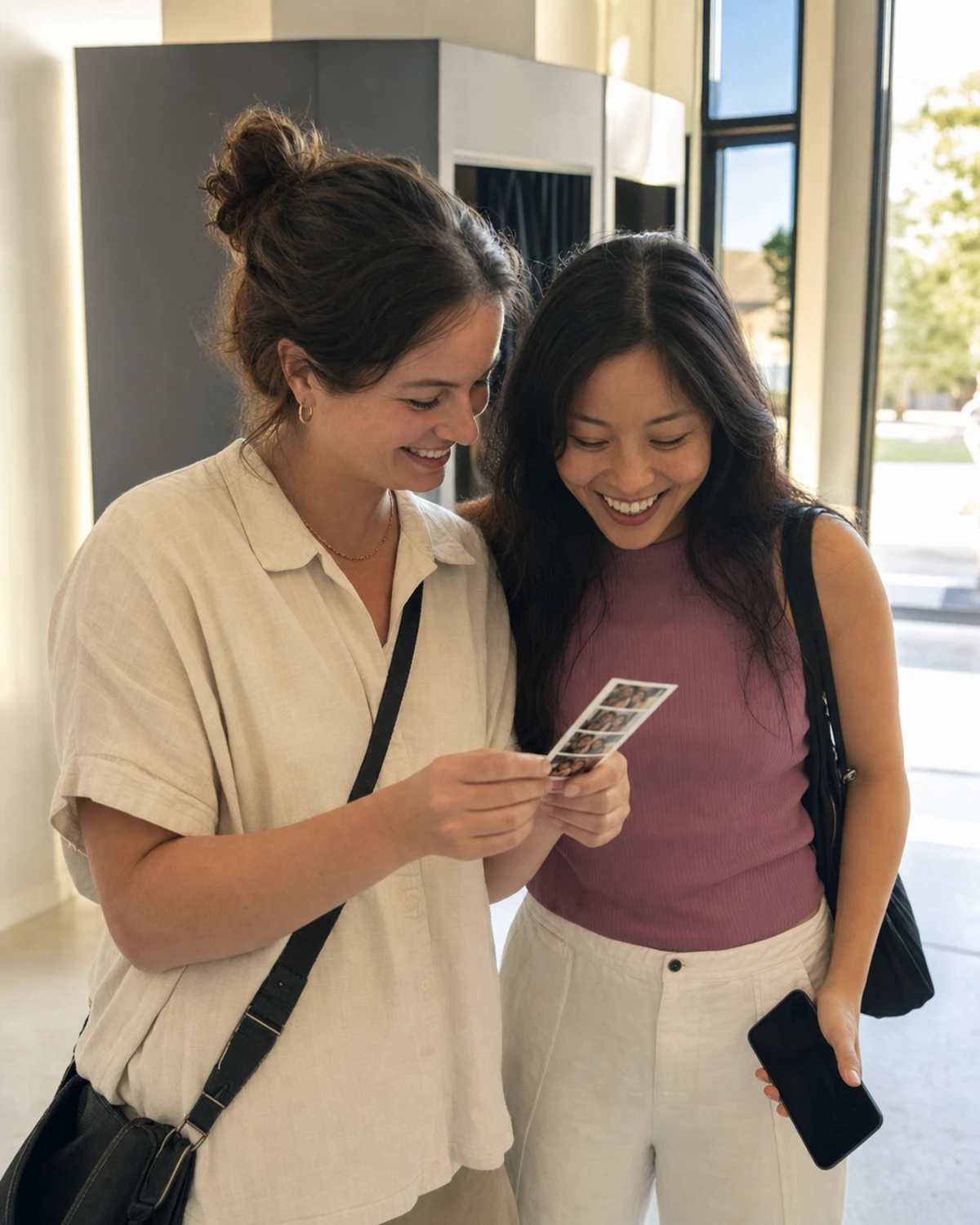
Print, SMS, email, QR code, branded microsite. The delivery method is also the data-capture method. A printed strip captures nothing, while email or text delivery is the moment the visitor’s contact details are volunteered. That makes delivery options not a convenience feature but the hinge of the whole investment.
Branded Output
Every photo should leave with the institution’s logo and the exhibition’s name and dates on it. A souvenir that travels home, gets posted, and gets shown around is also a small, dated advertisement, which is exactly the earned reach the booth is supposed to generate.
Placement and Throughput: Can One Booth Handle the Visitor Volume?
A museum places its new booth in a quiet side gallery, near a minor exhibit, and three weeks in the session counter is barely moving. The hardware is fine. The location is wrong.
Placement Decides Usage
Placement decides usage more than any spec. A booth in the lobby or atrium near the exit catches visitors on the way out, when the visit is complete and they are relaxed. A booth at a specific exhibition’s exit ties the photo to that show, which is what makes exhibition-branded overlays worth the effort. A member lounge placement rewards existing members; a placement in a rentable event space lets the booth do double duty. Each spot trades reach against relevance: the exit catches everyone, the exhibition exit catches fewer people but with a sharper, more marketable photo.
Capacity Check
Capacity is rarely the real constraint, but it is worth checking. Take a museum open eight hours a day with a single booth and a session that runs about 75 seconds from first tap to delivery. Back to back, that is roughly 48 sessions an hour and a theoretical ceiling near 380 a day. Booths never run back to back, so the honest planning number is far lower, and the useful question is what share of daily visitors will actually stop. A museum drawing 1,500 visitors a day at a 12% stop rate gets 180 sessions, well inside one booth’s capacity. The same 12% on a 5,000-visitor blockbuster weekend is 600 sessions, more than a single unit can deliver in an eight-hour day even running flat out. The fix for a high-traffic institution is rarely a faster booth; it is a second unit, or placement away from the single worst bottleneck.
Free Admission
Free admission changes the math. A free-admission museum, the Smithsonian model, has a weak case for a paid-print or revenue-share booth: per-print income is marginal next to its real return, which is contact data and earned reach. That points it toward ownership or a data-favorable contract. A paid-admission museum, zoo, or aquarium has more room for a revenue-share amenity, because its visitors already arrived in a paying frame of mind and a modest per-print charge fits the transaction they expected. The admission model and the acquisition model are not separate decisions.
Turn the Booth Into a Membership and Donor Pipeline
Inside the museum field, the photo booth has a reputation problem. The r/MuseumPros community on Reddit, documented in Curator: The Museum Journal in 2025, is where museum professionals trade candid and often skeptical views, and a booth is easy to file there under gimmicky “selfie-museum” content that flatters Instagram and does nothing for the institution’s mission. That skepticism is aimed at the wrong object. The selfie is not the product. What the museum learns and keeps is the product.
Visitors Already Share
Visitors are already photographing and sharing, with or without a booth. IMPACTS Experience, a cultural-sector analytics firm, found through its National Awareness, Attitudes, and Usage study that 52% of visitors to cultural organizations use social media onsite in a way tied directly to their visit, and that those visitors report measurably higher satisfaction than those who do not. Museums have been shaping that behavior on purpose for years. The sector publication MuseumNext has documented the tactic, from subtle selfie corners to the Museum of Ice Cream’s sprinkle pool at the optimized extreme.
The effect on attendance can be large. When the Smithsonian’s Renwick Gallery reopened in 2015 with “Wonder,” an exhibition of nine large-scale immersive installations that NPR covered as built to provoke awe, it drew record crowds. The curator told VOA News the response had surpassed anything the team imagined across two years of planning, and several visitors interviewed there said they had come because of images shared online. A booth does not manufacture this behavior. It channels it into a branded, measurable moment the museum controls.
Contact Value
That moment produces something more valuable than the photo. It produces an email address or phone number, volunteered willingly at a point of delight, attached to a person who has just demonstrated interest in the institution. That is zero-party data: information a visitor hands over knowingly, in exchange for something they want. A printed strip is a keepsake. A digital delivery is a keepsake plus a contact record.
Museum Scenario
Consider a mid-sized museum drawing 1,500 visitors a day, open about 310 days a year, with one booth near the exit. Suppose 12% of visitors use it, so 180 sessions a day. Of those, suppose 35% choose email or text delivery rather than a print or no copy at all. That is a deliberately conservative figure, since no independent opt-in benchmark exists for museum booths, and a low-friction, high-motivation moment plausibly does better. Those assumptions yield 63 new contacts a day, roughly 19,500 across the year, every one a recent and willing visitor. The value sits in what those contacts become.
IMPACTS Experience, analyzing 18 cultural organizations, found the average member worth about $727 to the institution over ten years against $160 for a general visitor, and worth roughly $135 a year against $34. Apply a cautious 1.5% conversion from the warm list to membership: 19,500 contacts yield around 290 new members. At $135 in first-year value that is close to $39,000, and carried across the ten-year member value the same cohort represents on the order of $210,000. One booth, one year, one conservative set of assumptions. A museum that runs the same arithmetic on its own attendance and membership figures will see why the contact, not the photo, is the asset.
Use the List
A list does nothing sitting inside the booth. Captured contacts have to flow into the systems the museum already runs memberships and fundraising on. In the U.S. that usually means Tessitura, Blackbaud Altru, or ACME. The museum web-development firm Cuberis, reviewing the field in 2024, rated Tessitura highest for integration depth and API capability, described Blackbaud Altru as widely used but less integrable, and noted ACME’s Salesforce foundation and open API, with Spektrix a strong fourth, particularly outside the U.S. The realistic plan is a periodic data hand-off into one of these platforms followed by a post-visit nurture sequence, not a claim of seamless native integration.
Ownership Argument
This is the strongest argument for the ownership model. If a no-cost placement contract leaves the email list in the vendor’s hands, the entire pipeline above belongs to the vendor, not the museum. The data opportunity is precisely why the acquisition question is the one that matters: a booth the institution does not control is collecting a five-figure asset for someone else.
Explicit Opt-In
The opt-in has to be explicit. A checkbox reading something like “Send me my photo and occasional news from the museum,” left unchecked by default, is the standard. Bundling marketing consent into photo delivery, or pre-checking the box, is the kind of practice GDPR (for any EU residents among the visitors) and CCPA (for California ones) exist to penalize. The practical step is simple: have the museum’s privacy counsel review the booth’s consent screen before launch, not after.
Accessibility, Durability, and the Public-Accommodation Standard
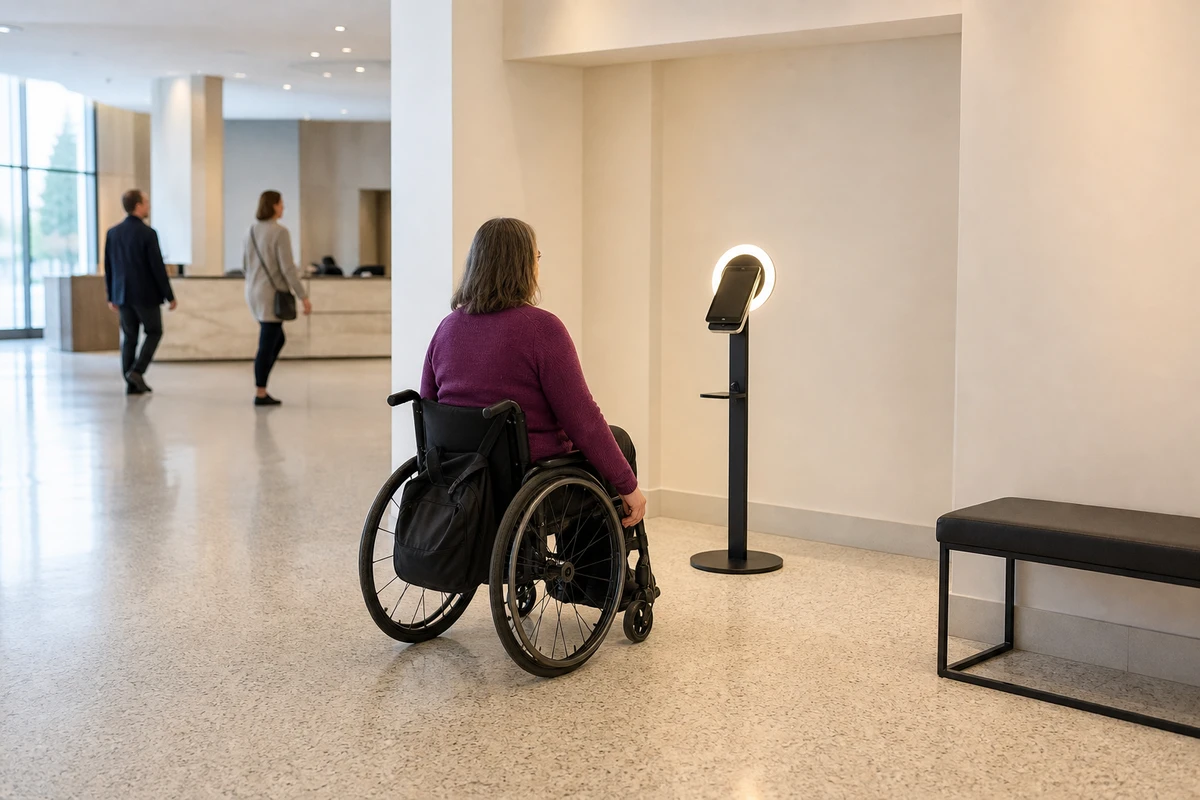
A visitor using a wheelchair approaches the booth, reaches for the on-screen start button, and cannot comfortably get to it. At a private event that is an awkward moment. At a museum it is a compliance failure.
ADA Public Accommodation
A museum is a place of public accommodation under Title III of the Americans with Disabilities Act, and a permanently installed booth is a public-facing fixture, not a temporary rental that slips under the radar. The relevant numbers come from the 2010 ADA Standards for Accessible Design. Section 308 sets reach ranges: an unobstructed forward or side reach has a maximum height of 48 inches and a minimum of 15 inches above the floor, and the booth needs a clear floor space of at least 30 by 48 inches so a wheelchair user can approach it.
Where a control sits behind a counter or other obstruction deeper than 20 inches, the maximum reach drops to 44 inches. Section 707, which governs ATMs and fare machines, is the closest regulatory analogue for a self-service interactive kiosk and adds expectations around speech output and tactile labeling. A booth has to be specified and installed against these numbers. “ADA-compliant” on a brochure means little if the unit ends up mounted to a height that suits a standing adult and no one else.
Accessibility Beyond Reach
Accessibility is wider than reach ranges. International visitors are better served by a multi-language interface, first-time users of every age are served by short and plain on-screen prompts, and any booth using a bright flash should be checked for rapid-flashing effects that can affect visitors with photosensitivity. None of this is exotic, but it has to be written into the specification, not discovered after installation.
Durability
Durability belongs in the same conversation. A booth in a museum lobby is handled by thousands of people a week, including children, for years. Commercial-grade construction, a planned consumables and maintenance schedule, and theft-resistant mounting for any exposed tablet are what keep the booth from becoming the broken, unplugged object in the corner of the lobby. A museum that has run its building for decades already knows that the cheapest fixture to buy is rarely the cheapest to own.
How to Run the Decision: A Buyer’s Scorecard
The booth decision tends to land on one person’s desk, usually in marketing or visitor experience, and that is the first mistake. A museum booth touches at least five desks: visitor experience, marketing and communications, membership and development, facilities, and an accessibility coordinator. Each sees a different part of the decision, and a choice made by one department alone usually misses at least one of the four constraints this article opened with.
Vendor Questions
With the right people in the room, the questions to put to any vendor are short and specific:
- Who owns the visitor data the booth collects, and does the museum receive an exportable copy?
- Can museum staff rotate exhibition branding themselves, ideally remotely, or does each change require a paid visit?
- Is the placement exclusive, and how long does the contract run?
- What is the exit clause, and what happens to the data and the booth when the deal ends?
- What uptime and support-response time are guaranteed in writing?
- Is the unit ADA-compliant as installed, measured against the Section 308 reach ranges?
Red Flags
The red flags are mostly answers that never arrive. A “free” pitch that will not put the data-ownership answer in writing is, in effect, telling the museum who owns the list. Revenue-share terms that reward paid prints over free digital sharing are optimizing against the museum’s reach. No remote monitoring and no self-service branding both point to a booth that drifts out of date and out of service between vendor visits.
Order of Operations
Underneath all of it sits one order of operations. Decide what the booth is for and how it will be paid for before anyone compares cameras and enclosures. The museums that get this purchase wrong almost always got that order backward.
Frequently Asked Questions
How much does a photo booth for a museum cost?
It depends entirely on the acquisition model. Buying a custom booth outright typically runs in the range vendors in this category quote at $20,000 to $40,000, plus ongoing maintenance, content, and consumables. A no-cost vendor placement carries no purchase price; the cost shows up as control the museum gives up over data and branding. A revenue-share placement is also free upfront, with the vendor taking a share of per-print or per-session income. The real question is not what a booth costs, but what each model costs in money versus control.
Do museum photo booths need staff to operate?
No, and a booth that does is the wrong booth. A museum will not assign someone to attend a booth all day, so self-service operation is a baseline requirement rather than a feature. The booth should be usable by a first-time visitor with no help, and staff should be able to monitor it (paper levels, uptime, faults) from a remote dashboard instead of standing beside it.
Can a photo booth be branded for a specific exhibition?
Yes. Some vendors build booths designed to rebrand with each major show; Majestic Photobooth has described creating one for the Brooklyn Museum intended to shift from a Monet look to a Picasso one as exhibitions change. The detail worth confirming before signing is whether museum staff can swap the graphics, screen design, and photo overlays themselves, ideally remotely, or whether every exhibition change requires a paid vendor visit.
Are photo booths worth it for free-admission museums?
Yes, but the value comes from a different place. A free-admission museum gets little from print revenue or a revenue-share model the way a ticketed attraction can, so the return shifts entirely to data capture and earned reach: contact details for the membership pipeline, and branded photos that travel home and get shared. For a free-admission institution, that argues strongly for owning the booth or negotiating data rights into any placement contract.
Do photo booths work for zoos and aquariums?
Yes, and the same logic applies, with one difference. Zoos and aquariums adopt booths heavily through revenue-share placement; trade coverage from blooloop documented one vendor running 94 such installations across zoos and aquariums. Zoos also tend to want booths that physically blend into habitat theming rather than look like a polished gallery fixture. The data and reach argument holds either way: a captured visitor contact supports membership, donation, and conservation messaging long after the visit ends.
Is a museum photo booth required to be ADA accessible?
Yes. A museum is a place of public accommodation under the ADA, and a permanently installed booth is a public-facing fixture subject to the 2010 ADA Standards for Accessible Design. In practice that means controls within the Section 308 reach ranges (a 48-inch maximum reach height, a 15-inch minimum) and a clear floor space of at least 30 by 48 inches for a wheelchair approach. Confirm compliance as the booth will actually be installed, not just in principle.
Sources
- American Alliance of Museums (2024). “Museums and Community Perceptions and Engagement: A 2024 Annual Survey of Museum-Goers Data Story.” https://www.aam-us.org/2024/10/25/museums-and-community-perceptions-and-engagement-a-2024-annual-survey-of-museum-goers-data-story/
- blooloop (2024). “ThisPlays leads in sustainable photo booth experiences for zoos & aquariums, and more.” https://blooloop.com/animals/news/thisplays-revolutionises-photo-booth-zoos-aquariums/
- Cuberis (2024). “Best Ticketing/Transaction Platforms for Museum Website Integration.” https://cuberis.com/the-transactional-museum-website-tickets-memberships-donations-and-more/
- Dilenschneider, Colleen / IMPACTS Experience (2017). “How Onsite Social Media Use Impacts Visitor Satisfaction (DATA).” https://www.colleendilen.com/2017/08/16/onsite-social-media-use-impacts-visitor-satisfaction-data/
- Dilenschneider, Colleen / IMPACTS Experience (2019). “Crunching The Numbers – Just How Valuable Are Your Members? (DATA).” https://www.colleendilen.com/2019/04/09/crunching-the-numbers-just-how-valuable-are-your-members-data/
- Moskowitz, P. (2025). “Building Reddit’s MuseumPros.” Curator: The Museum Journal. https://onlinelibrary.wiley.com/doi/10.1111/cura.12658
- MuseumNext (2020). “How Can Museums Encourage Visitors to Post About Them on Social Media?” https://www.museumnext.com/article/museum-encourage-visitors-to-post-on-social-media/
- NPR (2015). “This Art Exhibit Makes You ‘Wonder,’ And That’s The Whole Point.” https://www.npr.org/2015/11/13/455751386/this-art-exhibit-makes-you-wonder-and-thats-the-whole-point
- U.S. Department of Justice (2010). “2010 ADA Standards for Accessible Design.” https://www.ada.gov/law-and-regs/design-standards/2010-stds/
- Voice of America News (2016). “Stunning Artworks Attract Record Crowds, Thanks to Social Media.” https://www.voanews.com/a/stunning-artworks-attract-record-crowds-renwick-gallery/3176177.html