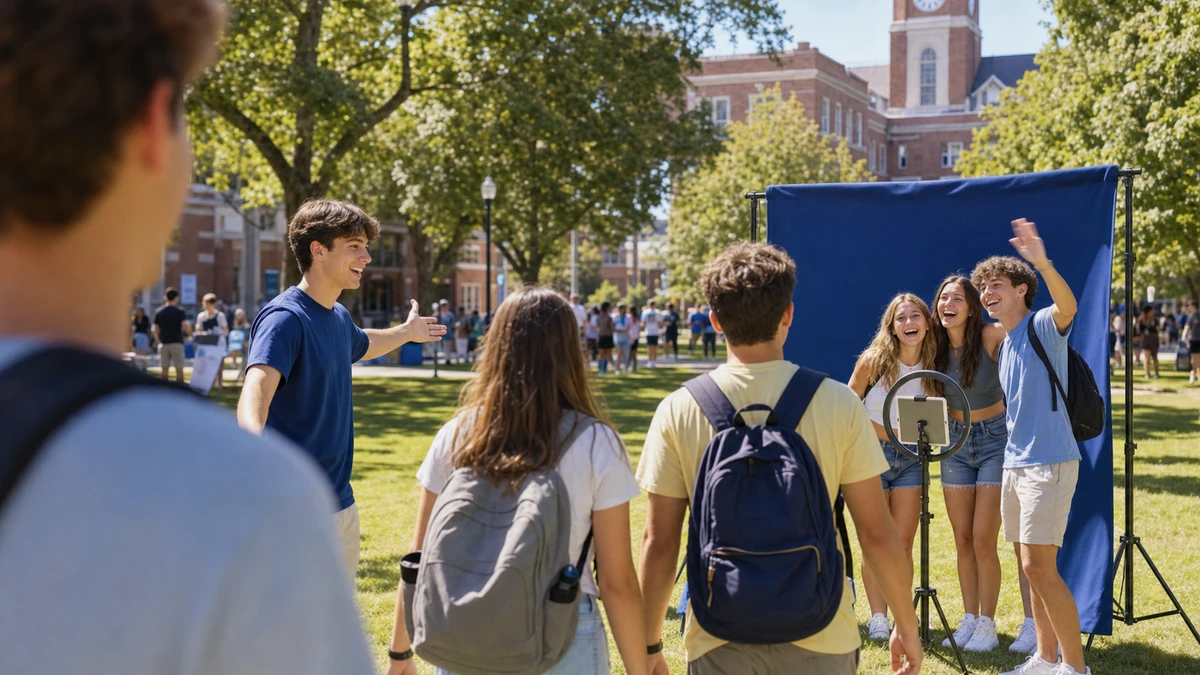
In the second week of August, a photo booth stands on a campus quad for new-student orientation, run by two student volunteers in matching shirts. Three weeks later the same unit is inside the student union for the club fair. By October it has worked a homecoming tailgate, a residence-hall study break, and a career-services headshot day. One piece of equipment, five offices, five budget lines, five reasons for booking it.
That pattern separates the best photo booth for a university from the best photo booth for a single event. A campus booth is not chosen for the flashiest format or the longest feature list. It is chosen to survive the institution’s real operating constraints: many departments sharing one tool, a calendar of dozens of photographable events a year, and a privacy obligation, FERPA, that consumer photo-booth pages never mention. What follows is the campus-specific buyer’s guide: a selection checklist, the rent-versus-own break-even math for an institution that runs many events, and the criteria a student-life, admissions, or advancement team should screen on before signing anything.
What “Best” Means When the Buyer Is a Whole Campus
When a photo booth request reaches a campus business office, it usually arrives from one department with one event in mind. Student life wants something for Welcome Week, and the request gets evaluated as if Welcome Week were the whole job. It is not. The booth that shows up for orientation will, within a year, be asked to work an admissions preview day, a donor reception, an athletics event, and a residence-hall program, often booked by people who have never spoken to each other.
A university is not one event host
A university is not one event host. It is a dozen of them under one roof: student life and programming, admissions and enrollment, advancement and alumni relations, athletics, career services, residence life, the student activities board, and individual academic departments. Each runs events. Each holds a budget line. Each has an approver. The buyer is plural even when the purchase order is signed by one office.
That reframe reorders every criterion that follows. If the booth is an institutional asset rather than a one-event rental, durability matters because the unit travels between buildings all year. Self-serve operation matters because no single department staffs it. Multi-event software matters because each office needs its own branding without re-buying anything. Ownership economics matter because the cost spreads across dozens of bookings instead of one.
It also corrects the most common mistake in this purchase. The best campus booth is not the flashiest one. A mirror booth or a 360 platform photographs beautifully and headlines well in a rental brochure, but the question for a campus is not which booth looks most impressive on display. It is which booth a sophomore volunteer can set up in ten minutes, which one survives a year of being wheeled across campus, and which one every office can rebrand for its own event. Best, for an institution, means most reusable.
The Campus Events a Photo Booth Actually Serves
Pull up a campus-activities calendar in August and the photographable events are already on it, running from move-in week to commencement. Fall opens with new-student orientation and Welcome Week, then club and organization fairs, homecoming, spirit weeks, and athletics tailgates. Admissions runs preview days and admitted-students events on its own schedule. Residence life programs through the term and ramps up again for finals-week study breaks. Career services holds fairs and headshot days. Cultural and heritage-month celebrations land throughout the year. Spring closes with commencement and graduation celebrations, and the alumni and advancement calendar adds reunions, homecoming weekends, and donor galas on top of all of it.
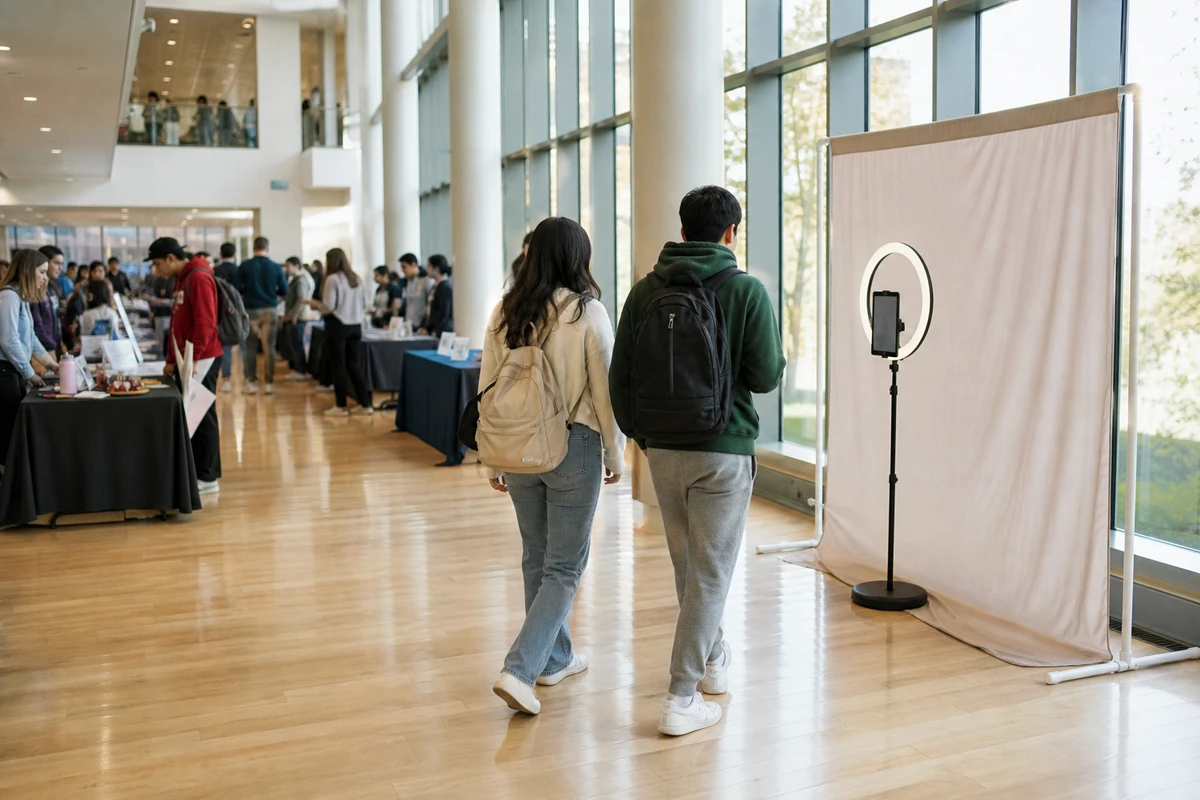
Count honestly across every office and a mid-size campus reaches two to four dozen photographable events a year without straining. That count, not a guess, is what the rent-versus-own math runs on, so it is worth tallying honestly rather than estimating low.
The events are not interchangeable, and that matters for selection. A recruitment event wants a polished, branded keepsake a prospective student carries home. Student programming wants a fast, social ice-breaker that keeps a line moving. An advancement gala wants a refined experience that suits a room of donors. A career-services headshot day wants throughput above all else: hundreds of students cycle through in a fixed window, and a booth that needs a photographer for every shot becomes a scheduling problem instead of a solution. A booth that handles only one of these tones, or only one of these speeds, is a booth several campus offices will quietly decline to book.
Rent vs. Own: The Break-Even Math for a University
The recurring question inside campus offices is simple to state and rarely worked out on paper: how many events does it take before buying a booth costs less than renting one. Both cost structures are knowable, so the arithmetic is worth doing once.
Renting is priced per event
Renting is priced per event. Thumbtack’s 2025 marketplace data, drawn from project estimates across the country, puts the national average photo-booth rental at $489, with a typical range of $387 to $619 and full-service three-to-five-hour packages around $499 to $649. Add social-media connectivity, custom branding, or a GIF feature and a campus booking realistically lands between $500 and $800 per event once it is branded and staffed for a multi-hour campus event.
Owning is a one-time outlay plus small recurring costs: the booth or stand, an iPad or camera, a backdrop, and an annual software license. Independent pricing for purchased booth equipment is not published the way rental pricing is, so a campus should get its own quotes rather than trust a number from a blog. As an illustrative figure only, treat a complete owned setup as a one-time cost in the low thousands of dollars.
The break-even is then straightforward
The break-even is then straightforward. If a campus runs N photographable events a year and pays R per rental, annual rental spend is N times R. An owned booth costs C up front. Cumulative rental spend passes that one-time cost after C divided by R events. Take a mid-size campus that runs 30 events a year and pays $600 for a branded, full-service rental each time: that is $18,000 in annual rental spend. If an owned setup runs somewhere between $3,000 and $5,000, that campus passes the purchase price between its fifth and ninth booking, inside the first months of the academic year, and every event after that runs close to free.
The honest call competing pages avoid: renting still wins in two cases. The first is the campus that runs one flagship event a year and nothing else worth photographing. The second is the specialty format, a 360 platform or a mirror booth, that a campus genuinely wants once and would not use again. Ownership wins the moment multiple departments share one booth across a recurring calendar. Campus offices often describe the same arc: an office rents a booth for one large event, likes it, runs the numbers, and finds that renting for every event would cost more than owning one outright.
The Campus Photo Booth Selection Checklist
A booth fails on a campus in specific, predictable ways. It needs a vendor attendant the campus did not budget for. It dies on gym Wi-Fi mid-event. Its screen sits too high for a seated guest. Each failure traces back to a criterion that should have been screened before purchase. Below is what a campus team should evaluate, and the campus-specific reason each item earns its place.
Form factor
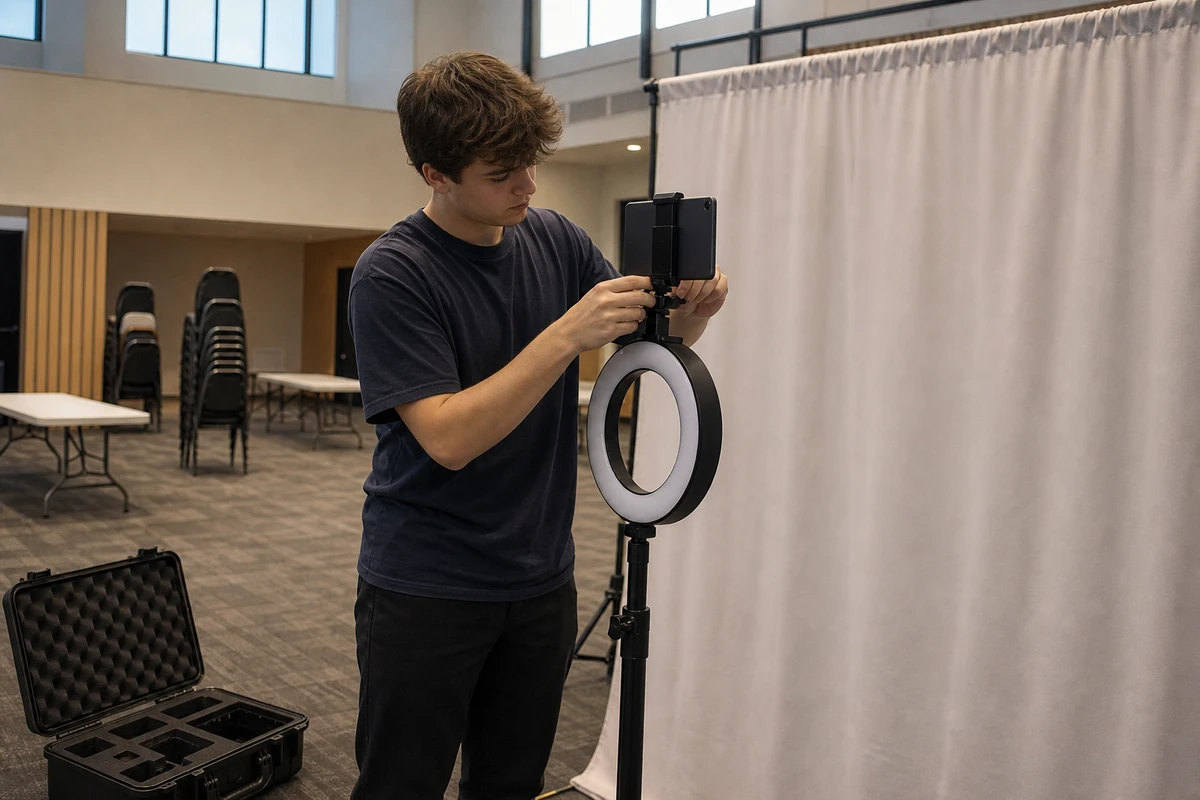
Form factor. Open-air and iPad booths suit campus conditions: they fit tight indoor spaces, move easily between buildings, and handle a high-throughput line. Enclosed booths, mirror booths, and 360 platforms photograph well but are heavier, slower to set up, and often need an attendant. Neither is universally correct. The point is to match the format to how the campus actually uses it, not to crown the most impressive one.
Self-serve versus attended. Campus events are run by student staff and volunteers, not a hired attendant. A booth a campus owns has to set up in minutes and run unattended, because the labor model assumes a student can learn it between classes. For a university specifically, this belongs in the top three criteria.
Durability and portability. The same unit moves from a quad to the union to the gym to a hotel ballroom across one semester. Weight, a real carrying case, and rugged construction are not luxuries; they decide whether the booth survives its second year.
Software and reuse. Branded templates and per-event overlays let one booth wear many identities. An admissions office should be able to spin up its own event design without calling a vendor or paying for a new template. One booth, many event skins.
Sharing modes. Text, email, QR code, and social sharing are what turn a photo into reach. A booth that only prints gives a student a keepsake; a booth that also sends the photo digitally puts the campus brand on a feed.
Connectivity. Campus Wi-Fi is unreliable in gyms and outdoors, guest networks frequently block the device-to-device connections a booth needs, and many booths cannot hold a network connection and a printer connection at the same time. A booth that captures offline and uploads later, when a connection returns, will not strand a department mid-event with a unit that can neither send nor print. Simple Booth’s HALO kit, for instance, holds the captured photos in an offline upload queue when campus Wi-Fi drops and delivers them once a connection returns, so a tailgate or gym event still finishes its photos.
Analytics. Session counts and opt-in totals let a department prove the spend to whoever approved it. A booth that reports nothing leaves the next budget request with no evidence behind it.
FERPA and Student Data: The Criterion No One Else Lists
A campus marketing office finds a great booth photo from homecoming: a student laughing, perfectly lit, ideal for a recruitment email. Can the office use it? The honest answer is “not automatically,” and the reason is the criterion that no competing buyer’s guide for this keyword mentions at all.

A photo booth on a campus captures two things federal student-privacy law touches. The first is images of identifiable students. The second, when the booth is used to build a mailing list, is student contact information. Both fall under FERPA, the Family Educational Rights and Privacy Act.
The U.S
The U.S. Department of Education’s Student Privacy Policy Office explains, in its FERPA guidance on photos and videos, that a photo is an “education record” when it is both directly related to a student and maintained by the institution or a party acting for it. The distinction that matters for a booth: the Department notes that an image is not directly related to a student when it is incidental or part of the background, “or if a student is shown participating in school activities that are open to the public and without a specific focus on any individual.” A crowd shot from a tailgate is generally lower-risk. A photo booth portrait is the opposite case. The entire purpose of the booth is to focus the image on a specific person, which makes that photo directly related to the student, and an education record once the institution or its vendor stores it.
FERPA also lets institutions designate certain information, including photographs, as “directory information” they may publish without consent. That designation carries a duty. The institution must give annual notice and honor opt-out requests, and a student who has filed a directory-information hold cannot have a recognizable photo published, in a booth gallery or a social post, without separate consent. The marketing office with the great homecoming photo has to check that suppression list before the photo becomes marketing material.
None of this makes a photo booth non-compliant. FERPA compliance is not a property of hardware. It is a property of how the institution configures consent, posting, and storage. That turns the law into four concrete selection questions a campus team should ask any vendor:
- Can the booth show a clear consent and opt-in screen before it captures and before it shares, so permission is recorded at the moment of capture rather than reconstructed later?
- Does the institution control auto-posting and any public gallery, or does the vendor? A booth that hard-sells automatic public posting is harder to run inside FERPA than one a campus can set to private by default.
- Who owns and stores the photos and the captured emails, the campus or the vendor’s cloud, and can that data be exported and deleted on request? A vendor holding student data on the institution’s behalf is acting as a school official under FERPA and is bound by it.
- Can the workflow honor a directory-information opt-out by suppressing or withholding a specific student’s image?
The best booth for a university, on this criterion, is the one that hands the institution control of student images and data. It is not the one that makes automatic public posting the easiest thing to do.
The Recruitment and Stewardship Payoff
On an admitted-students day in April, a high school senior deciding between three offers steps into a photo booth, takes a picture against a backdrop carrying the university’s name and colors, and posts it before leaving the building. That single share is a large part of why a campus spends on this at all. The payoff sits with two audiences beyond current students: prospective students, and alumni or donors.
Start with recruitment
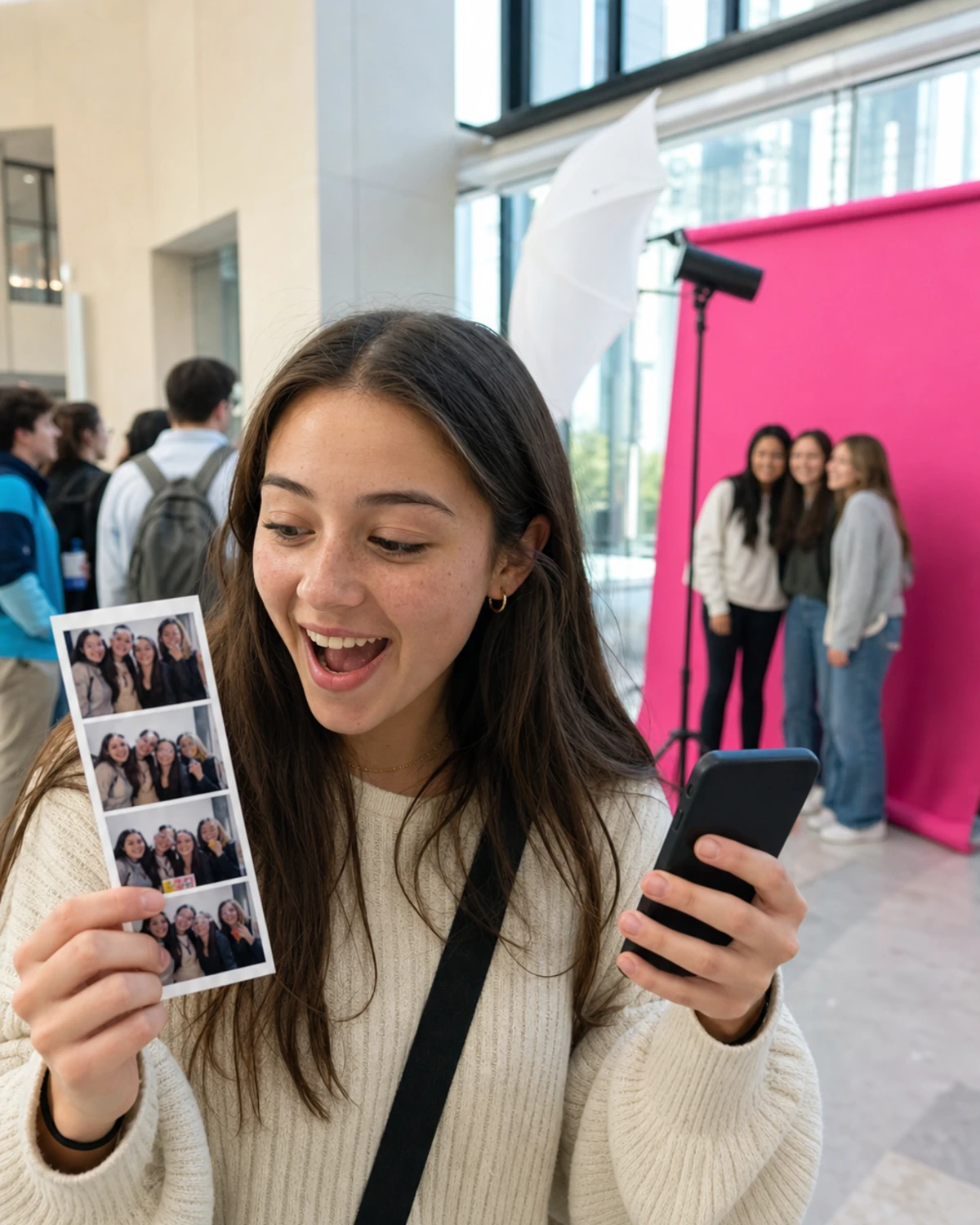
Start with recruitment. BHDP Architecture surveyed 183 chief enrollment officers in 2021 and found that 95% consider the campus visit important to a prospect’s decision to enroll, and roughly 80% reported a matriculation rate of 30% or higher among students who visit. In the same research, when those enrollment officers were asked for campus-visit improvements, one recommendation on the list read, verbatim, “Add a selfie station with the College’s branding for social media sharing.” That recommendation comes from enrollment professionals, not photo-booth marketers.
There is a reason it lands
There is a reason it lands. Encoura’s Eduventures research, published in 2023, found that only 36% of college-bound students rated campus tours among their best information sources, down from 63% in 2019. The visit has not stopped mattering; roughly 80% of students still visit a campus before enrolling. What changed is its job. Students arrive already informed and use the visit to answer an experiential question instead: will this place feel right for four years. A branded, shareable booth moment at an admitted-students day speaks to exactly that question, and it puts the institution’s name on a recruit’s social feed during the precise window the student is choosing between offers.
The reach is worth a rough number. Event Marketer’s EventTrack benchmarking has long reported that almost all attendees create some kind of content at events; a more conservative reading of the data puts unprompted public posting to a personal feed at roughly a third of attendees. Take six admitted-students days a year, 100 booth sessions each, a third of those shared to networks averaging 300 followers: that is roughly 60,000 branded impressions a year, seen by exactly the peers a prospective student trusts, at close to zero marginal cost per event. The figure is illustrative, and a campus should treat it as a model rather than a promise, but the order of magnitude is the point.
For advancement, the same tool plays a quieter role. A refined booth at a donor gala produces stewardship content: photos of donors and scholarship recipients an office can use in thank-you communications, and, where the booth captures consented contact details, a clean touchpoint for the alumni list. A thank-you that carries a donor’s own photo from the evening reads as personal attention rather than a form letter, and personal attention is what keeps a giving relationship warm. The booth that recruits in the fall stewards in the spring.
Accessibility, Power, and Getting It Through Procurement
A student who uses a wheelchair rolls up to the booth at the club fair and finds the touchscreen mounted at standing height, out of reach. A booth can clear every criterion above and still fail on practical campus realities like that one, the realities the ranking pages skip.
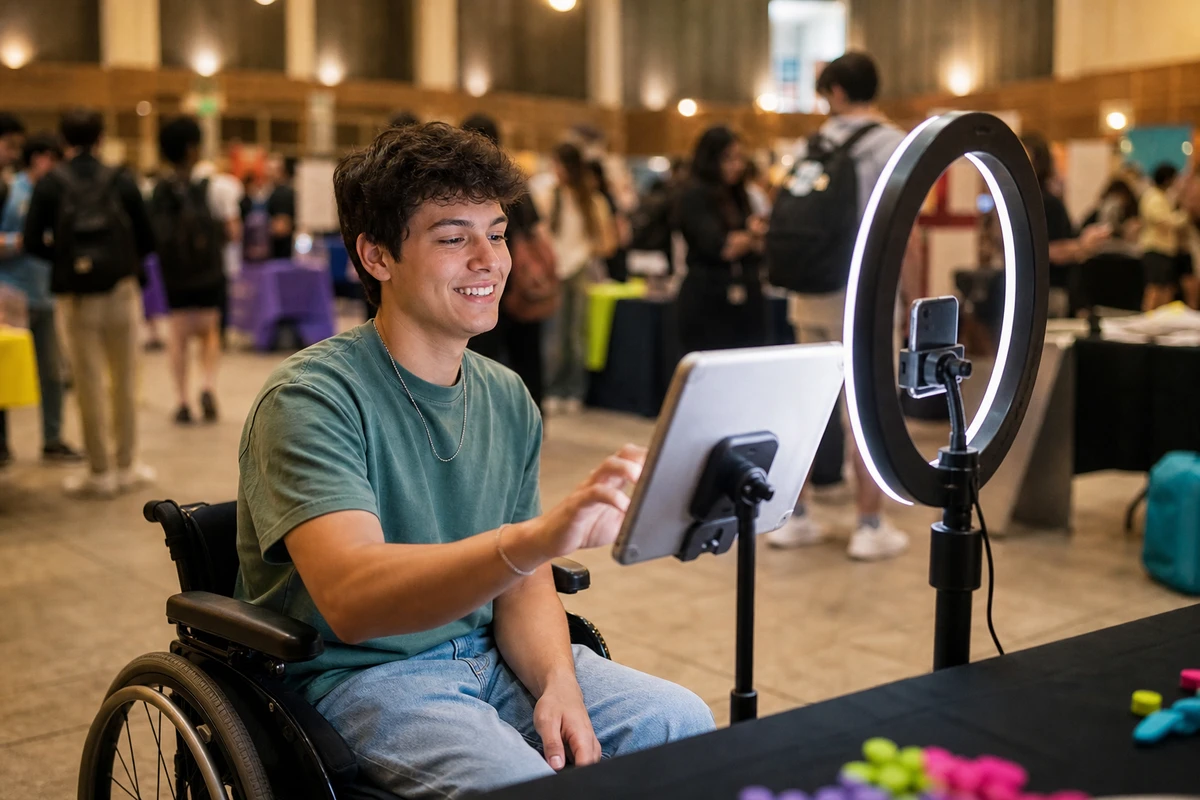
Accessibility comes first because a public university has a legal obligation to it. A self-serve booth has a touchscreen, and that touchscreen is an operable control. The U.S. Access Board’s ADA Standards require operable parts on an accessible route to sit within reach from a wheelchair: for an unobstructed forward reach, no higher than 48 inches and no lower than 15 inches above the floor. A booth whose screen and controls sit above 48 inches, or that only works for a standing guest, does not meet the standard a Title II institution is held to. Screen height and reach range belong on the evaluation sheet, not in a post-purchase surprise.
The physical campus is the next constraint. Outdoor events on a quad or at a tailgate need a power plan, lighting once the sun goes down, and a weather contingency. Indoor events need a footprint that fits a crowded union concourse or a residence-hall lounge. A booth that assumes a wall outlet and good interior light is a booth that will sit dark at half the campus events that book it.
Campus IT Review
Then there is IT. If the booth runs on institution-owned iPads, expect the IT department to review the app and, in many cases, to require enrollment in mobile device management before the hardware goes live. Even on vendor-supplied hardware, a campus may review the application and its data handling before it touches the campus network. Building that review into the timeline avoids a booth that arrives weeks before anyone is allowed to turn it on.
Procurement is the last gate, and usually the one that stalls. The practical questions are organizational, not technical: who signs off on the purchase, which department’s budget line carries an owned booth, and how a shared-service arrangement works when one office buys the equipment and others book it. Warranty terms, support response time, and the cost of training student staff are line items in that decision, not afterthoughts. A campus that answers these before it shortlists hardware moves faster than one that discovers them at the business office.
Matching the Booth to the Campus
A campus that runs one flagship event a year, or needs a specialty format once, should rent. The math does not justify ownership for a single annual booking.
Staffing
A campus where multiple departments run a recurring calendar, staffed by student volunteers, should own a self-serve, portable, brandable booth and run it as a shared campus service: one office holds the equipment, others book it.
A campus with heavy outdoor and athletics use should weight durability, offline capture, and a power plan above format and finish.
A campus where recruitment and advancement drive the use should weight branding control, sharing modes, and FERPA-defensible data handling above everything else.
Frequently Asked Questions
How much does a photo booth cost for a university?
Renting runs roughly $400 to $800 per event for a branded, full-service booking, based on Thumbtack’s 2025 national marketplace data (average $489). Owning is a one-time outlay in the low thousands of dollars plus an annual software license. The real cost depends entirely on how many events your campus runs each year.
Should a university rent or buy a photo booth?
Rent for a single flagship event or a specialty format you need once. Buy once several departments share a recurring calendar of events. The break-even is the purchase price divided by the average rental fee: a campus running a few dozen events a year usually passes that point within the first semester of ownership.
Are photo booths FERPA-compliant?
FERPA compliance is not a feature of the hardware. It depends on how your institution configures consent, posting, and data storage. Choose a booth with a consent screen before capture, institution control over public galleries, and exportable, deletable data, and confirm the workflow can honor a student’s directory-information opt-out.
What campus events is a photo booth best for?
Orientation and Welcome Week, club and organization fairs, homecoming and spirit weeks, athletics events, admitted-students and preview days, residence-life programming, career fairs and headshot days, heritage-month celebrations, commencement, alumni reunions, and advancement galas. Most mid-size campuses find two to four dozen photographable events a year once every department is counted.
Do students still think photo booths are worth it?
The “dated” worry is misplaced. A booth feels stale when it only prints and sits in a corner. A booth that is branded, social, and shares photos by text or QR code still draws a line at orientation and spirit events, because the appeal was never the booth itself. It was the shareable moment.
Who on campus should own and manage the booth?
A shared-service model works best. One office, often student life or the student union, owns the equipment, holds the budget line, and handles scheduling. Other departments book it like any campus resource. That arrangement spreads the cost across many events and keeps one team accountable for upkeep, training, and the booking calendar.
Sources
- U.S. Department of Education, Student Privacy Policy Office (2021). “FAQs on Photos and Videos under FERPA.” https://studentprivacy.ed.gov/faq/faqs-photos-and-videos-under-ferpa
- U.S. Department of Education, Student Privacy Policy Office (2021). “When is a photo or video of a student an education record under FERPA?” https://studentprivacy.ed.gov/faq/when-photo-or-video-student-education-record-under-ferpa
- U.S. Access Board. “ADA Standards for Accessible Design, Sections 308–309: Reach Ranges and Operable Parts.” https://www.access-board.gov/ada/#ada-308
- BHDP Architecture (2021). “Research on the Prospective College Student Campus Visit and Its Impact on Matriculation.” https://www.bhdp.com/insights/research-prospective-college-student-campus-visit-and-its-impact-matriculation
- Encoura / Eduventures (2023). “The State of College Campus Visits.” https://www.encoura.org/resources/wake-up-call/the-state-of-college-campus-visits/
- Thumbtack (2025). “2025 Photo Booth Rental Cost.” https://www.thumbtack.com/p/photo-booth-rentals-prices
- Event Marketer / Event Marketing Institute. “EventTrack Experiential Marketing Benchmarking.” https://www.eventmarketer.com/reports/event-track/