
By 8:30 the rented hall has settled into its real shape. The marketing team has claimed a table by the window. A few managers stand near the bar holding drinks they have been nursing for an hour. A leader taps a microphone, thanks everyone for a strong year, and the room half-listens before drifting back into the same small clusters it arrived in. By nine the coat check has a line.
That evening repeats in some form every December, and it explains why so many corporate holiday parties feel flat. The cause is rarely the venue, the catering, or the budget. It is that the party was planned as an event to attend rather than an experience to take part in, and attendance is not the same thing as engagement. The corporate holiday party ideas below are organized by the engagement they actually produce, so a planner can pick the two or three that fit a specific team instead of working down a menu of twenty-five.
The stakes have risen. A 2023 Visier survey of 1,000 US employees found that 64% had reduced or stopped attending after-hours company events, and 69% would rather receive a larger annual bonus than attend a holiday party (Visier, 2023). Attendance has since recovered. ezCater’s 2025 workplace party report, the company’s own survey, found 82% of employees planned to attend, up from 70% a year earlier (ezCater, 2025). The recovery does not mean the old formula works again. It means companies are trying harder, and the question of what makes a party land is still open.
Stop Shopping for Activities. Start Designing for Engagement.
A planner opens three browser tabs of holiday party ideas and finds the same menu in each: game show, ugly-sweater contest, escape room, gingerbread build, karaoke, scavenger hunt. The lists are interchangeable because each one treats the task as shopping. Pick an activity, book it, done. Two facts break that approach.
That a party which simply happens now competes directly
The first is that a party which simply happens now competes directly with the employee who decides to go home instead. Visier’s deterrent data is specific about why people skip: 36% say they get enough socializing during the workday, 33% keep personal and professional life separate, 28% do not want time away from family, and 24% say they do not feel connected to their coworkers. A GrubHub corporate-client survey from the same season, reported by WorkLife, found 40% of companies worried that staff would not show up at all (WorkLife, 2023). The planner’s competitor is not a boring party down the street. It is the parking lot.
The second fact is that spending more does not
The second fact is that spending more does not fix a flat party. The same GrubHub survey found 20% of companies planning to increase their holiday budgets that year, rising to 50% among financial firms, even as attendance fell. Money is being poured into a problem money does not solve. Research on holiday well-being points the same direction. In a study published in the Journal of Happiness Studies, Kasser and Sheldon found that people reported more happiness when family and religious experiences were prominent in the season, and lower well-being when spending money and receiving gifts dominated (Kasser & Sheldon, 2002). That study looked at personal Christmas celebrations, not office parties, so it is a directional signal rather than proof. The signal is consistent though: production value is not what people remember warmly.
Here is the reframe worth carrying through the rest of this article. A corporate holiday party is the company’s single largest internal brand activation of the year. A marketing team would never run a brand activation without deciding in advance what it should produce. The party deserves the same planning.
What an Engaged Holiday Party Actually Produces
Every list of holiday party ideas uses the word “engagement” and none defines it. They treat “fun activity” and “engagement” as the same thing. They are not. An engaged holiday party produces three concrete things, and every idea further down is judged on which of them it delivers.
Participation
The first is participation: the share of people actively doing something rather than standing near the bar watching. A party where 90 people attend and 20 of them play, make, compete, or vote is a 20-person party with 70 spectators. Attendance is an input. Participation is a result.
Connection
The second is connection: interactions that did not exist before the night. Cross-team, cross-level, cross-location. This is not a soft goal. Gallup’s analysis of its long-running engagement data found that only about 2 in 10 US employees strongly agree they have a best friend at work, and that moving a workforce toward 6 in 10 is associated with 12% higher profit and 7% more engaged customers (Gallup, 2018). Eagle Hill Consulting’s 2023 employee connection survey, conducted by Ipsos among 1,362 US employees, found that 45% did not believe their organization was investing in employee connection (Eagle Hill Consulting, 2023). The party is one of the few moments a company can act on that gap, and the 24% of Visier respondents who skip parties because they “don’t feel connected” show the cost of not trying: last year’s party never connected them, so this year they stay home.
Content and recall
The third is content and recall: what survives the night. Photos, written messages, a moment people retell in January. This is where a party stops being a one-night cost and becomes a reusable asset.
The rest of this article sorts ideas by those three outputs. Most planners will not need all three in equal measure. A distributed company should weight content and connection, since its people rarely share a room; a company whose teams are strong but siloed should put almost everything into connection. Choosing the output first, then the activity, is the whole method.
Ideas That Get People Participating, Not Watching
The clearest sign of a passive party is the long leadership speech and the seated stage show. Brief recognition is welcome. A presentation is, in practice, a meeting in holiday clothes, and energy drops fast once people shift into audience mode. The fix is to design the night so there is no comfortable spectator position to default into.
A mixed-team game show or competition does this well
A mixed-team game show or competition does this well when it is built from fast rounds, varied categories, and a visible scoreboard. The mechanism is simple: short rounds and team scoring give every person at the table a reason to lean in, and no single host monologue carries the room. The categories should range wide enough that the trivia buff, the music fan, and the new hire each have a round where they are useful.
A station or zone format removes the audience position entirely. Instead of one stage, the venue runs several activities at once: a craft corner, a competitive game, a tasting flight, a quiet lounge for people who need a break from noise. Choice plus movement means nobody settles into watching, and the same floor plan serves introverts and extroverts without forcing either into the other’s evening.
Hands-on workshops are the most reliable participation trigger because a task in someone’s hands does the work automatically. Cookie decorating, a mixology or cooking class, an ornament or wreath make-station, a build-your-own ugly-sweater bar. People who would never dance will absolutely decorate a cookie. The activity matters less than the rule it enforces: everyone’s hands are busy, so everyone is in the party rather than beside it.
Ideas That Connect People Who Don’t Normally Talk
Connection rarely happens on its own at a party. Left alone, people cluster with the team they already sit with all year, and the marketing table stays the marketing table. New connection has to be built into the format on purpose.
The simplest move is to assign deliberately mixed teams
The simplest move is to assign deliberately mixed teams for any competition, splitting departments and seniority levels across tables. A “holidays around the world” passport format extends the same idea: zones built from employees’ own heritage and traditions, with a stamp card that keeps people walking between stations and talking to colleagues they have never met. The one guardrail is to source those zones from real employees who want to host them, so the night celebrates the team rather than caricaturing it.
A charity auction of employee talents does something the others cannot: it surfaces hidden sides of colleagues. Toggl ran a version its CEO Alari Aho described in a practitioner roundup, where employees donated skills and experiences (a photography lesson, homemade desserts, a yoga session) and the proceeds went to a team-chosen cause. He noted it was “fun to see what hidden talents people bring to the table” (Breezy HR, 2024). A colleague’s offer of a guitar lesson is a far better conversation starter than a wrapped gift.
Low-stakes structured sharing works the same way. In a swap party, people explain why an item matters before passing it on. Dr. Maria Knobel, who runs one with her team, found that “people enjoy sharing stories about why they’re passing along certain items, and it ends up being more personal than just buying a random gift.” A holiday scavenger hunt does the connecting through a shared task. Management trainer Cecilia Gorman described hers as something that “stretches people out of their comfort zone and is a fun way to get people who don’t normally interact to work together.” That is the entire goal of the connection output stated in one sentence. The party that manufactures a first conversation is also the party people are willing to return to next year, because Visier’s data suggests pre-existing relationships are close to a prerequisite for some employees to attend at all.
Ideas That Keep Working After the Party Ends
The morning after most holiday parties, there is nothing to show for the spend. The decorations come down, the invoice is filed, and the only record is a few blurry phone photos scattered across personal camera rolls. A party designed for content and recall leaves something the company can use for the next twelve months.
Staffing
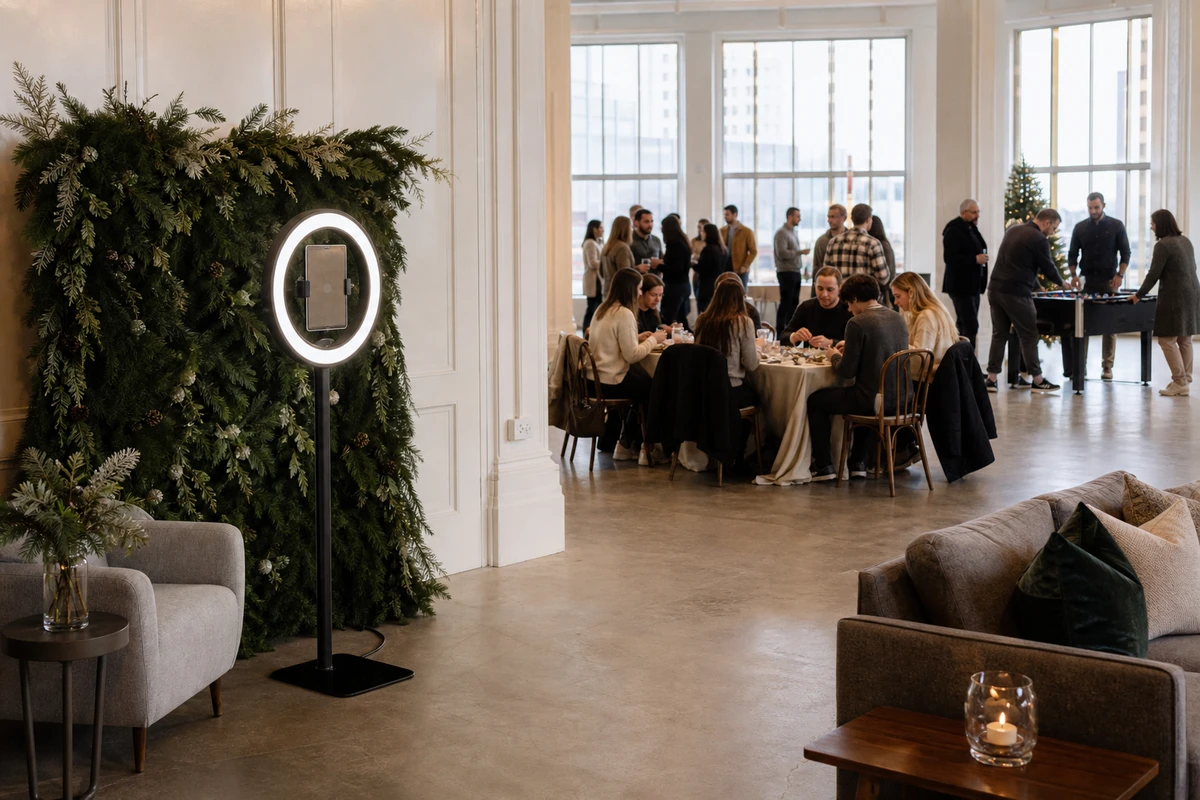
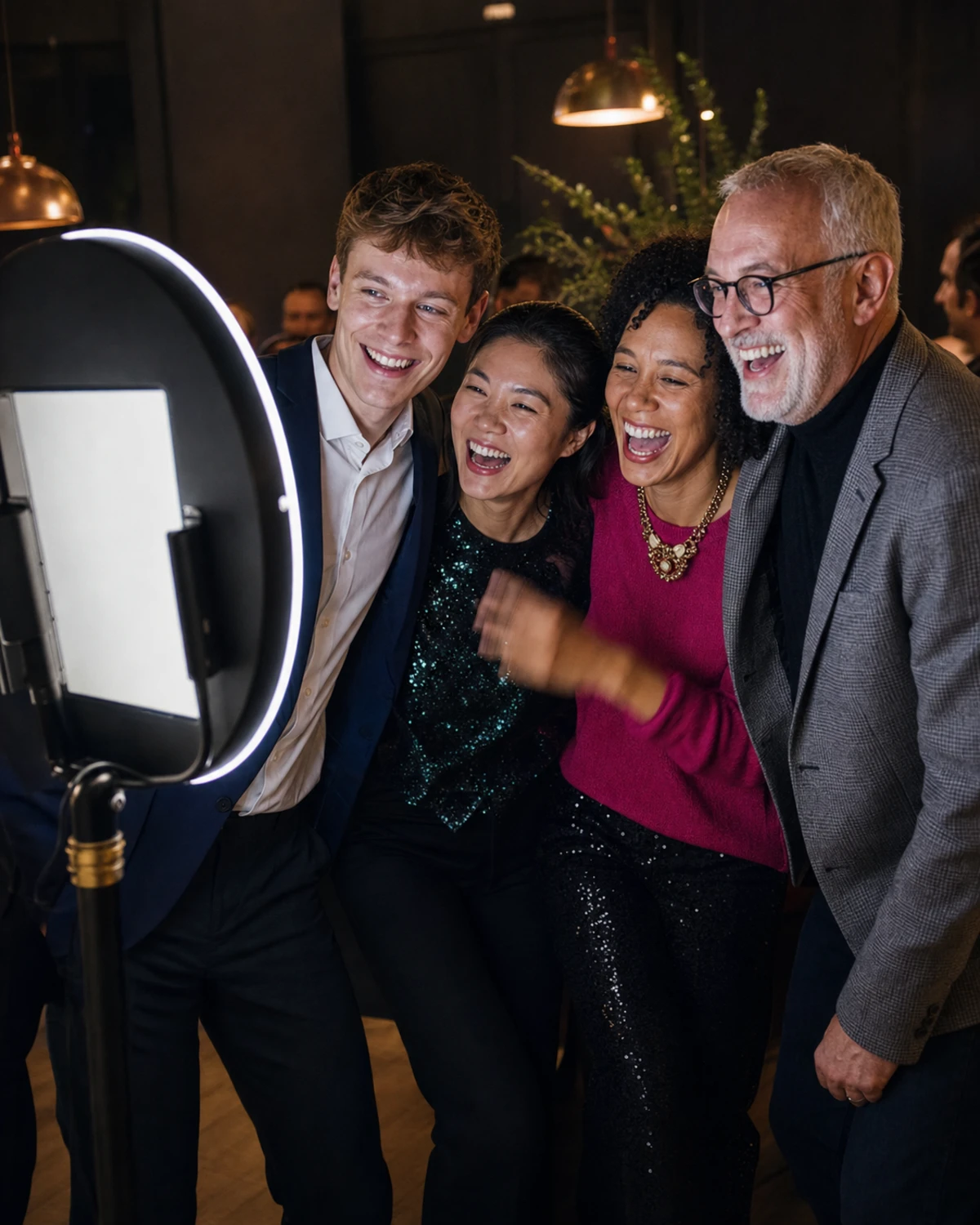
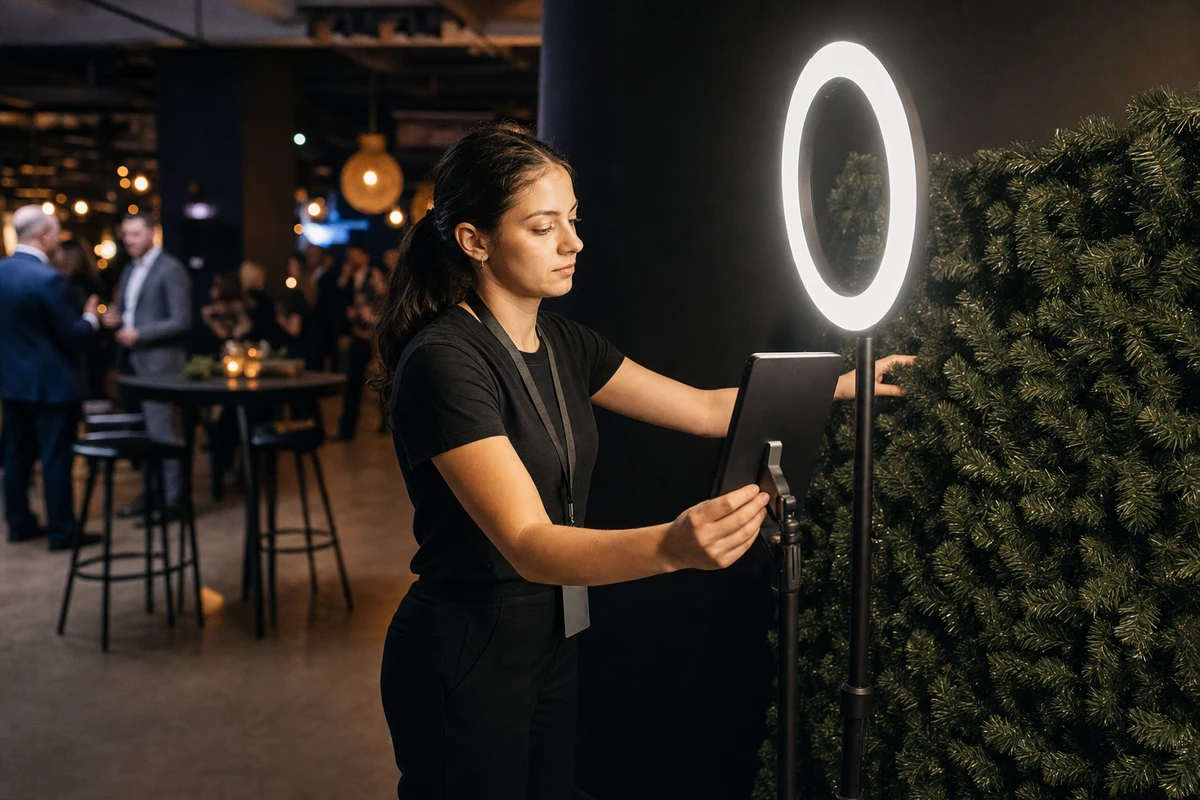
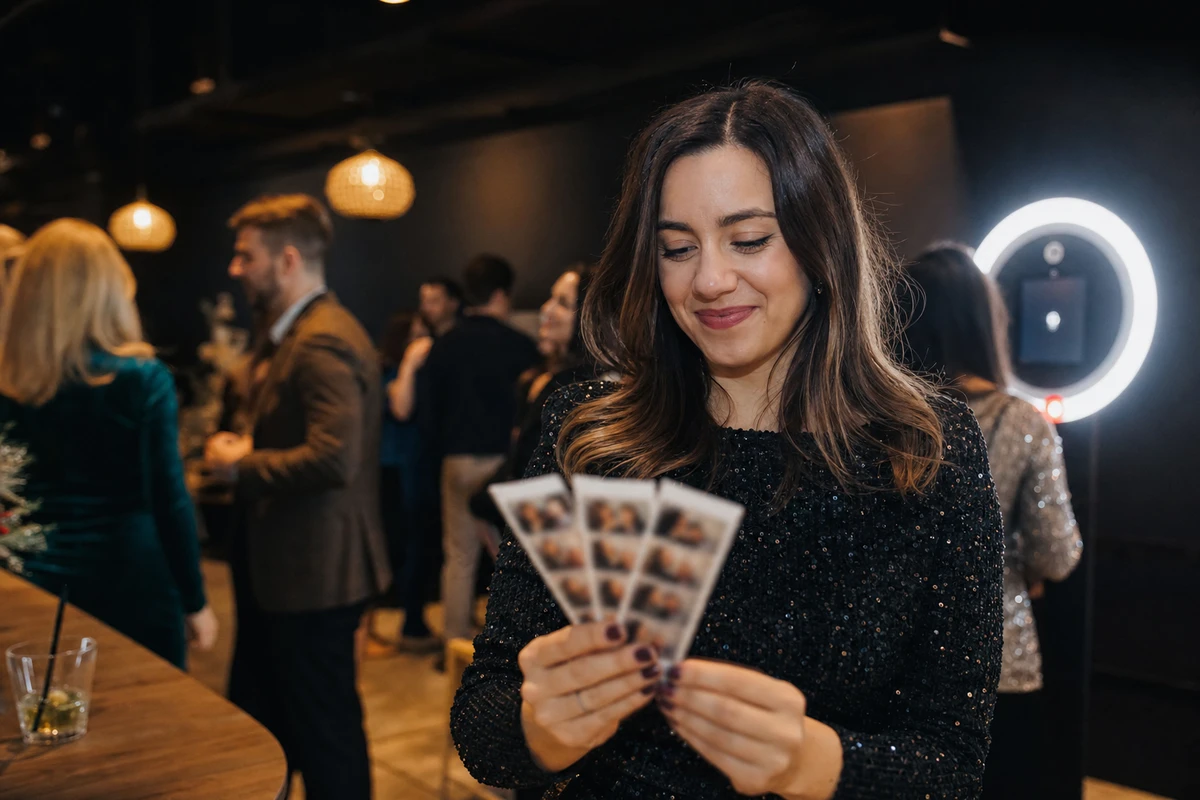
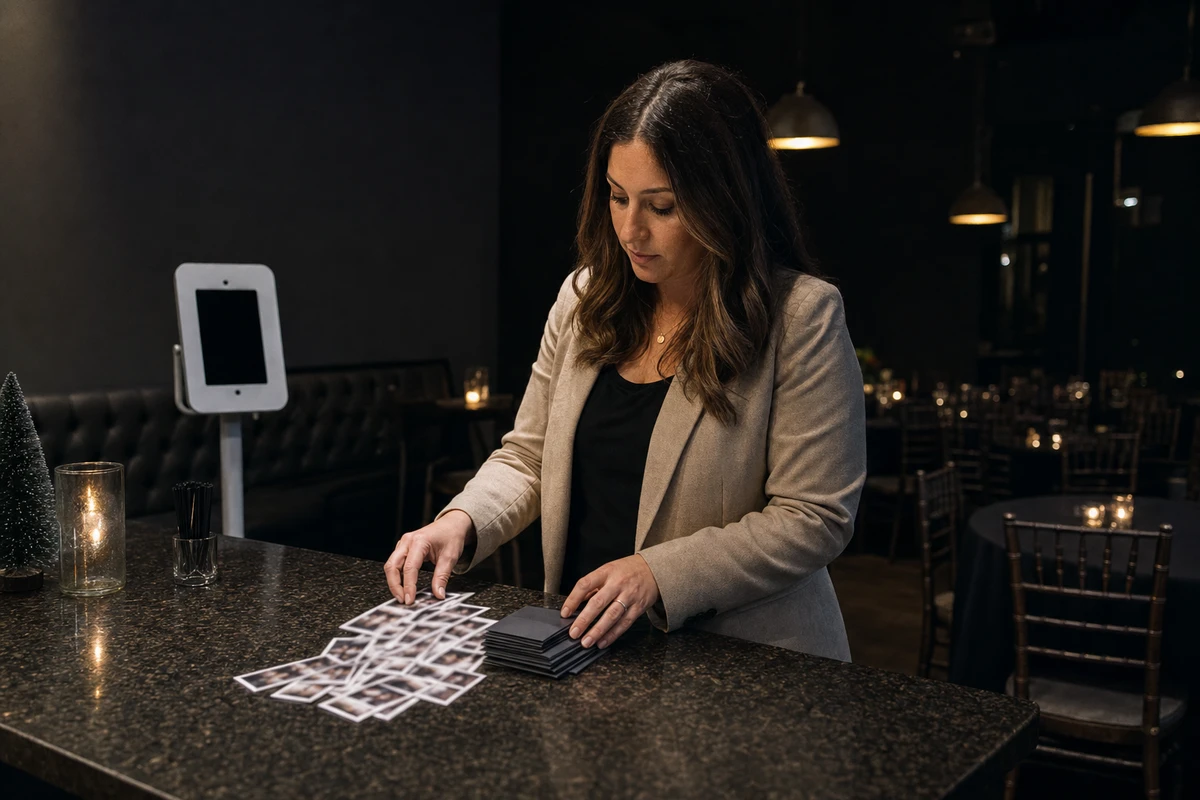
A designed photo moment is the foundation: a built backdrop and an on-site photo station, so each person leaves with an image and the company leaves with a library it owns. The framing matters here. The output is not a gadget in the corner. It is a folder of usable photographs that can feed a careers page, an intranet, an internal newsletter, and next year’s invitation, without anyone having to ask staff to dig through their phones in February. Simple Booth’s HALO kit is one concrete version of that station: guests photograph themselves on an iPad, get a copy by QR code, email, or text, and every image lands in one gallery the company can export afterward. Its offline upload queue holds the night’s sessions when a rented hall’s Wi-Fi drops and delivers them once the connection returns.
A photo contest with categories, best team, best dressed, most festive desk, plus simple voting, aggregates employee-shot images without requiring anyone to post on personal social media, which sidesteps the privacy objection that kills most “share it online” plans. A gratitude or message wall, where leaders and peers post specific year-end appreciation, becomes a culture artifact that reads better in onboarding decks than any mission statement. A recorded talent show with a short highlight reel, or a year-end time capsule of predictions reopened next December, does the same job over a longer arc.
For distributed teams, content is also what makes a hybrid company feel like one company. A shared digital feed that pulls in remote employees’ photos and messages in real time gives people in three time zones a single event to point at, rather than three disconnected gatherings and a muted video call.
Designing for the Team You Actually Have
Inclusivity is usually treated as a compliance checkbox. It is better understood as an engagement lever, because every deterrent removed is participation gained. The data makes the deterrents specific.
Start with timing
Start with timing. The 2023 ezCater survey reported by WorkLife found 64% of workers felt obligated to attend after-hours work events they did not want to join, roughly half admitted lying to skip one or sneaking out early, and more than 80% wished their company held bonding events during the workday. In ezCater’s 2025 report, 53% wanted the holiday event itself scheduled during work hours. A daytime or end-of-day party converts a reluctant attendee into a present one without changing the activities at all.
Then work arrangement
Then work arrangement. Visier found in-office employees more interested in parties (34%) than remote (26%) or hybrid (18%) workers. The mechanism behind that gap is that distributed staff have weaker pre-existing relationships, which gates attendance, which starves the connection the party is supposed to build. The answer is not a Zoom link bolted onto an in-person event. Operations supervisor Sara Bandurian described shipping gingerbread house kits to remote staff so they build alongside the office over a shared channel. Simultaneous local gatherings and shipped activity kits give remote employees a real role instead of a window into someone else’s night.
Generations pull in different directions too
Generations pull in different directions too. Visier found Gen Z (40%) and millennials (49%) far more interested in attending than Gen X (19%) and baby boomers (13%). No single format serves a four-generation workforce, which is the practical case for the station approach: parallel activities let each group find its own corner of the same party.
Finally, the standard format excludes more people than planners assume. Custom Neon’s Clare Jones described moving away from “the usual ugly jumpers, secret Santas and boozy nights” toward daytime activities, “because not everyone in the team drinks, we have different cultures, so not everyone celebrates Christmas.” Mocktails, secular framing, family-inclusive timing, and plus-ones are not concessions. They are how more of the payroll ends up participating. UK survey data from Capital on Tap supports the point: alcohol-led events and pub or bar formats were the least preferred social option among the 2,000 employees it surveyed (Capital on Tap, 2025).
One step does double duty here
One step does double duty here. Polling employees on date, venue, and food before the event raises attendance, and both the GrubHub and ezCater data point to it. The poll also becomes the baseline for measuring whether the party worked.
How to Tell If the Party Actually Worked
Not one of those idea lists gives the reader a way to know whether last year’s party succeeded. They end with a sales pitch, not a scorecard. The scorecard is the missing piece, and it maps directly onto the three outputs.
Participation rate is two numbers
Participation rate is two numbers. The easy one is RSVP-to-attendance. The honest one is the share of attendees who actively did something: played a round, made an item, voted, contributed to the wall. Staff running stations can estimate it on the night. Content captured is a count: how many photos, messages, and clips the party produced, and how many were reused in the months after. Connection signal is a one-question post-event pulse, “did you talk to someone new,” paired with next year’s RSVP rate as the lagging indicator.
Numbers make the difference concrete
Numbers make the difference concrete. Take a 150-person company planning its December party at a per-head figure of $120, an $18,000 budget. Run the listicle version: a venue, a caterer, an open bar, a band. Around 60% attend, so 90 people are in the room, and most cluster with the team they already sit with. Nothing is captured, nothing is asked afterward, and in January there is no way to say whether the $18,000 bought anything beyond a night out.
Now run the same $18,000 as an engagement-designed party. The event is scheduled to end the workday rather than start a second one, the floor uses a station format, a photo station runs in the corner, and a poll set the menu three weeks earlier. Attendance reaches 85%, about 128 people. The station format means nearly all of them do something. The night produces more than 200 reusable photos and around 60 message-wall notes that feed the careers page and internal comms for a year, and a one-question pulse score goes on file for next year’s comparison. Same budget. One version is a cost. The other is an asset with a number attached.
A planner cannot improve what was never measured, and measurement is what turns next year’s party from a guess into a decision. Choosing two or three ideas matched to participation, connection, and content costs no more than working down a list of twenty-five, and it leaves the planner as the only one in the building who can prove, the following January, that the party did something.
Sources
- Visier (2023). “Holiday Partiers RSVP No to Company-Sponsored Events.” https://www.visier.com/blog/office-holiday-parties-unpopular/
- ezCater (2025). “The Workplace Holiday Party is Back: ezCater Report Reveals Increase in RSVPs and Budgets” (company-published survey). https://www.ezcater.com/company/press-release/the-workplace-holiday-party-is-back-ezcater-report-reveals-increase-in-rsvps-and-budgets/
- WorkLife / Digiday Media (2023). “Is anyone going to the company holiday party this year?” https://www.worklife.news/culture/corporate-holiday-party-attendance-2023/
- Kasser, T. & Sheldon, K.M. (2002). “What Makes for a Merry Christmas?” Journal of Happiness Studies, 3(4), 313–329. https://doi.org/10.1023/A:1021516410457
- Gallup (2018). “Why We Need Best Friends at Work.” https://www.gallup.com/workplace/236213/why-need-best-friends-work.aspx
- Eagle Hill Consulting (2023). “Fostering employee connection beyond relationships delivers big business results.” https://www.eaglehillconsulting.com/insights/employee-connection/
- Breezy HR (2024). “11 Office Holiday Party Ideas that Keep It Fun and Inclusive.” https://breezy.hr/blog/holiday-ideas-for-workplace
- Capital on Tap (2025). “The Social Culture Report 2025: How UK Employees Feel About Workplace Socials.” https://www.capitalontap.com/en/blog/posts/social-culture-report/